Should My 4-Year-Old Know How to Read? Normal vs Not
· Updated
What You'll Learn
- The honest answer about whether a 4-year-old "should" be reading — and why the question itself might be the wrong one
- The specific pre-reading skills your 4-year-old actually needs right now (hint: it's not memorizing sight words)
- The real red flags that signal a problem vs. the stuff that's completely normal at 4
- A concrete reading readiness checklist you can use today — no appointment, no assessment fee, no waiting list
The Short Answer: No, Your 4-Year-Old Probably Isn't "Behind"
Let me save you about 45 minutes of anxious Googling at midnight.
Your 4-year-old not reading yet is normal. Full stop. Most 4-year-olds can't read, aren't expected to read, and don't need to be reading sentences off a page.
But — and this is a big but — that doesn't mean you should be doing nothing.
The "Wait and See" crowd loves to say things like "they'll read when they're ready" and "just surround them with books and it'll happen naturally." That advice sounds lovely. It's also scientifically wrong. Stanislas Dehaene's Reading in the Brain (2009) showed that humans aren't born with a dedicated reading module the way we are for spoken language. The brain has to repurpose existing visual and language networks, and kids need explicit instruction to map letters to sounds. Reading isn't like walking or talking — it doesn't just emerge when the child is developmentally ready. That instruction has a name: phonics.
So no, your 4-year-old isn't behind because they can't read "cat." But if they can't hear the difference between "cat" and "bat"? That's a different conversation.
What Should a 4-Year-Old Actually Know About Reading?
Here's what drives me crazy. Parents panic because their neighbor's kid is "reading" at 4, and meanwhile their own kid would rather eat the book than look at it. But that neighbor's kid? Nine times out of ten, they've memorized a few books and are reciting them from memory. That's not reading. That's a party trick.
Real talk — here's what a 4-year-old should be working on. Not reading. Pre-reading.
The Pre-Reading Skills That Actually Matter at Age 4
1. Letter Recognition (Most Letters, Not All)
By age 4, most kids should recognize somewhere between 10-20 uppercase letters. Some will know all 26. Some won't. Both are fine. The trajectory matters more than the snapshot.
My 4-year-old, Mei, knows all her uppercase letters and about 18 lowercase ones. But I've been drilling letters with her since she was 2.5 because that's what we do in this house. If your kid knows 12 letters at 4, you're not failing. You just need to keep going.
2. Phonological Awareness (The Big One)
This is where I need you to pay attention. Phonological awareness — the ability to hear and manipulate sounds in spoken language — is one of the strongest predictors of future reading success, especially for decoding. Alongside letter-sound knowledge and rapid naming, it's the skill that makes phonics actually work.
If I had to pick ONE thing to start with at age 4, it's sound awareness — because without it, letter-sound instruction doesn't stick.
At 4, your child should be able to:
- Hear and produce rhymes ("Does 'cat' rhyme with 'hat'? What about 'cat' and 'dog'?")
- Clap out syllables in words ("wa-ter-mel-on" = 4 claps)
- Hear the first sound in a word ("What sound does 'fish' start with?" → /f/)
If they can do most of that? They're on track. If they can't do any of it? Don't panic, but don't ignore it either.
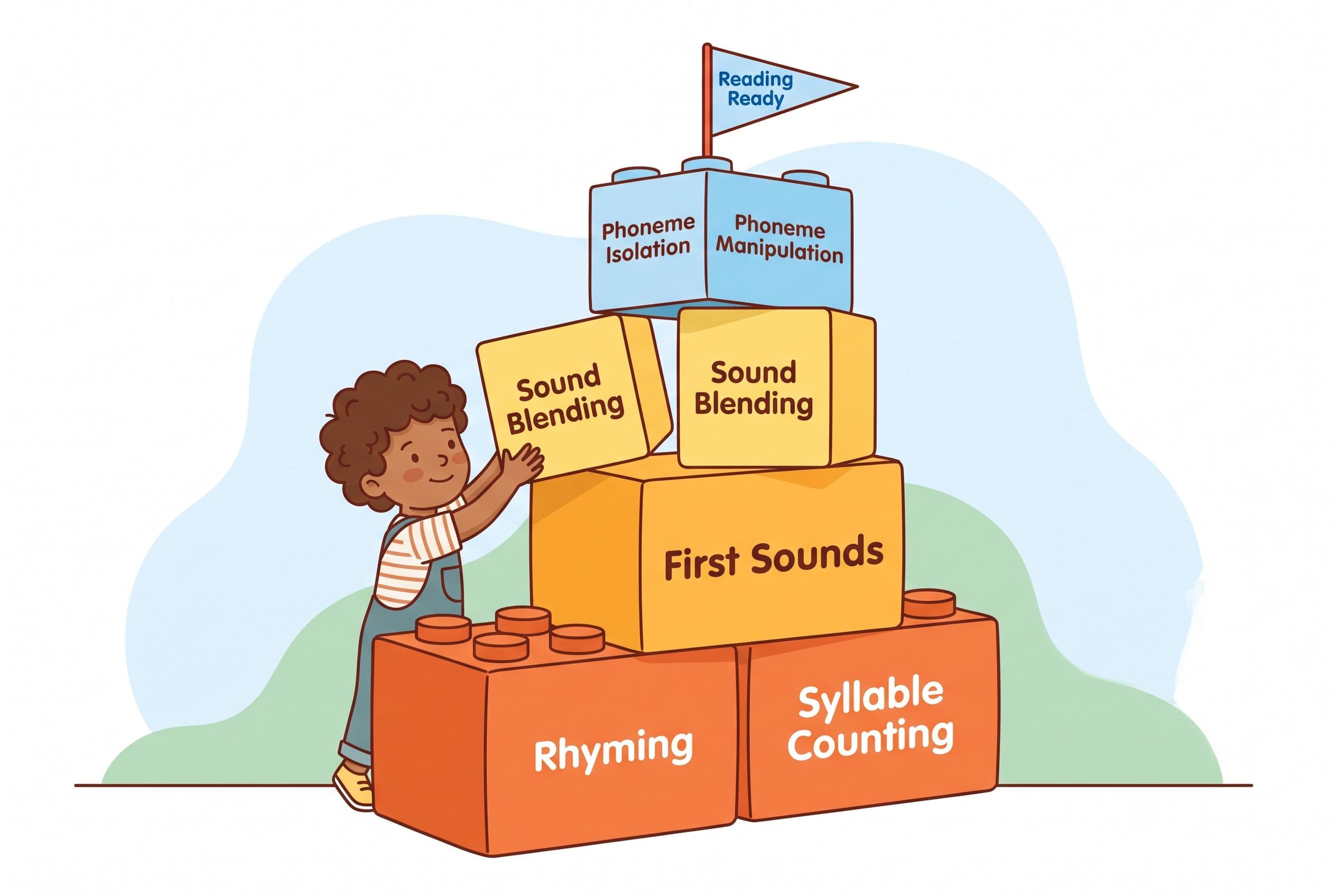
Here's the thing most parents don't realize — phonological awareness is different from phonemic awareness. Phonological awareness is the umbrella term. It includes rhyming, syllable counting, and onset-rime. Phonemic awareness is the most advanced subset — isolating, blending, and manipulating individual phonemes. That's harder, and most 4-year-olds are just beginning to scratch the surface of it.
David Kilpatrick's Equipped for Reading Success (2016) breaks this down beautifully. He shows that phonemic proficiency — specifically the ability to delete and substitute individual sounds in words — is what separates kids who learn to read easily from kids who struggle for years. His research on orthographic mapping explains why: kids who can rapidly manipulate phonemes can store words in long-term memory efficiently. Kids who can't? They're stuck guessing or memorizing each word individually. That's not sustainable.
3. Print Awareness
Does your kid understand that books have a front and back? That we read left to right? That the squiggly marks on the page are words, and those words carry meaning?
This seems obvious to us. It's not obvious to a 4-year-old. And if nobody has explicitly pointed it out, they may not know.
4. Letter-Sound Knowledge (Even a Few)
Knowing that the letter M says /m/? That's gold at age 4. Knowing 5-10 letter sounds puts them in great shape. They don't need all 26 yet. But they need to understand the concept that letters make sounds.
This is the fundamental insight of the alphabetic principle. And it's where a lot of Whole Language and Balanced Literacy approaches went wrong — in practice, they treated letter-sound work as optional or incidental, leaning instead on three-cueing strategies that taught kids to guess words from context clues and pictures. Kids paid the price. If you've ever watched a kid look at a picture of a boat and say "ship" when the word says "boat," you've seen that approach in action.
The Reading Readiness Checklist for 4-Year-Olds
Here's your quick gut check. I'm putting this in plain language because you don't need a master's degree to assess your own kid.
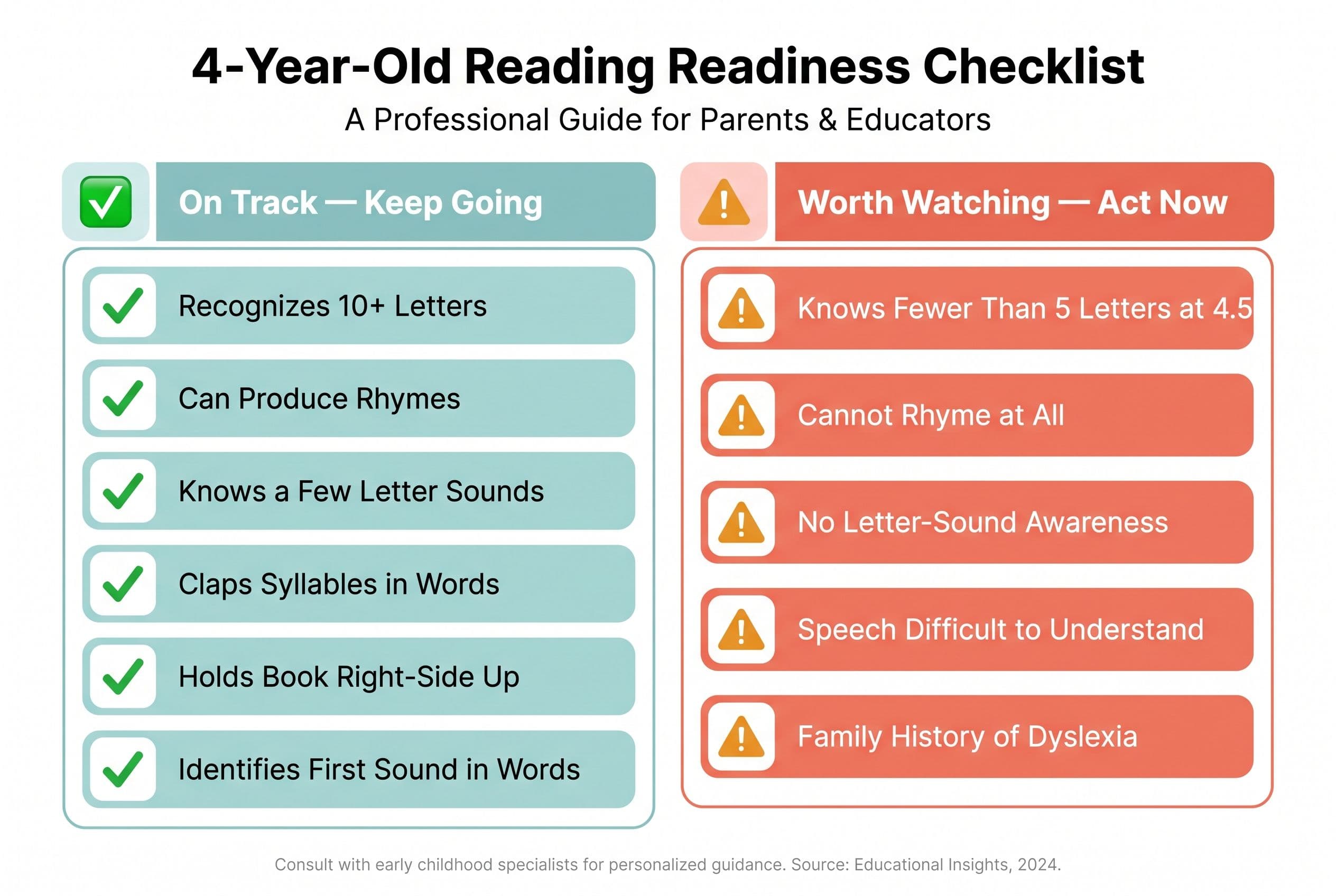
On Track (Relax, Keep Going):
- ✅ Recognizes 10+ letters by name
- ✅ Knows at least a few letter sounds
- ✅ Can produce or identify rhyming words
- ✅ Can clap syllables in their name
- ✅ Holds a book right-side up and turns pages front to back
- ✅ Shows interest in being read to (even if they're wiggly)
- ✅ Can identify the first sound in some words
Worth Watching (Don't Panic, But Act):
- ⚠️ Knows fewer than 5 letters at 4.5 years old
- ⚠️ Can't rhyme at all — not even with heavy prompting
- ⚠️ Doesn't seem to understand that letters represent sounds
- ⚠️ Shows no interest in books or printed words
- ⚠️ Has persistent difficulty with speech sounds (hard to understand)
- ⚠️ Family history of dyslexia or reading difficulty
If you checked more than two items in that second list, I'd start doing targeted phonological awareness practice right now. Not next month. Not "when kindergarten starts." Now.
The Tiger Truth: What Happens If You Wait
I know you don't want to hear this part. I'm going to tell you anyway.
The NAEP — the Nation's Report Card — showed that only 33% of 4th graders read at proficient level in 2022. That means two out of every three kids in America can't read well enough to learn from a textbook by 4th grade. The 2023 scores dropped another 3 points from 2019 — the largest decline in 30 years.
And here's the kicker: the Annie E. Casey Foundation's 2010 study found that children who can't read proficiently by the end of 3rd grade are four times more likely to drop out of high school. Four times.
That's the 3rd Grade Cliff. It's real. And the kids who fall off it? They almost never catch up.
"But Xia, we're talking about 4-year-olds! Third grade is years away!"
Exactly. That's the whole point. The gap between a kid who enters kindergarten with strong pre-reading skills and one who doesn't? It widens every single year. By 3rd grade, it's a canyon.
I was at a playground in Raleigh last year when a mom struck up a conversation with me. Her son's school had just switched from the Lucy Calkins curriculum to a Science of Reading approach because of North Carolina's SB 387 — the Excellent Public Schools Act. She was frustrated. "He was doing fine before," she told me, clearly annoyed by the disruption. Her son was in second grade. I asked — casually, not in a confrontational way — if he could read the word "splint." She called him over. He stared at it. Guessed "split." Then "spent." Then looked at her for help.
Second grade. Couldn't decode a one-syllable word with a consonant blend.
I spent 20 minutes on that playground bench walking her through why her school had made the switch — Emily Hanford's "Sold a Story" investigation for APM Reports that exposed how Balanced Literacy had failed a generation of kids, the NAEP data, the neuroscience from Dehaene's lab showing the brain doesn't just figure out reading on its own. She went home and listened to the Sold a Story podcast that night. Texted me at 11pm: "I had no idea. Why didn't anyone tell us this sooner?"
Nobody tells you because the system isn't set up to tell you. It's set up to wait. Wait until kindergarten. Wait until 1st grade. Wait until they "mature." Wait until they're so far behind that they qualify for an evaluation. Wait until there's a diagnosis. Wait until there's funding.
You don't have to wait.
What Your 4-Year-Old Should Be Doing Instead of "Reading"
OK so here's the game plan. Your 4-year-old doesn't need to be reading books. They need to be building the machinery that makes reading possible. Think of it like this: reading is the house. Right now, you're pouring the foundation.
Daily Phonological Awareness Practice (5-10 Minutes)
I can't stress this enough — this is the single highest-impact thing you can do with a 4-year-old. And it doesn't require any materials.
Rhyming games: "I'm thinking of a word that rhymes with 'dog'..." Let them guess. Give silly answers. Make it fun but do it every day. Yes, every day. We Never Skip.
First sound isolation: "What's the first sound in 'monkey'?" → /m/. Start with continuous sounds (m, s, f, n, l) because they're easier to stretch out and hear. Don't start with stop sounds (b, d, t, k) — those are harder to isolate.
Sound blending: Say three sounds separately — "/c/ ... /a/ ... /t/" — and ask your kid what word they make. This is the precursor to decoding, and you can practice it without a single letter in sight.
Kilpatrick's PAST (Phonological Awareness Screening Test) is a quick phonemic awareness screener included in his book Equipped for Reading Success. It takes about 5 minutes and tells you exactly where your child's phonological awareness breaks down. It's designed for ages 4 through adult, and I use it with all my kids. If you can't get your hands on the book, ask your child's school or speech-language pathologist about a reputable phonological awareness screener like PALS or the DIBELS phonemic segmentation measures — many districts offer these for free.
Systematic Letter-Sound Instruction (5 Minutes)
I'm not talking about the ABC song. I'm talking about teaching your kid that the letter S says /sss/. That the letter M says /mmm/. One letter at a time, with mastery before moving on.
Orton-Gillingham methodology — the gold standard for structured literacy — teaches letter sounds in a specific sequence, not alphabetical order. Programs like UFLI Foundations and Logic of English follow this principle. You start with the most common, most useful sounds first. You introduce consonants and vowels in a pattern that lets kids start blending real words almost immediately.
My approach with Mei right now: we do one new letter-sound per week. We practice it on a whiteboard, with magnetic letters, with finger-tracing, and with the Teach Your Kid to Read app. We drill the sound in isolation, then in the initial position of words she knows. By the end of the week, she owns that sound. Then we add another one.
Read Aloud. A Lot.
I read to my kids for at least 20 minutes a day. Every day. Sick days. Birthdays. Vacation. (We Never Skip applies to read-alouds too.)
But here's the part most parents miss: how you read matters as much as how much. Point to the words as you read them. Ask your kid to find a letter they know on the page. Talk about the story — what happened, why the character did what they did, what might happen next. This builds print awareness, vocabulary, and comprehension simultaneously.
Don't just read — interact with the text. That's the difference between a passive experience and an active literacy-building one.
When to Actually Worry
Look, I'm not here to make you panic. But I'm also not going to lie to you. There are genuine warning signs at age 4 that deserve attention — not next year, not when kindergarten starts, but now.
Red Flags That Warrant Action
- No awareness of rhyme whatsoever — can't tell you if "cat" and "hat" rhyme, even with lots of practice
- Persistent speech sound errors — not just cute mispronunciations, but consistent difficulty producing certain sounds or being understood by people outside the family
- Family history of dyslexia — the International Dyslexia Association notes that dyslexia runs in families, and kids with a parent or sibling who struggled to read have a 40-60% chance of having similar difficulties
- No interest in or active avoidance of letter/sound activities — particularly if this resistance seems to stem from frustration rather than preference
- Can't learn letter names even with consistent practice — if you've been working on letters for months and they can't reliably name more than a handful, that's worth investigating
Linnea Ehri's phases of word reading development — pre-alphabetic, partial alphabetic, full alphabetic, and consolidated alphabetic (from her 2005 meta-analysis) — give us a useful framework here. At age 4, most kids should be somewhere in the pre-alphabetic to early partial alphabetic phase. They should be starting to notice that letters correspond to sounds, even if they can't use that knowledge to read words yet. A kid who's showing zero awareness of the alphabetic principle at 4.5, despite exposure and practice, is worth a closer look.
If you're seeing these warning signs, talk to your pediatrician. Ask about a referral for a speech-language evaluation. And start doing phonological awareness practice at home today — don't wait for the appointment.
The NICHD research led by Reid Lyon showed that high-quality, early, explicit instruction prevents most reading failure — and many struggling readers can catch up with intensive intervention, especially when it starts early. But "early" is the key word. Every year you wait, intervention gets harder and more expensive. The average remedial reading program costs $10,000-$15,000 per year — and insurance rarely covers it.
How Teach Your Kid to Read Fits In
This is where I tell you about the tool I actually use with my own kid.
Teach Your Kid to Read is built on systematic synthetic phonics — the same methodology behind Orton-Gillingham, the same approach recommended by the National Reading Panel in their 2000 report (the one Congress actually commissioned). That report found that systematic phonics instruction produces significant reading benefits for children in kindergarten through 6th grade — and the effects were especially strong for at-risk readers.
The app follows a structured sequence. Letter sounds first. Then blending. Then CVC words. Then consonant blends. Then digraphs. No guessing from pictures. No "three-cueing" strategies that teach kids to look at the first letter and guess. Just sound-by-sound decoding, building toward fluency.
For a 4-year-old, you'd start at the very beginning. Letter-sound introduction. Short, focused sessions — 5-10 minutes max for this age. The app keeps the pace right so your kid isn't overwhelmed, but they're also not just tapping buttons mindlessly.
I use it with Mei during our morning phonics time. She sits next to me (not in another room with a tablet — this isn't lazy iPad parenting). We do it together. I watch her responses, I correct errors immediately, and we celebrate when she gets a tough one right. Then we put the tablet away and practice with magnetic letters on the fridge.
That combination — app for structured practice, hands-on for reinforcement — is the sweet spot.
The Action Step: Your 4-Year-Old Reading Readiness Plan
Here's exactly what I'd do if I were starting from scratch with a 4-year-old today.
Step 1: Assess Where They Are (This Week)
Run through the reading readiness checklist above. Be honest. If you want something more formal, look into the PALS (Phonological Awareness Literacy Screening) — some states offer it free through pre-K programs — or ask your child's school or speech-language pathologist about a phonological awareness screener.
Step 2: Start Phonological Awareness Practice (Today)
Five minutes a day. Rhyming, first sounds, syllable clapping. Do it during bath time, in the car, while you're cooking dinner. No materials needed.
Step 3: Introduce Letter-Sound Correspondence (This Month)
Pick 2-3 letters to start with. I recommend M, A, and S — you can blend them into real words almost immediately ("am," "Sam," "mas"). Use the Teach Your Kid to Read app to structure this so you're not guessing about sequence or pacing. start lesson one free
Step 4: Read Aloud Every Single Day (Non-Negotiable)
Twenty minutes minimum. Point to words. Ask questions. Let your kid hold the book and turn pages. Make it a habit that's as automatic as brushing teeth.
Step 5: Track Progress Monthly
Write down which letters and sounds your kid knows at the start of each month. Watch for growth. If you see progress — even slow progress — you're on the right track. If you see no movement after 2-3 months of consistent daily practice, get a professional evaluation.
By kindergarten, you want steady growth in letter-sound knowledge and the ability to blend simple CVC words when taught. That's your north star. You don't need to hit it today. But you need to be building toward it.
Step 6: Drop the Guilt
Your 4-year-old isn't behind because they can't read. They're 4. But they will fall behind if you spend the next two years doing nothing because someone told you to "wait and see." The best time to start was yesterday. The second best time is right now.
Frequently Asked Questions
Should a 4-year-old be reading words?
Most 4-year-olds are not reading words, and that's developmentally appropriate. Some early readers might decode simple CVC words like "cat" or "dog" by age 4, but this isn't the norm and it's not necessary. What matters far more at this age is that your child is building strong pre-reading skills — letter recognition, letter-sound knowledge, and especially phonological awareness (the ability to hear and play with sounds in spoken language). These are the foundation skills that make actual reading possible in kindergarten and first grade.
How do I know if my 4-year-old has a reading problem or is just young?
The key distinction is between "not yet" and "can't even start." A 4-year-old who doesn't know all their letters yet? Totally normal — just keep practicing. A 4-year-old who can't detect rhyme at all after months of practice, has persistent speech difficulties, or shows no awareness that letters have sounds despite regular exposure? That's worth investigating. Family history of dyslexia is another important risk factor. The International Dyslexia Association notes that 40-60% of children with a dyslexic parent will have reading difficulties themselves. Early screening with a phonological awareness tool can help identify gaps before they become reading failures.
What pre-reading skills should I work on with my 4-year-old?
Focus on four areas: (1) letter recognition — aim for most uppercase letters by age 5; (2) letter-sound knowledge — start connecting letters to their sounds, even if you only cover a few at a time; (3) phonological awareness — rhyming, syllable counting, and identifying first sounds in words; and (4) print awareness — understanding that books have a front and back, text goes left to right, and those marks on the page are words with meaning. Of these four, phonological awareness is one of the strongest predictors of future reading success — especially for decoding — according to decades of research.
Is it bad to teach a 4-year-old to read early?
Absolutely not — as long as you're doing it correctly. Teaching letter sounds, blending, and decoding through systematic phonics is not harmful at any age. What is harmful is using the wrong methods — like encouraging kids to guess words from pictures or memorize words as whole shapes. It's also harmful to push a child past their frustration threshold in marathon practice sessions. For 4-year-olds, keep phonics instruction to 5-10 minute sessions, make it multi-sensory, and celebrate effort. The goal isn't to create a stressed-out little reader — it's to build a strong foundation so that when formal reading instruction begins, your child is ready to fly.
My 4-year-old's preschool says they're "on track." Should I trust that?
Maybe. But ask what they mean by "on track." Many preschools evaluate readiness based on things like sitting still during circle time, knowing colors and shapes, and writing their name. Those are fine skills, but they don't tell you anything about phonological awareness or letter-sound knowledge — the actual precursors to reading. Ask specifically: "Can my child identify rhyming words? Can they isolate the first sound in a word? How many letter sounds do they know?" If the teacher can't answer those questions with specific data, do your own assessment at home. Mississippi's Literacy-Based Promotion Act of 2013 — the law that took them from 49th to 21st in national reading scores in six years — worked because it required universal screening and early intervention. You don't have to wait for your state to mandate it. Screen your own kid.
Related comparisons
Part of these guides

Xia Brody
Co-Founder, Teach Your Kid to Read
Mom of 4 who has successfully taught her kids to read. Currently in the trenches with her 4-year-old while her two oldest (10 and 7) devour books on their own. Passionate about phonics-based methods and building a lifelong love of reading.
Related Articles
Is My 5 Year Old Behind in Reading? Age-by-Age Signs
Wondering if your 5-year-old should already be reading? Here’s the no-panic, no-waiting checklist for age 5 reading milestones, warning signs, and next steps.
Read More →
My 5 Year Old Can't Read Reception: When to Act
If your Reception child isn't reading yet, don't panic — but don't drift. Here's how to tell normal early reading from a real phonics gap, and what to do this week.
Read More →
My 7 Year Old Can't Read: 9 Steps to Act Now
If your 7-year-old still can't read, don't panic—but don't wait. Here's how to check the gap, stop guessing habits, and start a real phonics plan at home.
Read More →