Is My 2nd Grader Behind in Reading? 9 Signs
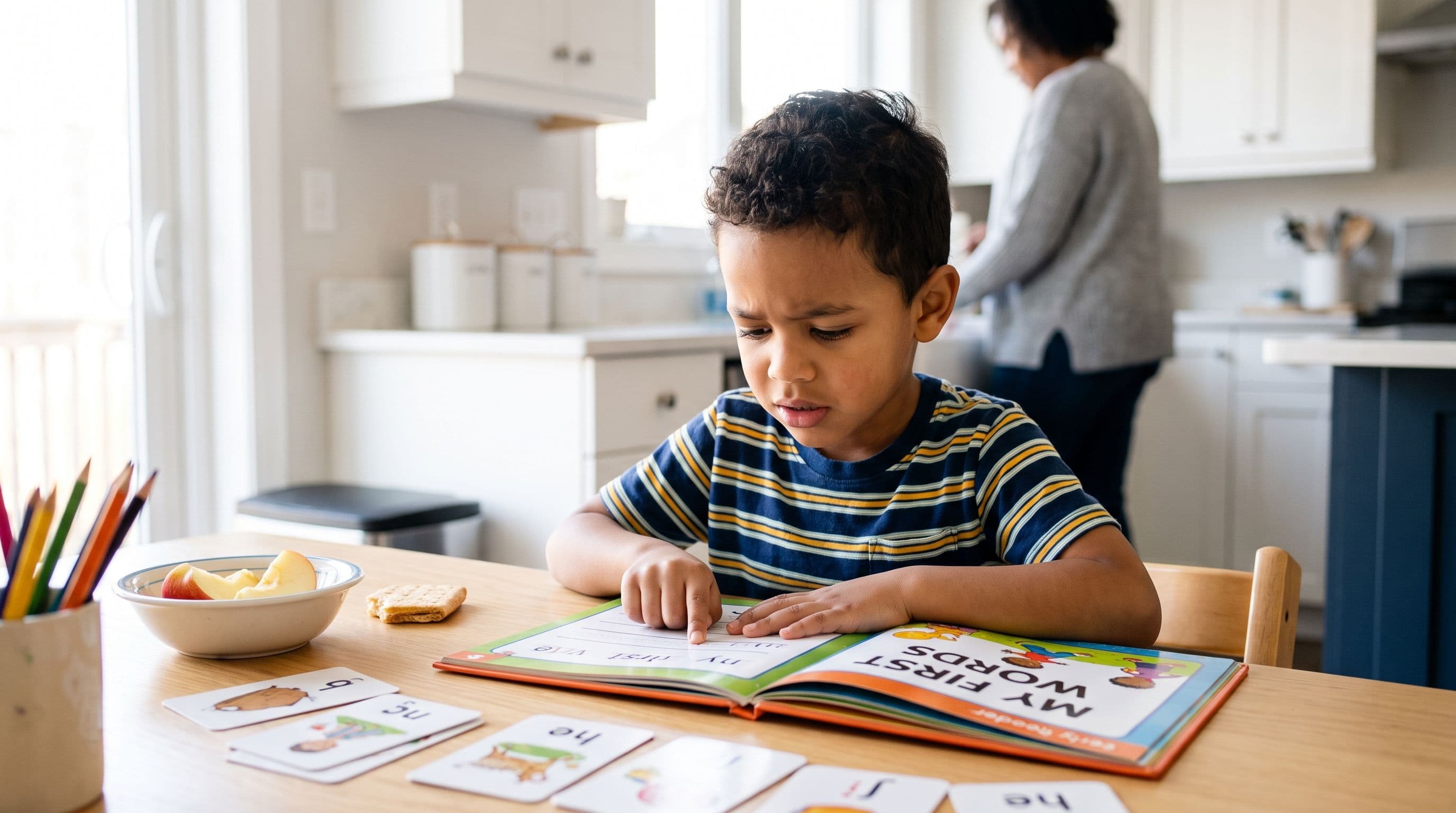
Is My 2nd Grader Behind in Reading? Signs, Benchmarks, and What to Do Next
What You'll Learn
- The 2-minute check that tells you if your 2nd grader is probably behind
- The reading behaviors that look “normal” but are actually red flags
- Why guessing from pictures wrecks confidence and fluency
- The next step I’d take this week if my own 7-year-old was struggling to read
Reality Check: Yes, Your 2nd Grader Might Be Behind
If you're asking, “is my 2nd grader behind in reading?” I want you to trust that little alarm bell in your stomach.
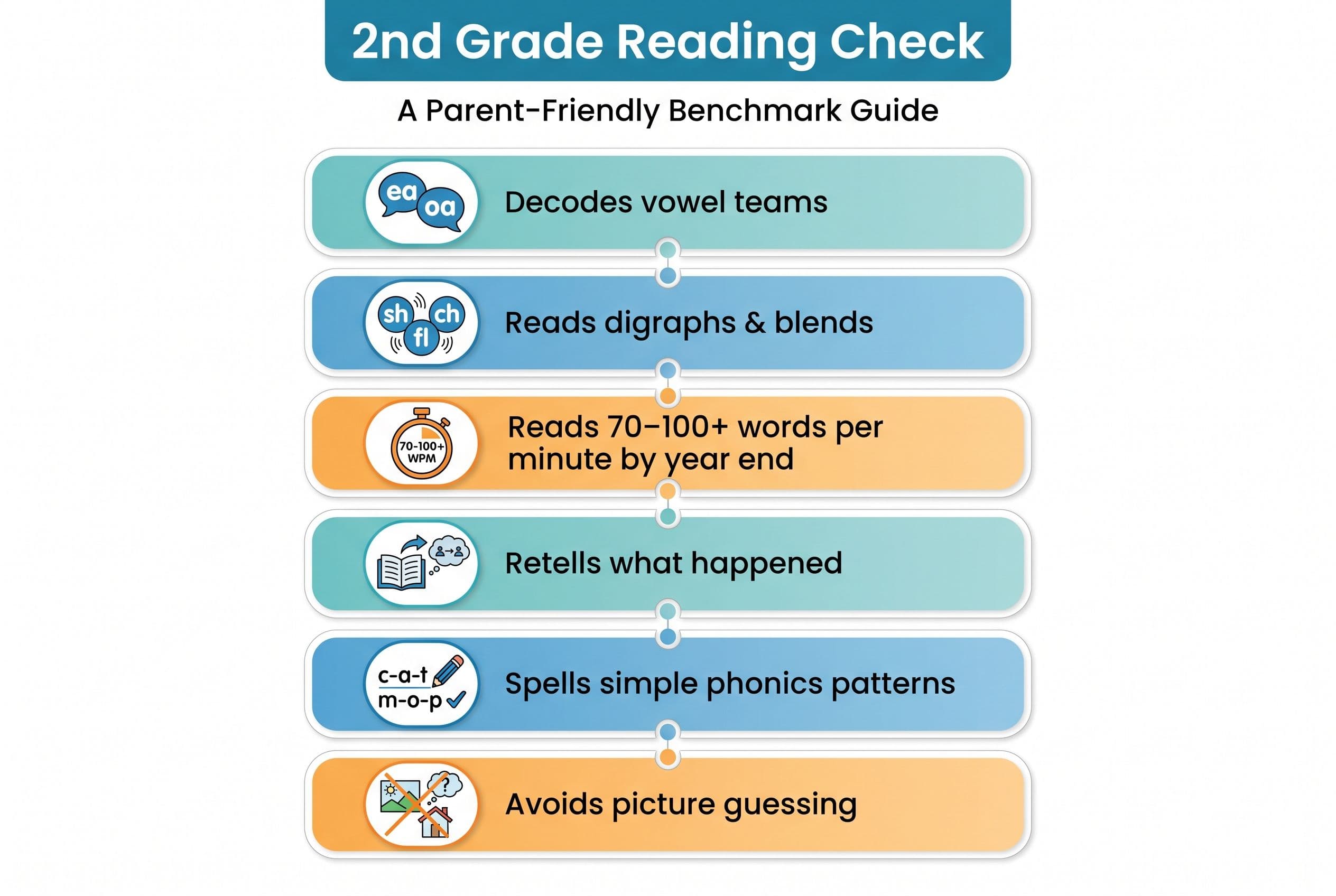
By 2nd grade (ages 7-8), most children should read simple grade-level text with growing accuracy, decode unfamiliar one-syllable words, handle common vowel teams like ai, ee, oa, read many high-frequency words automatically, and retell what they read without needing a parent to drag every detail out like a dental procedure.
Here’s the quick parent version.
Your 2nd grader may be behind in reading if they:
- Guess words from pictures or the first letter
- Read was as saw, form as from, or house as horse
- Sound out the same word again and again like they’ve never seen it before
- Avoid reading out loud
- Read so slowly that meaning disappears
- Can’t spell simple words they should be able to decode
- Melt down over short books
- Memorize leveled readers but freeze with new text
- Struggle with vowel sounds, blends, digraphs, or multisyllable words
Real talk — if your child reads “The ship is in the pond” as “The boat is in the water” because the picture shows a boat, that isn’t reading. That’s guessing in a cute outfit.
And guessing is not a Skill. Decoding is.
2nd Grade Reading Level Expectations: The Plain-English Checklist
Let’s make this concrete. No vague “literacy growth” talk. I’m a homeschooling mom. I need to know what the kid at my kitchen table can actually do before snack time, not what an education brochure says.
By the middle to end of 2nd grade (ages 7-8), a child should usually be able to:
Accuracy and Decoding
- Read short-vowel CVC words quickly: cat, bed, sit, hop, cup
- Read short-vowel words with digraphs, doubled consonants, or blends: ship, bell, snack
- Decode long-vowel patterns: cake, rain, goat, seed, light
- Read common digraphs: sh, ch, th, wh, ck
- Handle blends: stop, glad, print, frog
- Start reading two-syllable words: basket, rabbit, sunset, muffin
- Use phonics first, not pictures first
Fluency
Reading fluency norms for 2nd grade vary by assessment, season, and passage difficulty. For example, many schools use tools like DIBELS or AIMSweb and look at correct words per minute on grade-level passages, not random easy text from the shelf. Some end-of-year 2nd grade benchmarks land around 70-100+ correct words per minute, depending on the assessment.
Don’t obsess over one number from your kitchen-table timer. A home one-minute reading is an observation, not a standardized screening score. Do pay attention if your child reads word-by-word, loses their place constantly, guesses often, or sounds exhausted after one paragraph.
Comprehension
A 2nd grader should answer basic questions after reading a short passage:
- Who was the story about?
- What happened first, next, and last?
- Why did the character do that?
- What does this word probably mean in the sentence?
But here’s the kicker: comprehension falls apart when decoding eats all the brain power. If your child spends 10 seconds fighting the word bright, they won’t remember what the sentence meant. That’s not laziness. That’s overload.
Spelling Connection
Spelling tells the truth. If your child reads train but spells it trane, fine — they’re hearing the sounds and need help mapping the conventional spelling. If they spell train as chrane, that can also be a sound-based attempt because tr can sound a little like /ch/ in speech. Annoying? Yes. Weird? Not really.
But if they spell train as tn, now I’m looking harder at segmentation, letter-sound knowledge, and what’s actually happening under the hood.
This is where second grader reading problems get very clear, very fast.
What to Do If They're Not There Yet
If your child falls below that line, don’t panic — but don’t wait. The worst move is saying, “Maybe it’ll click next year.” I want to throw that phrase into the sun.
Start with a quick check at home. Have your child read a new, simple passage out loud for one minute. Mark skipped words, guessed words, slow sounding-out, and substitutions. Then take the 2-minute reading check so you have a clearer picture instead of just mom-gut panic at 9:47 p.m.
One common gap is decoding. Your child may know some letter sounds, but they may not have mastered grapheme-phoneme correspondence, blending, and orthographic mapping — the brain process that stores words for instant recognition. Other pieces can matter too, like language comprehension, attention, dyslexia, or needing more intensive instruction. This is why we gather data instead of just staring at the ceiling at midnight and spiraling. Ask me how I know.
This is exactly why I recommend Teach Your Kid to Read for parents who need a simple, structured next step at home. It uses systematic synthetic phonics with Orton-Gillingham-style principles: explicit sound work, blending, review, and no guessing. You can start lesson one free; lesson one is free with no card and nothing to cancel, and from lesson two the whole program is a 7-day free trial, then US$9.95 a month.
Tiger Truth: Waiting Can Get Expensive Fast
Here’s where I put on my tiger mom glasses.
Reading delays don’t politely stay in the reading corner. They spread. Math word problems get harder. Science texts get longer. Homework takes forever. Your sweet kid starts saying, “I’m dumb,” when the truth may be that their brain needs clearer, more direct, or more intensive reading instruction.
In the US, only 33% of 4th graders (ages 9-10) read at or above proficient on the 2022 NAEP / The Nation's Report Card. That’s not a tiny problem. That’s a five-alarm fire with laminated classroom posters.
Donald Hernandez’s 2011 report, Double Jeopardy, published by the Annie E. Casey Foundation, found that children who don’t read proficiently by the end of 3rd grade (ages 8-9) are four times more likely to leave high school without a diploma than proficient readers. That’s an association, not a magic crystal ball. Poverty makes the risk worse, but the reading problem itself still matters. A lot.
And remedial help costs real money. Private reading intervention can run US$10,000-US$15,000 a year in some areas, especially if a child needs intensive dyslexia-focused tutoring. Insurance often doesn’t cover it. Schools may help, but you can lose months waiting for meetings, testing, and “let’s monitor progress.”
Know what drives me crazy? Parents get told to relax while the gap grows teeth.
The Columbus Conference Story That Changed My Brain
A few years ago, I was at a homeschool conference in Columbus and sat in on a talk by a former Reading Recovery teacher who’d switched to structured literacy.
She described spending years using Marie Clay’s leveled text approach with struggling first graders (age 6): “use the picture,” “think about what makes sense,” “look at the first letter.” Sound familiar? That’s the same advice many kids still hear when they hit a hard word.
Then she said something I’ll never forget: “I thought I was helping them. I was teaching them to guess.”
Oof. You could feel every parent in the room sit up straighter.
She talked about how differently her students responded when she moved away from guessing prompts and toward an Orton-Gillingham approach: direct sound work, explicit phonics, and real decoding instead of picture-cue gymnastics.
That talk changed how I think about reading intervention for second graders. It’s not about more time with the wrong strategy. It’s about the right method, taught directly, practiced daily, and repeated until the child owns it.
No guessing. No vibes. Code first.
Why 2nd Grade Reading Problems Happen
Parents often blame themselves. Stop. You can take action without wearing shame like a backpack full of bricks.
Second grader reading problems usually come from one or more of these gaps.
1. Weak Phonemic Awareness
Phonological awareness covers sound patterns in spoken language, from rhymes and syllables down to individual phonemes. Phonemic awareness is that individual-sound part.
For example:
- Say ship without /sh/ → ip
- Change /m/ in mat to /s/ → sat
- Blend /f/ /r/ /o/ /g/ → frog
David Kilpatrick’s PAST — the Phonological Awareness Screening Test — takes about 5 minutes when you know how to give it, and it can show exactly where the sound breakdown happens. I love that kind of tool because it doesn’t flatter anybody. It tells you where to drill.
2. Too Much Leveled-Reader Guessing
Fountas & Pinnell levels are everywhere, but their leveled readers often rely on predictable patterns and picture clues. That whole-language-aligned setup can make a child look like they’re reading when they’re really memorizing and guessing.
Imagine your child sees: I see the pony.
The page shows a pony. The sentence pattern repeats. Your child says the words perfectly.
Then you cover the picture and show pony in a new sentence. Blank stare.
That’s not mastery. That’s performance.
3. Not Enough Systematic Phonics
The 2000 National Reading Panel report — the one a US federal panel produced after reviewing reading research — found that systematic phonics instruction helps children learn to read, especially in the early grades.
Louisa Moats’ 1999 paper “Teaching Reading IS Rocket Science” said the quiet part loudly: teachers need deep knowledge of speech sounds, spelling patterns, and language structure. Reading instruction isn’t just handing kids books and hoping magic happens.
Stanislas Dehaene’s Reading in the Brain (2009) makes the neuroscience point even sharper. The brain doesn’t naturally read. We train it to connect print to speech sounds.
So if my child is behind in reading second grade, I’m not asking, “How do I make reading more fun?” first.
I’m asking, “What part of the code hasn’t clicked yet?”
Signs Your 7-Year-Old Is Struggling to Read
A 7 year old struggling to read often looks capable in every other area. That makes parents second-guess themselves.
Maybe your child builds Lego sets with 143 steps, negotiates bedtime like a tiny attorney, and remembers every dinosaur fact ever spoken by a human. Then they hit the word shade and fall apart.
That mismatch is common.
Watch for these signs:
- They rely on memory instead of sounding out
- They skip small words like the, of, for, was
- They confuse vowel sounds
- They reverse or reorder letters after age 7 in a way that affects reading
- They read one page fine and the next page terribly
- They hate writing because spelling feels impossible
- They ask you to read everything for them
- They get headaches, stomachaches, or suddenly need water during reading time
Those last ones can come with reading stress, yes. But don’t wave them away like tiny theater. Persistent headaches, stomachaches, vision complaints, or big distress deserve a real conversation with a healthcare professional too. Tiger mom rule: we check the reading problem and the actual child.
Some kids also have dyslexia indicators. Dyslexia doesn’t mean low intelligence. It means the brain struggles with accurate, fluent word recognition, often due to phonological processing weaknesses. The International Dyslexia Association has parent-friendly explanations if you need a deeper rabbit trail.
Bottom line: if your child is bright but reading feels weirdly hard, take that seriously.
The Solution: Structured, Systematic Phonics
Here’s what I’d do if my own 2nd grader was behind.
I’d stop all guessing prompts immediately.
No “look at the picture.” No “what word would make sense?” No “try the first letter and guess.”
We’d use decodable text, direct phonics instruction, and short daily drills. I’d rather do 15 focused minutes every day than one dramatic 90-minute session where everyone cries and someone throws a pencil. Ask me how I know.
Good structured programs include UFLI Foundations, Logic of English, All About Reading, Barton Reading & Spelling, Wilson Reading System, and Fundations. For practice books, I like decodable readers better than predictable leveled readers. Bob Books can work for early practice, though older 2nd graders may need something less babyish.
Teach Your Kid to Read fits parents who want the plan laid out without becoming a part-time reading specialist overnight. It walks children through explicit phonics, blending, review, and controlled practice. Lesson one is free with no card and nothing to cancel; from lesson two the whole program is a 7-day free trial, then US$9.95 a month.
Action Step: What to Do This Week
Don’t make this complicated. Complicated dies by Thursday.
Do this:
- Listen for one minute. Pick a passage your child hasn’t memorized. Have them read aloud. Mark guesses, skipped words, and slow decoding.
- Check the code. Ask them to read words like ship, cake, rain, chop, bright, basket, sunset. If they miss patterns, write them down.
- Test sound skills. Say, “What’s smile without /s/?” or “Change /m/ in map to /t/.” If they can’t do it orally, phonemic awareness needs work.
- Stop guessing prompts today. Say, “Look at the letters. Say the sounds. Blend it.” Every time. We Never Skip.
- Use decodable readers. Match the book to the phonics pattern you’re teaching. Don’t hand a child a random leveled book and call it practice.
- Drill 10-15 minutes daily. Short, direct, boring-if-needed practice beats cute chaos. Mastery first. Fun can ride in the backseat.
- Track progress for 4 weeks. Note accuracy, speed, and mood. If your child makes little progress with daily structured practice, request a school evaluation or seek a dyslexia-informed tutor.
If you want the next step already laid out, start with Teach Your Kid to Read and give your child a clean phonics path instead of more guessing practice.
What About School Reading Levels?
School reading levels can help, but they can also confuse parents.
A child may test at a “level” because they use context, pictures, and memorized patterns. That doesn’t prove they can decode unfamiliar words. I care more about whether the child can read new words accurately than whether they moved from level J to level K with a sticker.
Ask the teacher specific questions:
- What phonics patterns has my child mastered?
- How many words can they read correctly in one minute on a grade-level passage?
- Do they guess from pictures or decode from print?
- What intervention are they receiving, and is it structured literacy?
- Are you using DIBELS, AIMSweb, MAP Growth, PALS, or another assessment?
DIBELS can give useful fluency and decoding data. AIMSweb can too. If a report only says your child is “developing as a reader,” ask for numbers. Politely. Firmly. Tiger mom smile optional.
When to Ask for More Help
Ask for help now if your 2nd grader:
- Still can’t read basic short-vowel words accurately
- Reads far below expected fluency on a school-administered grade-level measure
- Cannot blend sounds smoothly
- Has a family history of dyslexia
- Avoids all reading
- Shows major spelling problems
- Makes little progress after 4-6 weeks of daily structured phonics
For US parents, you can request a school evaluation in writing. Outside the US, ask your school or local authority about learning support, educational psychology assessment, or dyslexia screening routes. The system names change by country, but the need stays the same: get data, then get targeted instruction.
Don’t wait for failure to look official.
A Simple Home Drill for Tonight
Use this at the kitchen table. I had my 4-year-old doing a baby version of this last Tuesday while my 1-year-old tried to eat a crayon, so no, your house doesn’t need to look peaceful first.
Pick one pattern: ai.
Write:
- rain
- sail
- pain
- chain
- train
Then do this:
- Point to ai and say, “This spells /ā/.”
- Have your child tap each sound: /r/ /ā/ /n/.
- Blend: rain.
- Read all six words.
- Dictate two words for spelling.
- Read one sentence: The train is in the rain.
That’s it. No glitter. No circus. Skill, Drill, Mastery.
Do that with one pattern per day and review old patterns. Your child’s brain needs repetition to build automatic word recognition. Linnea Ehri’s 2005 work on phases of word reading development explains this beautifully: children move from visual guessing to partial alphabetic reading, then full alphabetic reading, then consolidated word recognition.
That’s the path. Don’t let anyone sell you a shortcut made of vibes.
The Parent Script: What to Say When Your Child Gets Stuck
Use this script:
“Look at the word.” “Say the sounds.” “Blend it.” “Now read the sentence again.”
If the word is irregular, point out the regular parts and the tricky part. For said, say: “The /s/ is regular. The /d/ is regular. The middle part is the tricky part we remember.”
Don’t say:
- “Guess.”
- “Look at the picture.”
- “What would make sense?”
- “Skip it.”
No Guessing is one of my Tiger Rules. Sound it out. Map it. Read it again.
If your gut says your child needs a more structured path, don’t sit in worry mode. Start with a short check, then give them explicit phonics practice every day.
FAQ
Is my 2nd grader behind in reading if they still sound out words?
Not always. Sounding out is normal. The red flag is sounding out the same simple words repeatedly without building automatic recognition, or needing to sound out nearly every word in a grade-level passage.
What should a 2nd grader be able to read?
A 2nd grader should read simple chapter books or grade-level passages with decent accuracy, growing fluency, and basic comprehension. They should decode common phonics patterns like vowel teams, digraphs, blends, silent-e words, and many two-syllable words.
My child is behind in reading second grade — can they catch up?
Yes, many children can make strong progress with structured, explicit phonics and daily practice. Don’t rely on guessing strategies or random reading time alone. Use direct instruction, decodable text, and progress checks.
Should I get my 7-year-old tested for dyslexia?
If your 7-year-old struggles with decoding, spelling, phonemic awareness, or reading fluency despite practice, ask about dyslexia screening or a full evaluation. Family history makes testing even more urgent.
How long should reading intervention take for second graders?
It depends on the size of the gap and the child’s profile. You should see some movement within 4-6 weeks of consistent, structured practice, but bigger gaps may need months of targeted intervention. The method matters more than wishful waiting.
Part of these guides

Xia Brody
Co-Founder, Teach Your Kid to Read
Mom of 4 who has successfully taught her kids to read. Currently in the trenches with her 4-year-old while her two oldest (10 and 7) devour books on their own. Passionate about phonics-based methods and building a lifelong love of reading.
Related Articles

Best Reading App for 2nd Graders Behind in 2026: Full List + Free Trial
Your 2nd grader is behind in reading and you need an app that actually works — not digital busy work. Here's a phonics-based ranking from a reading specialist mom who's helped her own kids catch up, plus warning signs you shouldn't ignore.
Read More →
Best Reading App for 3rd Graders Behind in 2026: Full List + Free Trial
Your 3rd grader is behind in reading and you're running out of time. Here's what the science says about which reading apps actually work — and which ones are expensive digital babysitters dressed up as 'learning tools.'
Read More →
My First Grader Can't Read? The 90-Day Catch-Up Plan
If your 6-year-old is guessing at words, memorizing books, or melting down at the page, you don't have a motivation problem — you have an instruction problem. Here's the exact 90-day catch-up plan I'd run, starting tonight.
Read More →