Best Reading App for 2nd Graders Behind in 2026: Full List + Free Trial
What You'll Learn
- The single biggest reason most "reading apps" make struggling 2nd graders worse — and how to spot the ones built on actual science
- Why your child's second grade reading level matters more right now than at any other point in their school career (the clock is ticking)
- A ranked breakdown of reading intervention apps for 2nd grade — what they do well, where they fall short, and which one I use with my own kids
- The 3-step action plan you can start tonight to figure out exactly where your child's reading is breaking down
Your 2nd Grader Is Behind. Let's Stop Pretending Otherwise.
I'm going to skip the part where I tell you "every child develops at their own pace" and "don't compare your kid to other kids." You've heard that. It hasn't helped.
Here's what's actually happening: your second grader is struggling to read, you can feel it in your gut, and you're searching for a reading app at 10:47pm because you don't know what else to do.
I get it. I've been that parent.
When my oldest was in second grade, I watched him freeze on the word "branch." Not a hard word. Five letters. One syllable. But he looked at the picture on the page — a tree — and said "tree." He wasn't reading. He was guessing. And his school had taught him to do exactly that.
So let me be direct with you: if your 2nd grader is behind in reading, an app alone won't fix it. But the right app — one built on systematic synthetic phonics, not gamified guessing — can be a genuine intervention tool. And the wrong app will burn months you don't have.
The Tiger Truth: Why Second Grade Is the Last Easy Off-Ramp
I'm not going to sugarcoat this part.
The National Assessment of Educational Progress (NAEP) — the Nation's Report Card — showed that on the 2022 Grade 4 Reading assessment, only about a third of students scored at or above the NAEP Proficient level. Now, "Proficient" on NAEP is actually a high bar — it doesn't mean "can read at grade level," it means strong academic competence. But here's the kicker: roughly a third of those 4th graders scored below NAEP Basic, meaning they couldn't demonstrate even partial mastery of grade-level reading skills. And Grade 4 reading scores dropped 3 points from 2019 to 2022 — one of the largest declines in decades. Those are 4th graders — kids who've already crossed the 3rd Grade Cliff.
Know what the worst part is? The Annie E. Casey Foundation's 2010 report (Early Warning! Why Reading by the End of Third Grade Matters) found that children who can't read proficiently by the end of 3rd grade are four times more likely to drop out of high school — with the risk even higher for children from low-income families. That's not a scare stat I'm pulling out of thin air. It's an association backed by longitudinal data tracking real kids through real school systems.
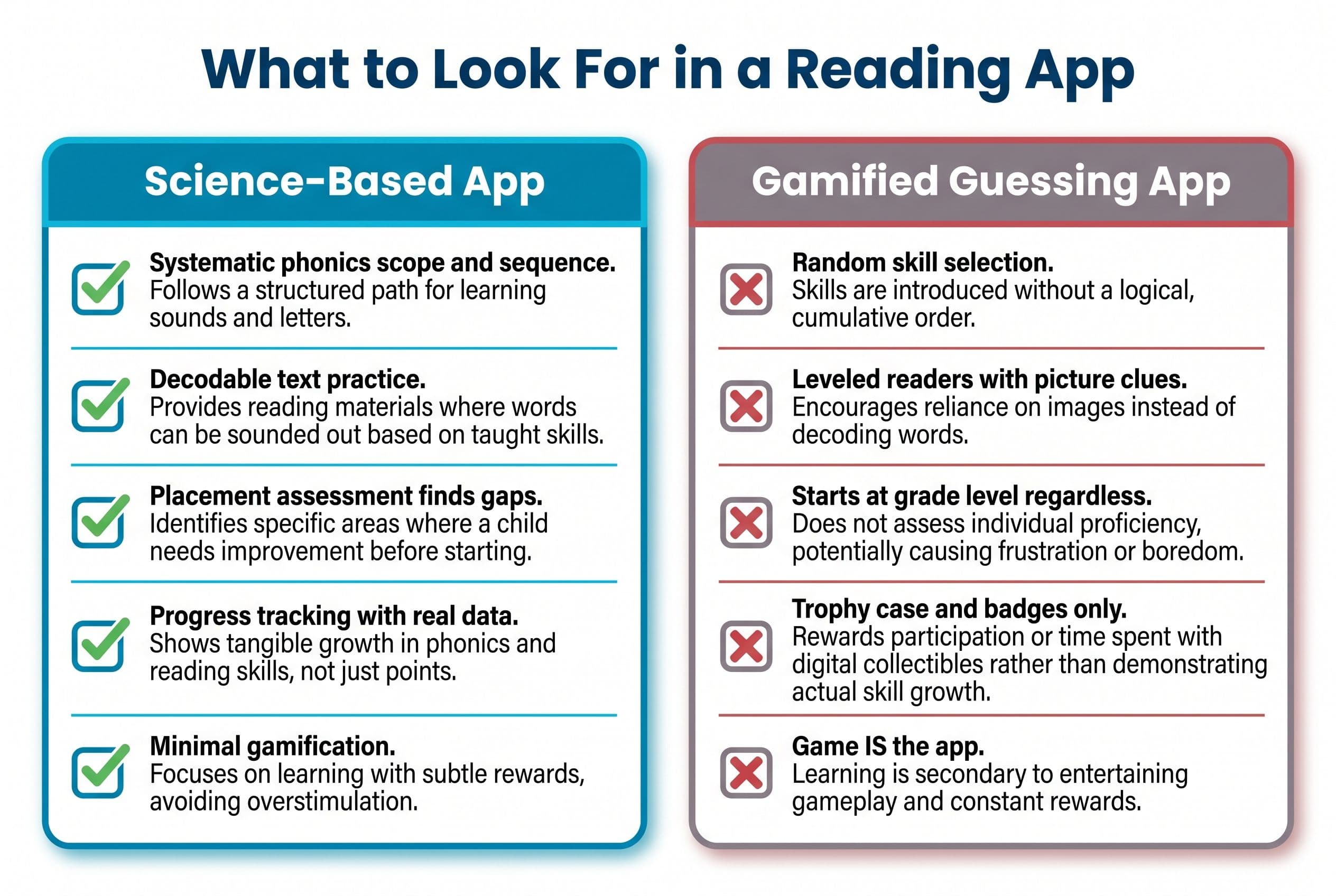
Second grade is your last real window before that cliff. Here's why:
- In K-1, kids are "learning to read." Teachers expect struggle. Support is built in.
- In 3rd grade, kids shift to "reading to learn." Every subject — math word problems, science, social studies — now assumes reading fluency.
- 2nd grade is the bridge. It's the year where gaps either close or become canyons.
If your child is reading below grade level right now, they're not going to magically catch up over summer. That's the "Wait and See" lie, and it's the most dangerous myth in education. Reid Lyon, who led the NICHD reading research program, testified before Congress that waiting is essentially educational malpractice — 38% of fourth graders can't read at a basic level, and most of them showed signs of struggle years earlier.
Private reading tutoring programs — Lindamood-Bell, for example — can run to thousands of dollars a year. Insurance doesn't cover it. Schools have 18-month waitlists for evaluations. You can't afford to wait.
So yeah. That's the scare. Now let's fix it.
Why Most Reading Apps for 2nd Graders Are Garbage
Real talk — most of what you'll find in the App Store is digital candy dressed up as education.
I've looked at dozens of reading apps over the past six years. For my oldest, then my second kid, and now for my 4-year-old (who I'm currently teaching to read at our kitchen table using decodable texts and a whiteboard). I've seen the whole spectrum.
Here's the pattern with bad apps:
- They reward guessing. The child taps pictures to "read" a story. No actual decoding happens. This is Whole Language philosophy in a touchscreen wrapper.
- They teach sight words in isolation. Lists and lists of memorized words with no phonics structure underneath. David Kilpatrick's Equipped for Reading Success (2016) explains why this fails — without orthographic mapping (the brain's process of bonding letter patterns to pronunciation and meaning), "memorized" words don't stick.
- They prioritize engagement over instruction. Coins, badges, dancing animals, mini-games between "lessons." Your kid plays for 20 minutes and decodes zero words. The app reports "80% completion!" and you feel good. Nothing happened.
- They skip systematic progression. Real phonics instruction follows a scope and sequence — short vowels before long vowels, single consonants before blends, blends before digraphs. Most apps let kids bounce around randomly.
A reading app for a struggling 2nd grader needs to do what Orton-Gillingham-based programs do in person: systematic, explicit, sequential phonics with built-in review and mastery checks. If the app doesn't have a scope and sequence you can actually see, delete it.
What a Good Reading Intervention App Actually Looks Like
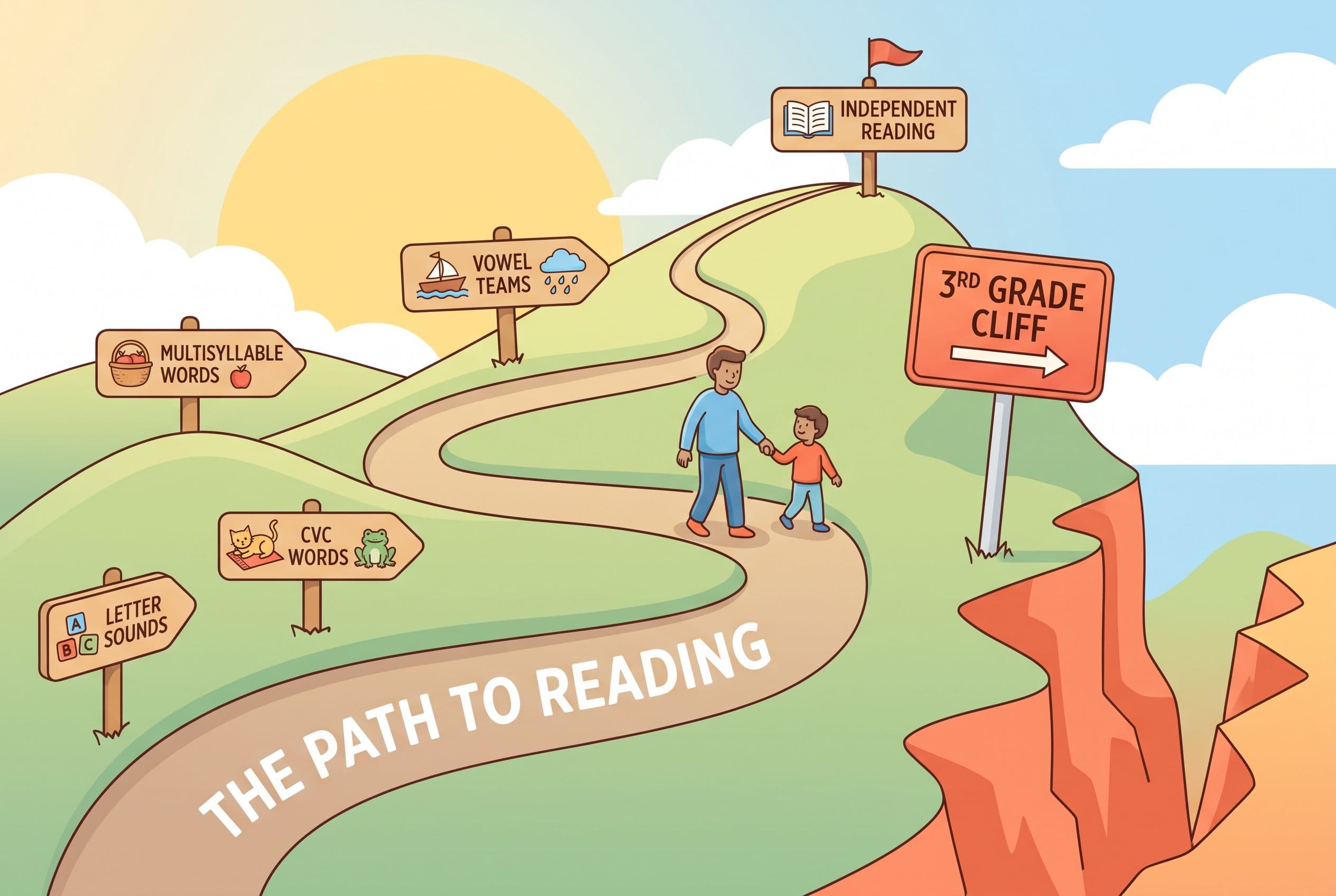
Before I rank anything, let me tell you what I look for. These are non-negotiable.
1. Systematic Synthetic Phonics The app teaches grapheme-phoneme correspondences (letter-sound relationships) in a logical sequence. It doesn't just show flashcards. It teaches blending. It teaches segmenting. It follows the progression that the National Reading Panel identified in its 2000 report as producing significant benefits for reading achievement.
2. Decodable Practice After teaching a phonics pattern, the app gives the child text that uses only patterns they've already learned. No guessing from context. No picture clues. If the child just learned the /sh/ digraph, they read sentences full of "sh" words.
3. Placement Assessment A struggling 2nd grader might have gaps going all the way back to kindergarten-level skills. The app needs to figure out where the breakdown is and start there — not at "2nd grade level."
4. Minimal Gamification Some reward structure is fine. My kids aren't monks. But if the game IS the app and phonics is the afterthought, it's junk.
5. Progress Tracking Parents Can Actually Read I want to see which sounds my kid has mastered, which ones are shaky, and how many words per minute they're decoding. Not a cartoon trophy case.
The Best Reading Apps for 2nd Graders Who Are Behind (2026 Rankings)
OK, here's what you came for. I'm ranking these based on each app's published approach, the Science of Reading research, and what I've seen work with my own kids and with families I've coached through our site.
1. Teach Your Kid to Read — Best Overall for Catching Up
I'm biased. I co-founded this. But I'm biased because nothing else did what I needed it to do.
Teach Your Kid to Read is built on Orton-Gillingham principles and systematic synthetic phonics. It's the same methodology used in Wilson Reading System and Barton Reading & Spelling — programs that cost thousands of dollars and require a trained tutor — but adapted into an app format that parents can use at home.
Here's what makes it different for a struggling 2nd grader:
- It finds the gap. The placement system identifies exactly where your child's phonics knowledge breaks down — even if that's back at CVC words. No shame, no skipping. You start where the foundation cracked.
- Decodable text at every level. Your child reads real sentences using only patterns they've mastered. No guessing from pictures. No memorizing word shapes.
- The scope and sequence is visible. You can see every lesson, every phonics pattern, every progression point. It's not a black box.
- It's short. 15-20 minutes a day. That's it. Consistency over marathon sessions — every single day, including weekends. (Tiger Rule #1: We Never Skip.)
- It doesn't pretend to be a game. It's a reading lesson. My kids know the difference.
I had my 7-year-old doing this app every morning before breakfast last year when she hit a wall with vowel teams. Six weeks of consistent practice and she went from struggling with "rain" and "boat" to reading them automatically. Orthographic mapping in action — exactly what Kilpatrick's research predicts.
2. UFLI Foundations Virtual Teaching Resource
UFLI Foundations out of the University of Florida is a fantastic phonics curriculum, and they've made some of their resources available digitally. It's not a standalone app in the traditional sense — it's more of a teaching tool that a parent walks through with the child.
Pros: Rock-solid scope and sequence. Backed by reading science. Free resources available. Aligned with the Simple View of Reading (Gough & Tunmer, 1986) and Scarborough's Reading Rope.
Cons: It requires a lot of parent involvement. You're essentially the teacher. For parents who want to hand the device to the kid and walk away (I get it — I have a 1-year-old attached to my hip), this won't work as a solo intervention. Also not a full app experience — you'll need to supplement with decodable readers.
Best for: Parents who are comfortable leading instruction and want a structured curriculum backbone.
3. Reading Horizons (Elevate / Discovery)
Reading Horizons has been around for years and has solid Science of Reading roots. Their app-based programs teach a systematic decoding method with what they call "42 sounds of English."
Pros: Very structured. Used in many schools that have adopted Science of Reading legislation. Has both a student-facing component and teacher/parent dashboard.
Cons: The interface feels dated compared to newer apps. Can be pricey depending on the subscription tier. Some families find the pacing slow for a 2nd grader who needs to move quickly.
Best for: Families whose schools use Reading Horizons already and want continuity at home.
4. Explode the Code Online
The print version of Explode the Code has been a homeschool staple for decades. The online version digitizes the workbook-style phonics practice.
Pros: Systematic phonics progression. Tons of practice at each skill level. Affordable.
Cons: It's workbook-on-a-screen, which means it's not particularly engaging for a kid who already hates reading practice. Limited decodable reading passages — it's heavy on isolated skill practice and lighter on connected text. For a struggling 2nd grader who's already frustrated, the worksheet feel can be a hard sell.
Best for: Kids who respond well to structured, repetitive practice and don't need bells and whistles.
5. HOMER
Homer gets a lot of press and has a slick interface.
Pros: Beautiful design. Kids love the stories and characters. It does include some phonics instruction and has a pathway structure.
Cons: Here's the thing — Homer mixes phonics with a lot of Whole Language-style activities. There are stories where kids are encouraged to use picture clues. The phonics sequence isn't as tight as Orton-Gillingham-based programs. For a child who's on track, it's a fine supplement. For a struggling 2nd grader who needs intervention, it's not rigorous enough. It's edutainment, and right now your kid doesn't need entertainment. They need explicit instruction.
Best for: Younger kids (ages 3-5) as a phonics introduction. Not for 2nd grade intervention.
What I'd Skip Entirely
Reading Eggs / ABC Mouse / Epic! — These are the apps that look great in ads and do almost nothing for a struggling reader. Reading Eggs mixes phonics with leveled readers that encourage guessing. ABC Mouse is a mile wide and an inch deep. Epic! is basically a digital library with no instruction at all — handing a struggling reader an unlimited library is like giving a drowning person a fishing rod.
Anything that uses Fountas & Pinnell leveled reading. F&P levels are everywhere — your kid's school probably uses them — but they're rooted in Whole Language philosophy. The levels are based on "text difficulty" factors that include picture support and predictable patterns, which trains guessing. Reading Rockets has good explainers on why decodable texts outperform leveled readers for struggling readers.
The Playground Conversation That Changed Another Mom's Mind
I was at a playground in Raleigh last spring when I got into one of those conversations that reminds me why I do this work. Another mom — her son was on the monkey bars, her daughter was eating Goldfish crackers on a bench — mentioned that her kid's school had just switched from Lucy Calkins' Units of Study to a Science of Reading curriculum. North Carolina's SB 387, the Excellent Public Schools Act, was forcing the change. She was confused and honestly kind of annoyed about it. "He was doing fine before," she told me.
So I asked if her son could read the word "splint."
She called him over. He's in second grade. Smart kid, chatty, clearly not lacking in vocabulary. He looked at the word on my phone screen and said... nothing. Tried to sound it out, got stuck on the blend, then guessed "split." Close — but that's a guess based on partial decoding, which is exactly what Linnea Ehri's research would call the "partial alphabetic phase." A 2nd grader should be solidly in the "full alphabetic" phase, mapping every grapheme to its phoneme without skipping letters.
I spent 20 minutes on that playground bench explaining why the curriculum switch was happening — Emily Hanford's "Sold a Story" investigation for APM Reports, the NAEP data, the neuroscience from Stanislas Dehaene's lab showing that the brain doesn't learn to read naturally the way it learns to speak (his 2009 book Reading in the Brain proved the visual cortex has to be literally retrained, letter by letter). She went home and listened to the "Sold a Story" podcast that night. Texted me at 11pm: "I had no idea. Why didn't anyone tell us this sooner?"
That's the thing. Nobody tells you. Your kid's school sends home leveled readers and a reading log and you assume they know what they're doing. And then your second grader can't read "splint" and suddenly you're on Google searching "best reading app for 2nd graders" at almost midnight.
You're not a bad parent for being here. You're a great parent for looking.
The 3-Step Action Plan: Start Tonight
Don't just download an app and hope. Do this first.
Step 1: Find Out Where the Breakdown Is
Your 2nd grader isn't just "behind." There's a specific phonics skill that's cracked, and everything above it is unstable. You need to find it.
Grab David Kilpatrick's PAST test — the Phonological Awareness Screening Test. It's free, takes about 5 minutes, and tells you exactly where your child's phonological awareness breaks down. Is it blending? Segmenting? Deleting sounds within words? The PAST will show you.
You can also check against DIBELS (Dynamic Indicators of Basic Early Literacy Skills) benchmarks for context. By mid-second grade, the Acadience Reading/DIBELS 8 Oral Reading Fluency benchmark is roughly 70–90 words correct per minute, depending on which benchmark set your district uses. Check your school's published benchmarks for the exact target — but if your child is significantly below that range, the gap is real and measurable.
Step 2: Start Systematic Phonics — Today, Not Monday
Download Teach Your Kid to Read. Run through the placement assessment. Let the app find the gap.
Then commit to 15-20 minutes every single day. I mean every day. Tiger Rule: We Never Skip. Not on weekends, not on holidays, not when they're tired. Especially when they're tired — that's when the brain is doing the hardest consolidation work.
My 7-year-old practices phonics on Christmas morning. She does it before she opens presents. She doesn't love it. She does it anyway. And she reads chapter books independently now because she did.
Step 3: Kill the Guessing Habit
This is the big one. If your child looks at a picture and guesses the word, cover the picture. If they skip a word, go back. If they say "house" when the word is "home," stop them immediately.
Tiger Rule #2: No Guessing. Sound it out. Every single time. Every single letter. No shortcuts.
This will feel brutal at first. Your child might cry. You might want to cry. Last Tuesday my 4-year-old threw a magnetic letter at the refrigerator because I wouldn't let her guess "dog" from the picture. She wanted to be done. I didn't let her be done. We finished the lesson. She sounded out "dog" — /d/ /ŏ/ /g/ — and I made a huge deal about it.
That's the work. It's not fun. It's effective.
How to Know If It's Working
You should see measurable progress within 4-6 weeks of consistent daily practice. Here's what to look for:
- Week 1-2: Your child starts self-correcting instead of waiting for you to catch errors. This is huge. It means they're monitoring their own decoding.
- Week 3-4: Words they previously struggled with become automatic. They're not sounding out "that" every time anymore. This is orthographic mapping kicking in.
- Week 5-6: Reading speed picks up. They attempt unfamiliar words instead of freezing or guessing. Confidence shifts.
If you don't see these signs after 6 weeks of truly consistent daily practice? That's your signal to get a professional evaluation. The International Dyslexia Association estimates that 15-20% of the population has some form of dyslexia. An app is a great first-line intervention, but some kids need one-on-one Orton-Gillingham instruction from a trained tutor. Understood.org has a solid directory for finding evaluators.
Don't wait 6 months to have that conversation. Six weeks. If the needle isn't moving, escalate.
The Policy Landscape Is Finally Shifting (Use It)
Here's some good news buried in all this: the reading world is waking up.
Over 40 states have now passed Science of Reading legislation since 2019. Mississippi's Literacy-Based Promotion Act of 2013 is the success story everyone points to — they went from 49th to 21st in national reading scores in six years by mandating evidence-based phonics instruction and holding kids to a 3rd grade reading gate. Ohio's Third Grade Reading Guarantee, Florida's Just Read, Florida! initiative, and North Carolina's SB 387 (the law that prompted my playground conversation) are all following the same playbook.
What this means for you: your child's school is probably in the middle of a curriculum transition right now. Teachers are being retrained. Old materials are being thrown out. New decodable readers are replacing leveled readers.
This is great in the long run. In the short run, it means chaos. Your kid's teacher might be learning the new approach at the same time she's teaching your child. The transition isn't smooth. And your 2nd grader can't wait for the system to figure itself out.
That's why the app matters. You can't control what happens at school from 8am to 3pm. You can control what happens at your kitchen table from 6pm to 6:20pm.
Frequently Asked Questions
How do I know if my 2nd grader is actually behind in reading?
Ask them to read a passage from a book they've never seen before — no pictures, no context clues. A child reading at second grade level should decode most single-syllable words with blends and digraphs (think: "clamp," "shrimp," "stitch") without hesitating for more than a second or two. The Acadience Reading/DIBELS 8 Oral Reading Fluency benchmark for mid-second grade is roughly 70–90 words correct per minute, depending on your district's benchmark set. If your child is reading significantly below that range, or if they're guessing words from pictures instead of sounding them out, they're behind. The PAST test by Kilpatrick will pinpoint the exact phonological skill that's breaking down.
Can a reading app really replace tutoring for a struggling 2nd grader?
For many kids — yes, if the app is built on systematic synthetic phonics and the parent is consistent with daily practice. The same Orton-Gillingham principles used in expensive one-on-one tutoring (like Wilson Reading System or Barton Reading & Spelling) can be delivered through a well-designed app at a fraction of the cost. Teach Your Kid to Read does exactly this. That said, if your child has a suspected learning disability like dyslexia, an app should be your starting intervention, not your only one. Six weeks of consistent app-based phonics with no progress = time to get a professional evaluation.
How much time per day should my 2nd grader spend on a reading app?
15-20 minutes of focused, systematic phonics instruction. Not 45 minutes of browsing a digital library. Not 30 minutes of phonics mini-games wrapped in cartoon rewards. Short, focused, and daily. The consistency matters more than the duration. I'd rather see 15 minutes every single day — weekends included — than 45 minutes three times a week. My kids do their reading practice before anything else, every morning. Non-negotiable.
My child's school says he's "on track" but I'm worried. Who do I believe?
Believe the data, not the report card. Schools often use assessment systems like Fountas & Pinnell levels that are aligned with Whole Language philosophy — they measure whether a child can "get through" a text, not whether they can actually decode the words. A child can score at "Level J" by memorizing sentence patterns and using picture clues, while having massive gaps in phonics knowledge. Give your child Kilpatrick's PAST test at home. Have them read unfamiliar decodable text with no picture support. If they struggle, the school's assessment is painting an incomplete picture.
Is it too late if my child is already in 2nd grade and behind?
Absolutely not. But urgency matters. Second grade is the bridge between "learning to read" and "reading to learn." You have roughly 12-18 months before the 3rd Grade Cliff, where every subject assumes reading fluency. Mark Seidenberg, the University of Wisconsin cognitive scientist who wrote Language at the Speed of Sight (2017), makes clear that the brain remains plastic enough for reading intervention well into adulthood — but the window where intervention is efficient (fast, relatively easy, and doesn't require undoing years of bad habits) is right now. Start today.
The Bottom Line
Your 2nd grader is behind. You're looking for an app. You found one article that didn't lie to you about the stakes.
Here's what I need you to do:
- Tonight: Download the PAST test and assess your child's phonological awareness. Five minutes.
- Tomorrow morning: Start Teach Your Kid to Read. Let the placement assessment find the gap. Do the first lesson. 15 minutes.
- Every day after that: 15-20 minutes. No skipping. No excuses. Cover the pictures. Sound out every word. Celebrate every small win.
The school system is catching up, but your child can't wait for bureaucracy. Forty-plus states have passed Science of Reading laws. The research has been clear since the National Reading Panel's 2000 report. Stanislas Dehaene proved the neuroscience. Emily Hanford exposed the scandal. The answers aren't hidden anymore.
The only question is whether you'll act on them.
Ready to start? Visit start lesson one free to try Teach Your Kid to Read — systematic phonics built on the same Orton-Gillingham methodology used by the best reading interventionists in the country — at your kitchen table, on your schedule, for a fraction of the cost. Or call us at (407) 707-6850 and we'll help you figure out exactly where your child needs to begin.
Your kid isn't broken. They were just never taught to read the right way. Let's fix that.
Part of these guides

Xia Brody
Co-Founder, Teach Your Kid to Read
Mom of 4 who has successfully taught her kids to read. Currently in the trenches with her 4-year-old while her two oldest (10 and 7) devour books on their own. Passionate about phonics-based methods and building a lifelong love of reading.
Related Articles
Is My 2nd Grader Behind in Reading? 9 Signs
Wondering if your 2nd grader is behind in reading? Here are the real warning signs, what 2nd graders should be able to do, and what to do next if your child is guessing, slow, or stuck.
Read More →
Best Reading App for 4th Graders Behind + Free Plan
Your 9-year-old is guessing at words and hiding books in his backpack. Most reading apps are built for 5-year-olds and will waste his time. Here's what a real 4th grade reading intervention app has to do — and the exact daily plan I use.
Read More →
My 9 Year Old Can't Read: Parent Action Plan
If your 9-year-old can't read, don't wait for school to fix it someday. Here's how to check their reading level, stop guessing habits, and start a real phonics-based intervention at home.
Read More →