My 9 Year Old Can't Read: Parent Action Plan
What You'll Learn
- The blunt benchmark: what a 9 year old reading level should look like
- The one mistake parents make when a 3rd grader can't read
- How to check decoding at home in under 2 minutes
- The daily action plan I’d use if this were my kid
Reality Check: A 9-Year-Old Should Not Be Guessing Through Books
If you're Googling my 9 year old can't read, your stomach already knows the truth.
By age 9, most children should read simple chapter books with enough accuracy to understand the story. In US school terms, that usually means 3rd grade (ages 8-9) or 4th grade (ages 9-10), depending on birth month and placement.
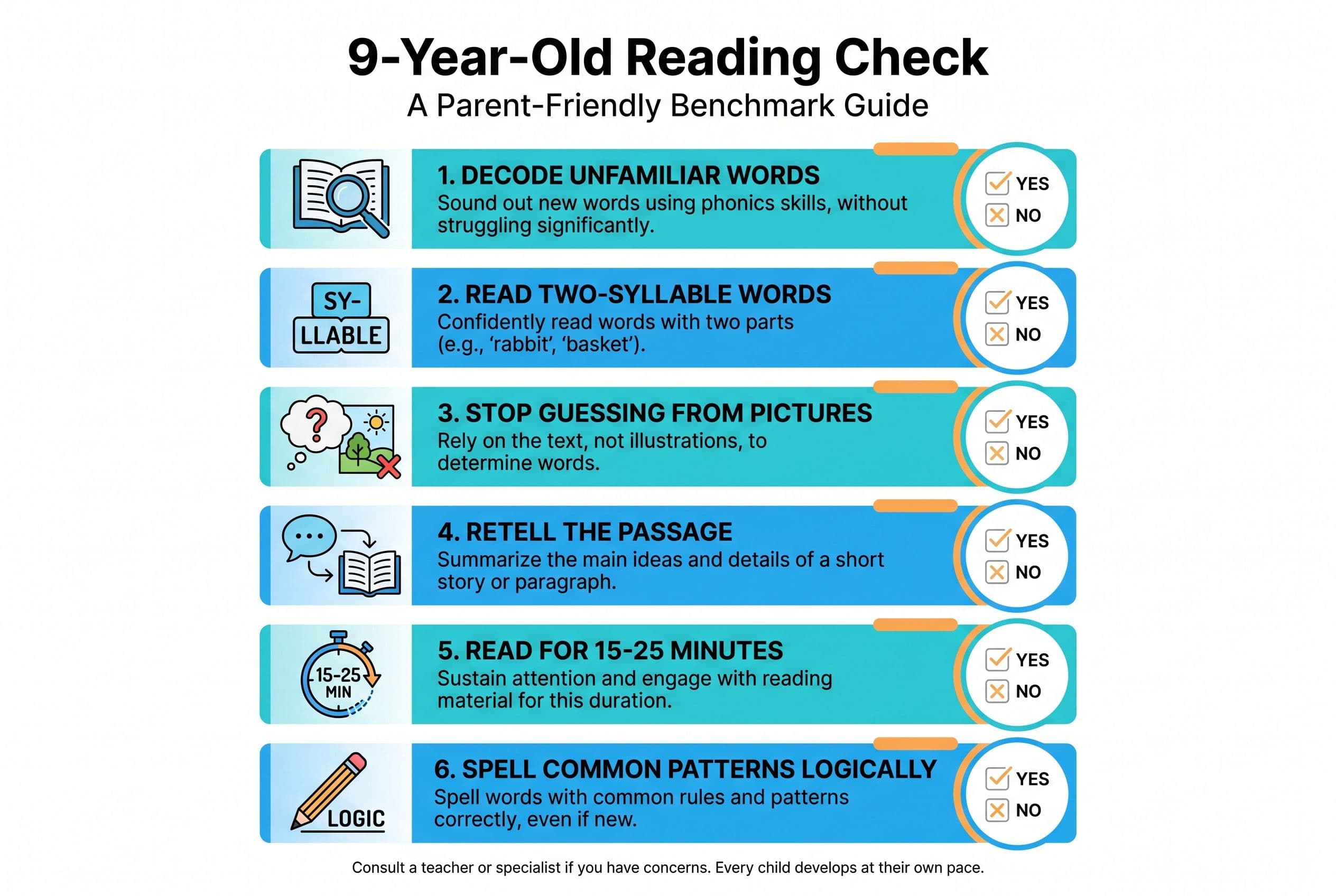
Here’s the quick parent benchmark:
| Skill | What a typical 9-year-old should do |
|---|---|
| Decoding | Read unfamiliar one-syllable and many two-syllable words without guessing |
| Fluency | Read grade-level text smoothly enough to understand it |
| Comprehension | Retell main events, explain character motives, answer basic inference questions |
| Spelling | Spell common phonics patterns and attempt longer words logically |
| Stamina | Read independently for 15-25 minutes without melting down |
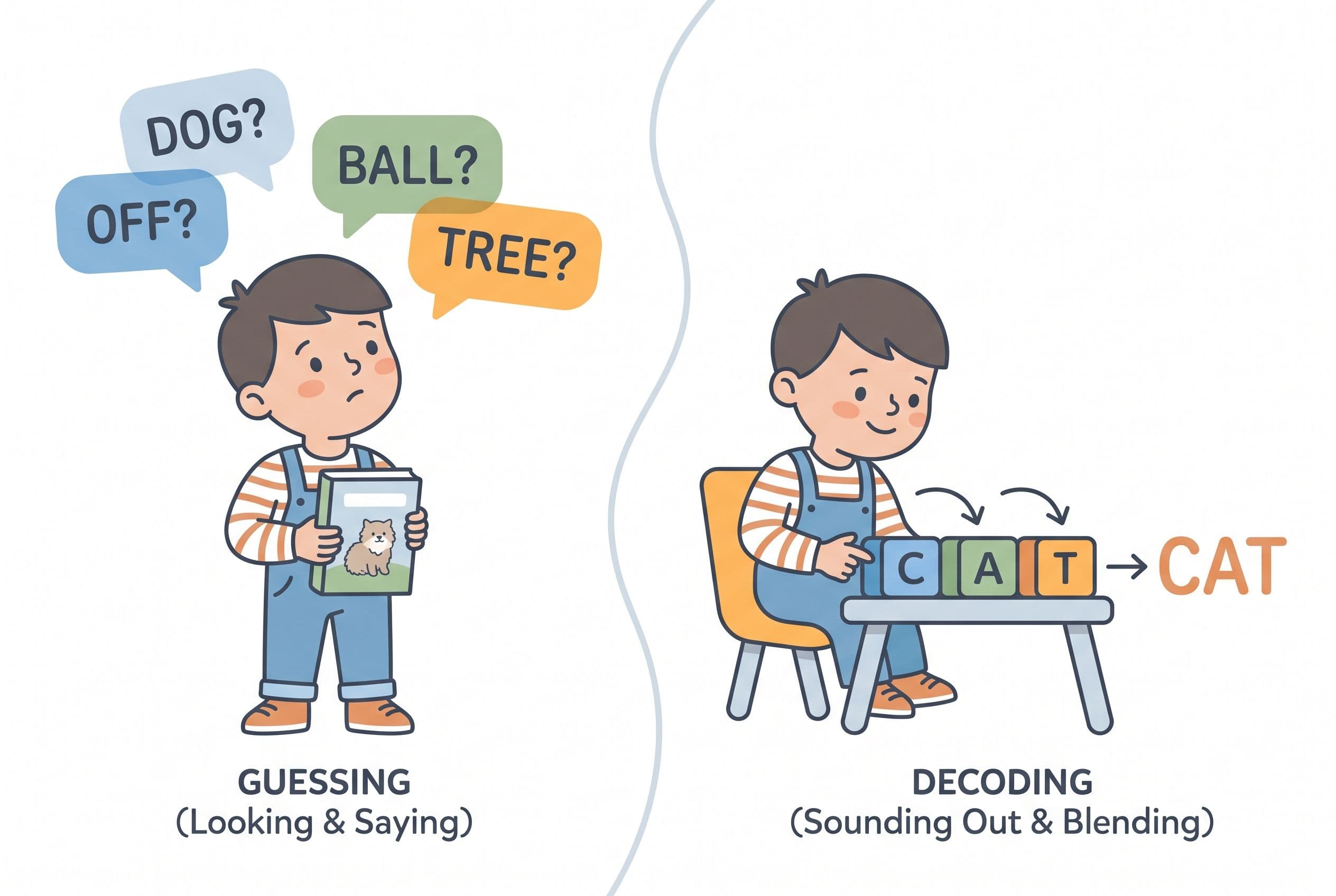
If your child looks at scratch and says “school” because both start with s, that’s not reading. That’s guessing in a Halloween costume.
And honestly? This is where I get tiger-mom serious. A struggling reader at home needs direct instruction, not vague reassurance.
If Your Child Is Below That Line
First, don’t panic. Panic wastes calories. Action helps.
Check the gap fast: hand your child 10 words without pictures. Mix easy words like cat, ship, and flag with harder ones like splint, market, and basket. If they guess, skip sounds, or stare at you like you just handed them ancient Greek, you need more than “more reading time.” You can also take the 2-minute reading check to get a quick read on whether your child is behind.
Many older struggling readers don’t have a “love of books” problem. The first thing I’d check is decoding. Reading trouble can also involve fluency, vocabulary, background knowledge, language comprehension, or a messy combo platter, because children like to keep us humble. But if a child learned to look at the first letter, check the picture, and make a smart-sounding guess, that habit can fool adults for years.
The next step is direct, systematic phonics. Teach Your Kid to Read uses systematic synthetic phonics with Orton-Gillingham-style principles: explicit sounds, blending, review, controlled words, and no guessing. Lesson one is free with no card and nothing to cancel; from lesson two the whole program is a 7-day free trial, then US$9.95 a month. Start with start lesson one free and treat it like brushing teeth: short, daily, non-negotiable.
Tiger Truth: Waiting Is Not Neutral
Look, I know this sounds harsh, but “wait and see” is how kids fall off the 3rd Grade Cliff.
In the US, only 33% of 4th graders (ages 9-10) scored proficient in reading on the 2022 NAEP / The Nation's Report Card. That means this is not just your family. This is a massive reading failure hiding in plain sight.
The 2000 National Reading Panel report found that systematic phonics instruction gives children significant reading benefits. Louisa Moats said it plainly in her 1999 paper Teaching Reading IS Rocket Science: teaching reading requires real knowledge of language structure. Not vibes. Not guessing. Skill.
And the consequences? They’re ugly.
Kids who can’t read by 3rd grade often start hating school. They avoid homework. They develop stomachaches before reading groups. They memorize enough sight words to fake it for a while, then hit longer words in science and history and crash hard.
Donald Hernandez’s 2011 Annie E. Casey Foundation report, Double Jeopardy, found that children who weren’t reading proficiently by the end of 3rd grade were four times more likely to leave high school without graduating. That’s an association from the study, not a fortune cookie predicting your child’s future. But still? That statistic makes my mom brain want to throw every leveled guessing book into a volcano.
Remediation later can cost US$10,000-US$15,000 a year through private tutoring centers. Dyslexia evaluations can run into the thousands. And the worst cost isn’t money. It’s the kid who says, “I’m stupid,” when the adults failed to teach the code.
They’re not stupid.
They need better instruction.
The Playground Conversation That Still Bugs Me
I was at a playground in Raleigh when another mom told me her kid’s school had just switched from Lucy Calkins to a Science of Reading curriculum because of North Carolina’s SB 387, the Excellent Public Schools Act. That’s a US state law, by the way, not some universal school rule.
She sounded confused and a little annoyed. “He was doing fine before,” she told me.
So I asked one question: “Can he read splint?”
Her son was in 2nd grade (ages 7-8). He could not.
I sat on that playground bench for 20 minutes while my toddler tried to eat mulch (because of course), and I explained why the switch was happening. Emily Hanford’s 2023 APM Reports / "Sold a Story" investigation exposed how many Balanced Literacy programs promoted cueing strategies that encouraged children to use pictures, context, and first letters instead of relying first on decoding. Stanislas Dehaene’s Reading in the Brain (2009) showed that the brain doesn’t learn to read naturally; we have to train it to connect speech sounds to print.
That mom went home and listened to Sold a Story that night. At 11 p.m., she texted me: “I had no idea. Why didn’t anyone tell us this sooner?”
Exactly.
Why didn’t anyone tell parents sooner?
Why a 9-Year-Old Reading Problem Usually Isn’t “Lazy”
A 9-year-old who can’t read often looks lazy because reading feels awful.
They wiggle. They joke. They ask for snacks. They suddenly need the bathroom. My 4-year-old pulled this exact stunt last Tuesday at the kitchen table when I asked her to blend map. She acted like the chair had personally betrayed her.
But for older kids, the stakes feel bigger. They already know other kids read better. They’ve spent years hiding.
Common signs your 9-year-old needs reading intervention for older kids:
- They guess from pictures or first letters
- They skip small words like the, of, and was
- They read horse as house
- They melt down after one page
- They memorize books but can’t read new words
- They spell wildly, even after practice
- They can understand stories read aloud but can’t read them alone
That last one matters. If your child understands audiobooks but can’t read print, the issue probably isn’t intelligence. It may be word recognition, fluency, or another reading skill that needs a closer look.
Gough and Tunmer’s Simple View of Reading (1986) explains reading as decoding multiplied by language comprehension. If decoding is weak, comprehension suffers even when the child is bright. Bottom line: you can’t think deeply about a sentence you can’t read accurately.
Stop the Guessing Habit Immediately
Here’s the rule in my house: No Guessing. Sound it out.
If my child looks at ship and says “boat” because there’s a picture of water, I don’t clap for creativity. I cover the picture and point to the letters.
“Sound?”
/sh/ /i/ /p/
“Blend it.”
Ship.
That tiny correction matters. Guessing builds the wrong brain habit. Decoding builds orthographic mapping, which Linnea Ehri described in her 2005 work on phases of word reading development. Orthographic mapping means the brain stores written words for instant recognition after enough accurate sound-to-print practice.
No-brainer rule: if the book requires guessing, the book is too hard.
Use decodable readers instead. Bob Books can work for beginners. UFLI Foundations has excellent word lists and routines. Logic of English teaches phonograms clearly. Wilson Reading System and Barton Reading & Spelling can help children with dyslexia indicators, though they require more adult training and structure.
Fountas & Pinnell levels? Be careful. Those leveled readers are everywhere, but they grew from whole-language-aligned thinking. A Level M book doesn’t tell you whether your child can decode stomped, thunder, or cracked without guessing.
How to Help a 9 Year Old Read: The Parent Action Plan
You need a plan that respects two facts:
- Your child is older and probably embarrassed.
- Your child still needs foundational phonics, even if that feels “too young.”
Don’t hand them baby worksheets and announce, “We’re starting over!” That’s how you start World War III at the kitchen table.
Say this instead: “Some reading skills need more teaching. That’s not your fault. We’re going to fix the gaps fast.”
Step 1: Test the Real Gap
Use a quick phonological awareness and decoding screen.
The PAST test by David Kilpatrick takes about 5 minutes once you know how to give it, and it can show where phonological awareness breaks down. DIBELS can also give useful fluency and decoding data when it’s given and interpreted the right way. A screening score is not a dyslexia diagnosis, and it doesn’t prove how your child was taught. It’s a flashlight. Use it to see where to look next. For a 9-year-old, weak nonsense word reading can signal a decoding gap that deserves a closer look.
At home, start simpler:
- Ask for all short vowel sounds
- Ask them to read CVC words: mat, sip, tub
- Add blends: flag, pond, scrap
- Add digraphs: ship, thick, lunch
- Add two-syllable words: basket, sunset, napkin
Write down exactly where accuracy falls apart.
Step 2: Rebuild Phonics Daily
Do 20 minutes a day, 5-6 days a week.
Yes, on busy days. Yes, during holidays. We Never Skip. I’m not saying you need tears at grandma’s house on Christmas morning, but five minutes of sound review? Absolutely.
A strong lesson includes:
- Sound review
- Blending practice
- Dictation
- Word reading
- Sentence reading
- One tiny win at the end
Keep it boring enough to work. I know the internet wants everything to be glitter slime and unicorn points, but mastery comes from drill. Fun can join the party after accuracy shows up.
Step 3: Use Controlled Text
Don’t practice phonics for 10 minutes and then hand your child a random library book packed with patterns they haven’t learned.
That’s like teaching bike balance in the driveway, then pushing them into traffic.
Use decodable text that matches the phonics skill. If today’s skill is sh, read sentences with ship, shop, fish, and dish. If the skill is closed syllables, read words like rabbit, basket, and contest.
Controlled text builds confidence because the child can actually apply what you taught.
Step 4: Protect Dignity
Older struggling readers need privacy.
Don’t make your 9-year-old read baby books in front of siblings. Don’t compare them to a 6-year-old cousin. Don’t say, “Even your little sister can read that.” Real talk — that stuff sticks.
Use plain language: “This is training. Athletes drill basics. Musicians drill scales. Readers drill sounds.”
Short. Calm. Serious.
Step 5: Track Accuracy Before Speed
Fluency matters, but accuracy comes first.
If your child reads fast and wrong, slow them down. I’d rather hear 20 accurate words than 80 sloppy guesses.
Track:
- Words read correctly
- Words missed
- Patterns missed
- Rereads with correction
- Emotional stamina
Celebrate accuracy like it’s a trophy. Because it is.
What If It’s Dyslexia?
If your 9-year-old has had years of reading instruction and still can’t decode, consider dyslexia screening.
Dyslexia doesn’t mean a child sees letters backward. That myth needs to retire. Dyslexia often shows up as weak phonological processing, slow word retrieval, poor spelling, and trouble mapping sounds to letters.
The International Dyslexia Association has parent-friendly information about signs and structured literacy. Orton-Gillingham-based instruction, Wilson Reading System, Barton Reading & Spelling, and Lindamood-Bell all come up often because they use explicit, multisensory, structured routines.
But please hear me: don’t wait months for an evaluation before you start teaching phonics. You can pursue testing and start intervention at the same time. That’s the power move.
What School Should Be Doing
If your 3rd grader can’t read, request a meeting in writing.
Ask these exact questions:
- What reading assessment did you use?
- What are my child’s decoding scores?
- Can my child read nonsense words accurately?
- What phonics scope and sequence do you teach?
- How many minutes per week does my child receive intervention?
- Is the intervention systematic and explicit?
- How will progress be measured every 2-4 weeks?
If the school says, “They just need to read more,” ask again about decoding.
Reading more helps children who can already decode. It does not magically teach a child the alphabetic code. That’s the kicker.
In the US, states like Mississippi used policy to push evidence-based reading instruction. Mississippi’s Literacy-Based Promotion Act of 2013 helped drive major reading gains; the state moved from near the bottom nationally to much stronger results within several years. Policy doesn’t teach your child at the kitchen table, but it shows one thing clearly: instruction matters.
The Home Schedule I’d Use This Week
Here’s the exact routine I’d start if my 9-year-old couldn’t read.
Monday: Find the Gap
Test letter sounds, short vowels, blends, digraphs, and two-syllable words. Stop when accuracy drops below about 80%.
Tuesday: Start One Skill Below the Gap
If blends are weak, start with CVC review plus simple blends. Don’t start at the hardest point. Build one clean win.
Wednesday: Add Dictation
Say ship. Child repeats ship. Child taps sounds: /sh/ /i/ /p/. Child writes the word.
Dictation exposes weak sound mapping fast.
Thursday: Read Controlled Sentences
Use sentences like:
- The ship is big.
- Dad had a snack.
- The frog can jump.
No guessing. Finger under the word. Sound to print.
Friday: Review and Reread
Reread the same word list and sentences. Track improvement. Older kids need proof that practice works.
Weekend: Read Aloud for Joy
You read aloud to them. Audiobooks count for vocabulary and knowledge. Don’t turn every book into a battle.
Reading instruction and read-aloud time serve different jobs. Both matter.
What Teach Your Kid to Read Does Differently
Teach Your Kid to Read gives parents a clear path instead of a pile of random worksheets.
The lessons teach sounds in a sequence, build blending, stop guessing, and keep practice short enough for real families. I built this because parents kept asking me, “But what do I actually do on Tuesday?”
Lesson one is free with no card and nothing to cancel; from lesson two the whole program is a 7-day free trial, then US$9.95 a month. If your child is 9 and behind, use it as daily intervention at home while you also push school for proper support.
This is not a magic wand. Every child differs. Dyslexic children may need more repetition, more time, and more specialized help.
But structured daily phonics beats waiting. Hands down.
FAQ
Is my 3rd grader behind if they can’t read chapter books?
Possibly. A 3rd grader (ages 8-9) doesn’t need to devour huge novels, but they should decode grade-level passages with reasonable accuracy and understand what they read. If they rely on guessing, pictures, or memorized text, check decoding right away.
How do I help a 9 year old read without embarrassing them?
Frame it as training, not failure. Say, “You missed some pieces of the code, and we’re fixing them.” Use short daily lessons, controlled text, and private practice. Don’t use babyish materials in front of siblings.
Should I hire a tutor?
If you can, a skilled structured literacy tutor can help, especially if dyslexia signs appear. Ask whether they use Orton-Gillingham, Wilson Reading System, Barton Reading & Spelling, UFLI Foundations, or another explicit phonics program. If tutoring costs too much, start daily structured phonics at home now.
Can a 9-year-old catch up in reading?
Yes, many older struggling readers make strong progress with explicit phonics, enough practice, and honest progress tracking. Don’t expect a fixed timeline. Start with decoding accuracy, then build fluency and comprehension.
What’s the biggest mistake parents make?
They keep asking the child to read harder books instead of teaching the missing code. More exposure won’t fix weak decoding. Explicit, systematic phonics targets decoding gaps, but some children need more intensive help, individualized instruction, and regular progress checks.
Part of these guides

Xia Brody
Co-Founder, Teach Your Kid to Read
Mom of 4 who has successfully taught her kids to read. Currently in the trenches with her 4-year-old while her two oldest (10 and 7) devour books on their own. Passionate about phonics-based methods and building a lifelong love of reading.
Related Articles
My First Grader Can't Read? The 90-Day Catch-Up Plan
If your 6-year-old is guessing at words, memorizing books, or melting down at the page, you don't have a motivation problem — you have an instruction problem. Here's the exact 90-day catch-up plan I'd run, starting tonight.
Read More →
Best Reading App for 3rd Graders Behind in 2026: Full List + Free Trial
Your 3rd grader is behind in reading and you're running out of time. Here's what the science says about which reading apps actually work — and which ones are expensive digital babysitters dressed up as 'learning tools.'
Read More →
My 7 Year Old Can't Read: 9 Steps to Act Now
If your 7-year-old still can't read, don't panic—but don't wait. Here's how to check the gap, stop guessing habits, and start a real phonics plan at home.
Read More →