My 8 Year Old Can't Read: Best Apps + Rescue Plan
What You'll Learn
- The app I’d choose first if my 8 year old can’t read and I need help now
- The sneaky feature that makes some reading apps feel fun while your child keeps guessing
- Why an 8 year old struggling to read needs intervention, not more leveled readers
- The exact first-week rescue plan I’d use at my own kitchen table
Reality Check
If my 8 year old can’t read, I’m not blaming the kid. Full stop.
But I’m also not pretending there’s only one possible cause. We check the instruction. We check for dyslexia signs. We check language, attention, hearing, vision, and whether the child has actually had enough explicit support. Needing help doesn’t mean your child failed. It doesn’t automatically mean you failed. It doesn’t automatically mean one teacher failed.
It means the reading problem needs a real plan.
Eight is not “too late,” but it is late enough that we stop playing cute games with guessing, picture clues, and “maybe they’ll bloom next year.” A child who can’t decode at age 8 needs explicit phonics, daily drill, good data, and adults who refuse to outsource the whole problem to hope.
If your child can’t read in 3rd grade — roughly age 8 or 9 in the US — you need a rescue plan this week. Not after the next school meeting. Not after one more report card. Now.
The Verdict: Best Reading Apps for an 8-Year-Old Who Can’t Read
| Rank | App / Program | What it teaches | Pricing model | Best fit |
|---|---|---|---|---|
| 1 | Teach Your Kid to Read | Systematic phonics, blending, decoding, no guessing | Lesson one free with no card; from lesson two, 7-day free trial then US$9.95/month | Age 4-8, especially stuck readers |
| 2 | Reading.com | Parent-led phonics and early reading activities | Subscription; check current price | Ages 3-8 |
| 3 | Nessy | Dyslexia-friendly literacy practice | Subscription; check current price | Ages 6-11 |
| 4 | Hooked on Phonics | Phonics lessons and practice | Subscription with 7-day app trial; check current price | Ages 3-8 |
| 5 | Khan Academy Kids | Broad early learning with literacy mixed in | Free; donation-supported | Ages 2-8, best as extra practice |
| 6 | Raz-Kids | Leveled digital books | Annual licence, mostly schools and teachers | Grades K-5, not my first rescue pick |
If I were sitting beside you with coffee and one child climbing the pantry shelves — because yes, that’s my life — I’d tell you to start with Teach Your Kid to Read because it’s built around the thing your child needs most: explicit decoding. You can start lesson one free with lesson one free, no card and nothing to cancel; from lesson two, the whole program is a 7-day free trial, then US$9.95 a month.
Tiger Truth: Waiting Makes This More Expensive
Look, I’m going to say the scary part because somebody has to.
US students on the 2022 NAEP / The Nation's Report Card showed 33% of 4th graders scoring at or above NAEP Proficient in reading. That’s a demanding achievement benchmark, not the same thing as “grade level,” and it does not mean the other 67% can’t read. But still? That’s not a tiny dip. That’s a five-alarm fire with glitter stickers on it.
Donald Hernandez’s 2011 Double Jeopardy report for the Annie E. Casey Foundation found that students who weren’t reading proficiently by the end of 3rd grade were four times more likely than proficient readers to leave high school without a diploma. That’s an association, not a crystal ball for your individual child. If poverty and low reading skills combine, the risk jumps higher. I hate that statistic, but I quote it because parents need the truth, not a scented candle version of literacy.
And private remediation? Families can easily pay US$10,000-US$15,000 a year for intensive tutoring or reading clinics. Insurance usually doesn’t cover it. Your child pays too — with shame, avoidance, behavior problems, and that awful little voice that says, “I’m dumb.”
No. We’re not doing that.
App Deep Dive: What I’d Choose and What I’d Watch Out For
1. Teach Your Kid to Read: Best First Pick for Real Phonics Rescue
Teach Your Kid to Read is my top pick for a parent typing my 8 year old can’t read with a pit in their stomach.
Why? Because an 8-year-old who can’t read needs more than exposure to books. They need direct work on grapheme-phoneme correspondence — letters and letter teams mapped to sounds — then blending, spelling, word reading, and sentence reading in a planned order.
That’s systematic synthetic phonics. Fancy phrase, simple idea: teach the code in a sequence and make the child sound out words instead of guessing.
The 2000 National Reading Panel report found that systematic phonics instruction produces significant benefits, especially in kindergarten (age 5) and 1st grade (ages 6-7), but older struggling readers need it too. Louisa Moats said it plainly in her 1999 paper, “Teaching Reading IS Rocket Science”: teachers need deep knowledge of language structure because reading does not come naturally.
This matters for age 8 because your child may already fake-read. They memorize a few books. They use the first letter. They stare at the picture. They say “pony” for “horse” and everyone smiles because the meaning was close enough.
Nope. Tiger Mom says no guessing.
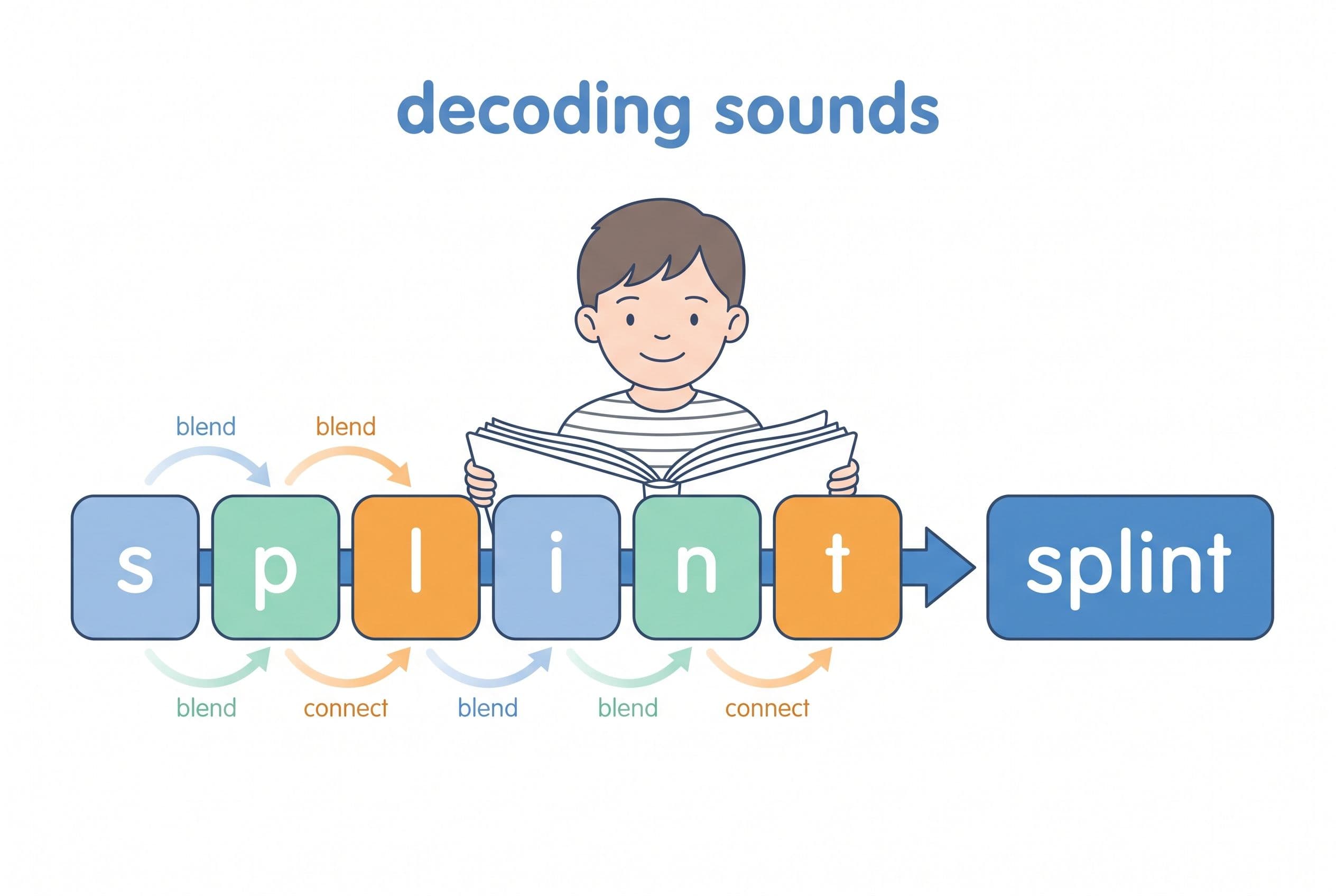
If the word is splint, your child must look at the letters and read /s/ /p/ /l/ /i/ /n/ /t/. No picture will save them. No context clue will save them. The alphabetic code will.
I like Teach Your Kid to Read for a struggling 8-year-old because it gives parents a structure. You’re not inventing lessons at 9:47 p.m. while a toddler licks a marker. You open the lesson, sit with your child, and drill the Skill.
What I’d do:
- Start below your child’s “school level” without apology
- Review short vowels until they stop mixing them up
- Make your child read every sound left to right
- Use decodable text, not leveled guessing books
- Stop the session before the meltdown becomes a family opera
Mastery beats ego. Every time.
2. Reading.com: Good Parent-Led Option, Watch the Scope
Reading.com says it serves ages 3-8 and comes from Teaching.com, the company behind Typing.com and Nitro Type. It uses a subscription model, so check the current price before you commit.
For an 8-year-old, I’d look closely at placement and lesson sequence. If your child has weak decoding, you don’t want cute activities that skip the hard parts. You want sound-symbol work, blending, dictation, and enough repetition to build automatic word recognition.
The big question: does your child read words from the letters, or does the app let them succeed by tapping, matching, or guessing?
If your child already feels embarrassed, parent-led instruction can help because you can slow down and keep the tone calm. But don’t let calm turn into mushy. Keep the drill.
3. Nessy: Strong Option for Dyslexia Concerns
Nessy Learning Ltd in the UK makes Nessy, and it’s part of ILT Education since April 2024. Its stated ages are 6-11, which makes it one of the more age-appropriate choices for an 8-year-old who still can’t read.
If you see signs of dyslexia in 8 year olds — trouble rhyming, weak phonemic awareness, mixing up short vowels, slow word reading, family history, terrible spelling despite bright oral language — Nessy belongs on your research list.
I still want parents to remember this: an app doesn’t diagnose dyslexia. Use it for practice, but get data. The PAST test — David Kilpatrick’s Phonological Awareness Screening Test — is a brief phonological awareness screener that can often be given pretty quickly by someone who understands the protocol. But don’t treat it like a diagnosis or the whole answer. Interpret it carefully alongside decoding, spelling, oral language, and fluency data. DIBELS can also flag weak nonsense word fluency and oral reading fluency.
If your school uses vague phrases like “developing reader” but can’t show you decoding data, ask harder questions. Politely. Then become a tiny dragon.
4. Hooked on Phonics: Familiar Name, Check the Level Carefully
Hooked on Phonics comes from Hooked & Company, Inc. and lists ages 3-8 in the App Store. It uses a subscription model with a 7-day free trial in the app, so check the current price.
It can fit some kids because it centers phonics more than many broad “learning” apps. For an 8-year-old, though, placement matters. A child reading below a 1st grade (ages 6-7) level needs the right starting point, not a rushed tour through skills.
Here’s the kicker: older struggling readers need success without babyish fluff. If the content feels too young, they shut down. If it moves too fast, they panic. That sweet spot matters.
5. Khan Academy Kids: Wonderful Free Extra, Not My Main Rescue Tool
Khan Academy Kids comes from Khan Academy, a 501(c)(3) nonprofit. It’s free with no ads or subscriptions, and the site asks for donations. Its stated ages are 2-8.
I like free. I’m a homeschooling mom of four. Free makes my little budget spreadsheet stop sweating.
But for reading intervention for 8 year old needs, Khan Academy Kids works better as extra practice than the spine of the rescue plan. It covers broad early learning, not just the structured phonics rebuild a nonreader often needs.
Use it if your child enjoys it. Don’t count app minutes as reading intervention unless your child actually practices decoding.
6. Raz-Kids: Useful Books, But Leveled Reading Can Hide the Problem
Raz-Kids comes from Learning A-Z, a Cambium Learning Group company. It serves grades K-5 and usually works through annual licences bought by schools and teachers.
Here’s my issue: leveled readers can make adults feel better while kids keep guessing. A child can “read” a level book by memorizing patterns, using pictures, and guessing from context.
That’s not decoding.
Fountas & Pinnell levels are everywhere too, but they come from a whole-language aligned system. If your 8-year-old can’t read unfamiliar words, don’t ask for a higher level. Ask for decodable books tied to the phonics pattern your child has learned.
The Playground Moment That Changed One Mom’s Mind
I was at a playground in Raleigh when another mom told me her child’s school had switched from Lucy Calkins to a Science of Reading curriculum because of North Carolina’s SB 387 — the Excellent Public Schools Act, a US state law.
She felt confused and a little annoyed. “He was doing fine before,” she said.
I asked if her second grader (age 7-8) could read the word splint.
He could not.
So I spent 20 minutes on that playground bench explaining why schools were making the switch: Emily Hanford’s 2023 APM Reports / "Sold a Story" investigation, the NAEP data, and Stanislas Dehaene’s “Reading in the Brain” from 2009. Dehaene, a French neuroscientist, showed that the brain has to build reading circuits through instruction. The brain doesn’t just “pick up” reading because we surround kids with books.
That mom went home and watched “Sold a Story” that night. She texted me at 11 p.m.: “I had no idea. Why didn’t anyone tell us this sooner?”
Honestly? That question still makes me mad.
Because parents trusted the system. Then the system handed kids cueing strategies, leveled readers, and “look at the picture” prompts. Now families sit at kitchen tables wondering why a bright 8-year-old can explain Minecraft engineering but can’t read brisk.
Sound familiar?
Why Your 8-Year-Old May Be Stuck
They Memorized Instead of Mapped
Linnea Ehri’s 2005 work on phases of word reading explains why real readers don’t memorize words as whole shapes. They connect sounds to spellings through orthographic mapping.
That means your child learns to connect a word’s spelling, pronunciation, and meaning. For ship, the child needs to notice that sh spells /sh/, i spells /i/, and p spells /p/, then link that printed word to the spoken word and its meaning. Phonemic awareness and letter-sound knowledge make that mapping easier, and weak skills can make words slippery. The good news? These skills can grow together during explicit instruction.
They Were Taught to Guess
Balanced Literacy and Whole Language trained kids to use three-cueing: meaning, structure, and visual cues. Translation: look at the picture, think what might make sense, and peek at the first letter.
This one drives me crazy.
Imagine Lily sees horse under a picture and says “pony.” The teacher says, “That makes sense!” But Lily didn’t read. She guessed.
At age 8, guessing becomes a trap. Books have fewer pictures, longer words, and more academic vocabulary. The child hits the third grade reading level wall and face-plants.
They May Have Dyslexia Indicators
Dyslexia does not mean low intelligence. Many dyslexic kids speak beautifully, build complex LEGO cities, and negotiate bedtime like tiny attorneys.
Look for:
- Slow, effortful word reading
- Trouble reading nonsense words like lat, shup, or mep
- Weak spelling with random vowel errors
- Confusing b/d or p/q past the early years
- Avoiding reading out loud
- Family history of reading trouble
- Strong comprehension when someone else reads aloud
If you see several signs, ask for evaluation. In the US, you can request a school evaluation in writing. Outside the US, use your local school or health pathway, and consider a qualified literacy specialist.
What to Demand From Any Reading App
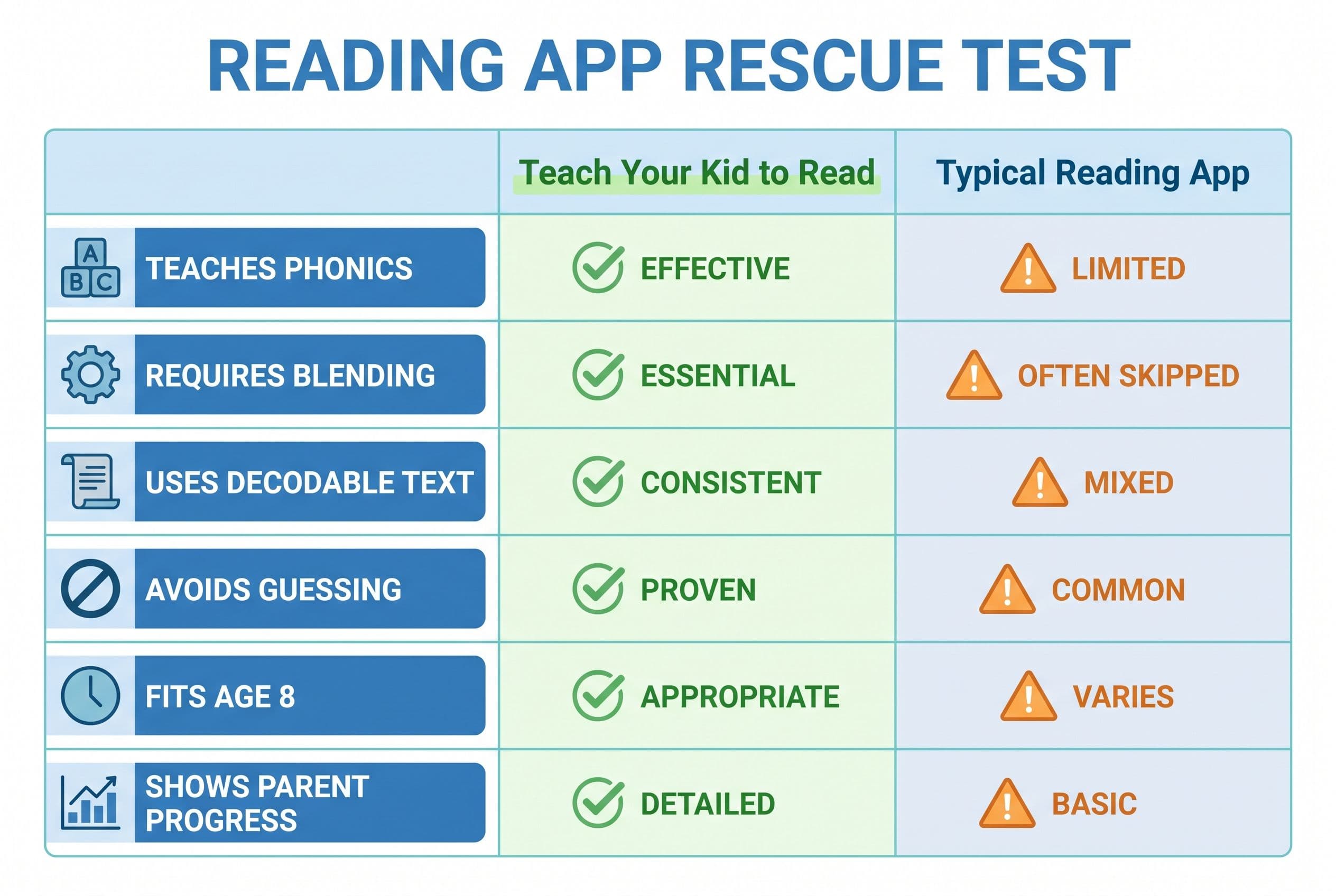
If my 8 year old can’t read, I want an app or program to pass five tests.
1. It Must Teach the Code
The app needs explicit grapheme-phoneme instruction. Short vowels. Digraphs. Blends. Silent e. Vowel teams. R-controlled vowels. Syllable types.
No code, no deal.
2. It Must Make the Child Blend
Blending is where the magic gets sweaty. Your child sees stamp and says /s/ /t/ /a/ /m/ /p/, then blends it into a word.
Apps that let kids tap pictures without reading can’t fix decoding.
3. It Must Use Decodable Text
Decodable text matches what the child has learned. If your child learned short a, m, s, t, and p, then Sam sat makes sense. A random story about giraffes and volcanoes does not.
Bob Books, UFLI Foundations, All About Reading, Logic of English, and Explode the Code all use structured literacy principles in different ways. Wilson Reading System and Barton Reading & Spelling often serve kids with stronger dyslexia indicators through trained instruction.
4. It Must Give Enough Repetition
Kids don’t master reading by being entertained. They master reading by correct practice.
Yes, we can keep it warm. Yes, we can celebrate. But if the app gives confetti for guessing, throw it into the digital sea.
5. It Must Let Parents See the Skill
I want to know what my child practiced today. Not “completed jungle level.” Not “earned 42 gems.” Tell me the phonics pattern.
Was it short e? Consonant digraphs? Closed syllables? Multisyllable words?
Details matter.
The 7-Day Rescue Plan for an 8-Year-Old Struggling to Read
Here’s what I’d do this week if my 8 year old can’t read.
Day 1: Stop the Guessing
Tell your child: “From now on, we read the letters. We don’t guess from pictures.”
Keep your voice calm. This is a rule, not a punishment.
Day 2: Check the Foundation
Test letter sounds, not just letter names. Then test blending with simple CVC words:
- map
- sit
- lip
- pen
- hot
If your child can’t read these smoothly, start there. I don’t care if the school calls them 3rd grade. Reading level labels don’t teach children.
Day 3: Screen Phonemic Awareness
Use Kilpatrick’s PAST if you can and you understand the administration guidance. If not, do a quick oral check:
- Say cat without /k/
- Say smile without /s/
- What sounds do you hear in ship?
If your child can’t pull sounds apart orally, decoding will feel like wrestling an octopus.
Day 4: Start a Structured Lesson
Use Teach Your Kid to Read, UFLI Foundations, Logic of English Essentials, Barton, Wilson, or another structured program that teaches phonics in sequence.
Pick one. Don’t app-hop every three days. That’s how parents feel productive while kids stay confused.
Day 5: Add Decodable Reading
Choose decodable books tied to the phonics pattern. Keep sessions short:
- 10 minutes phonics
- 5 minutes word reading
- 5 minutes decodable text
- 2 minutes praise and chocolate for the parent
I’m only half joking.
Day 6: Track Accuracy
Write down 10 words your child missed. Review them tomorrow.
Don’t write “needs confidence.” Write the actual pattern: short i, sh, final blends, silent e. Confidence grows from Skill.
Day 7: Contact the School
Ask for data:
- DIBELS results
- Nonsense word fluency
- Oral reading fluency
- Spelling inventory
- Intervention minutes per week
- Program name used for intervention
If your child reads far below a third grade reading level, ask what evidence-based intervention they’ll receive and how progress will be measured.
Then keep teaching at home. We Never Skip.
If you want the simplest starting point, use Teach Your Kid to Read today: lesson one is free with no card and nothing to cancel; from lesson two the whole program is a 7-day free trial, then US$9.95 a month.
Red Flags That Mean You Need More Than an App
An app can help, but some kids need a specialist.
Get extra help if your child:
- Still can’t read CVC words after several weeks of daily instruction
- Cannot segment or blend three sounds orally
- Shows strong dyslexia indicators
- Cries, shuts down, or panics during reading
- Reads below grade level and the gap keeps growing
Look for structured literacy, Orton-Gillingham principles, or programs like Wilson Reading System, Barton Reading & Spelling, Lindamood-Bell, or a qualified dyslexia therapist. Ask what they teach, how they measure progress, and whether they use decodable text.
If someone tells you to just read more books together, smile politely and back away slowly.
Bottom Line: Your 8-Year-Old Can Still Learn to Read
If my 8 year old can’t read, I don’t waste another semester hoping maturity fixes instruction gaps.
I check the foundation. I stop guessing. I choose a structured phonics path. I use daily drill. I ask the school for data. I watch for dyslexia signs. I keep the tone loving, but the expectation firm.
Reading is a survival Skill. It’s Independence. It’s access to every subject your child will meet next.
Start now. Your child doesn’t need panic. They need a plan.
Teach Your Kid to Read gives you that plan in small, parent-led lessons: lesson one is free with no card and nothing to cancel; from lesson two, the whole program is a 7-day free trial, then US$9.95 a month.
FAQ
Is it too late if my 8-year-old can’t read?
No, but don’t wait. Many 8-year-olds make strong progress with explicit phonics, daily practice, and the right intervention. The older the child gets, the more intentional you need to be.
What should an 8-year-old be able to read?
Many 8-year-olds read chapter books or grade-level texts, but the real marker is decoding. Your child should read unfamiliar words using letter-sound patterns, not guessing from pictures or memorizing whole pages.
What are common signs of dyslexia in 8 year olds?
Watch for slow word reading, weak spelling, trouble with nonsense words, poor phonemic awareness, family history, and strong listening comprehension paired with weak independent reading. Ask for a formal evaluation if several signs fit.
What is the best reading intervention for an 8 year old?
Choose structured literacy: explicit phonics, phonemic awareness, spelling, decodable text, and fluency practice. Orton-Gillingham based instruction, Wilson, Barton, UFLI Foundations, and strong parent-led phonics programs can all fit different families.
Should I use a reading app or hire a tutor?
If the gap is mild to moderate, a strong phonics app plus daily parent practice may help. If your child shows dyslexia indicators, severe avoidance, or little progress after consistent instruction, add a trained reading specialist.
Part of these guides

Xia Brody
Co-Founder, Teach Your Kid to Read
Mom of 4 who has successfully taught her kids to read. Currently in the trenches with her 4-year-old while her two oldest (10 and 7) devour books on their own. Passionate about phonics-based methods and building a lifelong love of reading.
Related Articles
My 9 Year Old Can't Read: Parent Action Plan
If your 9-year-old can't read, don't wait for school to fix it someday. Here's how to check their reading level, stop guessing habits, and start a real phonics-based intervention at home.
Read More →
My 7 Year Old Can't Read: 9 Steps to Act Now
If your 7-year-old still can't read, don't panic—but don't wait. Here's how to check the gap, stop guessing habits, and start a real phonics plan at home.
Read More →
My First Grader Can't Read? The 90-Day Catch-Up Plan
If your 6-year-old is guessing at words, memorizing books, or melting down at the page, you don't have a motivation problem — you have an instruction problem. Here's the exact 90-day catch-up plan I'd run, starting tonight.
Read More →