My First Grader Can't Read? The 90-Day Catch-Up Plan
My First Grader Can't Read: How to Tell If They're Guessing + A 90-Day Phonics Catch-Up Plan
What You'll Learn
- The 5-minute kitchen-table test that tells you whether your child is actually reading — or just memorizing and guessing (most parents can't tell the difference)
- The one word I ask every struggling reader to sound out, and why failing it exposes the exact gap in their instruction
- Why "he's a late bloomer" is the most expensive sentence in early education
- A day-by-day catch-up plan you can run in 20 minutes a night, no teaching degree required
Reality Check: Guessing Is Not Reading
Your first grader can't read. You've known it for a while. The teacher said "he's developing at his own pace," and you wanted to believe her.
Stop believing her.
Here's what "my first grader can't read" usually looks like in real life: your kid opens a book, glances at the picture, and says "puppy" when the word is dog. He reads a page perfectly on Tuesday and can't read a single word of it on Thursday — because he memorized it, he didn't decode it. He gets stuck on shut and looks up at your face for the answer.
That's not reading. That's a very smart child running a very sophisticated workaround because nobody taught him the code.
And honestly? It's not his fault. It's almost never the kid.
The Tiger Truth: What Happens If You Wait
I'm going to be blunt because I'd rather you be uncomfortable now than devastated in fourth grade.
The 3rd Grade Cliff is real. It's not quite a cliff edge — the shift happens gradually across roughly 2nd through 4th grade (ages 7-10 in the US system), and exactly when depends on your school, your state's cutoffs, all of it. But the shift is coming either way. In the early grades, kids learn to read. Then, somewhere in that window, the assignments flip and they're reading to learn — science, history, word problems, instructions. A child who can't decode by then doesn't just fall behind in reading. He falls behind in everything, all at once.
The numbers, and yes, these are US numbers:
- On the 2024 NAEP — the US Nation's Report Card — only about 31% of 4th graders read at or above proficient. That's roughly two out of three US kids not reading well enough for their grade.
- Donald Hernandez's 2011 study for the Annie E. Casey Foundation found that kids who aren't reading proficiently by the end of 3rd grade are about four times more likely to leave school without a diploma. For kids who are also low-income, it's worse.
- Private remediation — a certified Orton-Gillingham tutor, Lindamood-Bell, a reading clinic — is billed by the hour. Two sessions a week for a school year can run to thousands of dollars. Health insurance doesn't touch it.
But the number I actually care about isn't on any report card. It's the moment a 7-year-old decides he's "the dumb one." I've watched it happen in a co-op class. The kid stops raising his hand, starts clowning around during read-aloud, and by 3rd grade he'll tell you flat out that he hates books.
That self-concept is way harder to fix than the phonics.
Why Your Kid Ended Up Here (It's Probably Not You)
Last spring I was at a playground in Raleigh, pushing my youngest on the baby swing, and another mom struck up a conversation. Her son's school had just yanked their old Lucy Calkins units and replaced them with a Science of Reading curriculum because of North Carolina's SB 387, the Excellent Public Schools Act — that's US state legislation requiring evidence-based reading instruction.
She was annoyed about it. "He was doing fine before," she said.
He was in 2nd grade (ages 7-8). I asked her if he could read the word splint.
She went quiet. Then she said, "Probably not."
So I sat on that bench for twenty minutes and explained the whole thing — Emily Hanford's reporting in "Sold a Story", the flat NAEP data, and the neuroscience from Stanislas Dehaene's lab (his book Reading in the Brain, 2009) showing that the human brain has no built-in reading circuit. Speech is natural. Reading is not. The brain has to be rewired to map letters onto sounds, and that rewiring only happens if somebody explicitly teaches it.
She went home and listened to the podcast that night. Texted me at 11pm: "I had no idea. Why didn't anyone tell us this sooner?"
That's the whole problem in one text message. For thirty years, millions of kids were taught to read by looking at the picture, checking the first letter, and guessing what "makes sense." Marie Clay's three-cueing system. Reading Recovery. Fountas & Pinnell leveled readers. It's still sitting in classrooms right now.
So if your first grader is struggling to read, the most likely explanation isn't dyslexia, laziness, or immaturity. It's that he was taught a guessing strategy that works fine on 20-word predictable books and collapses completely the second the words get harder.
First Grade Reading Benchmarks: What "On Track" Actually Means
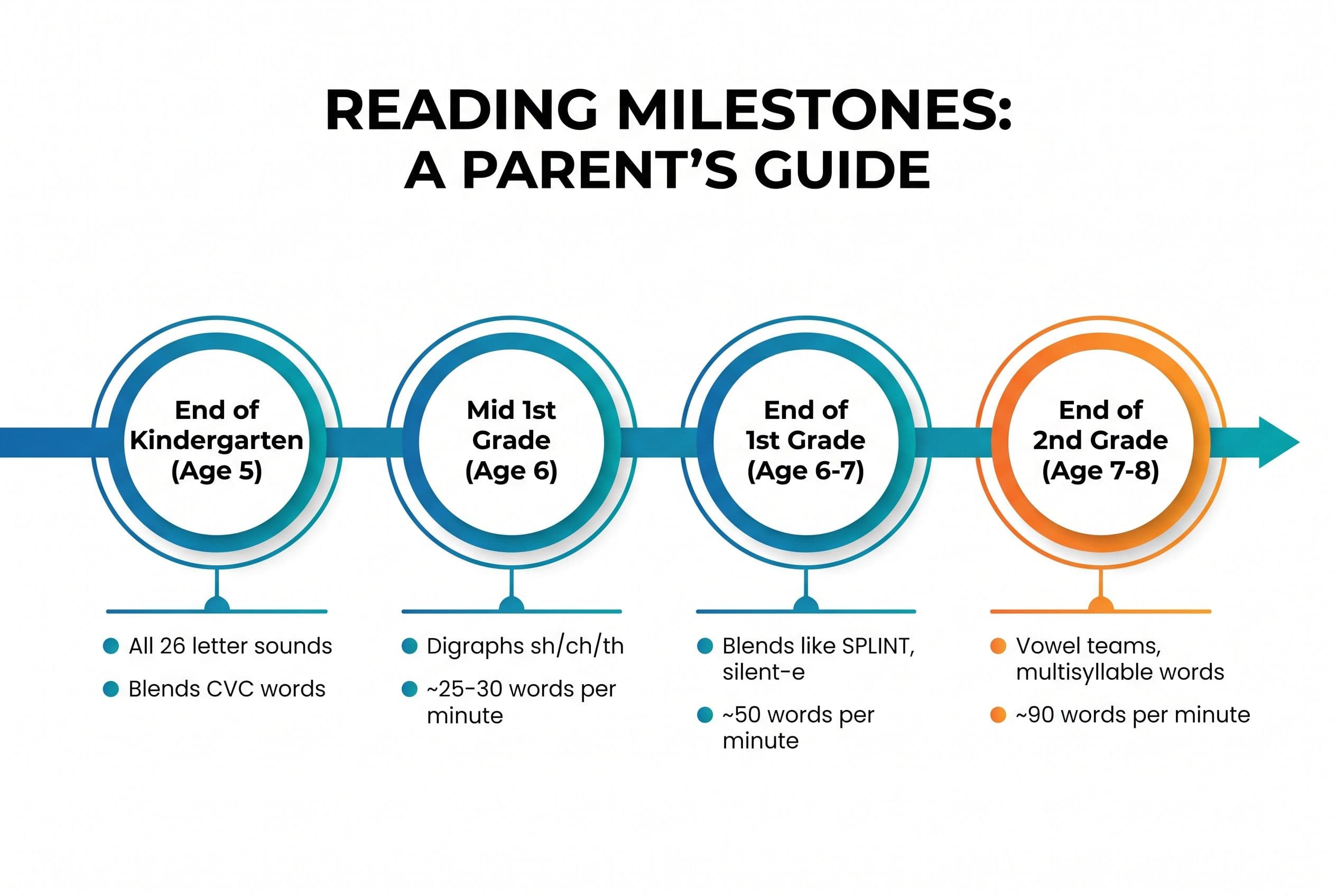
Before you can build a catch-up plan, you need to know how far behind we're talking. Here are realistic first grade reading benchmarks (age 6-7). These are drawn from DIBELS 8th Edition and standard curriculum-based measures used across US schools — the skills themselves apply anywhere.
One caveat before you panic at a number: benchmarks shift depending on which assessment your school uses, which state you're in, and what time of year you're testing. Treat these as ballpark targets, and if you want the exact bar your kid is being measured against, ask the school for their DIBELS or CBM norms.
End of kindergarten (age 5):
- Knows all 26 letter names and their primary sounds, fast, no hesitation
- Blends and segments 3-sound words orally (m-a-p → map)
- Reads simple CVC words: cat, sun, big, hop
- Around 25-30+ correct letter sounds per minute on nonsense word fluency
Middle of 1st grade (age 6):
- Reads CVC words automatically, plus digraphs (sh, ch, th, ck) and consonant blends (st, fl, dr)
- Nonsense word fluency in the neighborhood of 40+ correct letter sounds per minute, and reading some of those nonsense words as whole units
- Reads a decodable passage at roughly 25-30 words correct per minute
End of 1st grade (age 6-7):
- Handles blends both sides of the word — splint, strap, crunch
- Knows silent-e (hope, bike) and common vowel teams (ai, ee, oa, ow)
- Reads an unfamiliar grade-level passage around 50 words correct per minute with 95%+ accuracy
- Retells what he just read
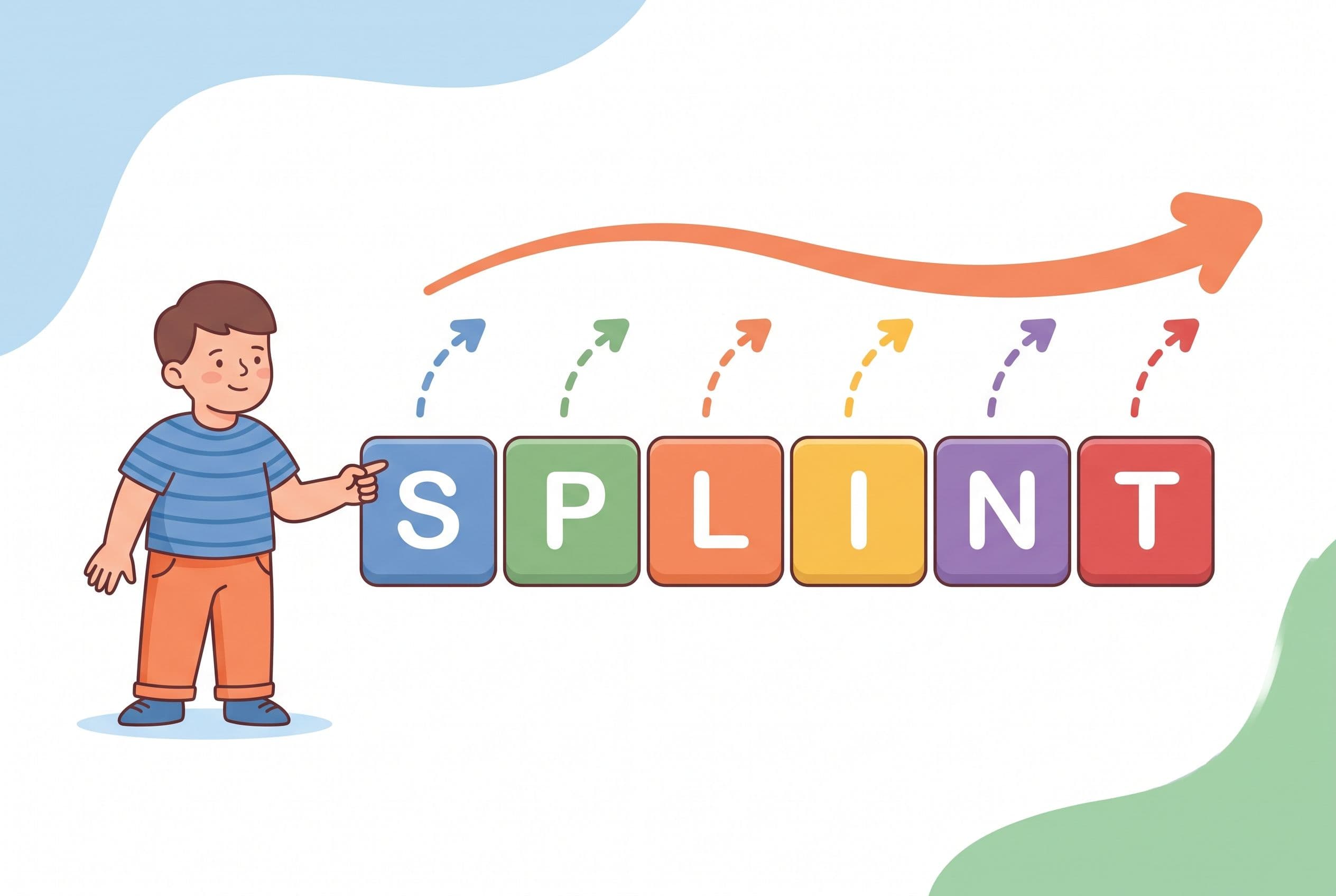
Look at that splint word again. S-p-l-i-n-t. Six letters, six sounds, a three-consonant blend at the front and a two-consonant blend at the back. A kid who's memorizing sight words has zero chance. A kid who's been taught to decode gets it on the first try.
The 5-Minute Diagnostic You Can Run Tonight
Don't guess at where the hole is. Test it. Grab an index card and a timer.
Test 1 — Letter sounds (60 seconds). Write all 26 lowercase letters in random order. Point and ask for the sound, not the name. Mark every miss. A first grader should get all 26, instantly. Hesitation counts as a miss.
Test 2 — Nonsense words (2 minutes). Write: nup, tex, blad, shom, frin, chelp, stig, splant. Nonsense words are the honest test — he can't have memorized them. If he can't decode these, he's been faking with sight-word memory.
Test 3 — Phoneme manipulation (2 minutes). Say: "Say stop. Now say it without the /s/." (top) "Say black. Change /b/ to /s/." (slack) "Say swim. What's the last sound?" (/m/) This is the phonemic awareness piece David Kilpatrick writes about in Equipped for Reading Success (2016). His PAST — the Phonological Awareness Screening Test — takes about five to ten minutes and tells you precisely where the sound system broke down. It's the single most diagnostic thing you can do at a kitchen table.
How to read your results:
- Misses letter sounds → start at the very beginning. Non-negotiable.
- Letter sounds fine, nonsense words fail → he never learned to blend. That's your target.
- Decodes fine but can't manipulate phonemes → orthographic mapping is weak, and words won't stick in memory no matter how many flashcards you buy.
- Fails everything, plus family history of reading trouble → screen for dyslexia. Start at the International Dyslexia Association.
The Solution: Systematic Synthetic Phonics, 20 Minutes a Day
Here's the good news, and it's genuinely good. Reading is a code. Codes can be taught. And a 6-year-old brain is fast.
The 2000 National Reading Panel report — the one the US Congress actually commissioned — reviewed decades of studies and landed on this: systematic, explicit phonics instruction produces significantly better outcomes than incidental or no phonics, and it works best in kindergarten and 1st grade. The Clackmannanshire study out of Scotland (Johnston & Watson, 2005) tracked kids for seven years and found the synthetic phonics group finished years ahead of their peers in word reading.
Systematic means a sequence. Simple sounds before complex ones, one new thing at a time, review built in, nothing skipped. That's the Orton-Gillingham backbone — multisensory, explicit, cumulative, diagnostic.
That's exactly how the Teach Your Kid to Read app is built. Not a game with phonics sprinkled on top. A real scope and sequence: letter sounds → CVC blending → digraphs → blends → silent-e → vowel teams, with decodable practice text at every step so your child is applying the rule he just learned instead of guessing from pictures. No leveled readers. No three-cueing. No "look at the picture, what would make sense?"
Twenty minutes. Every day. That's the whole ask.
The 90-Day Catch-Up Plan
This is what I'd run if you told me your first grader can't read and you had one summer, or one semester, to close the gap. I've done a version of this with my own kids and with two families in our co-op.
Days 1-7: Stop the bleeding
- Remove every leveled reader from the house. Fountas & Pinnell books, Reading Recovery books, anything with a predictable repeating sentence and a picture that gives the word away. They're training the guessing habit. Box them up.
- Replace them with decodables. Bob Books for the earliest stage, then Flyleaf Publishing or High Noon Books. Free decodable passages come with UFLI Foundations too.
- Institute the No Guessing rule. When he gets stuck, you say: "Sound it out." Not "What would make sense?" Not "Look at the picture." If he can't get it in about five seconds, you tap each letter, say the sounds with him, and blend. Then he reads the whole word himself.
- Run the 5-minute diagnostic above. Write down the results with the date. You'll want this in eight weeks.
Days 8-30: Build the foundation
- Same time, same seat, every single day. Ours is right after breakfast, before anyone touches a screen. Twenty minutes. We Never Skip — not on birthdays, not on vacation, not on Christmas. My 4-year-old did letter sounds in the car on the way to my mom's house on Thanksgiving. Consistency beats intensity every time.
- Two minutes of phonemic awareness first, eyes closed. Blending, segmenting, deleting sounds. Purely oral, no letters. Kilpatrick's research is clear that this is the engine behind orthographic mapping — the process that lets a word get stored permanently after a couple of exposures.
- Ten minutes of explicit phonics. New sound, letter tiles or a whiteboard, build words, read words, spell words. Spelling matters — writing the word from dictation locks it in harder than reading it does.
- Eight minutes of decodable text. He reads out loud. You track accuracy. Anything under 95% accurate means the text is too hard, not that he's failing.
Days 31-60: Push into blends and multisyllable
- Add consonant blends aggressively — st, sl, cr, dr, spl, str, nd, mp, nt. This is where memorizers fall apart and where you'll see the biggest jump.
- Re-read the same passage three times across three days. Repeated reading is one of the best-supported fluency interventions we have, and it does wonders for confidence.
- Time him once a week. One minute, unfamiliar decodable passage, count words correct. Graph it on the fridge. Kids who see the line going up start asking for the lesson.
Days 61-90: Fluency and transfer
- Silent-e, vowel teams, and r-controlled vowels (car, bird, fork).
- Move to real books he chooses — but he reads them to you, out loud, with the No Guessing rule fully in force.
- Re-run the diagnostic from Day 1. Compare the numbers. If he's gained less than 15 words per minute in three months of daily work, it's time to bring in a professional evaluation — that's an outlier pattern and it deserves a real look.
When You Need More Than a Home Plan
I'm a big believer in parents doing this at home. I'm also not going to pretend every kid's needs fit in a 20-minute kitchen lesson.
Escalate if you see: 90 days of consistent daily instruction with almost no movement; letter reversals persisting well past age 7 combined with sound-level struggles; a family history of dyslexia; or a child whose oral vocabulary and comprehension are strong but whose decoding is stuck cold. That gap — the Simple View of Reading (Gough & Tunmer, 1986) calls it a word-recognition deficit with intact language comprehension — is the classic dyslexia profile.
Good next steps: an educational psychologist evaluation, a certified Orton-Gillingham practitioner, or a structured program like the Wilson Reading System or Barton Reading & Spelling. Wilson runs 12 steps with controlled readers and it's intense, but it works. Understood.org and Reading Rockets both have solid parent guidance on requesting an evaluation.
Getting a diagnosis is not a failure. It's a map.
The Part Nobody Tells You
The gap closes faster than you think it will.
When I started teaching my oldest, I was convinced I'd broken her because at 5.5 she still couldn't blend sat. Eleven weeks of stubborn daily practice later, she read an entire Frog and Toad chapter to me on the living room floor and I cried in front of her, which she still brings up.
Six is early. You have time. But you only have time if you start now, not in September, not "once things settle down."
Open the app. Sit him down. Twenty minutes.
start lesson one free | Questions about where to start? contact us today
FAQ
Is it normal for a first grader to not be able to read?
Common, yes. Normal, no. By the end of 1st grade (age 6-7), a child on track decodes unfamiliar words with blends and silent-e, and reads around 50 words correct per minute with 95%+ accuracy — though the exact target moves a bit depending on the assessment and time of year. Plenty of kids miss that mark — but "lots of kids are behind" is a statement about instruction quality, not about what your child is capable of. Test the specific skills instead of waiting to see.
How long does it take to catch up a struggling first grader?
With 20 focused minutes a day of systematic phonics, most first graders who are 6-12 months behind close the gap in one to two school terms. Kids with dyslexia indicators typically need longer and need a structured Orton-Gillingham-based program, but they absolutely can and do learn to read. What doesn't work is inconsistent practice — three sessions a week gets you a fraction of the result of daily ones.
Should I use sight word flashcards to help my 6 year old read?
Sparingly. A short list of genuinely irregular high-frequency words (said, was, of, one) is fine. But drilling hundreds of words as whole shapes builds the exact memorization habit that fails at 2nd or 3rd grade. Most "sight words" are perfectly decodable once your child knows the pattern. Teach the code, and the words become sight words on their own — that's orthographic mapping.
How do I know if my first grader has dyslexia or is just behind?
The cleanest tell is response to instruction. Run 60-90 days of daily, explicit, systematic phonics and measure. A child who was simply taught poorly takes off. A child with dyslexia improves more slowly, keeps struggling with phoneme manipulation tasks, and needs far more repetitions per skill. Family history matters too. Either way, the first move is the same: start structured phonics now, and screen if progress stalls.
What should I do if my child's school says to wait and see?
Say thank you, and start at home anyway. "Wait and see" costs you the years when reading intervention works best — the National Reading Panel found phonics instruction has its largest effect in kindergarten and 1st grade. In the US, you can also request a formal evaluation in writing at any time; the school is obligated to respond. Don't wait for permission to teach your own kid to read.
Part of these guides

Xia Brody
Co-Founder, Teach Your Kid to Read
Mom of 4 who has successfully taught her kids to read. Currently in the trenches with her 4-year-old while her two oldest (10 and 7) devour books on their own. Passionate about phonics-based methods and building a lifelong love of reading.
Related Articles
My 9 Year Old Can't Read: Parent Action Plan
If your 9-year-old can't read, don't wait for school to fix it someday. Here's how to check their reading level, stop guessing habits, and start a real phonics-based intervention at home.
Read More →
My 7 Year Old Can't Read: 9 Steps to Act Now
If your 7-year-old still can't read, don't panic—but don't wait. Here's how to check the gap, stop guessing habits, and start a real phonics plan at home.
Read More →
Is My 1st Grader Behind in Reading? 7 Warning Signs
Worried your first grader is behind in reading? Here are the warning signs I’d act on fast, the apps worth comparing, and the phonics plan I’d use at home.
Read More →