My 7 Year Old Can't Read: 9 Steps to Act Now
What You'll Learn
- The exact reading line a typical 7-year-old should be near—and what counts as a red flag.
- The one mistake parents make when a child gets stuck on a word. Spoiler: picture guessing is not reading.
- How to run a 2-minute home check before you spiral into midnight Googling.
- A no-drama, no-waiting action plan for reading intervention at home.
Reality Check: What Should a 7-Year-Old Be Able to Read?
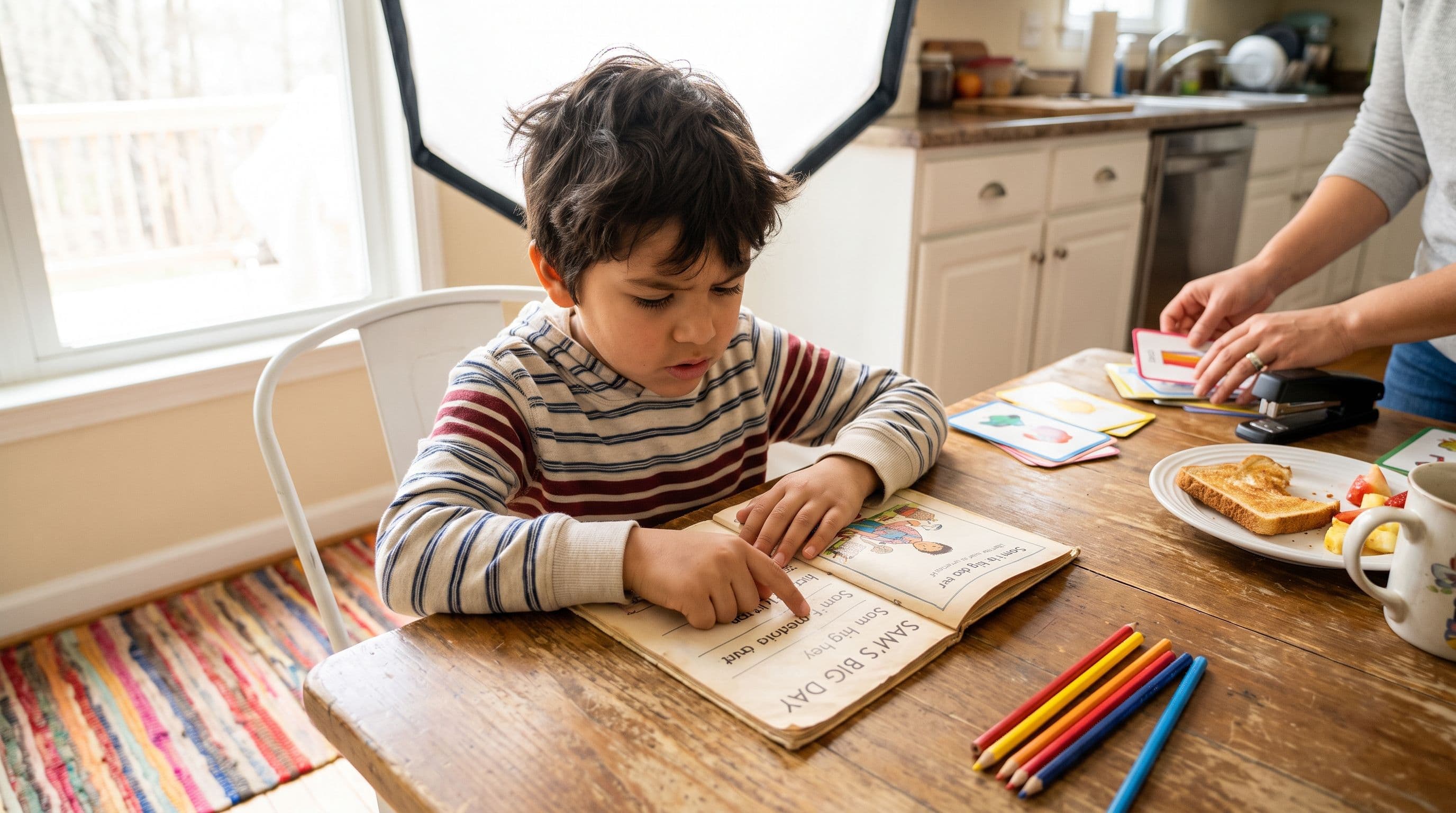
If you're searching my 7 year old can't read, here's the direct answer: by age 7, most children should read simple decodable books with short vowels, common digraphs like sh/ch/th, many high-frequency words, and basic two-syllable words with help.
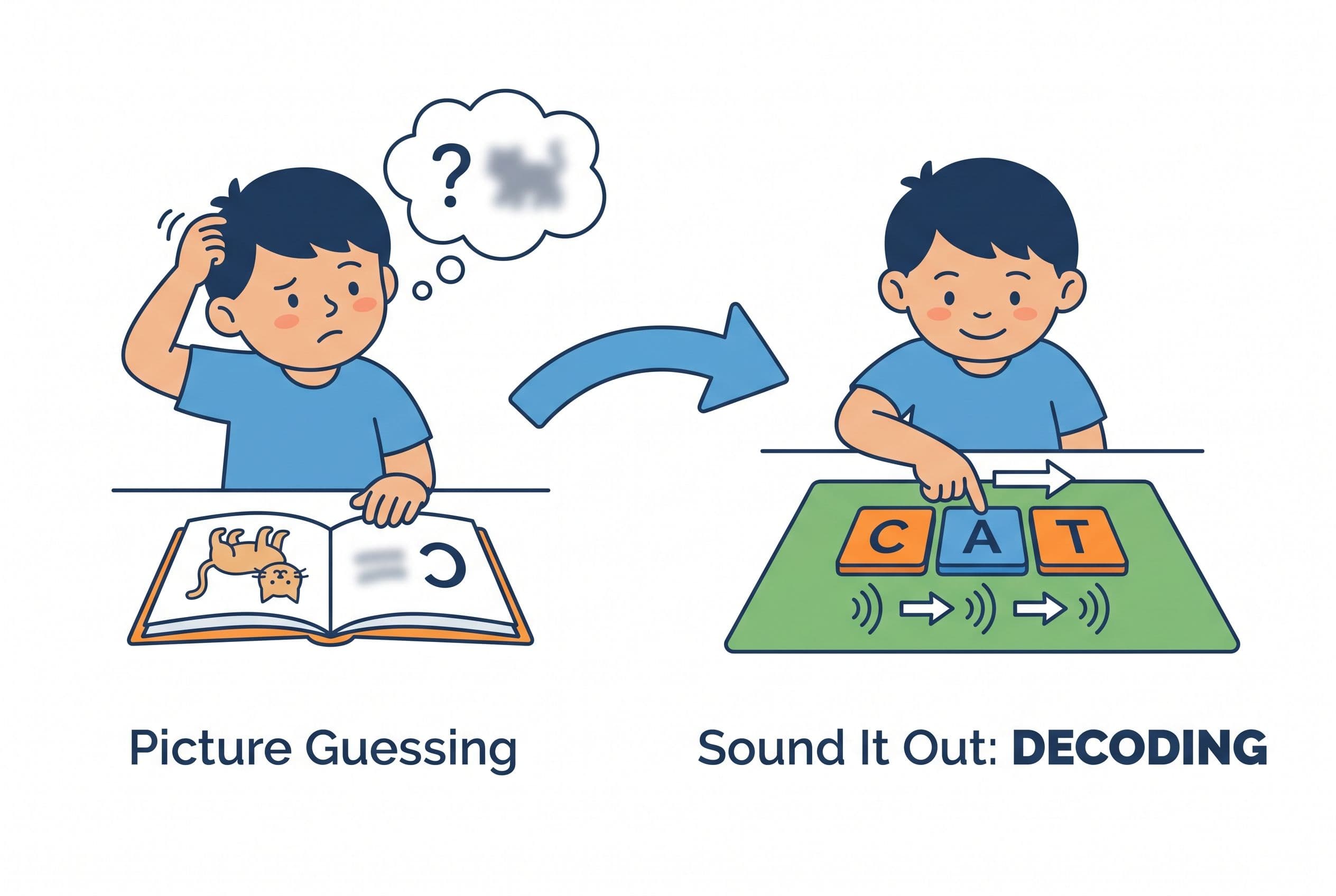
A 7-year-old in first grade (ages 6-7) or second grade (ages 7-8) should not rely on pictures to guess words. They should look at the letters, say the sounds, blend left to right, and self-correct when the word doesn't make sense.
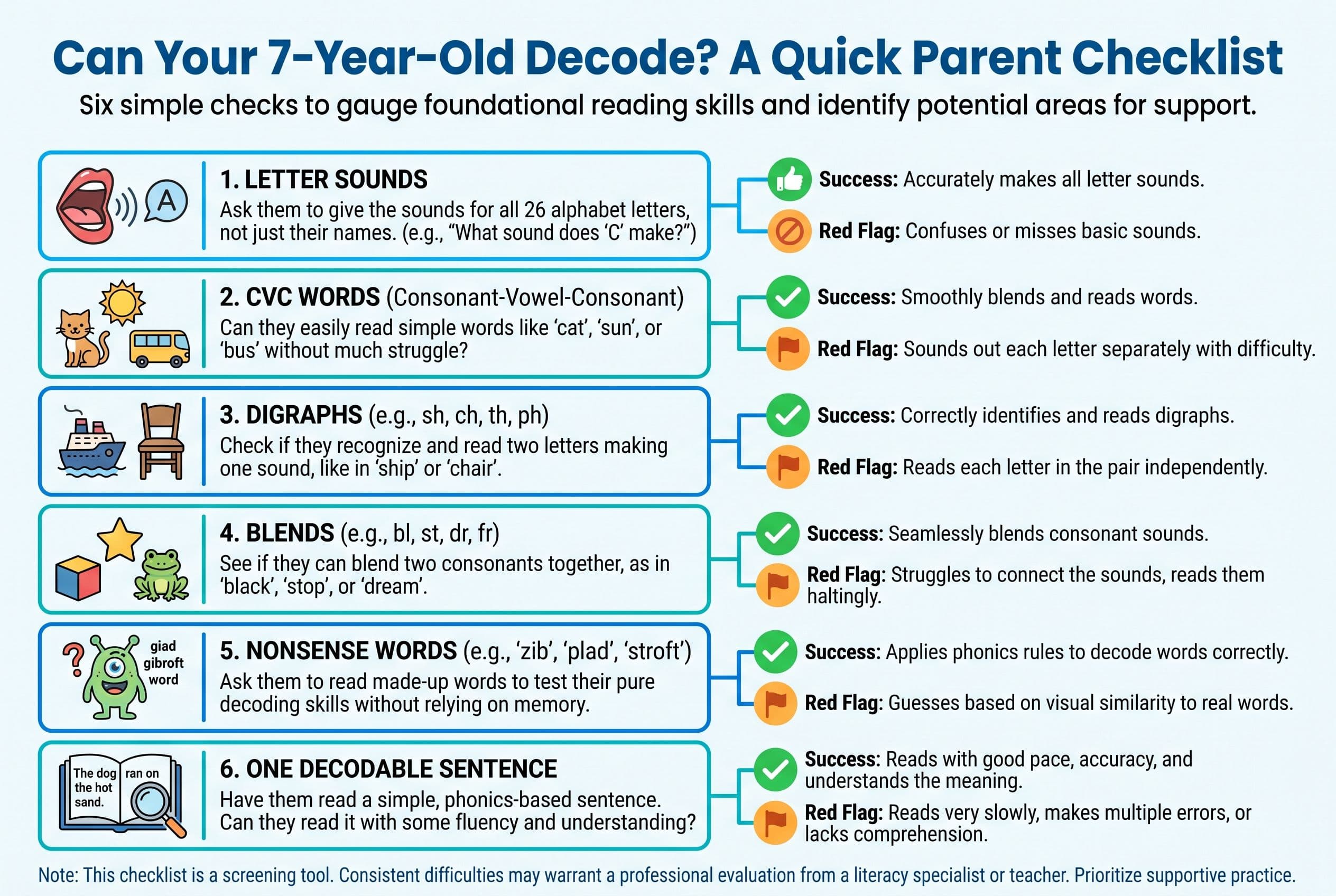
Here's my quick parent benchmark:
| Skill | A 7-Year-Old Should Usually Be Able To... | Red Flag |
|---|---|---|
| Letter sounds | Say most consonant and vowel sounds quickly | Still mixes up many basic sounds |
| Blending | Read CVC words like map, sit, cup | Guesses “monkey” for map because of a picture |
| Digraphs | Read ship, chat, thin | Reads ship as sip or shop every time |
| Nonsense words | Read lat, shup, thim | Freezes unless the word is familiar |
| Simple sentences | Read “The dog ran up the hill” | Memorizes books but can't read new pages |
| Spelling | Spell basic sound-based words | Writes random letters with no sound match |
Real talk: if your 7 year old not reading yet can't decode short words without guessing, that's not a “late bloomer” situation. That's a skill gap.
And skill gaps need drills.
What To Do If They're Below That Line
Don't panic. But don't wait.
Tonight, sit beside your child with five words: mat, ship, chop, flat, splint. Cover any pictures. Ask them to read each word. If they guess, look at the ceiling, or say a word that starts with the same letter but doesn't match the sounds, you've spotted something to investigate.
You can also take the 2-minute reading check to get a fast read on whether your child is behind. It won't replace a full evaluation, but it gives you a starting line. Parents need a starting line. Otherwise we just pace around the kitchen eating crackers and calling it “research.”
The usual issue I see? The child has learned to perform reading instead of actually decoding. They memorize patterns, use pictures, guess from the first letter, and hope nobody notices. I notice. You notice too, or you wouldn't be here.
But let's be clear: guessing is an observable behavior, not a diagnosis. Instruction history, language development, hearing or vision concerns, and reading disabilities can all be part of the picture. That's why you gather evidence instead of just vibes.
If your child is below the line, start structured phonics now with Teach Your Kid to Read at start lesson one free. The program matches your child's gap to the next lesson so you aren't throwing random worksheets at the wall and praying. Lesson one is free with no card and nothing to cancel; from lesson two the whole program is a 7-day free trial, then US$9.95 a month.
Why Your 7-Year-Old Might Not Be Reading Yet
Here's the thing: children don't learn to read the way they learn to talk.
Talking comes naturally for most kids because the human brain evolved for spoken language. Reading? Nope. Reading is a human invention. Stanislas Dehaene's Reading in the Brain (2009) explains that the brain has to connect visual symbols to speech sounds through training. That means your child needs direct instruction in grapheme-phoneme correspondence—the fancy term for matching letters to sounds.
The National Reading Panel report in 2000 found that systematic phonics instruction gives children significant reading gains, especially in kindergarten (age 5) and first grade (ages 6-7). Translation: teach the code clearly, in order, with daily practice.
If your first grader can't read, these are the most common reasons I see:
- They didn't master phonemic awareness, especially hearing and manipulating sounds inside words.
- Their school used leveled readers that encouraged guessing.
- They memorized books instead of decoding new words.
- They don't know vowel sounds well enough.
- They have dyslexia indicators that nobody has checked.
- They haven't had enough daily, systematic phonics practice.
And yes, some kids need more repetitions than others. My oldest picked up blending fast. My second needed more review. My 4-year-old? Last Tuesday at my kitchen table, she read “map,” then tried to call “mat” by the same name because she wanted to go build a Magna-Tile zoo. Cute? Yes. Acceptable long-term reading strategy? Absolutely not.
Tiger Mom Xia came out. We sounded it out.
The Playground Story That Still Makes Me Mad
I was at a playground in Raleigh when another mom told me her child's school had just switched from Lucy Calkins to a Science of Reading curriculum because of North Carolina's SB 387, the Excellent Public Schools Act. That's a US state law. She sounded confused and honestly a little annoyed.
“He was doing fine before,” she told me.
I asked if her kid could read the word splint. He was in second grade (ages 7-8). He could not.
So there we were: kids climbing, somebody crying near the slide, my toddler trying to eat mulch, and I spent 20 minutes on a playground bench explaining why the switch was happening. I talked about Emily Hanford's APM Reports podcast Sold a Story from 2023, the NAEP data, and Dehaene's neuroscience showing that the brain doesn't magically absorb reading through exposure.
That mom went home and listened to Sold a Story that night. She texted me at 11 p.m.: “I had no idea. Why didn't anyone tell us this sooner?”
Exactly.
That's why I don't play nice with guessing strategies. A child can look “fine” in early books because the books repeat patterns and match the pictures. Then second grade hits. The words get longer. The pictures disappear. Suddenly “I like the dog” turns into “The plants grew in spring,” and the whole thing falls apart.
The kicker is painful: the child thinks they're dumb. They're not dumb. They were taught the wrong moves.
Tiger Truth: Waiting Can Hurt Your Child
Now we need the scary part. I won't soften it because your child deserves better than soft lies.
In the US, only 33% of 4th graders (ages 9-10) scored at or above NAEP Proficient in reading on the 2022 NAEP / The Nation's Report Card. NAEP Proficient is a demanding achievement standard—not a synonym for reading on grade level. Still, that number is not “some kids struggle.” That's a national fire alarm.
Donald Hernandez's 2011 Annie E. Casey Foundation report, Double Jeopardy, found that children who don't read proficiently by the end of 3rd grade (ages 8-9) are four times more likely to leave high school without a diploma than proficient readers. That's an association, not proof that reading trouble alone causes dropout. But if the smoke alarm is screaming, we don't stand there debating the battery brand.
And the cost? Private remedial reading programs can run US$10,000-US$15,000 a year. Some families pay for Wilson Reading System tutoring, Orton-Gillingham tutoring, Lindamood-Bell, or Barton Reading & Spelling support because schools waited too long.
I don't say that to scare you into shame. Shame wastes time.
I say it because “wait and see” steals time from kids.
A child behind in reading first grade can still catch up, but the plan has to start now. Not next semester. Not after one more vague parent-teacher conference where everyone says, “He's making progress.” Progress toward what? At what speed? With what measure?
Ask for numbers. Demand the real deal.
Signs of Dyslexia in 7-Year-Olds
Let's talk about dyslexia without panic.
Dyslexia doesn't mean a child sees letters backward. Some kids reverse letters, sure, but dyslexia usually shows up as a language-based decoding problem. The International Dyslexia Association describes dyslexia as difficulty with accurate or fluent word recognition, poor spelling, and weak decoding.
Common signs of dyslexia in 7 year olds include:
- Trouble rhyming or pulling apart sounds in words.
- Slow, painful sounding-out even after practice.
- Guessing from the first letter.
- Mixing up short vowel sounds.
- Reading the same word correctly on one page and missing it on the next.
- Strong listening comprehension but weak reading.
- Family history of reading trouble.
- Avoiding reading, crying, joking, or suddenly needing water every 90 seconds.
That last one? I see you, tiny escape artist.
Use a screening tool if you're worried. The PAST—Kilpatrick's Phonological Awareness Screening Test—takes about 5 minutes and can show where the phonological breakdown sits. DIBELS can measure skills like nonsense word fluency, but benchmarks depend on the edition, grade, season, and exact measure. Translation: don't grab a random number from the internet and crown yourself the district assessment office. Ask the school for the actual benchmark report and what it means for your child's age and grade.
Don't use Fountas & Pinnell levels as your only comfort blanket. Those levels come from a whole-language aligned system. A child can climb levels by memorizing predictable books while their decoding stays weak. That one drives me crazy.
The Reading Method Your Child Needs Now
If why can't my 7 year old read keeps looping in your head, start with this answer: they probably need explicit, systematic synthetic phonics plus phonemic awareness practice.
That's a mouthful. Here's the plain-English version:
- Teach sounds directly.
- Teach letters and letter teams directly.
- Blend sounds into words every day.
- Read decodable text that matches the phonics pattern.
- Stop all guessing.
- Review until the skill sticks.
This lines up with Orton-Gillingham principles: structured, cumulative, multisensory, and direct. Programs like UFLI Foundations, Fundations, Logic of English, Wilson Reading System, and Barton Reading & Spelling all use structured literacy ideas in different ways.
Linnea Ehri's 2005 work on phases of word reading explains why this matters. Children move from pre-alphabetic guessing to partial alphabetic reading, then full alphabetic decoding, then consolidated word reading. Orthographic mapping—the process of permanently storing words in memory—depends on connecting sounds to letters accurately.
No accurate sound-letter map, no solid word memory.
That's why sight word flashcards alone don't fix a decoding problem. Your child doesn't need to memorize 300 shapes. They need to crack the code.
Your 9-Step Home Action Plan
OK so, here's what you do this week. Not someday. This week.
1. Stop the Guessing Today
New rule: No Guessing.
If your child sees “ship” and says “boat” because there's a boat in the picture, cover the picture. Say, “Look at the letters. Sound it out.” Calm voice. Steel spine.
Use this script:
- “Point to the first sound.”
- “Say each sound.”
- “Blend it.”
- “Now read the whole word.”
Short. Firm. Loving.
2. Check Phonemic Awareness
Ask your child:
- “What sounds do you hear in cat?”
- “Say smile without /s/.”
- “What word do /m/ /ă/ /p/ make?”
- “Change the /m/ in map to /t/. What's the new word?”
If they can't do these orally, don't start with harder books. Build the sound foundation first.
Phonological awareness covers spoken sound units, from rhymes and syllables down to individual phonemes. Phonemic awareness is the individual-sound part, and struggling readers often need direct drills there.
3. Audit Letter Sounds
Make a simple chart. Show lowercase letters first because books use lowercase most.
Mark:
- Knows instantly
- Knows with pause
- Doesn't know
- Confuses with another sound
Pay special attention to vowels. Weak vowel knowledge wrecks decoding. A child who can't tell /ă/ from /ĕ/ will stumble through every CVC word list like it's a haunted house.
4. Start With CVC Mastery
CVC means consonant-vowel-consonant: sat, pin, mop, bed, cut.
Don't rush. Mastery beats variety.
Daily drill:
- Read 10 CVC words.
- Build 5 with letter tiles.
- Dictate 5 for spelling.
- Read 2 decodable sentences.
- End before the child melts into pudding.
Ten focused minutes beats 45 minutes of begging.
5. Add Digraphs and Blends
After CVC words, teach digraphs: sh, ch, th, wh, ck.
Then blends: st, spl, gr, cl, tr.
This is where “splint” becomes useful. If a 7-year-old can read sit but can't read splint, that's normal during instruction. If nobody ever teaches how the sounds stack together, the child gets stuck.
Use finger tapping:
- /s/ /p/ /l/ /ĭ/ /n/ /t/
- Blend slowly.
- Blend faster.
- Read the word.
No-brainer drill. Big payoff.
6. Use Decodable Readers, Not Guessing Books
Bob Books can work for beginners. UFLI decodables, Flyleaf Publishing, High Noon Books, and many Orton-Gillingham style readers match text to taught patterns.
Avoid early books where the page says, “I see the hippopotamus,” while your child has only learned five sounds. That's not reading practice. That's a memory game with illustrations.
7. Practice Spelling With Reading
Reading and spelling feed each other. Dictate words that match the pattern you taught.
If you're teaching short a, use:
- map
- sat
- tap
- ham
- flat
Then dictate a sentence: “The cat sat on a mat.”
Spelling forces the brain to map sounds to letters. That's orthographic mapping in action, minus the academic headache.
8. Track One Number Each Week
Pick one measure and track it.
Examples:
- Correct letter sounds per minute.
- CVC words read correctly in one minute.
- Digraph words read correctly.
- Nonsense words decoded correctly.
Nonsense words matter because they reveal decoding. If your child can read “mip” and “shab,” they're using the code. If they can only read memorized real words, you still have work to do.
9. Get Help If Progress Stalls
If you drill 15 minutes a day for 6-8 weeks and your child still can't blend CVC words, ask for a formal reading evaluation. In the US, parents can request an evaluation through the public school system. In the UK, Australia, Canada, and New Zealand, ask your school, GP, pediatrician, or educational psychologist about local pathways.
Bring data. Say, “My child misses short vowel sounds, can't decode nonsense words, and guesses from pictures.” That lands harder than “I'm worried.”
If you want a guided home path, use Teach Your Kid to Read alongside school support. Lesson one is free with no card and nothing to cancel; from lesson two the whole program is a 7-day free trial, then US$9.95 a month.
What Not To Do
Please don't do these. I say this with love and a tiny bit of bossiness.
Don't Tell Them to Look at the Picture
Pictures can support comprehension after decoding. They should not replace decoding.
If the word is “pony” and your child says “horse,” that's a clue. They understood the picture. They did not read the word.
Don't Keep Re-Reading Memorized Books Forever
Re-reading has a place. But if your child can “read” a book only because they've heard it 47 times, test with a new decodable text.
Fresh text tells the truth.
Don't Depend on Screen Time Apps That Reward Tapping
A reading app should make your child read. Not swipe. Not decorate a dragon. Not earn coins for random clicking.
I like tech when it serves the skill. I don't like lazy iPad parenting pretending to be instruction. Hands down, a parent sitting nearby and demanding accurate sounds beats most flashy apps.
Don't Wait for Confidence Before Skill
Parents say, “I don't want to hurt his confidence.”
I get it. But fake success doesn't build confidence. Skill builds confidence.
A child who can decode chip, chat, chin stands taller. A child who guesses and gets praised knows deep down that they're faking it. Kids are smart that way.
What Progress Can Look Like
Every child moves at a different pace, so I'm not promising your 7-year-old will read chapter books in 30 days. That's internet nonsense.
But with daily structured practice, you may see:
- Less guessing within 1-2 weeks.
- Better CVC accuracy within 2-4 weeks.
- More confidence with decodable books within 4-8 weeks.
- Clearer spelling patterns as phonics sticks.
- Fewer tears because the task finally makes sense.
The bottom line: reading intervention at home works best when it's boring in the right way. Same routine. Same rules. Daily reps.
We Never Skip.
Yes, birthdays count. Vacation counts. Grandma's house counts. Do 10 minutes and then eat the cake.
A Simple 15-Minute Daily Schedule
Use this if your brain is tired.
Minute 0-2: Sound review
Flash through 10-15 letter sounds or phonograms.
Minute 2-5: Oral sound drill
Blend, segment, delete, and swap sounds.
Minute 5-9: Word reading
Read 10-20 words using the pattern you're teaching.
Minute 9-12: Spelling
Dictate 5 words and 1 short sentence.
Minute 12-15: Decodable text
Read a short passage or one decodable book page.
Stop there. Leave while they're still standing.
If your child begs for more, great. If they don't, also great. You're building mastery, not hosting a circus.
When To Involve the School
If your child attends school, ask specific questions:
- What phonics scope and sequence do you use?
- Do you use decodable readers?
- What does the latest DIBELS, AIMSweb, MAP Growth, or PALS data show?
- Is my child below benchmark in nonsense word fluency?
- How many minutes of reading intervention does my child receive each week?
- Who delivers the intervention?
- Is the intervention structured literacy or guided reading with leveled books?
Don't accept “We're monitoring it” as the whole answer.
Monitoring without instruction is watching a boat sink while holding a clipboard.
In the US, states like Mississippi changed reading outcomes after passing Mississippi's Literacy-Based Promotion Act of 2013, a US state law tied to early screening, teacher training, and intervention. Policy isn't magic, but it shows the same truth parents need at home: early, explicit reading instruction matters.
The Parent Mindset Shift
Your child doesn't need you to panic. Your child needs you to lead.
Say this to yourself: “Reading is a skill. We can teach skills.”
Not with shame. Not with yelling. Not with three-hour worksheet marathons that make everyone hate each other.
With clear instruction, daily drill, and zero guessing.
If your my 7 year old can't read search brought you here at 1 a.m., close the extra tabs. Tomorrow, check five words. Run the quiz. Start the first lesson. Ask the school for data.
Do the next right thing.
Lesson one in Teach Your Kid to Read is free with no card and nothing to cancel; from lesson two the whole program is a 7-day free trial, then US$9.95 a month. If your child needs a structured phonics path at home, start there and keep going.
FAQ
Is it normal for a 7-year-old not to read?
Some 7-year-olds develop later than others, but a 7-year-old who can't decode simple words needs action. Don't assume they'll grow out of it. Check phonemic awareness, letter sounds, blending, and nonsense word reading.
What if my 7-year-old memorizes books but can't read new words?
That's a decoding red flag. Memorized books can hide weak phonics skills. Use unfamiliar decodable words and nonsense words to see whether your child can sound out from left to right.
Could this be dyslexia?
Yes, it could be, especially if your child has persistent trouble with sound awareness, decoding, spelling, and fluent word reading. Dyslexia needs structured literacy instruction, and many children do very well with the right teaching.
How long should we practice reading each day?
Start with 10-15 focused minutes daily. Keep it direct: sound review, blending, word reading, spelling, and decodable text. Short daily drills beat long emotional battles.
Should I hire a tutor or try reading intervention at home first?
If your child has severe struggles, dyslexia signs, or no progress after 6-8 weeks of daily structured practice, seek an evaluation and consider a trained tutor. You can still start reading intervention at home now while you wait.
Part of these guides

Xia Brody
Co-Founder, Teach Your Kid to Read
Mom of 4 who has successfully taught her kids to read. Currently in the trenches with her 4-year-old while her two oldest (10 and 7) devour books on their own. Passionate about phonics-based methods and building a lifelong love of reading.
Related Articles
My First Grader Can't Read? The 90-Day Catch-Up Plan
If your 6-year-old is guessing at words, memorizing books, or melting down at the page, you don't have a motivation problem — you have an instruction problem. Here's the exact 90-day catch-up plan I'd run, starting tonight.
Read More →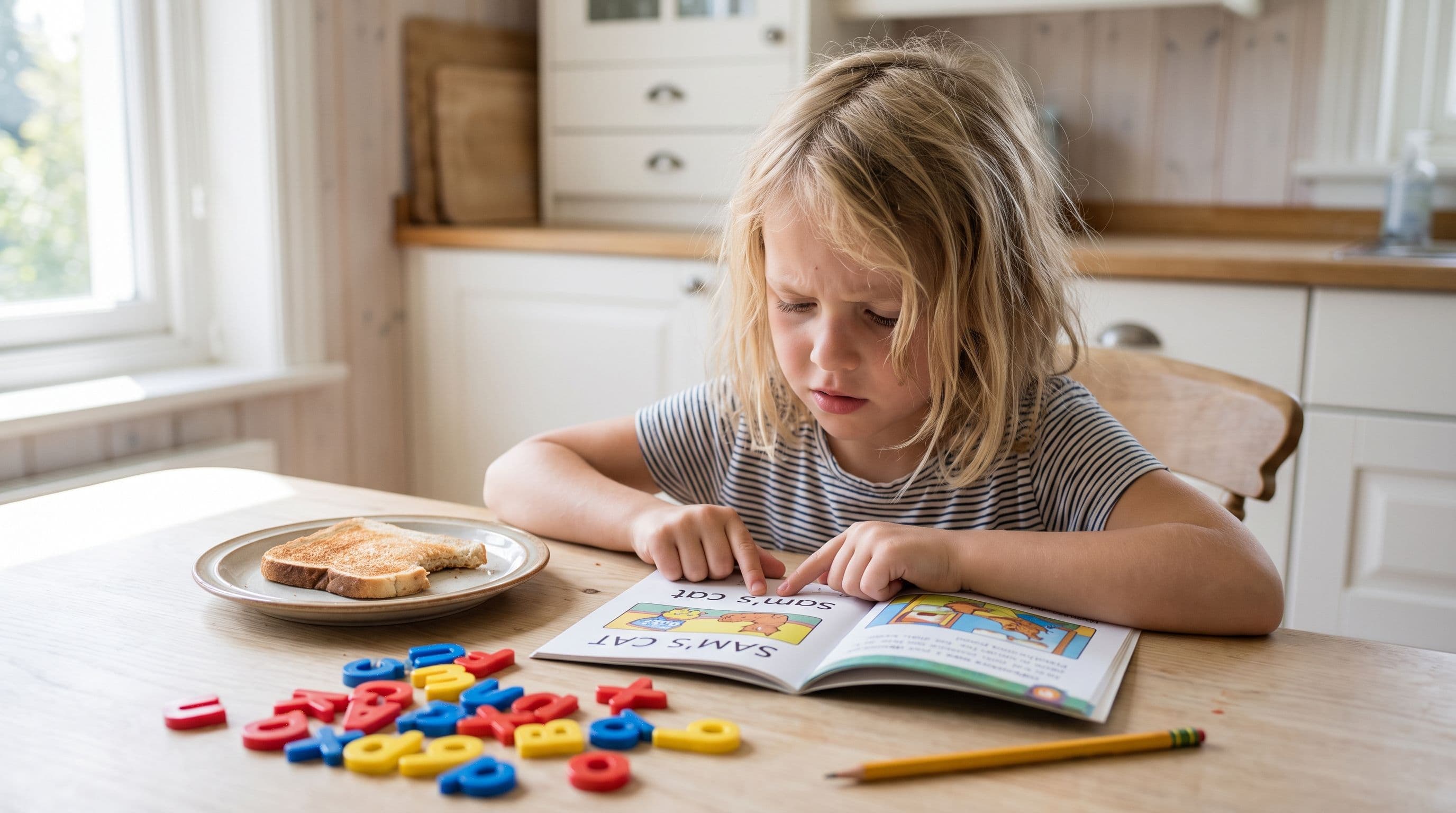
My 5 Year Old Can't Read Reception: When to Act
If your Reception child isn't reading yet, don't panic — but don't drift. Here's how to tell normal early reading from a real phonics gap, and what to do this week.
Read More →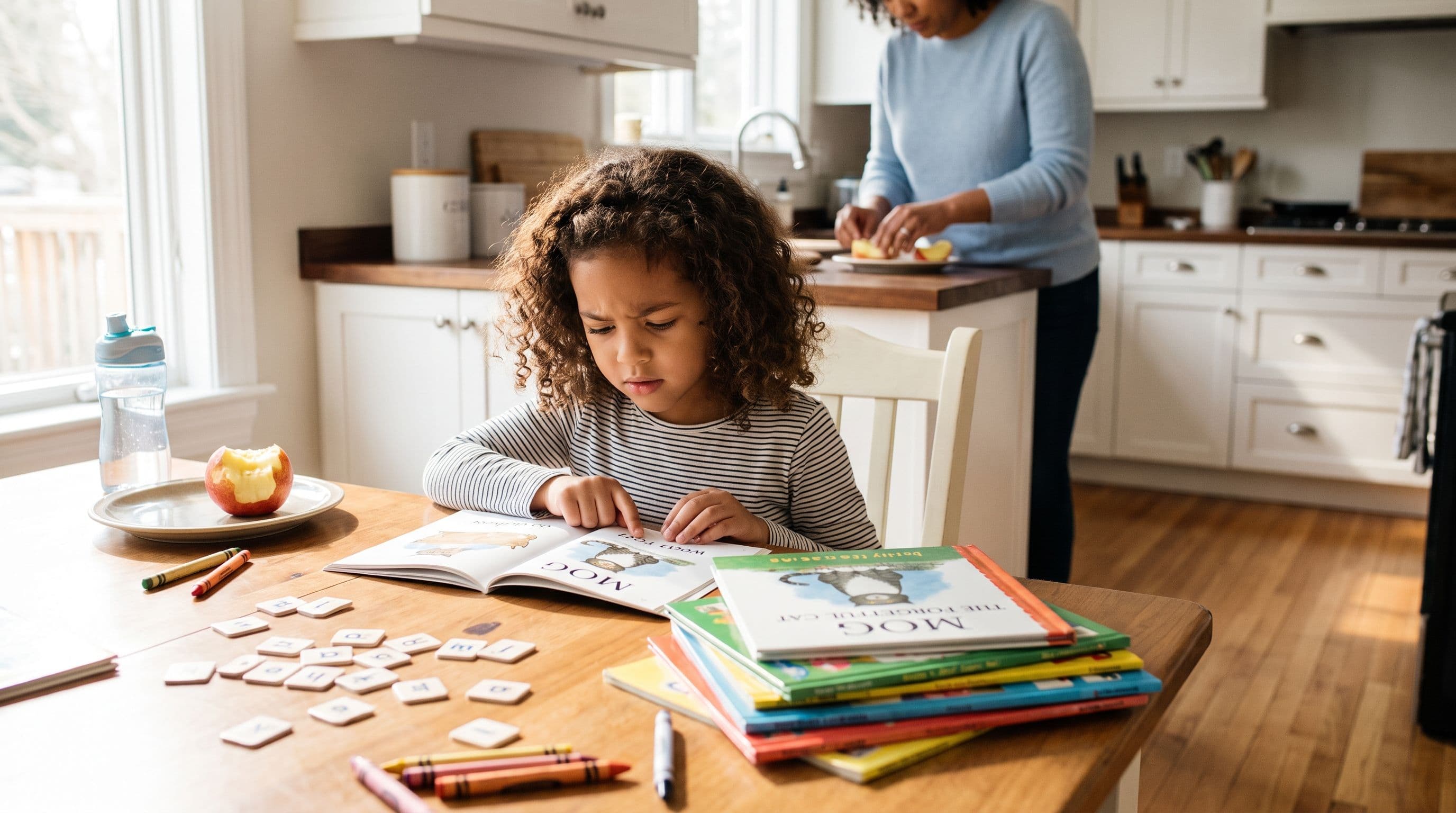
My 5 Year Old Can't Read: What to Do This Week
If your 5-year-old can't read yet, don't panic — but don't wait and see either. Here's what age-5 reading should look like, when to worry, and the phonics plan I'd start this week.
Read More →