My 3rd Grader Can't Read: Warning Signs + 4 App Picks
My 3rd Grader Can't Read: What to Do and Which Apps Can Help
Your 3rd grader (ages 8–9) can talk your ear off about volcanoes but freezes over a sentence about a cat. If you're searching “my 3rd grader can't read,” you don't need another reassurance that children develop differently. You need to know what's breaking down—and what to do tomorrow.
I'm Xia Brody, a Chinese-American homeschooling mum of four, ages 10, 7, 4 and 1. I've taught my oldest two to read, and I'm currently teaching my 4-year-old. My tiger-mum position? Take the difficulty seriously. Don't make the child feel like the difficulty.
What You'll Learn
- Which of four reading apps deserves a closer look—and what would rule each one out.
- Why a familiar book can hide a serious decoding gap.
- What to ask the school before buying another subscription.
- How to run a short practice session without turning dinner into a hostage negotiation.
The Verdict
For a third grader behind in reading, I rank these options by explicit sound-to-letter teaching, opportunities to blend unfamiliar words, adult involvement and suitability for missing foundational skills. This compares instructional fit and public product descriptions, not hands-on testing or proven superiority. Bottom line: choose the teaching, not the dancing mascot.
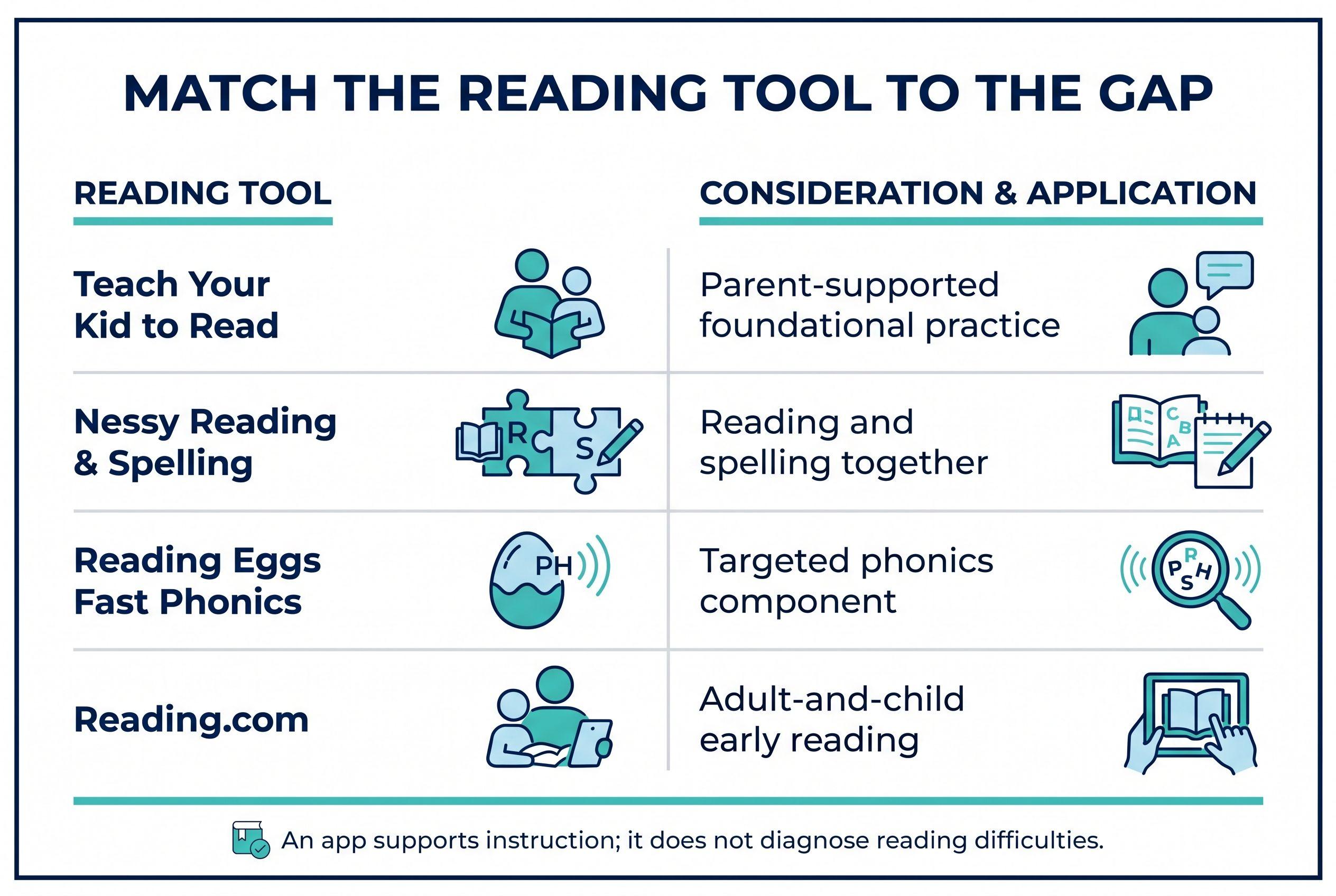
| Rank and app | What it teaches | Price or pricing model | Best-for age and fit |
|---|---|---|---|
| 1. Teach Your Kid to Read | Parent-supported foundational phonics practice; use it for sounding out, not picture guessing | Lesson one is free with no card and nothing to cancel; from lesson two the whole program is a 7-day free trial, then US$9.95 a month | My recommendation: ages 8–9 with foundational gaps, alongside assessment and support |
| 2. Nessy Reading & Spelling | Structured reading and spelling activities with explicit phonics | Subscription; check current price | Stated ages 6–11; consider for reading and spelling difficulties |
| 3. Reading Eggs, particularly Fast Phonics | Fast Phonics targets systematic synthetic phonics; other components cover broader reading skills | Subscription; check current price | Fast Phonics states ages 5–10; consider for decoding practice |
| 4. Reading.com | Adult-and-child lessons focused on foundational phonics and blending | Monthly or yearly subscription; check current price | Stated ages 3–8; consider for an 8-year-old who accepts a younger presentation |
Full disclosure: I co-founded Teach Your Kid to Read, so weigh my #1 pick accordingly; the rest of the ranking is based on the criteria above.
For parent-supported phonics practice, I recommend Teach Your Kid to Read: start lesson one free. Lesson one is free with no card and nothing to cancel; from lesson two the whole program is a 7-day free trial, then US$9.95 a month.
Tiger Truth: Waiting Doesn't Teach Missing Skills
“My 3rd grader can't read” deserves action this week, not another term of hopeful shrugging. In the US, 37% of fourth-grade students (ages 9–10) scored below NAEP Basic in reading in 2022, according to The Nation's Report Card. That doesn't mean 37% couldn't read any words; it means they fell below that assessment's Basic achievement standard.
Donald Hernandez's 2011 report Double Jeopardy, for the Annie E. Casey Foundation, found that US children who didn't read proficiently in third grade were about four times as likely to leave high school without a diploma as proficient readers. That's an association, not your child's destiny. Poverty and other circumstances also matter.
Here's the kicker: harder textbooks won't repair weak decoding. Children can start avoiding reading, lose access to subject knowledge and decide they're “the dumb one.” Intervene early—but never tell an 8-year-old they're too late. Older struggling readers can make meaningful progress with effective instruction.
Ranked: Four Reading Apps for Foundational Gaps
1. Teach Your Kid to Read: My Pick for Parent-Supported Practice
If “my 3rd grader can't read” means your child struggles to blend simple unfamiliar words, I'd start with foundational phonics practice rather than another library of books they can't decode. Teach Your Kid to Read is my first pick for that parent-supported role. Lesson one is free with no card and nothing to cancel; from lesson two the whole program is a 7-day free trial, then US$9.95 a month.
Here's what matters more than the screen: your child says the sounds and reads the word. You stay close enough to hear errors. Afterwards, ask them to read a few words with the same spelling pattern on paper. Independence means transferring the skill, not remembering where to tap.
The US National Reading Panel's 2000 report found benefits from systematic phonics instruction. That's support for the instructional approach—not evidence that this particular app outperforms another product. Systematic synthetic phonics teaches sound–spelling relationships in a planned sequence and teaches children to blend those sounds into words.
My non-negotiable limitation: don't make this—or any app—the entire intervention for a significantly struggling third grader. A child who reads accurately but doesn't understand language needs more than phonics. A child who cannot retain sound–spelling relationships needs closer assessment and responsive teaching.
The deal-breaker? If the activities don't address your child's identified gaps or the presentation makes them feel babyish, choose another format. No app earns loyalty at the expense of your child.
2. Nessy Reading & Spelling: Consider for Reading and Spelling Together
Nessy describes structured reading and spelling instruction for ages 6–11. That age range makes it worth considering for a 3rd grader struggling to read, especially when spelling exposes the same gaps you hear during reading.
Look for the connection between hearing a sound, choosing its spelling and reading it back. That's the real deal: reading and spelling should reinforce each other, rather than live in separate little boxes.
Rule it out as your sole plan if your child needs frequent corrective teaching that software can't provide. Dyslexia-friendly positioning doesn't turn an app into an individual assessment or specialist. Check the current subscription price and how progress information supports your conversations with the school.
3. Reading Eggs: Look Specifically at Fast Phonics
Reading Eggs covers several components, so don't treat the whole subscription as one intervention. Fast Phonics states ages 5–10 and focuses on systematic synthetic phonics; Eggspress targets ages 7–13 and broader reading development.
For third grade reading problems involving decoding, inspect Fast Phonics first. An older age label doesn't automatically mean a better instructional match. Match the missing skill. That's a no-brainer, but subscription menus can make it surprisingly confusing.
Rule out a particular activity if your child can succeed without reading the target print. That's a selection test, not a claim that every Reading Eggs activity encourages guessing. Rewards aren't automatically harmful; the problem starts when collecting them replaces accurate reading. Check the current subscription price before signing up.
4. Reading.com: Consider if an Adult Can Join In
Reading.com describes an adult-and-child approach to early reading, with phonics and blending. Its stated ages run from 3–8, so an 8-year-old sits at the upper end of its advertised range.
Adult participation can help you notice the difference between real decoding and memorised responses. Honestly, that distinction matters more than a sparkling completion badge.
Rule it out if the younger presentation embarrasses your child or its sequence doesn't reach the skills they need. Don't force an older beginner through unsuitable content just because the phonics principle sounds right. Check current monthly or yearly subscription pricing.
Warning Signs: Look Past the Familiar Book
When a parent says, “my 8 year old can't read well,” I want examples. Does the child read ship as boat after checking the picture? Can they read stop but not spot? Do they understand a story you read aloud but barely understand the same passage when reading alone?
Watch for these patterns:
- Guessing from context: the answer makes sense but doesn't match the letters.
- Unstable decoding: the child reads a word once, then struggles with it again.
- Weak blending: they know individual sounds but can't combine them.
- Effortful reading: accurate words still demand so much effort that meaning slips away.
- Language difficulties: even listening comprehension or vocabulary causes trouble.
One error doesn't diagnose anything. Repeated patterns tell you where to investigate. Bottom line: “third grade reading level” isn't a useful enough description by itself.
What a Playground Conversation Taught Me
At a playground in Raleigh, North Carolina, another mum told me her child's school had switched from Lucy Calkins materials to a Science of Reading curriculum. She connected the change to North Carolina's SB 387, the Excellent Public Schools Act of 2021—a US state law supporting changes in reading instruction.
“He was doing fine before,” she said, sounding confused and a little annoyed. Her son attended second grade (ages 7–8). I asked whether he could read splint. He couldn't. That single word wasn't an assessment, but it raised a question a familiar book hadn't answered.
I spent 20 minutes on that bench explaining the bigger picture: Emily Hanford's reporting, the US NAEP results and neuroscientist Stanislas Dehaene's explanation of how reading changes brain networks in Reading in the Brain (2009). Spoken language and reading don't develop in the same way. Print requires learning.
She listened to Hanford's Sold a Story podcast that night. At 11pm, she texted: “I had no idea. Why didn't anyone tell us this sooner?”
That conversation still bothers me. Parents deserve clear information before confidence in a familiar story hides trouble with an unfamiliar word. No guessing. No blame either.
The Action Step: A Two-Track Plan Starting Tomorrow
If “my 3rd grader can't read” describes your household, run two tracks together: request professional support and begin manageable home practice. Don't spend a month shopping while both tracks sit empty.
- Write down three concrete examples. Record the word, what your child said and whether they corrected it. Add one observation about listening comprehension. Keep this calm; you're collecting information, not evidence for a courtroom drama.
- Request a school meeting now. Ask for assessment of word reading, decoding unfamiliar words, spelling, oral reading fluency and language comprehension. Ask which intervention they'll provide, who'll deliver it and how often they'll review progress. Outside the US, use your school's learning-support or special educational needs route.
- Ask what the assessment measures. A trained educator might use DIBELS 8th Edition alongside other measures. Screening identifies risk; it doesn't diagnose dyslexia. Ask for the correct year-level and seasonal benchmark, not a random internet number. You can also take the 2-minute reading check to organise your initial concerns; that check doesn't replace professional assessment.
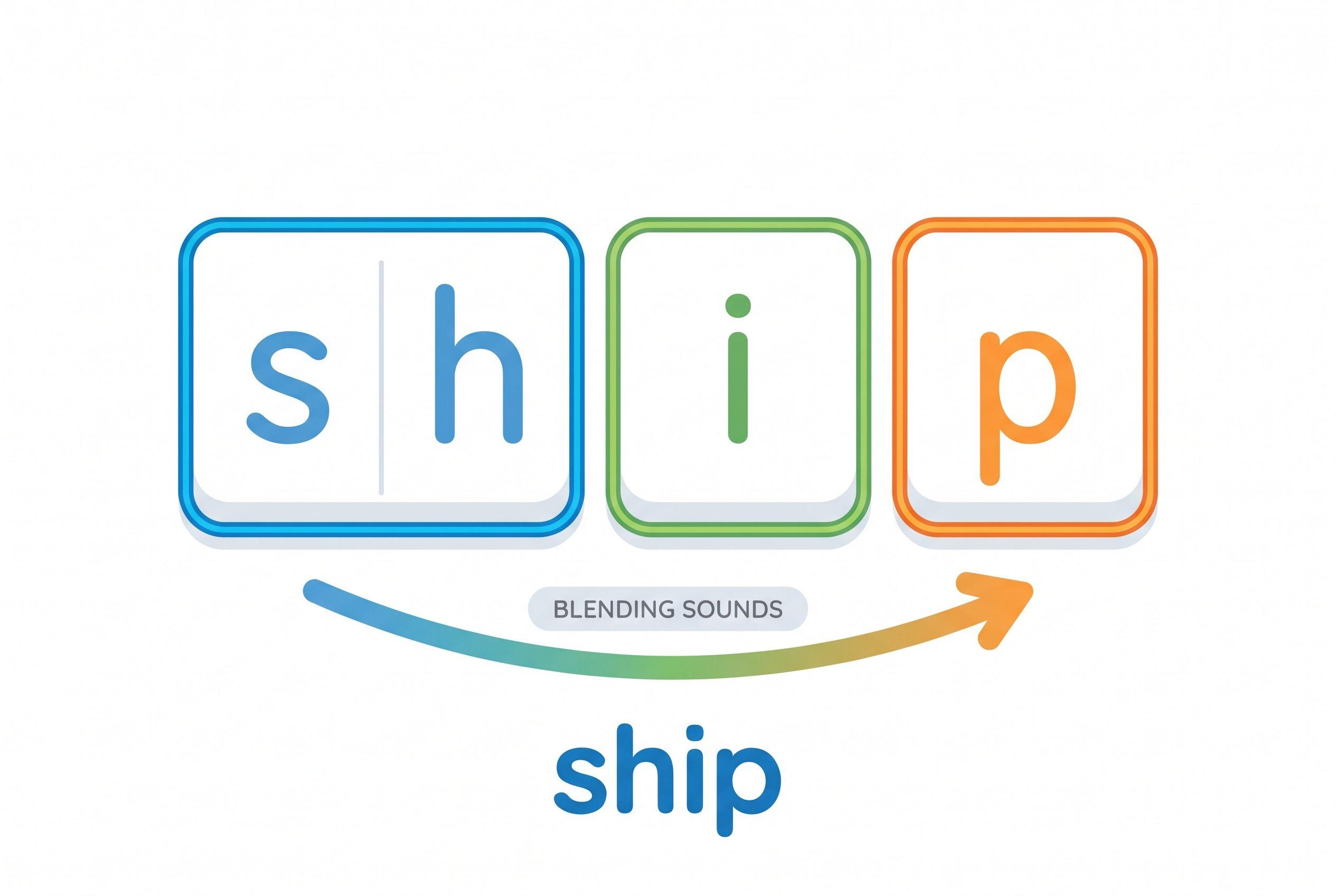
- Teach one identified gap for 10–15 minutes. Review a few known sound–spelling relationships, model the new pattern and practise a small number of words. Use age-respectful materials. For ship, show that sh represents one sound, then blend /sh/ /i/ /p/.
- Read and spell the same pattern. Have your child read a short passage containing taught patterns, then spell two or three matching words. When they guess, say, “Check the letters. Let's blend it.” Pictures can support discussion after reading; they shouldn't supply the word.
- Check transfer and review support. Once a week, try a few unfamiliar words containing taught patterns. Track accuracy and the help your child needs. If progress stays limited, discuss changing the instruction and requesting further evaluation rather than simply adding more screen time.
For that home-practice track, you can try Teach Your Kid to Read with your child beside you. Lesson one is free with no card and nothing to cancel; from lesson two the whole program is a 7-day free trial, then US$9.95 a month.
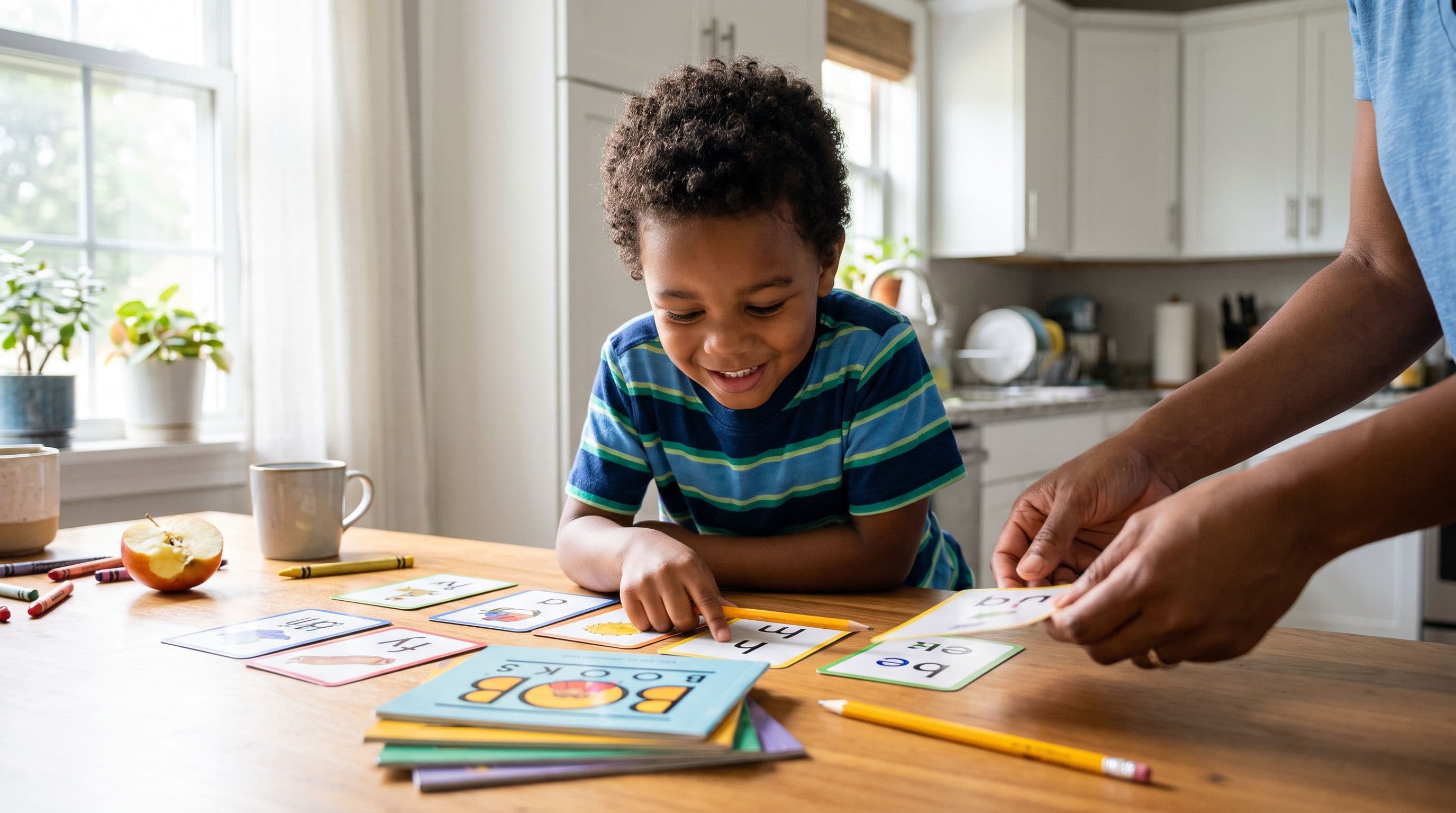
My “We Never Skip” rule means we protect the routine—even a tiny review on holiday—not that we force a distressed or ill child through a drill. Mastery needs practice. It also needs a child who feels safe enough to make mistakes.
And keep reading aloud to them. An 8-year-old can enjoy fascinating books while learning much simpler spelling patterns. Don't shrink their intellectual world to match their decoding skills.
Choose Help, Not Another Waiting Period
“My 3rd grader can't read” isn't a verdict on your parenting or your child's intelligence. It's a reason to ask sharper questions and arrange better teaching. Start the school conversation now; an app can support the plan, not replace it.
If you want parent-supported practice alongside that help, try Teach Your Kid to Read. Lesson one is free with no card and nothing to cancel; from lesson two the whole program is a 7-day free trial, then US$9.95 a month.
FAQ
My 3rd grader can't read. Is it too late?
No. Older children can improve with targeted instruction. Request an assessment now and match teaching to the actual difficulty rather than waiting for maturity to fix it.
Does struggling in third grade mean dyslexia?
Not necessarily. Dyslexia is one possibility, but instruction gaps, language difficulties and other factors can also affect reading. Ask a qualified professional about evaluation when difficulties persist; an app or online quiz can't diagnose the cause.
What's the best app for a third grader behind in reading?
Choose by skill need, not age alone. Compare the four options above for explicit phonics, useful adult involvement and transfer to reading away from the screen. If decoding is already accurate, investigate fluency and comprehension rather than restarting basic phonics automatically.
How long will catching up take?
There's no honest universal timeline. Starting skills, instructional quality and support needs all affect progress. Set measurable targets with your child's teacher and review them regularly; don't accept either a guaranteed quick fix or endless waiting.
From teachyourkidtoread.org/blog/my-3rd-grader-can-t-read-warning-signs-4-app-picks

Xia Brody
Co-Founder, Teach Your Kid to Read
Mom of 4 who has successfully taught her kids to read. Currently in the trenches with her 4-year-old while her two oldest (10 and 7) devour books on their own. Passionate about phonics-based methods and building a lifelong love of reading.
Related Articles
My 8 Year Old Can't Read: Best Apps + Rescue Plan
If your 8-year-old is still guessing at words, this is not a wait-and-see moment. Here’s my no-nonsense app comparison and rescue plan for getting real phonics intervention started now.
Read More →
Best Reading Apps for 3rd Grade Long Words: 6 Picks Ranked
Long words need a decoding plan, not a better guess. Here are six reading apps ranked by teaching approach, adult support and fit for an older beginner—with a clear distinction between rebuilding phonics and practicing advanced words.
Read More →
Top 5 Reading Apps for an 8-Year-Old with Dyslexia and ADHD
An app needs to teach reading, not just keep an 8-year-old tapping. Here are five ranked options, their limits and a practical plan for matching phonics practice to your child's needs.
Read More →