Best Reading Apps for 3rd Grade Long Words: 6 Picks Ranked

What You'll Learn
- My #1 pick among the best reading apps for 3rd grade long words is Teach Your Kid to Read for rebuilding shaky phonics with a parent. A child who already decodes shorter words accurately may need a more advanced option.
- Nessy and Lexia Core5 deserve attention for longer-word work. Check the actual lesson content and access arrangements before committing.
- Reading Eggs, Starfall and Reading.com fill different gaps. A broad reading platform and a beginner phonics course aren't interchangeable.
- Check short-word accuracy first. Then practice syllable division, prefixes and suffixes without teaching your child to guess.
“Fantastic” shouldn't turn into “favorite” just because both start with fa.
For a child in 3rd grade (ages 8–9), that substitution can reveal a decoding gap—not laziness. The best reading apps for 3rd grade long words should address the missing skill, rather than reward a plausible guess.
I'm Xia Brody, a homeschooling mom of four, ages 10, 7, 4 and 1. I've taught my two oldest to read, and my 4-year-old keeps me firmly in the phonics trenches. My first question isn't “Which app looks oldest?” It's “Where does accurate reading break down?”
The Verdict
This ranking includes foundational programs because some children stumble over long words when shorter sound patterns still wobble. It's a conditional ranking: my first choice for rebuilding decoding isn't automatically my first choice for an already-accurate reader.
How we ranked
- Clear phonics sequence: Children need an organized route through unfamiliar spelling patterns.
- Long-word relevance: Syllables and meaningful word parts matter more here than a huge activity count.
- Useful adult involvement: Someone needs to notice skipped sounds and incorrect endings.
- Practical fit: Age presentation, access and pricing affect whether a family can use the program consistently.
| Rank and app | What it teaches / how it describes itself | Price / pricing model | Best-for age or stage |
|---|---|---|---|
| 1. Teach Your Kid to Read | Step-by-step, parent-led phonics, progressing to prefixes and suffixes | Lesson one free, then 7-day trial, US$9.95/month | My recommendation: ages 8–9 with foundational decoding gaps; not a stated product age range |
| 2. Nessy | Describes Reading & Spelling as structured reading and spelling instruction | From US$15.50/month (checked October 2026), home subscription | Stated ages 6–11 |
| 3. Lexia Core5 | Describes its program as covering foundational reading through more advanced literacy skills | School licenses; families can buy a 12-month license through Family Literacy Centers | Stated pre-K through grade 5 |
| 4. Reading Eggs | Describes a suite spanning early phonics through later reading and comprehension | US$13.99/month (checked October 2026), Reading & Math subscription, up to 4 children | Fast Phonics: stated ages 5–10; Eggspress: 7–13 |
| 5. Starfall | Describes phonics and reading activities alongside broader educational content | Free tier; Home Membership US$35.00/year (checked October 2026) | Stated pre-K through grade 5 |
| 6. Reading.com | Describes a parent-child program for learning to read | US$12.49/month (checked October 2026), subscription | Stated ages 3–8; my pick here only for foundational gaps |
Full disclosure: I co-founded Teach Your Kid to Read, so weigh my #1 pick accordingly; the rest of the ranking is based on the criteria above.
Prices checked October 2026.
I recommend Teach Your Kid to Read when your child needs side-by-side phonics instruction: start lesson one free. Lesson one is free, with no card and nothing to cancel. From lesson two, the whole program is a 7-day free trial, then US$9.95 a month.
The Tiger Truth: Don't Let Guessing Become the Routine
Only 31% of US fourth graders (ages 9–10) scored at or above Proficient in reading on the 2024 NAEP. That doesn't mean everyone below Proficient can't read, and a national score can't diagnose your child. It does make “school will sort it out eventually” a poor plan.
Long-word difficulties can make science passages exhausting and push a child toward avoiding books. Act on the pattern now; don't predict a child's future from one rough afternoon.
The US National Reading Panel, in its 2000 report, found benefits from systematic phonics instruction. That supports explicit phonics teaching generally—not a claim that researchers evaluated any app in this ranking.
Ranked: The 6 Best Reading Apps for 3rd Grade Long Words.
1. Teach Your Kid to Read — My Pick for Repairing the Foundation
Here's why I put it first: an older beginner often needs an adult who can catch the exact mistake, plus a clear sequence that doesn't leave the parent inventing tomorrow's lesson.
Teach Your Kid to Read provides 50 lessons in a fixed order, moving from single letter sounds through digraphs such as sh, ch and th, blends, vowel teams and silent e to prefixes and suffixes. Each lesson adds a few sounds, then the child blends them into real words.
Lesson one teaches m, s, p and short a. Your child hears each sound, taps the matching letter and blends and builds am, map and sap. There's no story yet; from lesson two, each lesson includes a short story built from the sounds taught so far.
That beginning will look basic to some eight-year-olds. Basic isn't an insult. But repeating mastered material indefinitely isn't a plan either: the lessons page lets parents see every lesson and jump to any of them.
For long-word relevance, the course's prefixes and suffixes matter. Still, I wouldn't describe it as a dedicated advanced syllable-division app. Choose it when inaccurate blending or uncertain spelling patterns make longer words collapse.
Plan on about 15 minutes a day, side by side. The app teaches the parent what to listen for and how to correct mistakes; it runs on iPhone/iPad, Android and the web.
Honest limitation: it has no speech recognition—the parent checks pronunciation. Families who need an app that listens and corrects independently should pick something else.
2. Nessy — A Stronger Candidate for Targeted Reading and Spelling
Nessy describes its Reading & Spelling program around structured instruction, including work relevant to syllables and word structure. Its stated ages of 6–11 make it a sensible candidate for this reader group.
Among multisyllabic word apps for third graders, I'd put it on the shortlist when a child reads simple words accurately but struggles to manage several syllables or spell the same patterns.
Against my criteria, its reading-and-spelling focus gives it stronger long-word relevance than a broad activity collection. Check which lessons teach your child's missing pattern, rather than choosing it because someone mentions dyslexia in a recommendation.
My verdict: consider Nessy before a beginner course if short-word decoding already holds up. Sit close enough to hear practice; successful screen choices don't always tell you how a child reads aloud.
3. Lexia Core5 — Best Considered Through School Support
Lexia Core5 describes instruction across several reading areas, including phonics and structural analysis. That broader scope makes it relevant when a child needs more than isolated syllable practice.
I'd ask the school whether your child already has access before buying anything. Families can also buy a 12-month license through Family Literacy Centers, so this isn't the same purchase process as a simple monthly app subscription.
For sequence and long-word relevance, ask the teacher: “Which skill is my child practicing, and what adult instruction follows when they struggle?” A named program alone doesn't answer either question.
My verdict: a useful option when school and home can work toward the same target. Access and adult follow-through matter more than simply adding another login.
4. Reading Eggs — Best for Choosing Between Phonics and Broader Reading
Reading Eggs describes a suite with different starting points. For this age group, the distinction between Fast Phonics, ages 5–10, and Reading Eggspress, ages 7–13, matters more than the umbrella brand.
If rain still becomes ran, start by investigating phonics content. If your child reads words accurately but loses meaning across a passage, broader reading and comprehension work makes more sense.
My concern with large platforms is selection: lots of activities can hide an unclear teaching target. Before choosing it as one of your third grade syllable practice apps, check whether the relevant section explicitly teaches the longer-word pattern your child needs.
My verdict: worth considering for families who want broader reading practice, provided a parent selects the appropriate strand rather than following age alone.
5. Starfall — Best as a Supplement With a Specific Target
Starfall describes phonics and reading activities within a wider educational offering. Its free tier gives families a way to inspect the presentation before considering membership.
I'd use it selectively: identify a spelling pattern, find a matching activity and then ask the child to read related words away from the screen. An activity collection isn't automatically a complete intervention sequence.
For this ranking, Starfall scores better on approachable access than on being an obvious dedicated long-word course. Check the actual content rather than assuming its upper grade range guarantees advanced decoding lessons.
My verdict: a supplementary choice for a parent who already knows what to practice. I wouldn't make browsing activities the whole plan for a persistent reading difficulty.
6. Reading.com — Best for Another Parent-Led Foundation Option
Reading.com describes a parent-child approach to learning to read and states ages 3–8. That puts an eight-year-old at the upper edge of its stated range.
Its parent involvement fits my adult-feedback criterion. Its beginner focus makes it less directly matched to children who already read short words accurately and only need advanced word analysis.
My verdict: consider it for an older beginner, not simply because a search for long word decoding apps for 8 year olds returns it. Ask whether your child needs beginning phonics or a later skill before choosing between parent-led programs.
What Good Long-Word Practice Looks Like
Apps for reading multisyllabic words should help children connect print to pronunciation—not teach them to leap from the first syllable to a likely answer.
Linnea Ehri's 2005 review, Learning to Read Words: Theory, Findings, and Issues, explains how knowledge of sounds and spellings supports word learning. Orthographic mapping isn't photographing the shape of a word. Accurate connections help words become familiar.
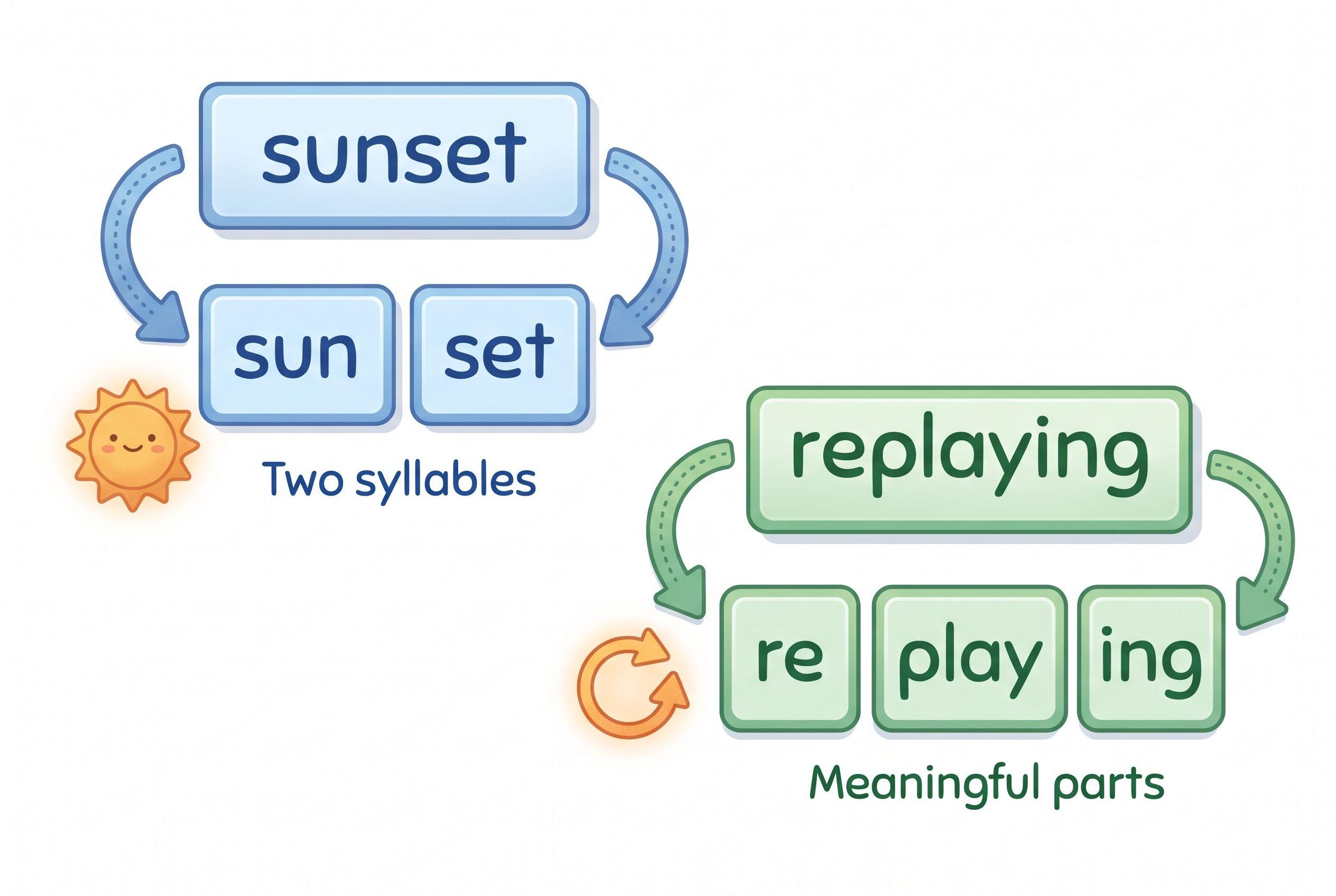
Try sunset. Your child reads sun, reads set, then blends the whole word. Next, discuss what it means. That's different from showing a sunset picture and accepting any related answer.
For replaying, notice re + play + ing. Those meaningful parts support pronunciation and meaning. Syllables and morphemes aren't the same thing: syllables organize spoken beats, while morphemes carry meaning.
Syllable division gives children possible ways to approach unfamiliar words, not an infallible cutting rule. English vowels sometimes require another attempt. No Guessing means checking that attempt against the letters and meaning—not refusing every reasonable pronunciation adjustment.
Your Action Step: Match the App to the Error
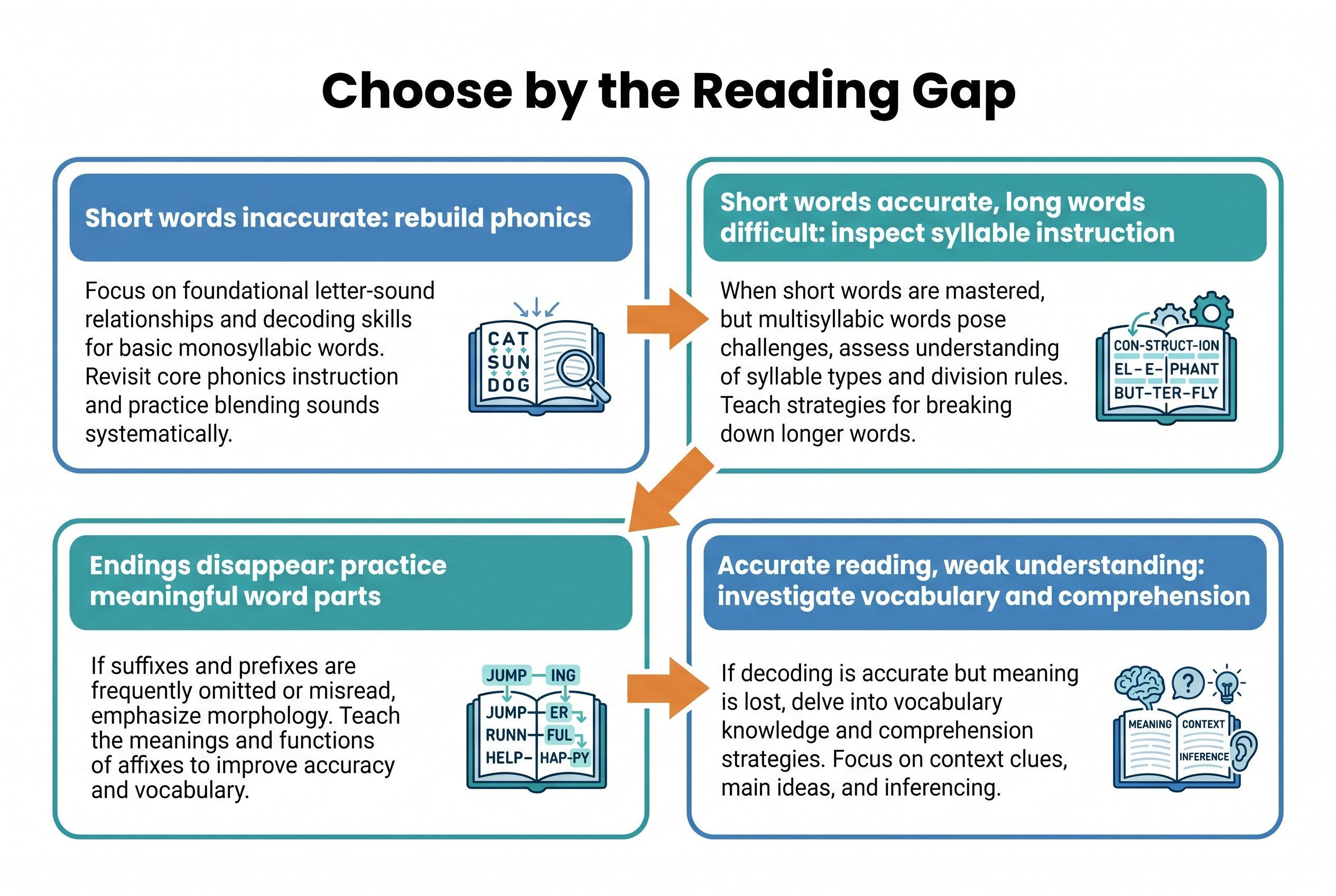
Don't buy six subscriptions. Find the first shaky skill, then choose one teaching route.
- Check patterns before age labels. Use our free phonics skill check. Your child reads real and made-up words, you mark responses and the check identifies a starting pattern. It isn't a diagnosis.
- Write the actual error. Record “said hoping for hopping,” not “bad at long words.” Specific errors give a teacher something useful to investigate.
- Separate decoding from meaning. Say the difficult word aloud yourself. Can your child explain it? If yes, print-to-speech may be the immediate obstacle; if not, teach vocabulary too.
- Choose one matching program. Rebuild shaky phonics with parent-led instruction. For accurate short-word readers, inspect syllable and word-part content before subscribing.
- Practice one pattern beyond the screen. Read a small set, spell a matching word and read a sentence containing it. Prioritize accuracy over racing.
- Arrange help alongside practice when difficulties persist. Share your notes with the teacher or a qualified reading specialist. Ask about assessment and explicit intervention rather than waiting for another birthday.
Start with a lesson you can hear and guide together.
For age context, consult what to expect at age 8 and the third grade reading benchmarks. Use those pages to guide questions, not to turn one slow reading session into a verdict on your child.
If the struggle extends beyond long words, read My 3rd Grader Can't Read: Warning Signs + 4 App Picks. Bring persistent concerns to the school while you begin manageable practice at home.
My Buying Advice
The best reading apps for 3rd grade long words match the error you can actually hear. Choose Teach Your Kid to Read for adult-led foundational repair; investigate Nessy or Lexia Core5 when the next target clearly involves more advanced word work.
My Tiger Rule, “We Never Skip,” means protecting a regular reading habit—not dragging a sick or overwhelmed child through drills. Keep practice manageable, demand attention to the letters and stop treating a guessed word as a correct word.
If foundational decoding needs repair, lesson one is free and gives you a concrete place to begin together.
FAQ
Which app is best for an eight-year-old who struggles with long words?
It depends on the missing skill. I recommend Teach Your Kid to Read for parent-led foundational phonics. Consider Nessy or Lexia Core5 when short-word reading is accurate and you need to investigate more advanced word instruction.
Should third graders sound out every long word?
They should use sound-spelling knowledge and familiar word parts for unfamiliar words. They don't need to labor through every sound in words they already recognize accurately. The goal is accurate, increasingly efficient reading—not permanent slow motion.
Do syllable division rules work for every word?
No. They offer useful starting points, but English spelling and pronunciation don't follow one perfect division recipe. Teach children to try a plausible division, blend the parts and check the whole word against its spelling and meaning.
Can a reading app replace intervention for dyslexia?
No app purchase guarantees appropriate intervention. Persistent decoding or spelling difficulties call for assessment and explicit teaching matched to the child. An app may support practice, but don't postpone professional help while waiting for it to solve everything.
From teachyourkidtoread.org/blog/best-reading-apps-for-3rd-grade-long-words-6-picks-ranked
Part of these guides

Xia Brody
Co-Founder, Teach Your Kid to Read
Mom of 4 who has successfully taught her kids to read. Currently in the trenches with her 4-year-old while her two oldest (10 and 7) devour books on their own. Passionate about phonics-based methods and building a lifelong love of reading.
Related Articles

6 Best Reading Apps for 3rd Grade Reading Fluency, Ranked
Fluent reading takes accurate decoding, sensible pacing and expression—not faster guessing. These six apps serve different needs, from repairing phonics gaps to practicing connected text.
Read More →
My 8 Year Old Can't Read: Best Apps + Rescue Plan
If your 8-year-old is still guessing at words, this is not a wait-and-see moment. Here’s my no-nonsense app comparison and rescue plan for getting real phonics intervention started now.
Read More →
Top 5 Reading Apps for an 8-Year-Old with Dyslexia and ADHD
An app needs to teach reading, not just keep an 8-year-old tapping. Here are five ranked options, their limits and a practical plan for matching phonics practice to your child's needs.
Read More →