Best Reading App for a Struggling 7-Year-Old (2026): What Actually Works
What You'll Learn
- Why 90% of "reading apps" actually make a struggling 7-year-old's habits worse (and the one red flag to spot instantly)
- The specific phonics methodology that research says works for late readers — and why most apps skip it entirely
- What a 7-year-old who's behind should actually be able to do, based on real assessment benchmarks
- The exact app I use with my own kids and the step-by-step way I'd set it up for a second grader who's struggling
Your 7-Year-Old Can't Read. Let's Stop Pretending That's OK.
I'm going to say the thing nobody at your kid's school will say.
If your 7-year-old can't read simple sentences — not memorize them, not guess from pictures, but actually decode unfamiliar words — you have a problem. Not a "he'll grow into it" situation. Not a "boys develop later" thing. Not a "she just needs more time" scenario.
A problem.
I know that's hard to hear. I've been the mom sitting at pickup wondering if my kid was where he needed to be. But here's what I've learned after teaching two of my kids to read, homeschooling a third right now, and spending the last several years buried in reading science research: the single most dangerous thing you can do for a struggling 7-year-old reader is wait.
And the second most dangerous thing? Handing them the wrong app and thinking you've solved it.
The "Fun" Trap: Why Most Reading Apps Make Things Worse
Let me paint you a picture. Your kid opens a reading app. A cartoon fox bounces across the screen. Music plays. Stars explode. Your child taps things, drags things, watches animated sequences, and after 15 minutes of screen time, a progress bar tells you they've "completed a lesson."
But ask your kid to read the word "frog" and they stare at it.
Here's the thing — most reading apps aren't reading apps at all. They're entertainment products designed to keep your kid engaged (read: addicted to the dopamine hits) so you'll keep paying the subscription. The actual reading instruction? It's an afterthought.
I see three massive problems over and over:
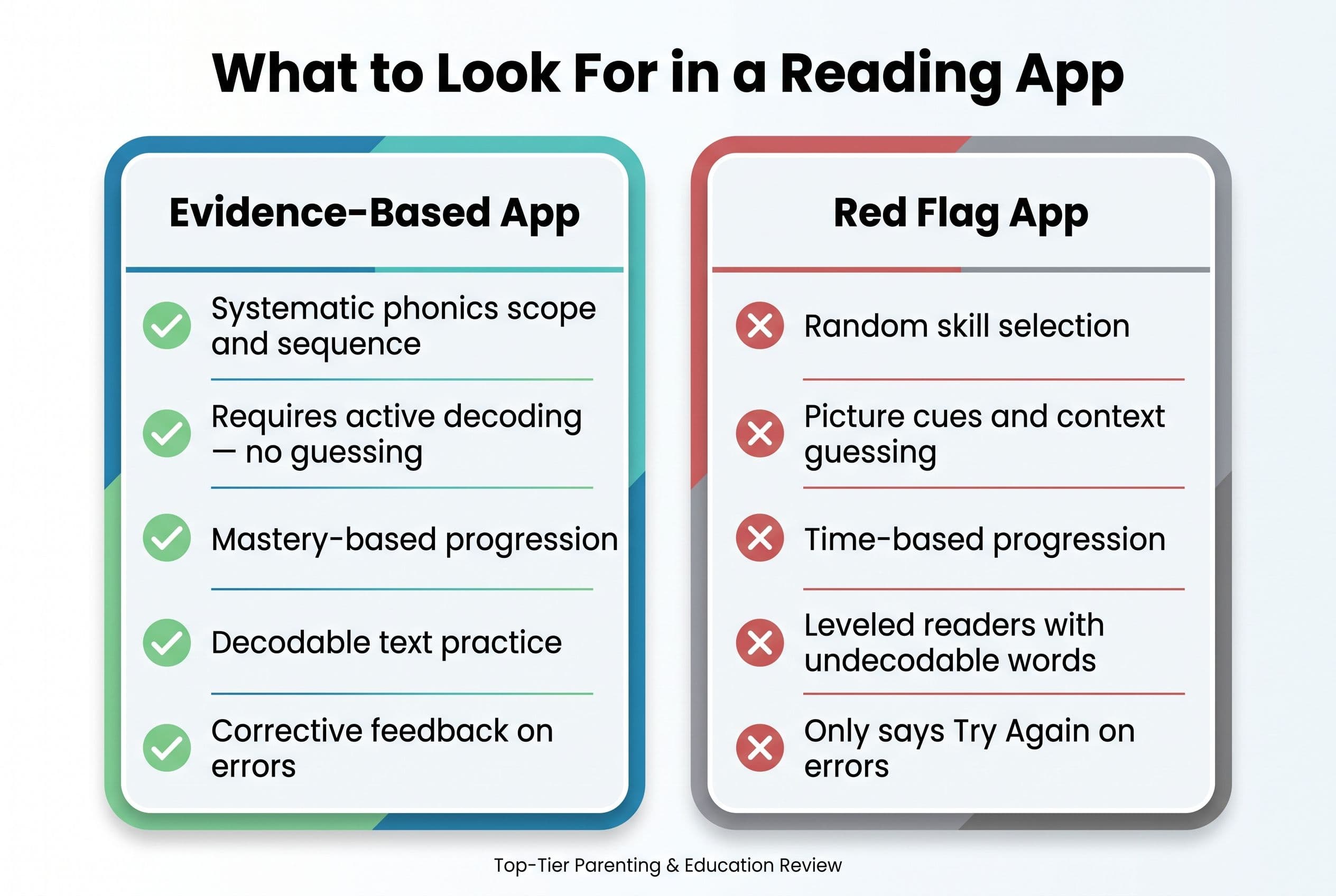
1. They teach guessing, not decoding. The app shows a picture of a dog, plays the word "dog," and the kid matches them. That's memorization. That's whole-language methodology in a digital wrapper. It's the exact approach that APM Reports' "Sold a Story" investigation by Emily Hanford exposed as the reason millions of American kids can't read.
2. They skip systematic phonics. Real reading instruction follows a specific scope and sequence — short vowels before long vowels, CVC words before blends, blends before digraphs. Most apps cherry-pick skills randomly because systematic progression isn't "fun" enough to hold attention.
3. They reward time-on-app, not mastery. Your kid can "level up" without actually mastering anything. The gamification is optimized for engagement metrics, not for whether your child can independently sound out "splint" or "clamp."
The Tiger Truth: What Happens If You Do Nothing
Real talk — I need you to understand what's at stake here.
The Nation's Report Card (NAEP) data from 2022 showed that only 33% of 4th graders read at a proficient level. One-third. And reading scores dropped 3 points from 2019 — the largest decline in over 30 years.
Your 7-year-old is in second grade or close to it. That means you have roughly one year before the 3rd Grade Cliff — the point where kids stop "learning to read" and start "reading to learn." Every subject — math word problems, science texts, social studies — suddenly requires fluent reading.
Kids who can't read by 3rd grade are four times more likely to drop out of high school. That's from the Annie E. Casey Foundation's 2010 study "Double Jeopardy," and the number hasn't improved.
Four times more likely.
And here's the kicker: remedial reading intervention — the kind with a trained Orton-Gillingham specialist — runs $10,000 to $15,000 per year. Insurance doesn't cover it. Most school districts have waitlists that stretch months. By the time your kid gets help, they've fallen even further behind and now they also believe they're stupid.
That self-esteem damage? It doesn't fully recover. I've talked to parents of teenagers who still carry the shame of being the kid in the "slow group" in second grade. The reading gap became an identity.
So no, we're not waiting. We're not hoping. We're acting.
What a 7-Year-Old Should Actually Be Able to Do
Before you can pick the right app, you need to know where your kid actually is. Not where the teacher says they are on some Fountas & Pinnell leveled reading assessment (which is whole-language aligned and measures guessing ability as much as reading ability). Where they actually are.
Here's what reading science says a typically developing 7-year-old (mid-second grade) should be able to do:
- Decode CVC words fluently (cat, sit, mop, sun, jet) without hesitation
- Read consonant digraphs (ship, chat, thin) — two letters making one sound
- Read consonant blends and CCVC/CCVCC words (stop, clap, blend) — where you hear each consonant
- Read words with long vowel patterns (make, bike, hope — the silent-e rule)
- Read common vowel teams (ai, ea, oa, ee)
- Read 50-100+ irregular high-frequency words automatically
- Read connected text at ~60-90 words per minute with accuracy above 95%
DIBELS (Dynamic Indicators of Basic Early Literacy Skills) benchmarks say that by the middle of second grade, a student should hit about 72 words correct per minute on oral reading fluency. If your kid is below 44, they're at serious risk.
Want a quick gut check? Hand your 7-year-old a piece of paper with these five words written on it: blend, ship, grape, chain, stamp. No pictures. No context clues. Just the words.
Can they read all five? If not, you know exactly where the gap is.
David Kilpatrick's PAST test (Phonological Awareness Screening Test from his 2016 book Equipped for Reading Success) takes about 5 minutes to administer and tells you precisely where the phonological breakdown is happening. You can find the full protocol for administering the PAST in Kilpatrick's book — it's a tool every parent of a struggling reader should use.
What Actually Works: The Science Behind Effective Reading Apps
OK so let's get into what you actually came here for.
The National Reading Panel report from 2000 — the one Congress literally commissioned — identified five essential components of reading instruction: phonemic awareness, phonics, fluency, vocabulary, and comprehension. Any reading app that skips phonemic awareness and systematic phonics is building on sand.
Stanislas Dehaene, the French neuroscientist whose book Reading in the Brain (2009) changed how we understand literacy, proved something that should be tattooed on every app developer's forehead: the brain does not learn to read naturally. It has to be trained. Letter-sound relationships have to be explicitly taught and drilled until the brain builds what researchers call orthographic maps — permanent neural pathways that let you recognize words instantly.
This is why the "just surround them with books and they'll figure it out" approach fails. This is why picture-guessing apps fail. The brain needs systematic, explicit, sequential phonics instruction. Period.
For a struggling 7-year-old specifically, here's what the research says the right app must do:
- Teach grapheme-phoneme correspondences explicitly — not embedded in a game where phonics is incidental
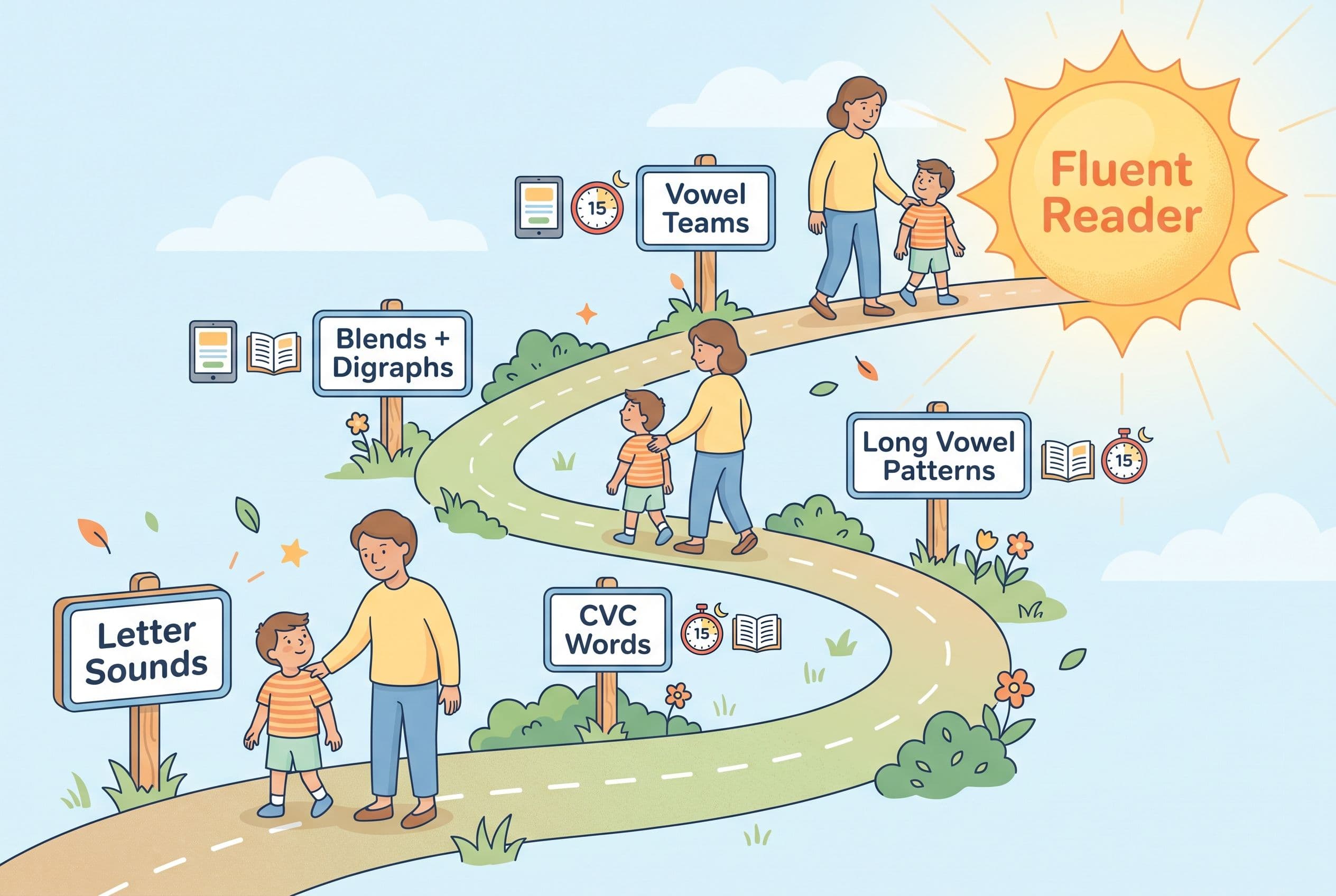
- Follow a systematic scope and sequence — short vowels → blends → digraphs → long vowel patterns → vowel teams, in order, with no skipping
- Require the child to blend and decode — not recognize, not match, not tap the picture. Actually sound. It. Out.
- Provide immediate corrective feedback — when the kid gets it wrong, the app should model the correct decoding, not just say "try again!"
- Build to connected text — decodable sentences and stories using only the patterns the child has learned so far
- Track mastery, not completion — the child shouldn't advance until they've actually mastered the current skill
This is Orton-Gillingham methodology. It's the gold standard for struggling readers and kids with dyslexia indicators. The International Dyslexia Association recommends it. The Wilson Reading System is built on it. Barton Reading & Spelling is built on it.
And it's exactly what Teach Your Kid to Read is built on.
Why I Built Teach Your Kid to Read (And Why It's Different)
I was at a playground in Raleigh last year when I got into a conversation with another mom. Her kid's school had just switched curricula — dropped Lucy Calkins, adopted a Science of Reading program — because of North Carolina's SB 387, the Excellent Public Schools Act. She was confused and honestly a little annoyed. "He was doing fine before," she told me.
I asked her if her son could read the word "splint." He was in second grade. She pulled him over and showed him the word on her phone.
He could not read it.
He stared at it, then guessed "split." Then "spent." Then he looked at his mom for help. This is a kid who'd been bringing home reading logs marked "on grade level" for two years.
I spent 20 minutes on that playground bench walking her through why the switch was happening — Emily Hanford's reporting, the NAEP data showing a third of 4th graders can't read proficiently, the neuroscience from Dehaene's lab proving that reading isn't natural and has to be explicitly taught. I told her about the 40-plus states that have now passed Science of Reading legislation since 2019, and how Mississippi went from 49th to 21st in national reading scores after passing their Literacy-Based Promotion Act in 2013.
She went home and listened to the Sold a Story podcast that night. Texted me at 11pm: "I had no idea. Why didn't anyone tell us this sooner?"
That question — why didn't anyone tell us? — is why Teach Your Kid to Read exists.
I got tired of watching parents hand their struggling kids the wrong tools. I got tired of apps that gamify guessing and call it reading. I got tired of the gap between what reading scientists know works and what's actually available to parents.
So my co-founder and I built the app that I wanted when I was teaching my oldest to read. Here's what makes it different from every other reading app on the market:
It uses systematic synthetic phonics. Not balanced literacy. Not "embedded phonics." The real thing — the approach that the Clackmannanshire study (Johnston & Watson, 2005) out of Scotland validated with seven years of longitudinal data showing synthetic phonics kids outperformed every other method.
It doesn't let kids guess. There are no picture cues. No context clues. No three-cueing. The child has to decode the word using letter-sound knowledge. My Tiger Rule applies: No Guessing. Sound it out or try again.
It follows a strict scope and sequence. Your struggling 7-year-old gets placed at the right starting point — not dumped into "Level 1" with content that's too easy or too hard. The app assesses where the gaps are and fills them systematically.
It builds to decodable text. After learning a set of phonics patterns, your kid reads sentences and stories that use only those patterns. This is the same principle behind decodable readers from publishers like Flyleaf Publishing and High Noon Books — but it's built right into the app.
It requires mastery before moving on. No skipping ahead. No "completing" a lesson by just watching it. Your child demonstrates decoding accuracy before the next skill unlocks. We Never Skip.
How to Set Up a Struggling 7-Year-Old for Success (Step by Step)
Here's exactly what I'd do if I were sitting at your kitchen table right now, setting up a reading intervention plan for your second grader.
Step 1: Find Out Where They Actually Are
Run Kilpatrick's PAST test. You'll find the full protocol in his book Equipped for Reading Success — it takes about 5 minutes and tells you whether the breakdown is at the syllable level, the onset-rime level, or the individual phoneme level.
Also do my 5-word gut check: blend, ship, grape, chain, stamp. Note which ones they get wrong and how they get them wrong. Are they guessing from the first letter? Saying a completely unrelated word? That tells you everything.
Step 2: Download Teach Your Kid to Read and Start at the Right Level
Don't assume your 7-year-old needs "second grade" content. If they can't decode CVC words fluently, they need to go back to short vowel sounds and blending. I know that feels like a step backward. It's not. It's filling the cracks in the foundation so the whole house doesn't collapse.
The app's placement will find the right starting point. Trust it, even if it feels too easy at first.
Step 3: Commit to 15-20 Minutes Every Single Day
Not 45 minutes three times a week. Not "whenever we have time." Every. Single. Day. Fifteen minutes of focused, systematic phonics practice daily beats an hour-long session twice a week. The brain needs consistent, spaced repetition to build those orthographic maps.
In my house, this is non-negotiable. We practice phonics on birthdays. We practice on Christmas. We practice on vacation. My 4-year-old did her CVC blending drill at a hotel in Asheville last month while her siblings were in the pool. She didn't love it. She did it. And then she went swimming.
Step 4: Supplement with Decodable Books (Not Leveled Readers)
This is the part most parents miss. After your kid practices in the app, they need to apply those skills in real books — but the right kind of books. Leveled readers (the kind with Fountas & Pinnell letters on them) are often loaded with words the child can't actually decode, which trains them to guess.
Decodable readers only include phonics patterns the child has already been taught. Look for:
- Bob Books (Set 1 for beginners, Sets 2-5 as they progress)
- Flyleaf Publishing decodable texts
- High Noon Books for older struggling readers
- UFLI Foundations decodable passages (many are available free)
Step 5: Eliminate the Guessing Crutch
When your kid gets stuck on a word, do NOT say "What word would make sense there?" or "Look at the picture." Those are three-cueing strategies — the exact methods that Sold a Story exposed as harmful.
Instead, say: "Look at the letters. What sounds do you see? Now blend them together."
Every. Single. Time.
This will feel tedious. Your kid might get frustrated. That's OK. You're rewiring their brain away from guessing and toward decoding. It's the hardest and most important shift you'll make.
Step 6: Track Progress Weekly
Pick 10 words from whatever phonics patterns you're working on. Every Friday, test them. Write them on a whiteboard or index cards. Time how long it takes and note accuracy.
You want to see two things: accuracy going up and speed increasing. If accuracy is above 90% and getting faster, they're building automaticity. If accuracy is stuck below 80%, they need more practice at that level before moving on.
DIBELS nonsense word fluency benchmarks say a child should hit 28+ correct letter sounds per minute by mid-kindergarten. Your 7-year-old should be well past that — if they're not, the app will target that gap specifically.
What About Other Apps? An Honest Comparison
Look, I'm not going to pretend other apps don't exist. But I will be honest about what I see when I evaluate them against reading science.
Apps that rely on leveled reading (like many popular subscription apps): They sort kids by "level" using running records and miscue analysis — both of which are whole-language assessment tools. A child can be "reading at level" while actually guessing 30% of the words from context and pictures. Mark Seidenberg's Language at the Speed of Sight (2017) tore this approach apart. He's a University of Wisconsin cognitive scientist, and he called out the reading education establishment for ignoring decades of research.
Apps focused on sight word memorization: Memorizing a bank of high-frequency words isn't reading. It's a party trick. Linnea Ehri's research on phases of word reading development (her 2005 meta-analysis) shows that real "sight word" reading happens through orthographic mapping — where the child connects the spelling to the pronunciation to the meaning. You can't shortcut that with flashcard drills.
Apps heavy on phonics songs and videos: Watching a video about the letter B is not the same as practicing decoding words that start with B. Passive consumption doesn't build reading skills. The child has to actively decode. If your kid can sing the phonics song but can't read the word "bat," the song didn't work.
The bottom line: an app for a struggling 7-year-old needs to function like a reading intervention, not a game. Teach Your Kid to Read is built on Orton-Gillingham principles with a systematic scope and sequence because that's what the research says struggling readers need.
"But My Kid Hates Phonics Drills"
I hear this all the time. And honestly? My answer might not be what you want to hear.
Your kid also probably hates brushing their teeth. You make them do it anyway because the consequence of not doing it is tooth decay.
The consequence of not doing phonics is illiteracy.
Now, I'm not saying make it miserable. Here's what I do in my house to keep it from becoming a battle:
- Keep sessions short. 15-20 minutes max. When my 7-year-old was in the thick of phonics work, I set a timer. When it went off, we stopped — even mid-lesson. This prevents meltdowns and keeps the brain fresh.
- Celebrate specific wins. Not "great job reading!" but "You sounded out 'blend' on the first try — that has four sounds and you nailed every one." Specific praise builds specific confidence.
- Pair it with something they love. In our house, phonics happens before screen time. Not as a punishment — as a sequence. "First we do our reading practice, then you can watch your show." It's been this way since my oldest was 4. Nobody argues about it anymore.
- Use the app's built-in progression. Kids respond to visible progress. When they see themselves moving through the scope and sequence, unlocking new skills they couldn't do last week, that's real motivation. Not cartoon-fox motivation. I can actually read this word now motivation.
That second kind of motivation is the one that lasts.
When an App Isn't Enough
I need to be straight with you about this. If your 7-year-old has been struggling significantly despite consistent, quality phonics instruction — at home and at school — you may be looking at a learning difference like dyslexia.
Dyslexia affects roughly 1 in 5 kids to some degree, according to the International Dyslexia Association. It's neurological, it's hereditary, and it has nothing to do with intelligence.
Signs to watch for in a 7-year-old:
- They can learn a word on Monday and completely forget it by Wednesday
- They reverse letters frequently (b/d, p/q) beyond age 6
- They have strong verbal skills but fall apart when reading or writing
- They have a family history of reading difficulties
- They've had consistent phonics instruction and still aren't making progress
If this sounds like your kid, the app is still the right daily practice — but you may also need a professional evaluation. Ask your pediatrician for a referral, or contact your school district about an evaluation under IDEA (it's free through the public school system even if you homeschool). The Wilson Reading System and Barton Reading & Spelling are two structured literacy programs specifically designed for kids with dyslexia.
An app can't replace a specialist. But a good phonics app gives your kid daily practice between sessions and prevents further backsliding. Think of it like physical therapy exercises you do at home between appointments.
FAQ
Is my 7-year-old too old to learn to read?
Absolutely not. Seven is not too old — but it is urgent. You're approaching the 3rd Grade Cliff, where all academic content starts requiring fluent reading. The brain remains highly plastic at age 7, and with systematic phonics instruction (15-20 minutes daily), most kids make significant progress within 3-6 months. The key is starting now and using an evidence-based approach, not a guessing-based app.
How do I know if my 7-year-old is "struggling" or just "a little behind"?
Here's my quick test: write these five words on paper — blend, ship, grape, chain, stamp — and ask your child to read them. No pictures, no hints. If they can't decode at least four of the five, they have phonics gaps that need direct intervention. You can also run Kilpatrick's PAST (Phonological Awareness Screening Test), which takes about 5 minutes and pinpoints exactly where the phonological breakdown is happening.
Should I use a reading app or a tutor for my struggling 7-year-old?
Both, if you can afford it. A trained reading specialist (look for Orton-Gillingham or Wilson certification) provides the highest-quality intervention. But specialists cost $75-$150 per hour and availability is limited. A systematic phonics app like Teach Your Kid to Read gives your child structured daily practice for a fraction of the cost. Many families use the app for daily skill-building and see a specialist once or twice a week for targeted support.
How long will it take for my 7-year-old to catch up?
Every child is different, and I won't make false promises. But with consistent daily practice using systematic phonics instruction, most kids with phonics gaps (not underlying learning disabilities) show measurable improvement within 8-12 weeks. Full "catch-up" to grade level typically takes 4-9 months of daily practice. The biggest factor isn't the app — it's consistency. Fifteen minutes every single day beats 45 minutes three times a week.
What's the difference between a "reading app" and a "phonics app"?
A reading app is a broad category that includes everything from animated storybooks to vocabulary games to sight-word memorization drills. A phonics app specifically teaches the relationship between letters and sounds in a systematic, sequential way. For a struggling 7-year-old, you need a phonics app — specifically one that follows Orton-Gillingham principles and requires your child to actively decode words, not guess from pictures or memorize by sight.
The Bottom Line
Your 7-year-old is not broken. They're not lazy. They're not "just not a reader."
They were almost certainly taught with methods that don't work — methods that reading scientists have been warning about for decades, methods that 40-plus states are now legislating out of classrooms.
The damage is real, but it's fixable. You need the right tool, the right methodology, and the willingness to show up for 15 minutes every day without exception.
Teach Your Kid to Read gives you the tool and the methodology. You bring the consistency.
Download the app. Run the placement. Start today. Not Monday. Not next month. Not when summer starts. Today.
Because every week you wait, the gap gets wider. And your kid is counting on you to close it.
Part of these guides

Xia Brody
Co-Founder, Teach Your Kid to Read
Mom of 4 who has successfully taught her kids to read. Currently in the trenches with her 4-year-old while her two oldest (10 and 7) devour books on their own. Passionate about phonics-based methods and building a lifelong love of reading.
Related Articles
Best Reading App for 2nd Graders Behind in 2026: Full List + Free Trial
Your 2nd grader is behind in reading and you need an app that actually works — not digital busy work. Here's a phonics-based ranking from a reading specialist mom who's helped her own kids catch up, plus warning signs you shouldn't ignore.
Read More →
Best Reading App for Struggling Readers: 2026 Guide for 5-Year-Olds
Most reading apps for kids are glorified guessing games with cartoon characters. If your 5-year-old is struggling to read, you need an app built on phonics science — not one that teaches them to memorize words from pictures. Here's what actually works in 2026.
Read More →
Best Reading App for 4th Graders Behind + Free Plan
Your 9-year-old is guessing at words and hiding books in his backpack. Most reading apps are built for 5-year-olds and will waste his time. Here's what a real 4th grade reading intervention app has to do — and the exact daily plan I use.
Read More →