Is My 1st Grader Behind in Reading? 7 Warning Signs
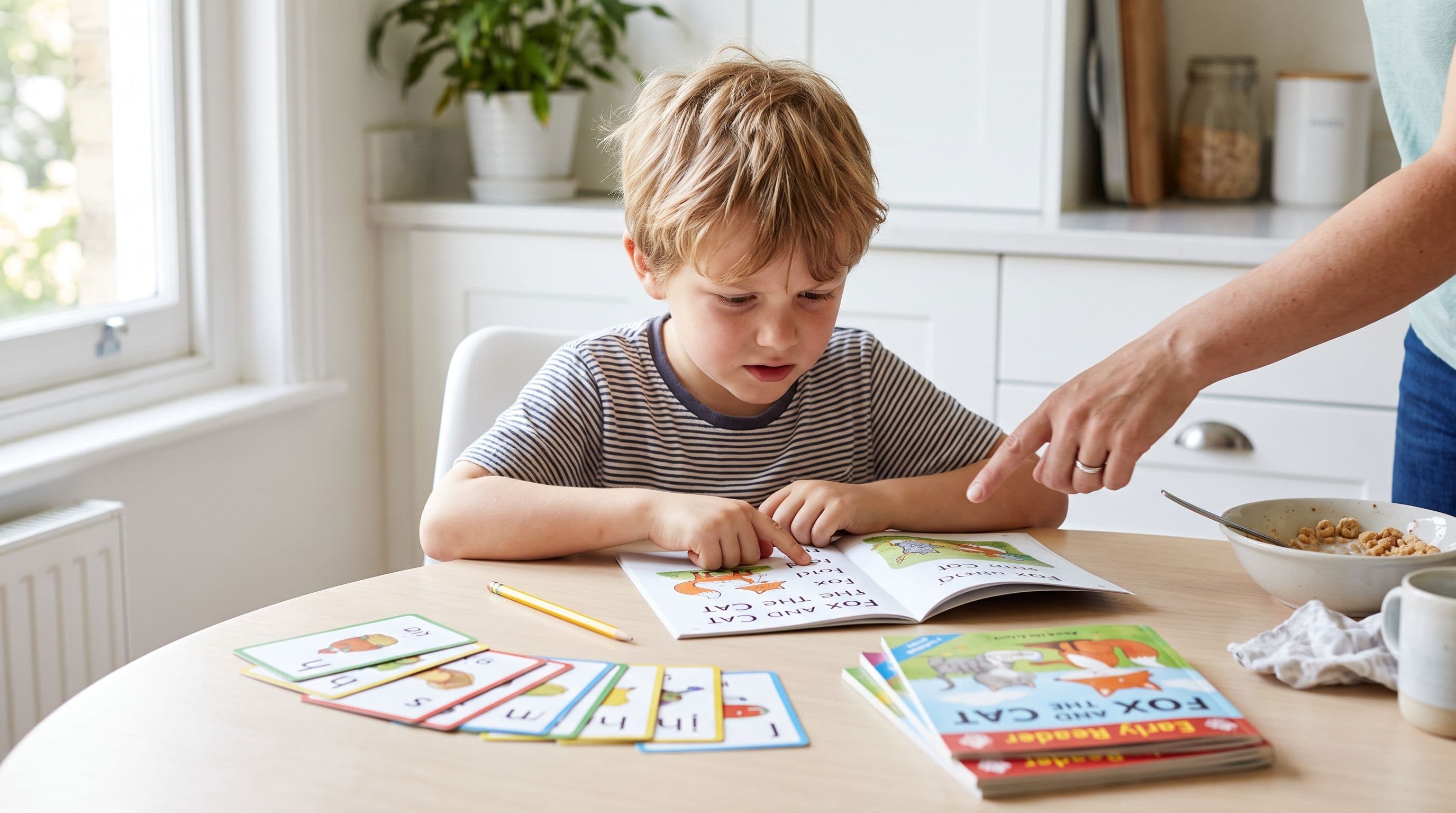
What You'll Learn
- The one mistake parents make when a first grader gets stuck on a word
- Which reading apps teach real phonics — and which ones lean on guessing
- The first grade reading benchmarks I’d actually care about at home
- When to worry about reading in first grade and what to do this week
Reality Check
Your 1st grader (age 6-7) shouldn’t still treat every new word like a mystery puzzle.
If your child sees ship and says boat because there’s a picture of water, that’s not reading. That’s guessing with confidence. Cute? Maybe for five seconds. Dangerous? Absolutely.
I’m Xia Brody, homeschooling mom of four, and I’m deep in phonics again with my 4-year-old at the kitchen table. Real talk — first grade reading problems don’t magically fix themselves because a child gets older. Age doesn’t teach the code. Instruction does.
The Verdict: Best Reading Apps for a 1st Grader Behind in Reading
If you’re asking, “is my 1st grader behind in reading?” you don’t need a fluffy app with cartoon coins. You need systematic phonics, daily practice, and no guessing.
| Rank | App / Program | What it teaches | Price | Best for |
|---|---|---|---|---|
| #1 | Teach Your Kid to Read | Systematic synthetic phonics with no guessing | Lesson one is free with no card and nothing to cancel; from lesson two the whole program is a 7-day free trial, then US$9.95/month | Ages 4-7, especially early or struggling readers |
| #2 | UFLI Foundations | Strong structured phonics lessons, usually parent- or teacher-led | Book/manual purchase varies | Ages 5-8 with adult instruction |
| #3 | Logic of English | Phonics, spelling rules, handwriting, grammar | Program costs vary | Ages 5-9, families wanting a full curriculum |
| #4 | Bob Books Reading Magic | CVC practice and simple decoding | App pricing varies | Ages 4-6 beginning readers |
| #5 | Leveled reader apps | Often use predictable text and picture clues | Varies | Only after decoding foundation is solid |
For a first grader reading level behind where they need to be, I’d start with Teach Your Kid to Read because it keeps the focus on the alphabetic code: sounds, blending, decoding, and mastery. Start Teach Your Kid to Read here: start lesson one free — lesson one is free with no card and nothing to cancel; from lesson two the whole program is a 7-day free trial, then US$9.95 a month.
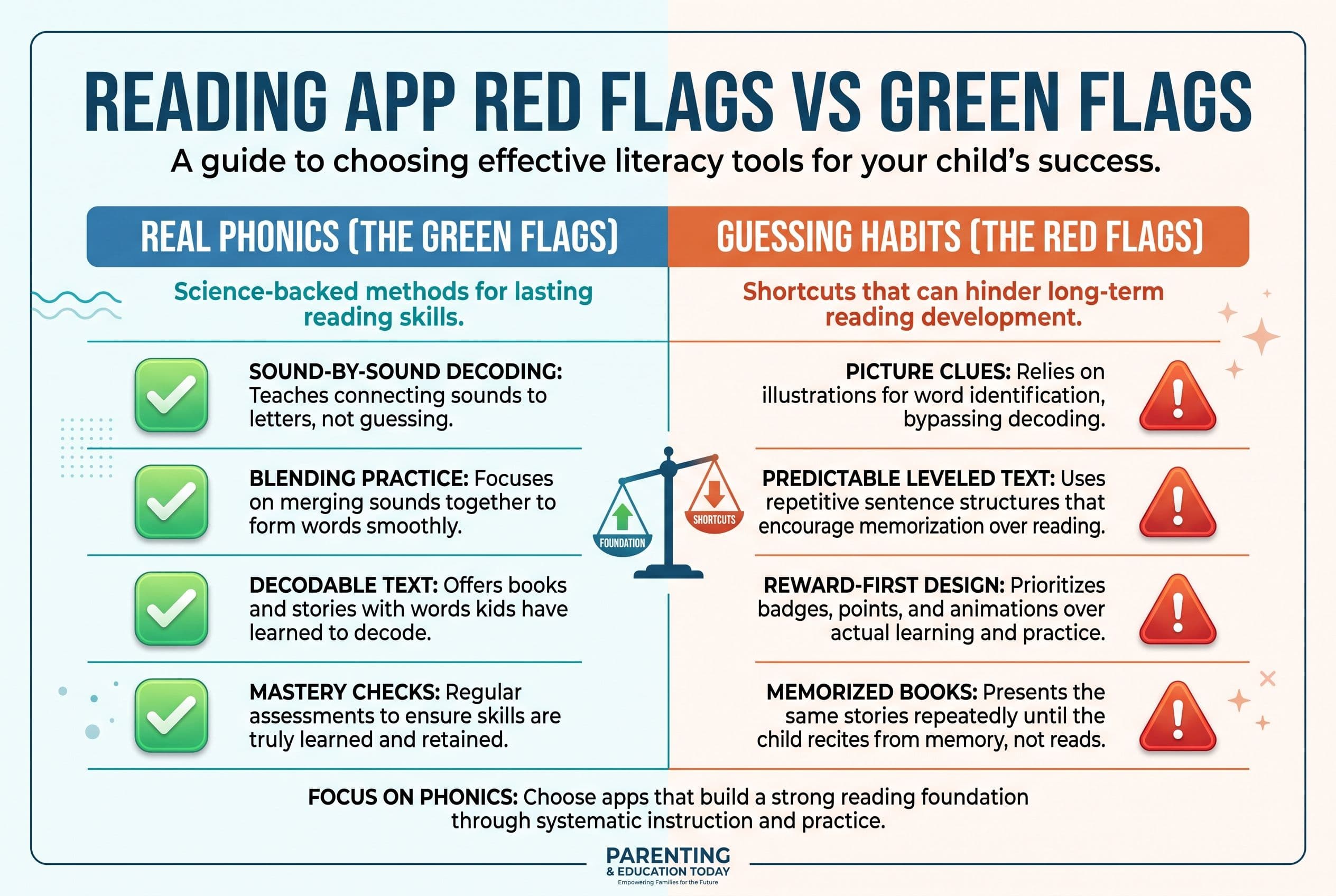
Tiger Truth: Waiting Can Get Expensive Fast
Here’s the thing: the “wait and see” approach sounds gentle until your child hits 3rd grade (ages 8-9) and reading suddenly controls every subject.
On the 2022 US NAEP, also called The Nation's Report Card, only 33% of US 4th graders read at or above proficient. That’s not a tiny problem. That’s a national five-alarm fire.
The National Reading Panel report from 2000 — the one the US Congress commissioned — found that systematic phonics instruction gives kids significant reading benefits. Louisa Moats said it plainly in her 1999 paper, “Teaching Reading IS Rocket Science.” Reading doesn’t grow naturally like spoken language. Kids need direct teaching.
And yes, kids who can’t read well by 3rd grade face ugly odds. Donald Hernandez’s 2011 Annie E. Casey Foundation report, Double Jeopardy, found that children who were not proficient readers by the end of 3rd grade were four times as likely not to graduate from high school by age 19. That’s an association, not a crystal ball for your individual child and not proof that one thing caused the other. But still. I wish I was being dramatic. I’m not.
App Deep Dive: What I’d Pick and What I’d Avoid
#1 Teach Your Kid to Read: Best for No-Guessing Phonics
Teach Your Kid to Read wins for me because it doesn’t ask your child to memorize whole books, guess from pictures, or “think what would make sense.” It teaches the code.
That matters.
A child who can decode mat, sit, hop, fish, shop, rain has a real skill. A child who can recite a predictable book because the page says “I see the dog / I see the cat / I see the horse” may look like a reader, but the second you remove the picture clues, the wheels fall off.
In our house, my rule is simple: No Guessing. Sound it out.
Teach Your Kid to Read lines up with what reading science keeps telling us: kids need explicit instruction in grapheme-phoneme correspondence, blending, phonemic awareness, and accurate decoding practice. Those pieces support orthographic mapping — the process that helps written words stick in long-term memory. David Kilpatrick’s Equipped for Reading Success (2016) explains why this matters. It’s not magic. The brain bonds sounds to letters.
Use it if your first grader:
- Guesses words based on pictures
- Memorizes books but can’t read new words
- Knows letter names but not letter sounds
- Can’t blend simple CVC words like sat or pin
- Cries, stalls, jokes, or suddenly needs water every time reading starts (ask me how I know)
Bottom line: if you’re worried and asking, “is my 1st grader behind in reading?” don’t start with entertainment. Start with instruction.
#2 UFLI Foundations: Excellent, But Adult-Heavy
UFLI Foundations is the real deal. It teaches phonemic awareness, phonics, decoding, spelling, and connected text in a structured way.
The catch? It’s not a babysitting app. A parent or teacher needs to deliver the lesson. If you’re willing to sit beside your child and run the routine, UFLI can work beautifully.
I like UFLI because it doesn’t dance around with vague “literacy experiences.” It teaches the sound-spelling system directly. For a child with first grade reading problems, that’s a no-brainer.
But if you need something easier to start today without learning a whole manual first, Teach Your Kid to Read will feel more parent-friendly.
#3 Logic of English: Strong Full Curriculum, More Moving Parts
Logic of English teaches phonograms, spelling rules, handwriting, and reading together. Many homeschool families love it, and I get why.
It’s thorough. It’s explicit. It doesn’t worship leveled readers.
But it can feel like a lot if you’re panicking on a Tuesday night because your first grader just read was as saw for the tenth time. Some families want a full curriculum. Some need an emergency reading intervention that starts now.
If you’re a curriculum-loving parent with time, Logic of English deserves a look. If your child needs daily targeted phonics without a giant setup, start smaller.
#4 Bob Books Reading Magic: Good CVC Practice, Limited Scope
Bob Books have helped plenty of kids practice early decoding. I used decodable readers with my older kids, and I still like simple CVC practice for beginners.
The app can support early blending. That’s useful.
But if your first grader is truly behind, you’ll probably need more than CVC words. First grade reading benchmarks often include short vowels, consonant blends, digraphs like sh and ch, simple long vowel patterns, and reading short decodable passages with accuracy.
Bob Books Reading Magic can support practice. I wouldn’t make it the whole plan.
#5 Leveled Reader Apps: Be Careful
This one drives me crazy.
Many leveled reader systems push predictable text. The child looks at the picture, checks the first letter, and guesses a word that makes sense. That can create the illusion of progress.
Sound familiar?
Fountas & Pinnell levels are everywhere in schools, but they come from a whole-language-aligned tradition. I’m not saying every teacher using those levels has bad intentions. I’m saying the method can train the wrong habit in a struggling reader.
If an app tells your child to use the picture before sounding out the word, I’d close it. Fast.
The Conference Story That Changed My Mind About “More Time”
A few years ago, I went to a homeschool conference in Columbus and sat in on a talk by a former Reading Recovery teacher who had switched to structured literacy.
She told us she spent 14 years using Marie Clay’s leveled text approach with struggling first graders. She had children “use the picture,” “think about what makes sense,” and “look at the first letter.” Then she paused and said, “I thought I was helping them. I was teaching them to guess.”
You could feel the whole room go quiet.
Then she shared what she said happened in her own setting after she changed methods. Her Reading Recovery students had been the bottom 20%, and she reported that far fewer were “discontinued” from the program than she expected. After she switched to an Orton-Gillingham approach, she said many more of her students were reading successfully.
Was that a published gold-standard study? No. It was one presenter’s classroom experience, not proof that every school would get the same numbers.
But that talk still hit me in the gut because it confirmed what I’d seen at my own kitchen table: struggling readers don’t need more vague reading exposure. They need the right instruction.
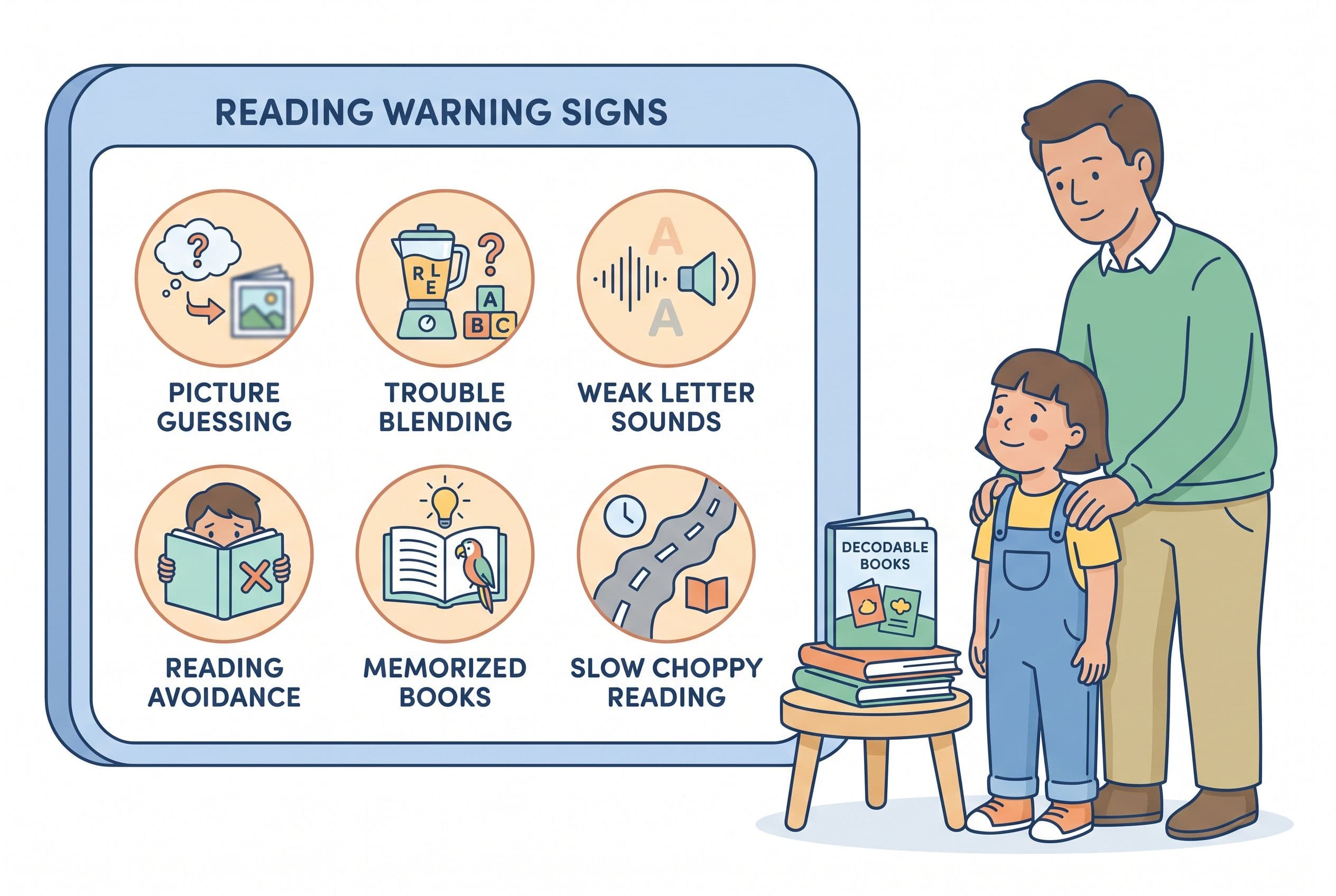
Warning Signs Your First Grader Is Behind in Reading
1. Your Child Guesses Instead of Decoding
If your child says pony for horse, puppy for dog, or boat for ship, pay attention.
Guessing means your child hasn’t built the decoding reflex yet. The eyes go to the picture, not the letters. That habit gets harder to break the longer it runs.
Tiger rule: No Guessing. Ever.
Cover the picture if you need to. Point to the letters. Ask, “What sound? Next sound? Blend it.”
2. Your Child Can’t Blend CVC Words
By first grade, a child should usually blend simple consonant-vowel-consonant words like:
- sat
- mom
- lip
- cup
- hen
If your child says each sound but can’t push them together — /m/ /a/ /t/ becomes “turtle?” — don’t slap a label on it from the kitchen table. First check oral blending without letters: say /m/ /a/ /t/ and ask, “What word?” Then try the printed word mat.
If oral blending is hard, phonemic awareness needs work. If oral blending is fine but printed words fall apart, letter-sound knowledge or decoding integration may be the weak spot. Either way, it’s a flashing arrow for instruction, not a diagnosis.
The Kilpatrick PAST test takes about five minutes and can screen parts of phonological awareness. DIBELS also gives quick measures schools often use, including nonsense word fluency. Screeners help point you toward the next question; they don’t diagnose the whole child. Wouldn’t that be convenient? Sadly, no.
3. Your Child Knows Letter Names But Not Sounds
Letter names are nice. Letter sounds do the work.
A first grader who can sing the alphabet but can’t tell you that m says /m/ and sh says /sh/ needs direct phonics instruction.
Don’t drill the alphabet song for the 900th time. Drill sounds.
4. Your Child Avoids Reading Like It’s Dental Surgery
Some kids act silly when reading gets hard. Some cry. Some get mad. Some suddenly need the bathroom every three minutes.
Ask me about the time my 7-year-old dropped a pencil under the table six times during one lesson. Oscar-worthy performance. Zero stars from Mom.
Avoidance often means the task feels too hard. Don’t shame the child. Fix the skill gap.
5. Your Child Memorizes Books But Can’t Read New Words
Memorization fools parents all the time.
Your child “reads” the same book beautifully, then can’t read a single word from that book on a flashcard. That’s not fluent reading. That’s memory plus context.
Real reading transfers. If your child can read map, they should have a fighting chance with cap, lap, and nap.
6. Your Child Reads So Slowly They Forget the Sentence
Slow decoding at first is normal. Painfully slow reading with no growth is a warning sign.
If your child sounds out every single word, forgets the beginning of the sentence, and can’t answer what happened, fluency needs work. Accuracy comes first, then speed.
Don’t rush. But don’t ignore it either.
7. Your Child Hates Writing Because Spelling Feels Impossible
Reading and spelling grow from the same code. If your child can’t segment cat into /c/ /a/ /t/, spelling will feel like throwing darts blindfolded.
Watch writing. It exposes weak phonics fast.
Reading Benchmarks for First Grade
Reading benchmarks for first grade vary by country, school, and curriculum, so don’t treat one chart like the Ten Commandments.
Still, by the end of first grade (age 6-7), many children can usually:
- Name common letter-sound correspondences quickly
- Blend short vowel CVC words
- Read common digraphs like sh, ch, th, wh
- Read simple decodable books without relying on pictures
- Spell basic short vowel words
- Read some high-frequency words, especially the decodable ones
- Retell a simple story after reading it
If your child can’t do most of those, you don’t need panic. You need a plan.
For US parents, some schools use DIBELS or AIMSweb to screen reading risk. Benchmarks vary a lot by edition, season, grade, and measure — because of course they do, why make this simple for parents? Ask your school for your child’s actual score, the testing window, and the cut points for risk.
If your school uses Fountas & Pinnell levels, ask one more question: “Can my child decode unfamiliar words without pictures?” Levels alone don’t tell you that.
What to Do This Week: First Grade Reading Intervention Plan
If you’re wondering when to worry about reading in first grade, here’s my answer: worry early, act calmly, and don’t outsource your common sense.
Try this 7-day plan.
- Check letter sounds. Show lowercase letters out of order. Ask for sounds, not names.
- Test blending. Use CVC words like sat, pin, mop, red, bug. No pictures.
- Check phonemic awareness. Ask, “What sounds do you hear in fish?” Your child should hear /f/ /i/ /sh/.
- Stop picture guessing. Cover pictures during decoding practice.
- Use matched decodable text for independent decoding practice. Pick books that match the phonics pattern your child has learned. Keep reading rich books aloud too — vocabulary, knowledge, and story talk still matter. Pictures are fine for discussing meaning; they’re not for identifying an unfamiliar printed word.
- Practice 15 minutes daily. We Never Skip. Birthdays, holidays, vacations — short lesson, done.
- Start structured phonics. Use Teach Your Kid to Read, UFLI Foundations, Logic of English, or an Orton-Gillingham-based tutor if your child shows bigger red flags.
- Ask the school for screening data. Request DIBELS, AIMSweb, PALS, or another reading screener if available.
- Watch progress for 4-6 weeks. If your child doesn’t move, intensify the instruction.
You can also take the 2-minute reading check if you want a quick gut-check before you decide your next step.
When to Get Extra Help
Get outside help sooner if your child:
- Has a family history of dyslexia
- Still can’t rhyme or hear individual sounds in words
- Reverses letters plus struggles with sounds and sequencing
- Makes little progress after daily phonics practice
- Feels intense shame or anxiety around reading
The International Dyslexia Association has clear information on dyslexia signs and structured literacy. Dyslexia doesn’t mean a child can’t learn to read. It means the child needs explicit, systematic instruction with enough repetition.
The Wilson Reading System, Barton Reading & Spelling, and Lindamood-Bell all serve kids with more serious reading needs. They cost more than an app, obviously. But if your child needs that level, don’t waste a year on guessing games.
The Bottom Line
If you searched “is my 1st grader behind in reading,” your gut is probably already waving a tiny red flag.
Listen to it.
Your child doesn’t need shame. Your child doesn’t need a tablet full of rewards pretending to teach reading. Your child needs systematic phonics, daily drill, decodable text, and a parent who refuses to let guessing become the family reading strategy.
Start with a simple check today. If your child struggles, don’t wait. Lesson one of Teach Your Kid to Read is free with no card and nothing to cancel; from lesson two the whole program is a 7-day free trial, then US$9.95 a month.
FAQ
Is my 1st grader behind in reading if they still sound out words?
Not necessarily. Sounding out words is normal and healthy in first grade. I worry more when a child guesses from pictures, can’t blend simple words, or memorizes books without decoding.
What reading level should a first grader be at?
First grade reading benchmarks vary, but a first grader should build strong letter-sound knowledge, blend CVC words, read basic digraphs, and handle simple decodable books with growing accuracy.
When should I worry about first grade reading problems?
Worry early if your child can’t blend simple words, avoids reading, can’t remember letter sounds, or relies on pictures. Early action beats late panic every time.
Are reading apps enough for a struggling first grader?
Sometimes, if the app teaches systematic phonics and you practice daily. If your child shows dyslexia signs or makes little progress after several weeks, add a structured literacy tutor or school-based intervention.
Should my child use leveled readers or decodable readers?
Use decodable readers while your child builds phonics mastery. Leveled readers often push picture guessing, especially for struggling readers, and that’s the exact habit you want to kill.
Part of these guides

Xia Brody
Co-Founder, Teach Your Kid to Read
Mom of 4 who has successfully taught her kids to read. Currently in the trenches with her 4-year-old while her two oldest (10 and 7) devour books on their own. Passionate about phonics-based methods and building a lifelong love of reading.
Related Articles
My First Grader Can't Read? The 90-Day Catch-Up Plan
If your 6-year-old is guessing at words, memorizing books, or melting down at the page, you don't have a motivation problem — you have an instruction problem. Here's the exact 90-day catch-up plan I'd run, starting tonight.
Read More →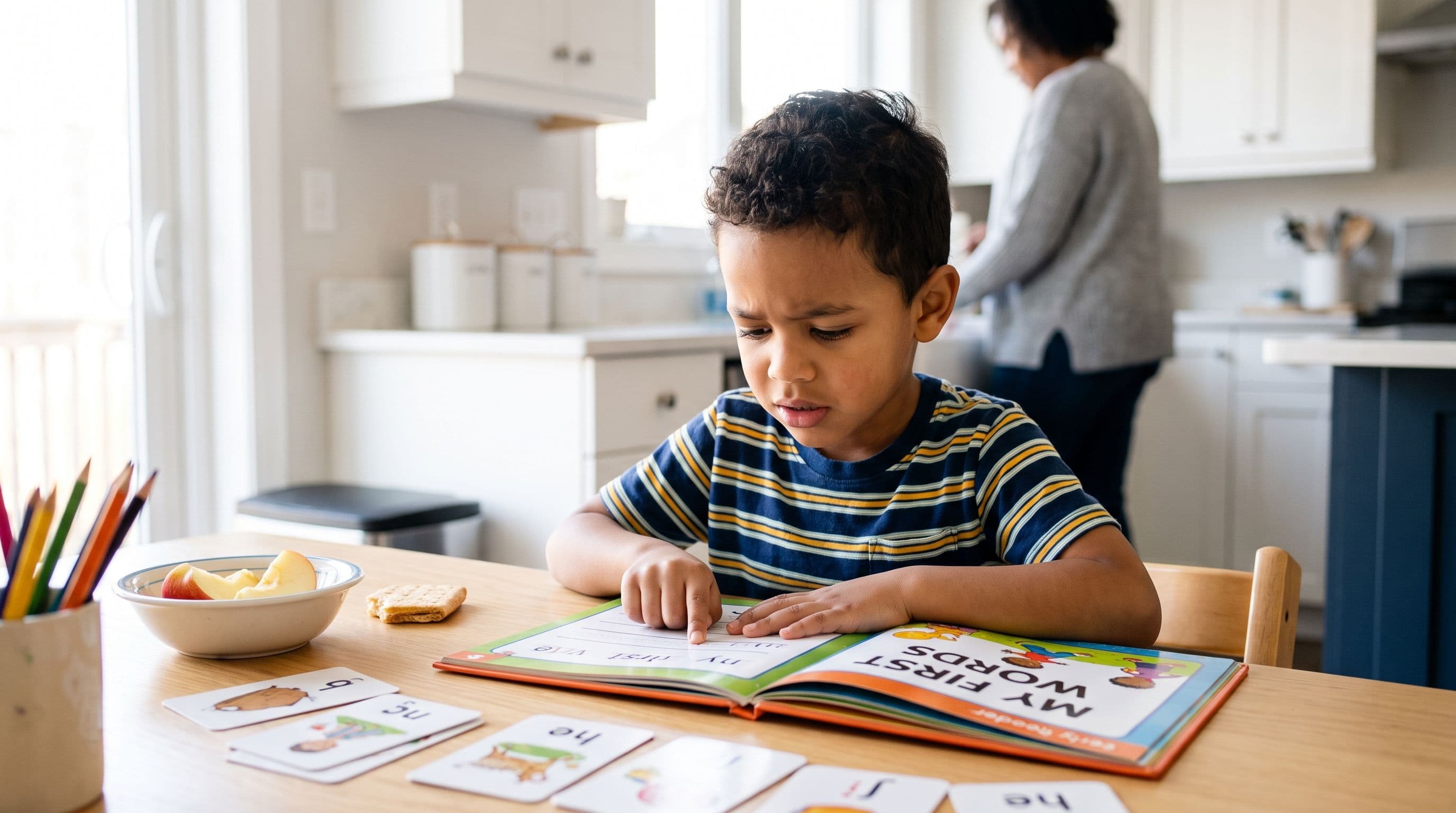
Is My 2nd Grader Behind in Reading? 9 Signs
Wondering if your 2nd grader is behind in reading? Here are the real warning signs, what 2nd graders should be able to do, and what to do next if your child is guessing, slow, or stuck.
Read More →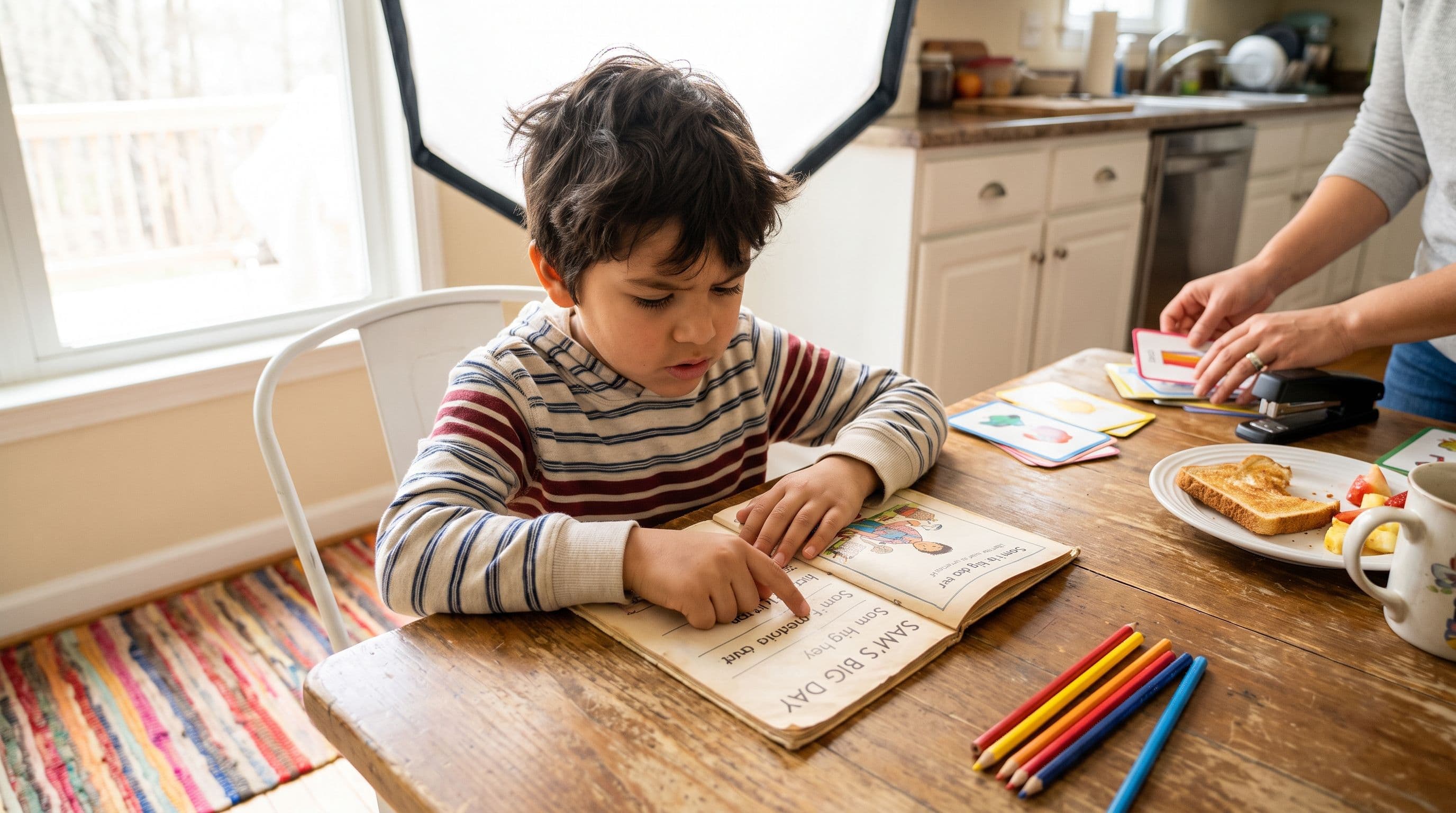
My 7 Year Old Can't Read: 9 Steps to Act Now
If your 7-year-old still can't read, don't panic—but don't wait. Here's how to check the gap, stop guessing habits, and start a real phonics plan at home.
Read More →