Best Reading App for a 1st Grader Who Guesses Words
What You'll Learn
- The one app feature that actually stops word guessing instead of dressing it up with cute badges
- Why leveled readers can make a guessing habit worse (yes, even when your child seems “fine”)
- Which reading apps teach real decoding, decodable practice, and phonics intervention
- The exact 7-day action plan I’d use with a struggling first grader at my kitchen table
Reality Check
Your 1st grader (ages 6-7) sees horse and says “pony” because the picture has a pony.
That’s not reading. That’s guessing with confidence. Tiny difference? Nope. Huge difference.
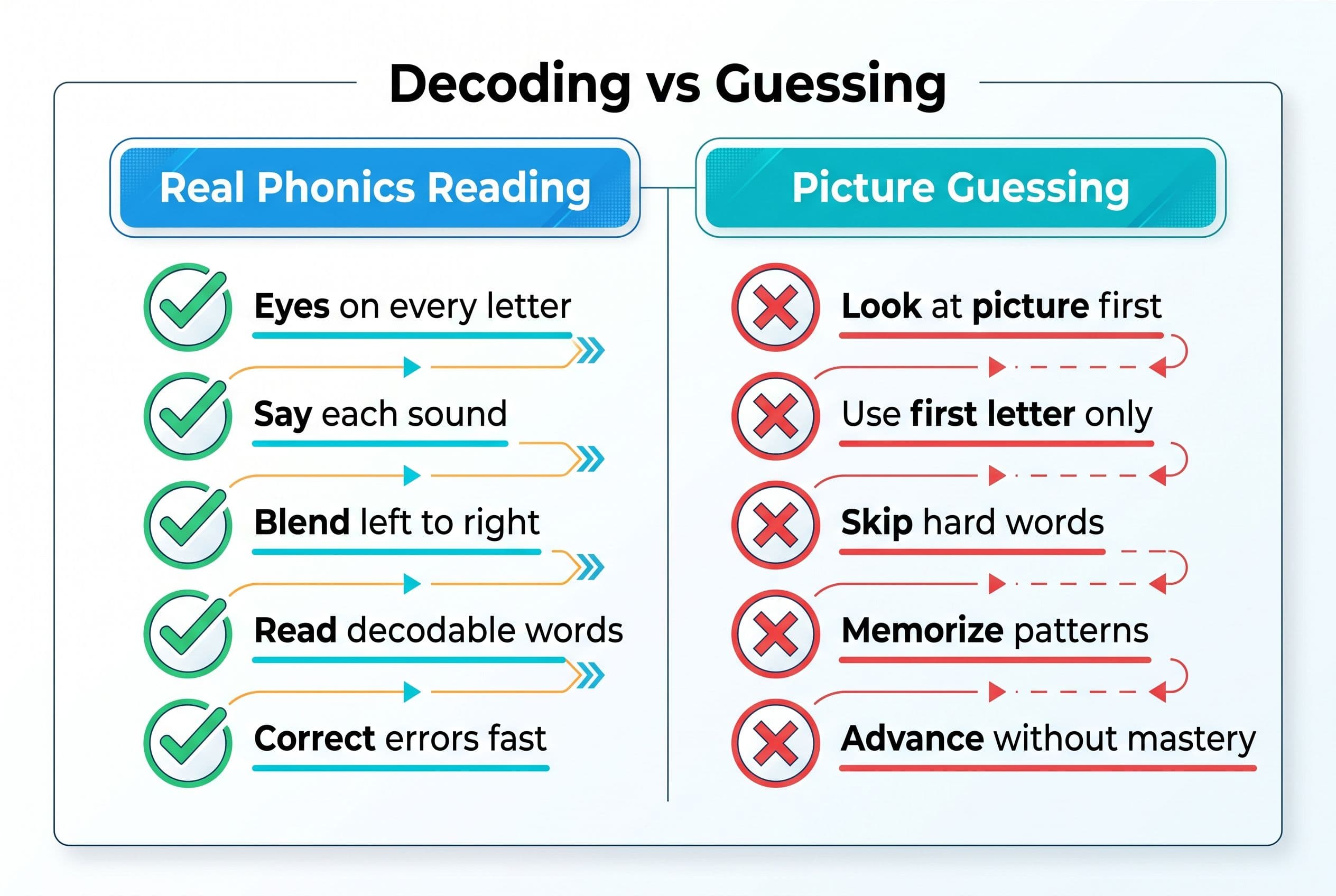
If you’re searching for the best reading app for a 1st grader who guesses words, you don’t need a cute game with fireworks. You need an app that forces your child to look at the letters, say the sounds, blend left to right, and stop freelancing like a tiny illiterate lawyer.
The Verdict: Best Apps for a 1st Grader Who Guesses Words
| Rank | App | What it teaches | Price | Best for |
|---|---|---|---|---|
| #1 | Teach Your Kid to Read | Systematic synthetic phonics, decoding, no guessing | Lesson one free with no card and nothing to cancel; from lesson two the whole program is a 7-day free trial, then US$9.95/month | Ages 4-7, especially guessers |
| #2 | UFLI Foundations support materials | Strong phonics scope and sequence, parent-guided | Book/materials vary | Parents who want a print-heavy plan |
| #3 | Reading Eggs | Mixed phonics and game-based practice | Subscription varies | Kids who need motivation but don’t over-rely on rewards |
| #4 | Epic! | Huge digital library, not a decoding program | Subscription varies | Already-decoders who need more books |
| #5 | Fountas & Pinnell-style leveled readers | Predictable text and picture cues | School/library dependent | Not my pick for guessers |
My pick is Teach Your Kid to Read because it targets the exact bad habit you’re seeing: guessing instead of decoding. You can start with start lesson one free — lesson one is free with no card and nothing to cancel; from lesson two the whole program is a 7-day free trial, then US$9.95 a month.
Tiger Truth: Guessing Gets Expensive Fast
Real talk — “wait and see” is how small reading problems become big reading problems.
In the US, only 33% of 4th graders (ages 9-10) scored at or above proficient in reading on the 2022 NAEP / The Nation's Report Card. That’s not a vibe. That’s a five-alarm literacy fire.
The 2000 National Reading Panel report found that systematic phonics instruction produces significant benefits, especially in the early grades. Translation: teach the code early, teach it directly, and don’t let kids guess from pictures like reading is a scavenger hunt.
And if you think schools always catch it? I wish.
I was at a playground in Raleigh when another mom told me her child’s school had switched from Lucy Calkins to a Science of Reading curriculum because of North Carolina’s SB 387 — the Excellent Public Schools Act, a US state law. She felt annoyed. “He was doing fine before,” she said.
So I asked one question: “Can he read splint?”
Her son was in second grade (ages 7-8). He couldn’t.
I spent 20 minutes on that playground bench explaining why the switch was happening: Emily Hanford’s APM Reports / "Sold a Story", the NAEP data, and Stanislas Dehaene’s neuroscience from Reading in the Brain (2009), which shows the brain doesn’t naturally learn to read the way it learns to speak. That mom went home, listened to Sold a Story, and texted me at 11 p.m.: “I had no idea. Why didn’t anyone tell us this sooner?”
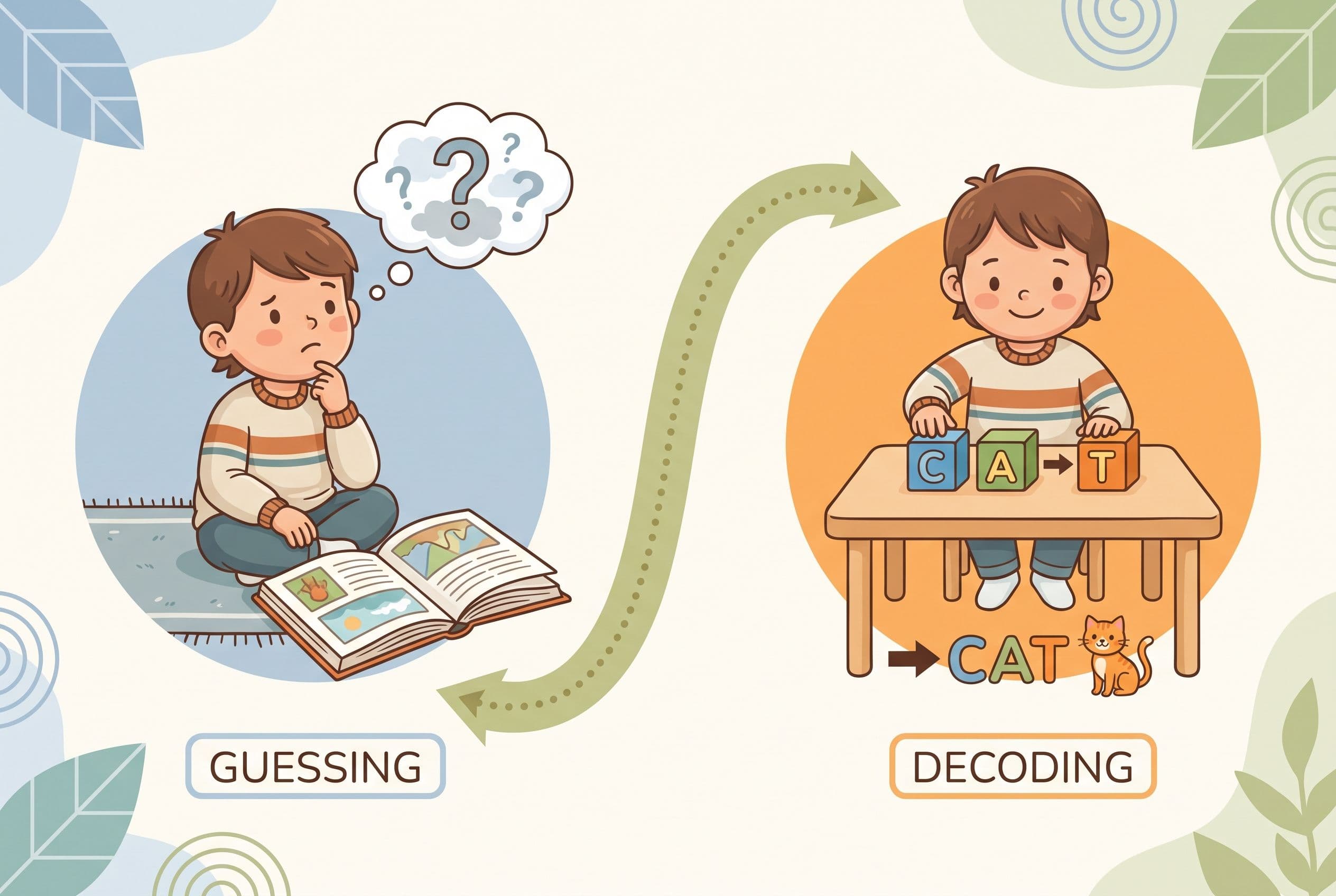
That’s the kicker. Parents trusted systems that told kids to look at pictures, skip hard words, and keep the story moving. Then everyone acted shocked when the kids couldn’t decode.
Deep Dive: The Best Reading Apps and Tools Compared
#1 Teach Your Kid to Read: Best Phonics App for a 1st Grader Who Guesses Words
Teach Your Kid to Read is my top pick because it treats guessing as the problem, not as a “strategy.” Bless the teachers who meant well, but “look at the picture” has caused enough chaos.
This app teaches systematic synthetic phonics. That means your child learns the sound-spelling code in a planned order, then practices blending words made from patterns they’ve already learned. No random leveled reader full of mystery words. No “just memorize the shape.” No “what would make sense?” nonsense.
Here’s what I want in a reading app for 1st grade decoding:
- Direct grapheme-phoneme correspondence practice
- Short daily lessons that don’t require a three-ring binder and a prayer candle
- Decodable words, not predictable text
- Immediate correction when the child guesses
- Mastery before moving on
That’s why Teach Your Kid to Read fits guessers. If the word is ship, your child has to process sh-i-p. They can’t glance at a picture of a boat and say “sailboat” while everyone claps.
I use this same logic with my own kids. Last Tuesday, I had my 4-year-old at the kitchen table reading CVC words while the 1-year-old tried to eat a crayon. We still did phonics. Tiger Rule: We Never Skip. Birthdays, vacation, Christmas morning — we do the drill. Five minutes counts. Zero minutes becomes a habit.
Teach Your Kid to Read also lines up with what researchers like Linnea Ehri described in her 2005 work on phases of word reading development. Kids move from partial letter guessing into full alphabetic reading when they connect sounds to spellings and map words into memory. That process is called orthographic mapping, and David Kilpatrick explains it beautifully in Equipped for Reading Success (2016).
Bottom line: if your child guesses words, they need more decoding, not more exposure to books they can’t actually read.
#2 UFLI Foundations: Strong, But Parent-Led
UFLI Foundations is excellent. It’s structured, explicit, and very aligned with reading science. If you’re a parent who likes printed lesson plans, word chains, sound cards, and a clear sequence, UFLI can be the real deal.
But it’s not really an app experience for a busy parent who wants guided digital lessons. You’ll do more setup. You’ll need to sit there and run the lesson. For some families, that’s perfect. For others, it becomes another abandoned binder next to the math manipulatives and the glitter glue.
I’d use UFLI as a supplement if you’re already confident teaching phonics. If you’re panicking because your first grader guesses every third word, I’d start with a more parent-friendly phonics app first.
#3 Reading Eggs: Fun, But Watch the Rewards
Reading Eggs can help some kids practice early reading skills. It has phonics elements, games, and lots of motivation. Some children love it. I’m not anti-fun. I have four kids. I’m anti-fake learning.
The issue? Rewards can replace instruction if you’re not careful. A child can click, guess, earn animations, and still avoid the hard work of blending sounds.
If you use Reading Eggs, sit nearby for the first week. Watch what your child does when they hit an unfamiliar word. Do they sound it out? Or do they tap until something works?
That answer tells you everything.
#4 Epic!: Great Library, Not a Phonics Intervention
Epic! gives kids access to tons of digital books. That sounds amazing, and for fluent readers it can be useful. But a library is not a reading teacher.
If your child can’t decode splash, giving them 400 more books won’t fix the code gap. That’s like handing a kid a cookbook when they can’t turn on the stove.
Use Epic! after your child can decode basic patterns. Don’t use it as your main struggling first grader reading app if the problem is guessing.
#5 Fountas & Pinnell-Style Leveled Readers: My Hard No for Guessers
This one drives me crazy.
Fountas & Pinnell levels are everywhere in schools, but the approach grew out of whole-language and balanced-literacy thinking. The books often rely on predictable patterns: “I see the dog. I see the cat. I see the horse.” Kids can memorize the sentence frame, peek at the picture, and appear to read.
Then you hand them grass, split, or trap, and the whole thing falls apart.
If your child guesses words, skip leveled readers for now. Use decodable readers instead. Bob Books, Flyleaf Publishing decodables, High Noon Books, and Explode the Code-style practice give kids controlled text they can actually decode.
What Disqualifies a Reading App for Guessers?
A child guesses words reading app should never reward guessing. I don’t care how cute the mascot is.
Reject an app if it:
- Tells your child to use the picture first
- Uses books with many untaught spelling patterns
- Lets kids advance after sloppy guessing
- Focuses more on coins, pets, badges, and dancing animals than accuracy
- Teaches sight words as pure memorization without sound mapping
Here’s the thing: sight words aren’t magic shapes. Even words like said and was have sound-spelling logic. Some parts are irregular, but kids still need to map the sounds to letters. That’s orthographic mapping, not visual guessing.
How to Know If Your 1st Grader Needs Phonics Intervention
You don’t need a formal diagnosis to start better instruction. You need evidence.
Try this quick check today. Use patterns your child has actually been taught — don’t throw ship at a kid who hasn’t learned sh yet and then act surprised. That’s not a reading check. That’s a trap with a pencil.
- Write five short words with no pictures, using taught patterns if you can: cat, ship, trap, sled, spin.
- Ask your child to read them.
- Cover each word after they read it and ask, “What sounds did you say?”
- Give two nonsense words with taught patterns, like mip and lat. Tell your child, “These are made-up words, so you can’t memorize them. I want to see how you sound them out.”
- Watch the eyes. Are they looking at every letter or searching your face for help?
If your child can read memorized books but freezes on nonsense words, that’s a reason to check decoding more closely. It doesn’t prove the whole problem in two minutes — I’m bossy, not psychic — but it does tell you the “looks fine in books” story may be hiding a code gap.
Assessments like DIBELS, AIMSweb, and Kilpatrick’s PAST test can give more detail. The PAST takes about 5 minutes when you know how to give it, and it shows where phonological awareness breaks down. DIBELS nonsense word fluency also gives useful decoding data; many schools expect solid letter-sound fluency by the end of kindergarten (age 5), though exact benchmarks vary by country and school system. If the guessing keeps showing up, ask the school for a reading assessment. Don’t wait six months while everyone smiles politely.
The 7-Day Action Step Plan
Use this plan before you buy anything long-term. No drama. No 90-minute battles.
- Day 1: Test without pictures. Use 10 decodable words and 3 nonsense words. Write down every guess.
- Day 2: Start one phonics lesson. Use Teach Your Kid to Read, UFLI, or another systematic phonics plan. Keep it short.
- Day 3: Drill sounds for 5 minutes. Say the sound, trace the letter, read 5 words.
- Day 4: Read only decodable text. No leveled guessing books this week.
- Day 5: Correct guessing instantly. Say, “No guessing. Eyes on the letters. Sound it out.” Calm voice. Steel spine.
- Day 6: Repeat the same pattern. Mastery beats novelty. Boring works.
- Day 7: Retest. Use new words with the same patterns. Look for less guessing and more left-to-right blending.
If you want the simplest place to begin, use Teach Your Kid to Read for the first lesson today. Lesson one is free with no card and nothing to cancel; from lesson two the whole program is a 7-day free trial, then US$9.95 a month.
My Final Pick
The best reading app for a 1st grader who guesses words is the one that stops the guessing habit cold and teaches decoding directly.
For me, that’s Teach Your Kid to Read.
Use UFLI if you want a strong parent-led print plan. Use Reading Eggs carefully if your child needs motivation and you’re watching for click-guessing. Use Epic! later for reading volume. Put Fountas & Pinnell-style predictable books on pause if your child guesses.
Reading is a survival skill. Not optional. Not “when they’re ready.”
If your child guesses today, start decoding practice today. Tiny daily drills beat big emotional meltdowns later — hands down.
FAQ
What is the best reading app for a 1st grader who guesses words?
Teach Your Kid to Read is my top pick because it teaches systematic phonics and decoding instead of encouraging picture guessing. The offer is: lesson one is free with no card and nothing to cancel; from lesson two the whole program is a 7-day free trial, then US$9.95 a month.
Is guessing words normal in 1st grade?
A little guessing can happen, but a pattern of guessing means your child needs stronger decoding instruction. If they rely on pictures, first letters, or sentence context instead of sounding through the whole word, treat it as a skill gap.
Should I use leveled readers or decodable readers?
Use decodable readers for a child who guesses. Decodable books match the phonics patterns your child has learned, so they practice real reading instead of memorizing sentence patterns.
How long should my 1st grader practice phonics each day?
Start with 10-15 minutes a day. Keep it direct, calm, and consistent. Daily practice matters more than marathon sessions.
When should I ask for a reading assessment?
Ask now if your child guesses often, avoids reading, can’t read simple CVC words, or struggles with nonsense words. Tools like DIBELS, AIMSweb, and Kilpatrick’s PAST can help pinpoint the breakdown.
Part of these guides

Xia Brody
Co-Founder, Teach Your Kid to Read
Mom of 4 who has successfully taught her kids to read. Currently in the trenches with her 4-year-old while her two oldest (10 and 7) devour books on their own. Passionate about phonics-based methods and building a lifelong love of reading.
Related Articles
Best App for a 6-Year-Old Who Guesses Words: 5 Picks
If your 6-year-old guesses words from pictures, they don't need more leveled books. They need systematic phonics, daily decoding practice, and a parent who stops the guessing cold.
Read More →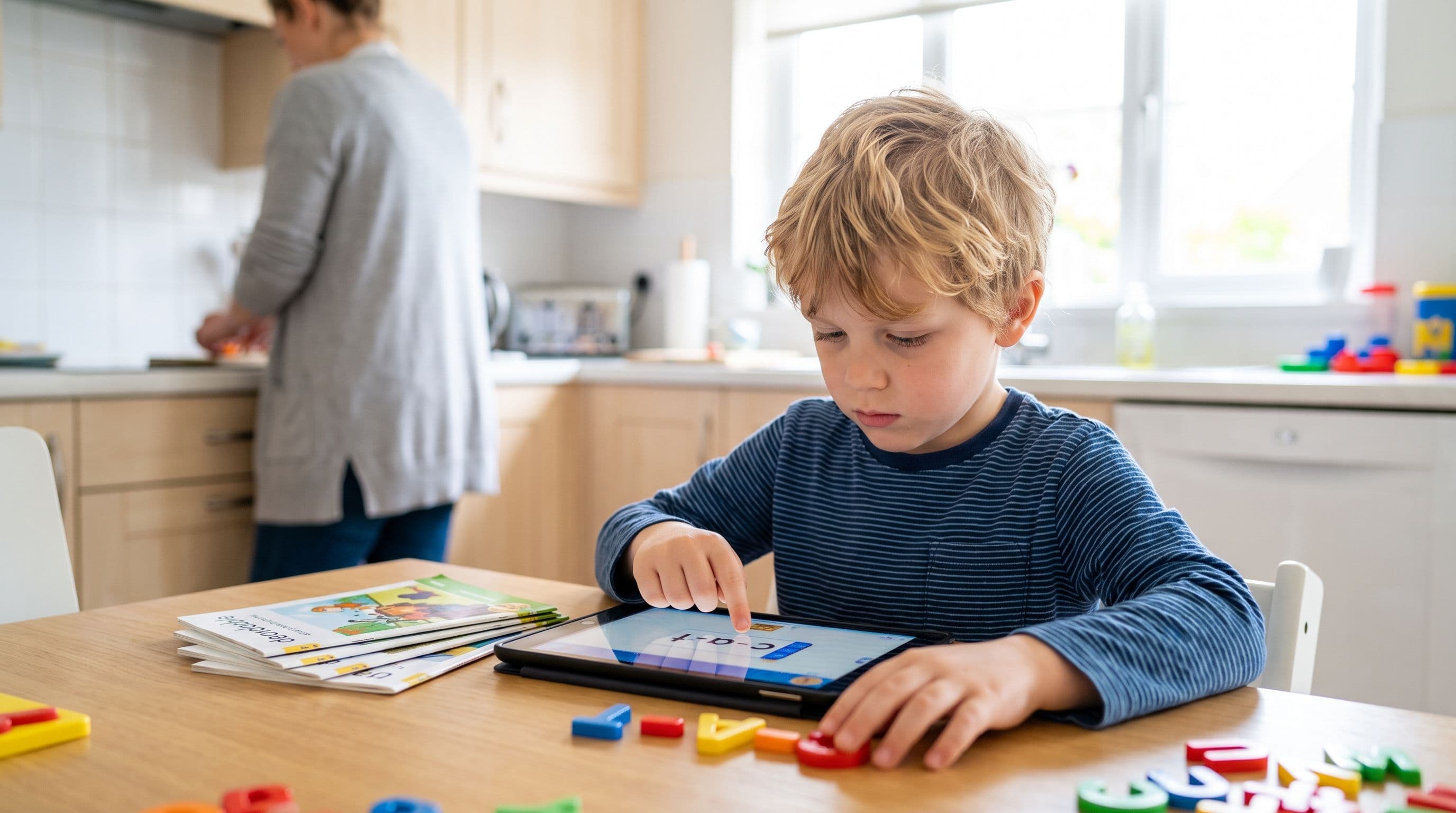
Best Reading App for a 6-Year-Old with Dyslexia: 2026 Picks
If your 6-year-old with dyslexia is guessing at words, cute reading games won’t fix it. Here’s how to choose a structured literacy app that builds decoding skill instead of wasting precious time.
Read More →
Best Reading App for 1st Graders in 2026: 6 Apps Compared Side by Side
Not all reading apps are created equal — most first grade reading apps teach kids to guess, not read. I compared 6 of the most popular ones and broke down exactly which ones use real phonics and which are dressed-up screen time.
Read More →