Year 2 Reading Level Australia: Signs + Next Steps
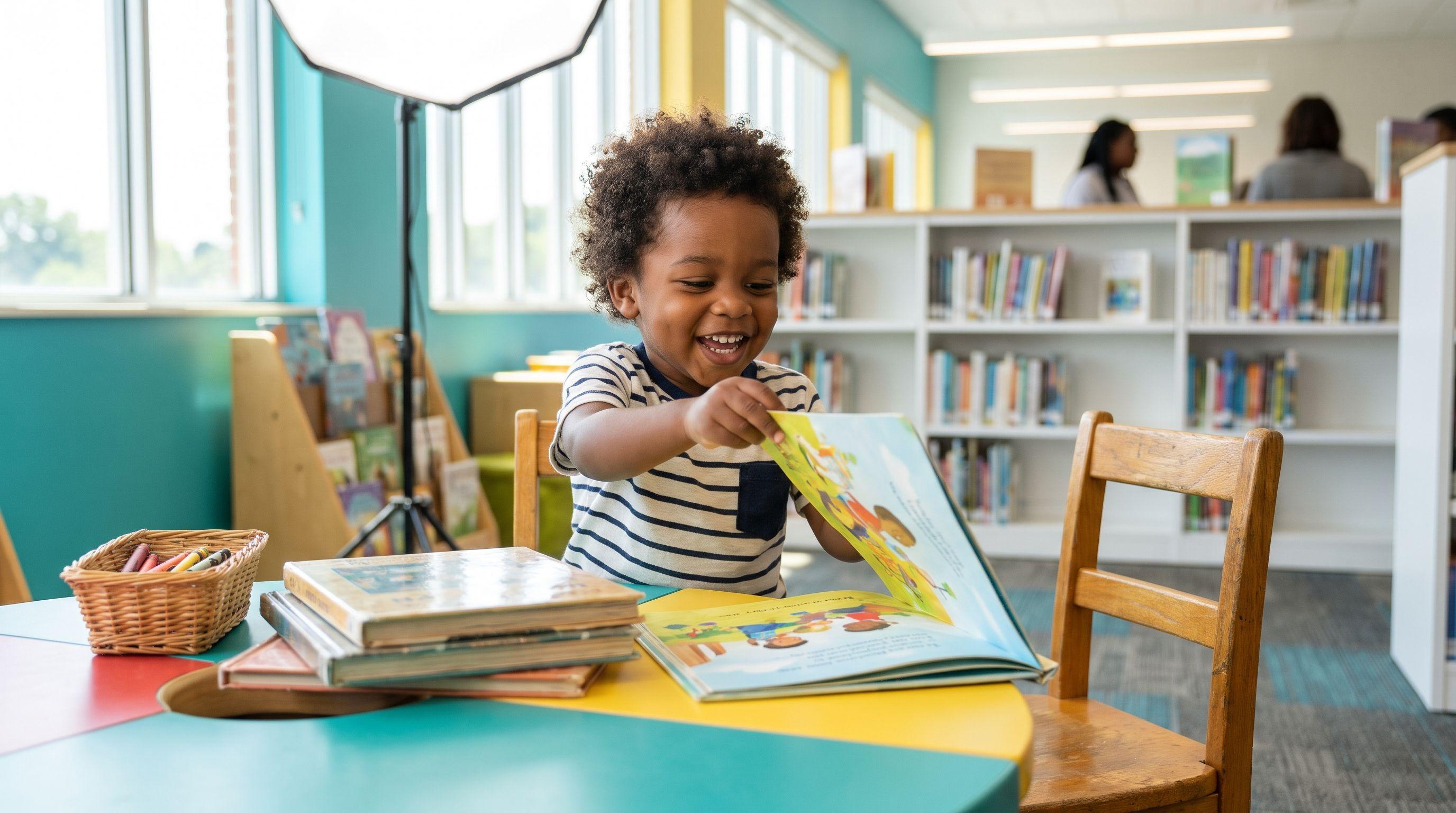
Your child remembers yesterday's book beautifully. Today, you point to one word without the picture — and suddenly there's a very urgent need for a snack.
That deserves a closer look. If you're checking your child's Year 2 reading level in Australia, here's my first rule: Remembering a story isn't the same as reading its words. But one difficult word doesn't diagnose a reading problem, either.
I'm Xia Brody, co-founder of TeachYourKidToRead.org and a Chinese-American homeschooling mum of four, aged 10, 7, 4 and 1. I've taught my oldest two to read; my four-year-old keeps me humble. The baby mostly checks whether books taste educational.
What You'll Learn
- Which Year 2 reading skills matter more than a coloured book band.
- What a words-per-minute score can — and can't — tell you.
- How to spot the difference between decoding and a convincing guessing performance.
- What to ask the teacher so you leave with a plan, not another “give it time”.
Year 2 Reading Level Australia: The Practical Answer
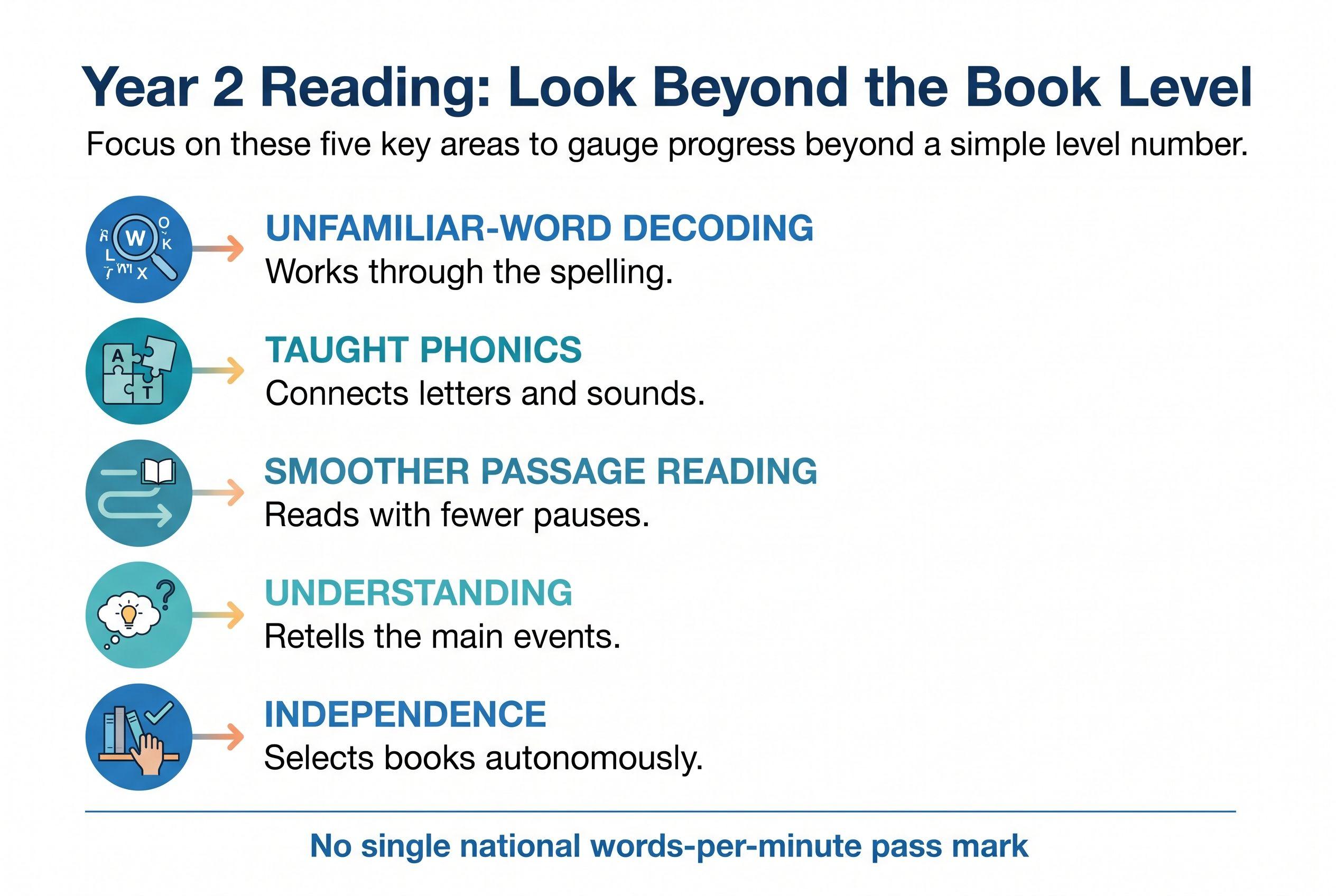
In Year 2 (ages 7–8), children should be developing accurate, increasingly fluent reading of suitable texts, using phonics to read unfamiliar words and explaining what they've read. Expectations build across the year. February and November aren't the same checkpoint.
Here's the catch: Australia doesn't have one universal Year 2 book level or compulsory national words-per-minute pass mark. Schools use different assessments. A book-band number alone won't tell you whether your child can decode independently.
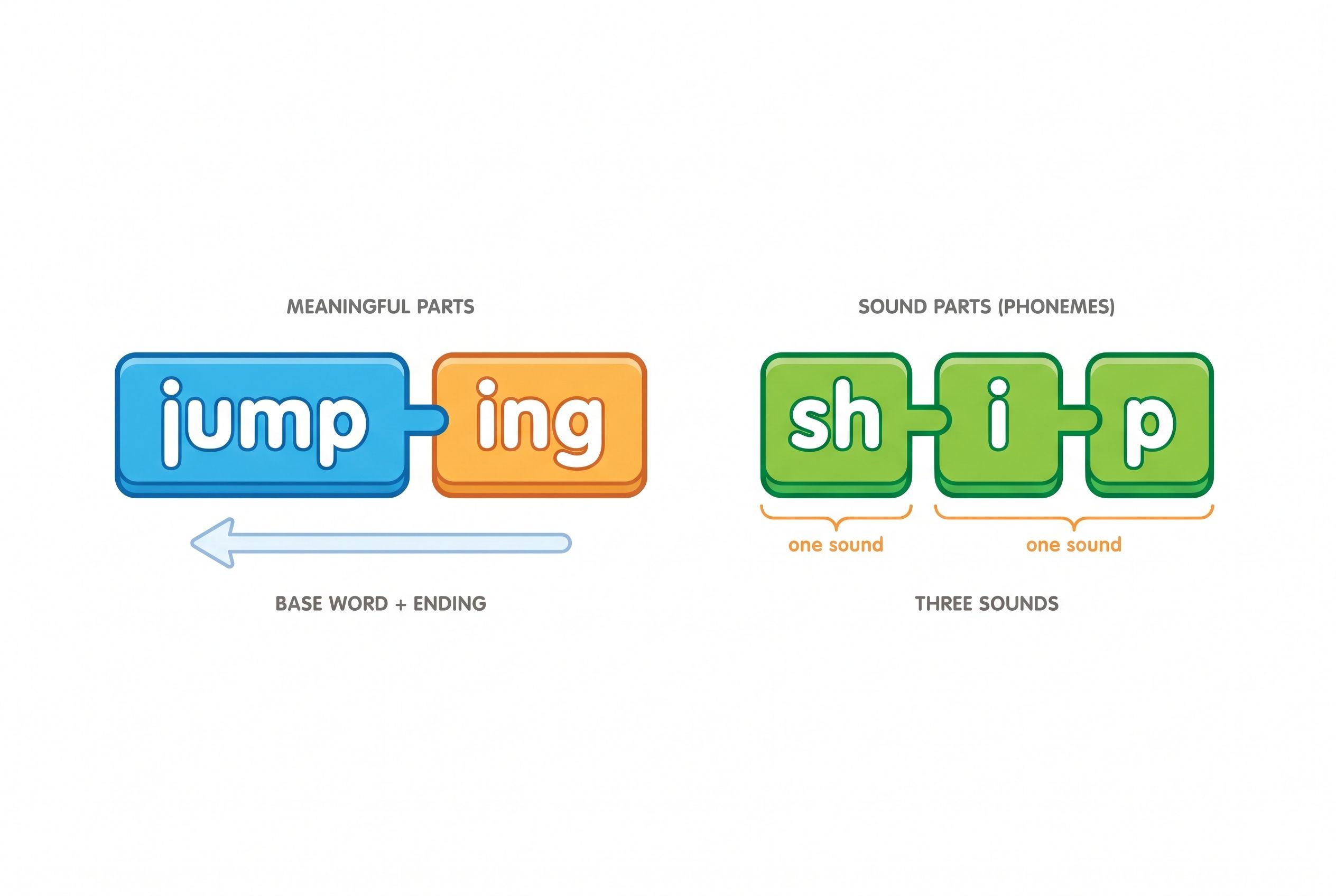
The Australian Curriculum, Version 9.0, English Year 2 achievement standard describes reading with phonic, morphemic and grammatical knowledge, alongside understanding texts. In parent language: children need to connect spellings with sounds, recognise meaningful word parts and make sense of sentences.
Use this checklist as a conversation starter, not a home diagnosis.
| Skill | What you're looking for | What deserves follow-up |
|---|---|---|
| Reading unfamiliar words | Your child works through the spelling rather than relying on a picture | They replace the printed word with something that fits the story |
| Phonics knowledge | They apply taught vowel patterns, consonant combinations and endings | Previously taught patterns repeatedly stop them |
| Longer words | They work through manageable parts, including familiar endings | They say the first syllable and invent the rest |
| Connected reading | Suitable passages become smoother with practice, with attention to punctuation | Nearly every sentence requires heavy effort |
| Understanding | They retell key events and explain straightforward answers | They pronounce the passage but can't explain its meaning |
| Independence | They attempt suitable new text without constant rescue | They avoid reading or need you to supply many words |
If that table sounds like your child's guessing routine, I'd start with guided phonics practice beside them. Try Teach Your Kid to Read: start lesson one free. Lesson one is free, no card needed. From lesson two you get a 7-day free trial, then it's $9.95/month (US$; your A$ charge shows at checkout).
What about Year 2 reading fluency words per minute?
A useful fluency measure counts words correct per minute, not simply words attempted. If a child attempts 65 words and makes eight errors under that assessment's scoring rules, the score is 57 words correct per minute.
That's arithmetic, not a benchmark.
Interpret the result using the specific assessment's passage difficulty, term and reference data. Different passages can produce very different scores. Ask the teacher: “Which assessment are you using, and what does its expected range mean at this point in Year 2?”
Bottom line: accuracy, expression and comprehension belong beside speed. Don't turn your kitchen into a tiny speedway.
What To Do If They're Not There Yet
Start with a small check, not a showdown. You can take the 2-minute reading check to organise your concerns, then listen to your child read a few unfamiliar words containing spellings they've already learnt. The quiz offers a starting point; it doesn't diagnose dyslexia or replace a school assessment.
Watch what happens when the word feels difficult. Do their eyes follow the letters, or do they look at the picture and guess? Guessing can hide weak decoding, although language difficulties, limited instruction and other factors can also contribute.
My next step for a child who needs guided phonics practice is to explore Teach Your Kid to Read with you beside them: start lesson one free. Lesson one is free, no card needed and nothing to cancel. From lesson two you get a 7-day free trial, then it's $9.95/month (US$; your A$ charge shows at checkout).
Keep the school involved. An app can support practice, but a child with persistent difficulty needs targeted teaching and progress checks — not just more screen time. No guessing. No handing over the tablet and hoping for magic.
Tiger Truth: Another Term Of Guessing Has A Cost
Reading difficulty can spread beyond reading lessons. A child who spends all their effort decoding a maths question has less attention available for solving it. The same problem follows them into instructions and independent writing.
Then comes the “I'm stupid” talk. That one makes my stomach drop.
Difficulty isn't a verdict on intelligence. It's a signal to investigate and teach. Children can improve with effective intervention; they don't face some birthday after which learning becomes impossible. But waiting doesn't supply the missing instruction.
The Australian checkpoint worth asking about
The Year 1 Phonics Check, normally taken in Year 1 (ages 6–7), contains 40 items: 20 real words and 20 pseudo-words, according to South Australia's Department for Education. Pseudo-words test whether children can apply letter–sound knowledge to something they haven't memorised.
South Australia made the check mandatory in its public schools in 2018; NSW introduced mandatory implementation in its public schools in 2021. Other jurisdictions have their own arrangements, so ask your school what it uses.
The check isn't a complete reading assessment. It doesn't measure everything involved in vocabulary, comprehension or fluent passage reading. But it's a useful clue.
If your child fell below the expected threshold, ask what the school taught next and what later assessment showed. “Below expected” means they didn't demonstrate enough of the decoding skill that assessment sampled. It doesn't mean they're lazy or incapable.
The kicker is that a result without follow-up changes nothing. Before the school year ends, you want a clear account of the remaining gaps and a plan that carries into the next year, which starts in late January or February depending on your location.
The Playground Conversation I Still Think About
At a playground in Raleigh, another mum told me her child's school had switched from its previous reading approach to a science-of-reading curriculum. She sounded confused and a little annoyed. “He was doing fine before,” she said.
Her son was around the age of a Year 2 child. I asked whether he could read splint.
He couldn't.
Now, one word doesn't establish a reading level. Perhaps he hadn't learnt that combination yet; perhaps he simply didn't fancy a playground reading check. Fair enough. But the gap between his familiar-book performance and that unfamiliar word gave his mum something specific to ask about.
I spent about 20 minutes on that bench explaining why schools were changing direction. We talked about Emily Hanford's reporting in APM Reports' Sold a Story, which began in 2022, and why guessing from context can look like successful reading.
We also talked about Stanislas Dehaene's Reading in the Brain (2009). His account of reading neuroscience explains how learning to read adapts existing brain networks; print doesn't simply become readable through exposure alone.
She listened to the podcast that night. At 11 pm, she texted: “I had no idea. Why didn't anyone tell us this sooner?”
Honestly, that's the bit that stays with me. Parents can't ask about a teaching problem they don't know exists. Once you know what to watch for, though, you can ask better questions.
What Effective Help Looks Like
For a child with decoding gaps, look for explicit, systematic phonics instruction: a planned sequence, clear modelling and enough guided practice to apply each pattern.
With systematic synthetic phonics, children learn letter–sound correspondences and blend sounds to read words. They also segment spoken words for spelling. Reading and spelling support each other; neither requires a picture-guessing detour.
The US National Reading Panel reported in 2000 that systematic phonics instruction benefits children's reading development, particularly in the early stages. That's support for an instructional approach, not proof that every product carrying a “phonics” badge works equally well.
Reading also needs oral language and comprehension. A child might decode The puppy crept beneath the veranda accurately but not understand beneath. More blending practice won't teach that meaning by itself.
Ask about the teaching, not just the programme name
Australian parents may hear schools mention InitiaLit, a whole-class early literacy programme, or MiniLit, a small-group intervention programme. Those names can help you start a useful discussion; they don't replace an explanation of your child's instruction.
Ask: “Which spelling patterns are you teaching my child? How much extra instruction are they getting? What evidence will show it's helping?”
That's the real deal. “We're supporting them” sounds lovely, but it doesn't tell you what happens on Tuesday morning.
Choose Year 2 decodable readers by skill
Year 2 decodable readers should match the phonics your child knows, not just the age on the cover. A reader full of untaught vowel spellings can make a capable beginner look helpless.
Look for material that respects their age while targeting the missing skill. An older struggling reader doesn't need babyish presentation as an extra punishment.
Keep reading richer books aloud, too. Decodable practice builds word-reading independence; shared stories stretch language and knowledge. You don't have to choose one and abandon the other.
Your Action Plan: Start Small, Get Specific
Here's my no-nonsense plan for a Year 2 struggling reader in Australia. Keep the home check brief and the school conversation concrete.
-
Collect three examples. Write down the printed word, what your child said and how they responded to help. “Read ship as boat after looking at the picture” tells the teacher more than “reading seems bad”.
-
Check familiar phonics without pictures. Choose five words containing patterns the teacher confirms your child has learnt. Include a few they haven't memorised. Don't introduce advanced spellings and call the resulting struggle a failure.
-
Listen to a short, suitable passage. Note substitutions, skipped endings and frequent stops. Then ask your child to tell you what happened. Don't time every session; a stopwatch can change a relaxed check into an audition.
-
Book a teacher conversation. Ask for the latest decoding information, any Year 1 Phonics Check results and the school's current fluency measure. Request the name of the assessment and an explanation of its Year 2 reading benchmark for this term.
-
Agree on one teaching target. That might mean blending consonant clusters, distinguishing particular vowel spellings or reading words with -ing and -ed. “Improve reading” isn't a teachable target. “Read words with these two vowel patterns accurately” gives everyone a job.
-
Practise briefly and consistently. Try about ten minutes: review a few taught correspondences, blend several words, spell two or three and read a short matching passage. Adjust the length if your child tires quickly. Model the sound cleanly — /m/, not “muh”.
-
Set a review date and escalation plan. Agree with the teacher when you'll check progress, perhaps after four to six weeks of targeted instruction. If difficulties persist, discuss specialist assessment or more intensive intervention. Don't require your child to fail for another year before asking.
For guided practice alongside that plan, you can try Teach Your Kid to Read. Lesson one is free, no card needed and nothing to cancel. From lesson two you get a 7-day free trial, then it's $9.95/month (US$; your A$ charge shows at checkout).
What I mean by “We Never Skip”
In our house, “We Never Skip” means we protect the habit, even when the practice shrinks to two minutes on a busy day. It doesn't mean drilling through illness, distress or exhaustion. We're teaching children, not training kitchen appliances.
My other Tiger Rule stays firm: No Guessing. If the child knows the relevant spelling, I point back to it and help them blend. If they haven't learnt it, I teach it or supply the word — I don't demand a skill I haven't taught.
Fun can help. Fun can't replace instruction. A silly voice after an accurate reread? Excellent. Twenty minutes tapping balloons without reading? Different activity, mate.
When To Ask For More Than Home Practice
Seek further help if your child struggles persistently despite explicit teaching, shows strong distress around reading or has continuing difficulty connecting sounds with letters. A family history of dyslexia gives you another reason to raise concerns early.
Ask the teacher or learning-support coordinator about the intervention pathway. Depending on the pattern of difficulty, a speech pathologist or psychologist with relevant literacy expertise may help assess language or learning needs. Discuss hearing or vision concerns with an appropriate health professional, too.
Don't diagnose from a checklist. Don't dismiss the checklist either.
The point of checking your child's Year 2 reading level in Australia isn't to win a comparison with the neighbour's child. It's to identify the next skill and teach it properly. Independence grows from that kind of mastery.
If you want a low-pressure first look at our approach, begin with lesson one beside your child. Lesson one is free, no card needed and nothing to cancel. From lesson two you get a 7-day free trial, then it's $9.95/month (US$; your A$ charge shows at checkout).
Frequently Asked Questions
Is my Year 2 child behind in reading if they still sound out words?
Not necessarily. Sounding out unfamiliar words shows a useful strategy. Look at whether familiar words become easier, whether your child applies taught phonics and whether they understand the passage. Persistent difficulty with previously taught patterns deserves follow-up.
What's the expected Year 2 reading fluency in words per minute?
Australia doesn't have one universal national Year 2 words-per-minute pass mark. Ask which assessment the school uses and how it interprets the result for that term. Words correct per minute, passage difficulty and comprehension matter together.
Should my Year 2 child still use decodable readers?
Yes, if they need practice applying phonics. Choose readers that match their current knowledge and respect their age. Keep sharing richer stories aloud so decoding difficulty doesn't restrict their access to interesting language and ideas.
Does a low Year 1 Phonics Check result mean dyslexia?
No. It signals that the child needs closer attention to decoding and instruction. A dyslexia assessment considers a wider pattern, including learning history and response to teaching. Ask what support followed the result and what progress the school has recorded.
How can I help a Year 2 struggling reader in Australia?
Start with a teacher conversation about specific gaps, agree on targeted instruction and use short home practice that matches it. Set a review date. If progress remains limited, request further assessment and more intensive support rather than repeating the same approach indefinitely.
From teachyourkidtoread.org/blog/year-2-reading-level-australia-signs-next-steps

Xia Brody
Co-Founder, Teach Your Kid to Read
Mom of 4 who has successfully taught her kids to read. Currently in the trenches with her 4-year-old while her two oldest (10 and 7) devour books on their own. Passionate about phonics-based methods and building a lifelong love of reading.
Related Articles
My 3rd Grader Can't Read: Warning Signs + 4 App Picks
An app can support reading practice, but it can't replace an assessment or targeted teaching. Here are four ranked options, the warning signs I'd take seriously and a concrete plan for getting help.
Read More →
My 8 Year Old Can't Read: Best Apps + Rescue Plan
If your 8-year-old is still guessing at words, this is not a wait-and-see moment. Here’s my no-nonsense app comparison and rescue plan for getting real phonics intervention started now.
Read More →
Decodable Readers Australia: Best Sets by Phonics Stage
Buy the sounds your child can read, not the biggest box on the shelf. Here’s how I rank four reading options for Australian families—and match decodable books to the phonics your child actually knows.
Read More →