Best Phonics Apps for Kids in 2026: 10 Tested Picks That Actually Work

What You'll Learn
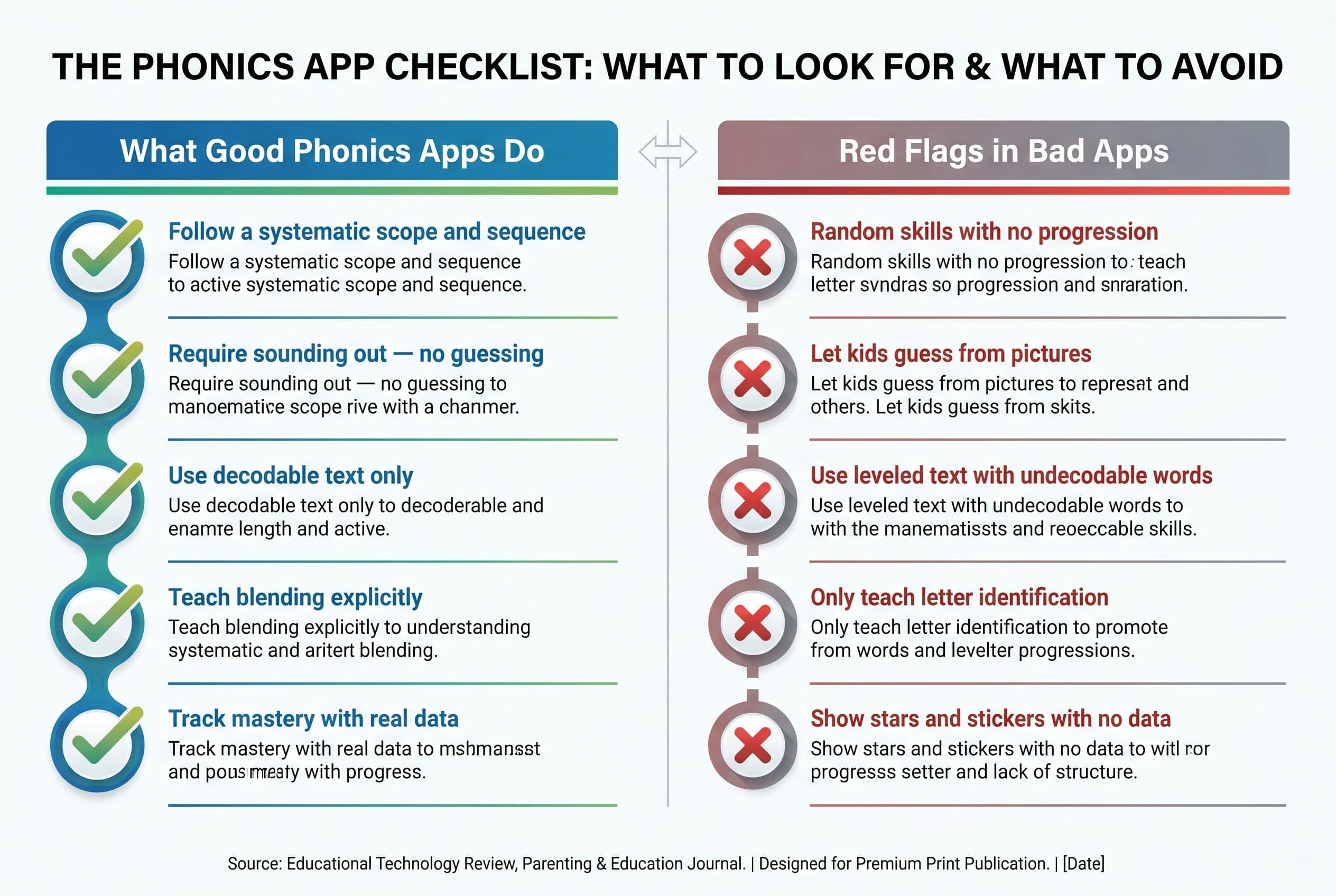
- Why 90% of "phonics apps" are actually teaching your kid to guess — and the 3 red flags that give them away
- The one structural feature that separates apps that produce real readers from apps that produce screen addicts
- My ranked list of 10 phonics apps I've personally used or tested with my four kids — including free options
- The brutal truth about what happens when you rely on apps alone (and the dirt-cheap offline tool that changed everything for my 4-year-old)
The App Trap Is Real — Let's Talk About It
Your kid has been "playing" a reading app for three months. They can tap the right picture of a frog when the screen says "frog." They can match rhyming words in a mini-game. They earned 47 digital stickers and unlocked a cartoon dragon.
And they still can't read the word "ship" on a page without guessing "boat" because there's a picture of a boat next to it.
Sound familiar?
Here's my problem with most phonics apps for kids: they're designed by app developers, not reading specialists. The incentive structure is engagement metrics — time-on-app, daily opens, in-app purchases — not whether your child can actually decode a three-letter word independently. And parents, understandably, mistake screen time for learning time.
I fell into this trap myself. When my daughter Mei was 4, I tried three different phonics apps before finding something that worked. The first was one of the most popular learn-to-read apps on the App Store — millions of downloads, gorgeous animations, 4.8-star rating. All games, zero systematic progression. Mei loved it. She played it for weeks. She learned almost nothing.
Then I tried a workbook-app hybrid that jumped from CVC words straight to multisyllabic words with no bridge in between. Mei went from sounding out "cat" to staring blankly at "fantastic" in the space of three lessons. She started guessing. She started crying. We both hated it.
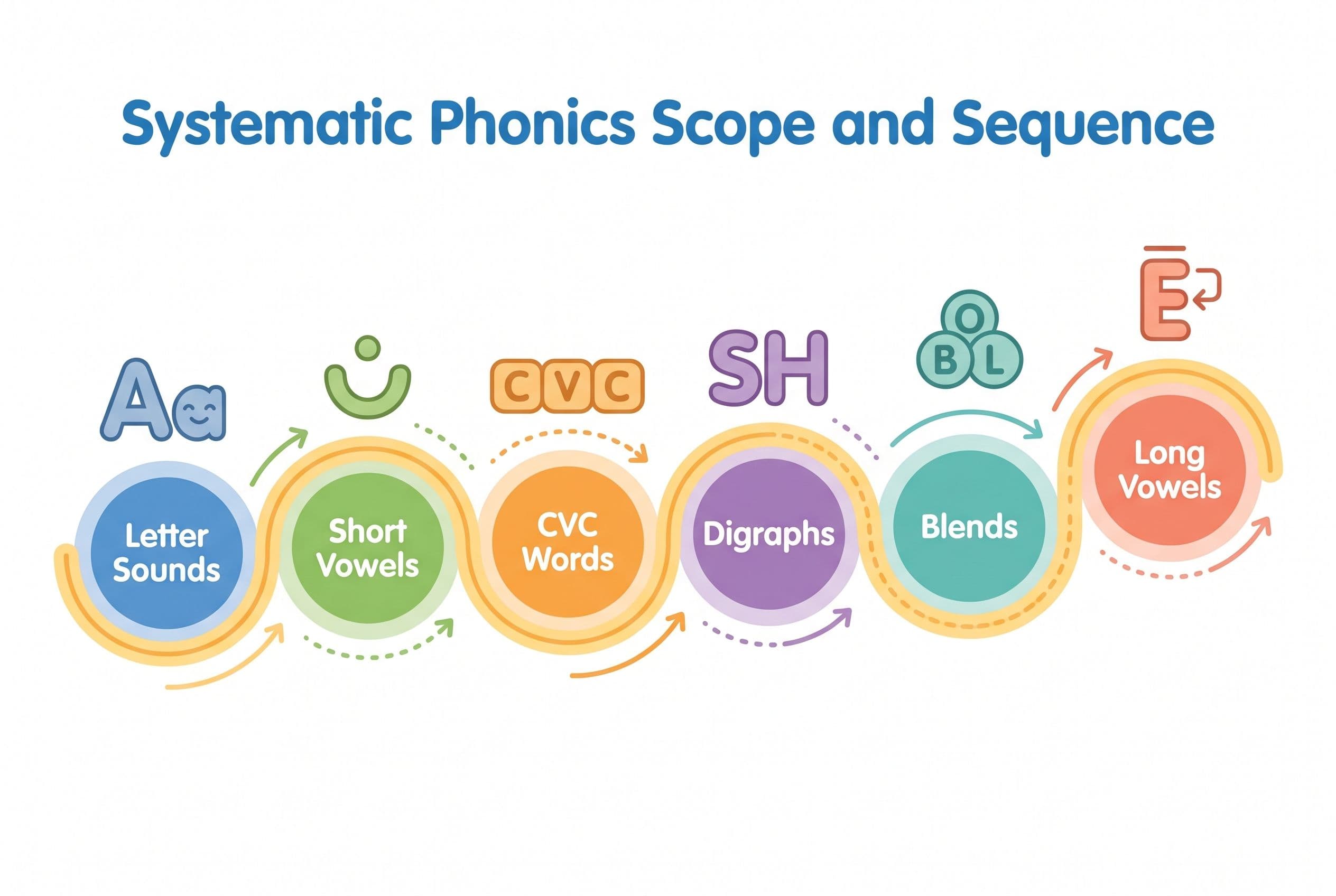
Finally, I landed on UFLI Foundations — which isn't even an app, it's a free curriculum from the University of Florida Literacy Institute — and paired it with a genuinely systematic app. Within two weeks, Mei was making more progress than she'd made in the previous two months combined. The difference? A real scope and sequence. The program is systematic and cumulative — starting with high-utility consonants and short vowels, quickly moving into CVC decoding, then expanding to digraphs, blends, and more advanced patterns. Each lesson built on the last one. No random skill dumps. No cartoon dragons.
I wish I'd started there instead of wasting two months on apps that taught her nothing.
The Tiger Truth: What's Actually at Stake
Let me hit you with the numbers, because this isn't hypothetical.
Only 33% of 4th graders read at a proficient level on the 2022 NAEP — that's the Nation's Report Card, the gold standard of educational measurement. The 2023 scores dropped another 3 points from 2019, the largest decline in 30 years.
Kids who aren't reading proficiently by the end of 3rd grade — especially those living in poverty — are about four times more likely to drop out of high school. That's from the Annie E. Casey Foundation's 2010 analysis, "Double Jeopardy." Not my opinion. Data.
And here's the kicker: remedial reading intervention programs — the ones schools offer when your kid falls behind — cost $10,000 to $15,000 per year. Insurance doesn't cover it. Most school districts have waitlists measured in months, not weeks.
So when I say that choosing the wrong phonics app isn't just a waste of $4.99, I mean it. Every month your kid spends "learning" on an app that doesn't follow the science of reading is a month they're falling further behind. The 3rd Grade Cliff is real. The research from Reid Lyon at the NICHD — the guy who testified before Congress — showed that 38% of fourth graders can't read at a basic level. Basic. Not proficient. Basic.
You don't have time for apps that look cute but teach nothing.
How I Evaluated These Apps (My 5 Non-Negotiables)
Before I give you the list, you need to know how I judged these. I didn't just download 50 apps and pick the prettiest ones. I used five criteria grounded in what reading science actually says works.
1. Systematic, Explicit Phonics Instruction
The 2000 National Reading Panel report — the one Congress actually commissioned — found that systematic phonics instruction produces significant benefits for reading achievement compared to non-systematic or no phonics instruction. "Systematic" means there's a scope and sequence. Letter sounds are taught in a deliberate order, not randomly. This is the single most important feature to look for.
Red flag: If an app teaches the letter "X" in lesson 3 before your kid has mastered short-A words, run.
2. No Guessing From Pictures
This is my Tiger Rule: No Guessing. Ever. If an app shows a picture of a sun next to the word "sun" and your kid taps it without decoding, that's not reading. That's a matching game. Emily Hanford's 2023 APM Reports investigation "Sold a Story" exposed how the three-cueing system (guessing from pictures, context, and first letters) destroyed a generation of readers. I won't tolerate it in an app.
3. Decodable Text, Not Leveled Text
After teaching letter sounds, the app should give kids words and sentences they can actually sound out using what they've learned. This is decodable text. It's the opposite of Fountas & Pinnell leveled readers, which are whole-language aligned and throw words at kids they have no phonetic tools to decode.
4. Blending Practice (Not Just Letter ID)
Knowing that "B" says /b/ is useless if your kid can't blend /b/-/a/-/t/ into "bat." Linnea Ehri's research on phases of word reading development (2005) shows that blending — the actual act of pushing sounds together — is where the magic happens. The app needs to explicitly teach and practice blending.
5. Progress Tracking That Tells You Something
I need to see what my kid has mastered, what they're struggling with, and what's coming next. "Great job! 5 stars!" tells me nothing. Give me data.
The 10 Best Phonics Apps for Kids in 2026
OK, here's the list. I've organized these by what they do best, because no single app is perfect for every kid. I've personally used or tested every one of these with at least one of my four children (ages 10, 7, 4, and 1 — though the 1-year-old mostly chews on the iPad).
1. Teach Your Kid to Read App — Best Overall for Systematic Phonics
This is the one I keep coming back to, and yes, I'm biased because I co-founded this program — but I'm biased because I built what I couldn't find anywhere else. Teach Your Kid to Read follows Orton-Gillingham principles with a strict scope and sequence: consonant sounds, short vowels, CVC blending, digraphs, blends, long vowels, r-controlled vowels, diphthongs. Each lesson builds on the previous one. There's no skipping ahead. There's no guessing.
The app uses decodable text at every stage, so your kid only encounters words they have the tools to sound out. Progress tracking shows you exactly which grapheme-phoneme correspondences your child has mastered.
Best for: Ages 3-7, parents who want a structured daily program Cost: Free trial available, affordable subscription Tiger Rating: 🐯🐯🐯🐯🐯
2. UFLI Foundations (Paired With Digital Resources) — Best Free Option
UFLI Foundations is technically a curriculum, not an app — but the University of Florida Literacy Institute provides free digital resources and lesson plans that you can deliver on a tablet. This is what finally worked for Mei after two months of dead ends. The scope and sequence is systematic and cumulative — starting with high-utility consonants and short vowels, quickly building into CVC decoding, then expanding to digraphs, blends, and beyond. It's explicit, it's systematic, and it's free.
The downside? It requires a parent to deliver the instruction. This isn't a "set your kid in front of the screen and walk away" tool. You're the teacher. For some parents that's a dealbreaker. For me, it's the whole point.
Best for: Ages 4-7, parents who want to actively teach Cost: Free Tiger Rating: 🐯🐯🐯🐯🐯
3. Phonics Hero — Best for Blending Drill
This Australian-made app is one of the few I've found that hammers blending — actually pushing sounds together, not just identifying letters. It follows a systematic synthetic phonics approach and includes decodable readers inside the app. The games are simple (not overly flashy) and the focus stays on decoding. It also gives parents a dashboard with genuinely useful data.
I used this with my son Jude when he was 5 and it nailed the blending piece. He went from choppy segmenting (/c/... /a/... /t/) to smooth blending in about three weeks.
Best for: Ages 4-7, kids who know letter sounds but can't blend yet Cost: Free limited version, paid subscription for full access Tiger Rating: 🐯🐯🐯🐯
4. Dandelion Reader App — Best for Decodable Practice
Most reading apps give kids leveled text disguised as decodable text. Dandelion Readers are the real deal — controlled, decodable books where every word can be sounded out using previously taught skills. The app version puts these readers on a screen with audio support. No guessing. No three-cueing nonsense.
The design is simple. Some parents find it too plain. I find it honest. Your kid is reading, not being entertained.
Best for: Ages 5-7, kids ready to practice reading connected text Cost: One-time purchase Tiger Rating: 🐯🐯🐯🐯
5. Explode the Code Online — Best Workbook-Style App
If you know the Explode the Code workbook series (and if you're a homeschooling parent, you probably do), the online version digitizes that same systematic approach. It moves through short vowels, consonants, digraphs, and blends with tons of repetition. It's not glamorous. It's not "fun" in the YouTube-Kids sense of the word. But it works.
I used the physical workbooks with my oldest, Lily, and the online version with Jude. Both learned to decode reliably.
Best for: Ages 4-8, kids who respond well to repetitive practice Cost: Paid subscription Tiger Rating: 🐯🐯🐯🐯
6. Reading Eggs — Best for Reluctant Learners (With Caveats)
Reading Eggs is one of the most popular learn-to-read apps out there, and honestly? It's a mixed bag. The early phonics levels are genuinely systematic. The games are engaging enough to hook kids who resist sit-down instruction. The scope and sequence through the first 40 lessons is solid.
But — and this is a big but — the later levels start introducing whole-word memorization and context-based guessing. So I recommend it for the early stages only (lessons 1-40ish), then switch to something more rigorous.
Best for: Ages 4-6, kids who refuse to sit for direct instruction Cost: Free trial, then paid subscription Tiger Rating: 🐯🐯🐯
7. Bob Books Reading Magic — Best for Very First Readers
Bob Books have been a phonics staple for decades, and the app version keeps it simple: short-vowel CVC words, drag-and-drop letter assembly, and the same goofy illustrations your kid already loves from the physical books. It's limited in scope — you'll outgrow it fast — but as a starting point for a 3-4 year old just learning to blend? It's a no-brainer.
I handed this to Mei at 3.5 and it got her excited about sounding out words for the first time.
Best for: Ages 3-5, absolute beginners Cost: One-time purchase (cheap) Tiger Rating: 🐯🐯🐯
8. Teach Your Monster to Read — Best Free Phonics Game
This UK-based app follows a synthetic phonics approach and it's genuinely free (ad-supported on web, small fee on app stores). The monster customization hooks kids, and the phonics content moves through letter sounds, blending, and tricky words in a reasonable sequence. It aligns with the UK's Letters and Sounds framework.
The downside: the game elements can distract from the phonics. My kids sometimes got more excited about dressing their monster than reading the words. Use it as a supplement, not a primary curriculum.
Best for: Ages 4-7, supplemental practice Cost: Free on web Tiger Rating: 🐯🐯🐯
9. Homer Learn & Grow — Best for Building Background Knowledge
Homer has a phonics pathway that's reasonably systematic, but where it shines is vocabulary and comprehension — the other half of Scarborough's Reading Rope that most phonics apps ignore entirely. The stories and interest-based content build the background knowledge that kids need to actually understand what they're decoding.
I wouldn't use it as your only phonics tool. But paired with a rigorous decoding app, it fills an important gap.
Best for: Ages 3-7, building vocabulary alongside phonics Cost: Paid subscription Tiger Rating: 🐯🐯🐯
10. Kahoot! DragonBox Learn to Read — Best for Letter-Sound Introduction
This Scandinavian-designed app introduces letter-sound correspondences through animation and song. It's beautiful. It's engaging. And it does a genuinely good job teaching the alphabetic principle — the idea that letters represent sounds.
But it's weak on blending and basically nonexistent on decodable text. Think of it as a pre-reading app that gets your toddler or young preschooler ready for a real phonics program.
Best for: Ages 3-5, letter-sound introduction only Cost: One-time purchase Tiger Rating: 🐯🐯🐯
The Apps I Tested and Rejected (and Why)
Because you'll see these recommended everywhere, and I want to save you the same months I wasted.
ABCmouse: Covers everything from reading to science to art, which means it covers nothing deeply. The phonics content is scattered across the curriculum with no clear scope and sequence. It's the "balanced literacy" approach dressed up as an app.
Starfall: Was groundbreaking in 2002. In 2026, it's outdated. The phonics content is there but buried under animations and songs that reward clicking, not reading.
Hooked on Phonics App: The brand name carries weight, but the current app version leans heavily on memorization and whole-word recognition. The original HOP program from the '90s was better.
Real talk — none of these are terrible. But "not terrible" isn't the bar. The bar is: does this app follow systematic synthetic phonics, require actual decoding (not guessing), and build skills in a logical sequence? If the answer is no to any of those, your kid's time is better spent elsewhere.
The Uncomfortable Truth About Phonics Apps
Here's something I need to say, and it's going to sound weird coming from someone who co-founded a reading app.
No app, by itself, will teach your kid to read.
Stanislas Dehaene's "Reading in the Brain" (2009) — he's a French neuroscientist — explains that reading isn't biologically natural. The brain has to be actively trained to do it through explicit, structured teaching and practice. Kids don't become readers by osmosis. It doesn't happen through tapping cartoon characters. It happens through explicit instruction, guided practice, corrective feedback, and massive amounts of repetition.
Apps can deliver some of that. The best ones deliver a lot of it. But they can't replace a human sitting next to your kid, catching the moment they start guessing instead of decoding, correcting the error in real time, and saying "nope — sound it out."
David Kilpatrick's work in "Equipped for Reading Success" (2016) on orthographic mapping — the process by which the brain permanently stores words — shows that kids need phonemic proficiency, not just phonemic awareness, to become automatic readers. That kind of proficiency comes from intensive, corrective practice. The kind where someone notices your kid said /sh/ instead of /ch/ and fixes it immediately.
Apps are tools. Great tools, when chosen well. But you are the teacher.
Your Action Plan: How to Actually Use Phonics Apps in 2026
Here's exactly what I'd do if I were starting over today with a 4 or 5-year-old. (Actually, this is exactly what I'm doing right now with Mei.)
Step 1: Assess where your kid is right now. Download Kilpatrick's PAST (Phonological Awareness Screening Test) — it's free, takes about 5 minutes, and tells you exactly where the phonological breakdown is. If your kid can't isolate the first sound in "cat," they're not ready for blending apps. Start with phonological awareness activities (rhyming, syllable clapping, sound isolation) first.
Step 2: Choose ONE primary phonics program. Pick Teach Your Kid to Read or UFLI Foundations as your backbone. Don't use three apps simultaneously. One scope and sequence. One systematic path. Stick with it.
Step 3: Add ONE supplemental app for extra practice. Phonics Hero for blending, Dandelion Readers for decodable text practice, or Teach Your Monster to Read for gamified review. ONE supplement. Not four.
Step 4: Practice every single day. This is Tiger Rule #1: We Never Skip. Phonics on birthdays. Phonics on Christmas. Phonics on vacation. Fifteen minutes a day, minimum. I had Mei practicing CVC words at the kitchen table last Tuesday while I made dinner. It doesn't have to be fancy. It has to be consistent.
Step 5: Benchmark every 4-6 weeks. Use your school's DIBELS edition cut-scores for mid-year kindergarten, or track steady growth in correct letter sounds and whole words read per minute on nonsense word fluency measures. (The specific targets vary by DIBELS edition — 6th, Next, or 8th — so check which version your school uses.) That's a real, measurable way to know if things are working. If your kid isn't showing growth, adjust the program. Don't just keep doing what isn't working and hope it clicks.
Step 6: Get off the app and read real books. Decodable readers — not leveled readers. Flyleaf Publishing and High Noon Books make excellent decodable texts. Bob Books for beginners. The goal is transfer: can your kid take the skills from the app and apply them to actual printed words on an actual page? If not, you have an app-dependent kid, not a reader.
How These Apps Connect to What Schools Are Doing
Here's some good news, for once. Over 40 states have passed Science of Reading legislation since 2019. Mississippi's Literacy-Based Promotion Act of 2013 took them from 49th to 21st in national reading scores in six years. Colorado's READ Act now requires schools to use evidence-based reading instruction. Ohio's Third Grade Reading Guarantee holds schools accountable for reading outcomes.
The bad news? Policy changes take years to reach your kid's actual classroom. The teacher training pipeline is long. Curriculum adoptions are slow. Your child's kindergarten teacher might still be using Balanced Literacy methods because that's what they were trained in.
You can't wait for the system to catch up. The best phonics apps for kids — the ones on this list — give you the ability to deliver Science of Reading instruction at home, right now, today. That's not a replacement for good classroom instruction. It's insurance.
Frequently Asked Questions
What age should my child start using phonics apps?
Most kids are ready for basic letter-sound apps around age 3-4, and blending/decoding apps around age 4-5. But age is less important than readiness. If your child can't sit and attend for 5-10 minutes, or can't hear and repeat individual sounds (phonological awareness), they're not ready for phonics apps yet. Start with nursery rhymes, sound games, and alphabet songs. You can use Kilpatrick's PAST test to check if they have the phonological foundation needed.
Are free phonics apps as good as paid ones?
Some are. UFLI Foundations is free and it's one of the best systematic phonics programs available, period. Teach Your Monster to Read is free on the web and solid for supplemental practice. But many free apps are ad-supported, which means your kid is tapping on ads instead of decoding words. And some free apps use whole-language methods disguised as phonics. Don't choose an app because it's free — choose it because it's systematic and explicit. A good paid app at $5-10/month is worth more than a free app that teaches guessing.
How much time per day should my child spend on a phonics app?
Fifteen to twenty minutes of focused, active phonics instruction per day. Not 45 minutes of passive screen time. The research from the National Reading Panel found that short, consistent daily practice outperforms longer, less frequent sessions. And honestly, a 4-year-old's attention span for intensive decoding work is about 15 minutes before quality drops off a cliff. Use the app for focused instruction, then close it and read actual books together.
My child loves their current reading app — but I'm not sure they're actually learning. How do I tell?
Give them the "book test." Open a simple decodable book — Bob Books Set 1 works great for this — and ask your child to read a page without any pictures or hints. If they can sound out the words, the app is working. If they stare blankly or guess wildly, the app is teaching entertainment, not reading. Also look for the three red flags: (1) the app lets them guess from pictures, (2) there's no visible scope and sequence in the lesson progression, (3) your child can "beat" levels without actually reading any words. Any of those? Switch apps immediately.
Can phonics apps help a child with dyslexia?
Phonics apps can help, but they're usually not sufficient on their own. Dyslexia requires intensive, multisensory structured literacy instruction — the kind provided by Orton-Gillingham trained specialists, the Wilson Reading System (12 steps, controlled readers, very intensive), or Barton Reading & Spelling. If you suspect dyslexia (family history, persistent letter reversals past age 7, extreme difficulty blending sounds despite consistent practice), get a formal evaluation and pair app-based practice with professional intervention. The app can reinforce what a specialist is teaching, but it can't replace the specialist.
Bottom Line
The best phonics apps for kids in 2026 are the ones that follow the science: systematic, explicit, sequential, decodable, and blending-focused. They're not the prettiest ones. They're not the ones with the most downloads. They're the ones that treat your child like a student, not a customer.
I wasted two months on apps that taught Mei nothing before I figured this out. You don't have to.
Start with Teach Your Kid to Read or UFLI Foundations. Add one supplemental app. Practice every day. Benchmark regularly. Read real books.
That's it. That's the whole plan.
Part of these guides

Xia Brody
Co-Founder, Teach Your Kid to Read
Mom of 4 who has successfully taught her kids to read. Currently in the trenches with her 4-year-old while her two oldest (10 and 7) devour books on their own. Passionate about phonics-based methods and building a lifelong love of reading.
Related Articles
Reading Eggs vs ABCmouse for 5-Year-Olds: Best Pick
Choosing between Reading Eggs and ABCmouse? Here’s the no-fluff mom verdict on which app actually teaches a 5-year-old to read — and where both fall short.
Read More →
Reading Apps for 5-Year-Olds: 6 Skill-Level Picks
Most reading apps for 5-year-olds look cute. Too many teach guessing, tapping, and screen-zombie habits instead of real decoding. Here’s how I’d pick a phonics app by skill level if I were sitting at your kitchen table.
Read More →
Best App to Help a Kindergartner Learn to Read (2026)
Most reading apps for kindergartners are glorified guessing games. Here's how to tell the difference, what the science actually says about screen-based phonics instruction, and the one app I trust with my own kids in 2026.
Read More →