Top 6 Homeschool Reading Programs for a Struggling 7-Year-Old
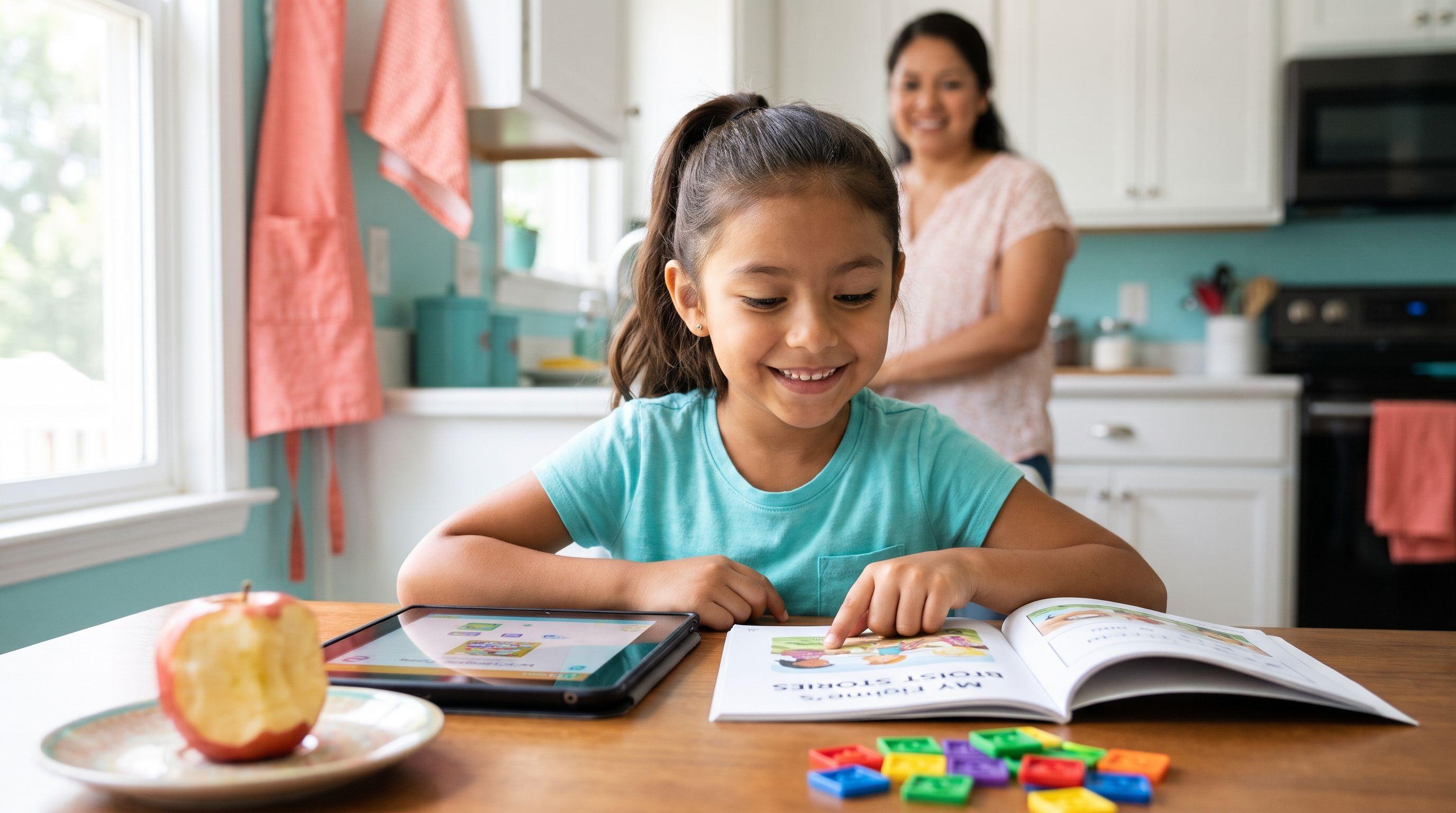
6 Best Homeschool Reading Programs for Struggling Readers: Ranked for Age 7
A reading lesson shouldn't turn the kitchen table into a daily courtroom, with you presenting evidence and your 7-year-old arguing for dismissal.
I'm Xia Brody, a homeschooling mom of four, ages 10, 7, 4 and 1. I've taught my two oldest to read, and I'm still in the thick of early phonics with my 4-year-old. My pick among the best homeschool reading programs for struggling readers starts with a practical question: can you teach the missing skill without guessing what to do next?
What You'll Learn
- Teach Your Kid to Read ranks first for parent-led decoding practice.
- UFLI Foundations and All About Reading offer print-based alternatives.
- Choose by reading skill, not the age on the box.
- Check unfamiliar words before buying.
Imagine Lily seeing ship and saying “boat” because of the picture. That's guessing, not reading.
Games can help, but rewards aren't proof of decoding.
The Verdict
This list includes apps and print programs because a struggling reader homeschool curriculum doesn't have to live on a tablet.
How we ranked
- Clear teaching sequence: missing sound patterns need direct instruction, not random practice.
- Support for the adult: parents need a usable lesson, not another planning job.
- Practice that matches instruction: children should apply the patterns they've learned.
- Practical family fit: consider screen use, adult time and purchasing model.
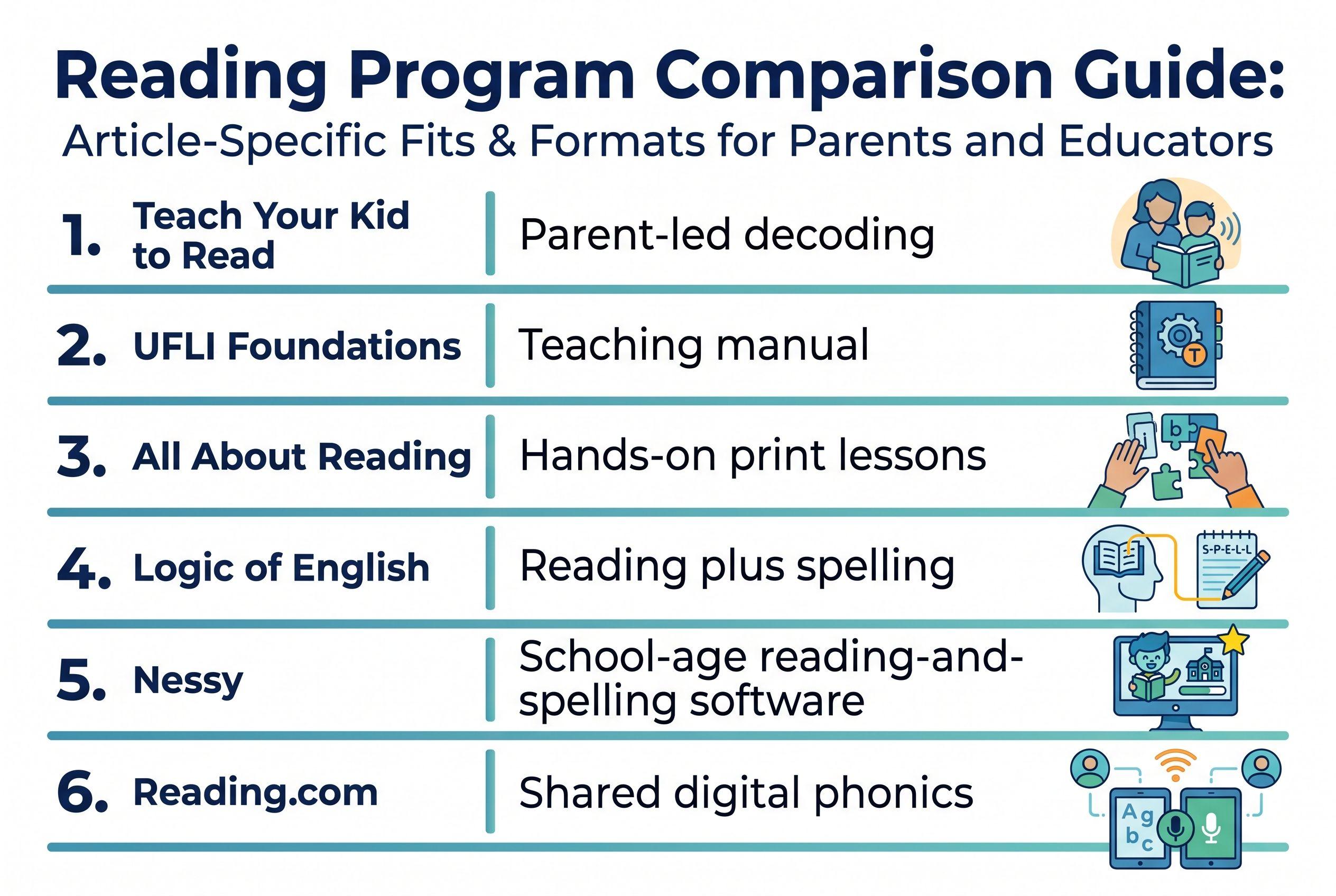
| Rank and program | What it teaches or how it describes itself | Price / pricing model | Best-for age or stage |
|---|---|---|---|
| 1. Teach Your Kid to Read | Step-by-step phonics with an adult; blending and short decodable stories from lesson two | Lesson one free, then 7-day trial, US$9.95/month | My recommendation: a 7-year-old rebuilding decoding with a parent |
| 2. UFLI Foundations | Describes an explicit, systematic program for foundational reading skills | Free online Toolbox; teacher manual US$70.00 (checked October 2026) | K–2 core instruction; intervention in any grade |
| 3. All About Reading | Describes a multisensory, mastery-based reading program | One-time purchase per level; level materials US$159.95 (checked October 2026) | My recommendation: age 7, with placement by skill rather than age |
| 4. Logic of English | Describes instruction connecting phonics, spelling and handwriting | One-time purchase | Foundations: ages 4–7; Essentials: ages 8 and up |
| 5. Nessy | Describes reading and spelling instruction with support for learners with dyslexia | Home subscription from US$15.50/month (checked October 2026) | Stated ages 6–11 |
| 6. Reading.com | Describes parent-and-child phonics lessons | Subscription; US$12.49/month (checked October 2026) | Stated ages 3–8 |
Full disclosure: I co-founded Teach Your Kid to Read, so weigh my #1 pick accordingly; the rest of the ranking is based on the criteria above.
Prices checked October 2026.
I recommend Teach Your Kid to Read for side-by-side decoding practice; start lesson one free. Lesson one is free, with no card and nothing to cancel. From lesson two, the whole program is a 7-day free trial, then US$9.95 a month.
These are curriculum-fit judgments, not results from hands-on competitor testing. A lower rank doesn't mean a weaker choice for every child; print preference or a need for specialist instruction can change your decision.
The Tiger Truth: Waiting Doesn't Teach the Missing Skill
Only 31% of US 4th graders (ages 9–10) scored at or above Proficient in reading on the 2024 NAEP. That doesn't mean everyone else can't read, and NAEP Proficient isn't simply a synonym for grade level. It does show a serious national reading problem.
Don't turn that statistic into panic about your own child. Turn today's difficulty into a teaching target. If short-vowel decoding remains shaky, harder books add more places to stumble.
The 2000 report from the National Reading Panel, a US federal reading panel, found significant benefits from systematic phonics instruction. That supports explicit phonics teaching generally; it doesn't establish that any app in this ranking will produce a particular result.
Start helping now. A 7-year-old who struggles isn't a lost cause.
Ranked: The 6 Best Homeschool Reading Programs for Struggling Readers
1. Teach Your Kid to Read — Best for Parent-Led Decoding Practice
This is my first recommendation for a parent who wants the lesson sequence on screen and the teaching relationship beside it. You sit with your child. The app teaches you what to listen for and how to correct a mistake while your child works through the lesson.
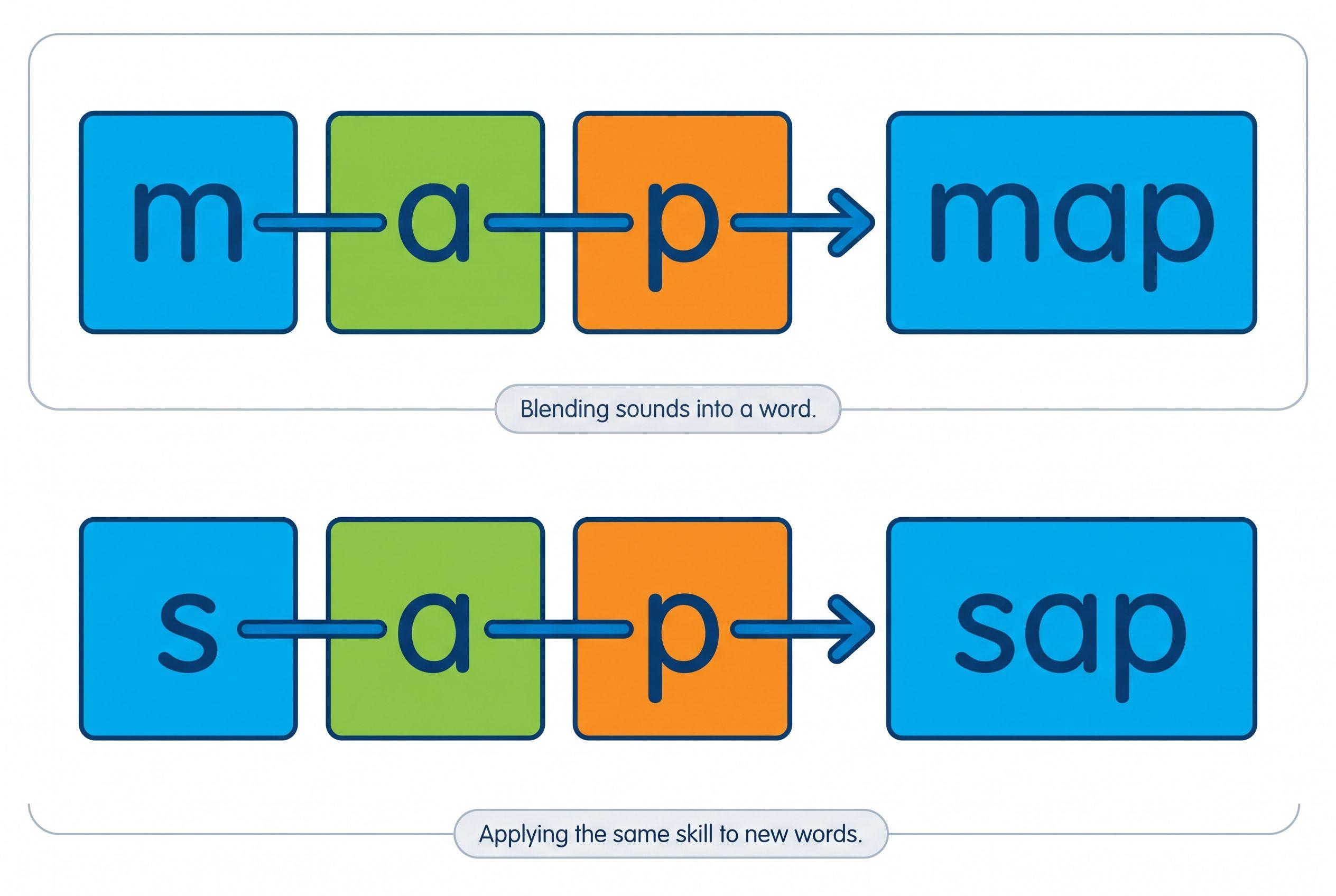
Lesson one introduces m, s, p and short a. Your child hears the sounds individually, taps the matching letters, then blends and builds am, map and sap. There's no story in lesson one; short stories begin in lesson two and use sounds taught so far.
The course contains 50 lessons in a fixed order. It moves from single letter sounds through digraphs such as sh, ch and th, then blends, vowel teams and silent e through prefixes and suffixes. It also teaches a small set of common irregular words by sight, calling them “leap words.”
For our ranking criteria, the match between instruction and practice matters most. A child doesn't need a surprise spelling pattern right after finally managing map. The parent guidance also removes some of the “What am I supposed to say now?” burden.
Plan for about 15 minutes a day together. The program works on iPhone/iPad, Android and the web, and families can include several children on one account. Parents can see every lesson and jump to one, although I wouldn't skip a shaky pattern just because its activities look easy.
Honest limitation: the app doesn't listen to your child or check pronunciation; you do. Choose something else if you need the software itself to hear reading and correct spoken errors.
My verdict: a practical homeschool phonics program when your priority is teaching decoding together, rather than handing over a device and hoping.
2. UFLI Foundations — Best for a Parent Who Wants a Teaching Manual
UFLI Foundations describes an explicit, systematic approach to foundational reading instruction. Its published lesson routine includes sound work, blending, spelling and connected-text practice, with a free online Toolbox supporting the manual.
That combination fits three ranking criteria well: a clear sequence, guidance for the instructor and opportunities to apply taught patterns. I like a routine that makes the next teaching move visible. Parents already make enough decisions before breakfast.
The trade-off is preparation. You take the instructor's role, organize materials and learn the lesson routine; this isn't a child-facing app that carries the session.
Choose it if: you want a manual-based struggling reader homeschool curriculum and don't mind learning how to deliver it. For a 7-year-old, start at the appropriate skill point rather than assuming the school-year label tells you where to begin.
3. All About Reading — Best for Hands-On, Screen-Free Lessons
All About Reading describes its program as multisensory and mastery-based, using explicit lessons, manipulatives and reading practice. Its placement guidance matters more than matching your child's birthday to a box.
For the best homeschool reading programs for struggling readers, “mastery-based” should mean something practical: revisit the skill when the child still needs support. Finishing an activity isn't proof that the learning stuck.
Its print-centered format suits parents who want tangible materials and a defined instructional path. The trade-off is managing those materials and teaching the lessons yourself. Consider the per-level purchasing model before committing, rather than comparing its upfront cost directly with one month of an app.
Choose it if: your child engages better with physical materials and you want reading instruction away from a screen. Check placement and the contents of your chosen package before ordering.
4. Logic of English — Best for Connecting Reading and Spelling
Logic of English describes an approach that connects phonograms and spelling rules with reading instruction. Foundations targets ages 4–7; Essentials targets ages 8 and up.
A phonogram represents a sound through one letter or a group of letters. That connection helps explain why sh works as a unit instead of two separate sounds. Reading and spelling can then reinforce the same pattern rather than feeling like unrelated school subjects.
Against the ranking criteria, its appeal lies in explicit instruction and a broader language focus. The trade-off is deciding which course and starting point fit your child's actual knowledge. Don't buy the next age band simply because another birthday approaches.
Choose it if: you want a homeschool reading program for a 7 year old that connects decoding with spelling instruction, and you're comfortable teaching from a fuller set of materials.
5. Nessy — Best to Investigate for Reading-and-Spelling Software
Nessy describes reading and spelling software for ages 6–11, with particular attention to learners with dyslexia. That age range includes this reader without requiring you to stretch a preschool product into a catch-up plan.
Its stated reading-and-spelling focus makes it relevant here. Still, check the current lesson examples and parent guidance before subscribing: can you identify what your child will learn, how practice follows instruction and what you need to do alongside the software?
I wouldn't treat dyslexia-focused marketing as a diagnosis or a promise of sufficient intervention. Persistent difficulty can call for direct teaching from a qualified reading specialist, even when software provides useful practice.
Choose it if: you want to investigate digital reading-and-spelling support for a school-age learner. Keep listening to actual reading outside the program; completing screen activities alone doesn't settle whether a skill transfers.
6. Reading.com — Another Parent-and-Child Phonics Option
Reading.com describes a parent-and-child phonics approach for ages 3–8. Its shared-lesson model makes it a relevant comparison for families who want guidance rather than an entirely independent activity.
For this ranking, adult involvement counts as a strength when the adult receives useful teaching support. Before buying, examine the sample instruction for blending and correction. Look for a clear response when a child substitutes a plausible word instead of reading the letters.
Its subscription model may suit a family that prefers ongoing access over a print curriculum purchase. The trade-off is the same practical question that applies to any shared app: will an adult consistently sit down and teach?
Choose it if: you're comparing parent-led digital phonics options. Judge the teaching routine and practice, not which screen looks most exciting.
Match the Program to the Error
The best homeschool reading programs for struggling readers won't all solve the same problem equally well. Listen closely before deciding.
- “Map” becomes “mop”: check short-vowel knowledge and accurate attention to the middle letter.
- Your child says each sound but can't combine them: model blending and practice with a smaller set of known sounds.
- A familiar page sounds fluent, but unfamiliar words fall apart: check decoding away from memorized sentences.
- Reading sounds accurate, but the meaning disappears: phonics alone won't cover the whole need; include vocabulary, discussion and comprehension instruction.
Linnea Ehri's 2005 review, Learning to Read Words: Theory, Findings, and Issues, explains how connections between spellings and pronunciations support word learning. Orthographic mapping isn't taking a mental photograph of a page. Accurate connections between sounds and letters matter.
That's why my No Guessing rule targets the strategy, not the child. I can stay warm while saying, “Let's look at the letters.”
Your Action Steps: Check, Choose, Teach
Use this plan before assembling an expensive tower of curriculum boxes.
- Find the first shaky pattern. Use our free phonics skill check to hear your child read real and made-up words. Note the first pattern that needs teaching; this check isn't a diagnosis.
- Separate decoding from language understanding. Read a short passage aloud yourself and discuss it. Then listen to your child read something manageable. Notice whether difficulty centers on reading the print, understanding the language or both.
- Check expectations without turning them into a race. Consult what to expect at age 7. If you're planning 2nd grade homeschool reading, use the second grade reading benchmarks alongside actual skill observations, not as a reason to push harder books.
- Choose one main program. Pick the format you can teach consistently. Use supplements for a specific missing skill, not as six competing lesson sequences.
- Teach and record one concrete observation. Write something like “read map independently; needed help blending sap.” Keep corrections brief. Recheck with different examples of the same pattern rather than repeatedly rehearsing one list.
- Ask for help when difficulty persists. Seek a qualified reading specialist or appropriate local school service for persistent decoding problems, severe distress or concerns about speech, language or hearing. Don't make your child finish another subscription before you ask.
Start with one shared lesson and listen to the sounds your child actually produces.
For focused catch-up phonics practice between lessons, choose a drill that matches your teaching from these CVC word activities.
Keep the Routine Firm and the Child Safe
My “We Never Skip” rule means protecting a teaching routine, not forcing a miserable child through exhaustion or illness. On a disrupted day, a tiny review may make more sense than introducing a new pattern. Consistency shouldn't become punishment.
The best homeschool reading programs for struggling readers give you a sequence; your observations tell you when to slow down. Keep rich read-alouds in the day, too. A child who needs simple decoding practice can still enjoy complicated ideas through listening.
Pick the program you can teach, start at the missing skill and notice what changes. Lesson one is free if you want to begin with guided, side-by-side phonics.
FAQ
What's the best homeschool reading program for a struggling 7-year-old?
My first pick here is Teach Your Kid to Read for parent-led decoding practice. UFLI Foundations suits parents who want a teaching manual, while All About Reading suits families seeking physical materials. Skill fit and the adult's ability to teach consistently matter more than the rank alone.
Should I start a 7-year-old with beginner phonics?
Yes, if a skill check shows missing beginner skills. Teach the gap without calling the work babyish. A child's age doesn't automatically supply accurate letter-sound knowledge or blending ability.
Can a phonics app replace a dyslexia assessment or specialist?
No. An app can support instruction, but it doesn't replace an assessment or individualized help. Ask for support when difficulty persists despite explicit teaching, and keep providing appropriate practice while you seek it.
How long will catch-up phonics take?
There's no honest universal timeline. Starting skills, language needs and the intensity of instruction all affect progress. Track accuracy on unfamiliar examples and seek additional help if the current plan isn't producing progress.
From teachyourkidtoread.org/blog/top-6-homeschool-reading-programs-for-a-struggling-7-year-old
Part of these guides

Xia Brody
Co-Founder, Teach Your Kid to Read
Mom of 4 who has successfully taught her kids to read. Currently in the trenches with her 4-year-old while her two oldest (10 and 7) devour books on their own. Passionate about phonics-based methods and building a lifelong love of reading.
Related Articles
Best App for a 7-Year-Old Who Guesses Words: 4 Picks
Guessing “pony” when the page says “horse” isn't reading, even if the story makes sense. Here's my parent-focused comparison of four apps, plus a practical plan for replacing guesses with decoding.
Read More →
Best App for a 6-Year-Old Who Guesses Words: 5 Picks
If your 6-year-old guesses words from pictures, they don't need more leveled books. They need systematic phonics, daily decoding practice, and a parent who stops the guessing cold.
Read More →
My 3rd Grader Can't Read: Warning Signs + 4 App Picks
An app can support reading practice, but it can't replace an assessment or targeted teaching. Here are four ranked options, the warning signs I'd take seriously and a concrete plan for getting help.
Read More →