CVC Words Activities for Struggling Readers: 12 Drills That Build Real Skill

What You'll Learn
- Why your struggling reader keeps guessing at CVC words — and the one brain process that's probably missing
- The difference between a CVC "activity" that wastes time and one that builds real decoding skill
- 12 specific, hands-on CVC blending activities you can start today with stuff you already own
- How to know when your child is actually ready to move past CVC words (hint: most parents move on too fast)
Your Kid Isn't "Just Not a Reader." They're Missing a Skill.
Let me paint a picture. Your child sits down with a simple book. The word on the page is "dog." There's a picture of a golden retriever right next to it. Your kid looks at the picture, looks at the first letter, and says... "puppy."
That's not reading. That's guessing.
And if your child is doing this with CVC words — those simple three-letter, consonant-vowel-consonant words like cat, dog, sit, mop — you don't have a "slow learner." You have a kid who hasn't been taught to blend sounds together. Period.
I see this all the time. Parents come to me panicked because their 5- or 6-year-old "can't read" and the school is shrugging it off. The teacher says "they'll catch up." The pediatrician says "every child develops at their own pace." And meanwhile, the kid is falling further behind every single week.
Here's what nobody tells you: CVC words are the foundation of everything. If a child can't decode cat, longer words become a nightmare — because every later step (blends, digraphs, syllables, morphology) is built on that same sound-by-sound decoding habit. And the skill they're missing isn't intelligence or motivation — it's blending. The physical act of pushing individual sounds together into a word.
Linnea Ehri's research describes a process called orthographic mapping — the way the brain forms permanent word memories by bonding spellings to their pronunciations and meanings. David Kilpatrick's work in Equipped for Reading Success (2016) builds on this, showing that advanced phonemic awareness — including the ability to blend and segment sounds — is what supports orthographic mapping and drives word-level reading development. Without those phonemic skills, the mapping process never kicks in. Your kid can stare at flashcards all day long and they still won't "just remember" the words, because the neurological pathway isn't there.
So let's build it.
The Tiger Truth: What Happens If You Do Nothing
I'm not going to sugarcoat this.
The National Assessment of Educational Progress (NAEP) — the Nation's Report Card — showed that only 33% of 4th graders read at proficient level in 2022. Let that number hit you. Two out of three kids in America can't read well enough by 4th grade.
And those kids didn't just wake up struggling in 4th grade. They were struggling with CVC words in kindergarten and first grade, and nobody did anything about it.
The Annie E. Casey Foundation's 2010 study found that children who can't read by 3rd grade are four times more likely to drop out of high school. Four times. That's not a scare tactic — that's longitudinal data.
Know what the worst part is? Remedial reading intervention costs $10,000 to $15,000 per year once your kid is behind. Insurance doesn't cover it. Schools often don't provide it until a child has "failed enough" to qualify for services. By then you've lost years.
The "Wait and See" approach is the most expensive lie in education.
You don't need to wait. You need CVC words activities that actually work — and you need to start them now.
Why Most CVC Activities Are a Waste of Time
OK so here's where I'm going to make some enemies.
Not all CVC activities are created equal. The Pinterest-worthy craft where your kid glues cotton balls onto the letter C? That's an art project. The app where they tap a cartoon cat and hear "cat!" while confetti falls? That's entertainment.
Neither of those is teaching your child to blend sounds.
Louisa Moats wrote in her landmark 1999 paper Teaching Reading IS Rocket Science (published by the American Federation of Teachers) that effective reading instruction requires explicit, systematic, and sequential phonics — not cute activities that happen to involve letters.
So what separates a real CVC blending activity from a time-waster?
Three things:
- The child must produce the sounds themselves. Not listen. Not watch. Produce. Out loud. With their mouth.
- The child must physically blend those sounds together. Not just say "c... a... t." They need to push those sounds together until "cat" comes out.
- The activity must require decoding, not memorization. If the kid has seen the word 50 times and is just recognizing the shape, they're not reading — they're memorizing a logo.
Keep those three filters in mind as we go through these activities. Every single one I'm about to share passes all three.
The Moment It Clicks (It Will Click)
Before I get into the drills, let me tell you about Mei.
My 4-year-old had been doing letter sounds for about three weeks. Just steady, boring, consistent practice — a few minutes every day at the kitchen table. No special curriculum, no $200 reading kit. Just letter tiles and my voice.
Then one morning, she was eating her Cheerios and she suddenly pointed at the word on the cereal box and said "c-a-t... cat!" Completely unprompted. I almost choked on my coffee.
Now, the word on the box wasn't actually "cat" — I think she was pointing at part of a longer word and just pulled out the CVC chunk she could decode. But the point is, the blending happened. The sounds connected. I watched her brain click in real time.
Within two weeks, she was blending every CVC word I put in front of her. We celebrated with a trip to the library where she picked out her own easy reader book. She held it like it was made of gold.
That's what I want for your kid. And these activities are how you get there.
12 CVC Words Activities for Struggling Readers That Actually Build Skill
1. The Sound-by-Sound Slide
This is the most basic CVC blending activity and honestly the most powerful. You need three letter tiles (magnetic letters, Scrabble tiles, or just letters written on sticky notes).
Place s, i, t on the table with spaces between them. Point to each letter. Have your child say the sound. Then physically slide the tiles together while they blend: "sssss... iiiii... ttt... sit!"
The physical movement of sliding the letters together gives their brain a concrete anchor for the abstract concept of blending. It's Orton-Gillingham 101 — multisensory instruction. Eyes see it, hands move it, mouth says it.
Do this with 5-8 words per session. Every single day. Yes, on weekends. Yes, on birthdays. We never skip.
2. CVC Word Chains
Start with cat. Ask your child to read it. Then swap just one letter: change the c to b. Now they read bat. Change a to i. Now it's bit. Change t to g. Now it's big.
This drill is a no-brainer for struggling readers because it forces them to notice which sound changed. They can't coast on memorization because the word keeps morphing.
UFLI Foundations — a free phonics curriculum out of the University of Florida — uses word chains extensively. The program is backed by systematic synthetic phonics research and it's free for teachers. Parents can grab the materials too.
3. Elkonin Sound Boxes
Draw three connected boxes on a piece of paper. Give your child three small objects — pennies, buttons, M&Ms (bribery is valid). Say a CVC word: "map." Your child pushes one object into each box as they say each sound: /m/ (push) /a/ (push) /p/ (push).
This builds phonemic segmentation — the ability to pull a word apart into individual sounds. It's the reverse of blending, and struggling readers need both directions.
The kicker is that this activity doesn't even use letters at first. You're training the ear before the eye. Once your kid can segment sounds with objects, THEN add letters to the boxes.
4. Body Blending
This one sounds weird but it works. Assign each sound in a CVC word to a body part. Touch your head and say /m/. Touch your waist and say /a/. Touch your toes and say /p/. Then "slide" your hands from head to toes while blending: "mmmaaaaap... map!"
Struggling readers often need to involve their whole body — not just their eyes and mouth. This comes straight from the Lindamood-Bell approach, which emphasizes sensory-cognitive processing. It looks goofy. Your kid will laugh. They'll also remember the blending motion.
5. CVC Word Sorts
Write 12-15 CVC words on index cards. Create category headers: "short A words," "short I words," "short O words." Have your child read each word aloud (no guessing — sound it out) and place it under the correct header.
This forces them to identify the medial vowel — the middle sound — which is hands down the hardest part of CVC words for struggling readers. Most kids nail the first and last consonant early. The vowel is where it falls apart.
6. Decodable Reader Hunts
Grab a set of decodable readers — I recommend the Bob Books series for absolute beginners, or Flyleaf Publishing readers for slightly more advanced CVC practice. (Stay away from Fountas & Pinnell leveled readers — those are whole-language aligned and rely on picture cues. Exactly the wrong approach.)
Have your child read through a decodable book and circle or highlight every CVC word they find. Then go back and read just those words in isolation. Then read the whole page again.
This bridges the gap between drilling isolated words and reading connected text — which is ultimately the whole point.
7. Roll-and-Read CVC Dice
Get three dice. Put consonant stickers on two of them and vowel stickers on the third (use the short vowels: a, e, i, o, u plus one repeat). Roll all three. Whatever letters come up, your child has to blend them.
Sometimes they'll roll real words. Sometimes they'll roll nonsense words like "lov" or "pid." Both are great. In fact, nonsense words are even better for struggling readers because they can't guess. There's no picture, no context, no way to cheat. Just pure decoding.
The DIBELS Nonsense Word Fluency (NWF) subtest exists for exactly this reason — it measures whether a child is truly decoding or just recognizing memorized words. Benchmarks vary by DIBELS edition and time of year, so ask your child's school for their current NWF score and the benchmark for that testing window. If your child can decode nonsense CVC combinations, they can decode anything.
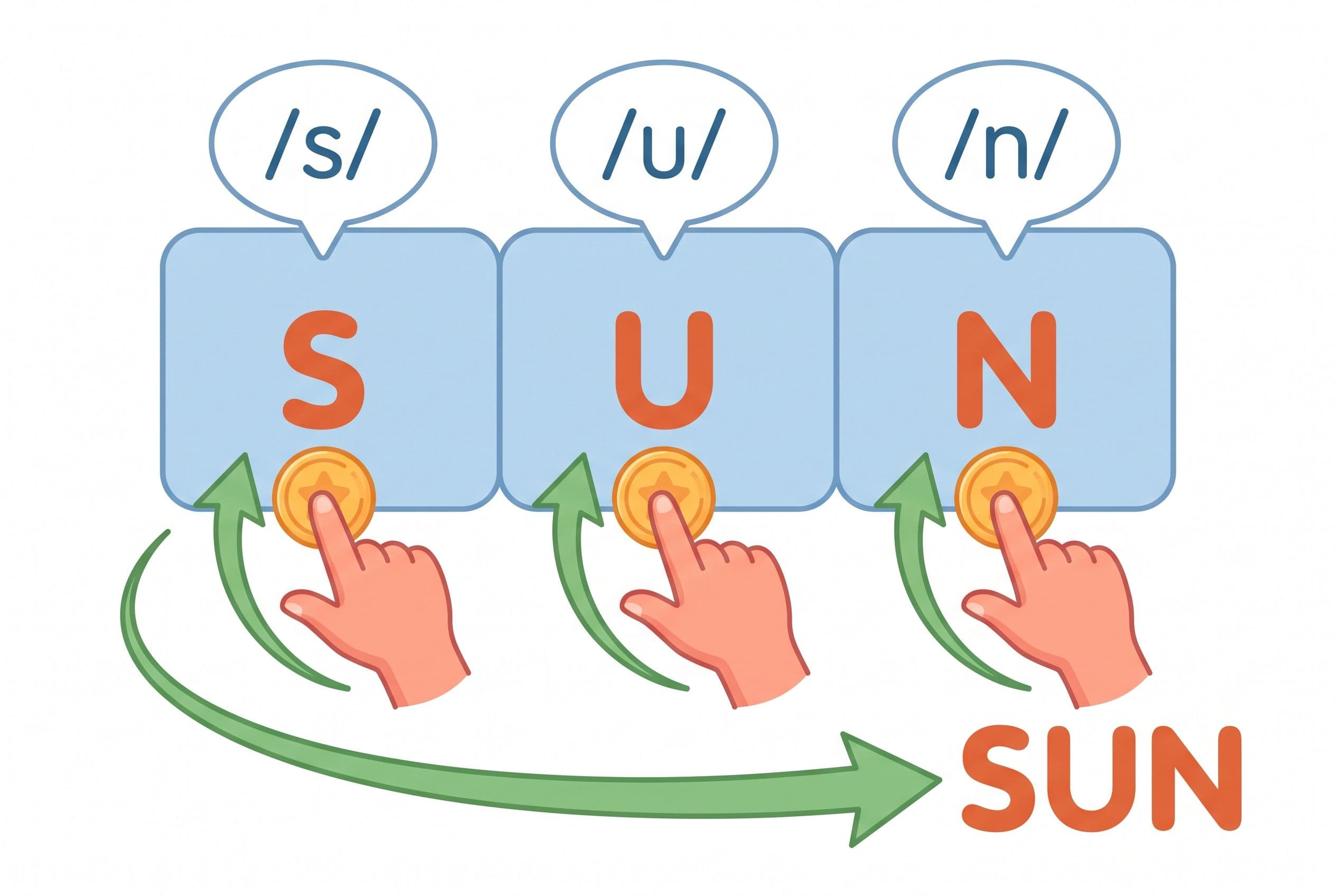
8. Tap-and-Sweep
Write a CVC word on a whiteboard. Have your child tap under each letter as they say the sound, then "sweep" their finger under the whole word as they blend it together.
Tap: /s/ /u/ /n/ Sweep: "sun!"
This is another Orton-Gillingham staple. The tapping isolates each phoneme. The sweeping triggers the blend. Your child physically rehearses the decoding process every single time. Repetition isn't boring when it's building a brain pathway.
9. CVC Memory Match (With a Twist)
Make pairs of cards — but instead of matching identical words, match a CVC word card to a picture card. Lay them all face down. Your child flips a word card, reads it aloud, then flips a picture card to see if it matches.
The twist: they MUST read the word before flipping the picture. No peeking. No guessing. Sound it out first, then check.
This turns a classic kids' game into a CVC blending activity that your struggling reader won't resist because it feels like a game. But make no mistake — every flip is a decoding rep.
10. Magnetic Letter Swap Board
Stick a CVC word on the fridge with magnetic letters. Throughout the day, walk by and swap one letter. Leave a sticky note that says "New word — come read me!" Your child finds it, sounds it out, and tells you the word.
I've been doing this with Mei and she now checks the fridge like it's sending her secret messages. She gets maybe 4-5 extra decoding reps per day without sitting down for a formal lesson. Those reps add up fast.
11. CVC Word Ladders
Similar to word chains, but structured as a vertical ladder. Start at the bottom with a word like hat. Give a clue: "Change one letter to make something a baseball player uses." (Answer: bat.) "Change one letter to make something you sit on." (mat.) "Change one letter to make what a cat does to the window." (tap — wait, that's harder. Start simple.)
Real talk — this activity works best for kids who already have shaky but emerging CVC skills. If your child can't blend at all yet, go back to activities 1-4 first. Word ladders require blending PLUS flexible thinking. Stack the skills in order.
12. The Teach Your Kid to Read App
Look, I'm biased. I co-founded TeachYourKidToRead.org. But I built it because everything else I found was either too gamey (all flash, no phonics) or too clinical (designed for reading specialists, not parents at the kitchen table).
The app uses systematic synthetic phonics — the same Orton-Gillingham principles behind activities 1, 8, and 10 above — in short daily lessons that take 10-15 minutes. It starts with individual letter sounds, moves to CVC blending, and progresses through a structured sequence that matches what the National Reading Panel identified as effective instruction back in 2000.
No guessing from pictures. No skipping ahead. No confetti for wrong answers.
How to Know If Your CVC Activities Are Working
You need benchmarks. "I think they're getting better" isn't good enough.
Here's what to watch for:
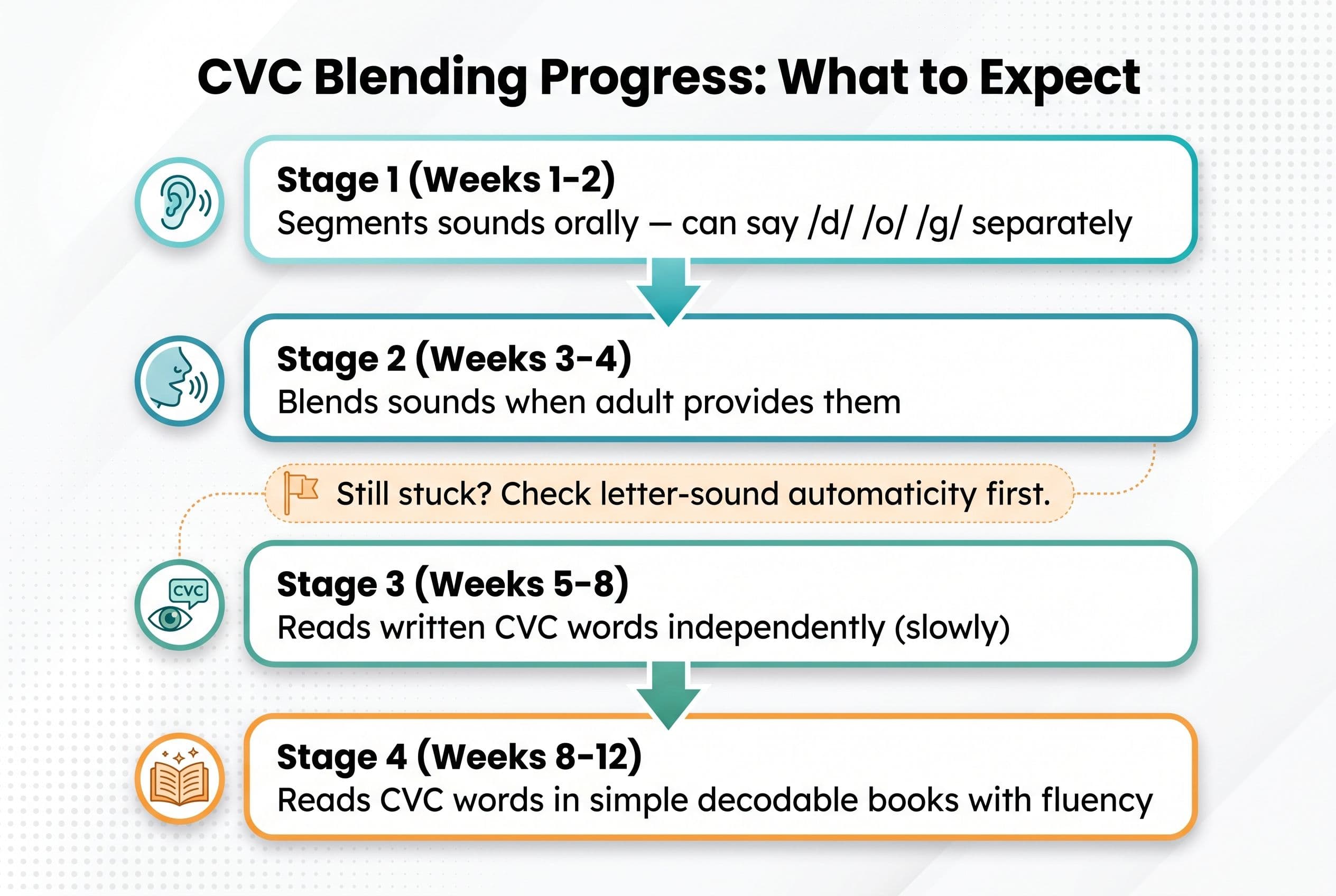
Week 1-2: Your child can segment CVC words orally (say the three sounds in "dog" separately: /d/ /o/ /g/).
Week 3-4: Your child can blend CVC words when YOU provide the sounds (you say /d/... /o/... /g/ and they say "dog").
Week 5-8: Your child can look at a written CVC word and blend it independently. Slowly at first. That's fine.
Week 8-12: Your child can read CVC words in connected text (simple decodable books) with reasonable fluency — not lightning fast, but without agonizing over each letter for 30 seconds.
If you're not seeing progress by week 4, don't panic — but do check the basics. Can they identify all 26 letter sounds automatically? (Not letter names — letter SOUNDS.) If there's hesitation on letter sounds, you're not ready for blending yet. Go back and drill the sounds.
You can use Kilpatrick's PAST test (Phonological Awareness Screening Test) to identify exactly where the breakdown is happening. It takes about 5 minutes and it's free. Your child might have solid letter-sound knowledge but weak phonemic awareness, or vice versa. The PAST tells you which.
The CVC Words List You Actually Need
Don't overcomplicate this. Here's a practical CVC words list organized by vowel sound. Start with short A words (they're the easiest for most kids), then move to short I, short O, short U, and short E.
Short A: cat, bat, hat, mat, sat, rat, can, fan, man, pan, ran, van, cap, map, nap, tap, bag, tag, rag, wag
Short I: sit, bit, hit, fit, kit, pit, big, dig, fig, pig, wig, bin, fin, pin, win, dip, hip, lip, rip, tip
Short O: hot, cot, dot, got, lot, not, pot, rot, cop, hop, mop, pop, top, cob, gob, job, mob, rob, sob, bog
Short U: bug, dug, hug, jug, mug, rug, tug, bun, fun, gun, nun, run, sun, bus, pus, but, cut, gut, hut, nut
Short E: bed, fed, led, red, wed, beg, leg, peg, ben, den, hen, men, pen, ten, bet, get, jet, met, net, pet
Print this out. Tape it to your fridge. Use it for word chains, sorts, dice games — everything.
When to Worry (And What to Do About It)
If your child has been doing consistent, daily CVC practice for 3+ months and still can't blend three sounds together, it's time to dig deeper.
This doesn't mean your kid has a problem. It means they might need a different approach or more targeted support.
Here's your action plan:
-
Get a DIBELS or PALS screening. Ask your child's school. These are quick, standardized assessments that tell you exactly where your child stands compared to grade-level benchmarks.
-
Rule out phonological processing issues. The International Dyslexia Association estimates that 15-20% of the population has some degree of dyslexia. Dyslexia is fundamentally a phonological processing disorder — the brain struggles to manipulate individual sounds. Early identification is everything.
-
Consider a structured literacy program. Programs like the Wilson Reading System, Barton Reading & Spelling, or Logic of English are specifically designed for kids who need more intensity than typical classroom instruction provides. They're all Orton-Gillingham based. They work.
Mississippi proved what early intervention looks like at scale. After passing the Literacy-Based Promotion Act of 2013 — which required evidence-based reading instruction and early screening for all K-3 students — the state posted some of the largest NAEP 4th-grade reading gains in the country, climbing from near the bottom of state rankings to the middle of the pack by 2019. That's what happens when you stop waiting and start teaching.
You can do the same thing at your kitchen table.
The Bottom Line
CVC words activities for struggling readers don't need to be fancy. They need to be consistent, explicit, and phonics-based.
Your child doesn't need more screen time, more worksheets, or more "exposure to print." They need someone — you — sitting next to them, pointing at letters, demanding they produce the sounds, and not accepting guessing as a substitute for decoding.
Ten minutes a day. Every day. With the right activities.
That's it. That's the whole secret.
And when your kid points at a cereal box one morning and blends a word out loud for the first time — unprompted, unassisted, just because their brain finally clicked — you'll understand why I almost choked on my coffee.
Start today. Not Monday. Not "when things calm down." Today.
Frequently Asked Questions
How long should I spend on CVC words activities each day?
Ten to fifteen minutes. That's it. Struggling readers burn out fast, and a short, focused session beats a 45-minute slog where everyone ends up crying. I do two sessions with Mei — one after breakfast, one before bath. Each one is under 10 minutes. Consistency matters more than duration.
My child knows all the letter sounds but still can't blend. What's going on?
This is incredibly common and it doesn't mean anything is wrong. Knowing letter sounds and blending them are two separate cognitive skills. Your child needs explicit blending instruction — start with the Sound-by-Sound Slide (activity #1) and Body Blending (activity #4). Slow the sounds down, stretch them out, and physically push them together. If you're still stuck after 4-6 weeks of daily practice, get a PAST screening from Kilpatrick's protocol to pinpoint the exact phonological gap.
Should I use real words or nonsense words for CVC practice?
Both. Real words build vocabulary and give your child the satisfaction of reading something meaningful. Nonsense words (like vin, mog, tup) are actually better for assessment purposes because they prove your child is truly decoding — not just recognizing a word they've memorized. The DIBELS nonsense word fluency subtest exists for exactly this reason. Mix them in regularly.
What's the difference between CVC words and sight words?
CVC words are decodable — your child can sound them out using phonics rules. Sight words (also called high-frequency words) are words kids encounter a lot in text. Here's the thing most people get wrong: many high-frequency words are actually fully or partially decodable. Even the "irregular" ones like was or said have parts that follow the rules. Best practice? Don't just have your kid memorize them like logos. Use a quick phonics-based routine: sound out what's regular, flag the tricky part (some teachers call it the "heart letter" — the part you have to learn by heart), and practice reading and spelling it. You're still building orthographic mapping, not just visual memorization. That said — teach CVC decoding FIRST. Stanislas Dehaene's research in Reading in the Brain (2009) showed that the brain needs phonological decoding pathways established before efficient whole-word recognition can develop. Build the decoding foundation, then layer in high-frequency words.
When is my child ready to move beyond CVC words?
When they can decode CVC words in connected text (decodable readers) with reasonable accuracy — around 90% or better — without long pauses or frequent errors. At that point, introduce consonant blends (like stop, grip), digraphs (like ship, chat), and silent-e words (like cake, pine). But don't rush it. A child who has rock-solid CVC mastery will fly through the next stages. A child who was pushed ahead too soon will crumble. Build the foundation right.
Part of these guides

Xia Brody
Co-Founder, Teach Your Kid to Read
Mom of 4 who has successfully taught her kids to read. Currently in the trenches with her 4-year-old while her two oldest (10 and 7) devour books on their own. Passionate about phonics-based methods and building a lifelong love of reading.
Related Articles

Best Reading App for CVC Words: 6 Picks for 2026
Looking for the best reading app for CVC words in 2026? Here’s my no-nonsense parent comparison of 6 apps, what they teach, what they miss, and which one I’d use first.
Read More →
Best Reading App for a 1st Grader Who Guesses Words
If your 1st grader guesses words from pictures, that’s not reading — that’s coping. Here’s the no-nonsense app comparison I’d use with my own kids.
Read More →
Best App for Kids Who Know Letters But Can't Read
Your child knows the alphabet but still can't read words? That's not laziness. It's a blending problem, and the right phonics app can help you fix it fast.
Read More →