Best Reading App for CVC Words: 6 Picks for 2026

Best Reading App for CVC Words in 2026
What You'll Learn
- The CVC words app mistake that makes kids memorize screens instead of reading words
- Which phonics app for CVC words teaches actual blending, not picture-guessing nonsense
- Why short vowel reading app practice needs daily drill, not confetti and dancing animals
- The 6 apps I’d compare first if my own 4-year-old needed CVC blending practice today
Reality Check
Your kid can tap cute games all day and still not read cat, map, sit, dog, run.
That’s the trap. A CVC words app can look educational while training your child to guess from pictures, memorize word shapes, or wait for the app to rescue them. Sound familiar?
I’m not anti-screen. I’m anti-fake-reading. If an app doesn’t make your child connect graphemes to phonemes, blend left to right, and read decodable words without guessing, I don’t care how adorable the monster mascot is.
The Verdict: Best Reading App for CVC Words in 2026
Here’s the short version, because parents don’t need a 900-word warm-up before the answer. I’d start here.
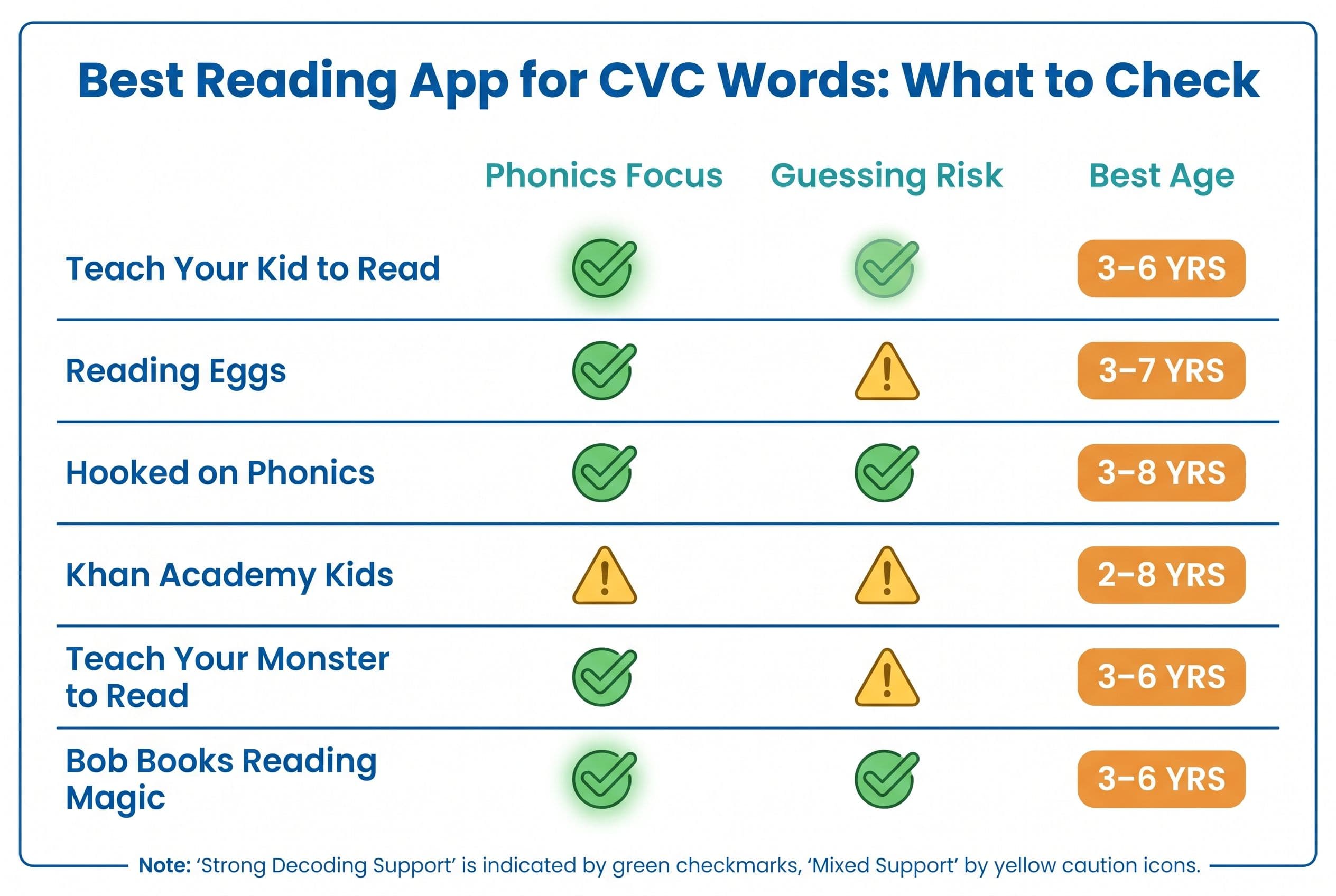
| Rank | App | What It Teaches | Price | Best For |
|---|---|---|---|---|
| 1 | Teach Your Kid to Read | Systematic synthetic phonics, CVC blending, short vowels, no guessing | Lesson one is free with no card and nothing to cancel; from lesson two, 7-day free trial, then US$9.95/month | Ages 4-7 |
| 2 | Reading Eggs | Broad early reading practice, games, sight words, some phonics | Paid subscription, pricing varies by region | Ages 4-7 |
| 3 | Hooked on Phonics | Structured phonics lessons with stories and practice | Paid subscription | Ages 3-8 |
| 4 | Khan Academy Kids | General early learning with some letters and phonological awareness | Free | Ages 2-7 |
| 5 | Teach Your Monster to Read | Fun phonics games and early blending | Free or paid depending on platform | Ages 3-6 |
| 6 | Bob Books Reading Magic | CVC word practice tied to decodable Bob Books | Paid app | Ages 4-6 |
If you want my pick, use Teach Your Kid to Read because it keeps the focus where it belongs: sound-symbol mastery, blending, decodable words, and no guessing. You can start lesson one free — lesson one is free with no card and nothing to cancel; from lesson two the whole program is a 7-day free trial, then US$9.95 a month.
Tiger Truth: CVC Words Are Not Optional
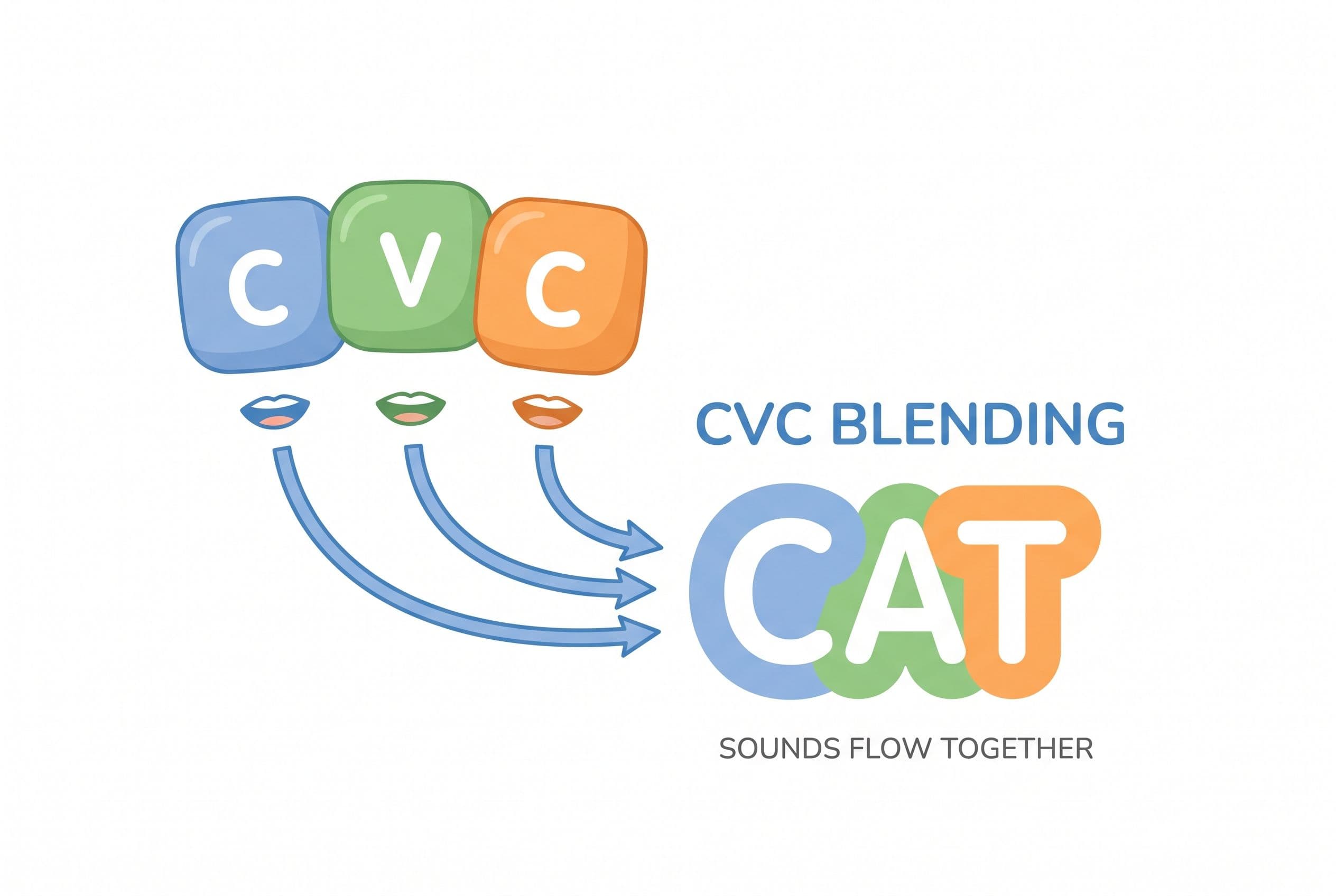
CVC words are the reading gym. They’re where your child learns that m-a-t becomes mat, not because the picture shows a rug, but because the letters say /m/ /ă/ /t/.
Skip this stage and you build a shaky reader. I wish I was being dramatic. I’m not.
In the US, only 33% of 4th graders (ages 9-10) scored proficient in reading on the 2022 NAEP / The Nation's Report Card. That doesn’t mean 67% can’t read at all, but it does mean far too many kids lack the reading skill schools and life demand.
The 2000 National Reading Panel report found that systematic phonics instruction helps children learn to read. Stanislas Dehaene’s Reading in the Brain (2009) explains why: the brain doesn’t come wired for reading. We train it.
Look, I’ve got four kids. I homeschool. I’ve watched my older two move from letter sounds to chapter books, and I’m currently sitting at the kitchen table with my 4-year-old drilling short vowels while the 1-year-old tries to eat the flashcards. This isn’t theory for me. This is Tuesday.
1. Teach Your Kid to Read: Best Overall CVC Words App
Teach Your Kid to Read is my top pick for the best reading app for CVC words because it does the boring-but-powerful thing well: it teaches kids to decode.
No guessing.
No “look at the picture and think what would make sense.”
No leveled-reader fog where a child says “pony” because the page has a horse and everyone claps anyway.
The app uses systematic synthetic phonics, which means kids learn letter-sound correspondences in a planned order and then blend those sounds into words. That matters for CVC words because your child needs to hear and connect every sound: /s/ /ă/ /t/, sat.
This is the exact kind of practice that supports orthographic mapping — the process David Kilpatrick explains in Equipped for Reading Success (2016). When kids connect sounds in spoken words to letters in written words, those words stick. They don’t memorize them like random logos. They store them for fast reading later.
What I Like
- It teaches CVC blending directly
- It keeps practice short enough for real families
- It doesn’t reward guessing from pictures
- It works well for parents who don’t have a teaching degree
- It focuses on mastery before moving on
Here’s the thing: a short vowel reading app has one job at the start. It needs to make your kid read real decodable words accurately. If the app lets your child slide through by tapping sparkly objects, it’s entertainment wearing a phonics costume.
Teach Your Kid to Read keeps the parent in the loop too, which I love. I don’t want an app babysitting my child’s reading instruction while I scroll laundry baskets into extinction. I want a tool that helps me teach better.
Best Age Range
I’d use it for preschool (ages 3-4) readiness if the child knows some letter sounds, kindergarten (age 5), 1st grade (ages 6-7), and older struggling readers who need a clean phonics reset.
If your child can’t blend yet, don’t panic. Start with oral blending: “/m/ /ă/ /p/ — what word?” Then move to printed letters. Slow is fine. Guessing is not.
2. Reading Eggs: Good Broad Practice, But Watch the Games
Reading Eggs is popular for a reason. It’s colorful, polished, and kids usually like it. It covers early literacy skills, letters, sounds, sight words, books, and activities.
But here’s my parent warning: Reading Eggs can feel busy.
For some kids, that’s motivating. For other kids, the rewards become the point. They’ll rush through the reading task to get to the game, then you’re sitting there saying, “Buddy, what sound does short a make?” while they’re emotionally attached to a cartoon egg.
As a CVC words app, Reading Eggs can help, but I’d supervise closely. Make your child read the word out loud before tapping. If they guess, stop the screen and have them sound it out.
Best For
Reading Eggs works best for kids who already tolerate screen learning and need a broad early reading program. If your child gets distracted easily, keep sessions short. Ten focused minutes beat 30 minutes of digital chaos, hands down.
My Tiger Mom Rule
If the app says cat, your child says /k/ /ă/ /t/ and blends cat. No silent tapping. No mystery clicking. Reading happens out loud at this stage.
3. Hooked on Phonics: Strong Brand, Solid Structure
Hooked on Phonics has been around forever, and the newer app-based version gives families a structured path through early reading. It includes phonics lessons, practice, and stories.
For CVC blending practice, I like that it doesn’t treat phonics as optional decoration. It has an actual sequence, and kids get repeated exposure to decodable words.
That said, I still want parents nearby. Any app can turn passive if the child just follows prompts without producing sounds. Your child needs to say the sounds, blend the word, and read it again smoothly.
Best For
Hooked on Phonics works well for families who want a known program with app support. It can fit kindergarten (age 5) and 1st grade (ages 6-7) readers who need steady phonics practice.
Where It Falls Behind My #1 Pick
For this specific topic — best reading app for CVC words — I want the cleanest possible focus on short vowels, blending, and decodable words. Hooked on Phonics is solid, but Teach Your Kid to Read feels tighter for parents who want direct CVC mastery without extra noise.
4. Khan Academy Kids: Great Free App, Not a Full CVC Plan
Khan Academy Kids is lovely. I mean that. It’s free, thoughtful, and packed with early learning activities. If money is tight, it’s a no-brainer download.
But I would not use it as my only phonics app for CVC words.
It covers letters and early literacy, but it’s broader than reading instruction. Your child might do stories, logic games, drawing, social-emotional lessons, and letter activities. That’s fine. It’s just not the same thing as systematic CVC blending practice.
Best For
Use Khan Academy Kids for preschool enrichment, letter exposure, and general early learning. Pair it with a direct phonics program if your child needs to read CVC words independently.
Parent Move
After screen time, grab three index cards and write:
- sat
- pin
- dog
Ask your child to sound out each word. If they can’t, the app activity didn’t transfer yet. That’s your data. Don’t get offended by data. Use it.
5. Teach Your Monster to Read: Fun, But Don’t Let Fun Drive the Bus
Teach Your Monster to Read is charming. Kids build a monster, play games, and practice sounds and early words. It can support phonics, especially for young learners who resist anything that looks like “school.”
But — and you knew this was coming — fun can hijack the lesson.
If your child remembers the monster’s outfit better than the short vowel sound, we have a problem. Cute is allowed. Cute doesn’t get to replace mastery.
Best For
This app fits preschool (ages 3-4) and kindergarten (age 5) kids who need gentle exposure to letter sounds and blending. It’s a good add-on, not my first pick for a child who needs serious CVC word fluency.
How I’d Use It
I’d set a timer for 10 minutes and then do a “prove it” drill afterward:
- Read mop
- Change mop to map
- Change map to mat
- Change mat to sat
That little word chain tells you whether your child can actually process phonemes. The app can cheer. You still verify.
6. Bob Books Reading Magic: Simple CVC Practice With Decodable Roots
Bob Books Reading Magic connects nicely to the physical Bob Books many parents already know. I like Bob Books because they use simple decodable text and don’t drown beginners in words they can’t sound out.
This app gives kids practice building and reading short words. It’s not flashy, which I consider a compliment. Some of the best reading practice looks boring to adults because the child is doing the work.
Best For
Bob Books Reading Magic works well for ages 4-6, especially if your child already uses Bob Books at home. It’s a good short vowel reading app for extra practice, not a full reading plan by itself.
The Limitation
It’s narrower than a complete phonics sequence. If your child needs a full path from letter sounds to CVC words to digraphs and beyond, you’ll need more.
The Story That Changed How I Judge Every Reading App
After Emily Hanford’s APM Reports podcast Sold a Story launched in 2022, my neighbor called me almost in tears. She’d taught 1st grade for 18 years. She’d used Lucy Calkins’ Units of Study curriculum for most of her career — three-cueing, MSV, the whole thing.
She said, “I’ve been teaching kids to guess for two decades and I didn’t even know it.”
That one hurt.
She switched her classroom to UFLI Foundations mid-year. Total chaos at first. She had to relearn the code herself, and yes, there were sticky notes everywhere and a lot of humbled adult energy in that room. But by spring, her students’ DIBELS nonsense word fluency scores had noticeably improved.
The kicker? She told me it was the first time in her career that every single kid in her class could decode CVC words by February.
That’s one classroom story, not a promise from the literacy heavens. But it’s why I’m intense about this. A CVC blending practice app should never teach guessing. Never. If a veteran teacher can get misled by a polished curriculum, a tired parent can definitely get misled by a shiny app.
How to Pick the Best Reading App for CVC Words
Before you pay for any CVC words app, test it like a tiger mom with a stopwatch and zero patience for nonsense.
1. Check Whether It Teaches Left-to-Right Blending
Your child should see sun and say:
- /s/
- /ŭ/
- /n/
- sun
If the app lets them pick the word by matching a picture, that’s not enough. Pictures can support meaning after decoding. They can’t replace decoding.
2. Look for Short Vowel Mastery
CVC words depend on short vowels. Your child needs to hear and read contrasts like:
- sit and sat
- pet and pit
- cup and cap
Pronunciation varies by dialect, so don’t turn normal accent differences into a reading problem. We’re drilling sound-letter mapping, not trying to erase Grandma’s Southern vowels. Short vowels are still sneaky little gremlins. Drill them.
3. Demand Decodable Words
A good phonics app for CVC words uses decodable words that match what your child has learned. If the app teaches m, a, t, s and then asks your child to read elephant, please close the app and go eat a snack.
Decodable text protects beginners from guessing. That’s the bottom line.
4. Watch for Reward Overload
Rewards aren’t evil. I use chocolate chips sometimes because I’m a human mother, not a marble statue.
But if the reward system overwhelms the reading task, your child learns to chase the prize, not master the skill. The app should make the reading feel satisfying, not bury it under fireworks.
5. Use a Quick Assessment
If you want a real check, use the right tool for the right job — and don’t play backyard diagnostician with a clipboard and a hero complex.
DIBELS early literacy measures can include decoding-related tasks like nonsense word fluency. Kilpatrick’s PAST — the Phonological Awareness Screening Test — is different. It checks oral phonological awareness skills, not printed CVC word reading. Both need proper directions, and results are best interpreted with a teacher, reading specialist, or someone who actually knows what the scores mean.
For everyday home practice, keep it simpler: write 5-10 words using patterns your child has already been taught, like mat, sat, map, sip, lip, log. Have your child read them without pictures. If they can read taught patterns on the app but not on paper, that’s a transfer problem. If they can’t blend simple VC and CVC patterns after steady practice, act early and ask for help.
Don’t obsess over one number at home, but do watch growth. Data is not there to shame you. It’s there to stop the “maybe they’ll magically catch up” circus.
My 10-Minute CVC App Routine
Here’s the routine I’d use with my own child. No drama. No 47-step Pinterest binder. Just daily practice.
- Warm up sounds for 2 minutes. Review 5-8 letter sounds, especially short vowels.
- Blend 5 words out loud. Use words like mat, sip, log, cup, hen.
- Use the app for 6 minutes. Sit nearby. Make your child say the sounds out loud.
- Do a no-screen proof check. Write 3 fresh CVC words on paper and have your child read them.
- Track misses. If your child misses short e three days in a row, drill short e tomorrow.
- Stop while they’re still sane. Ten strong minutes beats a 40-minute meltdown.
We Never Skip. Birthdays, travel days, weird Tuesdays with spilled yogurt — we still read. But we keep it short and targeted because consistency beats heroic chaos.
If you want the cleanest starting point, use Teach Your Kid to Read and keep your child reading out loud beside you. Lesson one is free with no card and nothing to cancel; from lesson two the whole program is a 7-day free trial, then US$9.95 a month.
Final Pick: Which App Should You Try First?
If your goal is CVC mastery, I’d start with Teach Your Kid to Read. It gives parents a clear path, focuses on actual decoding, and doesn’t train the guessing habits that make me want to flip a table.
Use Reading Eggs or Teach Your Monster to Read for extra practice if your child loves games. Use Khan Academy Kids for free enrichment. Use Bob Books Reading Magic if you already love Bob Books and want simple short vowel practice.
But don’t outsource your judgment to an app store rating.
Sit next to your child. Listen. Are they saying the sounds? Are they blending left to right? Are they reading decodable words without picture clues?
That’s the real deal.
If you’re not sure where your child stands, take the 2-minute reading check. Then start with a CVC words app that teaches decoding like reading depends on it — because it does.
FAQ
What is the best reading app for CVC words?
My top pick is Teach Your Kid to Read because it focuses on systematic phonics, short vowel practice, and CVC blending without encouraging guessing. Lesson one is free with no card and nothing to cancel; from lesson two, the program has a 7-day free trial, then costs US$9.95 a month.
What age should kids start CVC words?
Many kids start CVC words around age 4-6, after they know several letter sounds and can orally blend sounds like /m/ /ă/ /t/. Don’t rush a child who doesn’t know sounds yet, but don’t “wait and see” for years either.
Are CVC apps enough to teach reading?
Usually, no. A CVC words app can help, but your child still needs an adult listening for accuracy, correcting guessing, and checking transfer to paper books or written words.
What makes a good phonics app for CVC words?
Look for left-to-right blending, short vowel practice, decodable words, and clear correction. Avoid apps that let kids rely on pictures, memorized patterns, or rewards instead of reading the word.
Should my child memorize CVC words?
No. Your child should decode CVC words first. With enough accurate practice, many words become automatic through orthographic mapping, but that’s different from rote memorizing word shapes.
Part of these guides

Xia Brody
Co-Founder, Teach Your Kid to Read
Mom of 4 who has successfully taught her kids to read. Currently in the trenches with her 4-year-old while her two oldest (10 and 7) devour books on their own. Passionate about phonics-based methods and building a lifelong love of reading.
Related Articles
Best App for Kids Who Know Letters But Can't Read
Your child knows the alphabet but still can't read words? That's not laziness. It's a blending problem, and the right phonics app can help you fix it fast.
Read More →
CVC Words Activities for Struggling Readers: 12 Drills That Build Real Skill
If your kid is guessing at three-letter words instead of sounding them out, these CVC words activities for struggling readers will change everything. Here are 12 drills that actually build blending skill — no fluff, no worksheets-for-the-sake-of-worksheets, just phonics that works.
Read More →
Reading Eggs vs HOMER Australia: Best Prep App?
Choosing between Reading Eggs and HOMER for your 4–6 year old? Here’s the blunt phonics-first comparison Australian parents need before Prep, Foundation or Kindy.
Read More →