Best App for Blending CVC Words: 6 Phonics Picks Ranked

Your child can say every sound in “cat” but still can't read “cat.” Another alphabet game won't necessarily fix that. You need practice joining sounds—not a louder celebration when your child taps the right picture.
I'm Xia Brody, a Chinese-American homeschooling mum of four, ages 10, 7, 4 and 1. I've taught my oldest two to read, and I'm back in the blending trenches with my 4-year-old. My coffee knows things.
The best app for blending CVC words should help your child read unfamiliar words away from the screen. That's the finish line.
What You'll Learn
- Which six apps make this shortlist—and why my first pick comes with a disclosure.
- The small difference between genuine blending practice and a lucky tap.
- What my daughter's breakfast-table breakthrough taught me about practice.
- How to check whether an app lesson carries over to paper.
Knowing sounds and joining sounds are different skills. CVC means consonant-vowel-consonant: think “map,” “sit” and “cup.” Start with these simple short vowel words, not every three-letter word; “the” doesn't follow the same beginner pattern.
Look, pictures aren't the enemy. Using pictures instead of reading the letters is the problem. For this ranking, I prioritise explicit sound-to-letter teaching, blending practice, adult involvement and transfer to print—not the number of games. I compare published approaches, not hands-on competitor testing.
The Verdict
These are my picks for beginning readers, not results from a head-to-head effectiveness study. The best-for ages below reflect my recommendations; check each product's placement guidance. Competitor pricing models come from the supplied October 2026 fact sheet—check current prices and regional availability before buying.
| Rank and app | What it teaches and the blending fit | Price or pricing model | Best-for ages: my recommendation |
|---|---|---|---|
| 1. Teach Your Kid to Read | My first choice for parent-supported phonics practice; keep accurate sounding-out central | Lesson one is free with no card and nothing to cancel; from lesson two the whole program is a 7-day free trial, then US$9.95 a month | 4–6 |
| 2. Reading.com | Parent-child phonics lessons with explicit blending support | Monthly or yearly subscription; check current price | 4–7 |
| 3. Teach Your Monster to Read | Letter-sound and blending practice within an adventure game | Free on computers; one-time paid app purchase; check current price | 3–6 |
| 4. Reading Eggs / Fast Phonics | Broader literacy activities; Fast Phonics provides the more targeted synthetic-phonics route | Subscription; check current price and trial terms | 5–7 for Fast Phonics |
| 5. Hooked on Phonics | Phonics lessons and connected reading practice | Subscription; check current price and trial terms | 4–7 |
| 6. Khan Academy Kids | Broad early learning with phonics among its literacy activities | Free, without ads or subscriptions; confirm current availability | 3–6 |
Full disclosure: I co-founded Teach Your Kid to Read, so weigh my #1 pick accordingly; the rest of the ranking is based on the criteria above.
I recommend beginning with Teach Your Kid to Read through start lesson one free: lesson one is free with no card and nothing to cancel; from lesson two the whole program is a 7-day free trial, then US$9.95 a month.
Tiger Truth: Don't Let Tapping Pass for Reading
Here's the kicker: a child can finish an activity without independently decoding a single word. If adults mistake that success for reading, the underlying difficulty can keep growing.
On the US 2024 National Assessment of Educational Progress, 40% of US 4th-grade students (ages 9–10) scored below Basic in reading. That statistic describes a national problem, not your child's destiny—and it doesn't show that apps caused it.
By US 3rd grade (ages 8–9), schoolwork places heavier demands on independent reading. Weak decoding can make science instructions, maths problems and homework exhausting. Don't wait for confidence to collapse before asking for help. Older struggling readers can improve, but “let's ignore it for another year” isn't a plan.
Ranked: The 6 Phonics Picks for CVC Blending
1. Teach Your Kid to Read: My Pick for Parent-Supported Practice
I put Teach Your Kid to Read first because I want parents involved in teaching—not supervising a streak counter. The app belongs inside a routine where you hear your child blend, correct errors calmly and check the same skill on paper.
My recommendation includes a condition: don't treat any app, including ours, as a substitute for listening to your child read. A screen can't carry your entire literacy plan. Neither can my enthusiasm.
The method I want parents to look for is systematic synthetic phonics: teach letter-sound correspondences in a planned sequence, then blend those sounds into words. The US National Reading Panel reported in 2000 that systematic phonics instruction benefits children's reading development. That supports the teaching approach; it doesn't establish that this particular app outperforms its competitors.
For CVC blending practice, sit beside your child. After a lesson, write three words using sounds they've already learned. Ask them to read without pictures or audio prompts. That's your reality check.
My 4-year-old, Mei, had practised letter sounds for about three weeks when she suddenly blended “c-a-t” at breakfast. She pointed to “cat” on her cereal box and just… did it. Completely unprompted. I almost choked on my coffee.
Within two weeks, she was blending every regular CVC word I put in front of her using the sounds we'd practised. We celebrated at the library, where she chose her own easy reader. I still checked the pages: an “easy reader” label doesn't guarantee a book matches a beginner's phonics knowledge.
That was Mei's timeline, not a promise for your child. The useful part of her story isn't the speed. It's that she read outside a lesson, without a helpful screen giving the answer away.
Bottom line: choose a tool that supports that independence. Reject any activity as your main blending lesson if your child can succeed without attending to the letters.
2. Reading.com: A Strong Parent-Child Alternative
Reading.com describes a parent-child lesson approach with explicit phonics and blending support. Its stated ages are 3–8. That adult partnership makes it relevant when a child knows sounds but struggles to combine them.
The appeal is straightforward: you participate instead of hoping the device handles every misunderstanding. Listen for the whole word after the individual sounds. Saying /m/ /a/ /p/ and stopping isn't yet reading “map.”
The catch? This isn't the right fit if you want independent screen time. That's a practical mismatch, not evidence of weak teaching. Check its current subscription price and sample lesson before deciding whether its parent guidance suits you.
3. Teach Your Monster to Read: A Playful Practice Option
Teach Your Monster to Read describes activities covering letter sounds, blending and segmenting within a game. Its stated app ages are 3–6. The computer version offers a no-cost way to explore the approach; the mobile app uses a one-time purchase model.
Fun isn't forbidden in my house. Trust me, I have four children—not a tiny military academy. But the game must serve the skill.
Watch the ratio of reading to play. If your child spends the session pursuing rewards and can't blend three matching words afterward, don't count game progress as mastery. That outcome would disqualify it as your main blending tool, even if your child loves the monster.
4. Reading Eggs / Fast Phonics: Choose the Targeted Route
Reading Eggs covers several age bands and learning paths. For this particular task, inspect Fast Phonics, its synthetic-phonics offering for stated ages 5–10, rather than assuming every activity in the wider subscription targets blending.
Here's the thing: a broad reading subscription can offer useful material while still making it harder to find today's exact practice. Your child needs to join three sounds, not tour the entire menu.
Check whether the lesson practises the short vowel and consonants your child knows. Don't reject a program just because it includes pictures or rewards; reject a specific activity as decoding practice if it lets your child bypass the print. Check current subscription terms before paying.
5. Hooked on Phonics: Consider the Lesson-to-Reading Connection
Hooked on Phonics describes phonics lessons alongside reading practice, and its app lists ages 3–8. That connection matters: isolated word practice should eventually lead to sentences and books your child can actually decode.
My buying question is simple: does the next reading task mostly use patterns the lesson has taught? A child who knows “sat” shouldn't suddenly need to guess “beautiful” from a picture.
The catch is fit, not proof of a defect. Check sample materials and the exact subscription contents, which may differ by offer or region. If the available starting level skips your child's blending gap, choose something more closely matched. Bigger bundles don't automatically mean better instruction.
6. Khan Academy Kids: A Useful No-Cost Supplement
Khan Academy Kids serves stated ages 2–8 and includes early literacy within a broader learning app. Its no-ads, no-subscription model makes it a practical option for families watching costs.
For a narrow blending problem, though, broad coverage brings a trade-off. You may need to select relevant literacy activities rather than treating general progress as a phonics sequence.
It's a reasonable supplement when you want a free option. But here's my non-negotiable: if you can't identify repeated practice joining known sounds into unfamiliar words, it isn't solving this particular problem yet. Add direct teaching instead of adding more minutes.
What Makes a Blending Sounds App Worth Using?
A useful phonics app for CVC words helps children connect print with speech. It doesn't just ask them to memorise a screen layout.
Linnea Ehri's 2014 paper, “Orthographic Mapping in the Acquisition of Sight Word Reading, Spelling Memory, and Vocabulary Learning,” explains how readers connect spellings, pronunciations and meanings in memory. Orthographic mapping isn't photographing the outline of a word. Sound-letter knowledge matters.
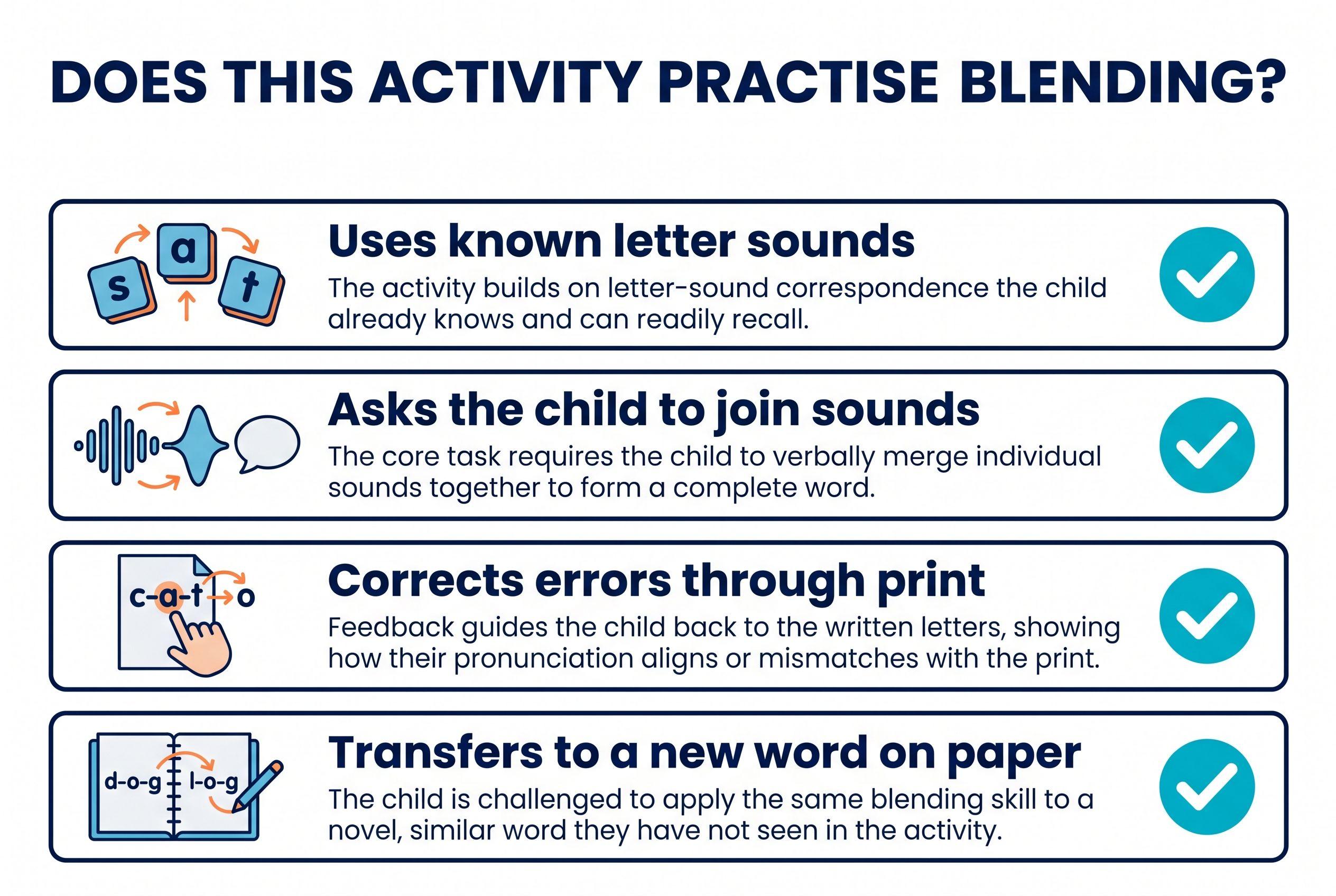
Use these buying checks:
- Known correspondences: Does practice mostly use letter sounds your child has learned?
- Actual blending: Must your child join sounds, rather than match pictures?
- Helpful correction: Does the lesson return attention to the letters after an error?
- Transfer: Can your child read a fresh example on paper?
Pictures can support meaning after decoding. Audio can model a difficult blend. Neither automatically makes an activity bad—the deal-breaker is letting those supports replace the reading.
You don't need six subscriptions. You need one workable routine and evidence that your child learns from it.
Action Step: Run This Short Blending Routine
Set aside roughly 5–10 minutes, adjusting for attention and frustration. That's a practical starting point, not a research-backed dosage or a deadline for mastery.
- Check three sounds. Show “m,” “a” and “s.” Ask for sounds, not just names. If your child doesn't know them, teach those first.
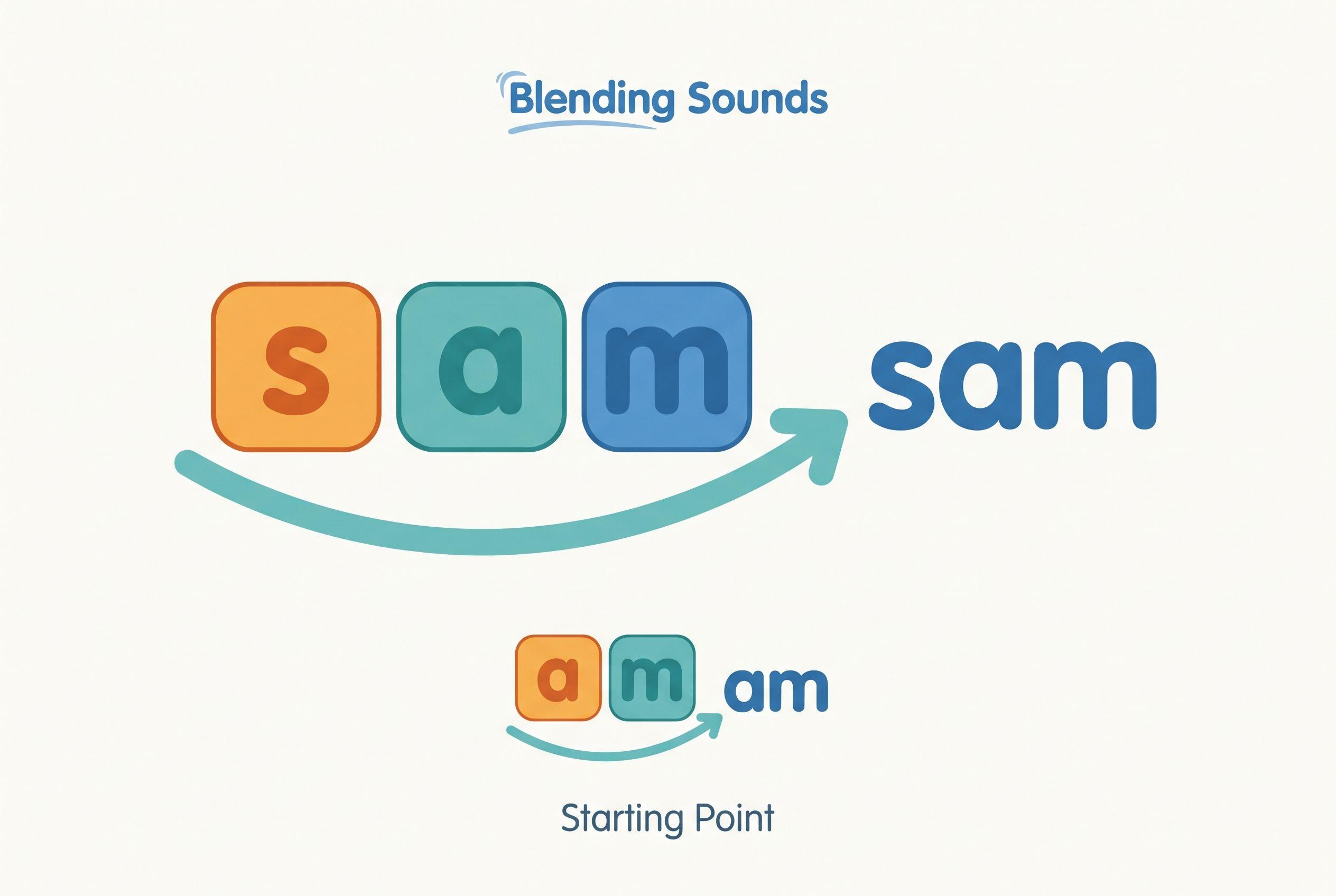
- Model one blend. Point beneath “Sam” and stretch /sss/ into /aaa/ into /mmm/. Keep the sounds connected. Avoid adding “uh” after consonants.
- Give a fresh word. Try “am,” then “sat” if your child knows /t/. Two-sound words can provide a gentler entry point.
- Use one matching app lesson. Sit beside your child and listen. Correct a guess with “Let's check each sound,” not “Look at the picture.”
- Move to paper. Write three suitable words in a new order. Record whether your child reads independently, needs a model or guesses.
- Choose tomorrow's practice. Repeat the shaky pattern rather than racing ahead. If you'd like our app alongside this routine, lesson one is free with no card and nothing to cancel; from lesson two the whole program is a 7-day free trial, then US$9.95 a month.
We have two Tiger Rules: “No Guessing” and “We Never Skip.” In my house, that second rule means keeping a small, sustainable routine—even a brief birthday review—not pushing a sick or distressed child through a lesson. Drill the skill; don't turn practice into a showdown.
UFLI Foundations offers a useful curriculum reference for planned phonics instruction and blending practice. You don't have to become a reading specialist overnight, but you do need a sequence rather than a random pile of short vowel words.
When Practice Still Doesn't Click
Sound familiar: your child knows the letters, tries hard and still can't combine the sounds? Reduce the task. Model oral blending without print, then return to a very short written example.
Phonemic awareness means working with individual speech sounds; phonics connects those sounds to print. A child may need help with either—or both. More guessing games won't identify the gap.
For a starting conversation, take the 2-minute reading check. Treat that check as guidance, not a diagnosis. If difficulty persists despite clear instruction, ask a teacher or qualified reading specialist for a closer look; discuss hearing or speech concerns with an appropriate clinician too.
The best app for CVC words is the one that supports useful practice at your child's current level. Don't wait for failure to become dramatic before seeking help.
Ready to try our parent-supported option? Lesson one is free with no card and nothing to cancel; from lesson two the whole program is a 7-day free trial, then US$9.95 a month.
FAQ
What is the best app for blending CVC words?
My first pick is Teach Your Kid to Read for parent-supported practice, with Reading.com another relevant option. Match any app to your child's known sounds and check decoding away from the screen. Our offer: lesson one is free with no card and nothing to cancel; from lesson two the whole program is a 7-day free trial, then US$9.95 a month.
Which option can we use without a subscription?
Khan Academy Kids offers free early-learning activities without ads or subscriptions. Teach Your Monster to Read offers free computer access and a separately paid mobile app. Check current availability and select activities that directly practise blending.
What age should children blend CVC words?
Many children begin during the preschool or early school years, but age alone doesn't determine readiness. Start with a few secure letter-sound correspondences and explicit modelling. Persistent difficulty deserves support, not blame or endless waiting.
Why can my child say the sounds but not read the word?
Recalling individual sounds and combining them require different work. Model connected blending, avoid extra “uh” sounds and try two-sound words before harder examples. If your child continues struggling, seek individual guidance rather than assuming another app will fix it.
From teachyourkidtoread.org/blog/best-app-for-blending-cvc-words-6-phonics-picks-ranked
Part of these guides

Xia Brody
Co-Founder, Teach Your Kid to Read
Mom of 4 who has successfully taught her kids to read. Currently in the trenches with her 4-year-old while her two oldest (10 and 7) devour books on their own. Passionate about phonics-based methods and building a lifelong love of reading.
Related Articles
Best App to Teach Blending Sounds: 6 Smart Picks
If your child knows letter sounds but freezes at blending, don't wait it out. Here's my no-nonsense parent guide to the best apps for teaching sound blending, phonics, and CVC word reading.
Read More →
CVC Words List: 10 Games and Activities for Struggling Readers
A CVC words list works harder when your child actually sounds out each word. These 10 games turn short-vowel practice into manageable lessons—with clear corrections when guessing sneaks in.
Read More →
My Kindergartner Can't Read CVC Words: 5 Fixes
Knowing letter names doesn't mean a child can blend cat. Find out whether sounds, short vowels or blending cause the trouble, then try five specific fixes without turning the kitchen table into a battleground.
Read More →