My Kindergartner Can't Read CVC Words: 5 Fixes

What You'll Learn
- The usual trouble spots involve shaky letter sounds, difficulty blending spoken sounds or guessing instead of checking every letter. Start with a picture-free word containing sounds your child knows.
- Five fixes help you target the gap: check sounds, practice oral blending, connect sounds smoothly, contrast short vowels and replace guessing with decoding.
- CVC means consonant-vowel-consonant, as in map. Start with a few familiar sounds rather than a giant worksheet.
- Persistent difficulty deserves help now. A home check can guide practice, but it can't diagnose dyslexia.
My Kindergartner Can't Read CVC Words: What Should I Try First?
Three little letters can bring an entire kitchen-table lesson to a screeching halt.
If you're thinking, “My kindergartner can't read CVC words,” check these likely causes, starting at the top. Kindergarten (typically ages 5–6 in the US) includes children with very different amounts of reading instruction; the grade name alone doesn't tell you which skill needs attention.
| What you notice | Likely gap | First fix |
|---|---|---|
| Your child names letters but can't give their sounds | Letter-sound knowledge | Practice the sounds in one simple word before asking for reading |
| Your child knows the sounds separately but can't join them | Blending | Say the sounds aloud yourself and help your child join them |
| Your child reads map as mop | Short-vowel confusion or incomplete checking | Contrast those two vowels and point to the middle letter |
| Your child says a picture-related word without checking letters | Guessing | Cover the picture during word reading and track each letter |
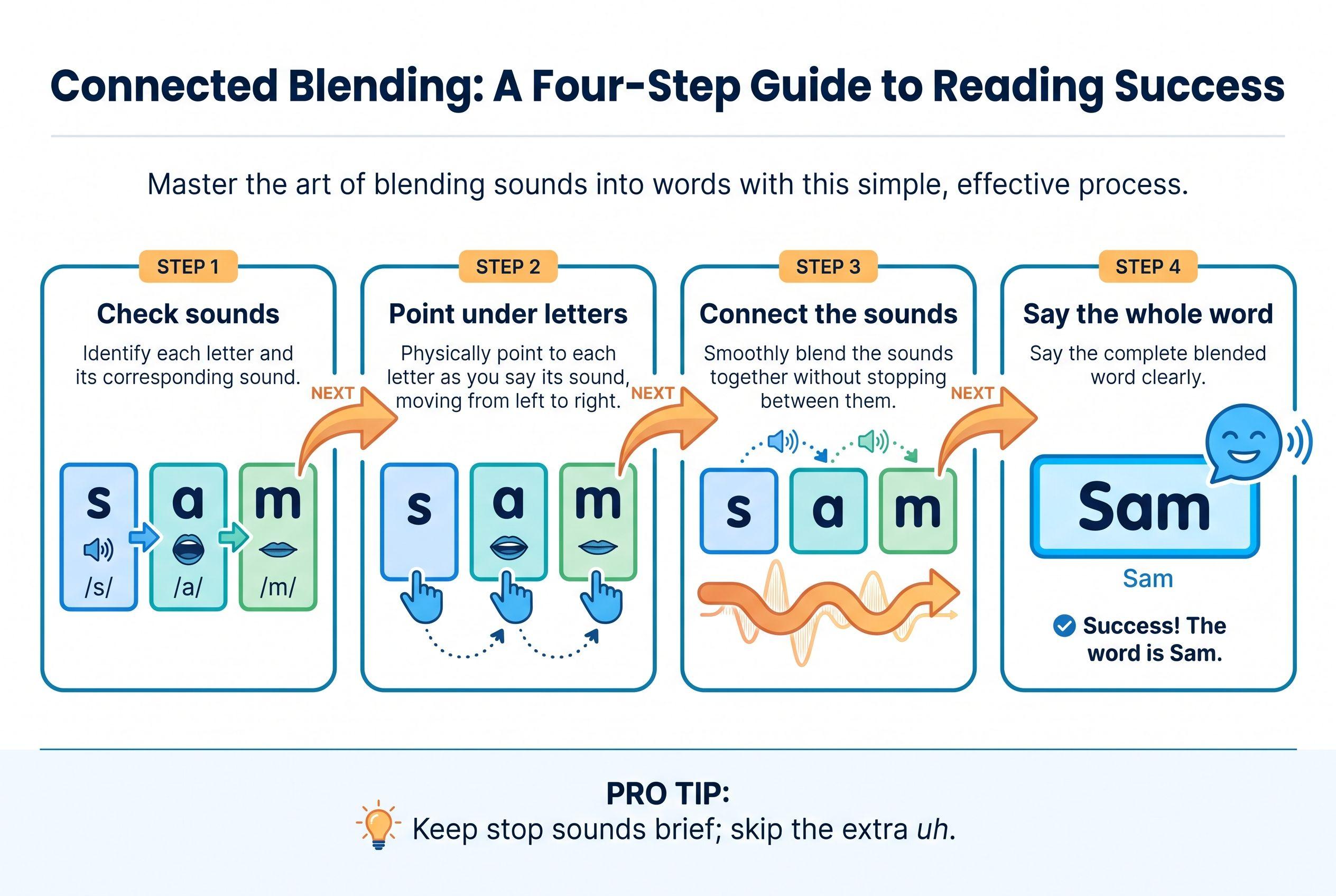
Try this today: Write Sam with no picture. Check that your child knows /s/, short /a/ and /m/. Then point under each letter while modeling the sounds close together: “sssaaammm, Sam.” Ask your child to copy you, then try again with less help.
If those sounds aren't familiar, teach them first. Asking for a word before teaching its parts creates frustration, not useful practice.
A CVC word has a consonant, a vowel and a consonant. Start with straightforward short vowel words such as map, sit and sun. Three letters alone don't make a word suitable: the doesn't follow the same simple pattern.
What to Do if They're Not There Yet
Take a minute or two to watch one picture-free attempt, then take the 2-minute reading check for an initial guide. Notice whether your child misses a sound, separates every sound without joining them or substitutes a completely different word.
“My kindergartner can't read CVC words” describes the problem, not the cause. Picture-based success can hide guessing instead of decoding, but a child who laboriously says every sound may simply need explicit blending instruction. Neither child needs a lecture about trying harder.
For a clear parent-led routine, I recommend Teach Your Kid to Read: start lesson one free. It's a step-by-step phonics program you do side by side with your child for about 15 minutes a day; lesson one teaches four sounds—m, s, p and short a—and blends them into real words. Lesson one is free, with no card and nothing to cancel. From lesson two, the whole program is a 7-day free trial, then US$9.95 a month.
The screen doesn't replace you. Listen, point and help your child connect the sounds. Research supports systematic phonics instruction generally; it doesn't establish results for this particular app.
The Tiger Truth: Don't Let Guessing Become the Routine
I learned this lesson with one of my older children when she was 5. She saw a dog and said “puppy,” even though the word said dog. She saw a child running and said “playing.” I thought she was reading—she absolutely wasn't.
I covered the pictures with sticky notes. Cold turkey. She felt frustrated for about three days, then started actually looking at the letters. That's my informal kitchen-table observation—not a standardized score or a timeline I can promise another parent. Best parenting decision I made that year.
Pictures weren't the enemy. Using pictures instead of print caused the trouble. I still shared illustrated books with her; I just stopped accepting a sensible guess as accurate word reading.
The US National Reading Panel, in its 2000 report, found that systematic phonics instruction helped children learn to read. That means teaching letter-sound relationships in a planned sequence, not waiting for enough storybooks to make decoding appear.
And the stakes deserve attention. On the 2024 NAEP, only 31% of US fourth graders (typically ages 9–10) scored at or above Proficient in reading. That doesn't mean everyone below Proficient can't read. It does show why “school will sort it out eventually” isn't a plan.
One difficult CVC lesson doesn't predict your child's future. But repeated guessing leaves the same gap in place while classroom reading grows harder. Act on the skill gap without frightening the child.
Five Fixes for a Kindergartner Who Can't Blend CVC Words
Fix 1: Check Sounds, Not Alphabet Recitation
Singing the alphabet and reading map require different skills. A child can name every letter and still hesitate when you ask what sound m represents.
Write the letters from a target word separately. Ask, “What sound?” rather than “What letter?” Mix their order so your child can't simply repeat a memorized sequence.
For map, check:
- m: /m/, without adding “uh.”
- a: the short vowel sound in apple.
- p: a brief /p/, not “puh.”
Those extra “uh” sounds matter. “Muh-a-puh” gives a beginner more speech sounds to untangle than map contains. Keep stop consonants brief; don't try to stretch /p/ like /m/.
If you're saying, “My kindergartner can't read CVC words,” but your child doesn't know the middle vowel, start there. More whole-word attempts won't teach a missing sound by magic.
For a more organized look, use our free phonics skill check. It includes real and made-up words across several phonics patterns and shows the first pattern to practice. Treat the result as a teaching starting point, not a diagnosis.
Fix 2: Separate Oral Blending From Looking at Letters
Put the pencil down briefly. Can your child combine sounds when you provide them?
Say /m/ /a/ /p/ with short gaps, then ask, “What word?” If your child doesn't know, model: “Listen: mmmaaap, map.” Let your child repeat the connected version with you.
This checks phonemic awareness: noticing and working with individual speech sounds. Phonological awareness is the broader category, which also includes larger sound units such as syllables. Phonics adds print to the task.
The distinction helps. If spoken blending works but printed blending doesn't, focus on connecting letters to sounds. If both feel difficult, practice oral blending alongside explicit letter-sound teaching rather than shelving print indefinitely.
David Kilpatrick's PAST—the Phonological Awareness Screening Test—can help a knowledgeable educator investigate sound-awareness difficulties. Follow its administration guidance; don't turn a few kitchen-table guesses into a clinical conclusion.
When a kindergartner can't blend CVC words, “Say it faster!” rarely explains enough. Give a model your child can actually imitate.
Fix 3: Connect the Sounds Instead of Leaving Big Gaps
Imagine saying three sounds with a long pause after each. By the last sound, a beginner may have lost the first one. That's a task-design problem, not proof of poor effort.
Start with a word like am, then add s to make Sam. The /s/ and /m/ sounds let you demonstrate connected blending without adding extra vowels.
Slide your finger under the letters as you model:
- “aaammm”: am.
- “sssaaammm”: Sam.
- Say the complete word naturally afterward.
Don't stretch every consonant. For map, sustain /m/ and the vowel, then finish with a crisp /p/. Keep your mouth movements visible and let your child join your voice before attempting the word alone.
Linnea Ehri's 2005 review, Learning to Read Words: Theory, Findings, and Scientific Studies, explains how connections between spellings and pronunciations support word learning. Orthographic mapping isn't memorizing the outline of a word. Knowing sounds and connecting them to letters helps children remember written words.
That's why I want accurate blending before speed. A quick guess doesn't become reading because someone claps.
Fix 4: Teach the Middle Vowel With Small Contrasts
If map, mop and mip all sound like map when your child reads them, look closely at the middle letter. Your child may need vowel instruction—or may have learned to launch a guess after seeing the first consonant.
Begin with one short vowel and known consonants. Use our printable short a CVC words list for examples such as cat, map, bag and jam. Choose a small selection; nobody needs all 43 words before breakfast.
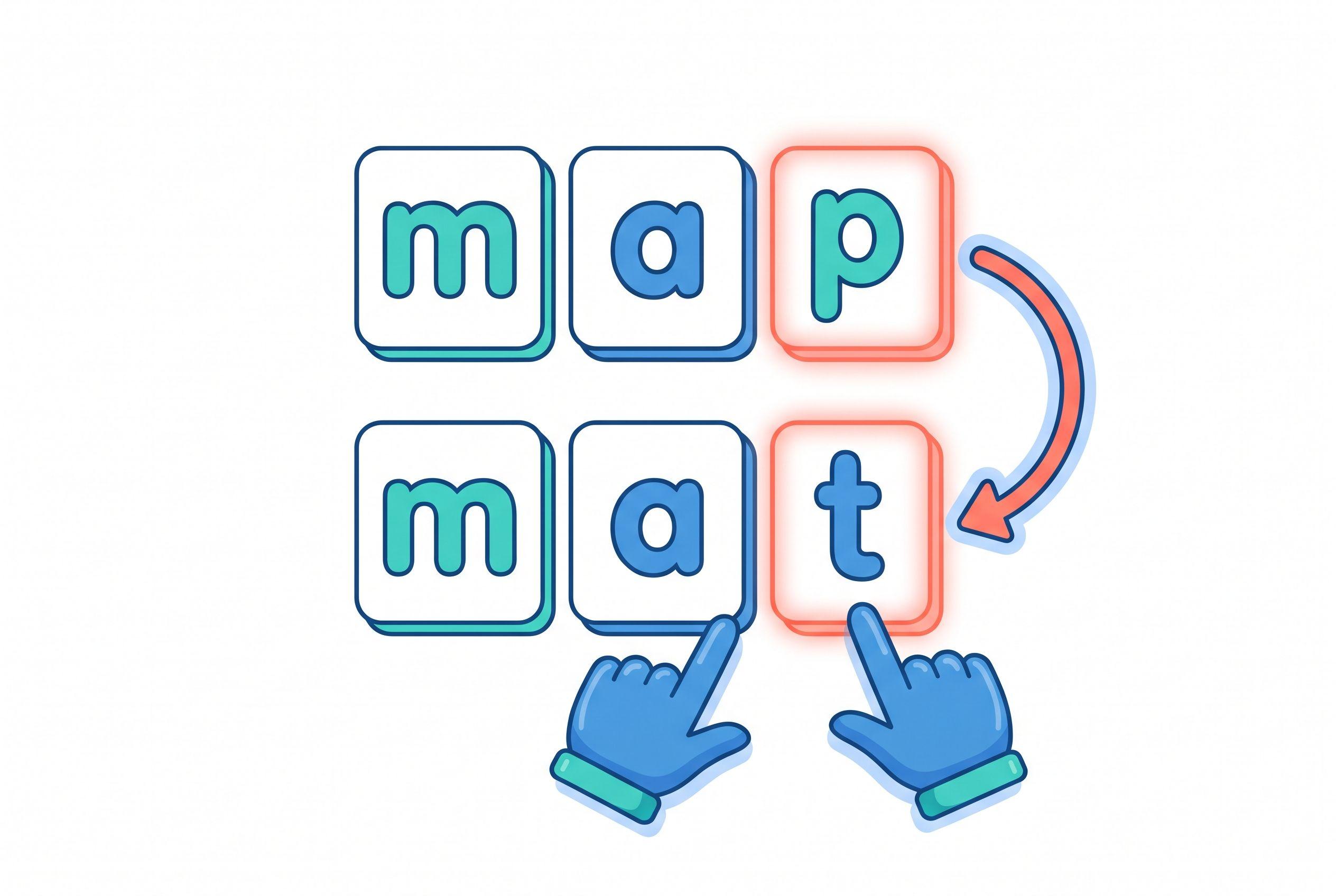
Once short a feels more secure, contrast map and mop. Change only the middle letter. Ask, “What changed? What sound does that letter represent?” Then blend the new word from the beginning.
Introduce short e deliberately with our printable short e CVC words list, which includes bed, hen, jet and pet. Don't toss every vowel into a timed game before your child can distinguish them calmly.
Word families help with practice, but predictable order can hide guessing. After cat, mat and sat, mix in a familiar word from another family. Check whether your child follows the letters rather than chants the ending.
Account for your family's accent, too. Model your own natural pronunciation rather than demanding a different country's vowel sound.
Fix 5: Stop Guessing Without Starting a Fight
This one drives me crazy: an adult asks, “What would make sense?” while the child stares everywhere except at the word.
Meaning matters. But meaning can't tell a beginner whether the page says dog or pup. Print has to settle that question.
Use a calm correction:
- “You said mop. Let's check.”
- Point to a: “This says /a/.”
- “Blend with me: mmmaaap, map.”
- “Now read it again yourself.”
Cover a distracting picture during the word-reading attempt, then uncover it for discussion. Keep pictures in read-alouds and conversations; the rule targets guessing, not illustration.
Choose short practice texts containing patterns your child has learned. UFLI Foundations provides one example of a curriculum with an explicit phonics sequence; its name alone isn't a reason to skip checking whether a particular passage matches your child's knowledge.
“My kindergartner can't read CVC words” doesn't call for tougher staring contests. It calls for instruction that makes the correct response possible.
Your Action Step: A Small Practice Plan for Today
I'm a homeschooling mom of four—10, 7, 4 and 1—and my current 4-year-old reminds me that a sensible plan must survive interruptions. An elaborate activity that takes longer to prepare than to teach won't last in my kitchen.
Here's a manageable sequence. These amounts describe a practice routine, not age-based assessment cutoffs.
- Pick one target. Choose a word such as map whose sounds your child knows. If a sound needs teaching, make that today's target instead.
- Check spoken blending. Say the sounds yourself. Model the joined word if your child needs help.
- Model printed blending. Point under each letter, connect the sounds and say the complete word. Have your child join you, then try independently.
- Change one letter. Move from map to mat. Correct the exact error rather than asking for repeated guesses.
- Record the next teaching step. Write something specific: “Knows m and p; short a needs practice.” Finish with a book you read aloud so language and enjoyment stay in the day.
My Tiger Rule is “We Never Skip.” That's my name for protecting a small daily reading habit, including birthdays and vacations—not a command to push through illness, distress or exhaustion. Another rule, “No Guessing,” applies to word identification, not thoughtful predictions during a story.
For more CVC words activities, see CVC Words Activities for Struggling Readers: 12 Drills That Build Real Skill. Choose one drill that addresses the error you observed, not twelve activities that exhaust everyone.
When to Ask for Extra Help
Don't wait for a birthday to make the concern legitimate. If your child struggles repeatedly despite clear instruction, avoids reading or finds sound work unusually difficult, talk with the teacher or a qualified reading specialist.
Bring examples: “She knows these letter sounds, but she can't blend them without my model.” Ask which skills the school has assessed, what explicit teaching it will provide and how it will track progress.
If hearing, speech or language concerns accompany the reading difficulty, discuss those with an appropriate health professional. One CVC check can't establish dyslexia, and a reassuring guess can't rule it out.
You don't need to solve everything tonight. You need to identify the next teachable skill and stop practicing the wrong response. Lesson one is free if you'd like a guided place to begin.
FAQ
Is it normal that my kindergartner can't read CVC words?
Children enter kindergarten with different experiences and skills. Difficulty can reflect missing letter-sound instruction, weak blending or guessing habits. Check the component skills now rather than assuming either a disorder or an automatic catch-up. Seek help if difficulty persists despite explicit teaching.
Why can my child say the sounds but not blend the word?
Your child may struggle to join speech sounds or may lose the sequence during long pauses. Check blending without print, then model connected blending while tracking letters. Keep stop sounds brief and avoid adding “uh.”
Which CVC words should I teach first?
Choose words containing sounds your child already knows. Sam, map and mat can work after you teach their letter-sound relationships. Use a CVC words list organized by family, but mix the practice order so predictable endings don't replace decoding.
Should I cover pictures while my child reads?
Cover a picture temporarily if your child uses it to guess the printed word. Help your child decode, then uncover the illustration and discuss meaning. Keep enjoying illustrated books together; pictures support conversation even though they can't substitute for checking letters.
How long should it take to learn blending?
There's no honest universal deadline. Track whether your child recognizes sounds more readily, joins them with less help and reads unfamiliar combinations accurately. If progress stalls despite consistent, explicit instruction, ask for assessment and targeted support rather than extending the same unsuccessful drill.
From teachyourkidtoread.org/blog/my-kindergartner-can-t-read-cvc-words-5-fixes
Part of these guides

Xia Brody
Co-Founder, Teach Your Kid to Read
Mom of 4 who has successfully taught her kids to read. Currently in the trenches with her 4-year-old while her two oldest (10 and 7) devour books on their own. Passionate about phonics-based methods and building a lifelong love of reading.
Related Articles

CVC Words List: 10 Games and Activities for Struggling Readers
A CVC words list works harder when your child actually sounds out each word. These 10 games turn short-vowel practice into manageable lessons—with clear corrections when guessing sneaks in.
Read More →
Best App to Teach Blending Sounds: 6 Smart Picks
If your child knows letter sounds but freezes at blending, don't wait it out. Here's my no-nonsense parent guide to the best apps for teaching sound blending, phonics, and CVC word reading.
Read More →
Best App for Blending CVC Words: 6 Phonics Picks Ranked
Knowing letter sounds isn't the same as reading a word. Here are six phonics apps ranked for the jump from /c/ /a/ /t/ to “cat”—plus the kitchen-table check that matters more than a digital reward.
Read More →