CVC Words List: 10 Games and Activities for Struggling Readers

What You'll Learn
- Start with the CVC words list below: 30 short-vowel words grouped by vowel, not a giant mixed worksheet.
- All 10 games require reading the letters before moving, matching or collecting anything. Pictures don't supply the answer.
- If your child knows individual sounds but can't blend them, model connected sounds and practice a smaller set.
- Aim for accuracy rather than speed. Persistent difficulty calls for targeted teaching and a reading assessment—not more waiting.
Start Here: A CVC Words List and 10 Games
Put down the stopwatch; this isn't a tiny reading Olympics.
CVC means consonant-vowel-consonant. In beginner phonics practice, CVC words usually contain three letters representing three sounds, with a short vowel in the middle: map, sit, cup. Words such as the and car don't fit this beginner short-vowel practice pattern just because they contain three letters.
Here's a starter CVC words list. Choose one row and begin with words whose letter-sound correspondences your child already knows.
| Vowel | Six words to practice |
|---|---|
| Short a | mat, map, sat, cat, bag, jam |
| Short e | men, met, pet, hen, bed, net |
| Short i | sit, pin, pig, lip, fin, fit |
| Short o | mop, pot, top, dog, log, hot |
| Short u | sun, run, cup, bug, mud, rug |
Pronunciation varies across English-speaking countries and accents, especially for vowels. Model your own natural pronunciation rather than asking your child to imitate an unfamiliar accent.
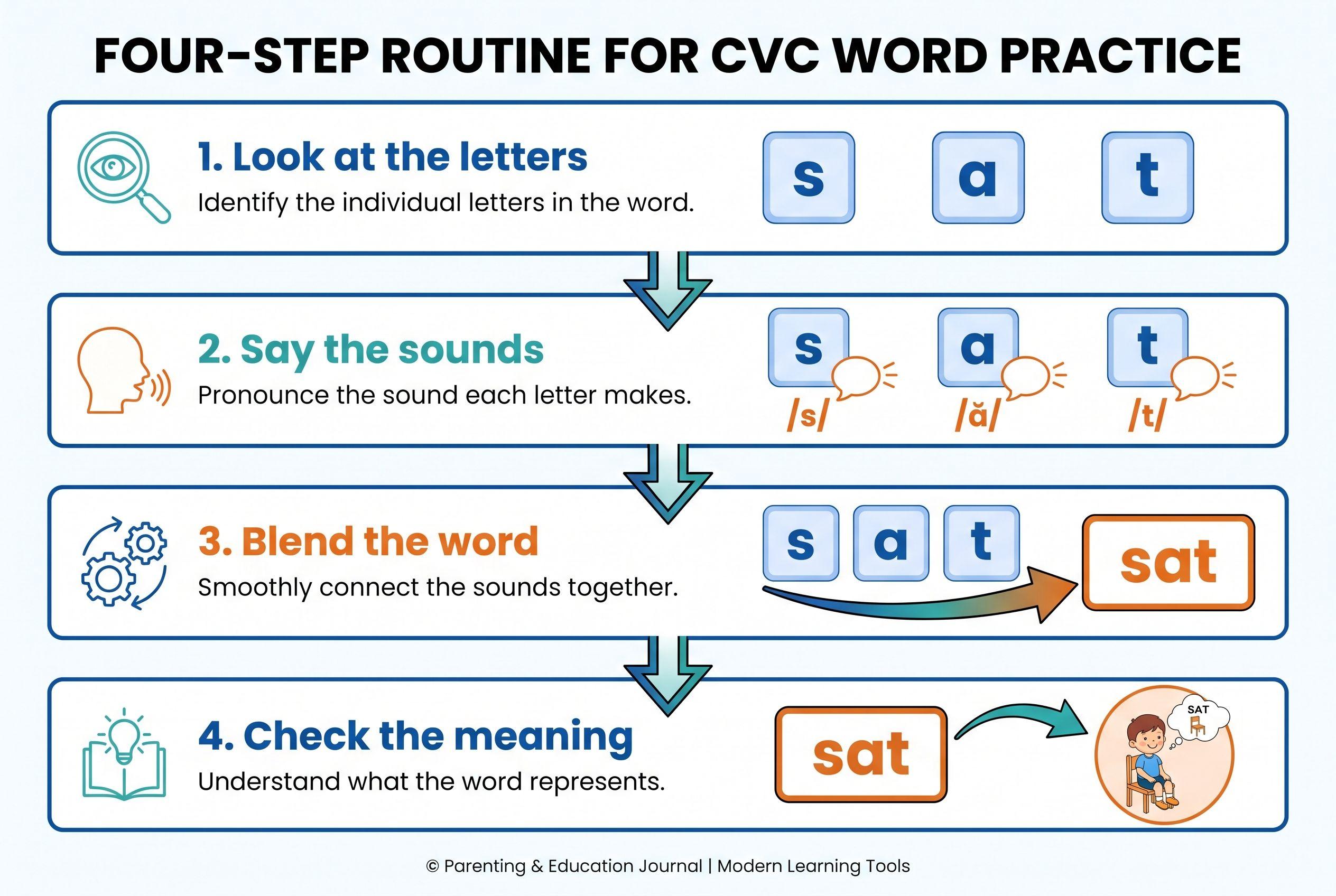
These are the 10 CVC word games for struggling readers I'll explain below. Every game uses the same routine: look at the letters, say the sounds, blend the word.
| Game | What your child does |
|---|---|
| 1. Slide and blend | Moves a counter beneath letters while blending |
| 2. Change one letter | Reads a new word after one letter changes |
| 3. Read and park | Reads a card before parking a toy car |
| 4. Feed the monster | Reads a card before feeding a cardboard creature |
| 5. Word detective | Finds and reads a word from spoken clues |
| 6. Read, then match | Reads a word before choosing its picture |
| 7. Short-vowel sort | Reads words and sorts them by vowel sound |
| 8. Build from memory | Reads, covers, builds and checks a word |
| 9. Treasure trail | Reads a card at each stop on a short path |
| 10. Silly sentence builder | Reads a short sentence using familiar patterns |
You don't need ten activities tomorrow. Pick one. Repeat the reading, not the craft-store shopping.
For more short-a choices, use our printable short a CVC words list. Keep your working CVC words list small enough that you can notice how your child reads, not just whether they finish.
What to Do If Your Child Can't Blend These Words Yet
Spend a minute or two checking a few familiar letter sounds, then offer mat without a picture. Does your child blend it, say separate sounds without joining them or guess an unrelated word? For a broader starting point, take the 2-minute reading check; treat the result as guidance, not a diagnosis.
Guessing can mean your child relies on pictures or the first letter instead of decoding. But don't assume every mistake comes from guessing: weak sound knowledge, difficulty blending or an uncertain vowel can also interrupt reading.
I recommend Teach Your Kid to Read when you want a step-by-step phonics program to do side by side with your child for about 15 minutes a day: start lesson one free. Lesson one teaches four sounds—m, s, p and short a—and blends them into real words. Lesson one is free, with no card and nothing to cancel. From lesson two, the whole program is a 7-day free trial, then US$9.95 a month.
The Tiger Truth: Games Can't Replace Teaching
A child who collects every treasure but guesses every word hasn't practiced reading. They've practiced treasure collection. Excellent pirate training; wrong lesson.
The US National Reading Panel, in its 2000 report, found that systematic phonics instruction benefits children's reading development. That supports planned instruction in sound-letter relationships—not a random stack of worksheets, and not a claim that research has validated this particular app.
Linnea Ehri's 2005 review, Learning to Read Words: Theory, Findings, and Issues, explains how connections between spellings and pronunciations help words become familiar. Orthographic mapping isn't memorizing a word's outline. Sounding out accurately helps establish those connections.
The stakes deserve attention without panic. On the 2024 NAEP, 31% of US 4th graders (ages 9–10) scored at or above Proficient in reading. That doesn't mean everyone below Proficient can't read; NAEP Proficient represents a specific achievement standard. It does show why vague reassurance doesn't replace useful instruction.
Waiting while a child repeatedly avoids reading can mean more missed practice and growing frustration. Act on the skill gap now. Don't turn a CVC words list into a test of character.
My Cereal Box Moment
My 4-year-old, Mei, had practiced letter sounds for about three weeks when she suddenly blended “c-a-t” at the breakfast table. She pointed at the word on her cereal box and just did it—without a prompt. I almost choked on my coffee.
That was her click moment. Within two weeks, she was blending every CVC word I put in front of her. I celebrated with a library trip, where she picked her own easy reader. I still checked which words she could decode and helped with the rest; an “easy” label doesn't tell you which spelling patterns a book contains.
I'm a Chinese-American homeschooling mom of four, ages 10, 7, 4 and 1, and I've taught my two oldest to read. Even so, Mei's breakthrough caught me off guard. Her timeline isn't a promise for another child. My job—and yours—is to teach the next manageable step, not demand a breakfast-table miracle.
10 CVC Words Activities That Keep Reading at the Center
Use your CVC words list as a teaching menu, not a completion checklist. For each game, introduce unfamiliar sounds before asking your child to read independently.
1. Slide and Blend
Write sat with generous spacing. Put a counter beneath the first letter, then move it from left to right while your child blends.
Stretch sounds that allow it, such as /s/ and /m/, and connect them to the vowel. Keep stop sounds such as /t/ brief; don't add “uh.” Model, then invite your child to try.
Make it easier: You model the whole blend first. This isn't cheating; it's teaching.
2. Change One Letter
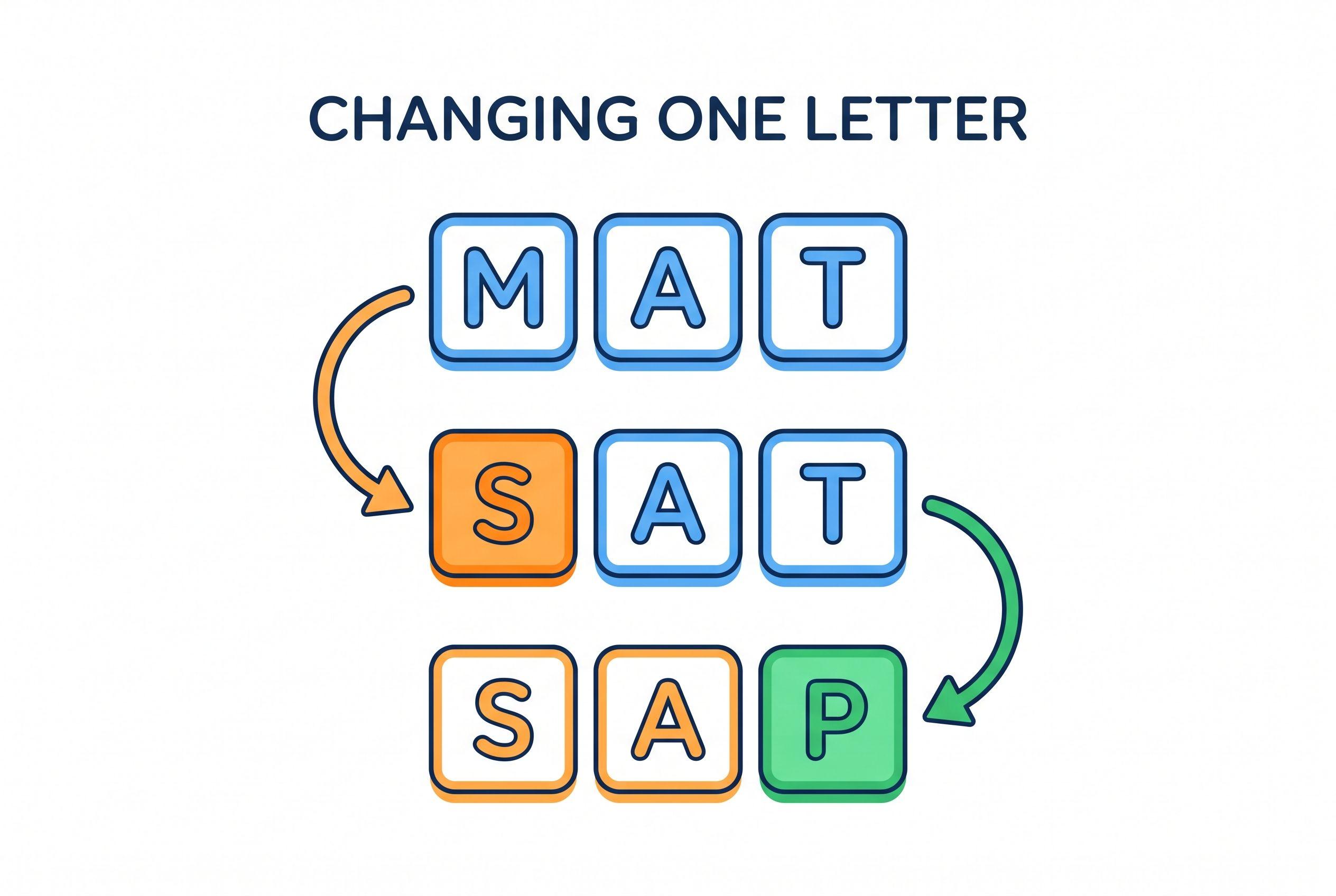
Build mat with letter tiles. Read it together, replace m with s, then ask your child to read sat. Next, change t to p for sap.
Ask, “Which sound changed?” Then read the whole new word. Don't let your child assume every card says mat because the ending looks familiar.
Later, mix these words with a different ending from your CVC words list to check attention to every letter.
3. Read and Park
Draw three parking spaces and place a word card in each: map, sat, mat. Your child reads one card before driving a toy car into that space.
If they say mat for map, point to the final letter: “This says /p/. Let's blend it again.” Keep your voice ordinary. A correction doesn't need a courtroom speech.
Move the cards between rounds so parking-space memory doesn't replace reading.
4. Feed the Monster
Cut a mouth in a small cardboard box. Your child reads a card, then feeds it to the monster.
The monster accepts corrected words, too. I don't want a child hiding mistakes because cardboard apparently has strict admissions standards.
Choose a few words from one row of the CVC words list. If reading falls apart, stop feeding and model a blend together.
5. Word Detective
Set out sun, sit and map. Say, “Find the word with /ŭ/ in the middle.” Your child checks the letters, chooses sun and reads it aloud.
This combines attention to sounds with print. Finding the card alone doesn't finish the task; reading it does.
Make it easier: Use only two cards. Make it harder: Ask your child to explain which letter ruled out the other choice.
6. Read, Then Match
Put word cards face up and picture cards face down. Your child reads pig, then turns over the pictures to find the pig.
Order matters. Showing the picture first can turn decoding practice into naming an animal.
Pictures have a useful job: confirming meaning after reading. They shouldn't supply an unfamiliar word. That's my No Guessing rule in action.
7. Short-Vowel Sort
Choose two vowel groups your child has already practiced. Try short a and short i with mat, sat, pin and sit.
Your child reads each card, says its middle sound and places it in the matching group. If they sort by the printed vowel without reading, pause and request the whole word.
Add short e later using our printable short e CVC words list. Keep short vowel words practice focused on a contrast your child can hear and learn.
8. Build From Memory
Show map. Have your child read it, cover it and build it with letter tiles while saying the sounds. Uncover the model and compare.
This links reading with spelling. It doesn't ask your child to memorize a visual shape.
If they build mp, stretch the spoken word together and listen for the missing vowel. Then rebuild and reread. Use tiles rather than handwriting if pencil control distracts from the sound work.
9. Treasure Trail
Place a few cards along the floor. Your child walks to each card, reads it and collects a counter after an accurate reading—including one you've helped correct.
No racing. For a struggling reader, a timer can reward hasty guessing or make a manageable task feel threatening.
Keep the trail short. More movement doesn't automatically mean more learning; the reading at each stop still does the work.
10. Silly Sentence Builder
Once your child reads the individual words comfortably, combine familiar patterns: A cat can nap. Teach the standalone word a separately; its usual sentence pronunciation differs from short a.
Ask your child to read, then explain or act out the sentence. Accurate decoding and understanding belong together.
Don't force every item from your CVC words list into a sentence. Choose language that makes sense, even if the cat's nap requires theatrical snoring.
Your Action Steps for the Next Practice Session
Here's my practical plan for cvc words practice for kindergarten (ages 5–6), or for an older child who needs the same foundational skill. Keep the instruction direct and choose materials that respect your child's age.
- Find the starting point. Use our free phonics skill check to look for the first pattern that needs practice. This teaching check doesn't diagnose dyslexia. A reading specialist can also use a tool such as Kilpatrick's PAST to examine phonological awareness alongside other assessments.
- Select a manageable set. Pull a few words with familiar sounds from the CVC words list. Start with one vowel if mixed vowels cause confusion; this is a teaching choice, not an age-based cutoff.
- Model one complete response. Point beneath each letter, say its sound and blend. Have your child repeat the process without a picture cue.
- Play one game. Choose sliding counters, parking cars or another activity above. Spend your attention on the reading, not elaborate rules.
- Correct and revisit. Supply the uncertain sound, blend together and return to the word after another card. Don't leave an incorrect guess as the last response.
- Record the pattern. Write a useful note: “Confused short e and short i” or “Needed help joining sounds.” Check progress across sessions instead of counting prizes.
- Seek help when difficulty persists. Share your notes with your child's teacher or a qualified reading specialist. Ask for assessment and explicit instruction rather than accepting an open-ended “wait and see.”
For a guided lesson alongside these games, start with lesson one.
What Progress Looks Like—and What It Doesn't
Look for fewer prompts, closer attention to the middle vowel and accurate reading of a new word using familiar sounds. Memorizing one CVC words list doesn't prove your child can apply the pattern elsewhere.
Don't apply passage-reading speed benchmarks to these games. Reading isolated beginner words and reading connected text measure different things.
My “We Never Skip” rule means I protect a regular practice habit, even when the calendar gets busy. It doesn't mean drilling through illness or distress. On a rough day, I simplify; I don't turn the kitchen table into a punishment station.
For more targeted practice, see CVC Words Activities for Struggling Readers: 12 Drills That Build Real Skill. Fun CVC word activities earn their place when they create accurate reading attempts—not merely a happy-looking worksheet.
If planning the next phonics step keeps stopping you, let Teach Your Kid to Read guide a side-by-side lesson. Lesson one is free.
FAQ
What Is a CVC Words List?
A CVC words list groups consonant-vowel-consonant words for phonics practice. Beginner examples include mat, hen, sit, mop and cup. Choose words with letter-sound relationships your child already knows, then teach unfamiliar patterns explicitly.
Which CVC Word Games Help Struggling Readers Most?
Start with slide and blend or change one letter because both make the decoding process easy to observe. Other games can work, too, if your child reads before receiving a picture clue or reward. Choose the format that lets you hear and correct each attempt.
What If My Child Knows the Sounds but Can't Blend?
Model connected blending with a word such as sat. Stretch /s/, connect it to the vowel and finish with a brief /t/, without adding extra vowel sounds. You can also practice blending spoken sounds without print, then return to the letters. Seek assessment if the difficulty persists despite explicit teaching.
Should I Practice All Five Short Vowels Together?
Not immediately if your child confuses them. Begin with a familiar vowel, introduce another explicitly and compare a small selection. Later, mix vowels and word endings so your child must read rather than predict the next word.
Can Older Struggling Readers Use These Activities?
Yes. Match instruction to the missing skill, while adapting the presentation to the child's age. Replace a cardboard monster with a card challenge or letter-tile puzzle. Older children with persistent reading difficulties also deserve a broader assessment; CVC practice alone might not address everything they need.
From teachyourkidtoread.org/blog/cvc-words-list-10-games-and-activities-for-struggling-readers
Part of these guides

Xia Brody
Co-Founder, Teach Your Kid to Read
Mom of 4 who has successfully taught her kids to read. Currently in the trenches with her 4-year-old while her two oldest (10 and 7) devour books on their own. Passionate about phonics-based methods and building a lifelong love of reading.
Related Articles

My Kindergartner Can't Read CVC Words: 5 Fixes
Knowing letter names doesn't mean a child can blend cat. Find out whether sounds, short vowels or blending cause the trouble, then try five specific fixes without turning the kitchen table into a battleground.
Read More →
Best App for Blending CVC Words: 6 Phonics Picks Ranked
Knowing letter sounds isn't the same as reading a word. Here are six phonics apps ranked for the jump from /c/ /a/ /t/ to “cat”—plus the kitchen-table check that matters more than a digital reward.
Read More →
Reading Eggs vs ABCya: 5 Picks for Your 5-Year-Old
Reading Eggs offers a reading lesson sequence; ABCya mainly offers games for practising skills. Here's how I'd choose between them, where three alternatives fit and how to check whether your child can actually read without the screen.
Read More →