Best Reading App for a Struggling Kindergartner 2026
What You’ll Learn
- How to choose the best reading app for a struggling kindergartner without getting fooled by cute games, stickers, and dancing animals
- Why picture-guessing apps can make a kindergartner behind in reading look “fine” until the wheels fall off
- The exact app comparison I’d use if my own 5-year-old were stuck on CVC words
- A 14-day reading catch-up plan you can start tonight at the kitchen table
Reality Check
Your kid doesn’t need another app that says “great job!” while they guess horse because there’s a horse in the picture.
They need to learn how print works. Letter sounds. Blending. Decoding. No guessing. No vibes. No “maybe they’ll bloom later.”
Kindergarten (age 5) is not the time to panic, but it is absolutely the time to act. If your child knows some letters but freezes at words like mat, sip, or fog, you need a real phonics app, not digital babysitting with confetti.
The Verdict: Best Reading Apps for a Struggling Kindergartner
Here’s my blunt mom answer. If I had to pick one best reading app for a struggling kindergartner in 2026, I’d pick Teach Your Kid to Read because it teaches systematic synthetic phonics in a parent-led, mastery-based way.
| Rank | App | What It Teaches | Price | Best For |
|---|---|---|---|---|
| #1 | Teach Your Kid to Read | Systematic phonics, blending, no guessing | Lesson one free with no card; lesson two starts a 7-day free trial, then US$9.95/month | Ages 4-7, especially stuck beginners |
| #2 | UFLI Foundations resources | Strong phonics sequence, parent needs to run lessons | Book/resources vary by seller | Parents who want print-based lessons |
| #3 | Logic of English | Phonics, spelling rules, handwriting tie-ins | Higher-cost curriculum | Families wanting a full curriculum |
| #4 | Bob Books Reading Magic | Decodable CVC practice | Low-cost app | Extra practice after explicit teaching |
| #5 | Hooked on Phonics | Phonics plus games and stories | Subscription pricing varies | Kids who need more engagement |
| #6 | Leveled reader apps | Often picture cues and memorized patterns | Varies | I’d avoid for struggling readers |
If you want the app I’d use first with a child who’s guessing, start with start lesson one free. Lesson one is free with no card and nothing to cancel; from lesson two the whole program is a 7-day free trial, then US$9.95 a month.
Tiger Truth: Waiting Is Expensive
Real talk — “wait and see” is how a small reading gap turns into a full-blown academic emergency.
In the US, only 33% of 4th graders (ages 9-10) scored proficient in reading on the 2022 NAEP / The Nation’s Report Card. That’s not a tiny group of kids having a rough week. That’s a national five-alarm fire.
The National Reading Panel report in 2000 — the one the US Congress commissioned — found that systematic phonics instruction produces significant benefits, especially for kindergarten (age 5) and 1st grade (ages 6-7) readers.
And no, the brain doesn’t “naturally” learn to read because you surround a child with beautiful books. Stanislas Dehaene’s Reading in the Brain (2009) explains why the brain has to build new pathways for reading. Speech is natural. Reading is trained.
I saw this hit another parent in real time at a playground in Raleigh. Another mom told me her child’s school had switched from Lucy Calkins to a Science of Reading curriculum because of North Carolina’s SB 387, the Excellent Public Schools Act — a US state law tied to early reading instruction. She sounded confused and honestly a little irritated. “He was doing fine before,” she said.
So I asked one question: “Can he read splint?”
Her son was in 2nd grade (ages 7-8). He couldn’t.
Now, one missed word doesn’t diagnose a reading problem. Obviously. I’m bossy, not magical. But that miss was enough to say, “Okay, let’s look closer.” Could he read several words with taught spelling patterns? Could he read connected text without guessing from the first letter and the picture? That’s where the truth starts showing up.
I spent 20 minutes on that playground bench explaining Emily Hanford’s APM Reports / Sold a Story, the NAEP data, and Dehaene’s neuroscience showing why kids can’t guess their way into reading. She went home and listened that night. At 11 p.m. she texted me: “I had no idea. Why didn’t anyone tell us this sooner?”
That question still makes me mad.
Deep Dive: Which Kindergarten Reading Apps Are Worth Your Time?
1. Teach Your Kid to Read: Best Overall for a Struggling Kindergartner
Teach Your Kid to Read is my #1 pick because it starts where struggling beginners actually struggle: sound-symbol connection, blending, and accuracy.
Not “tap the monkey.” Not “choose the word that matches the picture.” Not “memorize this leveled reader and smile for the teacher.”
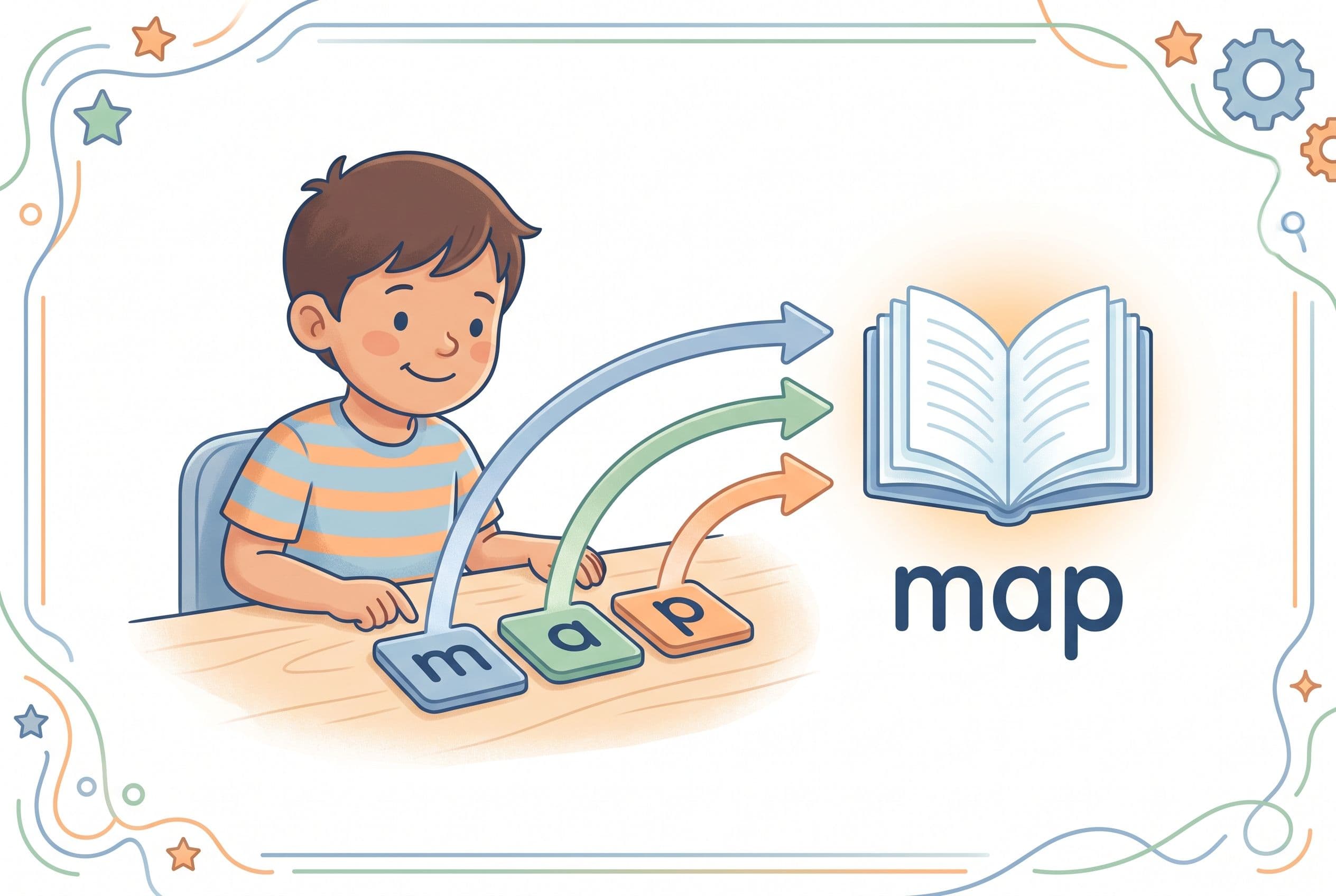
A good phonics app for kindergarten has to teach grapheme-phoneme correspondence — that’s the fancy phrase for matching letters to sounds — then make the child blend those sounds into words. The bottom line? Your child needs to see m-a-t, say /m/ /a/ /t/, blend it, and read mat without looking at a picture of a rug.
That’s why I like a parent-guided app for struggling readers. The app gives structure, but the adult still listens. You hear whether your kid says /b/ for d. You catch the guessing. You stop the “I forgot” drama before it becomes a habit.
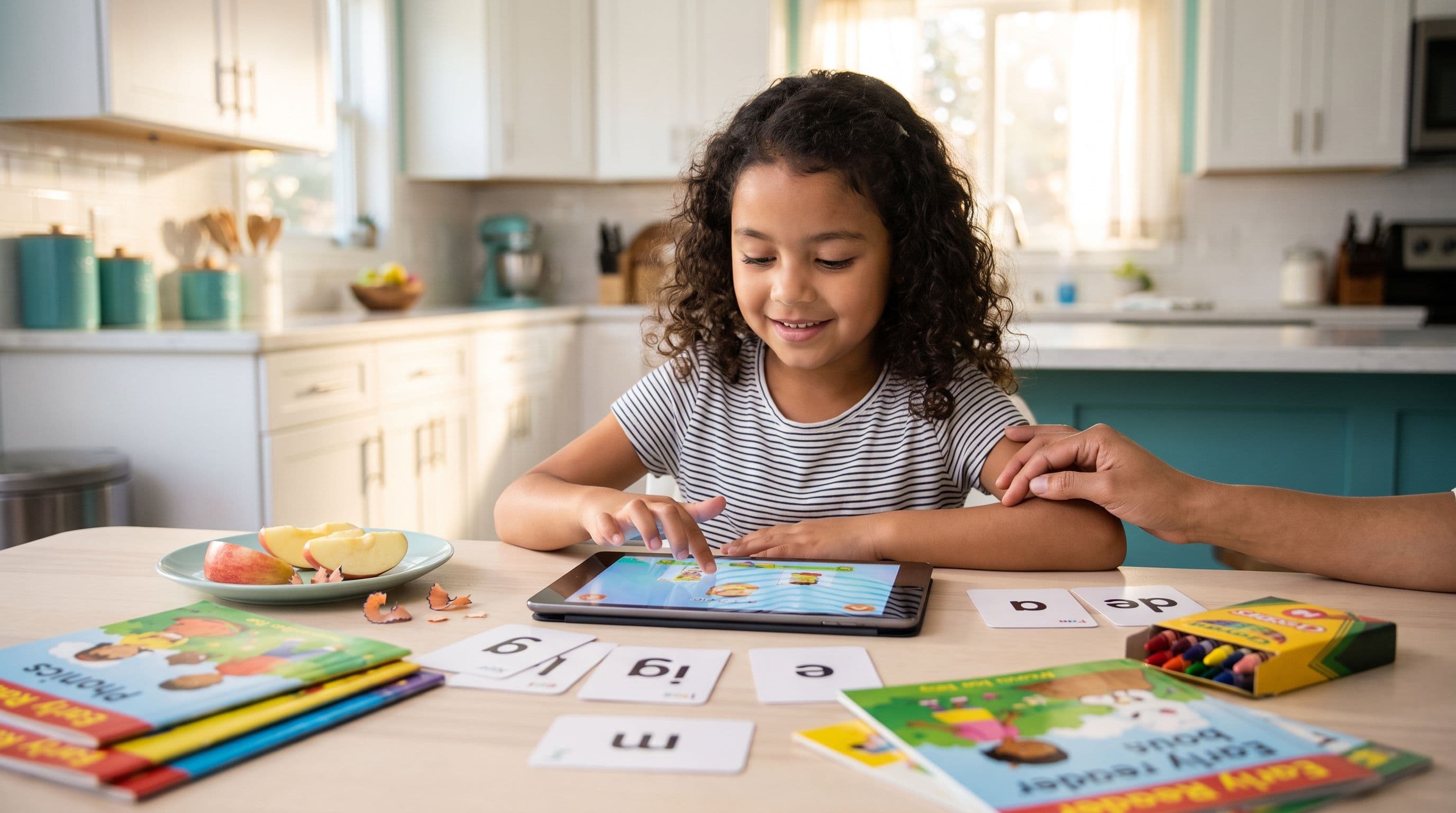
In my house, we use short lessons because I’m not trying to recreate school at my kitchen table. Last Tuesday, my 4-year-old sat next to a pile of sliced apples while we drilled CVC words for eight minutes. She read sat, guessed sit, rolled her eyes like a tiny teenager, and then fixed it when I made her point under each sound.
That’s the work.
Teach Your Kid to Read fits families who want:
- A clear phonics sequence
- Short daily lessons
- Parent involvement without a giant binder
- A no-guessing approach
- A price that doesn’t feel like a second mortgage
The honest offer matters too: lesson one is free with no card and nothing to cancel; from lesson two the whole program is a 7-day free trial, then US$9.95 a month.
2. UFLI Foundations: Best Print-Based Phonics Support
UFLI Foundations isn’t mainly an app, but parents ask about it because Science of Reading groups mention it constantly. It comes out of the University of Florida Literacy Institute, and it gives a strong systematic phonics sequence.
Hands down, it’s one of the better structured options if you’re willing to run lessons yourself.
The catch? You have to teach. You need to handle lesson pacing, correction, review, and practice. Some parents love that. Some parents open the book, see the lesson routine, and quietly place it under a stack of mail.
If your child is truly struggling, UFLI can pair well with a phonics app. Use the app for daily practice and UFLI-style routines for extra review.
3. Logic of English: Best Full Curriculum for Rule-Loving Families
Logic of English teaches phonograms, spelling rules, handwriting, and reading in a very explicit way. If you’re a homeschooling parent who wants the whole package, it can be the real deal.
But for a parent searching “apps to help kindergarteners read” at 10:37 p.m. while the dishwasher runs and someone is yelling about pajamas? It may feel like a lot.
I like Logic of English for families who want curriculum depth. I don’t love it as the fastest first step for a tired parent who needs a simple reading catch-up plan.
4. Bob Books Reading Magic: Best Extra CVC Practice
Bob Books have helped tons of kids practice simple decodable words. The app version can give a kindergartner extra repetition with CVC words like cat, dog, sun, and map.
But here’s the kicker: practice isn’t the same as instruction.
If your child already knows letter sounds and can blend with help, Bob Books Reading Magic can be useful. If your child doesn’t know how to blend yet, you’ll still need explicit teaching from a parent, tutor, or stronger phonics app.
Use it as dessert, not dinner.
5. Hooked on Phonics: Best for Kids Who Need Engagement
Hooked on Phonics has name recognition for a reason. Many kids like it. It includes phonics, stories, videos, and rewards, which can help a reluctant kindergartner sit down long enough to practice.
But rewards can cut both ways.
If the game layer starts driving the lesson, the child chases badges instead of reading the word. I’ve watched kids click through screens like tiny executives clearing email, with almost zero attention to the actual print.
If you use Hooked on Phonics, sit beside your child. Make them read aloud. Don’t let the app become the teacher and the babysitter.
6. Leveled Reader Apps: The Ones I’d Be Careful With
This one drives me crazy.
Many leveled reader systems grew out of whole-language or Balanced Literacy thinking. Fountas & Pinnell levels, for example, still show up everywhere, but that system leans heavily on leveled texts rather than a clean decodable sequence.
A struggling kindergartner can “read” a patterned book like this:
- I see the dog.
- I see the cat.
- I see the pig.
Then page four says, “I see the horse,” with a horse picture, and everyone claps.
But did the child decode horse? Nope. They used the picture and the pattern. Cute? Sure. Reading? Not yet.
For struggling readers, I’d rather see decodable books from publishers like Flyleaf Publishing or High Noon Books, or structured programs like Orton-Gillingham, Wilson Reading System, Barton Reading & Spelling, Fundations, or Explode the Code.
What Makes the Best Phonics App for Kindergarten?
The best reading app for a struggling kindergartner doesn’t need 900 games. It needs clean instruction.
Look for these non-negotiables:
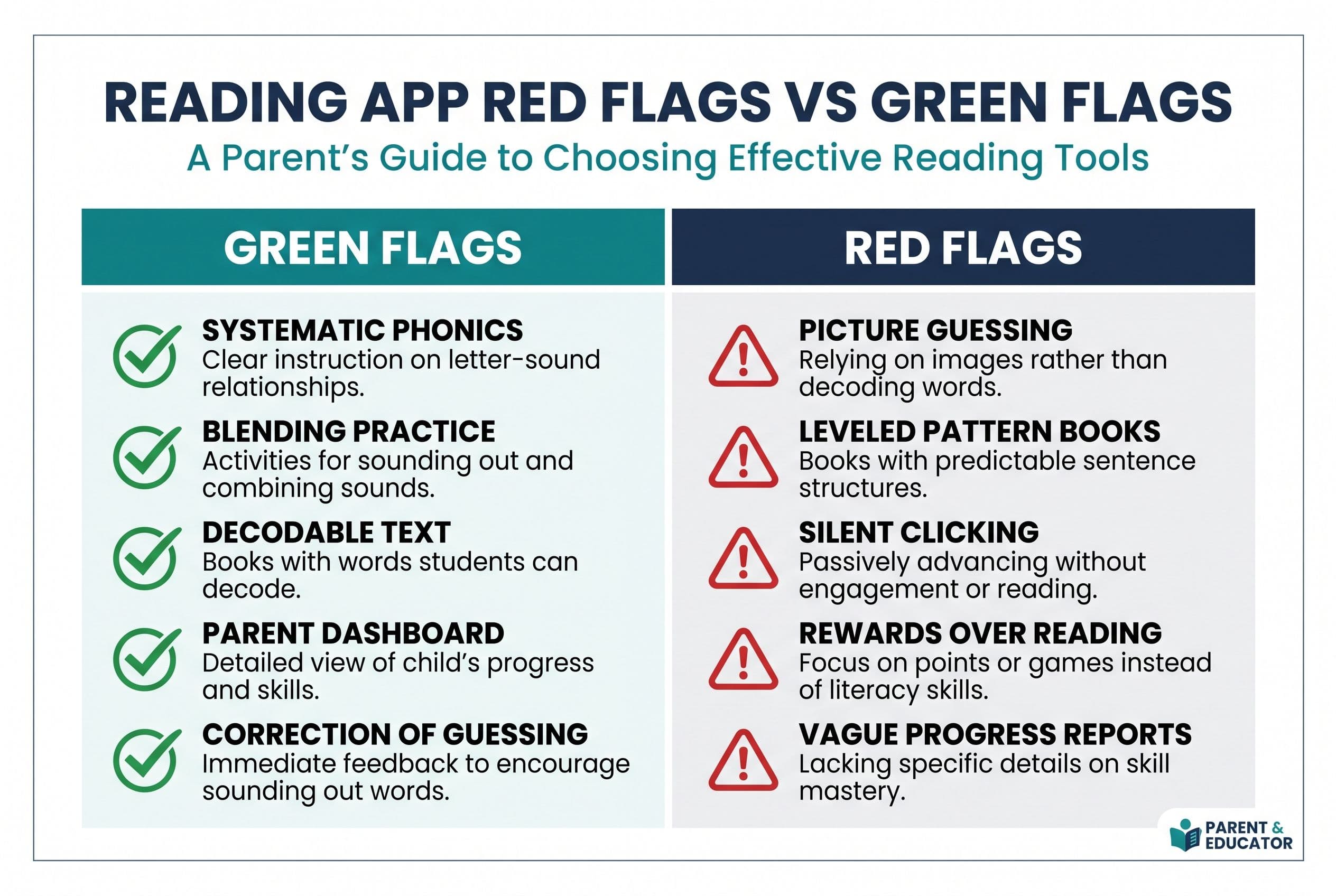
- Systematic phonics: Lessons follow a planned sequence, not random word exposure.
- Blending practice: Your child reads words sound by sound.
- Decodable text: Stories use patterns your child has learned.
- Immediate correction: Guessing gets stopped fast.
- Parent visibility: You can tell what your child knows and what they’re faking.
- Short lessons: Five to ten focused minutes beats 45 minutes of app wandering.
Look, fun is fine. I like fun. I also like coffee and clean laundry, but none of those replace phonemic awareness.
Phonological awareness means hearing sound patterns in spoken language. Phonemic awareness goes smaller: hearing and manipulating individual sounds in words. If pulling apart map is hard, practice the sounds while showing the letters. Those skills can grow together.
Linnea Ehri’s 2005 work on phases of word reading development explains why kids move from partial guessing to full alphabetic reading. David Kilpatrick’s Equipped for Reading Success (2016) explains orthographic mapping — how children store words for instant retrieval after they connect sounds to letters.
Translation: kids don’t memorize words by staring harder. They map sounds to print.
My 14-Day Reading Catch-Up Plan
If your kindergartner is behind in reading, don’t spiral. Get data, pick the right tool, and drill daily.
Here’s what I’d do.
- Check letter sounds first. Ask for the sound of each lowercase letter. Lowercase matters because books use lowercase most.
- Test blending. Write sat, mop, pin, rug, and bed. Ask your child to sound out each word.
- Listen for guessing. If they say puppy for dog because of a picture, stop using picture cues.
- Use a real phonics app daily. Start Teach Your Kid to Read for 5-10 minutes a day. Lesson one is free with no card and nothing to cancel; from lesson two the whole program is a 7-day free trial, then US$9.95 a month.
- Add 3 minutes of phonemic awareness. Say, “What sounds do you hear in sun?” Help them stretch /s/ /u/ /n/.
- Use decodable words for decoding practice. Don’t hand your child a practice book packed with patterns they haven’t learned and expect independent reading magic. But yes, still read rich books aloud, talk about vocabulary, ask questions, laugh at the funny parts, and discuss meaning. Phonics is not the whole dinner table.
- Track one skill at a time. This week might be short vowel a. Next week might be m, s, t, p, and n words.
- Use a quick screener if you’re worried. The PAST, Kilpatrick’s Phonological Awareness Screening Test, takes about 5 minutes and can show where a sound-level breakdown may be happening. It checks phonological awareness, not every possible cause of reading trouble. DIBELS can also show early literacy risk, but benchmark numbers depend on the edition, grade timing, and measure. Ask the school to administer and explain the right screener instead of making you decode a score report like it’s ancient treasure.
- Ask the school direct questions. “What phonics sequence do you use?” “Do you use decodable books?” “Do you cue from pictures?” Don’t accept foggy answers.
- Keep the streak. Tiger Rule: We Never Skip. Birthdays, holidays, vacation — five minutes still counts.
If you want the fastest starting point, use the app for the daily lesson and take the 2-minute reading check to see whether your child looks behind for their age.
Red Flags in Kindergarten Reading Apps
Some kindergarten reading apps look adorable and teach almost nothing. I wish I was kidding.
Run if you see these:
- The app asks your child to choose words from pictures instead of reading print.
- The stories use hard words before teaching the phonics pattern.
- The app rewards speed-clicking more than accurate reading.
- The child can pass levels silently.
- The parent dashboard shows minutes used, but not skills mastered.
- The app teaches sight words as whole shapes with no sound mapping.
Sight words are not magic wallpaper. Many so-called sight words have phonics patterns your child can learn. Even irregular words need sound analysis. For said, I’d say, “The s says /s/, the ai is the tricky part saying /e/, and d says /d/.”
That’s way better than “just memorize it, sweetie.”
So Which App Should You Pick?
Pick the app that makes your child read the word, not guess the word.
If your kindergartner knows fewer than 20 letter sounds, start with explicit letter-sound lessons. If they know most sounds but can’t blend, focus on CVC words. If they can read CVC words but stumble on digraphs like sh, ch, and th, move into a planned phonics sequence.
My vote for most families: Teach Your Kid to Read first, then add decodable books and optional extras like Bob Books Reading Magic for practice. If you want a full homeschool curriculum, look at Logic of English. If you want print-based intervention-style lessons, look at UFLI Foundations.
But don’t let comparison shopping become procrastination. Pick a tool tonight and start.
Your child doesn’t need a perfect parent. They need a consistent one with a plan.
Start with Teach Your Kid to Read: lesson one is free with no card and nothing to cancel; from lesson two the whole program is a 7-day free trial, then US$9.95 a month.
FAQ
What is the best reading app for a struggling kindergartner?
My top pick is Teach Your Kid to Read because it focuses on systematic phonics, blending, and parent-guided practice. A struggling kindergartner needs explicit decoding practice, not picture guessing or random leveled books.
How do I know if my kindergartner is behind in reading?
Check whether your child knows most lowercase letter sounds, can blend simple CVC words like sat and mop, and can read without guessing from pictures. If they can’t do those by the second half of kindergarten (age 5-6), start targeted phonics practice now.
Are reading apps enough without a parent?
Usually, no. Apps can give structure and practice, but a struggling reader needs an adult listening for errors. Sit nearby, make your child read aloud, and stop guessing the second it starts.
Should my child memorize sight words first?
Don’t start with whole-word memorization. Teach sounds and spelling patterns first, then map tricky words sound by sound. Orthographic mapping works better than flashcard panic.
How long should we practice each day?
Start with 5-10 focused minutes daily. Short, accurate practice beats long sessions full of whining, guessing, and snack negotiations.
Part of these guides

Xia Brody
Co-Founder, Teach Your Kid to Read
Mom of 4 who has successfully taught her kids to read. Currently in the trenches with her 4-year-old while her two oldest (10 and 7) devour books on their own. Passionate about phonics-based methods and building a lifelong love of reading.
Related Articles
Best Reading App for Struggling Readers: 2026 Guide for 5-Year-Olds
Most reading apps for kids are glorified guessing games with cartoon characters. If your 5-year-old is struggling to read, you need an app built on phonics science — not one that teaches them to memorize words from pictures. Here's what actually works in 2026.
Read More →
Best App to Help a Kindergartner Learn to Read (2026)
Most reading apps for kindergartners are glorified guessing games. Here's how to tell the difference, what the science actually says about screen-based phonics instruction, and the one app I trust with my own kids in 2026.
Read More →
Best Reading App for a 5-Year-Old with Dyslexia: 2026 Picks
A dyslexic 5-year-old doesn't need guessing games or pretty animations. They need systematic phonics, daily drill, parent coaching, and a plan that refuses to wait.
Read More →