CVC Words List for Kindergarten: 120+ Words by Family (Free Printable)

What You'll Learn
- What CVC words actually are — and why they're the first real milestone in your child's reading (hint: it's brain science, not opinion)
- The 120+ CVC words list organized by word family so you're not randomly throwing words at your kid and hoping something sticks
- The one blending technique that turned my 4-year-old from "staring blankly at letters" to reading words off cereal boxes in under three weeks
- Why skipping CVC mastery is like building a house on sand — and the specific data on what happens to kids who never get this foundation
Your Kid Knows the Alphabet. Great. Now What?
Here's what I see constantly: a parent spends months drilling the ABCs, their kid can sing the alphabet song backward and forward, maybe they even know most of their letter sounds. And then... nothing. The parent stalls out. They don't know what comes next.
Or worse — they hand the kid a book and say "try to read it," and the kid just guesses wildly based on the pictures.
That's not reading. That's a parlor trick.
CVC words are what comes next. They're the bridge between "I know my letter sounds" and "I can actually read." And if you don't cross that bridge deliberately, with a plan, your kid will flounder. I've watched it happen with friends' kids, with kids in co-op groups, and honestly, it almost happened with my oldest because I didn't know better at the time.
Let me tell you what it looks like when it clicks, though. My 4-year-old, Mei, had been practicing letter sounds for about three weeks — just short daily sessions at the kitchen table, nothing fancy. One morning she was eating breakfast and she pointed at a word on her cereal box and said "c... a... t... CAT!" Completely unprompted. I almost choked on my coffee. She just did it. That blend — three separate sounds merging into a word she recognized — that's the moment. Within two weeks she was blending every CVC word I put in front of her. We celebrated with a trip to the library where she picked out her own easy reader book and carried it around like a trophy.
That "click" doesn't happen by accident. It happens because of systematic practice with CVC words.
What Are CVC Words, Exactly?
CVC stands for Consonant-Vowel-Consonant. These are three-letter words that follow a dead-simple pattern: a consonant sound, then a short vowel sound, then another consonant sound.
cat. dog. sit. hop. bus.
That's it. No blends (like "st" or "br"), no digraphs (like "sh" or "ch"), no silent letters, no trickery. Just three sounds, three letters, one word.
Why do they matter so much? Because CVC words are where your child first learns the fundamental skill of reading: blending individual sounds into a word. Stanislas Dehaene explains this in Reading in the Brain (2009) — he's a French neuroscientist who proved that the brain doesn't naturally learn to read the way it naturally learns to speak. Reading requires your brain to build a brand-new neural circuit that connects visual letter shapes to their sounds. CVC words are where that circuit first fires.
Linnea Ehri's phases of word reading development (from her 2005 meta-analysis) describe this perfectly. Kids move from the "pre-alphabetic" phase — where they're basically memorizing word shapes like logos — through the "partial alphabetic" phase, and into the "full alphabetic" phase where they can map every grapheme to a phoneme. CVC words are the gateway to that full alphabetic phase. Skip them, and your kid gets stuck guessing.
The Simple View of Reading (Gough & Tunmer, 1986) tells us that reading comprehension = decoding × language comprehension. Your kid already has language comprehension — they talk your ear off, right? The missing piece is decoding. And decoding starts right here, with CVC words.
The Tiger Truth: What Happens If You Skip This
I'm not going to sugarcoat this.
The 2022 NAEP — that's the Nation's Report Card — showed that only 33% of 4th graders read at a proficient level. One in three. The 2023 scores dropped another 3 points from 2019, the largest decline in 30 years.
Know what those struggling kids have in common? They never built a solid decoding foundation. They were taught to guess at words using pictures and context clues — the Whole Language and Balanced Literacy approach that Emily Hanford exposed in her 2023 APM Reports investigation Sold a Story. They looked at a picture of a dog and guessed "puppy" when the word said "dog." They looked at a picture of a ship and said "boat."
Those kids are now in 4th grade. They can't decode unfamiliar words. They fake-read their way through class. And the Annie E. Casey Foundation's 2010 study found that kids who can't read proficiently by 3rd grade are four times more likely to drop out of high school.
Four times.
The 3rd Grade Cliff is real. Before 3rd grade, kids are learning to read. After 3rd grade, they're reading to learn. If your child hits that cliff without solid decoding skills, every single subject — science, social studies, math word problems — becomes a struggle.
And remediation? You're looking at $10,000 to $15,000 per year for programs like Lindamood-Bell or the Wilson Reading System. Insurance doesn't cover it. Most families can't afford it.
CVC words are the foundation. The non-negotiable starting point. Miss this, and you're building on sand.
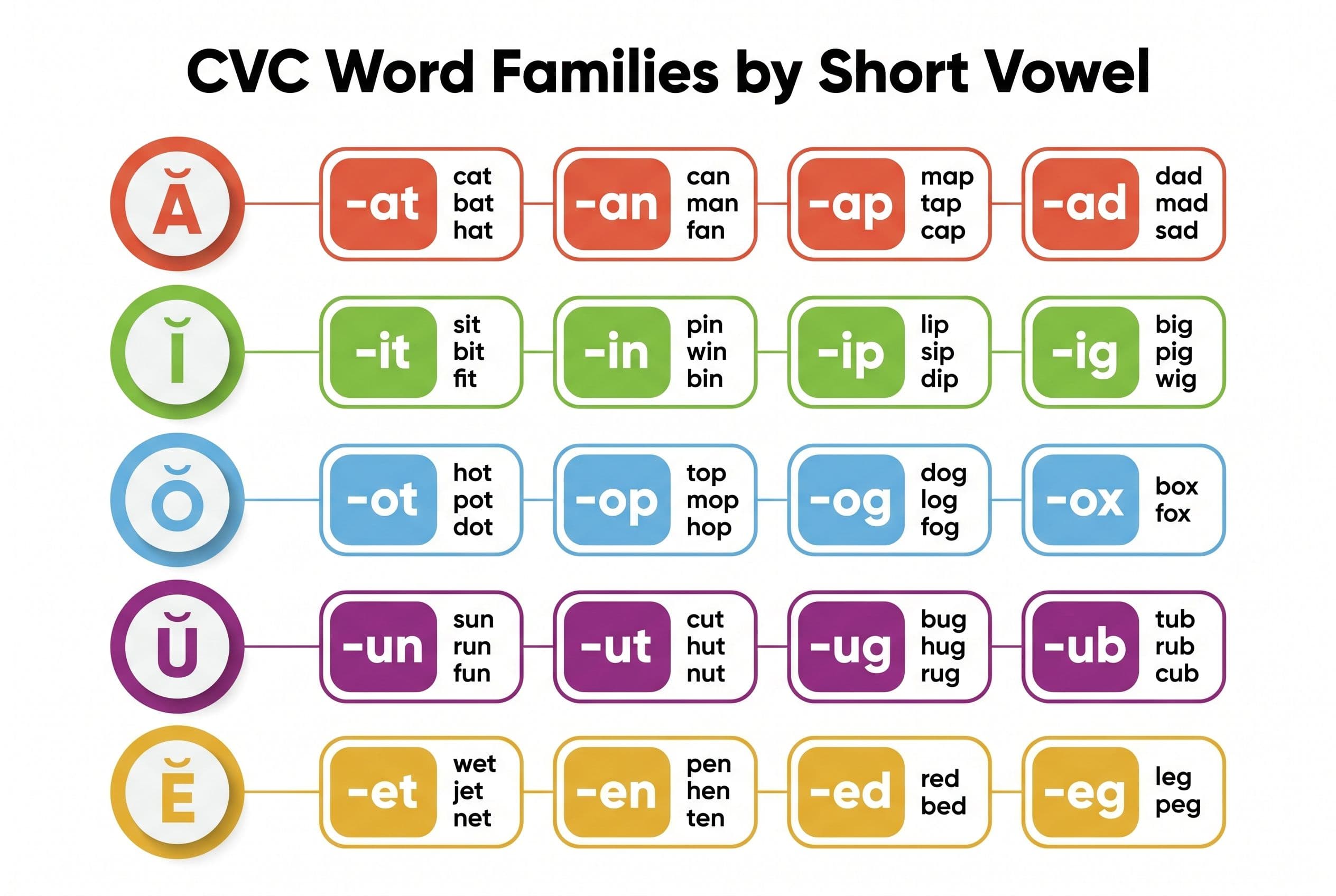
The Complete CVC Words List: 120+ Words Organized by Family
OK, here's the good stuff. I've organized these by short vowel sound, then by word family within each vowel. Word families group words that share the same ending sounds — so "-at" words (cat, bat, mat) all rhyme and follow the same pattern. This makes blending practice way more efficient because your child only has to swap out the first consonant.
Pro tip from my kitchen table: Don't try to teach all of these at once. Start with short A families, master those, then move to short I. I'll give you the exact order after the list.
Short A Word Families
-at family: cat, bat, hat, mat, rat, sat, fat, pat
-an family: can, man, fan, ran, pan, tan, van, ban
-ap family: cap, map, tap, nap, lap, rap, gap, zap
-ad family: bad, dad, had, mad, sad, pad, lad
-ag family: bag, tag, rag, wag, nag, gag, lag
-am family: ham, jam, ram, yam, dam, Sam
Short I Word Families
-it family: sit, bit, fit, hit, kit, lit, pit, wit
-ig family: big, dig, fig, jig, pig, rig, wig, zig
-in family: bin, din, fin, kin, pin, sin, tin, win
-ip family: dip, hip, lip, rip, sip, tip, zip, nip
-id family: bid, did, hid, kid, lid, rid
Short O Word Families
-ot family: cot, dot, got, hot, jot, lot, not, pot, rot, tot
-og family: bog, cog, dog, fog, hog, jog, log, tog
-op family: cop, hop, mop, pop, top, bop, lop
-ob family: bob, cob, gob, job, mob, rob, sob
Short U Word Families
-ug family: bug, dug, hug, jug, mug, pug, rug, tug
-ut family: but, cut, gut, hut, jut, nut, rut
-un family: bun, fun, gun, nun, pun, run, sun
-ub family: cub, hub, pub, rub, sub, tub
-up family: cup, pup, sup
-us family: bus, gus, pus
Short E Word Families
-et family: bet, get, jet, let, met, net, pet, set, vet, wet
-en family: ben, den, hen, men, pen, ten
-ed family: bed, fed, led, red, wed
-eg family: beg, keg, leg, peg
-ell family: bell, fell, sell, tell, well, yell
That's over 120 words right there. And here's the kicker — once your child masters the blending pattern with a few word families, the rest come fast. The brain generalizes the skill. David Kilpatrick calls this orthographic mapping in Equipped for Reading Success (2016) — it's the process where your child's brain permanently stores a word after successfully decoding it a handful of times. CVC words are where orthographic mapping begins.
The Exact Order to Teach CVC Word Families
Don't just hand your kid this list alphabetically. There's a science-backed order that makes this way smoother. The UFLI Foundations curriculum (one of the best systematic phonics programs out there) and Fundations both follow a similar progression:
Step 1: Start with Short A.
Short A is the easiest vowel for most kids to hear and produce. Start with the -at family because those words are the most common in early readers.
Drill: cat, bat, hat, mat, sat.
Once your kid can blend these without hesitation — I'm talking 3 seconds or less per word — add the -an family. Then -ap. Then -ad.
Step 2: Move to Short I.
Short I is the next most accessible. Start with -it, then -ig, then -in.
Step 3: Short O.
Start with -ot and -og.
Step 4: Short U.
Start with -ug and -un.
Step 5: Short E.
Save short E for last. It's the vowel sound that gives kids the most trouble because it's so similar to short I. By the time you get here, your child's blending skill will be strong enough to handle the confusion.
How long does this take? Every child is different — I can't give you a guaranteed timeline because that would be dishonest. But here's what I've seen with my own kids: my oldest took about 6 weeks to get through all five vowels. Mei was faster — maybe 4 weeks — because I'd refined my approach by then. Some kids take 8-10 weeks. That's fine. The point is daily practice, not speed.
How to Actually Teach CVC Blending (The Method That Works)
Here's my exact process. I've used this with three kids now and it works every time.
What You Need
- Letter tiles or magnetic letters (I use the ones from the fridge — nothing fancy)
- A flat surface (kitchen table, floor, cookie sheet for magnetic letters)
- 10-15 minutes of uninterrupted time
- Zero screens. None. Put the phone in another room.
The 4-Step Blending Routine
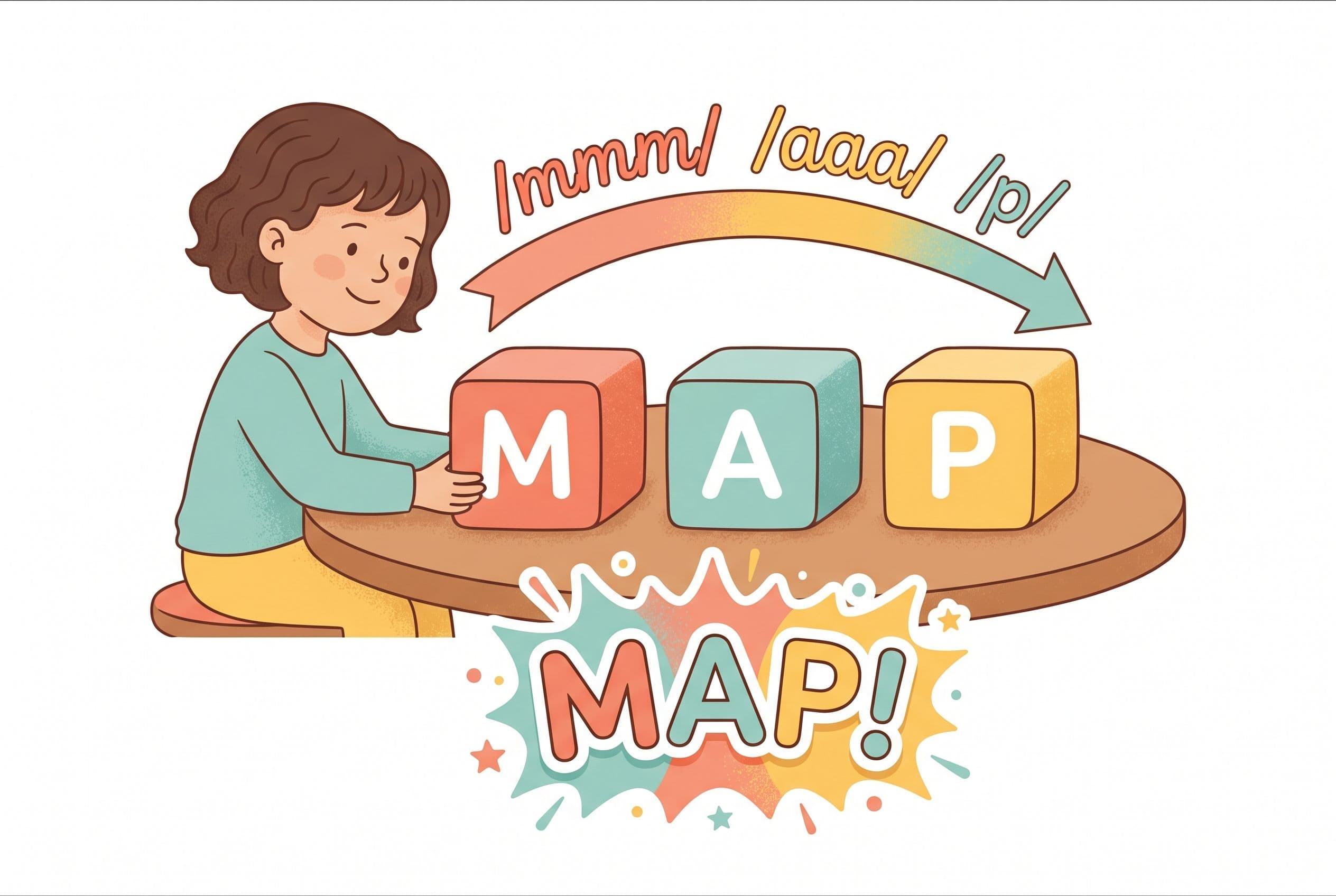
1. Isolate the sounds (30 seconds)
Point to each letter. Have your child say each sound in isolation. Not the letter name — the sound. For "cat": /k/... /ă/... /t/. If they say "see-ay-tee," correct immediately. Letter names are useless for blending. Sounds are everything.
2. Continuous blending (30 seconds)
This is the technique that changed everything for us. Instead of saying each sound with a gap between them (/k/... /ă/... /t/), have your child stretch the sounds together without stopping: "/kaaaat/." Run your finger under the letters slowly as they blend. No gaps. No pauses. The sounds flow into each other like a slow-motion word.
This is the method used in Orton-Gillingham instruction. It's the gold standard because it prevents the "choppy sound" problem where kids say the individual sounds but can't put them together.
3. Say the word fast (5 seconds)
After the slow blend, have them say the word at normal speed: "Cat!" This connects the slow decoding to the actual spoken word they already know.
4. Swap the first letter (repeat)
Now swap the C for a B. "What's this word?" /baaaat/... "Bat!" Swap for H. /haaaat/... "Hat!" This is where word families become magic. Your child only has to change one sound each time, which builds confidence and speed fast.
Tiger Rules for This Practice
- We Never Skip. Ten minutes a day, every single day. Birthdays. Holidays. Vacation. Consistency is the only thing that builds automaticity.
- No Guessing. If your child looks at a picture and guesses the word, cover the picture. If they guess randomly, go back to the sounds. "Don't guess. Sound it out." I say this phrase approximately 47 times per week.
- Praise the process, not the result. "I love how you sounded that out" beats "You're so smart" every time. You want them to value the work, not the natural talent.
What CVC Mastery Actually Looks Like
How do you know when your kid has actually mastered CVC words and is ready to move on to blends and digraphs? Here are the benchmarks I use, borrowed from DIBELS (Dynamic Indicators of Basic Early Literacy Skills) nonsense word fluency standards:
- Your child can read a CVC word in under 3 seconds without choppy sound-by-sound decoding. They see "mop" and say "mop," not "/m/... /o/... /p/... mop?"
- They can read nonsense CVC words. This is the real test. Can they read "vap"? "Zid"? "Mog"? If yes, they're truly decoding — not just memorizing. DIBELS benchmarks suggest 28+ correct letter sounds per minute by mid-kindergarten on nonsense word fluency.
- They can spell CVC words from dictation. Say "big" and they write B-I-G. This proves the mapping goes both ways — sounds to letters AND letters to sounds.
- They self-correct. When they misread a word, they catch it and fix it without you saying anything. That's the orthographic mapping kicking in.
Don't rush past CVC mastery. I know it's tempting to sprint ahead to longer words and "real books." But David Kilpatrick's research is clear: kids who develop strong phonemic awareness at the CVC level build orthographic maps faster for every word they encounter later. The time you invest here pays compound interest.
The Teach Your Kid to Read Approach
Look, I built Teach Your Kid to Read start lesson one free because I was frustrated with what was available. Most phonics apps either turn reading into a mindless game where kids tap buttons and earn stars without actually learning anything, or they dump a wall of content on parents with no structure.
Our approach is built on the same systematic synthetic phonics principles I just walked you through — the same methodology backed by the 2000 National Reading Panel report that Congress commissioned. That report found that systematic phonics instruction produces significant benefits for kids in kindergarten through 6th grade, and the effect was strongest when phonics was taught early and systematically.
Here's what that means in practice:
- CVC words are taught in the exact progression I outlined above — short A first, short E last, word families grouped together
- Continuous blending is built into every lesson — no choppy isolated sounds
- Nonsense words are included so your child proves real decoding, not memorization
- Decodable texts match the phonics skills taught — so when your kid reads a story, every word in it uses patterns they've already learned (unlike Fountas & Pinnell leveled readers, which are whole-language aligned and throw in words kids haven't been taught to decode)
If you want a structured, no-guessing, no-fluff approach to CVC words and beyond, check out what we've built at start lesson one free. Or call us at (407) 707-6850 — I'm happy to talk through where your child is and what they need.
Common Mistakes Parents Make with CVC Words
I've seen these a hundred times. Don't be that parent.
Mistake 1: Teaching letter names before letter sounds. Your kid doesn't need to know it's called "double-you." They need to know it says /w/. Letter names are trivia. Letter sounds are the operating system.
Mistake 2: Using picture clues. This one drives me crazy. If your CVC flashcard has a picture of a cat next to the word "cat," your child will look at the picture and say "cat" without ever looking at the letters. Cover. The. Pictures. Or better yet, use cards without them.
Mistake 3: Practicing once or twice a week. Twice a week is not practice. It's forgetting and re-learning. The research on spaced repetition is clear — short daily sessions (even 10 minutes) crush long weekly sessions. This is non-negotiable.
Mistake 4: Jumping to blends and digraphs too early. Your kid reads "cat" and "dog" and you think they're ready for "stop" and "ship." They're not. Master all five short vowels in CVC patterns first. Build the foundation before you add floors.
Mistake 5: Relying on apps to do the teaching. Apps can reinforce. Apps can provide practice. But your kid needs YOU sitting next to them, correcting their errors in real time, modeling the blending, and making them try again when they guess. No app replaces a parent's ear and attention.
What Comes After CVC Words?
Once your child has CVC mastery across all five short vowels, here's the progression:
- CCVC words (consonant blends at the beginning): stop, trip, clap, frog
- CVCC words (consonant blends at the end): milk, jump, belt, nest
- Consonant digraphs: ship, chat, thin, then
- Silent E / CVCe words: cake, bike, home, cute
- Vowel teams: rain, boat, seed, loud
Each step builds on the CVC foundation. This is the sequence used by programs like Logic of English, Explode the Code, and Barton Reading & Spelling. It's also the sequence that aligns with the 40+ states that have passed Science of Reading legislation since 2019 — including Mississippi's Literacy-Based Promotion Act of 2013, which helped that state jump from 49th to 21st in national reading scores in just six years.
Mississippi didn't do anything revolutionary. They just required schools to teach reading the way the research says it should be taught. Systematic phonics. CVC words first. No guessing.
You can do the same thing at your kitchen table.
Frequently Asked Questions
What age should I start CVC words?
Most kids are ready for CVC blending once they know at least 15-20 letter sounds reliably — not letter names, letter sounds. For many kids that's around age 4 to 5, but some 3-year-olds get there and some don't click until closer to 6. Mei was 4 years and 2 months when she blended her first CVC word. Don't compare your child to a chart — compare them to the prerequisite skills. Can they hear and produce individual letter sounds? Then they're ready to blend.
How many CVC words should my child learn?
There's no magic number. The goal isn't memorizing a specific list — it's mastering the skill of blending any three-letter CVC pattern. Once a child can decode nonsense CVC words (like "bim" or "fot") fluently, they've mastered the skill. The 120+ words on this list are practice material for building that skill, not a checklist to memorize.
My child knows letter sounds but can't blend them into a word. What's wrong?
Probably nothing is "wrong" — blending is a separate skill from letter-sound knowledge, and it takes practice. Try continuous blending (stretching sounds together without pauses) instead of segmented blending (saying each sound with gaps). If your child still struggles after 2-3 weeks of daily continuous blending practice, consider screening with Kilpatrick's PAST test (Phonological Awareness Screening Test) — it takes about 5 minutes and pinpoints exactly where the phonological breakdown is happening. Some kids need explicit phonological awareness training before blending clicks.
Are CVC words the same as sight words?
No. CVC words are decoded — your child sounds them out. Sight words (also called high-frequency words) like "the," "was," and "said" often don't follow regular phonics patterns and need to be learned through repeated exposure and orthographic mapping. Some CVC words (like "cat" and "big") eventually become sight words through practice — meaning your child recognizes them instantly without sounding out — but the path to get there is through decoding first, not memorization.
What's the difference between CVC words and word families?
Word families are groups of CVC words (and other words) that share the same ending pattern. The "-at" family includes cat, bat, hat, mat, and sat — they all end with the same vowel-consonant combination. CVC words describe the structure of the word (consonant-vowel-consonant). Word families describe the grouping. I teach CVC words through word families because swapping just the first letter makes blending practice more efficient and helps kids see patterns faster.
The Bottom Line
CVC words aren't glamorous. There's no app that makes them go viral. Your kid won't beg to practice them.
But they're the foundation of every word your child will ever read. Every novel. Every textbook. Every job application. Every text message. It all starts with three sounds blended together at a kitchen table.
Do the work now. Ten minutes a day. No skipping.
Ready to give your child a structured, science-backed path through CVC words and beyond? Visit start lesson one free or call (407) 707-6850 to learn how Teach Your Kid to Read can help.
Part of these guides

Xia Brody
Co-Founder, Teach Your Kid to Read
Mom of 4 who has successfully taught her kids to read. Currently in the trenches with her 4-year-old while her two oldest (10 and 7) devour books on their own. Passionate about phonics-based methods and building a lifelong love of reading.
Related Articles

CVC Words Activities for Struggling Readers: 12 Drills That Build Real Skill
If your kid is guessing at three-letter words instead of sounding them out, these CVC words activities for struggling readers will change everything. Here are 12 drills that actually build blending skill — no fluff, no worksheets-for-the-sake-of-worksheets, just phonics that works.
Read More →
Best App for Kids Who Know Letters But Can't Read
Your child knows the alphabet but still can't read words? That's not laziness. It's a blending problem, and the right phonics app can help you fix it fast.
Read More →
Reading Apps for 5-Year-Olds: 6 Skill-Level Picks
Most reading apps for 5-year-olds look cute. Too many teach guessing, tapping, and screen-zombie habits instead of real decoding. Here’s how I’d pick a phonics app by skill level if I were sitting at your kitchen table.
Read More →