How to Teach Diphthongs to Kids: OI, OY, OU, OW Activities (2026)
What You'll Learn
- Why diphthongs trip up kids who were reading just fine — and the exact phonics gap that causes it
- The difference between diphthongs and vowel teams (even most teachers get this wrong)
- A step-by-step system for teaching OI, OY, OU, and OW — with a diphthong words list you can start using tonight
- The one activity that made diphthongs click for my 7-year-old in less than a week
Your Kid Isn't "Struggling" — They Hit a Wall Nobody Warned You About
Here's what happens. Your child spends months cracking the code on CVC words. Cat. Dog. Sit. They're blending like champs. Then they move through consonant blends, digraphs, maybe even some long vowel patterns. You're feeling good.
Then they hit the word "coin."
And they say "cone." Or "can." Or they just freeze.
This isn't a regression. This is a predictable, specific gap in their phonics knowledge — and it has a name. Diphthongs. The OI in "boil," the OY in "toy," the OU in "loud," the OW in "cow." These are vowel sounds that glide from one position to another inside your mouth, and they don't follow the tidy rules your kid learned for short and long vowels.
The problem? Most parents don't know how to teach diphthongs to kids because nobody taught them. And a shocking number of reading programs skip right over this stage or bury it so deep in a workbook that kids never get enough practice.
I'm Xia, co-founder of TeachYourKidToRead.org, homeschooling mom of four, and I've been through the diphthong trenches twice now. My 10-year-old blew past them. My 7-year-old hit a brick wall with OU/OW that lasted three weeks before I figured out what I was doing wrong. My 4-year-old isn't there yet, but trust me — I've got a plan.
Let me save you those three weeks.
The Tiger Truth: What Happens When Kids Can't Decode Advanced Vowel Sounds
Let's talk consequences, because I don't do sugarcoating.
Diphthongs show up everywhere in the texts kids encounter by first and second grade. The words "house," "found," "point," "boy," "down," "around," "about" — these aren't fancy vocabulary words. They're high-frequency everyday words that appear on practically every page of a first-grade reader.
If your kid can't decode them, they do one of two things: they guess, or they skip.
Both are disasters.
Guessing is the gateway drug to reading failure. A child who looks at "shout" and says "shot" because they recognized the SH and the T isn't reading — they're playing a lottery. And this is exactly what the old Whole Language and Balanced Literacy programs trained kids to do. Look at the picture. Think about what makes sense. Use the first letter as a clue. Emily Hanford's 2023 APM Reports investigation Sold a Story blew the lid off this approach, showing how Lucy Calkins' three-cueing system had been producing a generation of guessers.
I saw this up close. After that investigation dropped, my neighbor — a first-grade teacher for 18 years — called me almost in tears. She'd been using Lucy Calkins' Units of Study curriculum her entire career. Three-cueing, MSV, the whole guessing system. She told me, "I've been teaching kids to guess for two decades and I didn't even know it." She switched her classroom to UFLI Foundations mid-year, and it was messy. She had to relearn everything herself first. But here's what stuck with me: by spring, her first graders' DIBELS nonsense word fluency scores had jumped noticeably — she told me it averaged around 15 points on correct letter sounds from winter to spring benchmarking. She said that was the first time in her career where every single kid in her class could decode CVC words by February. And the thing that surprised her most? Once those kids had solid decoding foundations, teaching them the next steps — digraphs, blends, and yes, diphthongs — went so much faster because they weren't relying on guessing anymore.
That story isn't just about CVC words. It's about what happens when kids have actual decoding skills versus a bag of guessing tricks. Diphthongs are where the guessing strategy completely falls apart, because these sounds don't look like anything kids have seen before.
Here's the data that should scare you into action: only 33% of 4th graders read at proficient level on the 2022 NAEP — that's the Nation's Report Card. The 2022 scores showed reading dropped another 3 points since 2019, the largest decline in over 30 years. And a widely cited analysis by Donald Hernandez (2011), summarized by the Annie E. Casey Foundation, found that kids who can't read proficiently by 3rd grade are several times more likely to not graduate from high school — especially those from low-income families.
Diphthongs aren't some obscure phonics footnote. They're a make-or-break skill that determines whether your child reads fluently or continues to struggle through every sentence.
Diphthong vs. Vowel Team: The Distinction That Actually Matters
OK so before we get into the teaching part, let's clear up a confusion that trips up parents and teachers alike.
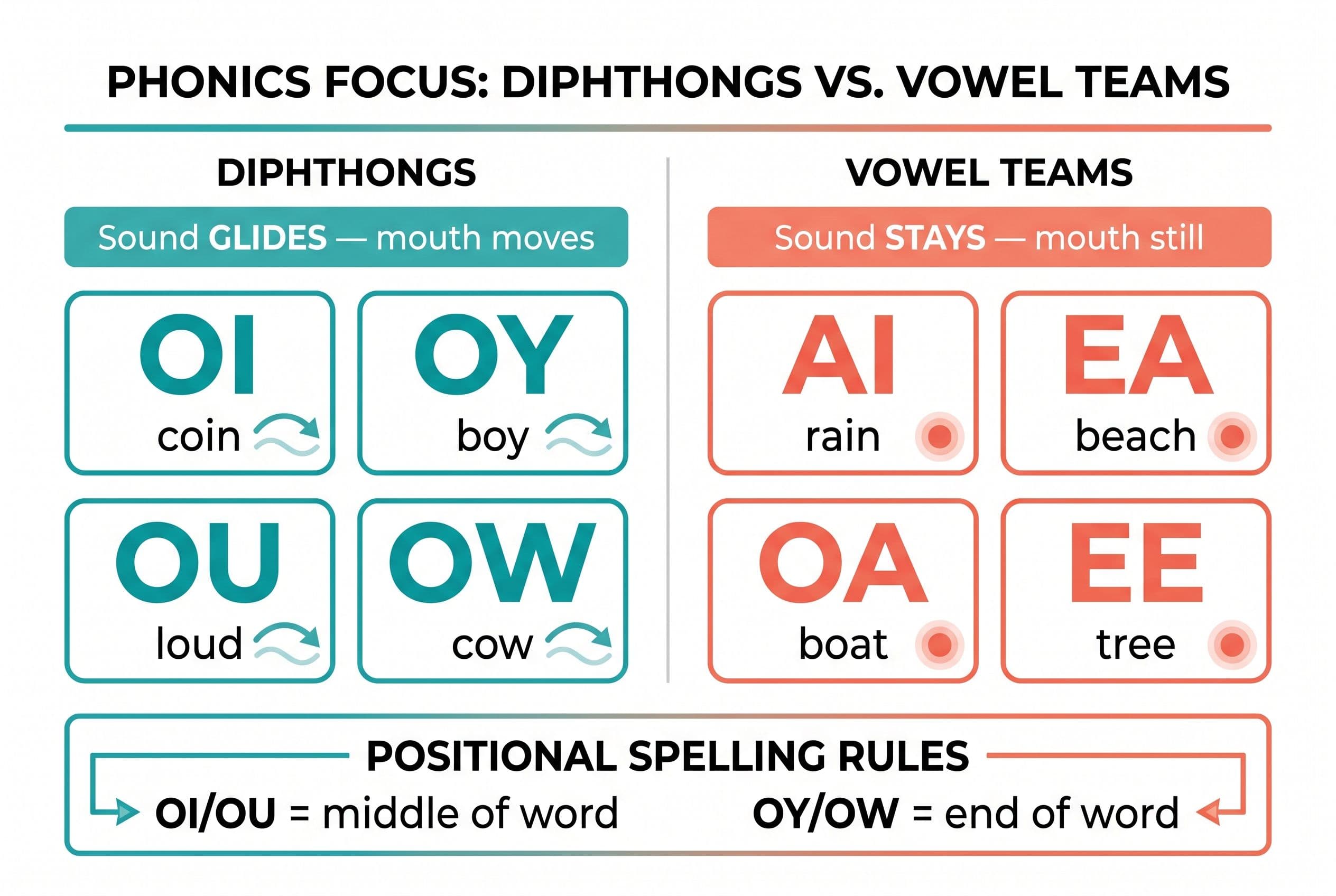
Vowel teams are two vowels that work together to make a single, stable sound. Think AI in "rain" (long A) or EA in "beach" (long E). The sound doesn't move — your mouth stays in one position.
Diphthongs are two vowels (or a vowel + W) that make a sound that slides from one position to another. Say "coin" out loud slowly. Feel your mouth start in one position and glide to another? That's a diphthong. Now say "rain." Your mouth stays put. That's a vowel team.
Here's the breakdown:
- OI (as in boil, coin, point) — diphthong
- OY (as in boy, toy, enjoy) — diphthong
- OU (as in loud, house, found) — diphthong
- OW (as in cow, town, brown) — diphthong
OI and OY make the same gliding sound. OU and OW make the same gliding sound. The difference is where they appear in a word. OI typically shows up in the middle of a syllable ("join"), while OY shows up at the end ("joy"). For OU and OW, it's a similar idea but with a twist: OU generally goes in the middle ("sound"), while OW shows up at the end ("plow") or before certain consonants like N, L, and D — which is why you see OW in words like "town," "owl," and "crowd" even though it's not at the very end.
This positional spelling pattern is one of the most practical things you can teach your kid. It's not just phonics — it's spelling logic. And kids love rules that are reliable. My 7-year-old literally said, "Oh, so it's like OY is the one that gets to go last?" Yep. Exactly, buddy.
Now, a tricky caveat: OW also represents the long O sound in words like "snow," "grow," and "show." This is where it gets confusing. But don't worry about that yet. Teach the diphthong sound first, get it solid, then introduce the alternate pronunciation. One thing at a time. This is how systematic synthetic phonics works — you build layer by layer.
Research in cognitive neuroscience — including Stanislas Dehaene's Reading in the Brain (2009) — tells us that reading isn't innate. The brain doesn't come pre-wired for it. It has to be trained through instruction and practice, and that process literally reshapes how the visual cortex handles letter patterns. When you teach your kid that OI says /oi/ as in "oil," you're helping the brain build reliable connections between that spelling and that sound. Repetition strengthens those connections. Skipping it guarantees they never form.
Where Diphthongs Fit in the Phonics Progression
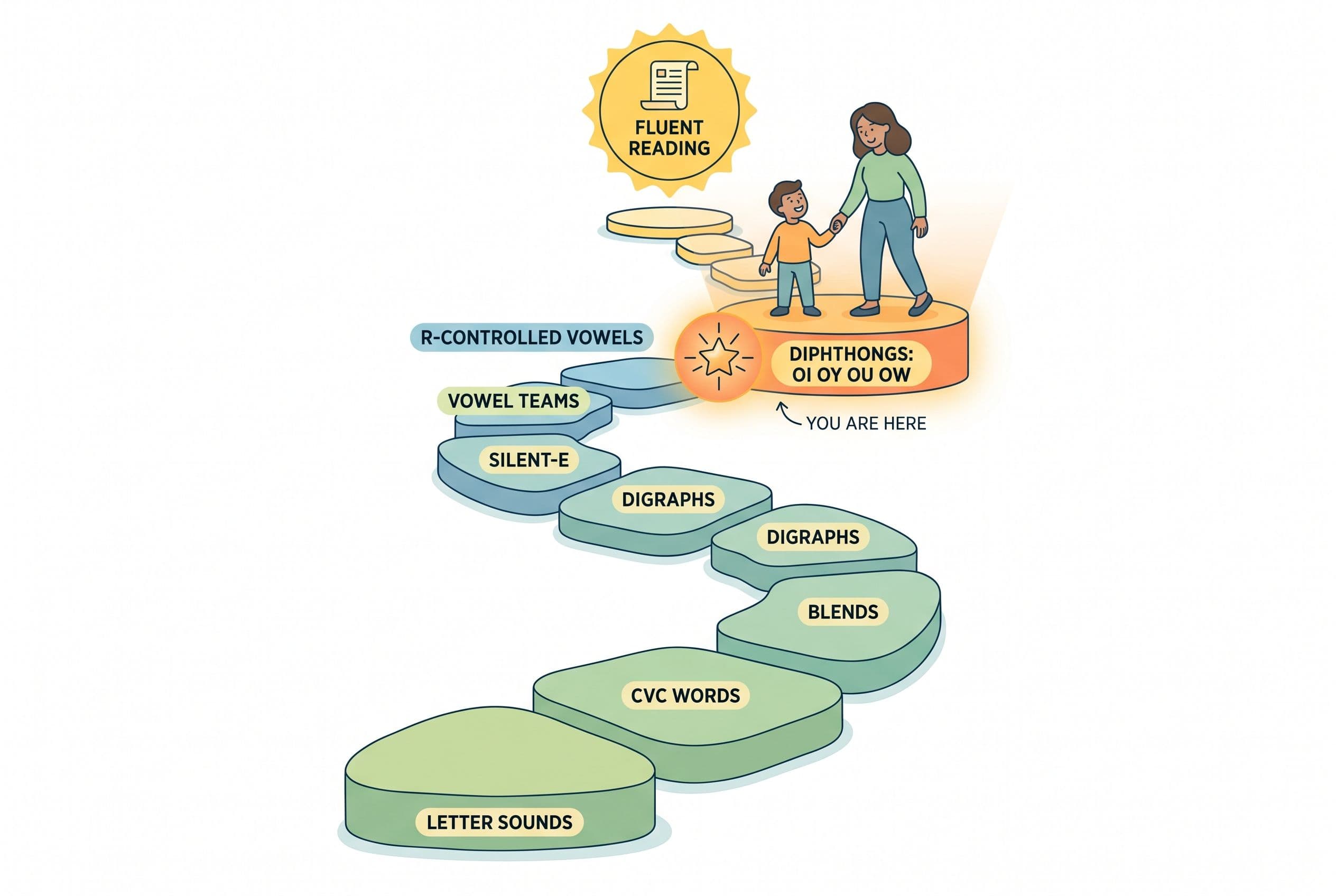
If you're wondering whether your kid is ready for diphthongs, here's where they typically fall in a systematic phonics progression:
- Letter names and sounds (26 letters)
- CVC words (cat, dog, hit)
- Consonant blends (bl, st, cr)
- Consonant digraphs (sh, ch, th, wh)
- Silent-e / CVCe patterns (cake, bike, hope)
- Vowel teams (ai, ea, oa, ee)
- R-controlled vowels (ar, or, er, ir, ur)
- Diphthongs (oi, oy, ou, ow) ← YOU ARE HERE
- Complex vowel patterns and multi-syllable words
Diphthongs typically come up in mid-to-late first grade through second grade. In the UFLI Foundations scope and sequence, OI/OY and OU/OW appear after vowel teams and r-controlled vowels. The Logic of English program introduces them around lesson 20-something after building a solid base of phonogram knowledge.
The point is: don't skip steps. If your kid hasn't mastered vowel teams yet, don't jump to diphthongs. Linnea Ehri's phases of word reading development (from her 2005 meta-analysis) show that readers move from partial alphabetic to full alphabetic to consolidated alphabetic knowledge. Each phase depends on the one before it. You can't consolidate patterns you never fully learned.
Here's my personal test: if your kid can read "train," "boat," "need," and "came" without hesitation, they're probably ready for diphthongs. If they're still guessing at those vowel team words, back up and shore up that foundation first.
How to Teach Diphthongs to Kids: The Step-by-Step System
All right, here's the actual plan. This is what I used with my 7-year-old, refined from what I learned with my oldest, and it follows Orton-Gillingham principles — multisensory, explicit, and systematic.
Step 1: Introduce One Diphthong Pair at a Time
Start with OI/OY. Don't teach all four spellings at once. That's a recipe for confusion.
Sit down with your kid and say: "We're going to learn a new sound today. This sound uses two letters that work together, and it sounds like this: /oi/." Make the sound. Have them make the sound. Have them feel their mouth glide from one position to another.
Then show them the two spellings: OI and OY.
Explain the rule: OI goes in the middle of a word. OY goes at the end.
- OI: boil, coin, join, point, soil, foil, moist, voice, noise, choice
- OY: boy, toy, joy, enjoy, annoy, destroy, loyal, royal, employ
Write these on index cards or a whiteboard. Read them together. Point to each one and have your kid decode it — not guess it, decode it. Sound by sound. /b/ /oi/ /l/. Blend. "Boil."
Step 2: Build It Multisensory
Orton-Gillingham works because it engages the eyes, ears, mouth, and hands simultaneously. Here's how I apply that to diphthongs:
- See it: Write the word on a whiteboard. Underline the diphthong in a different color.
- Say it: Kid reads the word aloud, emphasizing the diphthong sound.
- Hear it: You say a word and the kid identifies which diphthong they hear. "I'm going to say 'point.' What vowel sound do you hear?"
- Touch it: Use letter tiles (magnetic ones on the fridge work great) and have your kid physically build the word. Pull the OI tiles together as a unit.
I had my 7-year-old building words with magnetic tiles on our fridge while I was making dinner last month. He'd build "coin," I'd say "change it to 'join,'" and he'd swap the C for a J. Five minutes of this while the pasta boiled. Non-negotiable daily practice doesn't have to mean sitting at a desk.
Step 3: Dictation — The Skill Most Parents Skip
This is the part that separates real phonics instruction from playing phonics games. Dictation.
You say a word. Your kid writes it. No word bank. No multiple choice. Just the sound going into their ear and the letters coming out of their pencil.
"Write the word 'coil.'"
Your kid has to think: /k/ — that's C. /oi/ — that's in the middle of the word so I use OI. /l/ — that's L. C-O-I-L.
This is where the OI vs. OY positional rule gets drilled into long-term memory. David Kilpatrick's Equipped for Reading Success (2016) breaks down the orthographic mapping process — the mechanism by which printed words get stored in long-term memory. Dictation forces this mapping in a way that just reading words on a page doesn't. Kids have to retrieve the spelling pattern, not just recognize it.
Start with 5 words per session. That's it. Five words, dictated, written, checked, corrected.
Step 4: Introduce OU/OW (After OI/OY Is Solid)
Once your kid can read and spell OI/OY words without hesitation — I'm talking automatic, no pause, no second-guessing — move to OU/OW.
Here's the pattern: OU generally goes in the middle of a word. OW goes at the end — or before certain consonants like N, L, and D. That's why you'll see OW in "town," "owl," and "crowd," not just at the very end of a word like "cow." Once your kid gets the hang of it, this pattern clicks fast.
- OU: loud, cloud, house, mouse, found, sound, ground, shout, mouth, ouch
- OW: cow, how, now, wow, plow, town, down, brown, clown, crowd, growl, owl
Same process: introduce, decode together, multisensory practice, dictation.
One thing I need to flag: OW at the end of a word can say /ow/ as in "cow" OR /ō/ as in "snow." When you first teach OU/OW, only use the /ow/ sound words. After your kid masters those, then you introduce the idea that OW has two possible sounds. "Remember how we learned OW says /ow/ like in 'cow'? Well, OW can also say /ō/ like in 'snow.' When you see OW and the first sound doesn't work, try the other one." This is called a flex strategy — trying one pronunciation, and if it doesn't make a real word, flexing to the other. It's the opposite of guessing. It's strategic decoding.
Step 5: Mix and Practice Until It's Automatic
Now comes the grind. And yes, I call it a grind because that's what it is. Mastery requires repetition.
Make a mixed review list with all four diphthong spellings:
OI: foil, join, moist, point, choice, voice, spoil, broil OY: joy, ploy, coy, decoy, enjoy, annoy, loyal, royal OU: cloud, proud, couch, south, flour, scout, sprout, bounce OW: plow, frown, drown, prowl, crowd, browse, tower, flower
Have your kid read through this list daily. Time them if they're competitive (my oldest loved being timed — my second kid hated it, so read your child). Do dictation from this list. Mix in words from earlier phonics patterns so they're reviewing everything, not just diphthongs in isolation.
The benchmark I use: if my kid can read 20 mixed diphthong words in under 60 seconds with zero errors, they've got it. If they're still pausing on OI vs. OY or mixing up OU and OW, we keep drilling.
Diphthong Activities for First Grade (and Kindergarten, and Second Grade)
OK, the system above is the backbone. But here are specific diphthong activities that make the practice stick — and yes, some of them are actually fun. I'm a tiger mom, not a monster.
Word Sort: OI vs. OY / OU vs. OW
Write 20 diphthong words on index cards. Make two columns on the table: one labeled OI, one labeled OY. Kid reads each word and physically sorts it into the correct column. Then switch to OU vs. OW.
This activity targets the positional spelling rule directly. It's simple, it takes 5 minutes, and it works.
Diphthong Word Hunt
Grab any book your kid can mostly read. Set a timer for 3 minutes. Challenge them to find and list every OI, OY, OU, or OW word they can spot. They have to read each word aloud to get credit.
My 7-year-old found 11 diphthong words in a Frog and Toad chapter. He was so proud he wrote the number on the fridge. This is the kind of activity that bridges isolated phonics practice into real reading — exactly what Scarborough's Reading Rope model describes. You're weaving word recognition skills with language comprehension.
Sentence Dictation (Level Up)
Once single-word dictation is solid, dictate full sentences.
"The boy found a coin in the brown soil."
That one sentence hits OY, OU, OI, OW, and OI again. Your kid has to decode, spell, and write — all at once. This is Orton-Gillingham-style dictation at its finest. Hard? Yes. Effective? Hands down.
Build and Switch (Magnetic Tiles)
Give your kid letter tiles. Say "Build 'coil.'" They build it. Then say "Change 'coil' to 'coin.'" They swap the L for an N. "Change 'coin' to 'join.'" Swap C for J. This is called word chaining, and it forces kids to attend to every single letter in the word — no skipping, no guessing.
The Common Mistakes Parents Make Teaching Diphthongs
I've seen these over and over, both in my own homeschool and from parents who reach out to us at TeachYourKidToRead.org.
Mistake 1: Teaching All Four Spellings at Once
OI, OY, OU, OW — dumped on a kid in the same lesson. Their brain can't sort it. Introduce OI/OY as a pair. Master it. Then add OU/OW. The kicker is that most worksheet packets and Pinterest activities throw all four together because it looks neat on one page. Ignore those.
Mistake 2: Using Leveled Readers Instead of Decodable Readers
Fountas & Pinnell leveled readers are everywhere — libraries, classrooms, school book rooms. But they're whole-language aligned. They don't control for phonics patterns. A Level F book might throw "mountain," "outside," and "thought" at your kid on the same page, and none of those words follow the same vowel pattern.
For diphthong practice, you need decodable texts that specifically feature OI/OY and OU/OW words. Look for decodable readers from Flyleaf Publishing or High Noon Books. The Explode the Code series also has controlled practice for these patterns.
Mistake 3: Letting Kids "Sound Flexible" Too Early
Some well-meaning parents teach the OW dual pronunciation (cow vs. snow) right away. Don't. Get the /ow/ sound locked in first. Confusion kills confidence, and confidence keeps kids practicing.
Mistake 4: Not Enough Repetition
I see parents introduce OI/OY on Monday, practice it Tuesday, and move on Wednesday. That's not enough. Kilpatrick's orthographic mapping research shows that most kids need between 1 and 4 exposures to permanently store a word — but that's only if they have strong phonemic awareness. Kids with weaker phonological skills need dozens of exposures. Plan on at least a full week per diphthong pair, with daily practice.
How Teach Your Kid to Read Makes Diphthongs Click
Real talk — I built our program at start lesson one free because I was frustrated with what was available. Most phonics apps are glorified guessing games dressed up with cute animations. They show a picture of a coin and play the word "coin" and the kid taps a button. That's not decoding. That's matching.
Teach Your Kid to Read follows systematic synthetic phonics principles rooted in Orton-Gillingham methodology. When your child gets to diphthongs in our progression, they:
- Learn the sound explicitly — no discovery learning, no "figure it out from context"
- Practice decoding real words — blending sound by sound, OI/OY and OU/OW in controlled sequences
- Get immediate corrective feedback — if they misread "join" as "John," the program catches it and redrills
- Move through dictation and spelling — because encoding (spelling) reinforces decoding (reading) and vice versa
- Don't advance until mastery is demonstrated — no moving to the next skill because the calendar says so
This is the kind of approach Mississippi used when it overhauled its literacy instruction. After passing the Literacy-Based Promotion Act in 2013 and committing to structured literacy, Mississippi's 4th-grade NAEP reading scores improved dramatically — jumping from near the bottom of state rankings to the middle of the pack over the following decade. Explicit, systematic phonics instruction — including advanced vowel sounds for kids at every stage — delivered consistently.
Over 40 states have now passed Science of Reading legislation since 2019. The research is settled. The only question is whether your kid gets the benefit of it.
Your Action Plan: Diphthongs in 2 Weeks
Here's exactly what I'd do if I were starting diphthong instruction tomorrow. This is the plan.
Week 1: OI and OY
- Day 1: Introduce the /oi/ sound. Teach OI and OY spellings. Explain the positional rule (OI in middle, OY at end). Read 10 OI words together, then 10 OY words.
- Day 2: Review the sound and rule. Word sort activity — 20 cards, sort into OI and OY columns. Dictate 5 OI words.
- Day 3: Read an OI/OY word list (20 mixed words) for fluency. Dictate 5 OY words. Do Build and Switch with letter tiles.
- Day 4: Timed mixed list reading (OI and OY together). Sentence dictation: 2 sentences containing OI/OY words.
- Day 5: Word hunt in a real book. Review dictation. If accuracy is 90%+, move on Monday. If not, repeat the week. No shame in that.
- Weekend: Read a decodable book featuring OI/OY words. Casual, low-pressure, on the couch with hot chocolate. Tiger Rule: "We Never Skip" — but the intensity can vary.
Week 2: OU and OW
- Repeat the exact same sequence with OU/OW words.
- Day 5 of Week 2: Mixed review of ALL FOUR diphthong spellings — OI, OY, OU, OW. Dictate 10 words from the combined list. Read 30 mixed words for fluency.
If your kid nails this? They've added a massive chunk of decodable words to their reading vocabulary. Words like "around," "found," "enjoy," "point," "brown," "voice" — words that appear in every single book they'll pick up from now on.
If they struggle? That's fine. Repeat. Drill. Practice every single day. The benchmark on Kilpatrick's PAST test for phonemic proficiency is automatic-level responses, and that only comes from repetition. There's no shortcut.
Frequently Asked Questions About Teaching Diphthongs
What age should I teach diphthongs?
Most kids are ready for diphthongs between ages 5.5 and 7, typically in mid-first grade through early second grade. But age isn't the determining factor — prior phonics knowledge is. Your kid needs to have mastered CVC words, consonant blends and digraphs, CVCe (silent-e) words, basic vowel teams, and r-controlled vowels before diphthongs will make sense. If those aren't solid, go back and shore them up. Skipping steps is how reading problems snowball.
What's the difference between a diphthong and a vowel team?
A vowel team makes a single, stable sound — your mouth doesn't move. AI in "rain" says /ā/. EA in "meat" says /ē/. A diphthong makes a gliding sound — your mouth starts in one position and slides to another. OI in "coin" and OU in "loud" are diphthongs. The bottom line: vowel teams are static, diphthongs glide. Teach your kid to feel the difference in their own mouth.
Why does OW make two different sounds?
OW can say /ow/ as in "cow" or /ō/ as in "snow." This is because English absorbed words from different languages over centuries, and the same spelling ended up representing two sounds. Teach the /ow/ diphthong sound first. Once that's automatic, introduce the long O pronunciation and teach the flex strategy: try one sound, and if the word doesn't make sense, try the other.
My kid keeps mixing up OI and OY. What do I do?
Drill the positional rule: OI in the middle, OY at the end. Use the word sort activity daily until it sticks. Dictation is your best friend here — when kids have to produce the correct spelling (not just read it), the rule locks in faster. If they write "boyl" instead of "boil," don't just correct it — ask them: "Is this sound in the middle of the word or at the end?" Make them apply the rule themselves.
How long does it take to teach diphthongs?
With daily practice of 10-15 minutes, most kids can master OI/OY and OU/OW in 2-3 weeks. Some kids get it in a week. Some need a month. Every child is different, and I refuse to give you a false promise. What I will tell you: consistency matters more than duration. Ten minutes every single day beats 45 minutes twice a week. The neural connections that Dehaene's research describes need daily reinforcement to solidify. No skipping. Not on birthdays, not on vacation, not when you're tired. Tiger Rule number one.
Part of these guides

Xia Brody
Co-Founder, Teach Your Kid to Read
Mom of 4 who has successfully taught her kids to read. Currently in the trenches with her 4-year-old while her two oldest (10 and 7) devour books on their own. Passionate about phonics-based methods and building a lifelong love of reading.
Related Articles
Best Reading App for a 1st Grader Who Guesses Words
If your 1st grader guesses words from pictures, that’s not reading — that’s coping. Here’s the no-nonsense app comparison I’d use with my own kids.
Read More →
CVC Words Activities for Struggling Readers: 12 Drills That Build Real Skill
If your kid is guessing at three-letter words instead of sounding them out, these CVC words activities for struggling readers will change everything. Here are 12 drills that actually build blending skill — no fluff, no worksheets-for-the-sake-of-worksheets, just phonics that works.
Read More →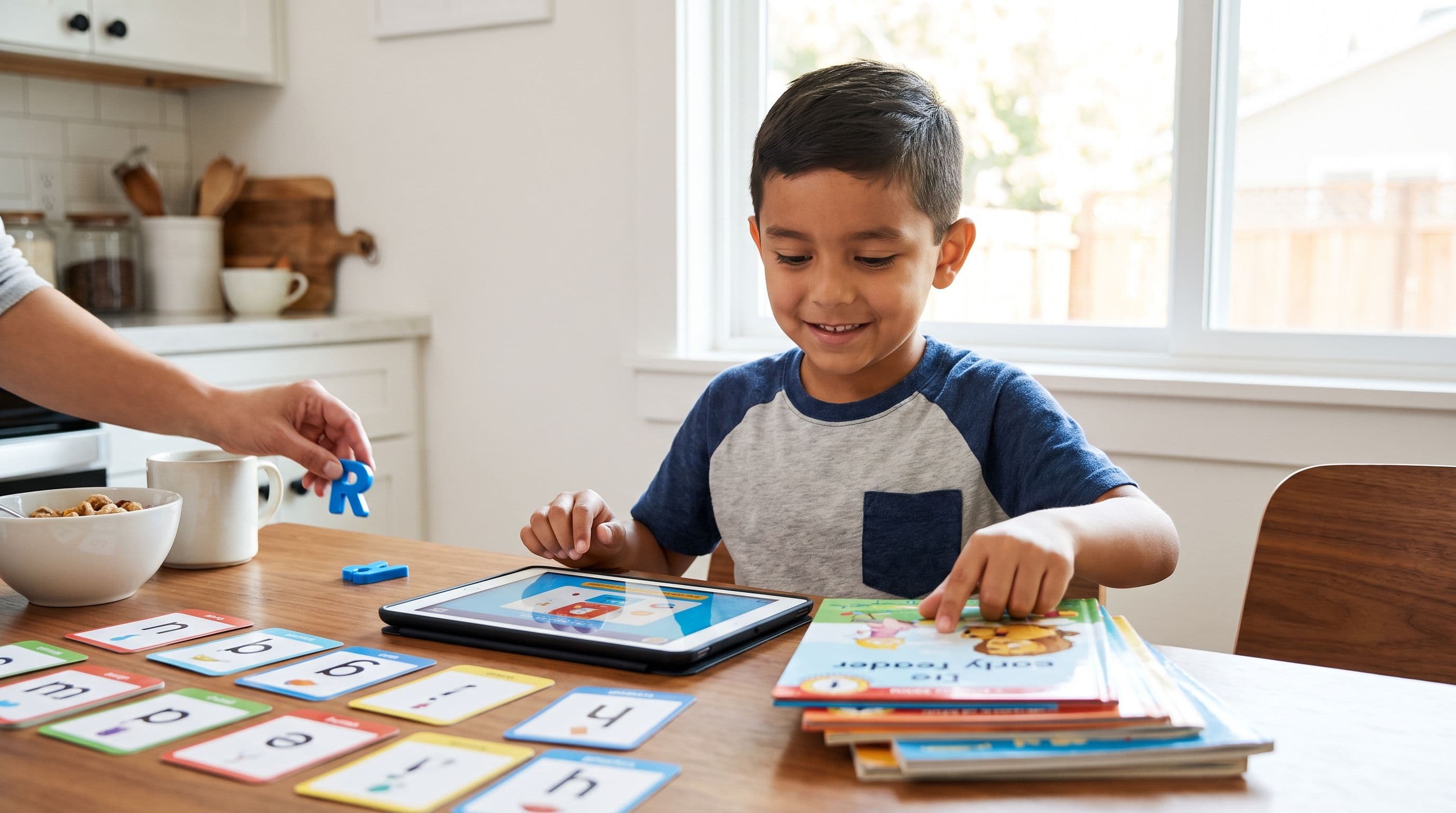
Best App to Teach Sight Words: 2026 Age Picks
Looking for the best app to teach sight words? Here’s my no-nonsense 2026 ranking by age, with phonics-first picks, guessing-method red flags, and the exact action plan I’d use with my own kids.
Read More →