How to Teach Phonics to a 4-Year-Old: Step-by-Step Plan for 2026

What You'll Learn
- The real reading readiness signs at age 4 — and why waiting for kindergarten is a gamble you don't need to take
- The exact sequence for teaching letter sounds to 4-year-olds (hint: it's NOT alphabetical order)
- Why your kid keeps guessing at words instead of sounding them out — and the one shift that can change things fast (often within days)
- A week-by-week phonics plan you can start at your kitchen table tomorrow morning with zero special training
Your 4-Year-Old Isn't "Too Young." They're Right on Time.
Let me guess. You mentioned teaching your 4-year-old to read and someone — maybe your mother-in-law, maybe a preschool teacher, maybe a well-meaning stranger at Target — told you to "let them be a kid."
I've heard it. A hundred times.
Here's what I say back: my kid IS being a kid. A kid who can sound out the word "frog" on the back of a cereal box. A kid who doesn't have to sit in a second-grade classroom faking it because nobody taught them how letters actually work.
Teaching phonics to a 4-year-old isn't about pushing them into something unnatural. It's about meeting them exactly where their brain is developmentally. Stanislas Dehaene — he's a French neuroscientist who wrote Reading in the Brain (2009) — proved that the human brain has to be trained to read. It doesn't happen naturally, the way speech does. There's no magical "reading switch" that flips on at age 5 or 6 or whenever someone decides your kid is "ready."
Reading is a taught skill. And age 4? That's a sweet spot.
The Tiger Truth: What Happens If You Wait
OK, I need you to sit with some numbers for a second.
Only 33% of 4th graders read at a proficient level on the 2022 NAEP — that's the Nation's Report Card, the gold standard of educational measurement. That means two out of every three kids in America can't read well enough to learn from a textbook by 4th grade.
Two out of three.
The Annie E. Casey Foundation's 2010 study found that kids who can't read proficiently by the end of 3rd grade are four times more likely to drop out of high school. Four times. And if they're also living in poverty? The odds get even worse.
This is the 3rd Grade Cliff. Before 3rd grade, kids are learning to read. After 3rd grade, they're reading to learn. If they hit that cliff without solid decoding skills, every subject — science, social studies, math word problems — becomes a wall.
And here's the kicker: remedial reading intervention programs like Lindamood-Bell or Barton Reading & Spelling can cost thousands of dollars a year out of pocket. Insurance doesn't cover them. Most school-based interventions are underfunded and understaffed.
You know what costs almost nothing? Teaching your 4-year-old phonics at home, 10-15 minutes a day, starting now.
Why Phonics — and Why Not "The Other Way"
I was at a playground in Raleigh last year when another mom told me her kid's school had just switched away from Lucy Calkins' Units of Study to a Science of Reading curriculum. North Carolina passed SB 387 — the Excellent Public Schools Act — and schools across the state were overhauling how they taught reading. This mom was confused and honestly a little annoyed. "He was doing fine before," she told me.
So I asked a simple question. "Can he read the word 'splint'?"
Her son was in second grade. He could not.
I spent 20 minutes on that playground bench explaining why the switch was happening. I told her about Emily Hanford's 2023 APM Reports investigation, Sold a Story, which blew the lid off how Balanced Literacy programs had been teaching kids to guess at words using pictures and context clues instead of actually decoding them. I walked her through the NAEP data — reading scores dropped 3 points between 2019 and 2022, the largest decline in 30 years. I explained what Dehaene's lab had found about how the brain processes written language — that it literally recycles a region of the visual cortex to map letters onto sounds, and that process has to be explicitly taught.
She went home and listened to the entire Sold a Story podcast that night. Texted me at 11pm: "I had no idea. Why didn't anyone tell us this sooner?"
Nobody tells you because the education system spent 30 years telling teachers that kids learn to read "naturally" through exposure to good books. That's Whole Language ideology. It's wrong. The 2000 National Reading Panel report — the one Congress actually commissioned — found that systematic phonics instruction produces significant benefits for reading accuracy and comprehension, especially for young kids and struggling readers.
So when I say "phonics for your 4-year-old," I'm not talking about some old-fashioned drill-and-kill approach your grandma used. I'm talking about the method that 40+ states have now written into law since 2019. I'm talking about what the science says works.
Reading Readiness at Age 4: What to Actually Look For
Before I hand you the step-by-step plan, let's make sure you know what "reading readiness" actually looks like at age 4. Forget the Pinterest milestones. Here's what matters:
Your 4-year-old is ready for phonics if they can:
- Recognize and name at least 10-15 uppercase letters (they don't need all 26 yet)
- Understand that books go left to right, top to bottom
- Hear and produce rhyming words — even silly ones ("Does 'cat' rhyme with 'bat'? What about 'cat' and 'dog'?")
- Clap out syllables in words (ba-na-na = 3 claps)
- Sit and focus on a structured activity for 5-10 minutes
That last one is huge. I'm not asking for 30 minutes of focused work. I'm asking for 5 to 10. If your kid can sit through a picture book, they can sit through a phonics lesson.
If your child can't do most of the things on that list yet? That's fine — start with phonological awareness activities (rhyming games, syllable clapping, first-sound isolation: "What sound does 'mama' start with?"). You're building the foundation that phonics sits on top of. Linnea Ehri's research on phases of word reading development (2005) makes this clear — kids move through a pre-alphabetic phase before they can do anything meaningful with letter-sound connections. Meet them where they are.
Run the Plan Yourself, or Let the App Run It
Everything below is the exact sequence I use. You can absolutely do it by hand with index cards and a magnetic letter set — plenty of parents do. The honest trade-off is consistency: the plan works because it happens every day in the right order, and that's the part that slips when life happens.
Teach Your Kid to Read is that same sequence — letter sounds, blending, first decodable words — packaged into 10-minute lessons a 4-year-old will sit through, with the app holding the order so you don't have to. Lesson one is free with no card, then a 7-day trial, then $9.95 a month. Not sure your 4-year-old is ready? take the 2-minute reading check first, then start lesson one free and follow along with the steps below.
The Step-by-Step Phonics Plan for Your 4-Year-Old
This is the actual plan. The one I used with my oldest two kids and the one I'm using right now with my 4-year-old. It's based on systematic synthetic phonics principles — the same approach underlying Orton-Gillingham methodology and programs like UFLI Foundations.
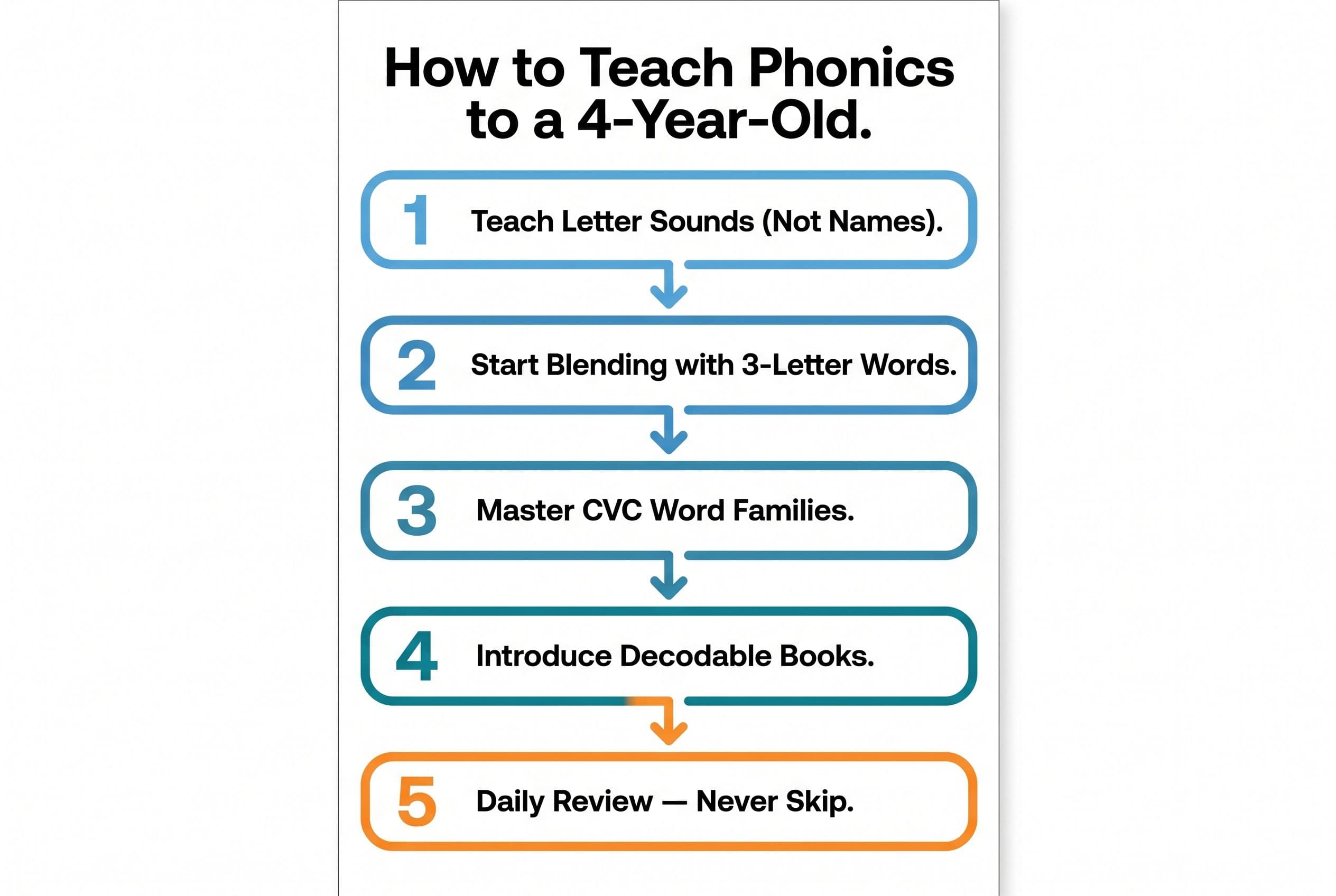
Step 1: Teach Letter Sounds First — and Prioritize Them Over Names
This is where so many parents go wrong. They start with the ABC song. They drill letter names. "A, B, C, D..."
Stop. Or at least, reprioritize.
Your kid doesn't need to know the letter is called "double-you" to start reading. Your kid needs to know that the letter W says /w/. Letter sounds are the priority for reading and spelling. Letter names? They'll pick those up too — casually, alongside sounds, and especially when school stuff comes up. Quick rule of thumb: when you're reading and spelling together, use sounds. When you're singing the alphabet song or talking about letters by name, that's fine too. But sounds drive the bus.
And don't teach them in alphabetical order. Teach the most useful, high-frequency sounds first so your kid can start blending real words as fast as possible.
Here's my recommended order:
Group 1: s, a, t, p Group 2: i, n, m, d Group 3: g, o, c, k Group 4: e, r, u, b Group 5: h, f, l, j Group 6: w, v, y, z, x, q
Why this order? Because with just Group 1 (s, a, t, p), your kid can already blend: sat, pat, tap, at, sap. They're reading real words within the first week. That's a motivation rocket.
How to teach each sound:
- Show the letter. Say the sound — not the name. "/s/ like sssssnake."
- Have your kid repeat the sound 3 times.
- Practice writing the letter (finger in sand, marker on paper, whatever — the motor memory helps lock it in).
- Review all previously learned sounds before introducing a new one.
I introduce one new sound every 2-3 days. Sometimes faster if my kid nails it. Sometimes slower. No rigid timeline — mastery matters more than speed.
Step 2: Start Blending Immediately
The second your kid knows /s/, /a/, and /t/, you start blending. Don't wait until they know all 26 sounds. That's a waste of weeks.
Blending is the magic act of phonics. It's where your kid goes from knowing isolated sounds to actually reading.
How I teach blending at the kitchen table:
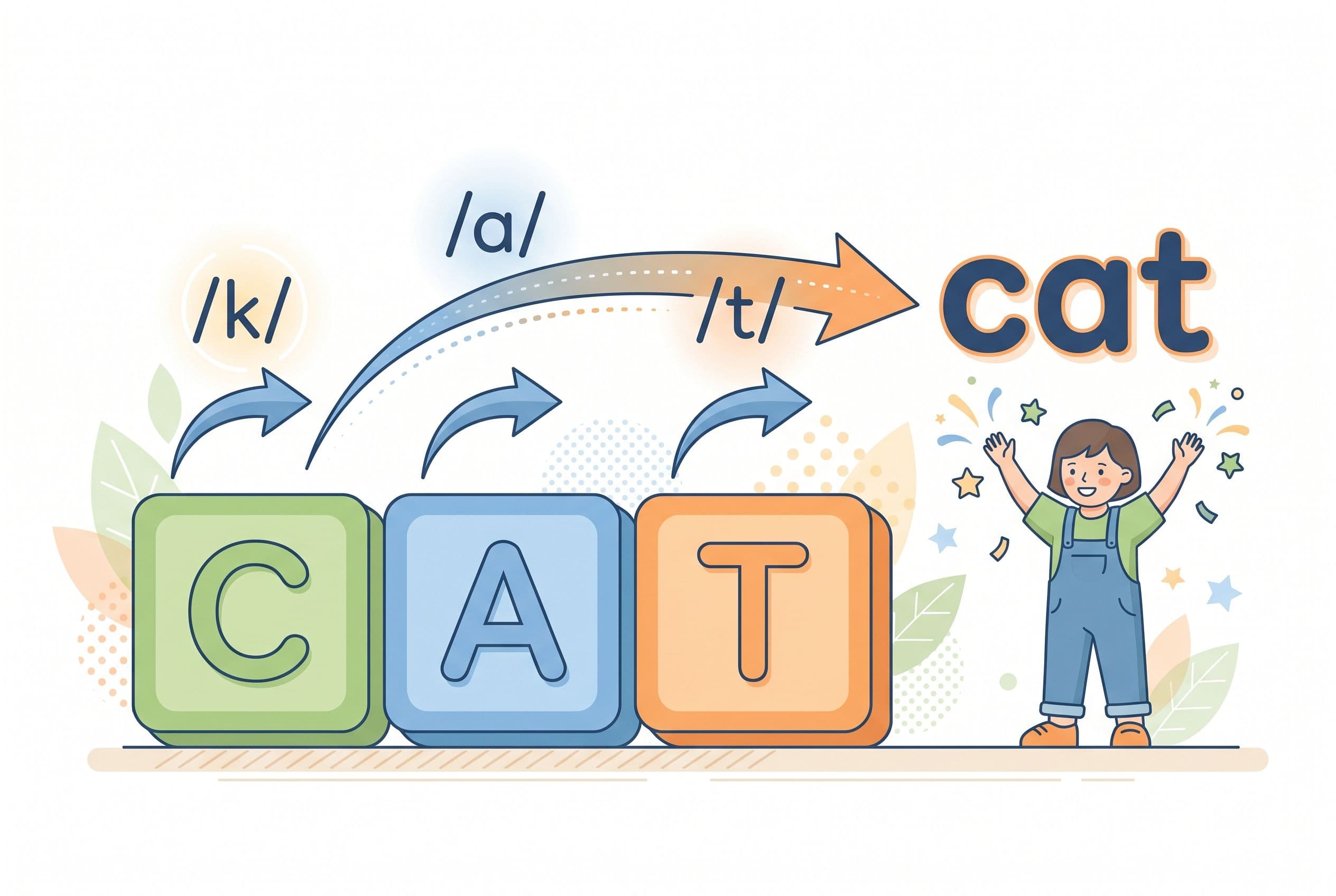
- Put three letter tiles (or write three letters) in front of your kid: s - a - t
- Point to each letter. Have them say each sound: "/s/ ... /a/ ... /t/"
- Now say: "Push them together. Faster. /s/ /a/ /t/. /sat/. SAT!"
- Celebrate like they just won the Super Bowl. (I'm serious. High-fives, cheering, the whole thing.)
The first time my oldest blended a word — she was 4 years and 2 months — she looked up at me like she'd just discovered a secret door. That look? That's what you're working toward.
Some kids get blending on the first try. Some need a week of practice. My 4-year-old needed about 5 days of daily 10-minute sessions before blending clicked. I used the "stretchy" method — I'd say the word super slowly, like taffy: "ssssaaaat" — and then snap it together: "sat!" Then she'd try.
Tiger Rule: No Guessing. If your kid looks at the word "sat" and says "set" or "sit" or anything that isn't right, you don't say "close!" You say: "Let's look again. What's the first sound? /s/. Good. Second sound? /a/. Good. Third sound? /t/. Now push them together." Every. Single. Time. David Kilpatrick's work on orthographic mapping — laid out in Equipped for Reading Success (2016) — shows that accurate, complete decoding is what builds the word-memory pathways in the brain. Guessing makes orthographic mapping unreliable and slows it way down — because the word isn't being mapped to the right sounds. That's why we correct every time, not just sometimes.
Step 3: CVC Words — The Building Blocks
Once blending clicks, you move into CVC (consonant-vowel-consonant) words. These are the bread and butter of preschool phonics.
CVC word families to work through:
- Short A: cat, bat, mat, sat, hat, ran, man, pan, can, fan, tap, map, cap, nap, gap
- Short I: sit, hit, bit, fit, kit, pin, tin, bin, fin, win, tip, dip, hip, rip, sip
- Short O: hot, pot, dot, got, not, top, hop, mop, pop, cop, dog, log, fog, hog
- Short U: cut, but, hut, nut, rut, bug, mug, hug, rug, tug, cup, pup, up, bus, gum
- Short E: bed, red, fed, led, pet, set, wet, get, let, hen, pen, ten, men, den
I work through one vowel sound at a time. We stay on short A words for a week or two until my kid can decode them without hesitation. Then short I. Then O. And so on.
Real talk — don't rush this. CVC words are where reading at age 4 actually lives. Your kid doesn't need to be reading chapter books by their 5th birthday. They need to nail CVC decoding so thoroughly that when they see "mat," they don't think — they just read. That's automaticity, and it's the whole game.
Step 4: Introduce Decodable Books
Here's where it gets really fun.
Once your kid can blend CVC words with short A and short I? Hand them a decodable reader. Not a leveled reader (Fountas & Pinnell levels are whole-language aligned — the books are designed for guessing, not decoding). A decodable reader.
Decodable books only use letter patterns the child has already been taught. So a book for a kid who knows short A CVC words might say: "The cat sat. The cat sat on a mat. The fat cat napped." It sounds boring to you. It sounds like a symphony to your kid. Because they can read every single word on the page by themselves.
My go-to decodable readers:
- Bob Books Set 1 — the OG starter books. Simple, no-frills, effective.
- Flyleaf Publishing decodable readers — beautifully designed, systematically sequenced
- High Noon Books — great for slightly older kids or kids who need lower-level text without "baby" illustrations
And of course — Teach Your Kid to Read builds this progression right into the app. Decodable stories that match exactly where your kid is in the phonics sequence. No guessing. No frustration. Just words they can actually decode.
Step 5: Daily Review and the "Never Skip" Rule
Tiger Rule time: We Never Skip.
Phonics on birthdays. Phonics on Christmas. Phonics on vacation. I'm not talking about hour-long sessions — I'm talking about 10-15 minutes, every single day, without exception.
Why? Because a 4-year-old's memory is a sieve. Skip two days and you'll spend day three re-teaching what they knew on Monday. I learned this the hard way with my oldest. We took a week off during a family trip to my parents' house in San Jose. Came back and she'd forgotten the difference between /b/ and /d/. A whole week of progress, gone.
Now I keep a ziplock bag of letter tiles in my purse. Waiting at the doctor's office? Phonics practice. Road trip? Sound drills in the car. My 4-year-old thinks it's just what we do. And she's right.
Daily session structure (10-15 minutes):
- Review (3 min): Flash through all known letter sounds. Speed round.
- New content (5 min): Introduce new sound OR practice blending new word family.
- Reading practice (5 min): Read a decodable page or word list.
- Celebration (1 min): Sticker, high-five, silly dance. Whatever lights them up.
That's it. Fifteen minutes. Your coffee hasn't even gotten cold.
Phonics Activities That Actually Work for 4-Year-Olds (Not Just "Fun")
I need to rant about the "fun trap" for a second.
Every phonics-for-preschoolers article on the internet will tell you to make it "fun and playful!" And then they'll suggest things like letter-shaped pancakes and alphabet treasure hunts and sensory bins full of letter beads.
Look — I'm not against fun. I bribe my kids with gummy bears during phonics sessions and I'm not ashamed. But the activity has to actually teach something. A sensory bin full of letter-shaped pasta is just a sensory bin. The kid isn't learning grapheme-phoneme correspondence by squishing noodles.
Here are preschool phonics activities that are both engaging AND effective:
1. Sound Swap Game Put out letter tiles to spell "cat." Read it together. Then say: "Watch this — I'm changing one sound." Swap the C for an H. "What does it say now?" This is phonemic manipulation, and it's one of the strongest predictors of reading success. Kilpatrick's PAST test (Phonological Awareness Screening Test) specifically measures this skill.
2. "I Spy" by Sound "I spy something that starts with /m/." Not the letter M — the sound /m/. Your kid scans the room and says "monkey!" (pointing at a stuffed animal). This builds phonemic awareness in a way that's genuinely interactive.
3. Decodable Word Scavenger Hunt Write CVC words on index cards and tape them around the house. Your kid has to find them, decode them, and bring them back. "Mat" on the doormat. "Cup" on a cup. "Bed" on the bed. My 4-year-old goes absolutely feral for this game.
4. Magnetic Letter Board Drills I keep a cookie sheet and a pile of magnetic letters on the kitchen counter. During breakfast, I set up a word and say "read it." Then I swap one letter. "Read it again." Fast, no-prep, brutally effective.
How Teach Your Kid to Read Makes This Easier
I designed this plan to work with zero materials except a pencil and paper. You can do this.
But do you want to make it 10 times easier on yourself?
Teach Your Kid to Read follows the exact same systematic synthetic phonics approach I've described — rooted in Orton-Gillingham principles, aligned with the Science of Reading, and sequenced so your 4-year-old moves from letter sounds to blending to CVC words to decodable stories without any gaps.
The app does the lesson planning for you. It tracks what your kid has mastered and what they still need to practice. It provides built-in review so nothing gets forgotten. And it uses real phonics — no picture-guessing, no memorizing word shapes, no shortcuts that fall apart in second grade.
I use it with my own kids. That's not a sales pitch — that's the truth.
What Your 4-Year-Old Should Be Able to Do (Realistic Benchmarks)
I'm not going to promise your kid will be reading Harry Potter by kindergarten. Every child moves at their own pace. But here's what consistent daily phonics practice — 10 to 15 minutes a day — typically produces by age 5:
- Knows all 26 letter sounds (and can produce them in under 2 seconds each)
- Blends CVC words across all five short vowels without hesitation
- Reads simple decodable sentences like "The dog sat on the rug"
- Hears and isolates beginning, middle, and ending sounds in words
- Writes/spells simple CVC words from dictation (you say "pig," they write P-I-G)
For context, the DIBELS nonsense word fluency benchmark says kids should produce 28+ correct letter sounds per minute by mid-kindergarten. If your kid has been doing phonics since age 4, they'll crush that number on day one.
And here's what that really means: your kid walks into kindergarten already reading. While other kids are learning the alphabet, yours is reading sentences. That confidence gap only grows.
Common Mistakes Parents Make Teaching Phonics to 4-Year-Olds
Mistake 1: Teaching letter names before sounds. I've said it twice and I'll say it again. Sounds first. (You can still learn names alongside — just don't let them take the driver's seat.)
Mistake 2: Going too fast. Your kid doesn't know short A words cold yet, and you're already jumping to short I? Stop. Go back. Mastery before new content. Always.
Mistake 3: Using leveled readers instead of decodable readers. A leveled reader at Level A might say "I see the horse. I see the cow. I see the pig." Your kid memorizes the pattern and "reads" by guessing. That's not reading. A decodable reader makes them actually decode every word.
Mistake 4: Accepting guessing. Your kid looks at the picture of a dog and says "dog" without looking at the letters? That's guessing. Redirect every time: "Look at the letters. What sound does the first one make?"
Mistake 5: Sessions that are too long. Fifteen minutes. Maximum. A 4-year-old who's forced to sit for 30 minutes of phonics will hate phonics by Friday. Short, focused, and done.
Frequently Asked Questions
Is 4 too young to start phonics?
Absolutely not. Linnea Ehri's research on word reading development shows that children as young as 4 can begin making letter-sound connections (the partial alphabetic phase). The key is keeping sessions short (10-15 minutes), systematic (following a scope and sequence), and pressure-free. You're not rushing your kid — you're giving them a head start that the research fully supports.
What's the difference between phonological awareness and phonics?
Phonological awareness is the ability to hear and manipulate sounds in spoken language — things like rhyming, clapping syllables, and isolating the first sound in a word. It's all oral. Phonics connects those sounds to written letters (grapheme-phoneme correspondence). You need phonological awareness as the foundation before phonics instruction sticks. If your 4-year-old can't rhyme or hear the first sound in "dog," start with phonological awareness games before jumping to letter sounds.
Should I use a phonics app or do it myself?
Both. Nothing replaces a parent sitting with their kid and working through letter sounds and blending together — that human feedback loop is powerful. But an app like Teach Your Kid to Read gives you the systematic sequencing, the built-in review, and the decodable practice that's hard to replicate on your own. Think of the app as your co-teacher, not your replacement.
How do I know if my 4-year-old needs extra help?
If after 4-6 weeks of consistent daily practice your child still can't reliably produce the sounds for letters they've been taught, or if blending just isn't clicking at all, it's worth getting a screening. Ask your pediatrician for a referral, or look into David Kilpatrick's PAST test (Phonological Awareness Screening Test) — it takes about 5 minutes and tells you exactly where the phonological breakdown is. Early identification of potential reading difficulties (including dyslexia indicators) is everything. The "wait and see" approach is the enemy.
My kid's preschool says they'll learn to read in kindergarten. Should I still teach phonics at home?
Yes. Here's why: kindergarten phonics instruction assumes your kid is starting from zero. If your child already knows their letter sounds and can blend CVC words, they're not repeating — they're reinforcing. And they're doing it from a position of confidence instead of struggling to keep up. Mississippi's Literacy-Based Promotion Act of 2013 proved what happens when you take reading instruction seriously — they went from 49th to 21st in national reading scores in 6 years. Don't leave your kid's literacy to chance. Stack the deck in their favor.
Bottom Line: Start Today, Not "Someday"
Your 4-year-old's brain is primed and ready for phonics. The science says so. The data says so. The 40+ states rewriting their reading laws say so.
You don't need a teaching degree. You don't need expensive curriculum materials. You need letter sounds, blending practice, decodable words, and 10-15 minutes of your day.
And you need to start. Not next month. Not when they "seem ready." Now.
Grab the Teach Your Kid to Read app at start lesson one free and pair it with the plan above. Or just grab a pencil and a piece of paper and write the letters S, A, and T. Point to each one. Make the sounds. Blend them together.
Your kid just read their first word.
Now don't stop.
Part of these guides

Xia Brody
Co-Founder, Teach Your Kid to Read
Mom of 4 who has successfully taught her kids to read. Currently in the trenches with her 4-year-old while her two oldest (10 and 7) devour books on their own. Passionate about phonics-based methods and building a lifelong love of reading.
Related Articles
Reading Readiness Quiz for 4-Year-Olds: 12 Signs
Wondering if your 4-year-old is ready to read? Here are 12 reading readiness signs I look for as a homeschooling mom, plus what to do if your child isn't there yet.
Read More →
Reading Apps for 5-Year-Olds: 6 Skill-Level Picks
Most reading apps for 5-year-olds look cute. Too many teach guessing, tapping, and screen-zombie habits instead of real decoding. Here’s how I’d pick a phonics app by skill level if I were sitting at your kitchen table.
Read More →
Reading Eggs vs HOMER Australia: Best Prep App?
Choosing between Reading Eggs and HOMER for your 4–6 year old? Here’s the blunt phonics-first comparison Australian parents need before Prep, Foundation or Kindy.
Read More →