Best Reading App for 3-Year-Olds: 5 Tested in 2026
What You'll Learn
- Why 90% of "reading apps for toddlers" teach your 3-year-old to guess — and the one red flag that gives it away in under 30 seconds
- The 3 pre-reading skills a real phonics app for 3-year-olds must drill (most skip the hardest one entirely)
- My honest rankings of 5 popular learn-to-read apps after testing them with my own kids at the kitchen table
- The specific app I use with my 4-year-old right now — and why I started her on it at 3
The Problem Nobody Wants to Talk About
Let me be blunt: most "educational" apps for 3-year-olds are digital pacifiers.
They look educational. They sound educational. Your kid taps the screen, a cartoon monkey dances, stars explode everywhere, and you feel like you're doing something productive while you unload the dishwasher. I get it. I have four kids. I understand the temptation.
But here's what's actually happening inside most of those apps: your child is learning to tap randomly until the app gives them a reward. There's no systematic instruction. No sequential phonics progression. No requirement that your kid actually produce a sound before moving on. The app just... keeps going. Whether they learned anything or not.
That's not a reading app for toddlers. That's a slot machine with alphabet wallpaper.
I've been homeschooling for seven years now. I taught my oldest (now 10) to read starting at age 3. I taught my second (now 7) starting at 3. I'm currently in the trenches with my 4-year-old, who started her phonics work at 3. And my 1-year-old is already hearing letter sounds during diaper changes because that's how this house operates.
So when I tell you I've tested reading apps obsessively, I mean I've sat next to my kids, watched every interaction, tracked what they retained, and compared app-based learning against our structured phonics sessions. I'm not reviewing these apps based on App Store ratings. I'm reviewing them based on whether they actually move a 3-year-old closer to reading.
The Tiger Truth: What Happens If You Pick the Wrong App
Here's what keeps me up at night. The 2022 NAEP — that's the Nation's Report Card — showed that only 33% of 4th graders read at a proficient level. One in three. And reading scores dropped 3 points from 2019, the largest decline in 30 years.
You know what else defined that generation of kids? They grew up during the explosion of "educational" app marketing. They were the first generation whose parents were told, "Just download this app, it'll teach them to read!" A lot of what they were sold as "reading" was actually guessing. That doesn't help — and the NAEP numbers show us just how badly the whole system was failing these kids, apps included.
It didn't work.
The Annie E. Casey Foundation's 2010 study found that kids who can't read proficiently by 3rd grade are four times more likely to drop out of high school. Four times. And once a child falls behind in reading, catching up is brutally expensive — we're talking $10,000 to $15,000 per year for private remediation through programs like Lindamood-Bell or the Wilson Reading System. Insurance doesn't cover it. Most schools don't provide it.
So yeah, the app you pick for your 3-year-old matters. Not because a 3-year-old needs to be reading chapter books (they don't), but because the pre-reading foundation you lay right now determines whether your child walks into kindergarten ready to decode — or walks in already behind.
The wrong app doesn't just waste time. It teaches bad habits. Guessing from pictures. Tapping through without processing. Associating "reading" with passive screen consumption instead of active brain work.
The right app? It builds the neural pathways that Stanislas Dehaene describes in Reading in the Brain (2009). Dehaene — he's a French neuroscientist at the Collège de France — proved through brain imaging that reading is NOT a natural process. The brain has to be explicitly trained to connect visual letter shapes with their sounds. It doesn't just "click" one day. You have to build it, brick by brick, sound by sound.
A 3-year-old's brain is spectacularly good at this work. But only if the app actually does the work.
What a Real Pre-Reading App for Preschoolers Must Do
Before I get to my rankings, you need to know what I'm measuring. Because "fun" is not a metric. "My kid likes it" is not a metric. (My kids like gummy bears too. Doesn't mean I'm serving them for dinner.)
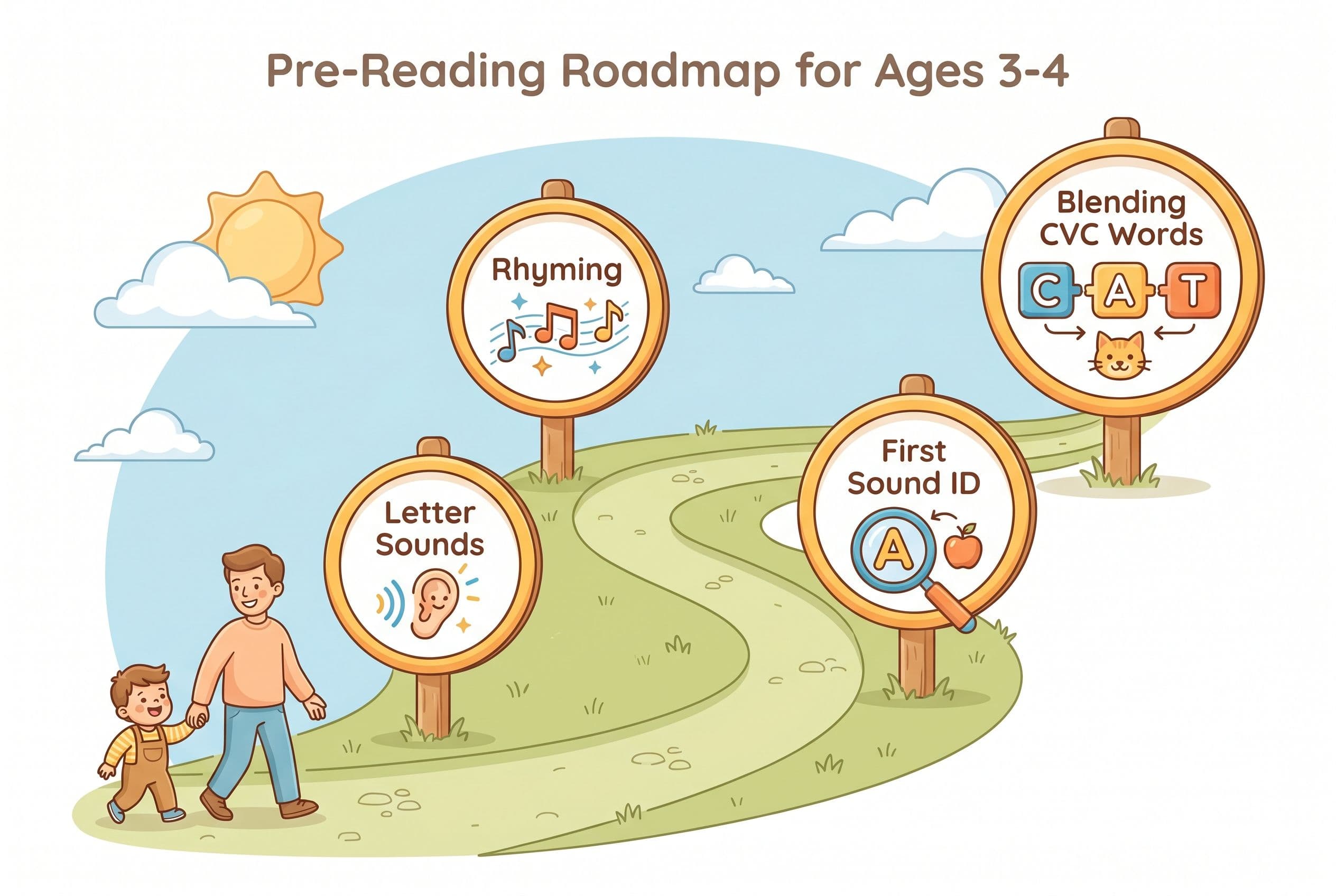
A legitimate phonics app for 3-year-olds needs to teach three things, in this order:
1. Letter-Sound Correspondence (Not Letter Names)
Your 3-year-old does not need to know the letter is "called" B. They need to know it says /b/. This is grapheme-phoneme correspondence — the foundational skill in systematic synthetic phonics and the basis of everything that comes after.
The Clackmannanshire study out of Scotland (Johnston & Watson, 2005) followed kids for seven years and found that children taught with synthetic phonics — starting with individual letter sounds — significantly outperformed kids taught with other methods. It's one of the most influential studies supporting synthetic phonics as a strong early approach, and the results held up over seven years of follow-up data.
If an app teaches the alphabet song before it teaches letter sounds, delete it.
2. Phonological Awareness Activities
Phonological awareness is the ability to hear and manipulate sounds in spoken language. Rhyming. Syllable clapping. Identifying first sounds in words. This is the auditory foundation that David Kilpatrick's research in Equipped for Reading Success (2016) identifies as the gateway to orthographic mapping — the process by which the brain permanently stores words for instant recognition.
At age 3, you're working on the big chunks: "Do 'cat' and 'bat' rhyme?" "What sound does 'mama' start with?" A good app drills this. A bad app skips it entirely because it's not as flashy as letter tracing.
3. Beginning Phonemic Awareness
This is the hard one. Phonemic awareness is a subset of phonological awareness — it's the ability to isolate individual sounds (phonemes) in words. "What's the first sound in 'sun'?" "/s/." "What's the last sound in 'cup'?" "/p/."
Most apps for 3-year-olds don't touch this because it's genuinely difficult to teach through a screen. But the apps that attempt it — even at a basic level — are the ones that actually prepare kids for blending and decoding CVC words at age 4.
Linnea Ehri's phases of word reading development (2005) describe the "pre-alphabetic" phase where kids have no letter-sound knowledge, and the "partial alphabetic" phase where they start connecting some letters to sounds. A strong pre-reading app for preschoolers should move a 3-year-old from pre-alphabetic into partial alphabetic territory. That's the goal.
OK, now let's talk apps.
The 5 Reading Apps I Actually Tested With My Kids
I used each of these apps for at least two weeks with my children. I watched every session. I noted what my kids retained the next day versus what vanished overnight. I'm ranking them from worst to best.
5. Homer (Formerly Homer Reading)
What it claims: Personalized reading program for kids ages 2-8.
What actually happens: Homer throws everything at the wall. There's some phonics, some sight words, some stories, some drawing activities. It's a buffet. And like most buffets, nothing is particularly excellent.
The phonics instruction exists, but it's buried under layers of stories and activities that don't reinforce the letter sounds your child just learned. My 4-year-old spent more time coloring within the app than practicing sounds. The progression isn't tight enough — it jumps around, introduces too many concepts at once, and relies heavily on picture-based context clues.
That picture-clue thing is a massive red flag. It's essentially the "three-cueing" strategy that Emily Hanford's 2023 APM Reports investigation Sold a Story exposed as the core failure of Balanced Literacy programs nationwide. If an app shows your kid a picture of a dog and asks "What word is this?" — your child isn't reading. They're guessing.
The verdict: Too scattered for a 3-year-old. Feels more like edutainment than instruction.
4. Starfall ABCs
What it claims: Free letter-sound instruction for young learners.
What actually happens: Starfall has been around forever, and honestly? It shows its age. But credit where it's due — it starts with letter sounds, not letter names. That's more than most apps do.
The problem is the pacing. The app lets kids tap through screens rapidly without demonstrating mastery. My daughter could blow through an entire letter module in 90 seconds without actually saying a single sound out loud. The app doesn't require verbal production — it just rewards tapping.
For a free app, it's not terrible. The animations connecting letters to their sounds are clear. But there's no phonological awareness component, no phonemic awareness work, and no adaptive difficulty. Every kid gets the same experience whether they've mastered /m/ or not.
The verdict: Fine as a free supplement. Not a standalone pre-reading app for preschoolers.
3. Endless Alphabet
What it claims: Teaches vocabulary and letter recognition through animated word puzzles.
What actually happens: OK, I need to be careful here because parents LOVE this app. And I understand why — the animations are charming, the monsters are funny, and kids genuinely enjoy dragging letters into place.
But here's my problem: Endless Alphabet teaches vocabulary, not reading. The letters make their sounds when you drag them, which is great. But the app is organized around whole words, not around a systematic phonics progression. A 3-year-old might learn the word "gargantuan" in this app before they can decode "cat." That's backwards.
There's no blending instruction. No phonological awareness. No sequenced letter-sound progression based on frequency or difficulty. It's a vocabulary app with phonics sprinkled on top.
The verdict: My kids love it. I let them use it for fun. But I don't count it as reading instruction.
2. Khan Academy Kids
What it claims: Free, comprehensive early learning app covering reading, math, and social-emotional development.
What actually happens: This one surprised me. Khan Academy Kids has a genuinely solid phonics strand that follows a logical sequence — letter sounds first, then blending, then simple CVC words. The instruction is explicit. The characters model sounding out instead of guessing. And the app includes phonological awareness activities like rhyming and alliteration.
The downside? It's embedded in a massive multi-subject app. A 3-year-old can easily wander from the phonics section into a math activity or a story that has nothing to do with letter sounds. You have to actively guide them to the reading content, which somewhat defeats the purpose of an independent learning tool.
Also, the phonics scope and sequence isn't as tight as a dedicated reading program. It's good. But it's not all it does, and that dilutes the intensity.
The verdict: Best free option by a mile. If you're supplementing structured phonics instruction, this is a strong pick. But it won't replace explicit, systematic teaching on its own.
1. Teach Your Kid to Read
What it claims: Systematic synthetic phonics app built on structured literacy principles, designed to take kids from zero to reading.
What actually happens: Real talk — I'm a co-founder of this app, so take my obvious bias into account. But I'm also going to tell you exactly WHY I helped build it, because the reason is the same frustration you're feeling right now.
I couldn't find a reading app that did what I was doing at the kitchen table with my kids. Every app either taught letter names instead of sounds, relied on picture guessing, lacked a systematic progression, or turned phonics into a passive tapping game. I wanted an app that taught the way the science says to teach: explicit, systematic, sequential, with multisensory engagement and no guessing.
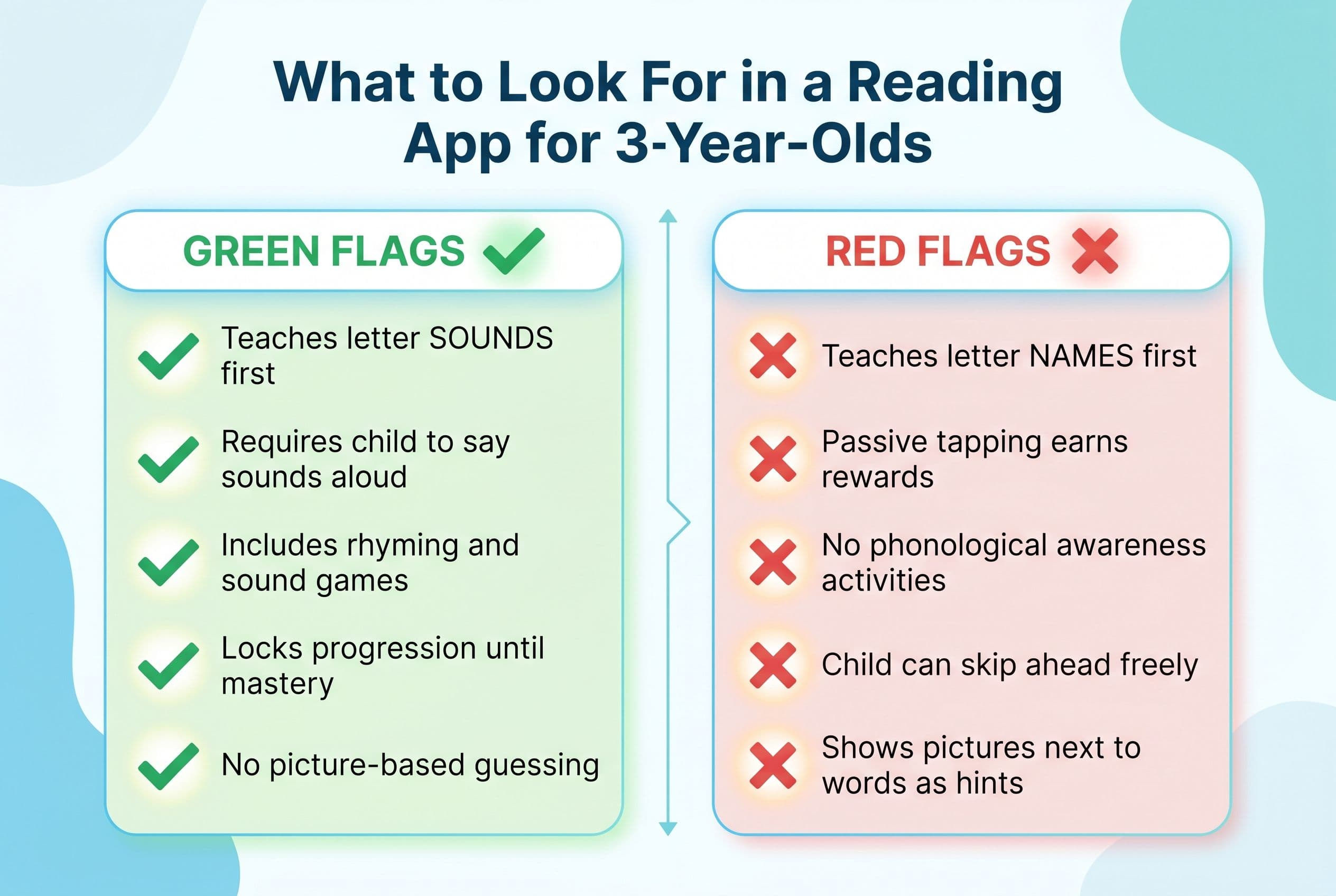
Here's what makes it different for 3-year-olds specifically:
- It starts with letter sounds, not letter names. Your child learns /m/, /s/, /a/, /t/ before they ever hear "em, ess, ay, tee."
- It requires sound production. The app doesn't just play sounds — it prompts your child to say the sound and models correct mouth formation.
- It includes phonological awareness drills. Rhyming, initial sound identification, syllable awareness — the auditory skills that Kilpatrick's research shows are non-negotiable for orthographic mapping.
- The progression is locked. Your child can't skip ahead without demonstrating mastery. No random tapping through screens. No accidental advancement.
- Zero picture guessing. Words are decoded through sounds, never guessed from illustrations.
I had my 4-year-old on this app starting at age 3, and by three months in she was blending CVC words. Not because she's a genius — because the app follows the same structured literacy principles I used with her older siblings: explicit instruction, cumulative sequencing, multisensory practice, and mastery at every step before moving on.
A Playground Conversation That Changed Everything
I was at a playground in Raleigh a few months ago and struck up a conversation with another mom while our kids climbed the monkey bars. She mentioned her son's school had just switched curricula — dropped Lucy Calkins and adopted a Science of Reading program because of North Carolina's SB 387, the Excellent Public Schools Act. She was confused and honestly kind of annoyed about it. "He was doing fine before," she told me.
So I asked her: can he read the word "splint"? Her son is in second grade. She pulled him over and showed him the word on my phone.
He could not read it.
He stared at it. He guessed "split." Then "spring." Then he looked at his mom for help. This is a second grader — a kid everyone thought was "doing fine" — who couldn't decode a one-syllable word with a consonant blend because he'd been taught to guess from context and pictures instead of sounding out letter by letter.
I spent twenty minutes on that playground bench explaining why the switch was happening. I told her about Emily Hanford's reporting. About the NAEP data. About Dehaene's brain imaging research proving that reading doesn't develop naturally — the brain has to be explicitly trained to map letters to sounds. I told her about the 40+ states that have passed Science of Reading legislation since 2019 because the old way was failing millions of kids.
She texted me at 11pm that night: "I had no idea. Why didn't anyone tell us this sooner?"
This is exactly why what you choose for your 3-year-old matters right now. That second grader's problems didn't start in second grade. They started when he was 3 and 4, learning to "read" through picture guessing and whole-word memorization instead of building letter-sound knowledge systematically. By the time anyone noticed, he was two years behind.
The best reading app for 3-year-olds isn't the flashiest one. It's the one that teaches your child to hear sounds, connect those sounds to letters, and eventually blend those sounds into words — without ever, ever guessing.
How to Use a Reading App With Your 3-Year-Old (The Right Way)
Even the best app in the world won't work if you use it wrong. And with a 3-year-old, there are some non-negotiable rules.
Step 1: Sit With Them
A reading app is not a babysitter. Period. At age 3, you sit next to your child for every session. You model the sounds. You make them repeat. You catch it when they tap randomly. This is active learning, not passive screen time.
I park my 4-year-old at the kitchen table, put the tablet on a stand, and sit right beside her with my coffee. Sessions last 10-15 minutes. That's it.
Step 2: Keep Sessions Short and Daily
10 minutes a day beats 45 minutes twice a week. Every time. The brain builds phonological pathways through consistent, repeated exposure — not marathon cram sessions. DIBELS benchmarks for mid-kindergarten expect 28+ correct letter sounds per minute, and you don't get there through sporadic practice.
We practice every single day. Birthdays. Christmas. Vacation. Tiger Rule #1: We Never Skip.
Step 3: Demand Sound Production
If your kid is silently tapping the screen, they're not learning phonics. They're learning to tap screens. Make them say the sound out loud. Every single time.
"What sound does this letter make?"
Wait.
Don't jump in. Let them think. Let them struggle for a few seconds. Then help if needed. But they have to produce the sound with their own mouth.
Step 4: Supplement the App With Offline Practice
The app is one tool. Not the whole toolbox. Back up what the app teaches with:
- Magnetic letters on the fridge. Have your child find the letter that makes /b/. Then /s/. Then /t/.
- Sound scavenger hunts. "Find something in this room that starts with /m/." My kids go nuts for this.
- Rhyming games in the car. "What rhymes with 'cat'?" This builds the phonological awareness that apps often underserve.
- Decodable books. Once your child knows 6-8 letter sounds, start with simple decodable readers. Flyleaf Publishing and High Noon Books make excellent ones. Avoid Fountas & Pinnell leveled readers — they're whole-language aligned and encourage guessing from pictures.
Step 5: Track Progress With a Real Assessment
Don't rely on the app's built-in progress tracker (though a good app should have one). Every 4-6 weeks, run a quick informal check:
- Can your child identify the sounds of all letters taught so far?
- Can they identify the first sound in a spoken word?
- Can they tell you if two words rhyme?
When your child is closer to age 4-5, you can use Kilpatrick's PAST (Phonological Awareness Screening Test) — it takes about 5 minutes and tells you exactly where the phonological breakdown is. It's free, and it's the gold standard.
What About Screen Time Concerns?
I hear this one constantly. "But Xia, the AAP says limited screen time for young children!"
Yes. And the AAP also distinguishes between passive screen consumption (watching YouTube videos of other kids opening toys) and active, educational screen use with adult co-viewing. A 10-minute phonics session where your child is actively producing sounds, with you sitting right there guiding them, is categorically different from handing them an iPad and walking away.
Do I love screens? No. Would I prefer to do everything with physical manipulatives and face-to-face instruction? Absolutely. And I do — the app supplements our hands-on phonics work, not the other way around.
But I'm also realistic. I have four kids. Sometimes the app buys me the structured practice repetition my 4-year-old needs while I'm helping my 7-year-old with her reading passage or keeping my 1-year-old from eating crayons. That's real life.
The bottom line: 10 minutes of systematic phonics instruction via app is infinitely better than zero minutes of phonics instruction because you couldn't find the time for a hands-on lesson.
The States Are Finally Getting This Right
Here's something that gives me hope. Mississippi passed the Literacy-Based Promotion Act in 2013, went all-in on Science of Reading, and climbed from 49th to 21st in national reading scores within six years. Colorado's READ Act requires evidence-based reading instruction. Ohio's Third Grade Reading Guarantee holds schools accountable. More than 40 states have passed Science of Reading legislation since 2019.
The tide is turning. Schools are finally moving away from the guessing-based methods that failed a generation of kids.
But here's the kicker: your 3-year-old isn't in school yet. You don't have to wait for the school system to catch up. You can start right now, at home, with the right app and 10 minutes a day.
That's the whole point of early intervention. The 2000 National Reading Panel report — the one Congress actually commissioned — found that systematic phonics instruction produces significant benefits for children in kindergarten through 6th grade. But the earlier you start building that letter-sound foundation, the smoother the transition into formal reading instruction.
You're not "pushing" your 3-year-old. You're giving them a head start on the single most important academic skill they'll ever develop.
Your 5-Minute Action Plan
- Tonight: Delete any app on your kid's tablet that teaches letter names before letter sounds or relies on picture guessing. You'll know it when you see it — if the app shows a picture of a dog next to the word "dog" and counts it as "reading," it goes.
- Tomorrow morning: Download a systematic phonics app. I obviously recommend Teach Your Kid to Read — it's what I built and what I use with my own children. But if you go with Khan Academy Kids (the free option), make sure you navigate directly to the phonics section and stay there.
- Set a daily alarm: 10 minutes. Same time every day. Non-negotiable. We do ours right after breakfast before the chaos of the day takes over.
- Sit with your child for every session. Make them say the sounds. Correct guessing immediately. Celebrate effort.
- In 4-6 weeks: Check progress. Can they produce 8-10 letter sounds from memory? Can they identify the first sound in spoken words? If yes, you're on track. If not, increase daily practice by 5 minutes and add more offline reinforcement.
Your 3-year-old's brain is ready for this. The question is whether you'll give them the right tool or the shiny distraction.
Choose the tool.
Frequently Asked Questions
Is 3 too young to start a reading app?
No — but the app has to match what a 3-year-old brain is developmentally ready for. At 3, you're building pre-reading skills: letter-sound correspondence, phonological awareness (rhyming, initial sounds), and print awareness. You're NOT expecting a 3-year-old to read sentences. The right learn-to-read app for a 3-year-old focuses on these foundational auditory and visual skills in short, engaging sessions. Linnea Ehri's research on reading development phases (2005) shows that children in the "pre-alphabetic" phase benefit enormously from early, systematic exposure to letter sounds.
How long should my 3-year-old use a reading app each day?
10-15 minutes maximum, with you sitting right beside them. This isn't about screen time quantity — it's about quality of interaction. Your child should be actively producing sounds, not passively tapping. I do one 10-minute session with my youngest every morning, then reinforce with offline activities (magnetic letters, rhyming games, sound hunts) throughout the day. Consistency matters more than duration.
What's the difference between a phonics app and a "reading readiness" app?
A phonics app teaches the explicit connection between letters and sounds using a systematic, sequential approach — this is what the Science of Reading research supports. A "reading readiness" app might teach letter names, shape tracing, vocabulary, or story comprehension without any structured phonics component. Reading readiness apps aren't harmful, but they're not sufficient on their own. Your 3-year-old needs an app that drills letter sounds and phonological awareness, not just exposure to books and alphabet songs. Look for apps built on structured literacy principles — explicit, cumulative, multisensory, and mastery-based.
Can an app really teach my child to read, or do I still need to teach them myself?
Both. An app is a tool, not a teacher. Even the best phonics app for 3-year-olds works best when a parent sits alongside the child, models correct sound production, corrects guessing, and reinforces skills offline. Think of the app as your structured curriculum — it provides the sequence, the practice, and the repetition. You provide the interaction, the encouragement, and the accountability. No app replaces a parent who says, "Don't guess — sound it out."
How do I know if the reading app is actually working?
Track three specific skills every 4-6 weeks: (1) How many letter sounds can your child produce from memory when you show them the letter? (2) Can they identify the first sound in a spoken word — "What sound does 'ball' start with?" (3) Can they tell you whether two words rhyme? If these numbers are growing, the app is working. If they're stagnant after 6+ weeks of daily use, switch apps or add more parent-guided offline practice. Once your child is closer to 4-5, Kilpatrick's PAST (Phonological Awareness Screening Test) gives you a detailed diagnostic in about 5 minutes — it's free and tells you exactly where the breakdown is happening.
Part of these guides

Xia Brody
Co-Founder, Teach Your Kid to Read
Mom of 4 who has successfully taught her kids to read. Currently in the trenches with her 4-year-old while her two oldest (10 and 7) devour books on their own. Passionate about phonics-based methods and building a lifelong love of reading.
Related Articles
Reading Apps for 4-Year-Olds: 6 Worth Trying in 2026
Most 'educational' reading apps for 4-year-olds are glorified cartoons with a phonics sticker slapped on. Here are 6 that actually teach your kid to read — and the red flags that tell you an app is wasting your child's time.
Read More →
Best Phonics App for a 3-Year-Old: 5 Tested & Compared (2026)
Most phonics apps for toddlers are glorified cartoons with a letter slapped on top. I tested 5 of the most popular ones with my own kids and ranked them by what actually matters: systematic phonics instruction, not flashy animations. Here's what I found.
Read More →
Reading Eggs vs ABCmouse for 5-Year-Olds: Best Pick
Choosing between Reading Eggs and ABCmouse? Here’s the no-fluff mom verdict on which app actually teaches a 5-year-old to read — and where both fall short.
Read More →