Best Reading App for 4-Year-Olds (Even with Zero Letter Knowledge)
The Best Reading App for a 4-Year-Old Who Doesn't Know Letters Yet
What You'll Learn
- Why most "top-rated" reading apps for preschoolers are glorified guessing games — and the one red flag that gives them away
- The exact skills your 4-year-old needs BEFORE letters even matter (hint: most parents skip this entirely)
- How a mom at a Raleigh playground helped me understand why so many parents don't realize their kid can't actually read
- A step-by-step action plan to go from zero letters to sounding out real words — using an app that follows the science
Your 4-Year-Old Doesn't Know Letters. Let's Talk About That.
I'm not going to tell you it's fine. I'm not going to pat you on the head and say "every child develops at their own pace" and send you on your way with a warm fuzzy feeling.
Your 4-year-old not knowing any letters is not a crisis — yet. But it IS a wake-up call. And if you're here searching for the best reading app for a 4-year-old, that tells me you already feel it in your gut: the clock is ticking.
Here's what I know from teaching four kids to read (my oldest two are fluent readers, my 4-year-old is currently in the thick of it, and my 1-year-old is busy eating board books — we'll get there). The difference between a kid who reads on time and a kid who falls behind is almost never intelligence. It's almost never "readiness." It's exposure. Instruction. Repetition.
And yeah — having the right app helps. But the wrong app? The wrong app is worse than no app at all.
The Tiger Truth: What Happens If You Do Nothing
Let me hit you with the numbers, because numbers don't care about your feelings.
Only 33% of 4th graders read at proficient level on the 2022 NAEP — that's the Nation's Report Card. One in three. The 2023 scores dropped another 3 points from 2019, the largest decline in 30 years.
Think about that. Two out of every three kids in America can't read well enough to learn from a textbook by 4th grade.
And here's the kicker: kids who can't read by 3rd grade are four times more likely to drop out of high school. That's from the Annie E. Casey Foundation's 2010 study, "Double Jeopardy." Four times. We're not talking about a slight disadvantage. We're talking about a life trajectory shift.
The 3rd Grade Cliff is real. Before 3rd grade, kids are learning to read. After 3rd grade, they're reading to learn. If your child hits that wall without decoding skills, every single subject — math word problems, science, social studies, all of it — becomes a mountain.
And the cost of catching up later? The average remedial reading program runs $10,000-$15,000 per year. Insurance doesn't cover it. Most school districts don't provide anything close to adequate intervention. You'll be fighting for services while your kid falls further behind.
Your 4-year-old is not in crisis today. But today is the cheapest, easiest, most painless day to start. Tomorrow it gets harder. Next year it gets expensive.
Why 90% of "Reading Apps" for Preschoolers Are Garbage
Real talk — I've downloaded and tested over 30 reading apps for preschoolers. My phone storage hates me. Most of them fall into one of three categories:
1. The Gamification Trap. These apps wrap a thin layer of letter recognition around an addictive game loop. Your kid earns coins, unlocks characters, and collects stickers. They play for 45 minutes and learn... maybe two letter names? The app developers know exactly what they're doing. Engagement metrics look great. Learning metrics are garbage.
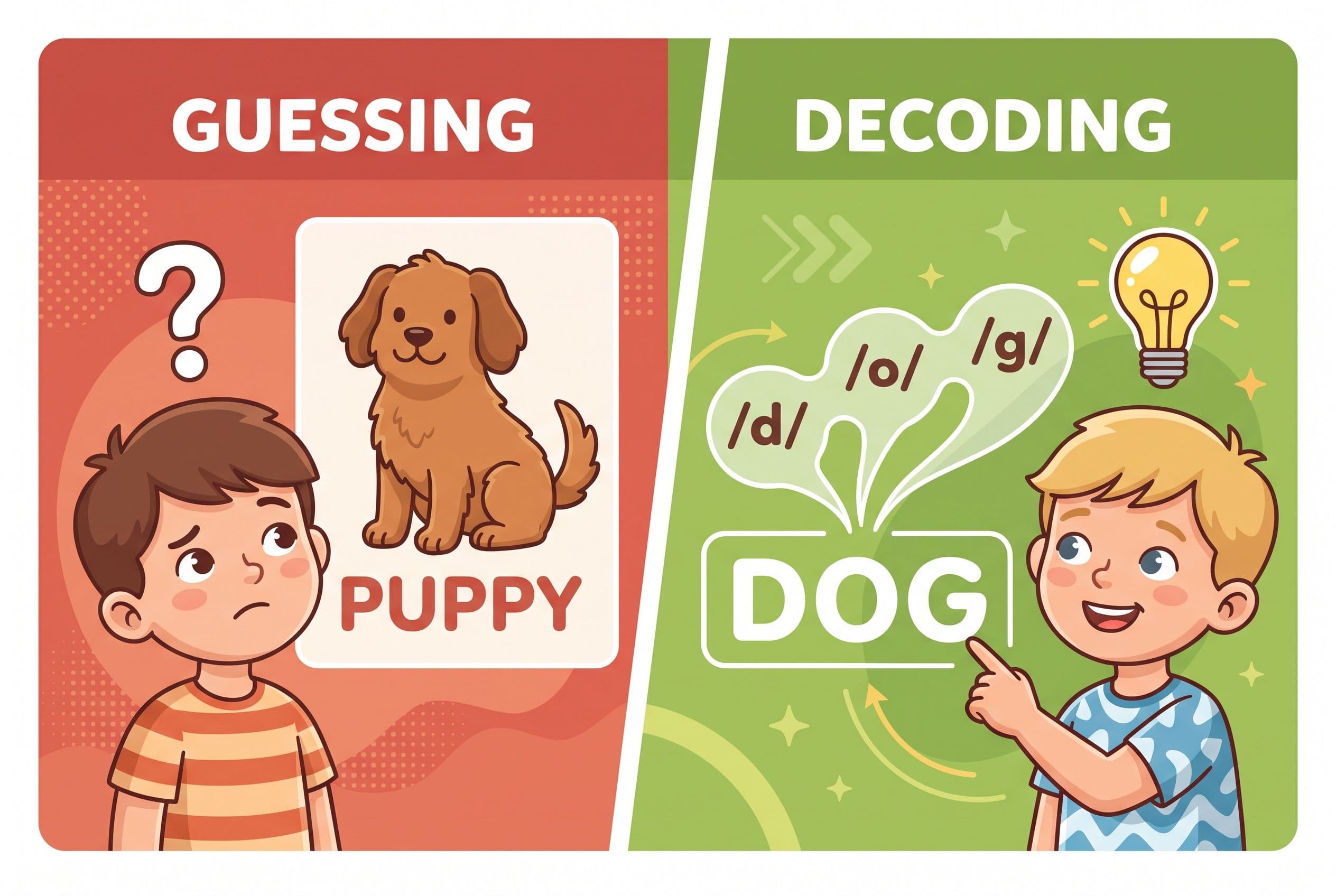
2. The Whole Language Hangover. Some apps still — in 2026! — use the three-cueing system. They show a picture of a dog and the word "dog" and call it "reading." Your kid memorizes the shape of the word or guesses from context. Stanislas Dehaene's research in Reading in the Brain (2009) showed definitively that the brain has to be TRAINED to decode text — it doesn't happen naturally through exposure, the way spoken language does. Apps that teach kids to look at pictures and guess are actively building bad habits.
3. The Random Letter Party. These apps teach letters in alphabetical order with no connection to phonics. Your kid learns A-B-C-D-E as letter names, sings the song, traces the shapes. Fine. But knowing that the letter is called "B" doesn't teach them that it makes the /b/ sound. And knowing isolated sounds without blending practice doesn't teach reading. It's like teaching someone the names of all the tools in a toolbox but never showing them how to build anything.
So what does the right pre-reading app for a 4-year-old actually look like?
What the Science Says a 4-Year-Old Actually Needs
Before I tell you about the app, let me tell you about the skill sequence. Because if you don't understand the sequence, you'll fall for marketing every time.
Linnea Ehri's phases of word reading development (from her 2005 meta-analysis) lay this out clearly. Your 4-year-old who doesn't know letters is in the pre-alphabetic phase. They might recognize the McDonald's logo or their own name written on their cubby, but they're not connecting letters to sounds. They're reading environmental cues, not text.
The goal isn't to jump from zero to reading sentences. The goal is to move them from pre-alphabetic to partial alphabetic — where they start mapping some letters to sounds and using that information to figure out words.
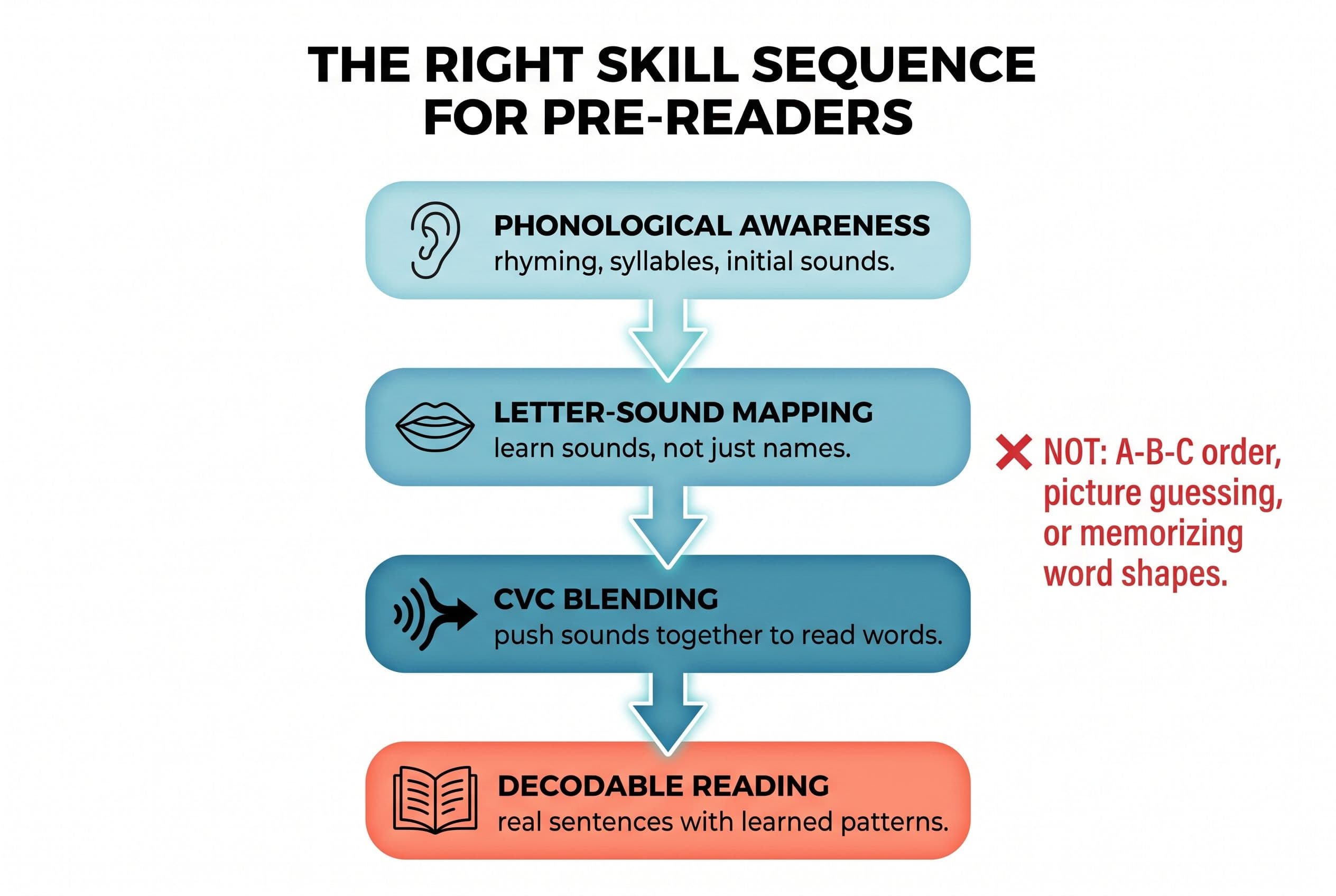
Here's the actual skill sequence your 4-year-old needs, backed by the National Reading Panel report and decades of research from the NICHD:
Step 1: Phonological Awareness — Then Phonemic Awareness (No Letters Required)
This is the hidden foundation most parents skip entirely. Before your kid touches a single letter, they need to hear and manipulate the sounds in spoken language.
Phonological awareness is the big umbrella — it covers larger sound chunks like syllables and rhyme:
- Can they clap syllables? ("wa-ter-mel-on" = 4 claps)
- Can they rhyme? ("Does 'cat' rhyme with 'hat'?")
But here's what most parents (and a lot of apps) miss: the piece that matters MOST for reading is phonemic awareness — working with individual sounds (phonemes) inside words. That's the level that directly drives decoding and spelling. You want your 4-year-old practicing things like:
- Identifying the first sound in a word: "What sound does 'mmmmom' start with?"
- Oral blending: "What word is /s/ /a/ /t/?" → "sat!"
- Segmenting: "Tell me the sounds in 'sun'" → /s/ /u/ /n/
- Deleting sounds: "Say 'map' without /m/" → "ap"
Phonemic awareness is the #1 predictor of reading success. Not IQ. Not vocabulary. Not how many books you've read to them. David Kilpatrick's Equipped for Reading Success (2016) breaks down the research on orthographic mapping — the process by which the brain permanently stores words — and it all starts with strong phonemic awareness.
A good reading app for a 4-year-old who doesn't know letters should spend SERIOUS time here — and not just on rhyming and syllables. It needs to get to the phoneme level.
Step 2: Letter-Sound Correspondence (Not Just Letter Names)
Once they can hear and play with sounds, THEN you introduce the letters that represent those sounds. And you introduce them in a strategic order — not A through Z.
Orton-Gillingham methodology (the gold standard, used by programs like Wilson Reading System and Barton Reading & Spelling) introduces high-utility letters first. You start with a small set — maybe s, a, t, p, i, n — because with just those six letters, you can build real words: sat, tap, pin, nap, sip, tan.
That's the whole point. You don't teach letters as isolated trivia. You teach them as tools for reading words.
Step 3: Blending (The Actual Act of Reading)
This is where the magic happens. Your kid sees s-a-t and pushes those three sounds together: /s/... /a/... /t/... "sat!" That's reading. Real reading. Not guessing from a picture. Not memorizing a word shape. Decoding.
A best-in-class phonics app for preschool builds this blending skill systematically, with tons of practice on CVC (consonant-vowel-consonant) words before introducing anything more complex.
The Playground Conversation That Changed a Mom's Mind
Let me tell you a story. I was at a playground in Raleigh a while back — one of those big wooden ones where you can actually sit down for five minutes because the kids are occupied — and I started chatting with another mom. Her son's school had just switched from Lucy Calkins' Units of Study to a Science of Reading curriculum because of North Carolina's SB 387, the Excellent Public Schools Act.
She was confused. A little annoyed, honestly. "He was doing fine before," she told me.
So I asked a simple question: can he read the word "splint"?
Her kid was in second grade. He could not.
He could read "the" and "was" and "like" because he'd memorized them as whole shapes. He could look at a picture of a tree and say "tree" when the word under it said "oak." He was using the three-cueing system — the approach Emily Hanford exposed in her APM Reports investigation Sold a Story — and his teachers genuinely believed he was reading.
But "splint"? No picture clues. No context. Just five sounds that need to be decoded left to right and blended together. He was stuck.
I spent twenty minutes on that playground bench explaining why the switch was happening. The Hanford reporting. The NAEP data. The neuroscience from Dehaene's lab showing the brain doesn't learn to read naturally like it learns to speak. She went home and watched the Sold a Story podcast that night. Texted me at 11pm: "I had no idea. Why didn't anyone tell us this sooner?"
That's why I'm telling YOU now. Your 4-year-old's blank slate is actually an advantage. You haven't built bad habits yet. You haven't spent two years teaching them to guess. You're starting fresh — and you can start right.
What Makes Teach Your Kid to Read Different
OK so let me lay this out plainly. I co-founded Teach Your Kid to Read because I couldn't find a learn-to-read app for age 4 that did all of the following:
It follows the actual science. Not the "looks sciencey" marketing. The real thing. Systematic synthetic phonics, built on Orton-Gillingham principles, aligned with Ehri's phases and the Simple View of Reading (Gough & Tunmer, 1986). Every lesson introduces sounds in a strategic sequence and builds blending skills from day one.
It starts where your kid IS — even if that's zero. If your 4-year-old doesn't know a single letter, the app doesn't shame them or skip ahead. It begins with phonological and phonemic awareness activities — rhyming, syllable counting, initial sound identification, oral blending, and segmenting — then introduces letter-sound correspondences in a carefully ordered sequence. Not A-B-C. More like s-a-t-p-i-n.
It never lets your kid guess. This one drives me crazy about other apps. If a kid gets stuck, most apps either give them the answer or show them a picture hint. Both are terrible. Our app teaches the skill of sounding out. Every word is decodable based on patterns they've already learned. No guessing. No picture cues. No three-cueing garbage.
It's a lesson, not a dopamine slot machine. There are no coins. No avatar shops. No mini-games that have nothing to do with reading. The reward is reading a word. Sounds boring? Tell that to my 4-year-old who literally cheered last Tuesday when she blended "map" for the first time at our kitchen table. The app mirrors that experience — short, focused, satisfying.
It gives YOU the parent a dashboard. You can see exactly what sounds your kid has mastered, where they're struggling, and what's coming next. No guessing on your end either.
Your Action Plan: Zero Letters to Sounding Out Words
Here's exactly how I'd use a reading app with a 4-year-old who's starting from scratch. This is what I'm doing with my own daughter right now.
Week 1-2: Phonological & Phonemic Awareness Boot Camp
- Spend 5-10 minutes a day on listening skills. Use the app's phonological awareness module. Start with rhyming and syllable clapping, but move quickly to phoneme-level work — oral blending ("What word is /p/ /i/ /n/?"), segmenting ("Tell me the sounds in 'cup'"), and initial sound identification.
- Do it at the same time every day. We do ours right after lunch, before quiet time. My 4-year-old knows it's coming. It's non-negotiable — we never skip. Birthdays, vacation, doesn't matter.
- Don't introduce letters yet. I know it's tempting. Resist. You're building the ear before you build the eye.
Week 3-4: First Letter-Sounds
- Introduce 2-3 letter-sounds per week. Start with s, a, t. The app will guide this sequence.
- Teach the SOUND, not the name. It's not "ess" — it's /s/. Not "ay" — it's /a/ (short a, as in "cat"). This distinction matters enormously.
- Practice writing alongside the app. Get a whiteboard. Have your kid trace the letters while saying the sound. Multisensory is the Orton-Gillingham way. Eyes, ears, and hands all at once.
Week 5-6: Blending CVC Words
- Start blending as soon as they know 4-6 sounds. With s, a, t, p, i, n your kid can read: sat, tap, pin, nap, sip, pan, tan, nip, snap, spin... the list goes on.
- Use the app's blending exercises daily. Start with continuous blending (/ssssaaaat/) before discrete blending (/s/ /a/ /t/).
- Read decodable books for decoding practice — not predictable/leveled readers. Predictable leveled readers (like many Fountas & Pinnell texts) rely on repetitive patterns and picture cues, which trains kids to guess instead of decode. For decoding practice, use decodable readers from publishers like Flyleaf Publishing or High Noon Books, or the decodable stories built into the app. (Leveled books can still be great for read-alouds or independent reading later, once decoding skills are solid.)
Week 7+: Add More Sounds, Keep Building
- Introduce 2-3 new letter-sounds per week. The app sequences these automatically.
- Review mastered sounds every session. Quick drill. 30 seconds. Non-negotiable.
- Benchmark check: By the time your kid has 8-10 months of consistent practice, aim for them to identify letter-sounds with automaticity. If you want a formal check, Kilpatrick's PAST (Phonological Awareness Screening Test) takes about 5 minutes and tells you exactly where any phonological breakdown is.
The Tiger Rules
- We Never Skip. Five minutes a day, every day. Consistency beats intensity.
- No Guessing. If your kid looks at a picture and guesses the word, cover the picture. Sound it out. Always.
- Celebrate Decoding. When your kid sounds out a word correctly, lose your mind. High-five. Dance. Make it a big deal. Because it IS a big deal.
How to Know If Your Reading App Is Actually Working
Here are rough targets I use, based on what I've seen with consistent app use (5-10 minutes a day, 5-6 days a week, starting from zero letter knowledge). These aren't standardized benchmarks carved in stone — they're more like green/yellow/red flags to help you gauge whether things are on track:
🟢 After 1 month (green flag): Your 4-year-old can identify initial sounds in spoken words ("What does 'mmmouse' start with?" → /m/) and knows 3-6 letter-sounds.
🟢 After 3 months (green flag): They can blend 2-3 sound CVC words with support (s-a-t → sat). They know 10-15 letter-sounds.
🟡 Yellow flag: If they're doing daily practice and can't identify any initial sounds after 6 weeks, or can't blend any CVC words after 4 months — don't panic, but don't ignore it either. That's a signal to dig deeper.
🟢 After 6 months (green flag): They're blending CVC words independently and starting to read simple decodable sentences ("The cat sat on the mat").
🟢 After 12 months (green flag): They're reading decodable books with consonant blends and digraphs, and some kids will be starting on long vowel patterns. (Some won't be there yet — and that's OK if the trajectory is solid.)
Every kid's timeline is different — I want to be clear about that. My oldest flew through the CVC stage in about six weeks. My second kid needed three months on the same material. Both are strong readers now. The speed doesn't matter. The consistency does.
🔴 Red flag: If your 4-year-old isn't making any measurable progress after 2-3 months of consistent daily practice, that's not a reason to spiral — it's a reason to investigate. Ask your pediatrician about a developmental screening. Look into whether your state offers free early intervention. Mississippi's Literacy-Based Promotion Act of 2013 proved that early, systematic intervention works at scale — they went from 49th to 21st in national reading scores in six years. The 40+ states that have passed Science of Reading legislation since 2019 are trying to replicate that success.
Don't wait and see. Waiting is the most expensive thing you can do.
"But He's Only 4 — Isn't This Too Early?"
I hear this one constantly. Let me be blunt.
Reid Lyon from the NICHD testified before Congress that 38% of fourth graders can't read at a basic level. Not proficient — basic. The research from his team consistently showed that early intervention (before age 6) resolves reading difficulties in the vast majority of kids. Wait until age 8 or 9? The success rate of intervention drops dramatically.
Your 4-year-old doesn't need to be reading chapter books. Nobody's saying that. But teaching them letter-sounds, building phonological and phonemic awareness, and starting to blend simple words? That's not "too early." That's exactly on time.
Louisa Moats said it best in her 1999 paper Teaching Reading IS Rocket Science for the American Federation of Teachers: reading is not natural. It requires explicit, systematic instruction. The idea that kids will "pick it up when they're ready" is a myth that has held back millions of children.
You're not pushing too hard. You're giving your kid a foundation.
Frequently Asked Questions
What if my 4-year-old resists the app or gets frustrated?
Keep sessions SHORT. Five minutes. That's it. I set a timer on my phone. When it goes off, we're done — even if we're mid-activity. This does two things: it prevents meltdowns, and it leaves your kid wanting more. If they're genuinely distressed (not just mildly annoyed — there's a difference), drop back to an easier level. Make sure they're getting lots of success. A 4-year-old needs to feel competent. Get that win ratio up — about 80% success, 20% challenge.
Is screen time for a reading app OK for a 4-year-old?
The American Academy of Pediatrics distinguishes between passive screen time (watching random YouTube videos) and interactive educational screen time. A structured reading app where your kid is actively responding, sounding out, and practicing falls in the interactive category. That said — don't hand them the tablet and walk away. Sit with them. Model the sounds. Add the multisensory piece (tracing letters on a whiteboard or in sand). The app is a tool, not a babysitter.
My kid knows the ABC song but can't identify individual letters. Where do we start?
The ABC song teaches letter ORDER, not letter recognition or sounds. It's basically useless for reading. (Sorry, "Sesame Street.") Start at the beginning of the app's sequence — phonological awareness activities first, then letter-sound correspondence. Don't assume that singing the song means they have any letter knowledge. Test it: point to random letters out of order and ask your kid to name them. You'll probably be surprised.
How is Teach Your Kid to Read different from apps like Homer or Khan Academy Kids?
Homer and Khan Academy Kids are well-made apps with solid production values, but they mix reading instruction with a lot of other content (math, creativity, social-emotional learning) and their reading approach isn't purely systematic synthetic phonics. Teach Your Kid to Read does one thing: teach your kid to read. It follows a strict Orton-Gillingham-aligned scope and sequence, uses only decodable text (no guessing from pictures), and builds phonological awareness before introducing letters. It's the reading app I built because I couldn't find one that matched what the science actually says.
Should I also be reading aloud to my 4-year-old, or does the app replace that?
Both. Always both. Reading aloud builds vocabulary, background knowledge, listening comprehension, and a love of stories — all things that feed into the "language comprehension" side of Scarborough's Reading Rope. The app builds the "word recognition" side — phonological awareness, decoding, sight recognition. You need both strands for skilled reading. I read to all four of my kids every night. It's not either/or. It's and.
The Bottom Line
Your 4-year-old who doesn't know letters isn't behind — but they will be if you wait another year and hope the problem solves itself. The best reading app for a 4-year-old isn't the one with the cutest characters or the most five-star reviews from parents who confuse "my kid loves playing it" with "my kid is learning to read."
The best app teaches sounds before letter names. It builds phonological awareness first. It follows a systematic, research-backed scope and sequence. It never lets your kid guess. And it gives you, the parent, visibility into what's actually happening.
That's what we built with Teach Your Kid to Read. Because I was that mom searching for a pre-reading app for my 4-year-old and coming up empty.
Start today. Five minutes. One lesson.
Ready to start? Download Teach Your Kid to Read at [TeachYourKidToRead.org] or call us at (407) 707-6850 if you have questions. We'll help you build a plan.
Part of these guides

Xia Brody
Co-Founder, Teach Your Kid to Read
Mom of 4 who has successfully taught her kids to read. Currently in the trenches with her 4-year-old while her two oldest (10 and 7) devour books on their own. Passionate about phonics-based methods and building a lifelong love of reading.
Related Articles
Reading Apps for 4-Year-Olds: 6 Worth Trying in 2026
Most 'educational' reading apps for 4-year-olds are glorified cartoons with a phonics sticker slapped on. Here are 6 that actually teach your kid to read — and the red flags that tell you an app is wasting your child's time.
Read More →
Best Reading App for a 4-Year-Old with Dyslexia Signs: My Top Pick
If your 4-year-old mixes up sounds, guesses from pictures, or avoids letters, don’t wait and see. Here’s my tiger-mom ranking of reading apps that help — and the ones I’d skip.
Read More →
Best Phonics App for a 3-Year-Old: 5 Tested & Compared (2026)
Most phonics apps for toddlers are glorified cartoons with a letter slapped on top. I tested 5 of the most popular ones with my own kids and ranked them by what actually matters: systematic phonics instruction, not flashy animations. Here's what I found.
Read More →