Best Phonics App for a 4-Year-Old: 5 Tested & Compared (2026)
What You'll Learn
- Why 90% of "phonics" apps actually teach kids to guess — and the one red flag that gives it away in under 30 seconds
- The 5 phonics apps I tested with my own 4-year-old and how each one stacks up against real reading science
- What a phonics app must include to actually teach your preschooler to read (most parents don't know this)
- The exact daily routine I use to pair app time with real phonics instruction — so screen time stops being wasted time
The Problem Nobody Wants to Talk About
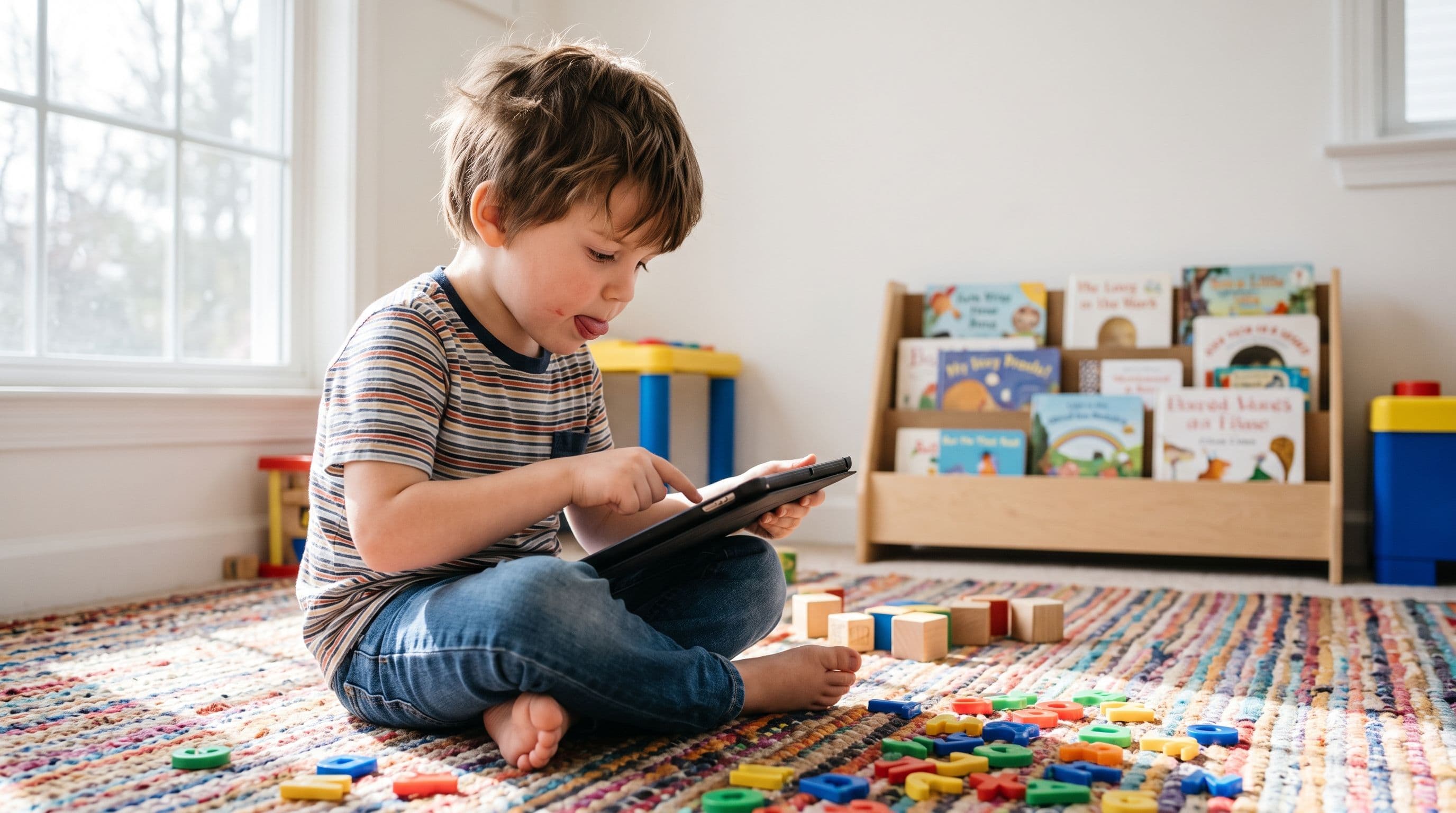
Your 4-year-old is tapping a glowing tablet and a cartoon monkey is clapping every time they pick the right banana. They're "learning phonics." Or so the App Store description told you.
Here's the truth: most phonics apps for preschoolers aren't teaching phonics at all. They're teaching pattern recognition, picture matching, and good old-fashioned guessing — the exact habits that will torpedo your kid's reading later.
I know because I've been there. When my oldest was 4 (she's 10 now), I downloaded every learn-to-read app age 4 crowd was raving about in the mommy Facebook groups. She could "pass" every level. She could not read the word "mat."
That's when I got serious.
The Tiger Truth: What Happens If You Pick the Wrong App
Let me scare you a little. On purpose.
The 2022 NAEP — the Nation's Report Card — showed that only 33% of 4th graders read at a proficient level. One in three. The 4th-grade reading average scale score dropped significantly between 2019 and 2022, marking one of the steepest declines in the assessment's history.
Kids who can't read by the end of 3rd grade are at dramatically higher risk of dropping out of high school. The Annie E. Casey Foundation's widely cited 2010 report estimated these students were four times more likely to leave school without a diploma — and while that specific figure involves correlation rather than direct causation, the link between early reading failure and later outcomes remains one of the most consistent findings in education research.
So when you hand your 4-year-old a "phonics app" that's really just a matching game with letter stickers, you're not just wasting $4.99 a month. You're burning the window when their brain is most primed to learn grapheme-phoneme correspondences — the actual skill that makes reading possible.
Stanislas Dehaene, the French neuroscientist who wrote Reading in the Brain (2009), and other reading researchers have shown that the brain repurposes visual and language networks for reading — and most kids learn best when decoding is taught explicitly and systematically. Reading isn't like talking. A child won't just "pick it up" from exposure to letter-shaped cookies and a monkey app. For the vast majority of children, the neural circuitry for reading has to be built through systematic, explicit instruction.
That means the app you choose actually matters.
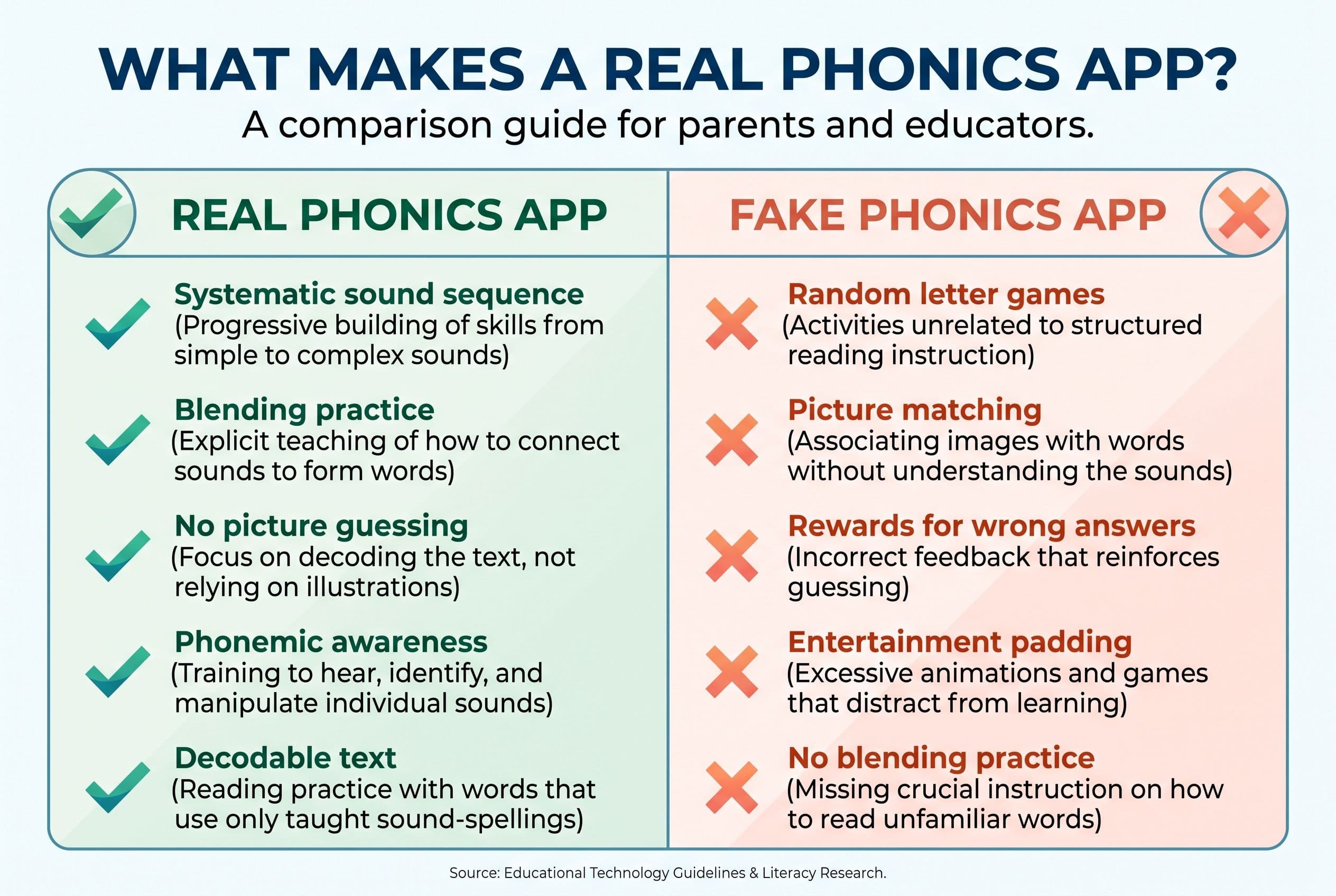
What a Real Phonics App Must Do (Non-Negotiable Checklist)
Before I get into the 5 apps I tested, here's my filter. If a phonics app for a 4-year-old doesn't hit these criteria, I delete it. No second chances.
1. Systematic, sequential phonics instruction. Not random letter activities. The app must teach sounds in a logical order — a common progression starts with single consonants and short vowels, then moves to blending, then digraphs, then long vowels. This aligns with structured literacy and Orton-Gillingham-style instruction: explicit, systematic, and cumulative sequencing. It's what the National Reading Panel recommended in their 2000 report.
2. Blending practice, not just letter identification. Knowing that B says /b/ is step one. Blending /b/ + /a/ + /t/ into "bat" is the actual skill. If the app never asks your kid to blend sounds into words, it's not a reading app. It's a letter-naming app.
3. Decodable words, not picture cues. Imagine your kid sees a picture of a dog next to the word "dog" and taps it. Did they read the word? No. They read the picture. A real phonics app strips away picture cues during decoding practice. This is the "No Guessing" rule I enforce at my kitchen table, and I expect an app to enforce it too.
4. No rewarding wrong answers. Some apps give you a star just for trying. That's participation-trophy literacy. If my kid taps the wrong letter, I want the app to say "try again" — not shower her with confetti.
5. Phonemic awareness built in. Before a child can map sounds to letters, they need to hear and manipulate sounds in spoken words. Does the app include segmenting? Blending spoken sounds? Rhyming? David Kilpatrick's research in Equipped for Reading Success (2016) makes it clear: phonemic awareness is the engine of orthographic mapping — the process that lets kids store words permanently in memory. An app that skips this is building on sand.
The 5 Phonics Apps I Actually Tested (2026)
Here's what I did. I sat down with my 4-year-old, Mei, over the course of three weeks and ran each of these apps for at least 5 sessions. I watched her like a hawk. Did she guess? Did she sound out? Did she get frustrated or bored? Did she actually learn anything transferable — meaning, could she read the same words in a book afterward?
I also cross-referenced each app against Linnea Ehri's phases of word reading development (pre-alphabetic, partial alphabetic, full alphabetic, consolidated) from her 2005 meta-analysis. A 4-year-old should be moving from pre-alphabetic to partial alphabetic — learning that letters represent sounds and starting to use that knowledge to decode simple words.
Here's how they ranked.
1. Teach Your Kid to Read App — The One I Actually Use
The verdict: This is the one.
Full disclosure — I co-founded TeachYourKidToRead.org, so yes, I'm biased. But I'm biased because I helped build this thing based on the exact Science of Reading principles I've been ranting about for years, and I watched it work with my own kids.
Here's what makes it different from everything else on this list:
- Systematic synthetic phonics built on Orton-Gillingham principles. Sounds are taught in a specific, research-backed sequence. Not random.
- Real blending practice. Your kid doesn't just tap letter B and hear /b/. They blend /s/ + /a/ + /t/ and read "sat." Then they read it in a decodable sentence.
- No picture guessing. During decoding, the word stands alone. Your kid has to use the sounds. Period.
- Phonemic awareness activities built into every lesson — segmenting, blending, sound isolation.
- Short sessions designed for 4-year-old attention spans. We're talking 10-15 minutes, not 45.
When I tested it with Mei, she went from recognizing about 10 letter sounds to blending 3-sound CVC words in under two weeks. Not because she's a genius (although obviously she is — tiger mom privilege). Because the app doesn't let her skip steps or guess.
The kicker: after each app session, I'd pull out Bob Books Set 1 and have her read a few pages. The Teach Your Kid to Read app was the only one where her app practice directly transferred to reading real books. That's the whole point.
2. HOMER Reading
Good content library, but the phonics instruction is a mess.
HOMER has beautiful illustrations and a massive story library. My kids enjoy it. But when I watched Mei do the "phonics" activities, she was mostly tapping pictures that started with a certain letter. That's phonological awareness at best, and picture matching at worst.
The blending practice is minimal. The app jumps between phonics, stories, and "creativity" activities with no systematic sequence I could identify. It felt like a buffet — lots of options, no progression.
HOMER is a fine read-aloud supplement. As a phonics app for a 4-year-old who needs to learn to decode? It's not structured enough.
Grade: B- for engagement, D+ for phonics instruction.
3. Khan Academy Kids
Free and solid, but it's a general learning app — not a phonics program.
Khan Academy Kids is honestly impressive for free. The letter-sound activities are decent, and they do include some blending. But it's a preschool learning app that covers math, social-emotional skills, and a bunch of other stuff. Phonics is one slice of a big pie.
The sequence isn't tight enough for serious phonics instruction. Mei would do one phonics activity, then the app would route her to a counting game, then a drawing activity. By the time she looped back to letters, she'd forgotten what she practiced 20 minutes ago.
If you can't afford a paid app, Khan Academy Kids is your best free option. But pair it with a structured phonics curriculum like UFLI Foundations or Explode the Code workbooks, or you'll have gaps.
Grade: B for overall quality, C for phonics as a standalone.
4. Hooked on Phonics
The OG. Still decent, but showing its age.
Hooked on Phonics has been around since I was a kid (the commercials are burned into my brain). The app version follows a systematic sequence and does include blending and decodable stories. That puts it ahead of most competitors right there.
But here's my issue: the app leans heavily on songs, videos, and entertainment padding. For every 2 minutes of actual phonics instruction, there's 3 minutes of cartoon celebration. My 4-year-old loved the songs. She also started skipping the decoding parts to get to the next video.
The decodable readers inside the app are solid. If your kid will sit through the fluff to get to the meat, it works. But I found myself wanting to yell "SKIP THE SONG AND READ THE WORD" about 40 times per session.
Grade: B for phonics content, C+ for efficiency.
5. ABCmouse
The worst offender on this list. I'm sorry. (I'm not sorry.)
ABCmouse is the app every parent has tried and every reading specialist quietly hates. It's a giant digital playground with thousands of activities, most of which have nothing to do with learning to read.
The "phonics" activities are mostly letter identification and picture matching. I watched Mei tap the picture of an apple next to the letter A for the fourth time in a row and she still couldn't tell me what sound A makes when it's in the middle of a word like "cat."
There's no systematic phonics sequence. There's no real blending instruction. There's no decodable text. It's Whole Language in a shiny app wrapper, and it drives me absolutely crazy.
I know ABCmouse has won awards. I know it has millions of subscribers. I don't care. If your goal is "my kid needs to learn to read," this app won't get you there.
Grade: A for marketing, F for phonics instruction.
The Quick Comparison
| App | Systematic Phonics | Blending Practice | No Picture Guessing | Phonemic Awareness | Decodable Text | Overall |
|---|---|---|---|---|---|---|
| Teach Your Kid to Read | ✅ | ✅ | ✅ | ✅ | ✅ | A+ |
| HOMER | ❌ | Minimal | ❌ | Some | ❌ | C+ |
| Khan Academy Kids | Partial | Some | ❌ | Some | ❌ | B- |
| Hooked on Phonics | ✅ | ✅ | Mostly | Minimal | ✅ | B |
| ABCmouse | ❌ | ❌ | ❌ | Minimal | ❌ | F |
Why This Matters More Than You Think (A Playground Story)
I was at a playground in Raleigh last spring when another mom started chatting me up. Her son's school had just switched from Lucy Calkins' Units of Study to a Science of Reading curriculum because of North Carolina's SB 387 — the Excellent Public Schools Act. She was confused and honestly kind of annoyed. "He was doing fine before," she told me, shaking her head.
I asked if her kid could read the word "splint." He was in second grade. He could not. He looked at it and guessed "split." Then "spent." Then he just said "I don't know" and ran back to the slide.
I spent 20 minutes on that playground bench explaining why the switch was happening — Emily Hanford's Sold a Story investigation that blew the lid off Balanced Literacy, the NAEP data showing a generation of kids who can't read, the neuroscience from Dehaene's lab showing that the brain has to be explicitly taught to decode text. Her son hadn't been "doing fine." He'd been memorizing words from picture cues and context clues, and the whole system had been telling her that was reading.
She went home and listened to the Sold a Story podcast that night. Texted me at 11pm: "I had no idea. Why didn't anyone tell us this sooner?"
Here's why I'm telling you this in an article about phonics apps: the same guessing strategies that failed that second-grader are baked into most of the "phonics" apps you're downloading for your 4-year-old right now. Picture cues. Context clues. Matching games disguised as reading instruction.
The app you choose at age 4 sets the trajectory. Pick one that teaches real decoding — systematic, explicit, no guessing — and you're building the foundation that prevents that playground conversation from being about your kid.
My Daily Routine: How I Use the App With My 4-Year-Old
An app alone won't teach your kid to read. I don't care how good it is. It's a tool, not a teacher. Here's exactly how I use Teach Your Kid to Read with Mei every day.
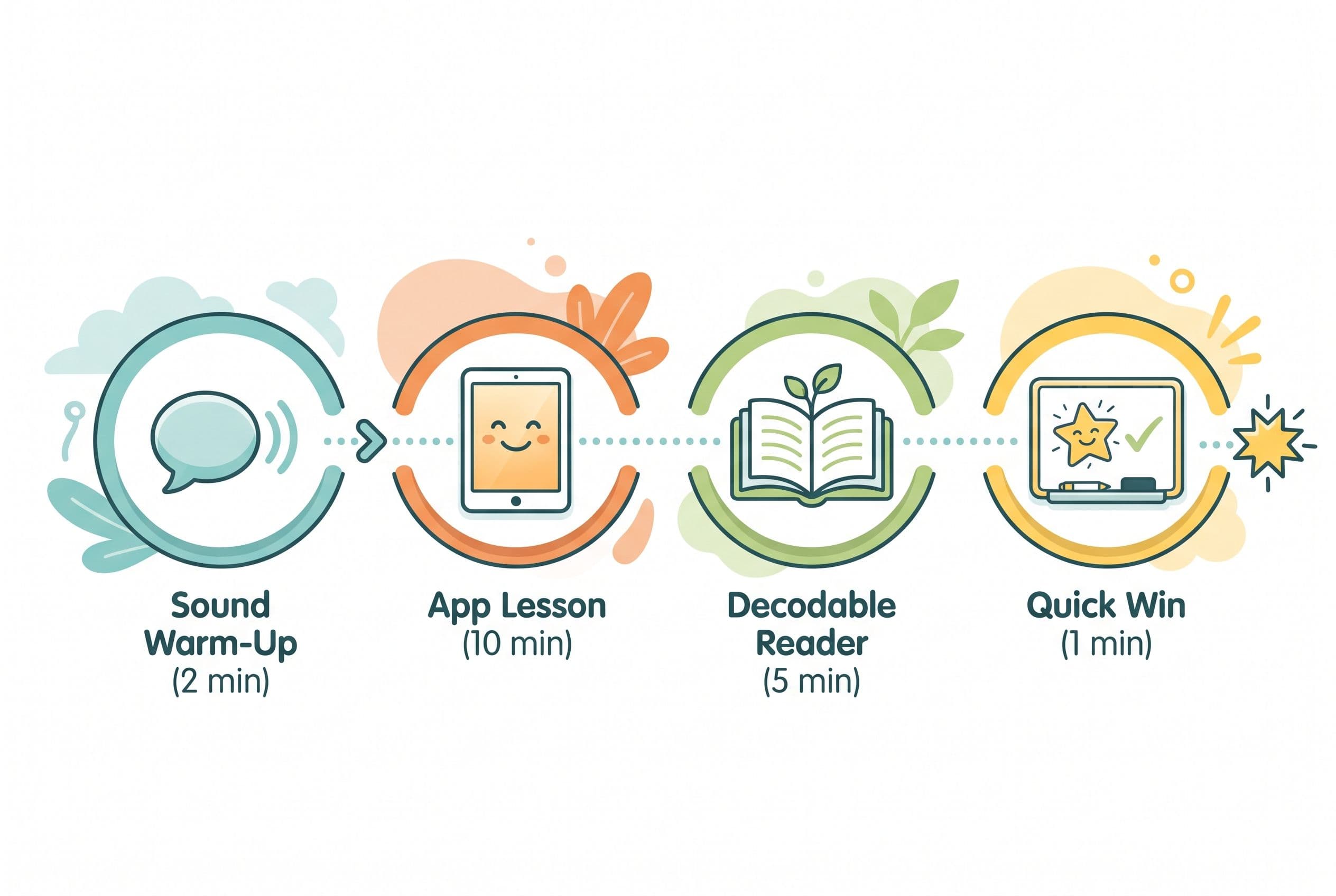
Step 1: Phonemic awareness warm-up (2 minutes, no screen) Before we even touch the tablet, I do quick oral activities. "What's the first sound in 'map'?" "/m/!" "Change the /m/ to /t/ — what word?" "Tap!" This builds the sound-manipulation skills Kilpatrick's PAST (Phonological Awareness Screening Test) measures — and it takes literally 2 minutes at the breakfast table.
Step 2: App lesson (10-12 minutes) Mei does one lesson in Teach Your Kid to Read. I sit next to her. Not across the room scrolling my phone — next to her. When she gets stuck, I don't tap for her. I say "What sound does that letter make?" and wait.
Step 3: Real book practice (5-8 minutes) I pull out a decodable reader — currently we're in Bob Books Set 1, Book 4 — and she reads it to me. This is where the transfer happens. If she can read the same phonics patterns on paper that she just practiced in the app, I know the app is working.
Step 4: One quick win (1 minute) I write a CVC word on our kitchen whiteboard — something she can decode — and she reads it. High five. Done.
Total time: about 20 minutes. We do this every day. Birthdays, holidays, Saturdays. We never skip. That's the tiger rule.
Standard early literacy benchmarks (like those in DIBELS/Acadience) expect kids to quickly produce letter sounds and blend CVC nonsense words by mid-kindergarten. Mei isn't there yet — she's 4 and has months before kindergarten — but she's trending in the right direction because we're consistent.
The "Fun" Trap: Why Entertainment ≠ Education
Look, I get it. Your 4-year-old doesn't want to drill phonics. They want to watch the cartoon monkey dance. And every app developer knows this, which is why they pack their apps with animations, songs, reward systems, and mini-games that have absolutely nothing to do with reading.
Here's my unpopular opinion: a phonics app doesn't need to be "fun" in the Disney sense. It needs to be effective. And the real fun comes when your kid reads their first word independently and their face lights up like a Christmas tree.
Mark Seidenberg — the University of Wisconsin cognitive scientist who wrote Language at the Speed of Sight (2017) — called out the entire education establishment for prioritizing engagement over instruction. The same principle applies to apps. An app that's 80% entertainment and 20% phonics isn't a phonics app. It's a game with letter decorations.
Mei doesn't love every minute of phonics practice. Sometimes she whines. Sometimes she tries to negotiate for "just the fun parts." I don't budge. And two weeks ago, she read the sentence "The cat sat on a mat" by herself for the first time, turned to me, and said "Mama, I can READ."
That's the fun. That's the real reward.
What About Kids Who Might Have Dyslexia?
If your 4-year-old is struggling significantly with letter-sound associations — like, they've practiced the sound for /s/ twenty times and still can't remember it tomorrow — don't panic, but don't ignore it either.
About 5-10% of children have dyslexia, and early identification is everything. The International Dyslexia Association recommends screening by age 5, but you can start watching for red flags now:
- Difficulty rhyming
- Can't segment a word into its individual sounds ("Say 'cat' without the /k/" — they can't do it)
- Family history of reading difficulties
- Trouble remembering letter names even after repeated practice
If you're seeing these signs, a phonics app alone won't be enough. You'll want a structured literacy program like Barton Reading & Spelling or the Wilson Reading System — both are Orton-Gillingham-based and designed for kids who need more intensive, multisensory instruction.
But here's the thing — the right phonics app can be your first line of defense. An app that uses systematic synthetic phonics with explicit blending instruction (like Teach Your Kid to Read) gives your kid the same type of instruction that intervention programs use. You're not replacing a specialist, but you're giving your kid a massive head start while you figure out next steps.
Don't Wait for School to Teach This
Mississippi passed the Literacy-Based Promotion Act in 2013 and made one of the largest NAEP 4th-grade reading gains of any state over the following years. As of 2024, over 40 states have passed some form of Science of Reading legislation (the Education Commission of the States tracks these). Schools are finally waking up.
But "finally" is the key word. Your 4-year-old doesn't have time to wait for their school to figure it out. And if they're not in school yet? Even better — you have a clear runway to build the foundation before anyone else touches their reading instruction.
A solid phonics app for your 4-year-old isn't a "nice to have." It's the first brick in a wall that protects them from the 3rd Grade Cliff, from remediation that costs $10,000-$15,000 a year (and insurance doesn't cover it), from the loss of confidence that comes when every other kid in class can read and they can't.
Start now. Be picky about which app you choose. And for the love of literacy, make sure it teaches real phonics — not the dressed-up guessing game that failed an entire generation of kids.
Frequently Asked Questions
What age should a child start using a phonics app?
Most kids are ready for structured phonics app instruction between ages 3.5 and 4.5. By this age, they should be able to recognize some letters, hold a tablet, and focus for 10-15 minutes. But the app needs to match their developmental level — start with letter-sound correspondence and simple blending, not complex phonics rules. I started Mei at 4 years and 1 month, and that felt right for her.
How much screen time should a 4-year-old spend on a phonics app?
10-15 minutes per session, max. The American Academy of Pediatrics recommends limiting screen time for preschoolers, and honestly, a 4-year-old's attention span for structured learning tops out around 12 minutes anyway. The trick is making those 12 minutes count — which means choosing an app with dense, sequential instruction, not one that pads time with cartoons and mini-games.
Can a phonics app replace a reading curriculum?
No. An app is a tool, not a complete reading program. Use it as one piece of a daily routine that includes hands-on activities (magnetic letters, whiteboard writing), decodable books (Bob Books, Flyleaf Publishing readers), and oral phonemic awareness practice. Think of the app as your kid's practice reps — but you're still the coach.
How do I know if a phonics app is actually working?
Test transfer. After your child uses the app, write a CVC word on paper — one they practiced in the app — and see if they can read it without the screen. If they can decode "sit" on paper after practicing it in the app, it's working. If they can only "read" it inside the app with the animations and picture cues, it's not. I do this test every single day with Mei. It takes 30 seconds.
Are free phonics apps worth using?
Some are. Khan Academy Kids is genuinely good for a free app, though it's not a dedicated phonics program. But most free apps make money through ads, data collection, or upselling — and the phonics instruction suffers because the business model prioritizes engagement metrics over learning outcomes. If you're serious about teaching your 4-year-old to read, investing in a high-quality paid app like Teach Your Kid to Read will save you time, frustration, and potentially thousands in remediation costs later.
Part of these guides

Xia Brody
Co-Founder, Teach Your Kid to Read
Mom of 4 who has successfully taught her kids to read. Currently in the trenches with her 4-year-old while her two oldest (10 and 7) devour books on their own. Passionate about phonics-based methods and building a lifelong love of reading.
Related Articles
Reading Apps for 4-Year-Olds: 6 Worth Trying in 2026
Most 'educational' reading apps for 4-year-olds are glorified cartoons with a phonics sticker slapped on. Here are 6 that actually teach your kid to read — and the red flags that tell you an app is wasting your child's time.
Read More →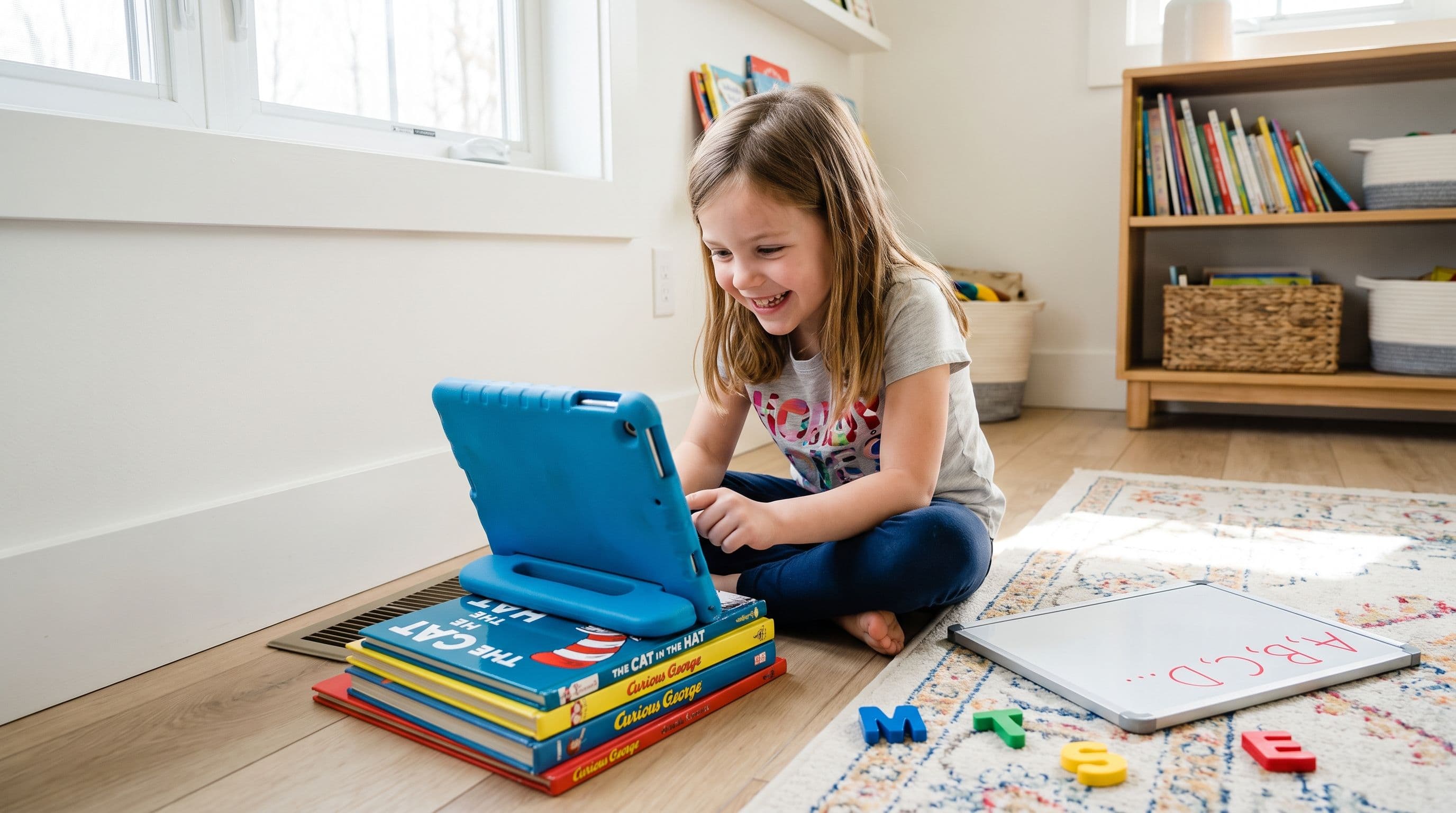
Best Phonics App for a 3-Year-Old: 5 Tested & Compared (2026)
Most phonics apps for toddlers are glorified cartoons with a letter slapped on top. I tested 5 of the most popular ones with my own kids and ranked them by what actually matters: systematic phonics instruction, not flashy animations. Here's what I found.
Read More →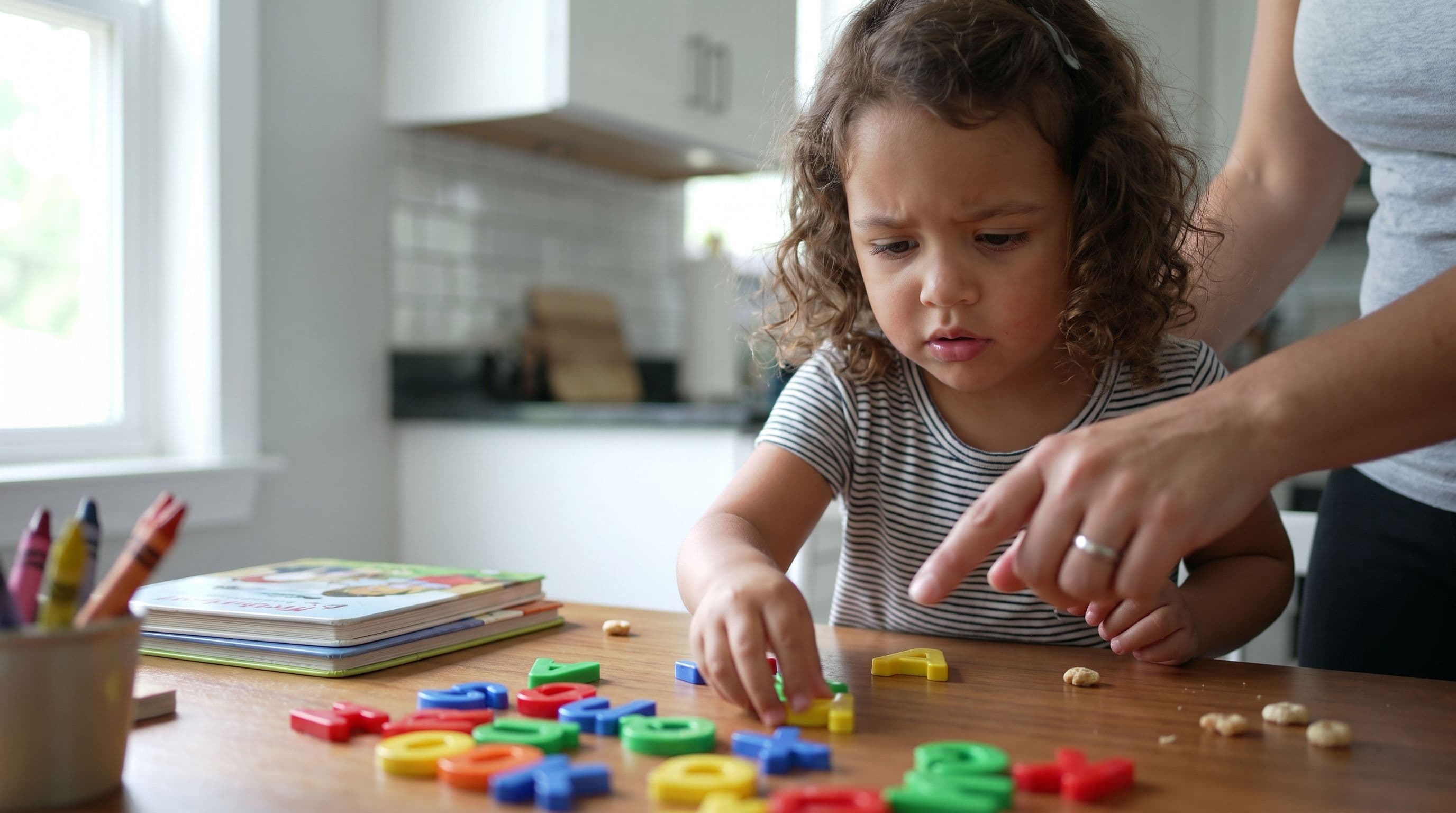
Best Reading App for a 4-Year-Old with Dyslexia Signs: My Top Pick
If your 4-year-old mixes up sounds, guesses from pictures, or avoids letters, don’t wait and see. Here’s my tiger-mom ranking of reading apps that help — and the ones I’d skip.
Read More →