Best App to Help a Kindergartner Learn to Read (2026)
What You'll Learn
- Why 90% of "reading apps" for kindergartners actually teach kids to guess — and the dead-simple test to spot them
- The specific phonics methodology an app MUST use if it's going to do anything besides waste your kid's time
- How the most popular kindergarten reading apps stack up against a simple decoding test (spoiler: most fail it)
- The one app built on Orton-Gillingham principles that I actually trust — and the exact routine I use with it
Your Kindergartner Doesn't Need Another Game. They Need Phonics.
Let me paint you a picture. Your 5-year-old is swiping happily on an iPad. The app is bright and colorful. There's a cartoon owl. Stars are flying across the screen. Your kid looks engaged.
But ask them to read the word "flat" and they stare at you blankly.
That's not reading. That's entertainment wearing a literacy costume.
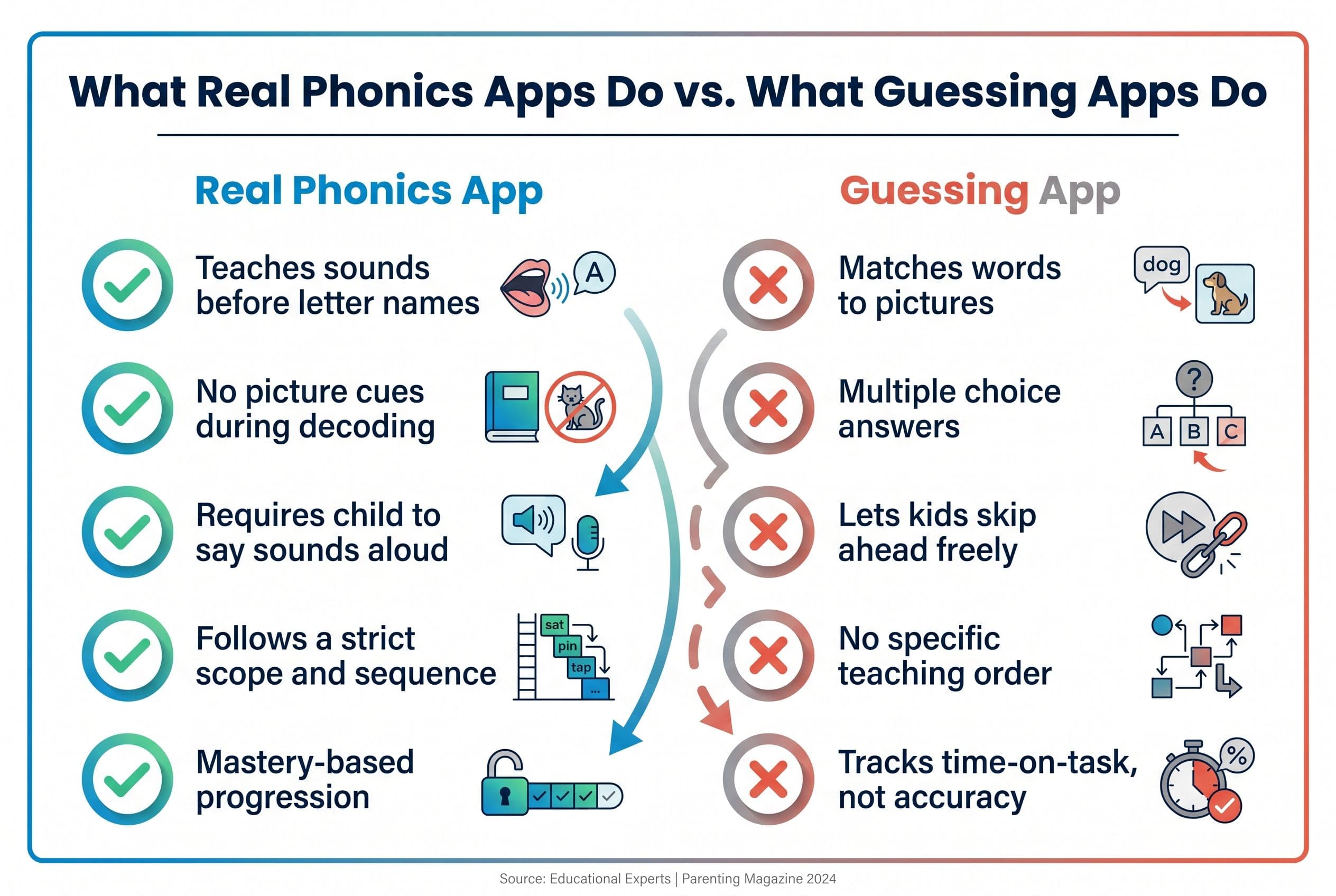
I see this constantly. Parents download the top-rated "reading app" from the App Store, their kid plays it for weeks, and they can't decode a single new word independently. Know why? Because most apps to help kindergarteners read aren't actually teaching reading. They're teaching kids to memorize shapes of words, guess from pictures, or tap the right answer out of three multiple-choice options.
That's Whole Language methodology in a shiny tech wrapper. And it's the same junk science that got us into the reading crisis in the first place.
Here's the thing — I'm not anti-technology. I'm anti-bad-technology. There's a massive difference between an app that systematically teaches grapheme-phoneme correspondences through explicit, sequential instruction and an app that shows your kid a picture of a dog and asks them to "find the word that matches."
One builds a reader. The other builds a guesser.
The Tiger Truth: What Happens If You Pick the Wrong App
Let's talk numbers, because the numbers are terrifying.
Only 33% of 4th graders read at proficient level on the 2022 NAEP — that's the Nation's Report Card. The 2023 scores were even worse, showing a 3-point drop from 2019, the largest decline in 30 years. Two-thirds of American kids can't read well.
Two. Thirds.
And that 3rd Grade Cliff is real. The Annie E. Casey Foundation's 2010 study found that kids who can't read proficiently by 3rd grade are four times more likely to drop out of high school. Not "a little more likely." Four times.
So when you hand your kindergartner an app that teaches them to guess at words from context clues and picture cues instead of sounding out grapheme-phoneme correspondences, you're not just wasting 15 minutes a day. You're burning through the most neuroplastic years of their brain development on a method that doesn't hold up to the evidence. The National Reading Panel's 2000 report — the one Congress actually commissioned — found strong evidence for systematic phonics instruction and phonemic awareness. That's exactly what guessing-based approaches skip.
I was at a playground in Raleigh last spring when another mom told me her kid's school had just switched from Lucy Calkins to a Science of Reading curriculum because of North Carolina's SB 387 — the Excellent Public Schools Act. She was confused and kind of annoyed about it. "He was doing fine before," she said. So I asked if her son could read the word "splint." He's in second grade. He could not. He looked at it and guessed "split." Close, but close doesn't count when you're reading medication labels or test instructions or literally anything that matters.
I spent 20 minutes on that playground bench walking her through why the switch was happening — Emily Hanford's APM Reports investigation that blew the lid off Balanced Literacy, the NAEP data showing flat or declining scores for decades, the neuroscience from Stanislas Dehaene's lab (his book Reading in the Brain from 2009 is the gold standard) proving that the human brain doesn't learn to read naturally. Reading has to be explicitly taught. Her son wasn't "doing fine" — he was memorizing and guessing, which works until the words get longer and the pictures disappear.
She went home and listened to the Sold a Story podcast that night. Texted me at 11pm: "I had no idea. Why didn't anyone tell us this sooner?"
Nobody tells parents this because the educational establishment has spent 40 years pretending reading happens naturally if you just surround kids with books. It doesn't. And an app that follows that same failed philosophy is just pouring gasoline on the problem.
The kicker? Remedial reading programs — the good ones like Wilson Reading System or Lindamood-Bell — can run to thousands of dollars a year. Insurance doesn't cover it. Schools have 2-year waitlists. You do NOT want to be in that line.
What a Real Reading App Must Do (Non-Negotiable Checklist)
Before I tell you what I actually use with my kids, let me give you the filter. Because most of the apps I've looked at fail these criteria.
A legitimate best kindergarten reading app for 2026 must:
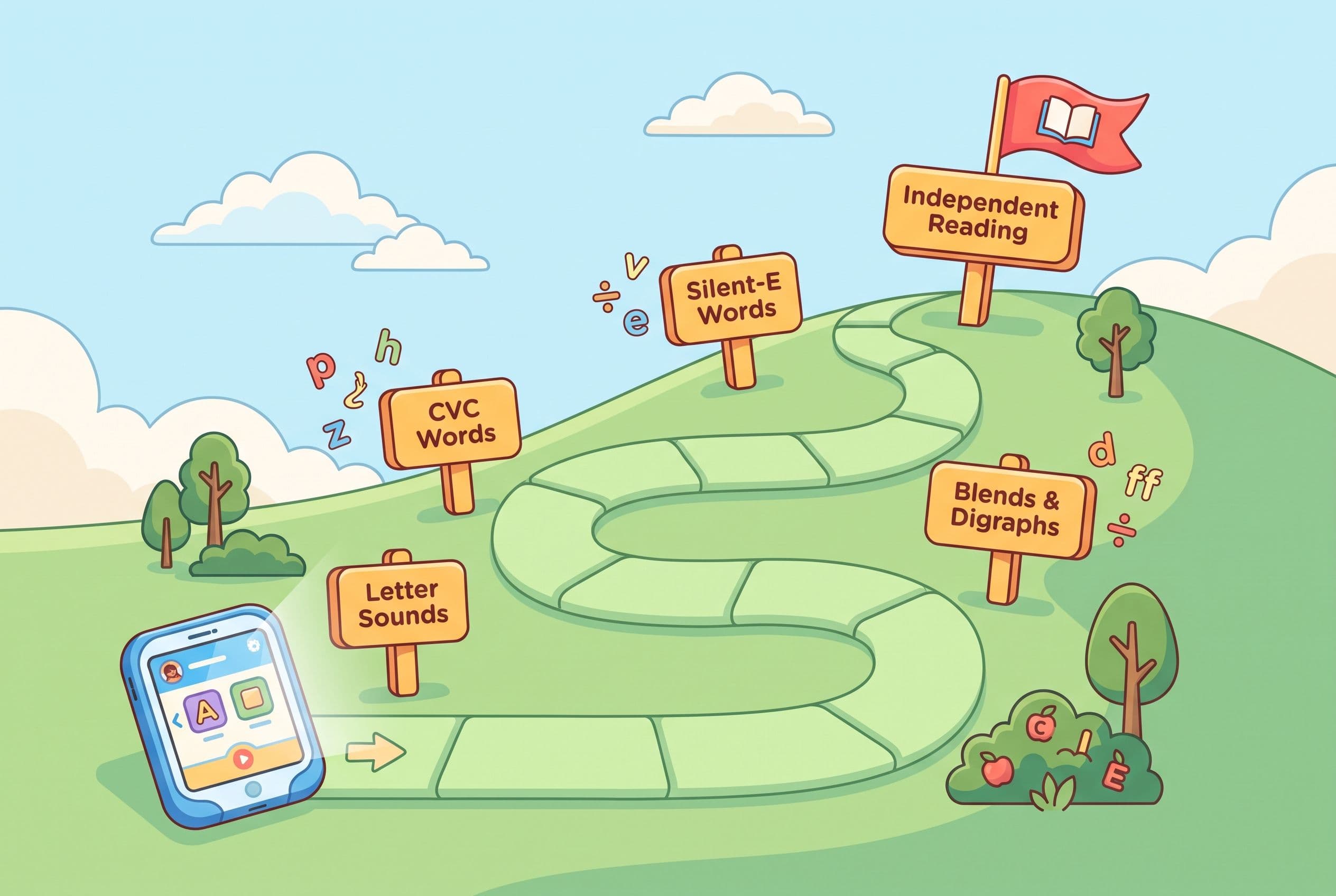
1. Teach systematic synthetic phonics. That means letter sounds first (not letter names), then blending those sounds left to right to decode words. The app should follow a specific scope and sequence — short vowels before long vowels, single consonants before blends and digraphs. If it dumps random words at your kid with no logical order, delete it.
2. Never let the kid guess from pictures. This is my biggest red flag. If there's a picture of a cat next to the word "cat," the child isn't reading. They're looking at a picture. Decodable text means the child can ONLY figure out the word by sounding it out. The picture, if there is one, should come after they've decoded.
3. Require the child to produce sounds, not just recognize them. Multiple choice is lazy. Tapping the correct answer out of four options doesn't build the neural pathways that David Kilpatrick describes in Equipped for Reading Success (2016) — the orthographic mapping process where the brain bonds the spelling of a word to its pronunciation and meaning. Your kid needs to say the sounds out loud, blend them, and produce the word.
4. Follow structured literacy principles. Look for instruction that's explicit, systematic, cumulative, and multisensory — with built-in diagnostic and prescriptive features. Many strong programs are Orton-Gillingham-inspired, and that's a great sign. But the non-negotiable is the structure and practice itself, not just a label. If the app lets the child skip ahead to whatever level they want, it's not diagnostic. If it doesn't adjust when the child struggles, it's not prescriptive. These aren't buzzwords — they're the backbone of every evidence-based reading intervention that actually works.
5. Track mastery, not just engagement. I don't care how many stars your kid earned. I care whether they can read "trim" without hesitating. The app should track accuracy and automaticity, not just time-on-task.
What Most Popular Apps Get Wrong
I'm not going to name every app I've looked at (some of them have very enthusiastic lawyers), but let me describe the patterns I see over and over.
The "Gamified Guessing" Apps: These are the big-name apps with millions of downloads and cute mascots. They look great. Kids love them. But when you actually watch what your child is doing, they're tapping pictures, matching shapes, and earning coins — not decoding.
The "Sight Word Flashcard" Apps: These drill the Dolch or Fry lists through pure memorization. Look — I'm not saying sight words don't matter. But memorizing 200 words without understanding the phonetic logic behind them is like memorizing 200 math facts without understanding what multiplication is. Linnea Ehri's research on the phases of word reading development (her 2005 meta-analysis is the definitive work here) shows that true sight word knowledge comes from orthographic mapping — the brain using phoneme-grapheme connections to store words permanently. Not rote flashcards.
The "Content Library" Apps: These give your kid access to thousands of leveled readers. Sounds great, right? Except those leveled readers are usually aligned to Fountas & Pinnell's system, which is whole-language at its core. The books use predictable, patterned text ("I see a cat. I see a dog. I see a bird.") that teaches kids to use picture cues and sentence patterns to "read." That's not reading. That's memorizing sentence frames.
What you want instead is decodable readers — books where every word can be sounded out using the phonics skills the child has already been taught. Flyleaf Publishing and High Noon Books make great physical decodable readers. But in app form? That's harder to find.
The App I Actually Use: Teach Your Kid to Read
Real talk — I helped build this app because nothing else on the market met my criteria. And I have high criteria, because I'm teaching my own children with it.
Teach Your Kid to Read is built on systematic synthetic phonics principles aligned with Orton-Gillingham methodology and structured literacy research. Here's what makes it different from the cartoon-owl apps:
It teaches sounds, not letter names first. Your kindergartner learns that the letter 'm' says /m/, not "em." This matters more than most parents realize. When a child tries to blend "em-ay-tee" they get gibberish. When they blend /m/-/a/-/t/ they get "mat."
No guessing. Period. There are no picture cues during decoding. The child must sound out each word using the phonics patterns they've learned. This is the "No Guessing" rule I enforce in my house — sound it out, never guess from pictures — and it's baked into the app's design.
It follows a strict scope and sequence. We don't throw random skills at kids. It starts with the simplest consonant-vowel-consonant (CVC) words and systematically builds through blends, digraphs, r-controlled vowels, vowel teams, and multisyllabic words. Nothing is skipped. Nothing is out of order.
The child produces the sounds. This isn't a tap-the-right-answer app. Your kid says the sounds out loud, blends them, and reads the word. It's multisensory instruction on a screen — which I know sounds like an oxymoron, but it works because we paired the visual with explicit audio modeling and require the child to speak.
Mastery-based progression. You don't move forward until you've actually mastered the current skill. No participation trophies. No skipping ahead because you're bored. This is the phonics equivalent of "We Never Skip" — my family rule that phonics happens on birthdays, Christmas, and vacation. No exceptions.
My Exact Daily Routine With the App (Steal This)
Here's what our kindergarten reading practice looks like on a typical day. I'm going to give you the real version, not the Instagram version.
Step 1: Warm-up review (3 minutes) We open the app and review the sounds from previous lessons. Mei sees a letter or letter combination, says the sound, and I confirm. If she hesitates on any sound for more than 2 seconds, we drill it again. Automaticity matters — we want fast, effortless sound recall, and if it takes longer than a couple seconds, that sound needs more practice.
Step 2: New lesson (5-7 minutes) The app introduces the next skill in sequence. Right now Mei is working on consonant blends — "bl," "cr," "st." She watches the modeling, then practices blending with the new pattern. I sit next to her. I don't help unless she's stuck for more than 10 seconds. Struggle is part of the process.
Step 3: Decodable reading practice (5 minutes) She reads decodable words and sentences that use ONLY the patterns she's been taught. No guessing. No skipping. If she gets a word wrong, she goes back and sounds it out again. I keep a little notebook where I jot down any words she struggled with so we can review them tomorrow.
Step 4: Off-screen practice (5 minutes) This is non-negotiable. We close the app and I pull out letter tiles or a whiteboard. She builds words with the pattern we just practiced. "Spell 'clap.' Now change the 'cl' to 'fl.' What's the new word?" This is word chaining, and it forces her brain to manipulate phonemes — the exact skill that Kilpatrick's PAST (Phonological Awareness Screening Test) measures.
Total time: about 20 minutes. Every single day.
Is she always thrilled about it? No. Last Tuesday she told me she'd "rather eat broccoli" than practice blends. But she did it anyway. Because in this house, reading isn't optional.
How to Know If Your Kid's Current App Is Working
Here's a 60-second test you can do right now.
Open whatever reading app your kindergartner has been using. Let them play for 5 minutes. Then close the app and write these three words on a piece of paper:
- "step"
- "flag"
- "brim"
These are CVC+ words with consonant blends. They're appropriate for any kindergartner who's been "learning to read" for a few months.
Can your child sound them out? Not guess. Not look at you for clues. Actually segment the sounds, blend them, and produce the word?
If yes — great. Your app might be working.
If no — and I'd bet money on this outcome for most apps — you don't have a reading app. You have a game that's teaching your kid to tap things on a screen.
Delete it. Start fresh with something that follows the science.
"But What About Screen Time?"
I hear this constantly. "Isn't any app just more screen time?"
Here's my take: the American Academy of Pediatrics distinguishes between passive screen time (watching YouTube) and interactive, educational screen time. A systematic phonics app where your child is actively producing sounds, blending words, and getting corrective feedback is fundamentally different from watching Cocomelon.
Is it as good as one-on-one Orton-Gillingham tutoring with a certified reading specialist? No. That runs $80-$150 per hour, and there aren't enough specialists to go around. The International Dyslexia Association has been sounding the alarm on the specialist shortage for years.
But a well-designed app that follows the same principles? That's accessible. That's affordable. And when combined with 5 minutes of off-screen practice (which is why I include Step 4 in our routine), it builds real decoding skills.
The bottom line: 15-20 minutes of structured phonics app time is not the same as 2 hours of iPad babysitting. Don't let screen time guilt keep you from using a tool that actually works.
What About Kids Who Might Have Dyslexia?
If your kindergartner is struggling significantly — can't remember letter sounds after weeks of practice, can't blend three sounds together, has a family history of reading difficulties — an app alone won't be enough. You need a screening.
Ask your child's school to administer the DIBELS or PALS (Phonological Awareness Literacy Screening). You can also give Kilpatrick's PAST test yourself — it takes about 5 minutes and tells you exactly where the phonological processing breakdown is happening.
But here's what I want you to understand: even kids with dyslexia indicators learn to read through systematic synthetic phonics. The methodology doesn't change. The intensity does. Programs like Barton Reading & Spelling and Wilson Reading System are Orton-Gillingham-based interventions designed for exactly these kids. And an app built on the same principles can supplement that instruction at home.
What does NOT work for these kids is the "wait and see" approach. Don't let anyone — not a teacher, not a pediatrician, not your mother-in-law — tell you to "give it time." Mississippi showed what happens when a state goes all-in on early literacy reform. They paired K–3 screening and coaching with evidence-based instruction and their Literacy-Based Promotion Act of 2013, and their NAEP 4th-grade reading scores improved meaningfully over the following years — climbing from near the bottom of state rankings. Multiple factors drove those gains, but the throughline was clear: stop waiting, start intervening. Early intervention is everything.
Frequently Asked Questions
What age should a kindergartner start using a phonics app?
Most kids are ready for structured phonics instruction — including app-based instruction — by age 4.5 to 5. If your child knows most letter names and can recognize some letter sounds, they're ready. My daughter Mei started with Teach Your Kid to Read at 4, and we kept sessions short (10-12 minutes) until her attention span grew. The key is consistency, not marathon sessions.
How long should my kindergartner use a reading app each day?
15-20 minutes of focused phonics app time is the sweet spot. Research consistently shows that short, daily practice beats long, sporadic sessions. I do 15 minutes on the app plus 5 minutes of off-screen reinforcement — letter tiles, whiteboard work, or reading decodable books together. Every day. Yes, weekends too.
Can an app replace a reading tutor?
For most kids, a strong systematic phonics app combined with parental involvement is enough to teach reading. The Simple View of Reading (Gough & Tunmer, 1986) tells us that reading comprehension = decoding × language comprehension. If your child has age-appropriate language skills and you provide systematic decoding instruction through a good app, they'll learn to read. If your child has significant phonological processing deficits or dyslexia indicators, you'll want a trained specialist in addition to the app.
What's the difference between a "phonics app" and a "reading app"?
Most "reading apps" for kindergartners focus on sight word memorization, leveled readers, or gamified activities that don't teach actual decoding. A genuine phonics app teaches the alphabetic code systematically — letter-sound correspondences, blending, segmenting — in a specific scope and sequence. If the app lets your kid "read" by matching words to pictures or choosing from multiple-choice options, it's not a phonics app. It's a guessing game.
How do I know when my kindergartner is ready to move beyond the app?
When your child can fluently read decodable text with consonant blends, digraphs, and silent-e patterns — and when they're starting to read simple trade books independently without guessing — they've built a solid foundation. That typically happens around age 6-7 for kids who've had consistent daily practice. But "move beyond the app" doesn't mean stop practicing. It means add more complex material. Reading instruction doesn't end at CVC words. Vowel teams, r-controlled vowels, multisyllabic words, and morphological awareness all come next.
Stop Scrolling the App Store. Start Teaching Your Kid to Read.
Look, I get it. Searching for the best app for kindergarten reading in 2026 feels like it should be simple. There are thousands of options. They all have glowing reviews. They all claim to teach reading.
But most of these apps fail the most basic test: can my child actually read a new word after using this?
Teach Your Kid to Read passes that test. It passed it with my oldest two kids, who are both reading above grade level. It's passing it right now with my 4-year-old, who just decoded "crust" on her own last week and literally did a little dance.
That dance? That's what real reading looks like. Not stars on a screen. Not a cartoon owl giving high-fives. A child who looks at a word she's never seen before, sounds it out, and gets it.
That's the skill. That's the foundation. That's what matters.
Ready to get started? Visit start lesson one free or call (407) 707-6850 to learn more about Teach Your Kid to Read.

Xia Brody
Co-Founder, Teach Your Kid to Read
Mom of 4 who has successfully taught her kids to read. Currently in the trenches with her 4-year-old while her two oldest (10 and 7) devour books on their own. Passionate about phonics-based methods and building a lifelong love of reading.
Related Articles
Best Reading App for a Struggling Kindergartner 2026
If your kindergartner is guessing words from pictures, that’s not reading. Here’s my no-nonsense 2026 comparison of kindergarten reading apps, with Teach Your Kid to Read ranked first for systematic phonics.
Read More →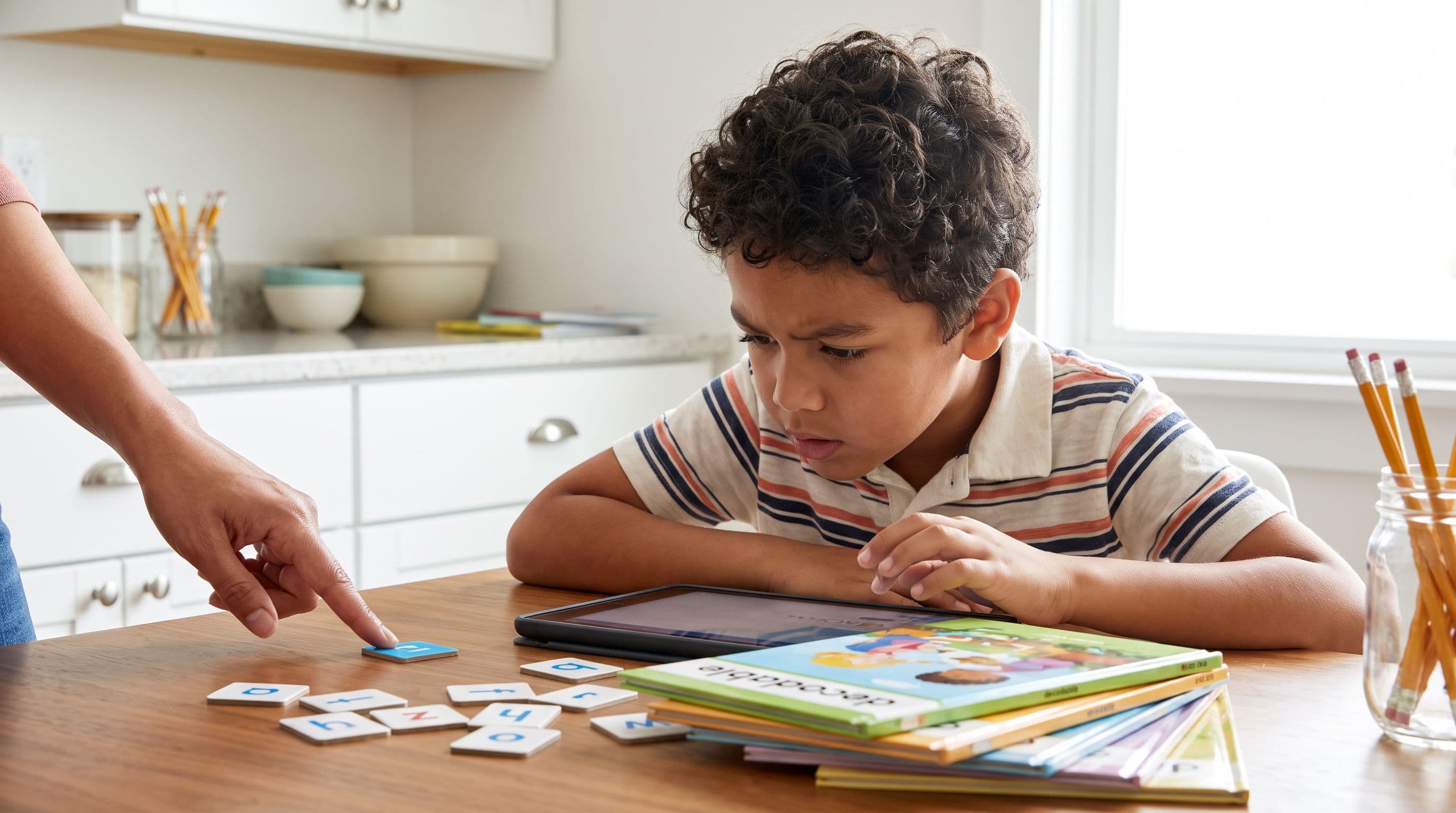
Reading Eggs vs ABCmouse for 5-Year-Olds: Best Pick
Choosing between Reading Eggs and ABCmouse? Here’s the no-fluff mom verdict on which app actually teaches a 5-year-old to read — and where both fall short.
Read More →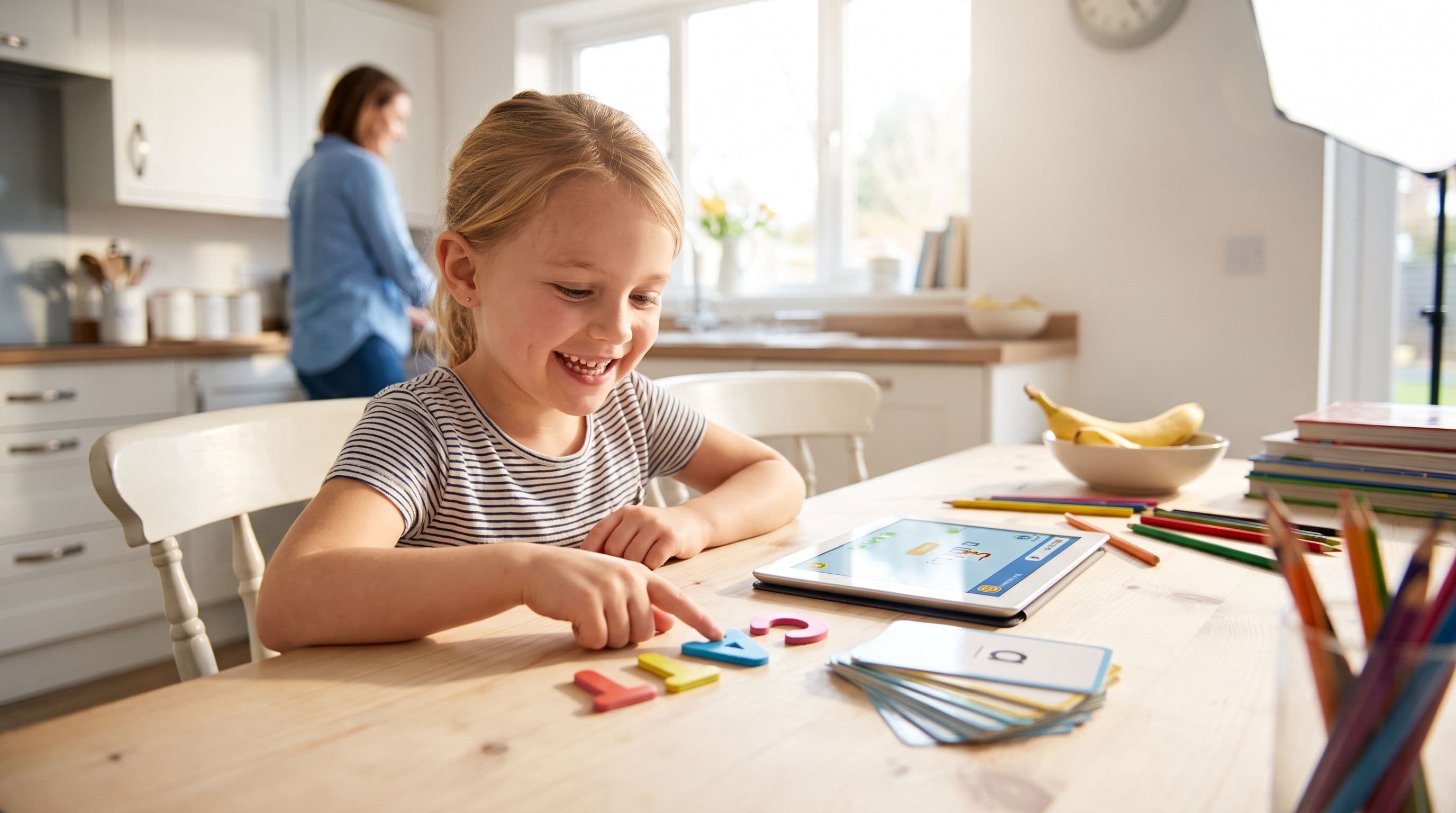
Reading Apps for 5-Year-Olds: 6 Skill-Level Picks
Most reading apps for 5-year-olds look cute. Too many teach guessing, tapping, and screen-zombie habits instead of real decoding. Here’s how I’d pick a phonics app by skill level if I were sitting at your kitchen table.
Read More →