Best Reading App for 4-Year-Olds: 6 Apps Tested in 2026
What You'll Learn
- Why most "reading" apps for 4-year-olds don't actually teach reading — and the one red flag that exposes a bad app in 30 seconds
- The 6 apps I tested with my own preschooler — ranked by real phonics methodology, not star ratings from the App Store
- What the brain science says about screen-based phonics instruction for 4-year-olds (spoiler: it's not all bad, but most apps ignore it)
- The exact benchmarks your 4-year-old should hit before and after using a reading app — so you know if it's actually working
The Hard Truth About Reading Apps for Preschoolers
Your 4-year-old can unlock your phone, open YouTube, and navigate to their favorite video of a guy in a dinosaur costume smashing watermelons. So naturally, you think: why not hand them an app that teaches them to read?
I get it. I really do.
But here's what nobody tells you when you search "best reading app for 4 year olds" and get hit with a wall of sponsored listicles: most of these apps aren't teaching reading at all. They're teaching your kid to tap, swipe, and collect digital stickers while letters float around in the background like decorations at a party nobody's paying attention to.
I've been homeschooling for seven years now. My oldest is 10 and reads at an 8th-grade level. My 7-year-old devours chapter books. My 4-year-old, Mei, is right in the thick of learning to decode CVC words. And my 1-year-old is currently eating a board book, which — developmental milestone? I'll take it.
The point is: I've tested a LOT of reading apps. Not in a lab. At my kitchen table, in the car during swim practice pickup, and on a rainy Tuesday when all four kids were home and I needed 15 minutes where nobody was screaming. I know what works, what wastes time, and what actively teaches bad habits.
Let me save you the trouble.
Why This Matters More Than You Think (The Tiger Truth)
Let's get the scary part out of the way.
Only 33% of 4th graders read at a proficient level on the 2022 NAEP — that's the Nation's Report Card. One in three. The 2022 scores dropped significantly from 2019, the largest decline in over 30 years.
Think those kids all came from tough backgrounds? Think again. Plenty of them had parents who downloaded every top-rated reading app on the market, bought the flashcards, did the "learning time" at the tablet. The problem wasn't effort. The problem was method.
The Annie E. Casey Foundation's 2010 study found that kids who can't read proficiently by 3rd grade are four times more likely to drop out of high school. Four times. And 3rd grade sneaks up fast. Your 4-year-old will be in 3rd grade in roughly four years. That's not a lot of runway.
Here's the kicker: the average private remedial reading program — something like Lindamood-Bell or a Wilson Reading System tutor — runs $10,000 to $15,000 a year. Insurance doesn't touch it. Most school districts have waitlists measured in semesters, not weeks.
So yeah, picking the right reading app for your preschooler? It matters more than the App Store rating would suggest.
What Makes a Reading App Actually Work (The Science)
Before I get to the rankings, you need to know what to look for. Because a reading app without proper phonics methodology is like a calculator that only does addition — it looks functional until you realize it's missing 90% of what you need.
Stanislas Dehaene, the French neuroscientist who literally mapped how the brain learns to read in Reading in the Brain (2009), proved something that every parent needs to understand: the human brain is not wired to read. Speaking? Yes. Your kid's brain was born ready for spoken language. But reading is an invention. It's technology. The brain has to be trained — rewired, essentially — to connect visual symbols (letters) to sounds (phonemes).
This process is called grapheme-phoneme correspondence, and it's the foundation of systematic synthetic phonics. The 2000 National Reading Panel — the one Congress actually commissioned — found that systematic phonics instruction produces significant benefits for reading and spelling, especially in kindergarten and first grade, compared with approaches that don't teach phonics explicitly.
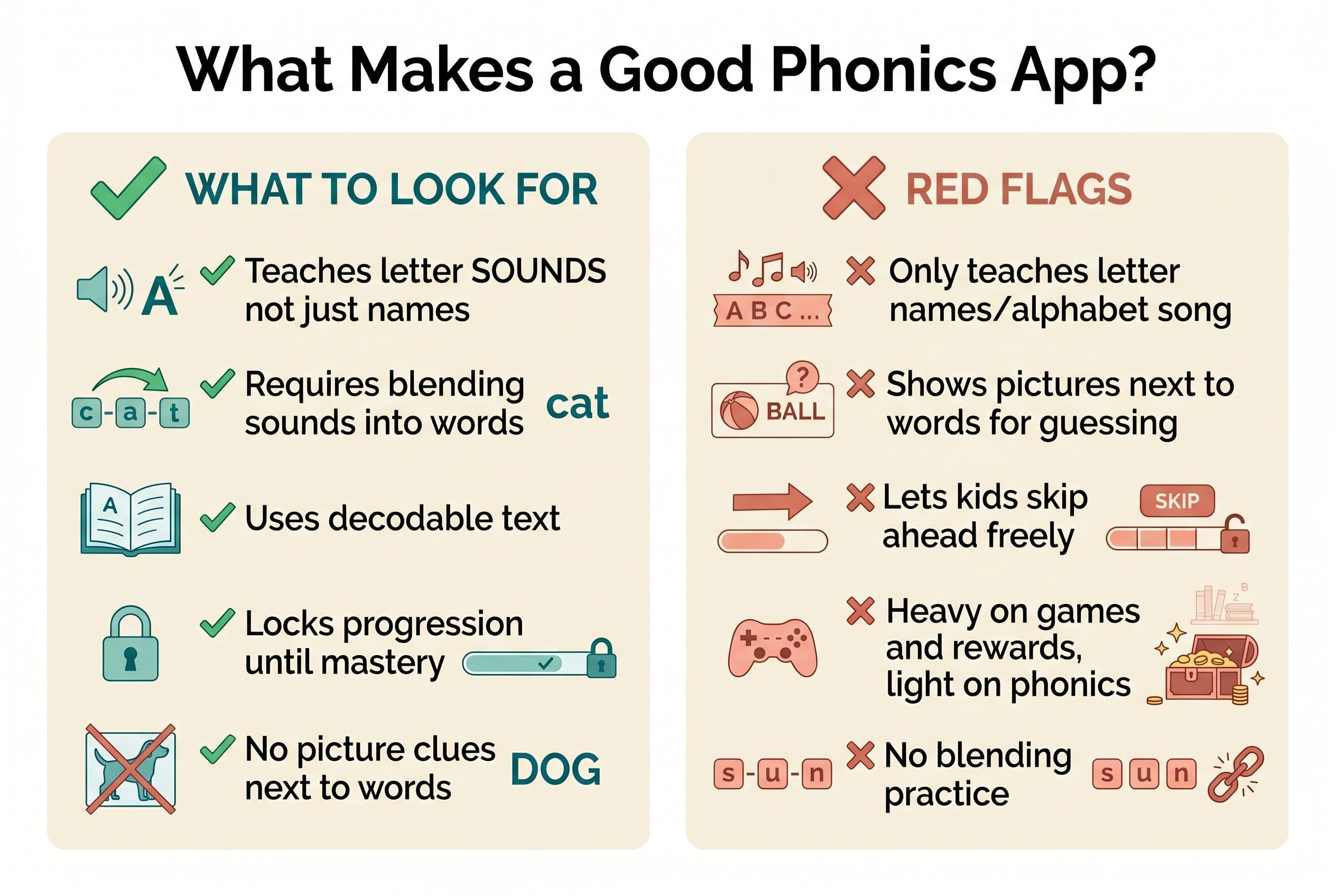
So when I'm evaluating a reading app for 4-year-olds, I'm looking for:
- Systematic phonics instruction — Does it teach letter sounds in a logical, sequential order? Or does it just throw random letters at your kid and hope something sticks?
- Blending practice — Does it make your kid actually blend sounds together to form words (c-a-t → cat)? Or does it just show them whole words and ask them to "recognize" them?
- No guessing from pictures — This is my dealbreaker. If the app shows a picture of a dog next to the word "dog" and counts it as "reading" when your kid taps the right answer, that's not reading. That's a matching game.
- Decodable text — Does the app progress to having kids actually read sentences using only the letter sounds they've already learned?
- Assessment and progression — Can you tell if your kid is actually mastering each skill before moving to the next one?
I was at a playground in Raleigh last spring when I had a conversation that basically summed up why this stuff matters. Another mom mentioned her kid's school had just switched from Lucy Calkins to a Science of Reading curriculum — North Carolina's SB 387, the Excellent Public Schools Act, forced the change. She was annoyed. "He was doing fine before," she told me. Her son is in second grade. I asked if he could read the word "splint." He stared at it. Couldn't do it. Not even close. He'd been guessing from pictures and memorizing word shapes for two years, and nobody caught it because apps and classroom tools kept telling him he was "progressing." I spent 20 minutes on that playground bench walking her through why the switch was happening — Emily Hanford's Sold a Story investigation, the NAEP data, Dehaene's neuroscience research showing the brain doesn't just pick up reading naturally like it does speech. She went home and watched the podcast that night. Texted me at 11pm: I had no idea. Why didn't anyone tell us this sooner?
That's why I'm picky about apps. A bad app doesn't just waste time. It trains bad habits that take years to undo.
The 6 Reading Apps I Tested — Ranked
I tested each of these apps with my 4-year-old, Mei, over a period of 2-4 weeks each during the fall and winter of 2024-2025. I also evaluated them against Linnea Ehri's phases of word reading development (pre-alphabetic → partial alphabetic → full alphabetic → consolidated), because a good app should move a child through these phases, not just park them at phase one with some confetti animations.
Here's how they stacked up.
1. Teach Your Kid to Read — Best Overall Phonics App for 4-Year-Olds
The bottom line: This is the one I actually use. Daily. Full disclosure: this is the app my team and I built because I couldn't find one that checked all my boxes. I'm biased, and I'm also proud of the results it gets.
Teach Your Kid to Read is built on Orton-Gillingham principles — the same systematic, multisensory approach used by clinical reading interventionists. It teaches grapheme-phoneme correspondence in a structured, sequential order. No guessing. No picture clues. Kids learn the sounds, practice blending, and progress to reading decodable words and sentences using only the sounds they've mastered.
What sold me is how it handles blending. Mei doesn't just tap letters and hear sounds in isolation. The app has her actually drag sounds together and produce the blended word. It's the closest I've found to replicating what I do at the kitchen table — pointing under each letter, stretching the sounds, and sliding my finger to blend.
The progression is tight. You can't skip ahead (tiger mom approved — we never skip). Each level builds directly on the last one. And there's a parent dashboard that shows me exactly where Mei is and where she's getting stuck.
What it does right: Systematic synthetic phonics. Blending, not guessing. Decodable text. No fluff.
What it doesn't do: It won't babysit your kid for an hour with games and songs. It's a teaching tool, not an entertainment platform. Sessions are short — 10-15 minutes — which is actually perfect for a 4-year-old's attention span.
My honest take: This is the app I recommend to every parent who asks me. It's not the flashiest. It won't win design awards from some Silicon Valley panel. But it teaches actual reading using actual science, and Mei went from knowing 12 letter sounds to blending three-sound words in about six weeks of daily use.
2. HOMER Reading — Good Content, Mixed Methodology
HOMER has a ton of content. Stories, songs, letter activities, vocabulary builders. The production quality is high. My kids find it visually engaging.
But here's my issue: HOMER mixes phonics instruction with whole-language elements. Some activities teach letter sounds systematically. Others ask kids to "read" by recognizing whole words or picking out words from picture context. That's the guessing strategy that Hanford's Sold a Story investigation exposed as ineffective.
It's like mixing good medicine with candy and hoping the medicine still works. Sometimes it does. Sometimes your kid just learns to eat candy.
Mei enjoyed HOMER, but after two weeks I noticed she was starting to look at pictures before looking at words. That's a habit I had to actively break.
The verdict: Solid supplemental content for vocabulary and comprehension exposure. Not reliable as a primary phonics tool.
3. Hooked on Phonics — Nostalgia Factor Is Real, Execution Is Decent
Yes, this is still around. The app version follows a systematic phonics sequence and uses decodable readers, which I appreciate. The lessons move through letter sounds, blending, and sight words in a structured way.
The issues? The pacing can be slow for a kid who's ready to move. And some of the sight word instruction feels disconnected from the phonics progression — it introduces high-frequency words as memorization targets rather than connecting them to phonics patterns, which David Kilpatrick's orthographic mapping research (from Equipped for Reading Success, 2016) suggests is the wrong approach.
Mei got bored with it faster than she did with Teach Your Kid to Read, mostly because the reward animations between lessons are longer than the lessons themselves. She wanted to watch the cartoon bear dance. She did not want to practice blending /sh/ + /i/ + /p/.
The verdict: Decent phonics methodology held back by pacing issues and too much entertainment padding.
4. Khan Academy Kids — Free and Broad, But Phonics Is an Afterthought
I love Khan Academy for math. I really do. The kids' app is free, the content is generous, and the production quality is surprisingly good for a free platform.
But reading instruction? It's surface-level. The phonics content exists, but it's scattered across the app like croutons on a salad — present, but not the main course. There's no clear systematic progression from letter sounds to blending to decodable text. A 4-year-old could easily spend 30 minutes in the app and never encounter a single phonics lesson if they wander into the storytime or social-emotional sections.
The verdict: Great free resource for general preschool enrichment. Not a reading app. Don't use it as one.
5. ABCmouse — The Flashiest App That Teaches the Least
Oh, ABCmouse. You beautiful, chaotic mess.
This app has everything: games, puzzles, coloring, music, "learning paths," a virtual aquarium, a virtual farm, and somewhere buried under twelve layers of gamification, some letter activities.
Mei loved ABCmouse. She played it for two straight weeks and could not tell me the sound that the letter M makes at the end of it. She could, however, tell me that her virtual hamster needed feeding and her farm needed watering.
Look — ABCmouse markets itself as an educational app, and it does cover a wide range of preschool topics. But its reading instruction relies heavily on letter recognition (naming letters) rather than letter-sound correspondence (knowing what sound each letter makes). Those are not the same thing. Knowing the letter's name is step one. Knowing its sound is step two. ABCmouse spends way too long on step one and barely touches step two with any rigor.
The verdict: An entertainment app wearing an education costume. Skip it if your goal is actual reading.
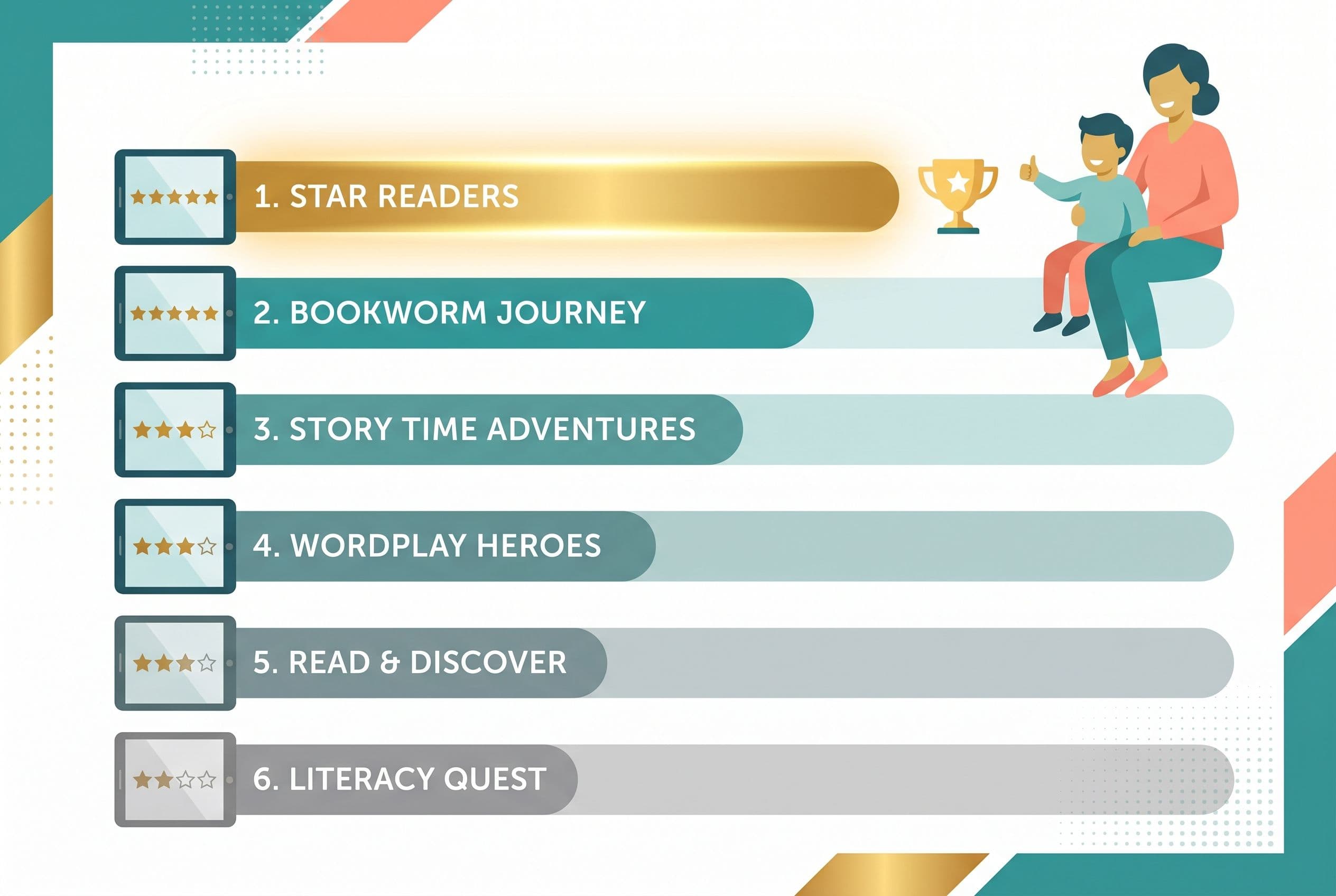
6. Starfall — A Classic That's Showing Its Age
Starfall has been around since 2002. In the early days of online phonics content, it was hands down the best thing available. I have a soft spot for it.
But it's 2026. The interface looks dated. The interactivity is limited. And while the phonics instruction follows a reasonable systematic sequence, the practice activities are thin — your kid clicks a letter, hears the sound, and moves on. There's not enough blending practice, not enough repetition, and not enough decodable text to build real fluency.
Mei lost interest in Starfall within four days. Can't blame her.
The verdict: Pioneering, but outpaced by modern apps that offer deeper phonics practice.
What I Actually Look for in a Learn-to-Read App for Preschool
After testing all six of these, here are my non-negotiables. Print this list. Tape it to your fridge. Use it every time someone recommends the next hot education app:
- Does it teach letter sounds, not just letter names? Your 4-year-old doesn't need to sing the alphabet song again. They need to know /m/ says "mmmm" — not "em."
- Does it require blending? The app should make your kid push sounds together to form words. If they're just tapping individual letters, they're not reading.
- Are there picture clues near the words? If yes, your kid will guess from the pictures every single time. The brain takes the path of least resistance. A picture of a cat next to the word "cat" isn't reading instruction — it's a matching game.
- Is the progression locked? Can your kid skip ahead to content they haven't mastered? If so, the app isn't assessing mastery — it's prioritizing engagement metrics.
- Is there decodable text? Eventually, the app should have your kid reading actual sentences built from the sounds they've learned. Not "leveled readers" that require guessing. Decodable text. There's a difference — Flyleaf Publishing and High Noon Books make great decodable readers if you want physical ones, too.
Teach Your Kid to Read checks every one of these boxes. Most of the other apps I tested check two or three at best.
How to Use a Reading App With Your 4-Year-Old (The Right Way)
Even the best reading app for 4-year-olds won't work if you just hand your kid a tablet and walk away. Sorry. I know that's not what you wanted to hear.
Here's how I use reading apps with Mei:
Step 1: Sit with them. At least for the first 2-3 weeks. You need to see what they're doing. Are they sounding out the letters or randomly tapping? Are they blending or guessing? You can't know if you're in the other room.
Step 2: Keep sessions to 10-15 minutes. A 4-year-old's productive attention span for focused learning is about 10-15 minutes. After that, you're getting diminishing returns. You don't build reading fluency by marathoning an app for 45 minutes. You get there with short, daily, consistent practice.
Step 3: Pair it with offline practice. The app is not the whole program. After Mei finishes her Teach Your Kid to Read session, we spend 5 minutes with magnetic letters on the fridge, building the same CVC words she just practiced in the app. Physical, multisensory reinforcement. The Orton-Gillingham approach emphasizes this — visual, auditory, AND kinesthetic learning.
Step 4: Test comprehension yourself. Don't rely on the app's progress report alone. Once a week, I pull out a few decodable words on index cards and ask Mei to read them cold. No app. No hints. No pictures. Can she decode them? If yes, we move forward. If not, we repeat. That's how you know the app is actually working.
Step 5: Don't skip days. Tiger Rule #1: we never skip. Phonics happens on birthdays. Phonics happens on Christmas. Phonics happens on vacation. Ten minutes a day, every day, beats 60 minutes twice a week. The brain needs daily repetition to build those neural pathways Dehaene mapped in his research.
Reading Readiness Benchmarks for 4-Year-Olds
Parents always ask me: how do I know if my kid is where they should be?
Here are the benchmarks I use, drawn from Ehri's phases and DIBELS early literacy indicators:
By age 4 (preschool entry):
- Recognizes and names most uppercase letters
- Knows at least 10-15 letter sounds
- Can identify rhyming words (does "cat" rhyme with "hat"? yes)
- Shows interest in print (points at signs, asks "what does that say?")
By age 4.5 - 5 (pre-K):
- Knows all 26 letter sounds (upper and lowercase)
- Can blend 2-3 sounds together orally (you say /c/ /a/ /t/, they say "cat")
- Beginning to decode simple CVC words (sat, mop, pig)
- Can segment words into individual sounds (you say "dog," they say /d/ /o/ /g/)
If your 4-year-old isn't hitting these yet, don't panic. But don't "wait and see" either. That's the lie that costs families years. Start a systematic phonics program — whether it's an app like Teach Your Kid to Read, a workbook like Explode the Code, or a curriculum like UFLI Foundations. Start now. Start today.
And if you want a quick assessment, ask your child's school about a phonological awareness screener — many schools use tools like the PAST (Phonological Awareness Screening Test) or similar assessments. If they don't offer one, you can search for the PAST through educational resource sites. It takes about 5 minutes and tells you exactly where the phonological breakdown is. Your pediatrician isn't going to test this. Your preschool probably isn't either. You have to ask for it.
The "Wait and See" Lie vs. Starting Now
Every time I tell a parent to start phonics at age 4, someone pushes back. "They're only four! Let them play! They'll learn to read when they're ready!"
Real talk — I'm not saying your 4-year-old should be sitting at a desk for three hours doing worksheets. I'm saying 10-15 minutes a day of structured, systematic phonics instruction — through a well-designed app, through magnetic letters on the fridge, through reading together on the couch. That's it.
Mississippi proved what happens when you stop waiting. After passing the Literacy-Based Promotion Act in 2013 — which mandated evidence-based reading instruction and held kids back if they couldn't read by 3rd grade — Mississippi went from 49th to 21st in national reading scores in six years. Forty states have now passed similar Science of Reading legislation since 2019. North Carolina's SB 387. Ohio's Third Grade Reading Guarantee. Colorado's READ Act.
The policy world figured it out. The neuroscience proved it. The data confirmed it. Systematic phonics works. Starting early works. Waiting doesn't.
Your 4-year-old is ready. The question is whether you'll give them the right tool.
Frequently Asked Questions
What age should a child start using a reading app?
Most children can begin a structured phonics app between ages 3.5 and 4, once they can hold attention for 10-15 minutes and have basic fine motor skills to tap a screen. The key is choosing an app with systematic phonics — not just letter games. I started Mei at 4 with Teach Your Kid to Read, and she was blending CVC words within six weeks. Starting earlier with the right methodology gives your child more runway before the 3rd-grade reading benchmark.
Are reading apps enough to teach a 4-year-old to read?
No app alone is enough. Think of a reading app as one tool in the toolbox — an important one, but not the only one. Pair app-based phonics practice with offline activities: magnetic letters, decodable books, writing practice, and reading aloud together. The Orton-Gillingham approach emphasizes multisensory learning (seeing, hearing, AND touching), and no screen can fully replace physical manipulation of letters and sounds. Use the app for structured daily practice, then reinforce with hands-on work.
How can I tell if a reading app is actually teaching phonics vs. just playing games?
Watch your child use the app for 5 minutes. Ask yourself three questions: Is my child sounding out letters, or just tapping randomly? Are there pictures next to words that let my child guess instead of decode? Can my child skip ahead without mastering the current level? If the answer to any of the last two is "yes," the app is prioritizing engagement over education. A good phonics app should require your child to produce sounds, blend them into words, and demonstrate mastery before advancing.
My 4-year-old seems too young for phonics. Should I wait?
No. The "wait and see" approach is the single most damaging piece of advice in early education. The brain's capacity to learn grapheme-phoneme correspondence — connecting letters to sounds — is strong at age 4. Stanislas Dehaene's neuroscience research shows the brain must be trained to read; it doesn't happen naturally. Starting at 4 with short, playful, systematic sessions isn't pushing too hard — it's giving your child the foundation they need before the stakes get higher. If something like dyslexia is present, early phonics instruction is actually the best early intervention you can provide.
What's the difference between a "reading app" and a "phonics app"?
A reading app is a broad category — it could mean anything from an audiobook player to a storytime app to a letter-matching game. A phonics app specifically teaches the relationship between letters and sounds in a systematic way. For a 4-year-old, you want a phonics app, not just a "reading" app. Specifically, you want one based on systematic synthetic phonics (teaching individual sounds and blending them into words) rather than analytic phonics or whole-language methods. Teach Your Kid to Read is a phonics app. ABCmouse is a reading-adjacent entertainment app. The distinction matters enormously.
Stop Scrolling. Start Teaching.
You've read the reviews. You've seen the data. You know that 67% of American 4th graders can't read at a proficient level, and you know that the right phonics instruction — started early, done consistently — can keep your kid out of that statistic.
Teach Your Kid to Read is the app I use with my own 4-year-old. Not because I built it (I co-founded it — full disclosure, full bias, zero apology). Because it works. It follows the same systematic synthetic phonics methodology that the National Reading Panel endorsed, that Dehaene's brain research supports, and that 40+ states are now mandating in their schools.
Ten minutes a day. Every day. That's the ask.
Download the app at start lesson one free or call us at (407) 707-6850 if you have questions. We'll talk you through it — real humans, not a chatbot.
Your kid's reading future starts now. Not in kindergarten. Not "when they're ready." Now.
Part of these guides

Xia Brody
Co-Founder, Teach Your Kid to Read
Mom of 4 who has successfully taught her kids to read. Currently in the trenches with her 4-year-old while her two oldest (10 and 7) devour books on their own. Passionate about phonics-based methods and building a lifelong love of reading.
Related Articles
Reading Apps for 4-Year-Olds: 6 Worth Trying in 2026
Most 'educational' reading apps for 4-year-olds are glorified cartoons with a phonics sticker slapped on. Here are 6 that actually teach your kid to read — and the red flags that tell you an app is wasting your child's time.
Read More →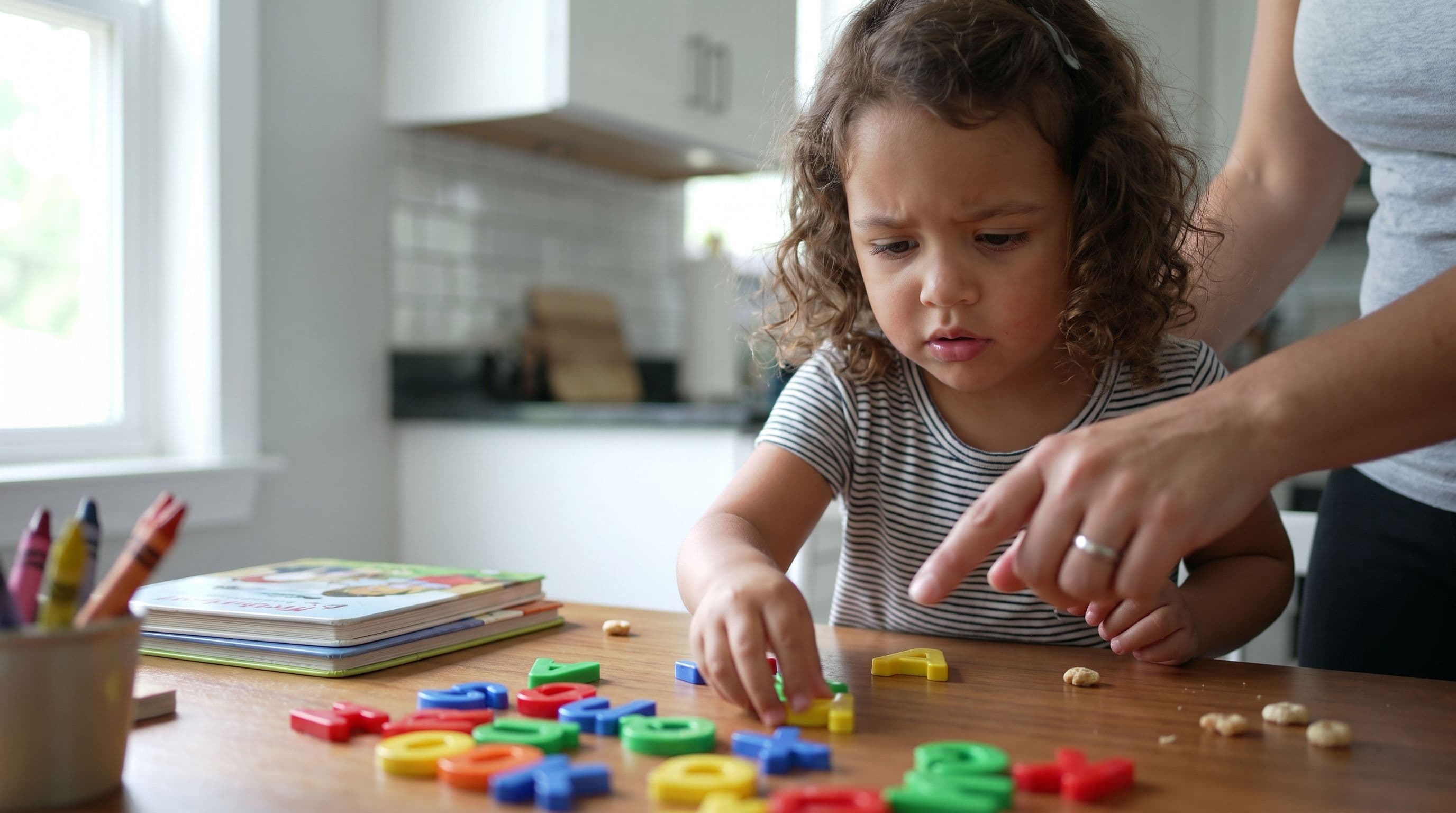
Best Reading App for a 4-Year-Old with Dyslexia Signs: My Top Pick
If your 4-year-old mixes up sounds, guesses from pictures, or avoids letters, don’t wait and see. Here’s my tiger-mom ranking of reading apps that help — and the ones I’d skip.
Read More →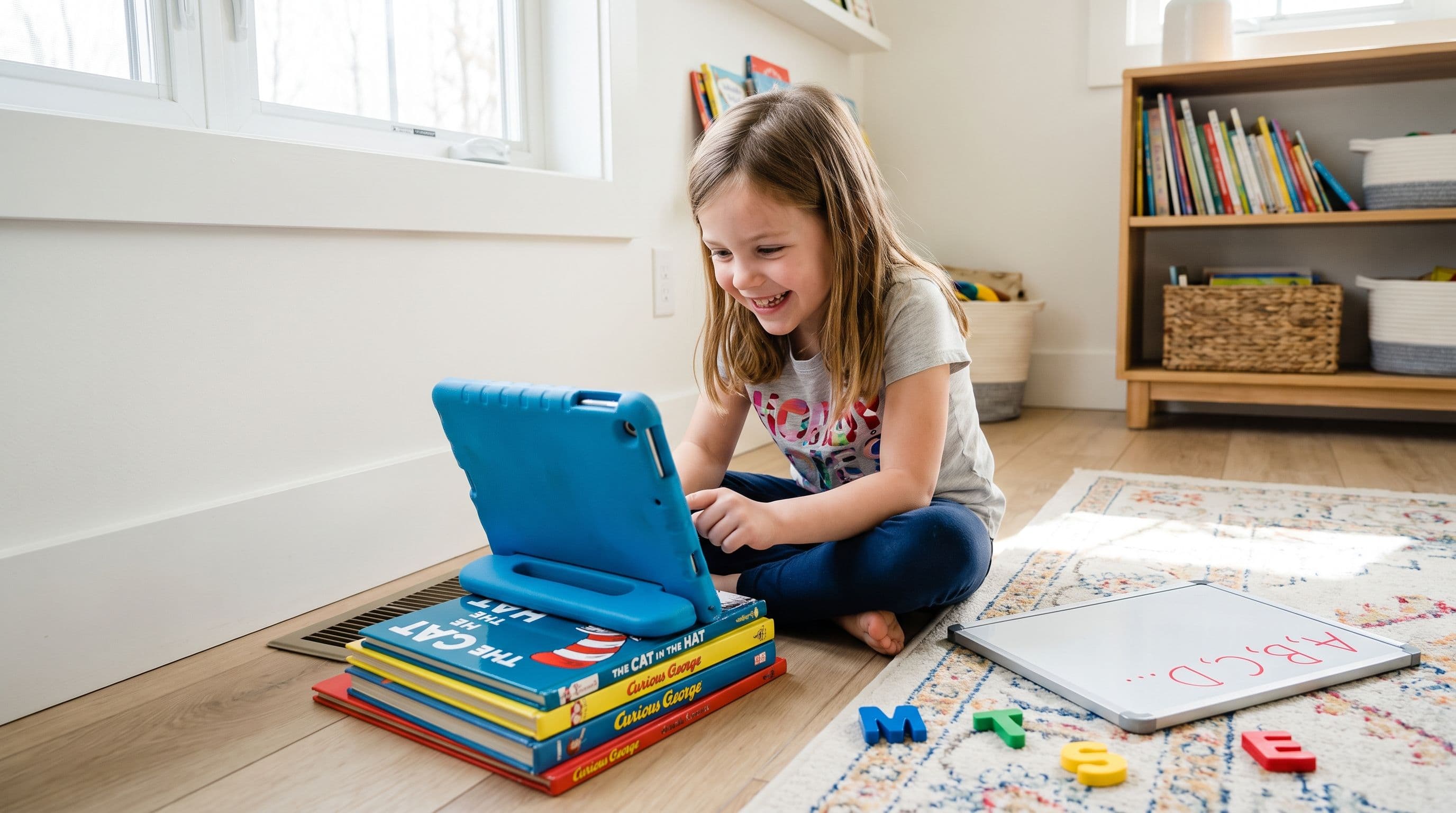
Best Phonics App for a 3-Year-Old: 5 Tested & Compared (2026)
Most phonics apps for toddlers are glorified cartoons with a letter slapped on top. I tested 5 of the most popular ones with my own kids and ranked them by what actually matters: systematic phonics instruction, not flashy animations. Here's what I found.
Read More →