What Should a 3-Year-Old Know Before Reading? Full Checklist

What You'll Learn
- The specific pre-reading skills your 3-year-old should have right now — not vague "literacy milestones," but a concrete checklist you can run through in 10 minutes
- Why "should a 3-year-old be reading?" is the wrong question — and the right question no one's asking
- The one skill that predicts reading success better than anything else — and most parents have never heard of it
- What happens when you skip these foundations — real numbers, real consequences, no sugarcoating
Your 3-Year-Old Doesn't Need to Read. But They Need THIS.
Let me kill this myth right now: your 3-year-old does not need to be reading.
Breathe. I know. In an age where someone on Instagram is posting videos of their 2-year-old "reading" flashcards (spoiler: that's memorization, not reading), it feels like you're already behind. You're not.
But here's the thing — and this is where I lose the chill parents — your 3-year-old absolutely needs to be building the foundation that reading sits on. Every single day. And if you're not actively working on that foundation, you're gambling with your kid's future.
I'm not being dramatic. I'm being a mom who's taught two kids to read, is currently in the trenches with her 4-year-old, and has read the research until her eyes bled.
So what should a 3-year-old know before reading? Let me give you the actual checklist.
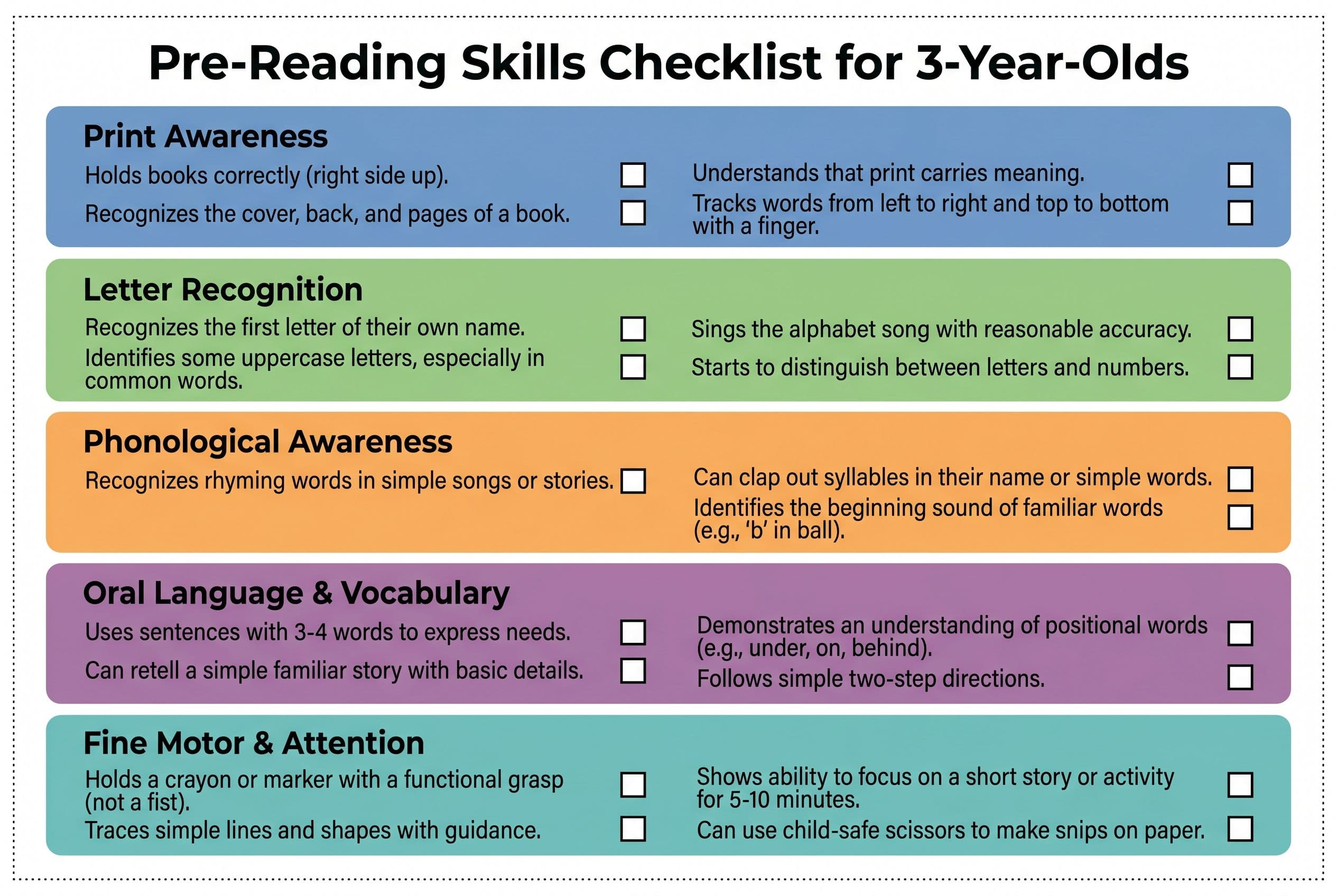
The Pre-Reading Skills Checklist for 3-Year-Olds
I've broken this into five categories. Grab a pen. Go through this list with your kid in mind. Be honest — nobody's grading you.
1. Print Awareness (Do They Understand What Books Are?)
- ✅ Holds a book right-side up
- ✅ Knows to turn pages left to right
- ✅ Points to words (even randomly) while "reading"
- ✅ Understands that the words on the page — not just the pictures — tell the story
- ✅ Can identify a book's front cover vs. back
This one's low-hanging fruit. If you're reading to your kid every day (you are, right?), they've probably picked up most of these. If not, start tonight.
2. Letter Recognition (The Bare Minimum)
- ✅ Recognizes and names at least 10 uppercase letters
- ✅ Can identify the letters in their own name
- ✅ Shows interest when they see letters in the environment (on signs, cereal boxes, etc.)
- ✅ Beginning to distinguish letters from numbers
Now — I said "at least 10." That's the floor, not the ceiling. My 4-year-old, Mei, knew all 26 uppercase letters by her third birthday. Not because she's a genius. Because we drilled them. Alphabet magnets on the fridge. Bath letters on the tub wall. "What letter is that on the stop sign?" in the car. Every. Single. Day.
But here's what matters more than letter names...
3. Phonological Awareness (The Big One)
This is it. This is the skill that predicts reading success better than IQ, better than socioeconomic status, better than how many books are in your house.
Phonological awareness is your child's ability to hear and play with the sounds in language — separate from meaning.
- ✅ Can clap out syllables (ba-NA-na = 3 claps)
- ✅ Recognizes rhyming words (cat/hat, sun/fun)
- ✅ Can produce a rhyming word ("What rhymes with dog?" → "log!")
- ✅ Notices when two words start with the same sound (ball and book both start with /b/)
- ✅ Can finish a compound word ("I'll say sun, you say... shine!")
Notice what's NOT on this list? Reading words. Writing letters. Sounding out C-A-T.
That comes later. Right now, at 3, your kid's brain needs to learn that words are made of sounds. This is phonological awareness at the preschool level, and it's the runway the reading plane takes off from.
David Kilpatrick's book Equipped for Reading Success (2016) lays out the research on this brilliantly. He explains orthographic mapping — the process by which the brain stores words for instant retrieval — and shows that it's most directly dependent on phonemic awareness (the ability to hear and manipulate individual sounds in words), which is the most advanced sub-skill within phonological awareness. Phonemic awareness, combined with letter-sound knowledge and actual decoding practice, is what makes orthographic mapping click. Weak phonemic awareness? Orthographic mapping stalls. Orthographic mapping stalls? No fluent reading. Period.
At age 3, you're building the broader phonological awareness skills — rhyming, syllable clapping, first-sound games — that pave the road toward phonemic awareness. It's a progression, and it starts here.
4. Oral Language & Vocabulary
- ✅ Uses sentences of 3-5 words or more
- ✅ Can tell a simple story (beginning, middle, end — even a messy one)
- ✅ Asks "why" and "what" questions constantly (yes, the WHY phase is actually good)
- ✅ Follows 2-step directions ("Get your shoes AND your jacket")
- ✅ Knows 1,000+ words (you won't count — just notice if they're chatty and expressive)
The Simple View of Reading, from Gough & Tunmer's 1986 research, gives us a clean formula: Reading Comprehension = Decoding × Language Comprehension. You can teach a kid to decode perfectly, but if their oral vocabulary is tiny, they'll read words they don't understand. That's not reading. That's a party trick.
So talk to your kid. Constantly. At the grocery store, in the bath, during dinner. Narrate your life like a podcast nobody subscribed to.
5. Fine Motor & Book Behaviors
- ✅ Can hold a crayon or marker (doesn't have to be "correct" grip yet)
- ✅ Scribbles with some intentional marks (circles, lines)
- ✅ Shows interest in "writing" — even if it's random scribbles they insist say something
- ✅ Can sit and attend to a story for 5-10 minutes
That last one matters more than you think. Attention is a muscle. If your kid can't sit through a 5-minute picture book at 3, you've got work to do — and the answer isn't a longer screen time session. It's more read-alouds, more often, until they build the stamina.
"But Should My 3-Year-Old Be Reading?"
Short answer: probably not, and that's fine.
Longer answer: some 3-year-olds can start blending three-letter words if their pre-reading skills are rock solid. My oldest, Ethan, started blending simple CVC words (cat, sit, hop) around 3.5 because he'd had a year of phonological awareness work and knew all his letter sounds. But I didn't push decoding at 3 as a goal. It happened naturally because the foundation was there.
The right question isn't "should a 3-year-old be reading?" The right question is: "Does my 3-year-old have the pre-reading skills that make learning to read possible?"
If the answer is no, that's not a reason to panic. It's a reason to start. Today.
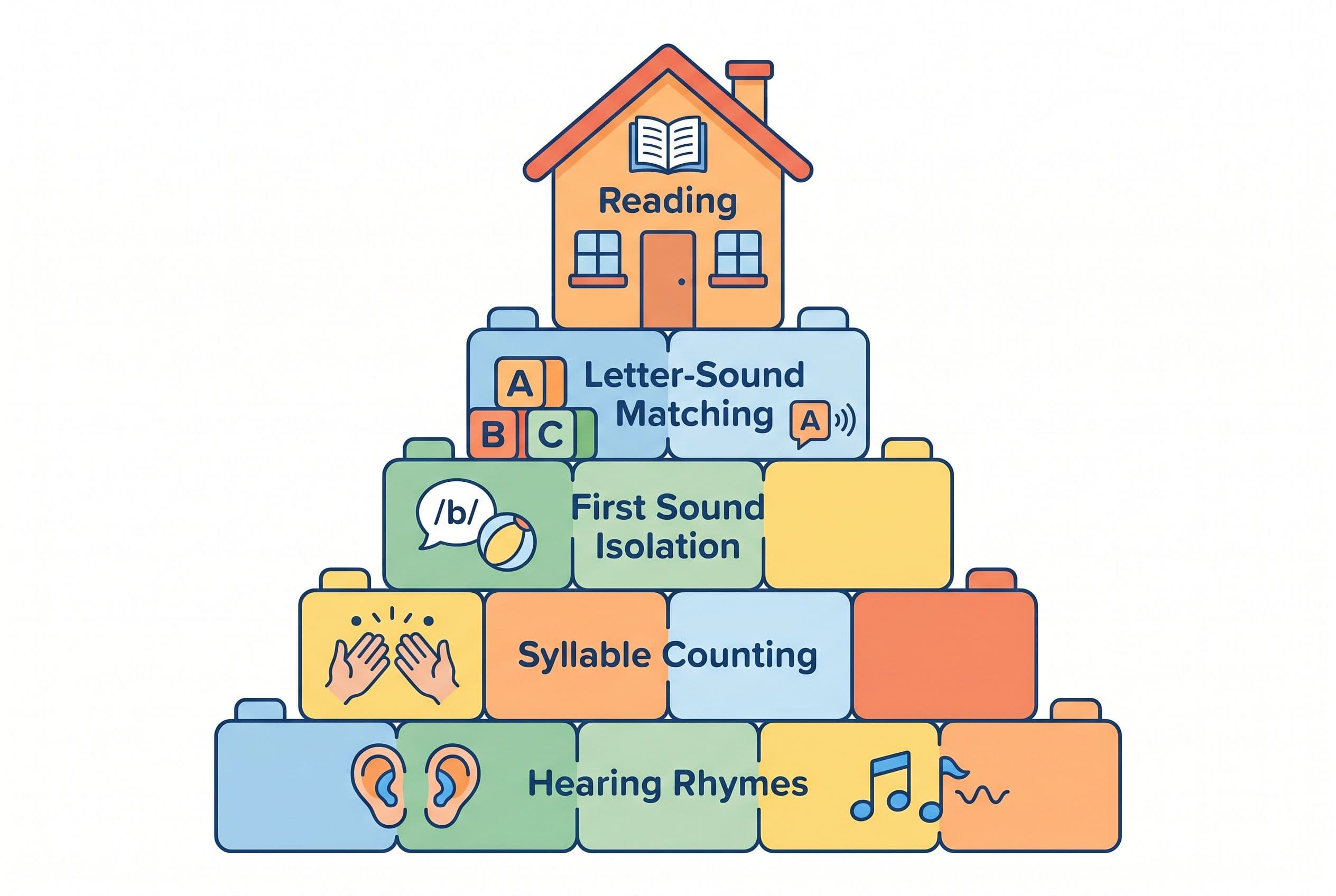
The Tiger Truth: What Happens If You Skip This
Real talk — I need to scare you a little. Because the "wait and see" crowd is loud, and they're wrong.
Here's what happens when you don't build pre-reading skills at 3:
Your child enters kindergarten behind. Many schools use early literacy screeners like DIBELS — Dynamic Indicators of Basic Early Literacy Skills — at or near the start of kindergarten. Measures like Letter Naming Fluency and First Sound Fluency identify kids who are at risk, and the cut scores vary by edition and district. But here's what doesn't vary: kids who show up at 5 with weak letter knowledge and no phonological awareness get flagged. And plenty of them arrive that way because nobody worked on letter recognition at 3.
They hit the 3rd grade cliff. Only 33% of 4th graders read at proficient level on the 2022 NAEP — that's the Nation's Report Card. Two out of three kids are below proficient. The Annie E. Casey Foundation's 2010 study found that children who can't read by 3rd grade are four times more likely to drop out of high school. Four times.
Catching up gets expensive. Private Orton-Gillingham tutoring runs $80-$150 per hour. Lindamood-Bell intensive programs can cost $10,000+ for a single session block. The Wilson Reading System is incredible for struggling readers, but it takes months of specialized instruction. Insurance doesn't cover any of it.
I was at a playground in Raleigh last year when another mom told me her kid's school had just switched from Lucy Calkins' Units of Study to a Science of Reading curriculum because of North Carolina's SB 387 — the Excellent Public Schools Act. She was confused and honestly a little annoyed. "He was doing fine before," she said. I asked if her son could read the word splint. He's in second grade. He could not. He looked at it, squinted, and said "split." Close — but that's a guess, not decoding. He couldn't process the /n/ tucked inside a consonant blend, because nobody had ever taught him to hear it.
I spent twenty minutes on that playground bench explaining why the switch was happening — Emily Hanford's APM Reports investigation Sold a Story (2023) that blew the lid off Balanced Literacy, the NAEP data showing reading scores dropped 3 points since 2019 (the largest decline in 30 years), the neuroscience from Stanislas Dehaene's lab at the Collège de France proving the brain doesn't learn to read naturally the way it learns to talk. She went home and watched the Sold a Story podcast that night. Texted me at 11 PM: "I had no idea. Why didn't anyone tell us this sooner?"
Because nobody tells you. That's why.
Mississippi figured this out. They passed the Literacy-Based Promotion Act in 2013, required evidence-based phonics instruction in every school, and went from 49th to 21st in national reading scores in six years. SIX YEARS. The whole state. Because they stopped guessing and started teaching.
Your kid doesn't have to wait for the state legislature to get its act together. You can start right now, at your kitchen table, when your child is 3.
How to Build These Skills Starting Today
OK so you've gone through the checklist. Maybe your kid nailed it. Maybe they're missing a few pieces. Either way, here's exactly what to do.
Step 1: Read Aloud 20+ Minutes Every Day (Non-Negotiable)
I don't care if you're tired. I don't care if it's Christmas. Tiger Rule #1: We Never Skip.
Read-alouds build vocabulary, print awareness, attention span, and story comprehension all at once. It's the single highest-ROI activity you can do with a 3-year-old. Pick books with rhyme and repetition — Chicka Chicka Boom Boom, Brown Bear Brown Bear, Dr. Seuss. These are phonological awareness machines disguised as picture books.
Step 2: Play Sound Games Every Day (5-10 Minutes)
Forget worksheets. Your 3-year-old needs oral phonological awareness games:
- Rhyme time in the car: "I'm thinking of a word that rhymes with ball." Take turns.
- Syllable clap: Clap the syllables of everything. Wa-ter-mel-on (4 claps). Dog (1 clap). Di-no-saur (3 claps).
- First sound isolation: "What sound does mommy start with? /m/!" Do this with every object you see.
- Odd one out: "Which word doesn't belong? Cat, can, ball." (Ball — it doesn't start with /k/.)
I did these games with Mei during bath time for months before we ever touched a letter sound. By the time we started mapping letters to sounds, she already understood that words are built from individual sounds. The letters just gave her something to attach those sounds to.
Step 3: Teach Letter Names AND Sounds Together
Here's where I break with some of the "letter names don't matter" crowd. Teach both. Kids are going to encounter letter names everywhere — the alphabet song, library programs, other kids. Don't confuse them by only teaching sounds.
But make sure you're teaching sounds from day one alongside names. "This is the letter B. It says /b/." Every time.
Alphabet magnets on the fridge. Letter puzzles. Foam bath letters. Alphabet books. The UFLI Foundations program, developed at the University of Florida, has excellent resources for understanding the systematic sequence of letter-sound introduction — even though it's designed for K-2, the letter-sound scope applies at the preschool level too.
Step 4: Build Vocabulary Through Conversation
Remember the Simple View of Reading. Decoding × Language Comprehension = Reading Comprehension. You're building the language comprehension half right now.
- Use big words and explain them. "That truck is enormous — that means really, REALLY big."
- Ask open-ended questions. Not "Did you like the park?" but "What was the best part of the park? Why?"
- Narrate constantly. "I'm chopping the carrots into thin slices. See how they're round? Like little orange circles."
Research on early language exposure — including the well-known Hart & Risley study from 1995 — suggests kids in language-rich homes hear millions more words by age 4 than kids in language-poor homes. Exact estimates vary across studies, but the core finding holds up: more rich, back-and-forth talk with your kid means a bigger vocabulary. And a bigger vocabulary means better reading comprehension down the road. The gap is real and it starts this early.
Step 5: Start Using Teach Your Kid to Read for Structured Practice
Look — the games and read-alouds and conversations are essential. But when you're ready for structured, systematic phonics instruction that follows Orton-Gillingham principles and the science of reading? That's where Teach Your Kid to Read comes in.
Our program is built for parents like you — parents who want to do this right, who don't want to cobble together Pinterest activities and hope for the best. It follows a systematic synthetic phonics sequence, introduces letter sounds in a research-backed order, and builds from phonological awareness through blending and into decodable reading.
For your 3-year-old, you can start with the foundational modules that focus on the exact skills on this checklist: letter-sound correspondence, phonological awareness games, and the beginnings of blending. By the time your kid is 4 or 5, they'll be reading CVC words — not because you forced it, but because the foundation was rock solid.
You can learn more at start lesson one free or call us at (407) 707-6850.
What About Screen Time and "Educational" Apps?
I know someone's going to ask, so let me head this off.
Most "educational" reading apps for 3-year-olds are garbage. I'm sorry. They teach kids to tap, swipe, and guess from pictures. That's not reading readiness — that's hand-eye coordination with a literacy sticker slapped on it.
If you're going to use screens (and let's be honest, sometimes you need 15 minutes to cook dinner without someone dangling from your leg), choose apps that explicitly teach letter-sound correspondence and phonological awareness through systematic instruction. Not ones that reward guessing from context clues.
The kicker is that Linnea Ehri's phases of word reading development — pre-alphabetic, partial alphabetic, full alphabetic, and consolidated alphabetic — show us exactly how children progress from non-reader to fluent reader. Most apps keep kids stuck in the pre-alphabetic phase, where they're just memorizing visual cues. The goal at 3 is to move them into partial alphabetic, where they start connecting at least some letters to sounds.
That's what real reading readiness looks like. Not tapping cartoon animals.
The "My Kid Isn't Interested" Excuse
I hear this one a lot. "My 3-year-old just doesn't like letters." "She won't sit still for a book." "He'd rather play trucks."
Of course he'd rather play trucks. He's 3. He'd also rather eat ice cream for dinner and skip baths forever. We don't let him do those things because we're the parents.
I'm not saying strap your toddler to a chair and drill flashcards for an hour. I'm saying: make it short, make it consistent, and make it non-negotiable.
Five minutes of letter sounds at the kitchen table. Every day. Five minutes of rhyming in the car. Every drive. One read-aloud before bed. Every night.
My son Liam (now 7, reading chapter books independently) went through a phase at 3 where he threw alphabet magnets at the cat instead of naming them. Did I stop? No. I picked up the magnets, redirected him, and we did it again the next day. And the day after that. Three weeks later, he was pointing out letters on every sign we passed. Kids resist new things. That's not a signal to quit. That's a signal to stay the course.
Red Flags: When to Get Help
Most 3-year-olds are still developing these pre-reading skills, and some variation is totally normal. But there are a few signs that warrant a conversation with your pediatrician or a speech-language pathologist:
- Can't hear or produce rhymes at all by age 3.5 (not even with practice)
- Very limited vocabulary — fewer than 200 words, or unclear speech that strangers can't understand
- No interest in books whatsoever — doesn't want to be read to, pushes books away consistently
- Difficulty following simple directions — not defiance, but genuine confusion
- Family history of dyslexia or reading difficulties — dyslexia is highly heritable, and early intervention is everything
If any of these ring true, don't wait and see. Get an evaluation. Kilpatrick's PAST test — the Phonological Awareness Screening Test — can be administered by a reading specialist and takes about 5 minutes. It'll tell you exactly where the phonological breakdown is. The earlier you catch it, the more you can do about it.
40+ states have now passed Science of Reading legislation since 2019. Your school district may have screening resources available for free. Call and ask.
The Bottom Line
Your 3-year-old doesn't need to read. But they need to be getting ready. And "getting ready" isn't passive — it's not "they'll pick it up when they're ready." It's active, daily, intentional work on the five skill areas in this checklist.
Print awareness. Letter recognition. Phonological awareness. Oral language. Fine motor skills and attention.
That's the runway. Build it now, and when your kid is 4 or 5 and ready to take off into actual reading, they'll soar. Skip it, and you're asking them to fly a plane without a runway.
I've watched it happen both ways. With my own kids and with hundreds of families who've reached out through TeachYourKidToRead.org. The kids who have the pre-reading foundation? They learn to read faster, with less frustration, and with more joy. Every time.
Start today. Five minutes. Your kitchen table. Go.
👉 Ready for a structured plan? Visit start lesson one free to see how Teach Your Kid to Read walks your family through every stage — from pre-reading skills at 3 to independent reading. Or call (407) 707-6850 and talk to a real person.
FAQ: Pre-Reading Skills for 3-Year-Olds
Should a 3-year-old be reading words?
Most 3-year-olds are not developmentally ready to decode words, and that's completely fine. The goal at 3 is building pre-reading skills — letter recognition, phonological awareness, oral vocabulary, and print awareness. Some 3-year-olds with strong foundations may begin blending simple CVC words (like "cat" or "sit") toward the end of their third year, but this is not the expectation or the benchmark. Focus on the checklist above.
How many letters should a 3-year-old recognize?
A reasonable literacy milestone for 3-year-olds is recognizing and naming at least 10 uppercase letters, including the letters in their own name. By age 4, you want all 26 uppercase letters and at least a handful of lowercase. But letter recognition by age 3 is just one piece — phonological awareness (hearing rhymes, clapping syllables) matters just as much, if not more.
What's the difference between phonological awareness and phonics?
Phonological awareness is the ability to hear and manipulate sounds in spoken language — rhyming, clapping syllables, isolating first sounds. It's entirely oral. Phonics is the system that connects those sounds to written letters (grapheme-phoneme correspondence). Phonological awareness comes first and is the foundation phonics sits on. You can't decode a word on paper if you can't hear the individual sounds in that word when someone says it out loud.
My child has a family history of dyslexia. Should I start earlier?
Yes. Absolutely. Dyslexia is highly heritable — if a parent or sibling has it, your child's risk is significantly higher than average. (Some studies estimate 40-60%, though exact numbers vary depending on the research and the family relationship.) Early, explicit, systematic phonological awareness training starting at age 3 (or even earlier) is the best intervention research supports. Don't wait for a formal diagnosis — build the pre-reading skills aggressively now. Kilpatrick's PAST test can screen for phonological weaknesses in children as young as mid-kindergarten, but you can start building the skills at home well before that.
How do I know if my 3-year-old is "on track" for reading?
Use the checklist in this article as your guide. If your child can recognize several letters, hear and produce rhymes, speak in 3-5 word sentences, sit through a short picture book, and shows awareness that print carries meaning, they're building a solid foundation. If they're missing multiple areas, don't panic — but don't wait either. Start working on the gaps today with intentional daily practice. Five minutes a day adds up fast.
Part of these guides

Xia Brody
Co-Founder, Teach Your Kid to Read
Mom of 4 who has successfully taught her kids to read. Currently in the trenches with her 4-year-old while her two oldest (10 and 7) devour books on their own. Passionate about phonics-based methods and building a lifelong love of reading.
Related Articles
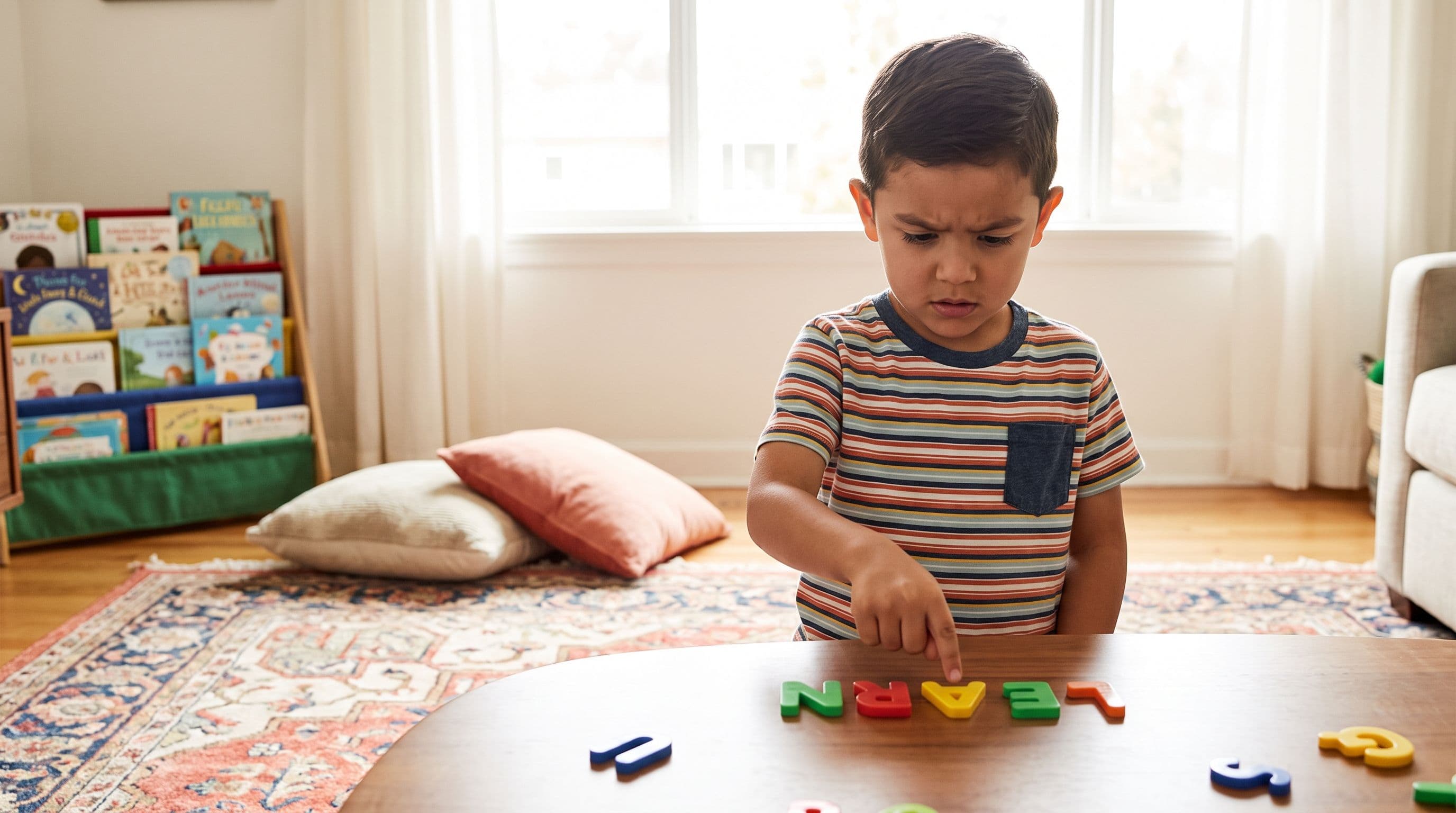
Is My 4-Year-Old Behind in Reading? Here's What's Normal (and What's Not)
Most 4-year-olds shouldn't be reading yet — but they absolutely should be building specific pre-reading skills. Here's how to tell if your child is on track, what the real warning signs look like, and what to do right now if they're not.
Read More →
Reading Readiness Checklist for 5-Year-Olds: Free Printable + Parent Guide
Is your 5-year-old ready to read? Most parents can't answer that question — because nobody gave them the right checklist. Here's the one I use with my own kids, backed by reading science, not wishful thinking.
Read More →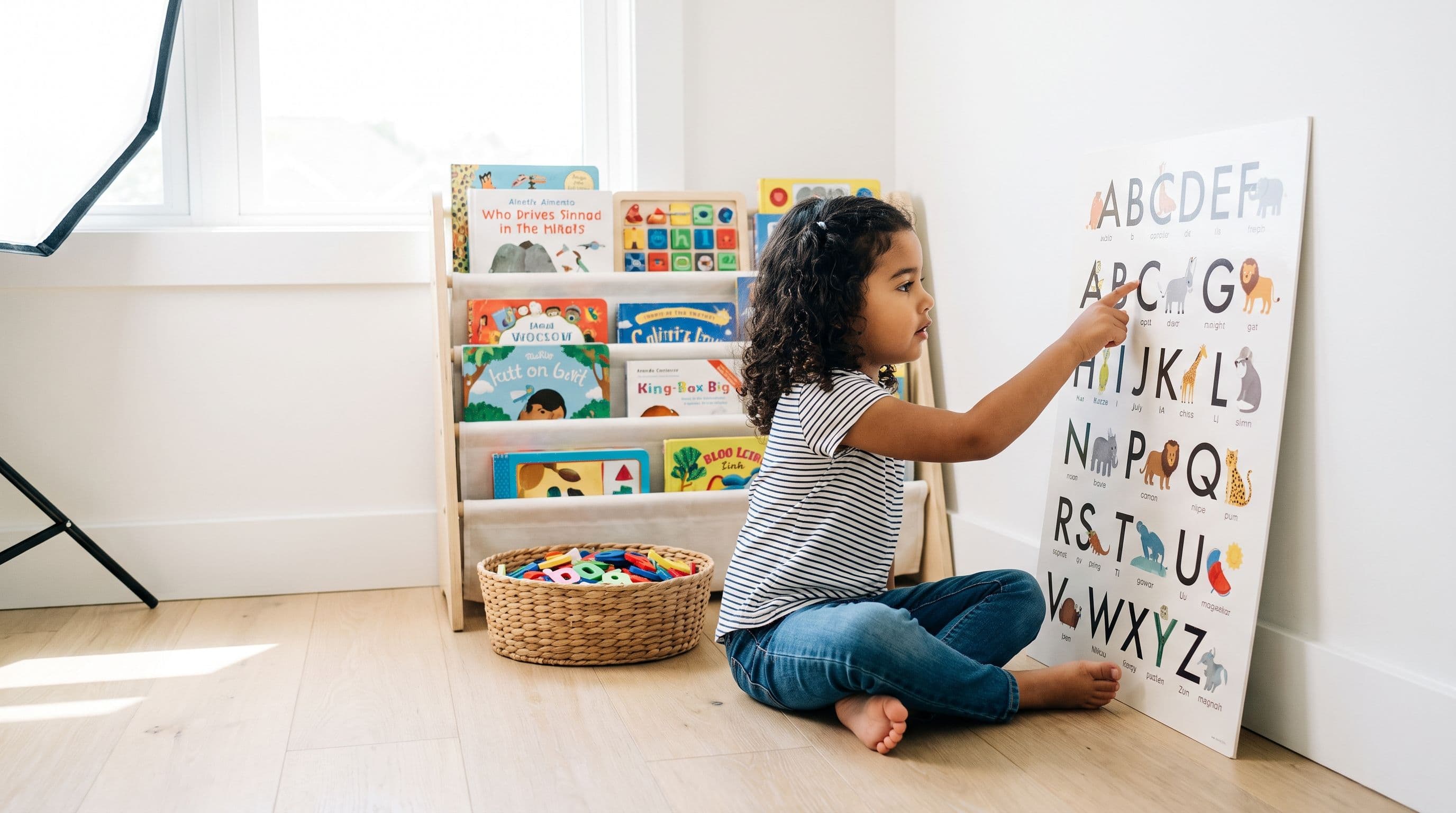
Reading Readiness Checklist for 4-Year-Olds: Free Printable + Parent Guide
Is your 4-year-old ready to start reading? This free reading readiness checklist covers every pre-reading skill that matters — phonological awareness, letter knowledge, print concepts, and more — with clear action steps if your child isn't there yet.
Read More →