First Grade Reading Level: Skills, Books & Red Flags (2026 Guide)

What You'll Learn
- The specific reading benchmarks your first grader should hit by fall, winter, and spring — with real numbers, not vague reassurances
- The one mistake 90% of parents make when their kid gets stuck on a word (hint: it feels helpful but it's actually training them to guess)
- Red flags that scream "intervene now" — and why your child's teacher might not be telling you about them
- Exactly which books a first grader should be reading at each stage — and which popular "leveled readers" are actually making things worse
The Truth About First Grade Reading That Nobody Warns You About
First grade is not "the year your kid learns to read." First grade is the year you find out whether everything you did (or didn't do) in the last three years actually worked.
Here's what I mean. By the time your kid walks into that first grade classroom, the clock is already ticking. They've got roughly two years before the 3rd Grade Cliff — the point where kids stop learning to read and start reading to learn. Every subject. Every test. Every assignment. It all requires reading.
And if your first grader can't decode words right now? They're not "developing at their own pace." They're falling behind a train that doesn't slow down.
Only 33% of 4th graders in the United States read at a proficient level on the 2022 NAEP — that's the Nation's Report Card. Let that number sit with you for a second. Two out of every three kids in this country reach fourth grade without solid reading skills. And most of those kids were already struggling in first grade, while their parents were being told, "Don't worry, it'll click."
It doesn't just click. You build it.
What Reading Level Should a First Grader Be At?
OK so let's get specific, because vague answers help nobody.
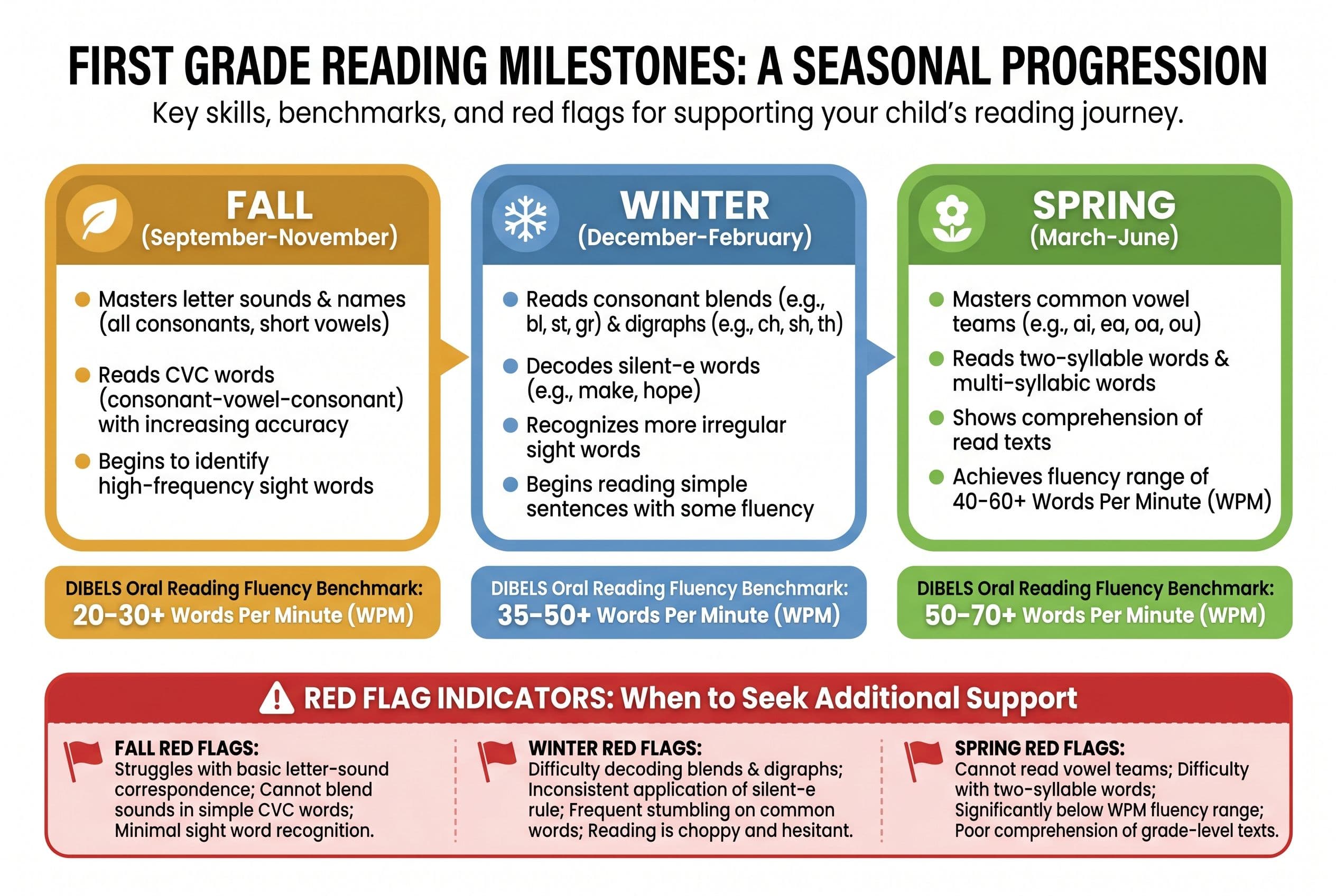
First grade reading expectations aren't one fixed target — they're a moving progression across the school year. I'm going to give you the actual benchmarks that reading specialists and schools use, broken down by season.
One quick note: DIBELS benchmarks vary by edition (6th vs. 8th) and by district, so your school's specific cut scores might look slightly different. Use the numbers below as a sanity check — and ask your child's school for their official benchmark chart.
Fall of First Grade (September–November)
Your child should be able to:
- Recognize and produce all 26 letter sounds — not just letter names. "B says /b/" not "B is bee."
- Blend CVC (consonant-vowel-consonant) words fluently: cat, sit, mop, fun. Not slowly. Not painfully. Fluently.
- Read 10-20 high-frequency sight words: the, and, is, it, he, she, was, for, you, they.
- Read simple decodable sentences like "The cat sat on the mat" without guessing from pictures.
On DIBELS 8th Edition, the Nonsense Word Fluency–Correct Letter Sounds (NWF-CLS) benchmark at the beginning of first grade is about 28+ correct letter sounds per minute. That tells you whether your kid can actually decode — not just recognize memorized words.
Winter of First Grade (December–February)
This is where things accelerate hard:
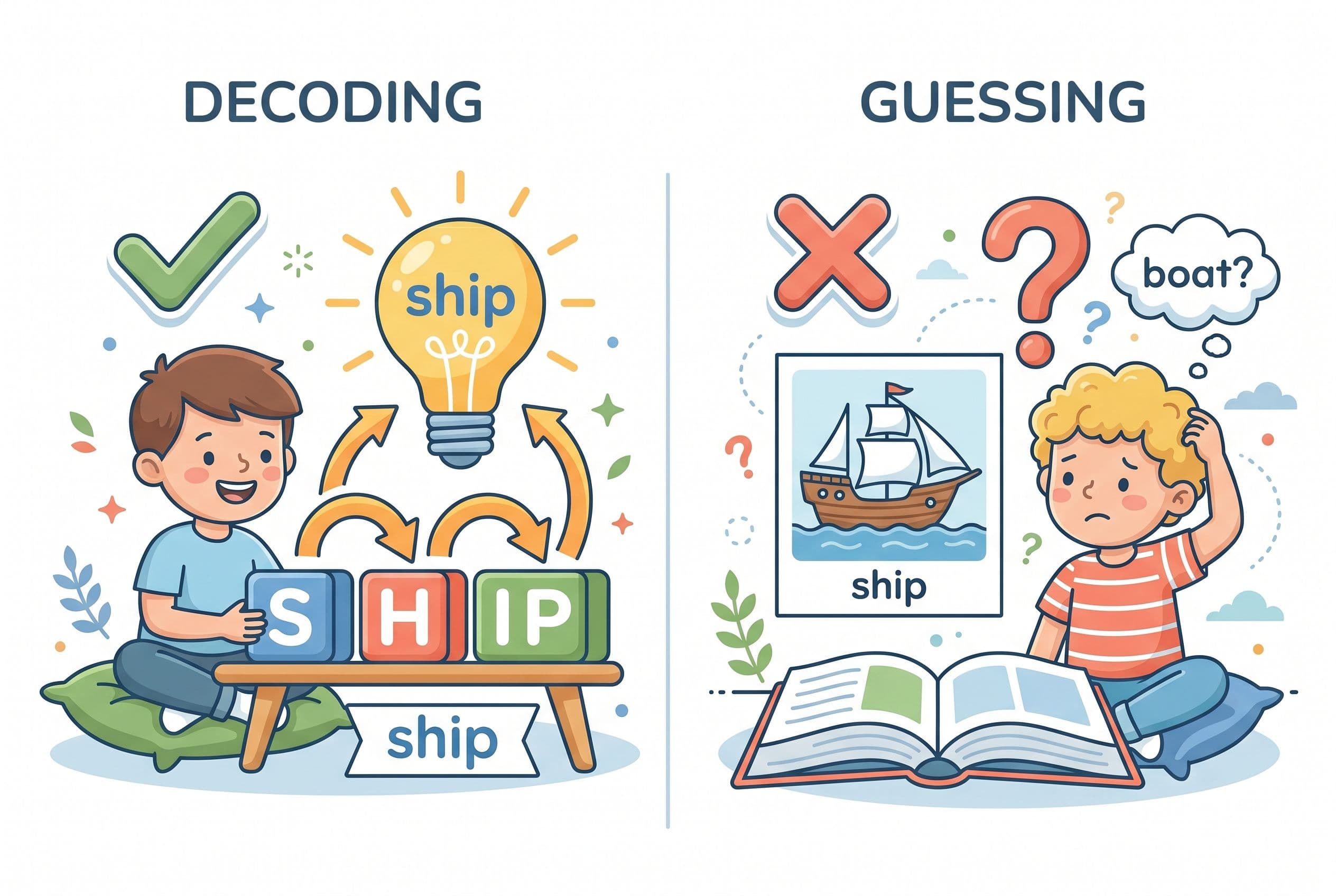
- Consonant blends and digraphs: sh, ch, th, bl, cr, sp, st. Your kid should read "ship" and not say "sip."
- Silent-e words: make, bike, hope, cute. They should know the rule, not guess.
- 50+ sight words recognized automatically.
- Oral reading fluency (DIBELS 8th: ORF-WCPM) around 20-40 words correct per minute on grade-level passages.
Spring of First Grade (March–June)
By the end of the year, a first grader should be able to:
- Decode one- and two-syllable words with common patterns (vowel teams like "ea" and "ai," r-controlled vowels like "car" and "bird").
- Read 100+ sight words automatically.
- Read aloud at 40-60+ words correct per minute (DIBELS 8th: ORF-WCPM) with accuracy and basic expression.
- Answer simple comprehension questions about a passage they just read.
- Self-correct when something doesn't make sense — and I mean using phonics to self-correct, not just looking at the picture again.
The DIBELS 8th Edition oral reading fluency benchmark by the end of first grade is 40+ words correct per minute. If your kid is below 20, that's a red flag. If they're below 10, that's a five-alarm fire.
If Your First Grader Isn't There Yet
First grade is where the gap between "learning to decode" and "guessing and hoping" opens up, and it's also the cheapest year to close it. A first grader who's behind in October and gets 10-15 minutes of real phonics a day is usually caught up by spring. The same kid with "wait and see" is the 3rd grader in the intervention group.
Before you do anything else, find out which kid you have. Ask them to read "ship," "chop," "flag," "stem," "mask" with no pictures. Stalling, or guessing a different word that starts the same way, means the blending isn't automatic. Two minutes, and you know. take the 2-minute reading check for an age-adjusted read.
If blending isn't automatic, Teach Your Kid to Read is the fix I use with my own kids: systematic synthetic phonics, decodable text, no guessing from pictures. Lesson one is free with no card, then a 7-day trial, then $9.95 a month. start lesson one free and keep reading this guide for the books and red flags.
The Books Your First Grader Should Be Reading (And the Ones to Ditch)
This is where parents get tripped up hard.
Schools love to send home "leveled readers" — those little books organized by Fountas & Pinnell levels (A through Z). Your kid comes home with a Level D or E book and you think, great, they're progressing. But here's the thing: many leveled readers used in Balanced Literacy classrooms are packed with predictable text and picture-supported patterns. They're designed so kids can "read" the book by looking at pictures and guessing the words. That's not reading. That's a magic trick.
Here's a quick litmus test: if your kid can "read" the book by looking at the pictures and the sentence pattern without actually decoding the words on the page — if the book is full of spelling patterns they haven't been taught yet — it's a guessing book. Ditch it.
I had my 7-year-old bring home a leveled reader once where the sentence was "The horse is running in the field" and the picture literally showed a horse running in a field. My kid could have "read" that book without knowing a single phonics rule. That's the problem.
What to Look for Instead: Decodable Readers
Decodable readers are books where 90%+ of the words follow phonics patterns the child has already been taught. The kid can't guess — they have to actually decode.
Here's what I recommend at each first grade stage:
Fall (CVC stage):
- Bob Books Set 1 and Set 2
- UFLI Foundations decodable texts (free online — seriously, the University of Florida gives these away)
- Primary Phonics by Barbara Makar
Winter (blends, digraphs, silent-e):
- Flyleaf Publishing decodable readers — these are hands down some of the best on the market
- High Noon Books (specifically designed for struggling readers but great for any first grader)
- Bob Books Set 3 and Set 4
Spring (vowel teams, multisyllabic words):
- Explode the Code readers
- Dog on a Log decodable chapter books (my 7-year-old devoured these)
- Real, simple chapter books: Frog and Toad, Henry and Mudge, Nate the Great
The kicker is that once your kid is genuinely decoding, they can start reading books they actually care about. My oldest went from decodable readers to the Magic Tree House series in about four months once phonics mastery clicked into place.
Red Flags: Is My First Grader Behind in Reading?
Let me tell you what keeps me up at night. It's not the kid who's clearly struggling — at least that kid might get help. It's the kid who looks fine on the surface because they've memorized a bunch of words and learned to guess from context.
Linnea Ehri's phases of word reading development describe this perfectly. A child stuck in the "partial alphabetic" phase can recognize some words by their first letter or shape but can't fully decode unfamiliar words. They look like they're reading. They're not. They're performing.
Red Flags That Demand Action
Watch your first grader read out loud. Sit next to them. Pay attention. Here are the specific warning signs:
🚩 They guess words based on the first letter. "House" becomes "horse." "Went" becomes "want." They glance at the first letter and fill in the rest from context or pictures.
🚩 They can't read nonsense words. Ask your kid to read "bim," "tof," or "speg." If they can't blend these, they don't have decoding skills — they have memorization skills. And memorization runs out around second grade when the words get too long and numerous.
🚩 They skip or substitute small words. Swapping "a" for "the," skipping "was," replacing "said" with "says." These look like tiny errors but they signal that the child is reading from memory and context, not from the actual letters on the page.
🚩 They resist reading aloud. A child who avoids reading, cries during reading time, or says "I'm stupid" is telling you something. Listen.
🚩 They can't segment sounds in spoken words. Say "cat." Ask them to tell you each sound: /k/ - /æ/ - /t/. If they can't do this with 3-sound words, their phonemic awareness — the foundational skill beneath all of reading — has gaps. David Kilpatrick's PAST (Phonological Awareness Screening Test) can pinpoint exactly where the breakdown is, and it takes about five minutes to administer.
🚩 Their reading fluency is below 20 words correct per minute by winter. This isn't "slow but normal." This is a kid who needs intervention yesterday.
Why "Wait and See" Is the Most Dangerous Advice in Education
I was at a playground in Raleigh last spring when another mom found out I teach reading. Her son's school had just switched from Lucy Calkins Units of Study to a Science of Reading curriculum because of North Carolina's SB 387 — the Excellent Public Schools Act. She was confused and honestly a little annoyed. "He was doing fine before," she told me.
I asked if her son could read the word "splint." He was in second grade. He could not.
He stared at it, said "split," then "plant," then shrugged. Classic partial-alphabetic reader — grabbing at familiar letter chunks and guessing. This is exactly what Stanislas Dehaene describes in Reading in the Brain (2009): the brain doesn't learn to read naturally the way it learns to speak. Reading requires explicit instruction that physically rewires the visual cortex to map letters onto sounds. Without that systematic training, kids develop workarounds. Guessing strategies. Coping mechanisms that look like reading until the words get hard enough to expose the gaps.
I spent twenty minutes on that playground bench explaining why her son's school made the switch — Emily Hanford's Sold a Story investigation, the NAEP data showing reading scores dropped 3 points since 2019 (the largest decline in 30 years), the decades of research from the National Reading Panel that schools had simply... ignored. She went home and listened to the Sold a Story podcast that night. Texted me at 11 PM: "I had no idea. Why didn't anyone tell us this sooner?"
Real talk — nobody tells you because the system failed parents for thirty years. Whole Language and Balanced Literacy approaches dominated American schools since the 1990s, teaching kids to guess words from pictures, skip words they didn't know, and memorize sight words by shape. It didn't work. It was never going to work. And now over 40 states have passed Science of Reading legislation since 2019 trying to undo the damage.
Mississippi figured this out first. Their Literacy-Based Promotion Act of 2013 required evidence-based phonics instruction and third-grade retention for kids who couldn't read. They went from 49th to 21st in national reading scores in six years. Six years. That's not a coincidence. That's what happens when you stop guessing and start teaching.
But here's what scares me: your kid can't wait for their school to catch up. Policy changes take years to reach classrooms. Your first grader is in first grade right now.
What Happens If Your First Grader Doesn't Catch Up
I'm not going to sugarcoat this.
The Annie E. Casey Foundation's 2010 study found that children who can't read proficiently by the end of third grade are four times more likely to drop out of high school. Four times. For low-income kids who couldn't read at grade level, the dropout rate was almost six times higher than proficient readers.
And the financial cost of catching up later? A private Orton-Gillingham tutor runs $80-$150 per hour, two to three sessions a week, for one to three years. Do the math: that's $10,000-$25,000 per year, and insurance doesn't cover it. The Wilson Reading System is phenomenal for kids with dyslexia indicators (it uses 12 structured steps and controlled readers), but getting a spot in a Wilson-certified program can mean waiting lists months long.
None of this accounts for the emotional damage. I've talked to parents whose kids were diagnosed in fourth or fifth grade after years of being told they were "lazy" or "just not a reader." Those kids internalized a belief about themselves that takes years of therapy to undo.
First grade is your window. It's wide open right now. Don't let someone close it with "wait and see."
How to Get Your First Grader on Track (The Action Plan)
OK, here's where we roll up our sleeves.
Whether your kid is right on track, slightly behind, or setting off alarm bells, here's exactly what to do.
Step 1: Assess Where They Actually Are
Don't trust the report card. Don't trust the leveled reader that came home in the backpack. Test them yourself.
- Nonsense word test: Write down 10 nonsense CVC words (bim, tof, ral, pug, ven, etc.). Can they blend and read each one? If not, phonics foundations have gaps.
- Kilpatrick's PAST test: You can find this in Equipped for Reading Success (2016) or ask your child's school if they administer it. It takes five minutes and shows you exactly where phonological awareness breaks down.
- Oral reading fluency: Have them read a grade-level passage aloud for one minute. Count the words read correctly. Compare to DIBELS benchmarks: beginning of first grade = 8-20 WCPM, middle = 23-47 WCPM, end = 40-60+ WCPM.
Step 2: Fill the Phonics Gaps Systematically
You can't skip steps. The Simple View of Reading (Gough & Tunmer, 1986) tells us reading comprehension = decoding × language comprehension. If decoding is zero, comprehension is zero. Period.
Work through phonics in order:
- Letter-sound correspondence (all 26 consonants and short vowels)
- CVC blending (cat, sit, hop)
- Consonant digraphs (sh, ch, th, wh)
- Consonant blends (bl, cr, st, sp, spl, str)
- Silent-e / CVCe words (make, bike, hope)
- Vowel teams (ea, ai, oa, ee, igh)
- R-controlled vowels (ar, er, ir, or, ur)
- Multisyllabic word strategies
Spend 15-20 minutes a day. Every day. Yes, on birthdays. Yes, on vacation. That's a Tiger Rule in our house: We Never Skip.
Step 3: Use the Right Tools
Teach Your Kid to Read was built on systematic synthetic phonics — the same Orton-Gillingham principles that the National Reading Panel confirmed work, the same approach Mississippi used to climb 28 spots in national rankings. It walks your child through every phonics skill in order, with built-in practice that requires real decoding — no guessing from pictures, no skipping words, no shortcuts.
The program gives you exactly what a $120/hour reading specialist would: explicit instruction, controlled practice, and immediate correction. Except you can do it at your kitchen table in your pajamas at 7 AM. (I speak from experience.)
Step 4: Practice With Decodable Texts Every Day
After the lesson, your kid reads. Real books. Decodable books matched to whatever phonics skill they just practiced.
My 4-year-old is in the CVC stage right now, so she reads Bob Books Set 1 after every lesson. When she finishes a book, she gets to put a sticker on her reading chart. (Tiger moms can still use stickers. We contain multitudes.)
For first graders, cycle through the decodable reader recommendations I listed above. Match the book to their current phonics level. If they can read 95%+ of the words accurately, the book is at the right level. Below 90%? Too hard. Above 98%? Time to move up.
Step 5: Build Sight Word Automaticity (the Right Way)
Here's a misconception I need to kill: sight words are not words you memorize by shape. Sight words are words you've decoded so many times that they become automatic — what David Kilpatrick calls orthographic mapping. Your brain stores the word's spelling, pronunciation, and meaning together so you recognize it instantly.
The right way to teach sight words:
- Sound out the word phonetically (even irregular ones — "said" is /s/ /ɛ/ /d/, the "ai" just makes an unexpected sound)
- Identify which part is regular and which part is "tricky"
- Practice reading it in connected text multiple times
- Review until it's automatic
Do NOT flash a card and say "this word is 'the' — just remember it." That's whole-word memorization, and it maxes out around 200-300 words before the child's memory becomes overloaded. Phonics-based orthographic mapping, on the other hand, is unlimited.
First Grade Reading Milestones: A Quick-Reference Chart
I know I threw a lot of numbers at you. Here's the bottom line, all in one place.
| When | What They Should Do | Red Flag If... |
|---|---|---|
| Fall 1st Grade | Blend CVC words, know all letter sounds, read 10-20 sight words | Can't blend 3-sound words at all |
| Winter 1st Grade | Read blends/digraphs/silent-e, 50+ sight words, 20-40 WPM | Below 20 WPM, still guessing from pictures |
| Spring 1st Grade | Vowel teams, 100+ sight words, 40-60+ WPM, basic comprehension | Below 30 WPM, can't read unfamiliar words |
Print this out. Stick it on the fridge. Check in monthly.
But My Kid's Teacher Says They're Fine
Look, I have enormous respect for teachers. Enormous. They're underpaid, overwhelmed, and often handed a curriculum that doesn't work and told to make it work anyway.
But here's what I need you to understand: a classroom teacher with 22 kids does not have time to give your child the individual reading assessment and intervention they might need. Many teachers were trained in Balanced Literacy programs during their education degrees — programs that are now being recognized as scientifically unsupported. It's not the teacher's fault. But it's your kid's problem.
If your gut says something is off, trust your gut. Get an independent assessment. Ask the school for DIBELS scores. Administer Kilpatrick's PAST yourself. Request a meeting with the reading specialist — not the classroom teacher, the reading specialist.
And if you don't want to wait for the school system to figure it out? Start at home. Tonight. Fifteen minutes of systematic phonics. That's all it takes to start.
Frequently Asked Questions About First Grade Reading Level
What level should my first grader be reading at by the end of the year?
By the end of first grade, most children should read grade-level text at 40-60+ words correct per minute with at least 95% accuracy. They should decode one- and two-syllable words with common phonics patterns, recognize 100+ high-frequency words automatically, and answer simple comprehension questions about what they read. On DIBELS 8th Edition oral reading fluency measures (ORF-WCPM), the benchmark is 40+ words correct per minute by spring.
How many sight words should a first grader know?
A first grader should know roughly 10-20 sight words by fall, 50+ by winter, and 100+ by spring. But here's the important part: these words should be learned through phonics-based orthographic mapping, not pure memorization. Kids who memorize words by shape hit a ceiling around 200-300 words. Kids who learn the letter-sound relationships within sight words can store an unlimited number.
Is my first grader behind in reading?
If your first grader can't blend three-sound words (like "cat" or "sit") by October, that's a concern. If they're below 20 words correct per minute on oral reading fluency by January, that's a significant concern. If they guess at words by looking at pictures, skip unfamiliar words, or can't read simple nonsense words like "bim" or "tof," they have phonics gaps that need explicit instruction. Don't wait for the school to tell you — test them yourself using Kilpatrick's PAST or the nonsense word test described above.
What's the difference between leveled readers and decodable readers?
Leveled readers (like those organized by Fountas & Pinnell A-Z levels) are sorted by text complexity but often rely on pictures and predictable patterns so kids can "read" without actually decoding. Decodable readers contain words that follow phonics patterns the child has been explicitly taught, requiring real decoding skill. Research overwhelmingly supports decodable readers for beginning readers. Once a child has strong decoding foundations (usually mid-to-late first grade), they can transition to authentic literature.
Should I be worried if my first grader is a slow reader?
Speed alone isn't the whole picture — accuracy and decoding ability matter more. A child who reads slowly but accurately is in a much better position than a child who reads quickly but guesses at half the words. That said, fluency does matter because it frees up mental energy for comprehension. If your child is significantly below DIBELS benchmarks (under 20 WCPM by mid-year), they likely need more practice with decodable texts at their current phonics level. Build accuracy first, then speed will follow.
Your First Grader Can't Wait
I talk to parents every single week who say the same thing: "I wish I'd started sooner."
Nobody ever says, "I wish I'd waited longer."
Your first grader has about 18 months before the 3rd Grade Cliff. That sounds like a lot. It's not. Phonics mastery takes consistent daily practice over months. You can't cram reading the way you crammed for your college finals.
But here's the good news: 15-20 minutes a day of systematic phonics instruction, using the right methodology, works. The research is overwhelming. The National Reading Panel proved it. Mississippi proved it. And I've watched it work in my own living room, four kids deep.
Teach Your Kid to Read gives you the exact system — systematic synthetic phonics, in the right order, with decodable practice built in. No guessing. No skipping. No "wait and see." Just a parent and a kid and 15 minutes a day.
Start today at start lesson one free or call us at (407) 707-6850. Your first grader's future reading life depends on what you do right now. Not next month. Not when the school "figures it out." Right now.
Part of these guides

Xia Brody
Co-Founder, Teach Your Kid to Read
Mom of 4 who has successfully taught her kids to read. Currently in the trenches with her 4-year-old while her two oldest (10 and 7) devour books on their own. Passionate about phonics-based methods and building a lifelong love of reading.
Related Articles
My First Grader Can't Read? The 90-Day Catch-Up Plan
If your 6-year-old is guessing at words, memorizing books, or melting down at the page, you don't have a motivation problem — you have an instruction problem. Here's the exact 90-day catch-up plan I'd run, starting tonight.
Read More →
Best Reading App for 1st Graders in 2026: 6 Apps Tested Side by Side
Not all reading apps are created equal — most first grade reading apps teach kids to guess, not read. I tested 6 of the most popular ones with my own kids and broke down exactly which ones use real phonics and which are dressed-up screen time.
Read More →
Is My 2nd Grader Behind in Reading? 9 Signs
Wondering if your 2nd grader is behind in reading? Here are the real warning signs, what 2nd graders should be able to do, and what to do next if your child is guessing, slow, or stuck.
Read More →