Reading Comprehension by Grade Level: K–5 Benchmarks for 2026

What You'll Learn
- The difference between decoding and comprehension — and why your kid can "read" a whole book and remember nothing from it
- Specific comprehension benchmarks for every grade from kindergarten through 5th — so you stop guessing whether your child is on track
- The one reading comprehension red flag that shows up in 2nd grade and gets misdiagnosed as "just not being a reader" for years
- The exact action steps I use with my own kids to build real comprehension — not the fake "just ask them questions" advice
Your Kid Can Read Every Word and Still Be Lost
Let me paint you a picture that should genuinely scare you.
Your 2nd grader picks up a book, reads every single word out loud — fluently, even — and when you ask "What happened in the story?" they stare at you like you asked them to explain cryptocurrency. Blank. Nothing. Maybe they parrot back the last sentence they read.
That's not reading. That's word-calling.
And honestly? And it's happening everywhere — not just your kid's school. Parents hear their kid sounding fluent and think, "We're good. Reading: checked off the list." But decoding and comprehension are two completely different cognitive processes. The Simple View of Reading — that's the framework from Gough and Tunmer's 1986 research — lays it out as a literal equation: Reading Comprehension = Decoding × Language Comprehension. Multiply anything by zero and you get zero.
Your kid can decode at a 3rd-grade level and comprehend at a kindergarten level. And nobody will catch it until the work gets hard.
The Tiger Truth: What Happens When Comprehension Falls Behind
Let me hit you with the numbers because honestly, they're brutal.
On the 2022 NAEP — the Nation's Report Card, basically the gold standard for how we measure reading nationally — only 33% of 4th graders scored "proficient" or above in reading. One-third. That's it. The 2023 scores? They dropped another 3 points from 2019. Largest decline in 30 years.
Let that sink in — two out of every three American 4th graders can't read at a proficient level, according to the 2022 NAEP (that's the Nation's Report Card, the biggest national assessment we've got). Two. Thirds.
And here's what most people don't realize: a huge chunk of that failure isn't decoding. It's comprehension. Back in 2010, the Annie E. Casey Foundation put out a report that should've made every parent in America lose sleep — kids who aren't reading proficiently by the end of 3rd grade are four times more likely to drop out of high school, and the academic struggles pile up fast from there. Proficiency includes both decoding and comprehension, but comprehension is a huge piece of the "why." That stat haunts me every time I sit down at the kitchen table with my 4-year-old and her CVC flashcards.
The 3rd Grade Cliff is real, and comprehension is the invisible edge most parents don't see until their kid falls off it. Through 2nd grade, kids are "learning to read." Starting in 3rd grade, they're "reading to learn." Science textbooks. Social studies passages. Word problems in math that assume you can extract meaning from a paragraph.
If comprehension isn't there by 3rd grade, every single subject starts to crumble. Not just reading. Everything.
Comprehension vs. Decoding: Why Both Matter (But Differently at Each Grade)
I need to clear something up because I see parents confuse this constantly.
Decoding is the ability to look at printed letters and turn them into sounds. It's the phonics piece. Sounding out "splint" letter by letter — /s/ /p/ /l/ /ɪ/ /n/ /t/ — and blending those sounds into a word. This is the skill Kilpatrick's research on orthographic mapping addresses: how the brain maps spelling patterns to pronunciation until word recognition becomes automatic.
Comprehension is what your brain does with those words once it decodes them. It's building a mental model of what the text means. Making inferences. Connecting new information to stuff you already know. Monitoring whether the text makes sense as you go.
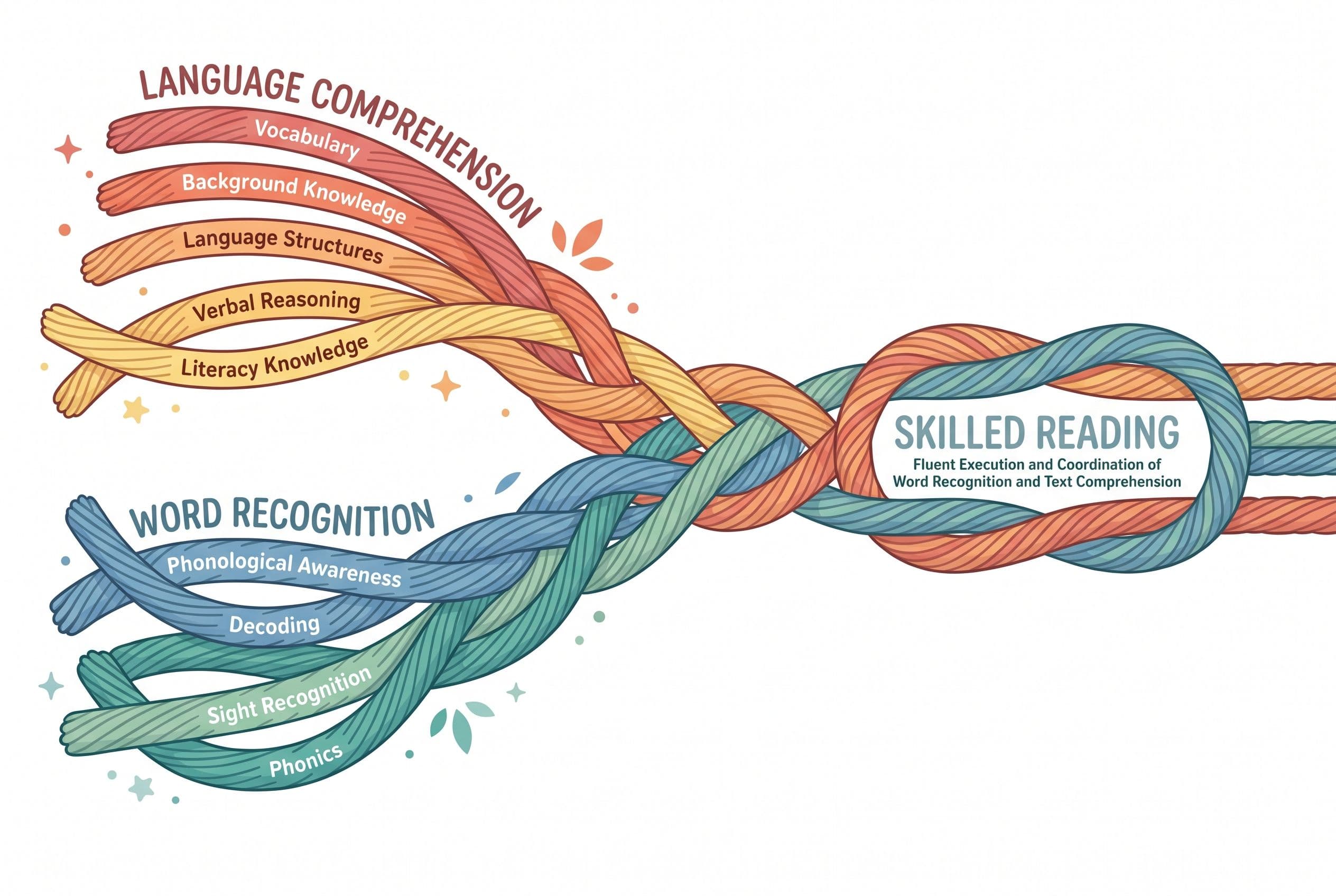
Scarborough's Reading Rope — you might've seen that braided-rope diagram — shows this beautifully. The bottom strands are word recognition (phonics, decoding, sight recognition). The top strands are language comprehension (vocabulary, background knowledge, verbal reasoning, literacy knowledge). Both sets of strands have to braid together into skilled reading.
Here's the kicker: in early grades (K–1), almost all the action is in the bottom strands. Decoding. Phonics. Learning the code. But by 2nd and 3rd grade, the top strands start carrying more and more weight. A kid who decoded fine but never built vocabulary, background knowledge, and inference skills? They hit a wall.
And the wall is comprehension.
Reading Comprehension by Grade Level: The Real Benchmarks
OK — here's what you actually came for. Grade by grade, here's what comprehension actually looks like — not the watered-down "your child should enjoy books" nonsense from your school newsletter. Real benchmarks.
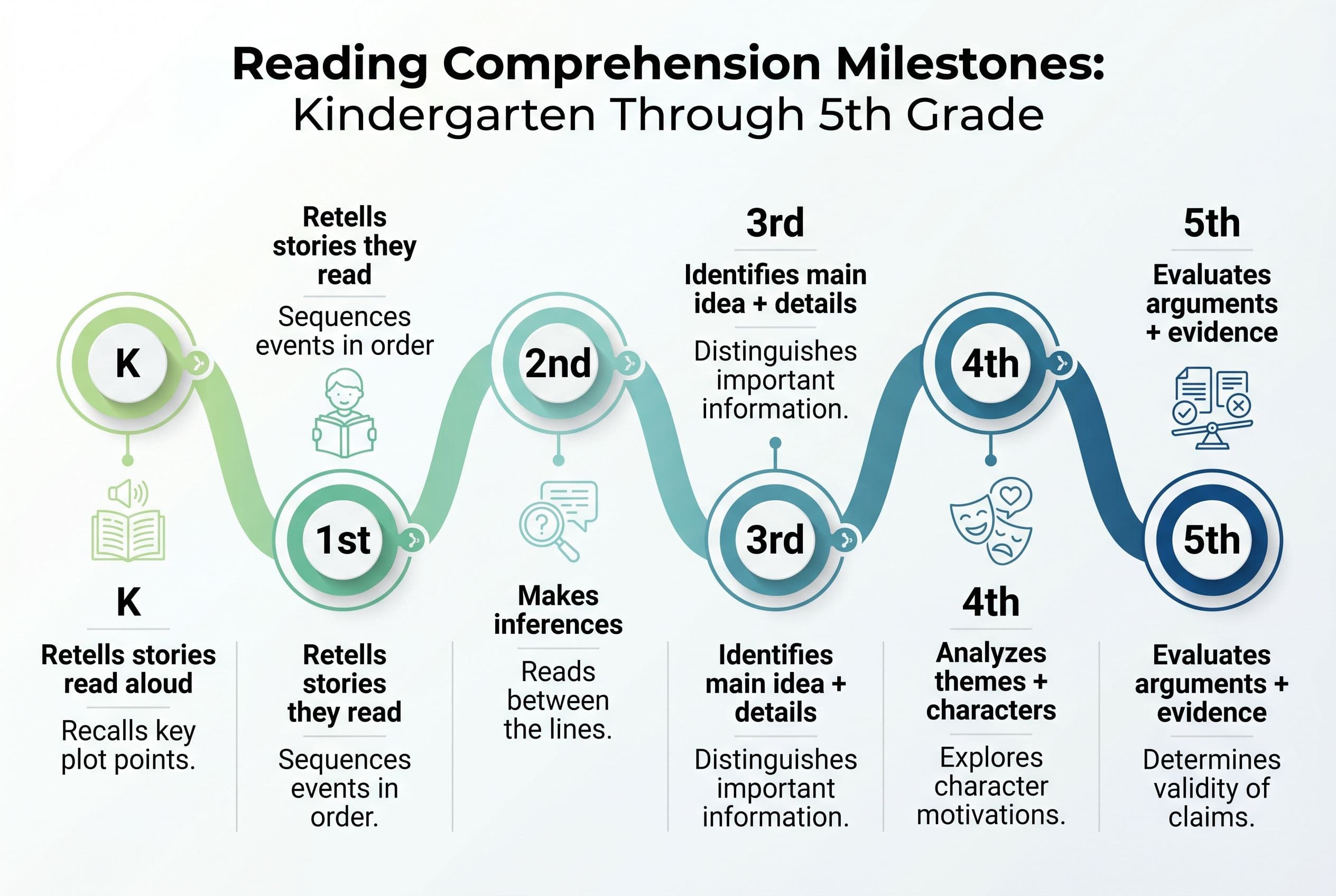
Kindergarten (Ages 5–6): Comprehension Is Mostly Listening
In kindergarten, your child's decoding skills are just getting off the ground. They're learning letter-sound correspondences. Maybe blending CVC words by spring. Comprehension at this stage is primarily about listening comprehension — what they understand when YOU read to them. (If your kiddo is already reading simple decodable texts, you can absolutely check comprehension there too — even a one- or two-sentence retell counts.)
Here's what a kindergartner should demonstrate:
- Retell a simple story you read aloud — beginning, middle, end — in roughly the right order
- Answer literal "who, what, where" questions about a read-aloud ("Who was the story about? Where did they go?")
- Make simple predictions ("What do you think will happen next?")
- Connect a story to their own life ("That happened to me too! I lost my shoe at the park!")
- Identify the main character and what the character wanted or did
Notice what's NOT on this list: reading a book independently and answering comprehension questions. That's not a kindergarten expectation. But — and this is the tiger mom part — listening comprehension is the scaffolding that reading comprehension is built on. So if your 5-year-old can't retell a story you just read to them — even a jumbled, half-backwards version where the ending comes first — that's a red flag right now. Not later. Now.
In my house, every single read-aloud ends with "Tell me what happened." My 4-year-old gives me the biggest eye roll you've ever seen. Every. Single. Time. Honestly? Doesn't matter to me one bit. We do it anyway. Every. Single. Time.
1st Grade (Ages 6–7): Comprehension Meets Decoding
First grade is where the two streams start to merge. Your child is now reading simple decodable texts — short books built on phonics patterns they've learned. And they need to start understanding what they're reading, not just saying the words.
What should a first grader understand when reading?
- Retell a story they read themselves — not just one you read to them
- Identify the main idea of a simple passage ("This book was about a dog who got lost")
- Answer literal questions about text they decoded independently
- Distinguish between fiction and nonfiction at a basic level
- Use context clues to figure out a word they don't know (but NOT to guess at decoding — there's a difference)
- Recognize cause and effect in simple stories ("The boy fell because the ice was slippery")
The big shift here: your kid should start self-monitoring. When a sentence doesn't make sense, they should notice. If they read "The dog climbed the tree" and don't pause, that's a comprehension monitoring problem. They're word-calling, not reading.
A 1st grader on track should be reading decodable texts at a rate that hits their screener's benchmark by end of year — on common tools like DIBELS, many on-track 1st graders land in the "Core Support" range by spring, though the exact number varies by edition. Ask your school which version they use and what the end-of-year target is. But fluency without comprehension is noise. I always pair fluency checks with a simple "Tell me what you just read" — two sentences is fine at this age.
2nd Grade (Ages 7–8): The Sneaky Danger Zone
This is where comprehension problems start hiding. And I mean really hiding.
Second grade is when kids transition from simple decodable texts to "real" books with more complex vocabulary, longer sentences, and plots that require inference. A kid who memorized sight words and developed a decent guessing strategy can fake their way through 1st grade. In 2nd grade? The cracks show.
I was at a playground in Raleigh a couple years ago when another mom mentioned her son's school had just ditched the Lucy Calkins Units of Study and switched to a Science of Reading curriculum. This was right after North Carolina passed SB 387 — the Excellent Public Schools Act — which required evidence-based reading instruction. She was frustrated. "He was doing fine before," she told me, clearly frustrated. So I asked a simple question: "Can he read the word 'splint'?" Her son was seven — second grade. He could not.
So there I am on the playground bench, probably looking unhinged, spending a solid twenty minutes breaking it all down for her — Emily Hanford's "Sold a Story" investigation, the 2022 NAEP disaster where only 33% of 4th graders hit proficient in reading, and Stanislas Dehaene's neuroscience work in his 2009 book Reading in the Brain showing that the brain absolutely does not just absorb reading the way it absorbs spoken language. It has to be trained. She went home that night, listened to the "Sold a Story" podcast, and texted me at 11pm: "I had no idea. "Why didn't anyone tell us this sooner?" she asked.
Here's the thing — her son's problem wasn't just decoding. He couldn't read "splint," sure. But he also couldn't tell her what a paragraph he'd read was about. The decoding gaps were dragging comprehension underwater.
Second grade benchmarks for comprehension:
- Make inferences the text doesn't spell out ("Why do you think the character was sad?" when the text only says the character walked away slowly)
- Compare and contrast two characters or two events in a story
- Identify the lesson or moral of a story
- Ask questions about the text — this shows active engagement, not passive word-calling
- Use text evidence to support an answer ("How do you know? Show me where it says that")
- Understand basic text features in nonfiction: headings, captions, bold words
If your 2nd grader can't do most of these with grade-level text, something is off. Don't you dare. Wait. The "Wait and See" approach is a lie dressed up as patience.
3rd Grade (Ages 8–9): The Cliff
Third grade. The grade that determines everything.
This is why Mississippi passed the Literacy-Based Promotion Act in 2013 — and went from 49th to 21st in national reading scores in six years. This is why Ohio has the Third Grade Reading Guarantee. This is why Florida's retention policy holds kids back if they can't read proficiently by end of 3rd grade. Every state that's serious about literacy draws the line here.
In 3rd grade, comprehension expectations jump dramatically. Your kid isn't reading to learn phonics patterns anymore. They're reading to learn content.
- Determine the main idea AND supporting details in nonfiction passages
- Summarize a full chapter without retelling every single thing that happened
- Make inferences across multiple paragraphs — not just within one sentence
- Understand vocabulary from context in science and social studies texts
- Distinguish their own point of view from the author's or character's
- Compare and contrast themes, settings, and plots across different texts
- Use text features strategically: table of contents, glossary, index, charts, diagrams
- Monitor comprehension independently — stop and re-read when something doesn't make sense without being told to
The reading comprehension expectations by grade jump is steep from 2nd to 3rd. I've watched parents be blindsided by it. "She was reading fine last year!" No — she was decoding fine last year. Comprehension demands in 3rd grade are a different animal.
If your school uses MAP Growth assessments, check your child's RIT score against the NWEA norms for that specific test year — don't rely on a single number you found online, because norms shift. Ask for your kid's percentile and their conditional growth report. That'll tell you a lot more than a raw score. But honestly? Forget the test scores for a second. Your 3rd grader reads a full page from their science textbook, you close the book, and they can't tell you what it was about — not parroting a sentence back, but actually explaining it in their own words? You've got a problem on your hands.
4th Grade (Ages 9–10): Reading to Learn Is the Whole Game
My oldest just turned 10, and I'm watching this shift happen right in front of me every day. Fourth grade reading is not "stories about friendly animals." It's multi-paragraph nonfiction about the water cycle, the American Revolution, and ecosystems. It's fiction with unreliable narrators and characters whose motivations are complex.
Fourth grade comprehension benchmarks:
- Identify themes (not just topics — the difference between "this book is about friendship" and "this book shows that true friends tell you the truth even when it's hard")
- Analyze character development — how and why a character changes across a story
- Integrate information from two different texts on the same topic
- Explain how an author uses evidence to support specific points in nonfiction
- Interpret figurative language: similes, metaphors, idioms, hyperbole
- Summarize objectively — without inserting their own opinion into the summary
- Determine word meaning using Greek and Latin roots and affixes — this is where morphological awareness pays off big time
This is also when state standardized tests get serious about reading comprehension. If your kid has been skating by on decent decoding and strong verbal skills, 4th grade is often where the gap reveals itself.
5th Grade (Ages 10–11): Near-Adult Comprehension Demands
By 5th grade, comprehension expectations start approaching what we'd recognize as adult reading skills — just with age-appropriate content. Word recognition is fully automatic at this point, freeing up all cognitive resources for meaning-making and advanced morphology.
- Analyze how a narrator's or speaker's perspective influences the way events are described
- Compare and contrast the overall structure of two or more texts (chronological vs. cause-and-effect vs. problem-solution)
- Evaluate arguments and claims in nonfiction — identify whether evidence actually supports the author's point
- Quote accurately from a text when explaining what the text says explicitly AND when drawing inferences
- Synthesize information from multiple sources to build understanding of a topic
- Explain relationships between two or more events, ideas, or concepts using specific textual evidence
- Analyze how visual and multimedia elements contribute to meaning in texts
If your 5th grader can do all of this, they're not just "on grade level." They're prepared for middle school. And middle school reading demands are no joke — I've seen the curriculum. It assumes fluent comprehension from day one.
Below the Benchmark? Check the Decoding Before the Comprehension
Most kids who miss the comprehension benchmarks above aren't missing comprehension. They're missing accurate, automatic word reading, and comprehension is what it looks like when that breaks. Kilpatrick's point stands: you can't understand a sentence you read as "the dog went to the (guess) and (guess)."
So before a single comprehension strategy, run a two-minute decoding check. Grade-level passage, pictures covered, read aloud. Count the misread words. Three or more in a minute, or lots of "close enough" substitutions, and the fix is phonics practice, not more questions about the text. take the 2-minute reading check if you want a scored version.
Teach Your Kid to Read is the phonics side of that fix — systematic, decodable, 10-15 minutes a day, from letter sounds through multisyllable words. Lesson one is free with no card, then a 7-day trial, then $9.95 a month. start lesson one free and the comprehension work below gets dramatically easier.
Red Flags at Every Stage: When to Worry
Here's your cheat sheet — the stuff that should set off alarm bells immediately.
K–1 Red Flags:
- Can't retell a simple story after you read it aloud (not a reading problem — a language comprehension problem)
- Shows zero interest in being read to (might indicate a hearing or processing issue)
- Can decode words but can't answer the simplest question about what they read
2nd–3rd Grade Red Flags:
- Reads fluently but can't summarize
- Avoids reading independently (often a sign they know they're not actually understanding)
- Can answer literal questions but falls apart on "why" and "how" questions
- Relies on pictures to "explain" what happened in the text
4th–5th Grade Red Flags:
- Struggles with any content-area reading (science, social studies, math word problems)
- Can't identify the main idea vs. supporting details
- Doesn't know what to do when they encounter an unknown word (no strategy beyond skipping it)
- Hates reading. Full stop. Kids who comprehend well don't hate reading. Kids who stare at words that mean nothing to them do.
You see these red flags? Don't sit around waiting for the school to notice. Grab Kilpatrick's PAST test — the Phonological Awareness Screening Test — it takes about 5 minutes and tells you if the issue is a decoding foundation problem feeding into the comprehension breakdown. You can also request a DIBELS assessment from your school to check fluency benchmarks.
How to Actually Build Comprehension (Not Just Test It)
Here's where most advice falls apart. Teachers and websites tell you to "ask your child questions about what they read." Great. That tests comprehension. It doesn't BUILD it.
Building comprehension requires building the underlying skills from Scarborough's Reading Rope: vocabulary, background knowledge, language structures, verbal reasoning, and literacy knowledge. Here's my actual playbook — the stuff I do with my kids.
Step 1: Fix the decoding foundation first.
You cannot build reading comprehension on top of broken decoding. If your kid is spending 80% of their brain power figuring out what the words say, there's nothing left for meaning. This is where explicit, systematic phonics programs — structured literacy approaches like UFLI Foundations, Logic of English, or a high-fidelity Orton-Gillingham program — do their work. (A heads up: not all materials that slap "OG-based" on the cover are truly Orton-Gillingham. Look for a clear scope and sequence plus cumulative practice.) Get decoding to automaticity. Then comprehension has room to grow.
Our start lesson one free phonics program at Teach Your Kid to Read is built on exactly this principle. We use structured literacy methodology grounded in Orton-Gillingham principles to get decoding off your kid's plate so their brain can focus on meaning.
Step 2: Build background knowledge like it's your job.
Mark Seidenberg's 2017 book Language at the Speed of Sight makes this case powerfully: comprehension depends heavily on what you already know about the topic. A kid with tons of background knowledge about animals will comprehend a passage about ecosystems way better than a kid with zero exposure — even if their decoding skills are identical.
Read aloud nonfiction. Watch documentaries. Visit museums. Talk about how things work at dinner. Every bit of knowledge you pour into your kid's brain becomes fuel for comprehension later. My 7-year-old devours books about space because we spent a year talking about planets, watching NASA launches, and visiting the Smithsonian Air and Space Museum. The background knowledge was already there when he hit those texts.
Step 3: Teach vocabulary explicitly.
Don't just define words. Use them. My rule: when we encounter a new word in a read-aloud, we use it in conversation at least 3 times that day. Last week my 4-year-old learned "furious" from a picture book. By dinner she was telling her brother his chewing was making her furious. Mission accomplished.
Step 4: Think aloud.
When YOU read to your kid, narrate your thinking process out loud. "Hmm, it says the character slammed the door. She's probably mad about what went down in the last chapter, right? She's probably angry about what happened in the last chapter — let me keep reading and find out if I'm right." This models the invisible cognitive work that skilled readers do automatically. Your kid can't build inference skills if they've never seen what inferring looks like.
Step 5: Use the "Tell me about it" protocol.
After every reading session — every one, no exceptions, including on birthdays and vacation (Tiger Rules: We Never Skip) — ask your kid to tell you about what they read. Not "Did you like it?" Not "Was it good?" Those questions are useless. Instead, try "Tell me what happened" or "Tell me what you learned." If they can't, they didn't comprehend it. Go back and re-read together.
Why "Teach Your Kid to Read" Builds Comprehension From Day One
Most phonics apps teach decoding and stop there. We don't.
Everything in our Teach Your Kid to Read program sits on top of the Science of Reading — the same research that powered Mississippi's climb from 49th to 21st in national reading rankings after they passed the Literacy-Based Promotion Act, the same body of evidence behind 40+ states passing Science of Reading legislation since 2019, and the same principles confirmed by the Clackmannanshire study out of Scotland (Johnston & Watson, 2005), where synthetic phonics kids were still beating analytic phonics kids seven years after the study ended. Wild, right?
But we go beyond decoding. Our lessons systematically build the comprehension strands alongside the decoding strands. Vocabulary is taught with every phonics lesson. Background knowledge is woven into the reading passages. Comprehension questions move from literal to inferential as your child progresses. We're braiding Scarborough's Rope in real time.
Here's the bottom line, and honestly it's the only one I care about: a kid who can decode every word on the page but can't tell you what they just read? That kid still can't read. And we refuse to produce kids who can't read.
Frequently Asked Questions
What's the difference between reading comprehension and decoding?
Decoding is turning printed letters into sounds and words. Comprehension is understanding what those words mean in context. Gough and Tunmer's 1986 Simple View of Reading says it plainly: reading comprehension equals decoding multiplied by language comprehension. You need both. A kid who decodes perfectly but doesn't understand what they read isn't actually reading — they're word-calling.
What should a 1st grader understand when reading?
A first grader should be able to retell a simple story they read themselves, identify the main idea, answer basic who/what/where questions, recognize cause and effect, and start noticing when something they read doesn't make sense. Oh, and they should know the difference between fiction and nonfiction — you'd be shocked how many first graders have zero clue. I've quizzed kids on this and gotten blank stares more times than I can count. They won't be making deep inferences yet — that ramps up in 2nd and 3rd grade.
My child reads fluently but can't answer questions about what they read. Is that normal?
Nope. I know it's common — trust me, I see it constantly — but common doesn't mean normal, and your kid is absolutely not going to "grow out of it." Fluent reading without comprehension is a red flag that the comprehension strands (vocabulary, background knowledge, inference, monitoring) aren't developing alongside decoding. Address it now. Build vocabulary, read aloud nonfiction, model thinking strategies, and make sure their decoding is truly automatic — sometimes "fluent-sounding" kids are still spending too much mental energy on word recognition.
When should I worry about my child's reading comprehension?
If your kindergartner can't retell a story you read aloud, that's worth investigating. If your 2nd grader reads fluently but can't summarize a passage, act now. If your 3rd grader struggles with content-area reading (science, social studies), you're already behind the curve. The research is clear: early intervention is everything. That stat is straight from the Annie E. Casey Foundation's 2010 report — a kid who can't read proficiently by the end of 3rd grade is four times more likely to drop out of high school. Four times. Don't wait for the school to raise a concern — many schools don't flag comprehension problems until it's much harder to fix.
How can I test my child's reading comprehension at home?
Start simple: after your kid reads something, close the book and say "OK, tell me about it in your own words." Then ask a "why" or "how" question that requires inference. If they can retell but can't infer, you know where the gap is. For formal screening, ask your school about DIBELS or PALS assessments, which include comprehension measures. Kilpatrick's PAST test can check whether a phonological processing issue is dragging comprehension down. MAP Growth scores (if your school uses them) also give a clear picture of where your child falls relative to grade-level expectations — just make sure you're looking at percentiles and growth reports, not just a raw RIT number.
Part of these guides

Xia Brody
Co-Founder, Teach Your Kid to Read
Mom of 4 who has successfully taught her kids to read. Currently in the trenches with her 4-year-old while her two oldest (10 and 7) devour books on their own. Passionate about phonics-based methods and building a lifelong love of reading.
Related Articles
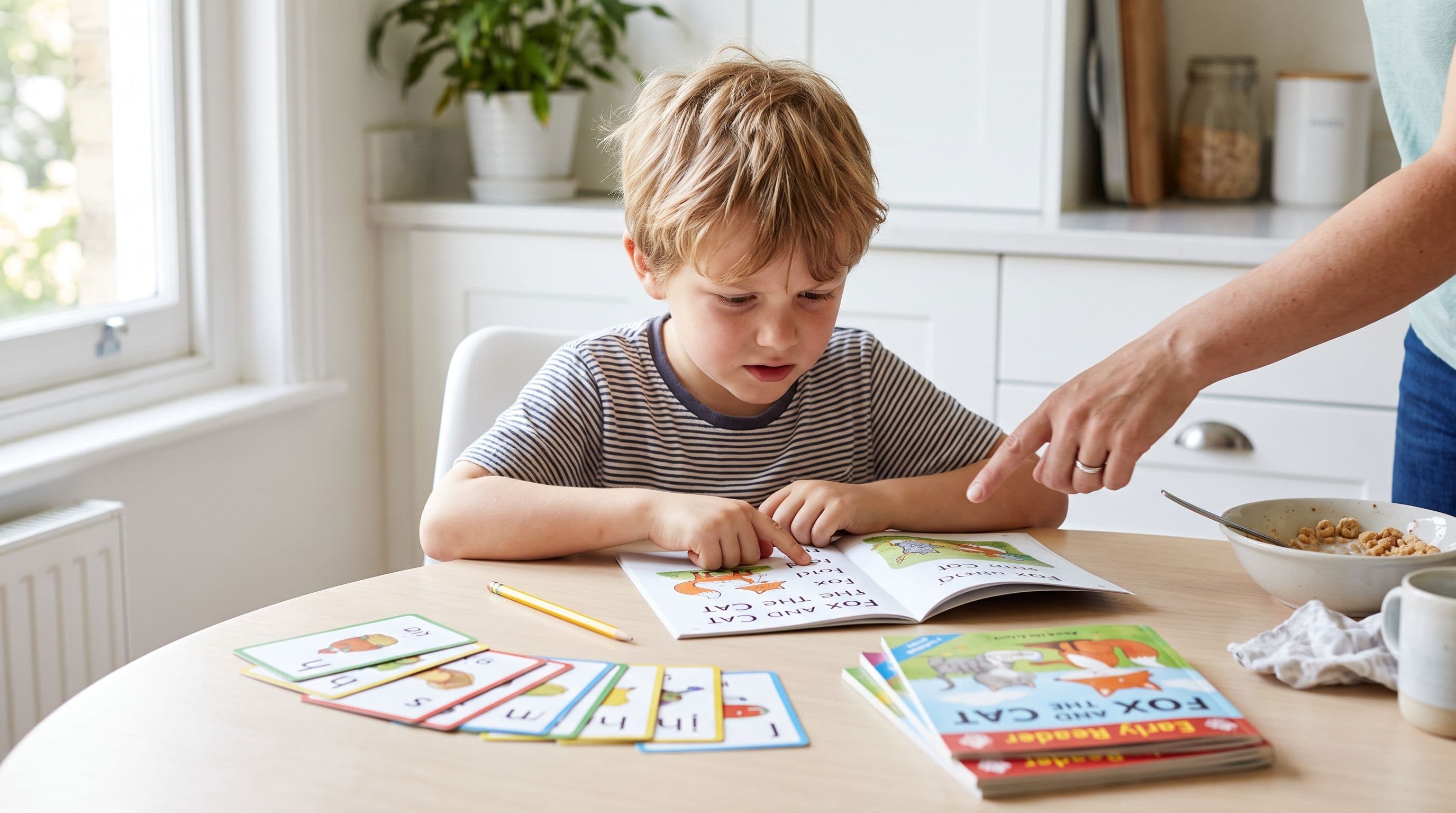
Is My 1st Grader Behind in Reading? 7 Warning Signs
Worried your first grader is behind in reading? Here are the warning signs I’d act on fast, the apps worth comparing, and the phonics plan I’d use at home.
Read More →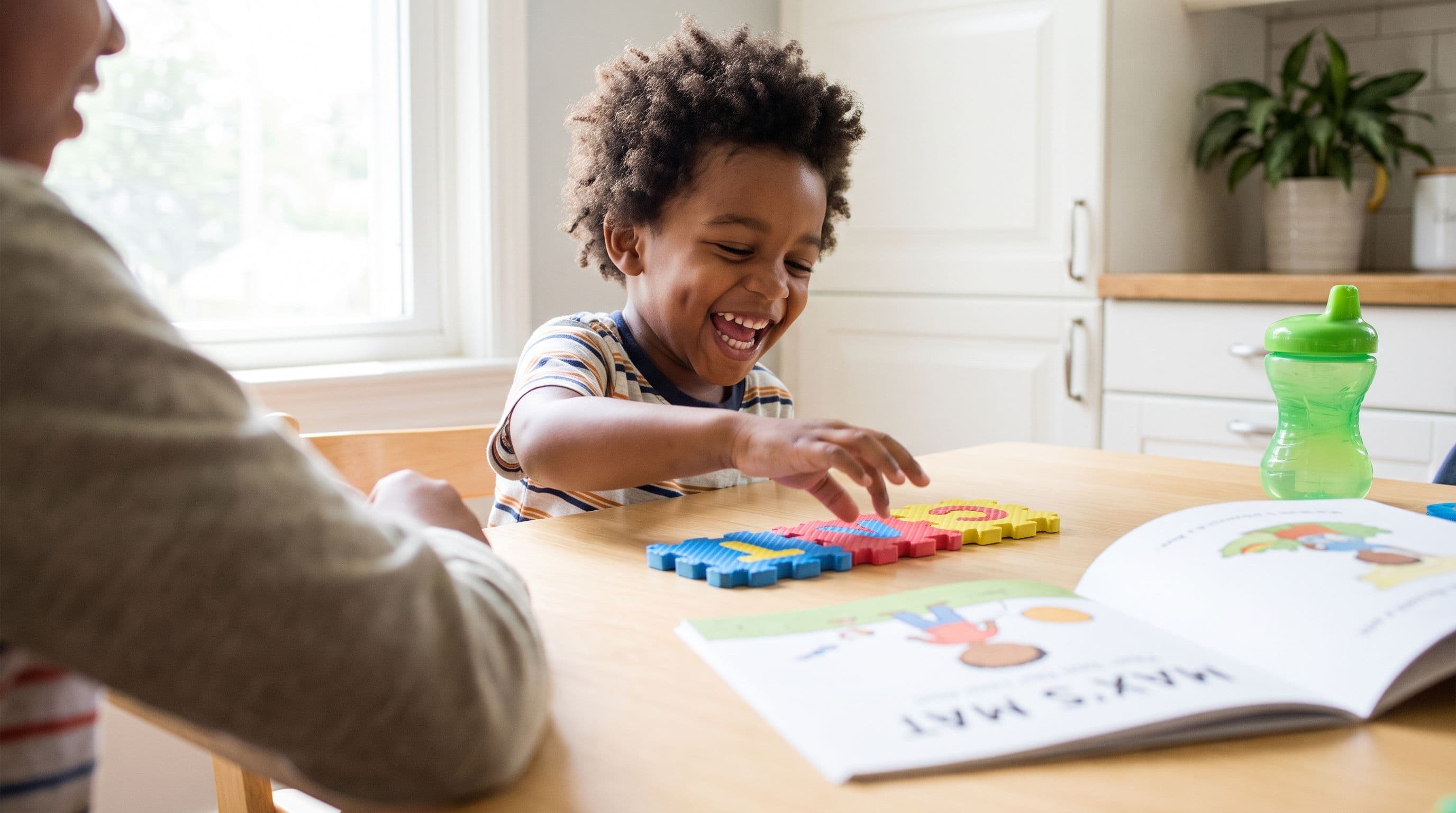
My First Grader Can't Read? The 90-Day Catch-Up Plan
If your 6-year-old is guessing at words, memorizing books, or melting down at the page, you don't have a motivation problem — you have an instruction problem. Here's the exact 90-day catch-up plan I'd run, starting tonight.
Read More →
Is My 3rd Grader Behind in Reading? Signs + App Plan
If your 3rd grader is guessing, avoiding books, or melting down over homework, don't wait. Here's how to tell if they're behind, which reading apps actually teach phonics, and what to do this week.
Read More →