Third Grade Reading Level: Avoid the Wall That Ruins Everything

What You'll Learn
- The real reason third grade is the make-or-break year — and why the statistics are terrifying
- What your child should actually be able to do at a third grade reading level (not the watered-down version schools sell you)
- The one skill most kids are missing that turns third grade into a brick wall instead of a launchpad
- How to tell in 5 minutes whether your child has the phonics foundation to survive what's coming
The Third Grade Wall Is Real — And It's Coming for Your Kid
I'm going to be blunt with you. Third grade is where the fairy tale ends.
For the first three years of school, your kid's been "learning to read" — that's the shift Jeanne Chall described decades ago, and it's real. Stories are short. Pictures are everywhere. Teachers read aloud. The whole setup is designed to hold your child's hand. Then third grade hits, and the entire game flips. Suddenly your child is "reading to learn." Science textbooks. Word problems in math. Social studies passages with no pictures. The training wheels don't just come off — they get chucked in a dumpster and lit on fire.
And if your kid doesn't have real reading skills? Not guessing-from-context skills. Not memorized-the-first-100-sight-words skills. I mean actual, phonics-based decoding mastery?
They slam face-first into the third grade reading wall.
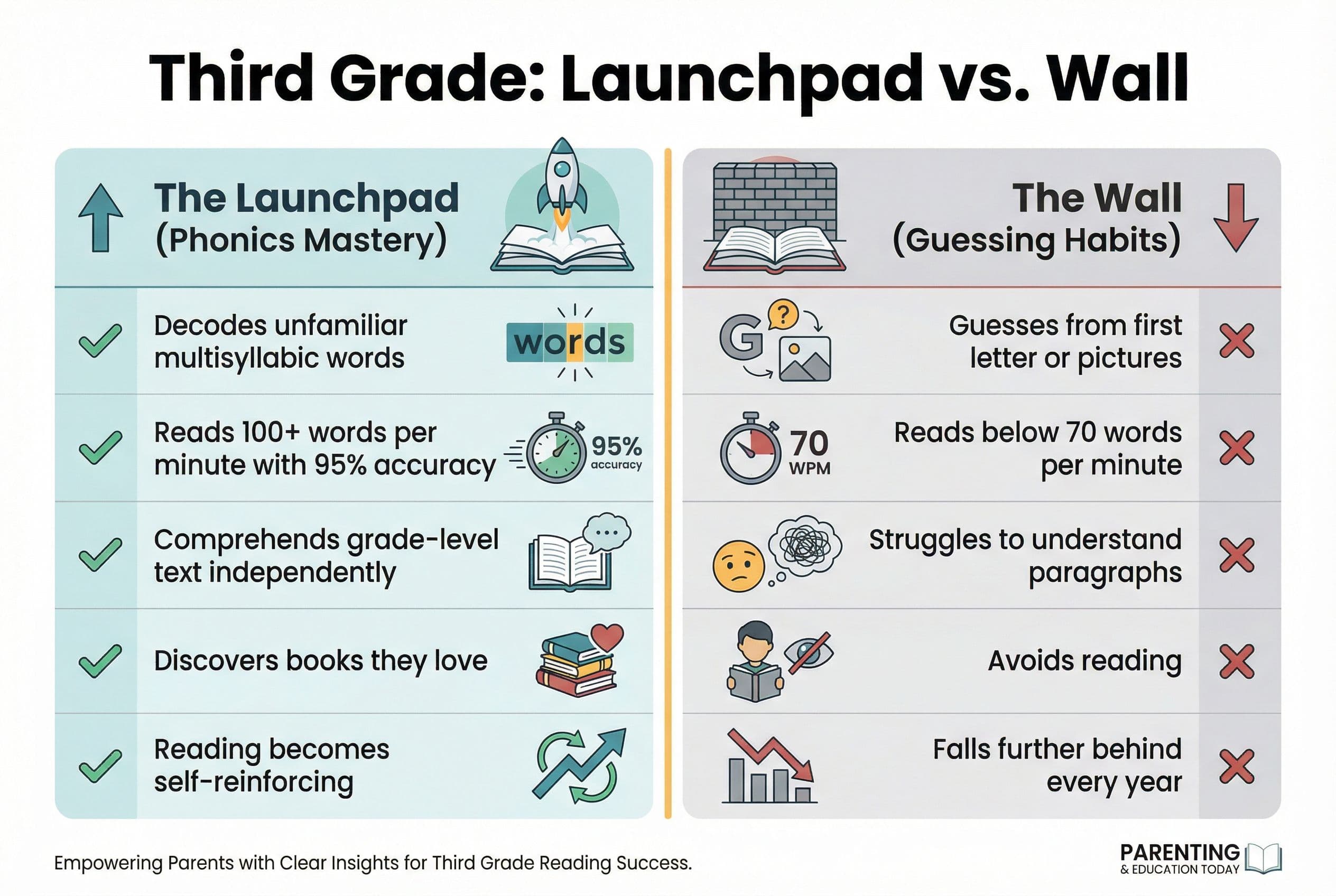
I've watched this play out four times now as a homeschooling mom. My oldest, who's 10, hit third grade material and took off like a rocket — because we'd drilled phonics relentlessly since she was 4. My 7-year-old? She's right in the thick of it now. And let me tell you, the difference between a kid who can decode any word they encounter and a kid who's been trained to guess? One kid devours books for fun — begs you for the next Wings of Fire — while the other avoids reading like it's a punishment.
That's the real story of third grade. It's not about passing some standardized test. It's the year your child either falls in love with reading — finds that book that changes everything for them, the one that makes them beg for "five more minutes" at bedtime — or they decide reading is something they're bad at. And that second outcome? It sticks. Sometimes forever.
The Numbers That Should Keep You Up at Night
Here's the stat that haunts me: only 33% of fourth graders scored at or above "Proficient" on the 2022 NAEP (4th-grade reading assessment) — that's the Nation's Report Card. One-third. Two out of every three kids in America are walking out of third grade unable to read well enough to handle what's about to hit them in fourth grade — the science textbooks, the word problems, all of it.
And it gets worse.
The Annie E. Casey Foundation published their landmark report Early Warning! Why Reading by the End of Third Grade Matters in 2010, showing that kids who don't reach reading proficiency by the end of third grade are four times more likely to drop out of high school. Four times. And for kids living in poverty who can't read by third grade? For kids living in poverty who can't read by third grade, that dropout rate climbs even higher. (Their definition of "not proficient" is based on NAEP's "below Proficient" threshold — so we're talking about kids who can't demonstrate solid comprehension of grade-level material.)
The 2022 NAEP main assessment showed 4th-grade reading scores dropped 3 points compared to 2019 — the largest decline since the assessment began tracking in 1990. We're going backwards.
Know what the kicker is? Here's the thing that should make you furious — most of these kids don't have learning disabilities. They're struggling because nobody taught them to read properly in the first place. They were taught to guess.
Reid Lyon — he was at the National Institutes of Child Health and Human Development — actually testified before Congress in the late '90s and early 2000s about this exact crisis. He cited data showing that roughly 38% of fourth graders scored below the "Basic" level on NAEP — meaning these kids couldn't even extract simple meaning from a grade-level paragraph. And he said — under oath — that the majority of reading failure is preventable with proper instruction.
Preventable. Sit with that for a second.
What a Third Grade Reading Level Actually Looks Like
OK so let's get specific, because "third grade reading level" is one of those phrases that sounds clear but is actually maddeningly vague. Schools will tell you your kid is "on level" based on some Fountas & Pinnell guided reading assessment — levels N through P for third grade — but here's my problem with that system: it's rooted in the same whole-language philosophy that got us into this mess. It measures whether kids can extract meaning from text, sure, but it doesn't tell you whether they're actually decoding or just using context clues and pictures to fake it.
Forget the Fountas & Pinnell levels for a second — here's what I think a third grader should actually be able to do:
Decoding Skills (The Non-Negotiable Foundation)
- Read any word that follows phonics rules they've been taught. Every single pattern. Short vowels, long vowels, vowel teams (ea, oa, ai, ay, ee), r-controlled vowels (ar, or, er, ir, ur), consonant blends, digraphs (sh, ch, th, wh), diphthongs (oi, oy, ou, ow) — I'm talking the whole Orton-Gillingham scope and sequence here. Every. Single. Pattern.
- Attack unfamiliar multisyllabic words by breaking them into syllable types — closed, open, vowel-consonant-e, vowel team, r-controlled, consonant-le. A third grader who's been taught phonics properly should look at the word "fantastic" and chunk it: fan-tas-tic. Not stare at it and guess "fun" because it starts with f.
- No more guessing from pictures. Ever. By third grade this habit should be long dead.
Fluency Benchmarks
DIBELS — Dynamic Indicators of Basic Early Literacy Skills — gives us hard numbers here. By the beginning of third grade, your child should be reading around 77 correct words per minute on grade-level oral reading passages. By the end of third grade? That benchmark jumps to about 100+ correct words per minute.
But speed without accuracy is worthless. I tell my kids: "Fast and wrong is still wrong." Aim for 95%+ accuracy on grade-level text.
Comprehension Skills
This is where the Simple View of Reading — that's Gough and Tunmer's 1986 formula — becomes your best friend. It says: Reading Comprehension = Decoding × Language Comprehension. It's multiplication, not addition. If either side is zero, the whole thing is zero.
So by third grade, your kid should be able to:
- Identify main ideas and supporting details in nonfiction
- Make inferences ("The text doesn't say it directly, but based on this evidence...")
- Compare and contrast characters, settings, and events
- Use context clues for vocabulary — BUT only after they've decoded the word first (this is the order that matters)
- Summarize a chapter or passage in their own words
The Piece Everyone Misses: Morphological Awareness
Now here's where most parents' eyes glaze over — but honestly, don't skip this part. Third grade is when prefixes, suffixes, and root words start mattering — a lot. Think about it: a kid who knows "un-" means "not" and "-able" means "can be" can crack open "unbreakable" without ever having seen it before. That's morphological awareness, and it's the bridge between decoding individual words and understanding academic language.
By third grade, your child should know common prefixes (un-, re-, pre-, dis-, mis-) and suffixes (-ful, -less, -ness, -ment, -tion, -ly, -able, -er, -est). This isn't optional vocabulary enrichment. This is how English works.
Why Kids Hit the Wall (And It's Not What Schools Tell You)
OK so let me tell you a story.
After Emily Hanford's "Sold a Story" investigation came out in 2022 — the APM Reports series that blew the lid off Balanced Literacy — my neighbor called me. Eighteen years as a first-grade teacher. She was practically in tears on the phone. Her entire career, she'd been using Lucy Calkins' Units of Study curriculum. Three-cueing, MSV, the whole guessing game. She said to me, "Xia, I've been teaching kids to guess for two decades and I didn't even know it."
She decided to switch her classroom to UFLI Foundations mid-year. It was messy. She had to relearn everything herself first — staying up late watching training videos, rebuilding her lesson plans from scratch. But by spring, her kids' DIBELS scores had jumped an average of 15 points on nonsense word fluency. She told me that was the first time in her career where every single kid in her class could decode CVC words by February.
Every. Single. Kid.
Now think about that. An experienced, dedicated teacher — someone who genuinely cared about her students — spent 18 years unknowingly sending kids into second and third grade without real decoding skills. And she's not the villain here. She was trained wrong. Her school gave her the wrong curriculum. The education establishment told her three-cueing was "best practice" when decades of cognitive science said the opposite.
Mark Seidenberg — he's a University of Wisconsin cognitive scientist — wrote about this exact problem in his 2017 book Language at the Speed of Sight. He called out the reading education establishment for ignoring the science. The research on systematic phonics has been clear since the 2000 National Reading Panel report (the one Congress actually commissioned), and yet millions of kids were taught to look at the first letter, check the picture, and guess.
Those kids are now in third grade. Hitting the wall.
The third grade reading wall isn't some mysterious developmental barrier. It's the predictable result of kids who were never taught phonics properly. They got through K-2 by memorizing high-frequency words and using context clues. And it worked — until the texts got harder, the words got longer, and the pictures disappeared.
The Two Paths Out of Third Grade
I've seen this play out with my own kids, and with every single family I've worked with through Teach Your Kid to Read — here's what happens.
A child who enters third grade with real phonics mastery — solid decoding, automatic letter-sound mapping, the ability to attack any new word using the rules they've learned over the years — that child has a foundation they'll build on as they read more and more books every year. Third grade becomes a launchpad, not a wall. They start reading chapter books. They discover series they love. Percy Jackson. Magic Tree House. Diary of a Wimpy Kid. Wings of Fire. Whatever grabs them.
And this is usually where the love of reading shifts into overdrive.
My oldest found the Warriors series (cats with swords, basically — don't ask me) in third grade and suddenly she was reading 200+ pages a week voluntarily. Not because I assigned it. Because she could read it, which meant she could lose herself in it. That right there? That's the magic. But it only happens when the mechanics are automatic.
Then there's the other path. The child who enters third grade still guessing at words. Still struggling with multisyllabic words. Still reading slowly enough that by the end of a paragraph, they've forgotten what the beginning said. That child doesn't find the book that changes everything for them — because every book feels like work. Reading becomes something they associate with failure and frustration. And once a kid decides "I'm not a reader"? Good luck changing that belief.
David Kilpatrick writes about this in Equipped for Reading Success (2016). His research on orthographic mapping — the brain process that turns decoded words into instantly recognized sight words — shows that kids need strong phonemic awareness to store words permanently in memory. Quick distinction here, because these terms get mixed up a lot: phonological awareness is the big umbrella — it covers awareness of words, syllables, rhyme, onset-rime, all of it. Phonemic awareness is the most specific and most important slice for decoding — it's about hearing and manipulating individual sounds (phonemes) in words. Kids with weak phonemic awareness have to re-decode the same words over and over. They never reach automaticity. And without automaticity, fluency tanks, and without fluency, comprehension collapses.
Total domino effect, honestly. And it starts with phonics.
How to Know If Your Third Grader Is Actually on Track
Don't trust the school's grade. Real talk — I've seen kids labeled as "on grade level" who can't decode a two-syllable word without guessing. Want to know where your kid actually stands? You can figure it out yourself in about 10 minutes flat.
The Kitchen Table Test
Step 1: Pick an unfamiliar word. Not a word your child has memorized. Something they've never seen in print. Try "splendid" or "tremendous" or "inspection." Grab a piece of paper, write it down — no pictures, no context clues, nothing. Hand it to your kid.
Step 2: Watch what they do. Do they look at the first letter and guess? Do they look at YOU for help? Or do they start sounding it out — chunking the syllables, applying phonics rules?
If they guess, you have a problem. If they struggle but attempt to decode, you have something to work with. If they sound it out and get it (even slowly), you're in good shape.
Step 3: Try a nonsense word. This is the real test. Write "blentish" or "crantiful" on a piece of paper. A child with genuine phonics mastery can read a word that doesn't exist — because they're not relying on memory. They're applying rules.
Use Real Assessment Tools
If you want hard data, grab the Kilpatrick PAST test (Phonological Awareness Screening Test) from his book Equipped for Reading Success — you can also find versions floating around online. It takes about 5 minutes and it tells you exactly where the phonological breakdown is — if there is one.
For fluency, pull a grade-level passage and time your child for one minute. Count correct words. Compare to DIBELS benchmarks: 77+ correct words per minute at the start of third grade, 100+ by the end. If your child is significantly below that, don't wait.
What to Do Right Now (The Action Plan)
Look, I'm not about to hand you some wishy-washy "just read more books together" advice and call it a day. If your child is at or approaching third grade and you're worried, here's the plan.
Step 1: Assess the Foundation
Run the kitchen table test I described above. If your child guesses at unfamiliar words, the phonics foundation has gaps. Period. Don't panic — but for the love of everything, don't wait.
"Wait and see" is a lie — honestly, it's the biggest lie in education. It's the most dangerous phrase in education. Kids don't magically "catch up" in reading. Linnea Ehri's phases of word reading development — from her 2005 meta-analysis — show that reading skill builds sequentially. You can't skip the full alphabetic phase and expect a child to reach the consolidated phase on their own.
Step 2: Fill the Gaps with Systematic Phonics
If your child is in third grade and still has decoding holes, you need a structured program. Not worksheets. Not random phonics games. A systematic, sequential, explicit phonics program.
Here's what you're looking for:
- Teach Your Kid to Read — our program at start lesson one free walks you through systematic phonics instruction step by step. It's built on Orton-Gillingham principles and designed so you can teach it at home, even if you've never taught reading before.
- UFLI Foundations — this is what my neighbor switched to in her classroom. It's free, research-based, and follows synthetic phonics methodology.
- Barton Reading & Spelling System — if your child shows signs of dyslexia or severe decoding deficits, Barton is intense but effective. It's based on Orton-Gillingham and designed to be taught by non-professionals.
The bottom line: your child needs to be able to read any word that follows the phonics rules they've been taught. That's your standard. Period. Not some of the words. Not most of the words. Any word.
Step 3: Build Fluency Through Repeated Oral Reading
Once decoding is solid, fluency comes from practice — specifically, repeated oral reading with feedback. Not silent reading. Not audiobooks. Your child reads aloud, you listen, you correct errors immediately, and they re-read until it's smooth.
Here's my routine with my 7-year-old right now: he reads the same passage three times. First time is slow and careful. Second time is smoother. Third time, he's aiming for expression — reading it like he's telling someone a story. The whole thing takes 10 minutes. We do it every single day, no exceptions. Birthdays, Christmas, vacation. Tiger Rules: we never skip.
Step 4: Feed the Hunger
Once your child can decode and read fluently, your job changes. Now you're a book matchmaker. You need to put the right book in their hands — the one that makes the switch flip.
For my oldest, it was Warriors. For my 7-year-old, it's the Dog Man graphic novels (not my favorite literature, but he reads them cover to cover in one sitting, so I'm not complaining). Some kids need Junie B. Jones. Some need nonfiction about sharks or volcanoes or space. The genre doesn't matter. What matters is that your child discovers reading isn't a school assignment — it's a superpower that gives them access to anything they're curious about.
But here's the thing that breaks my heart: a kid who can't decode will never find that book. Because every book is a battle. You can't fall in love with reading when every sentence is a struggle.
That's why phonics comes first. Always.
Step 5: Don't Stop at Decoding
Third grade is also when you need to layer in vocabulary, morphology, and comprehension strategies. Teach prefixes and suffixes explicitly. Build background knowledge through read-alouds (yes, you should still read to your third grader — the books you read aloud can be above their independent reading level). Discuss what you read. Ask "why" and "how" questions — not just "what happened."
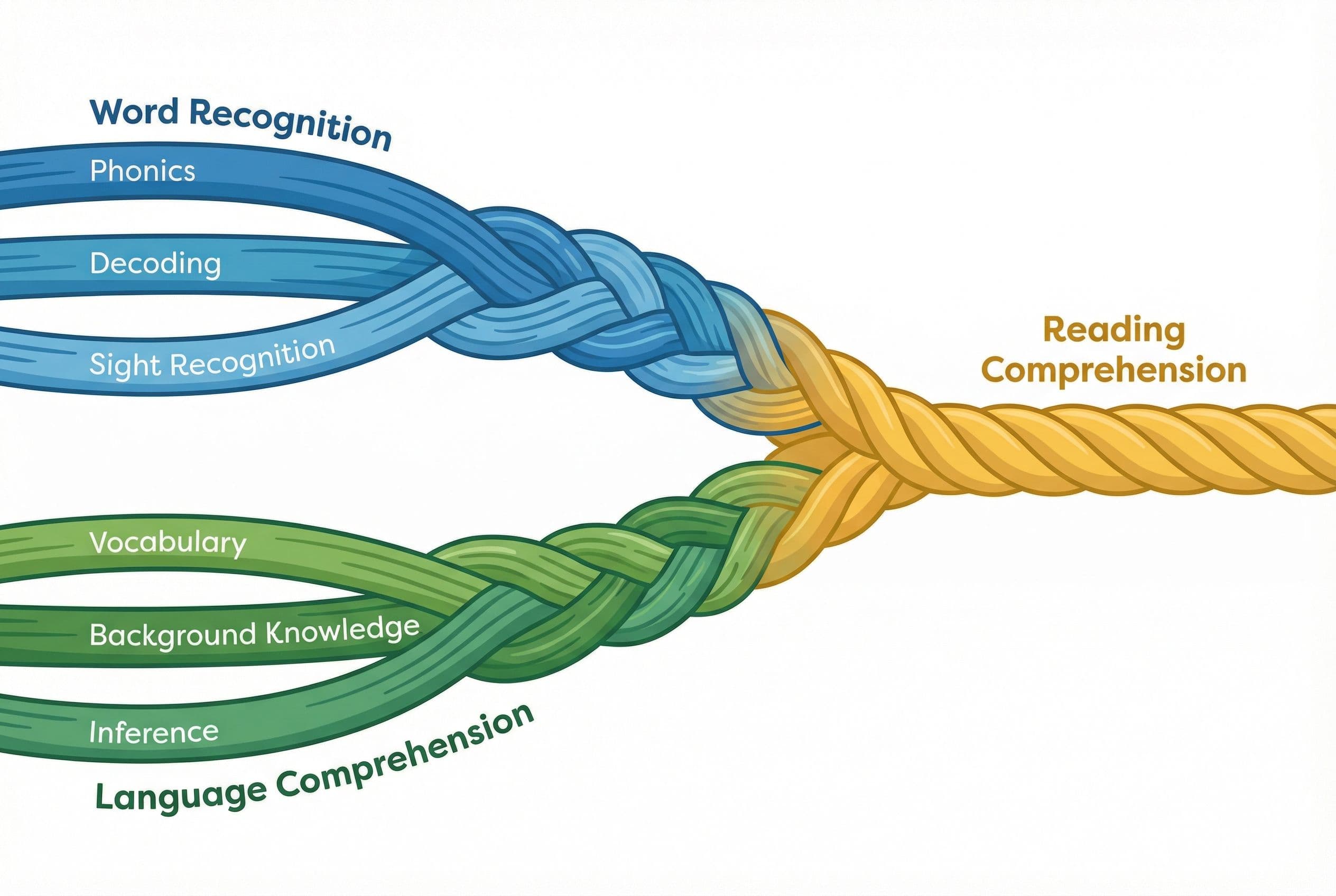
Scarborough's Reading Rope — that's Hollis Scarborough's visual model of how reading works — shows that reading comprehension is woven from two strands: word recognition (phonics, decoding, sight recognition) and language comprehension (vocabulary, background knowledge, inference, text structure). By third grade, you need both strands strong.
The States That Got This Right
If you think I'm just some Tiger Mom yelling into the void, look at Mississippi.
Mississippi passed the Literacy-Based Promotion Act in 2013. It wasn't just one thing — they overhauled their entire early reading approach. Here's what they did: required evidence-based reading instruction (systematic phonics, no exceptions) in every K-3 classroom, retrained thousands of teachers in the Science of Reading, planted literacy coaches in schools, mandated universal screening with assessments like DIBELS, poured intensive intervention into struggling readers, and yeah — they held back third graders who couldn't demonstrate grade-level reading, but gave them real support to catch up.
The result? On the NAEP 4th-grade reading assessment, Mississippi climbed from 49th among states to 21st between 2013 and 2019. Their average scale scores jumped while many other states flatlined or declined. It wasn't a single-cause miracle — it was what happens when a whole state commits to teaching reading the way the science says it should be taught.
Ohio has their Third Grade Reading Guarantee. Florida has their 3rd grade retention policy under Just Read, Florida! Over 40 states have now passed Science of Reading legislation since 2019. The tide is turning — but it's turning slowly, and your kid can't wait for their school to catch up.
FAQ
What should a third grader be able to read independently?
A third grader with solid phonics skills should be able to independently read chapter books like Magic Tree House, Junie B. Jones, or Diary of a Wimpy Kid. They should decode unfamiliar multisyllabic words using phonics rules, read at 100+ correct words per minute by year's end with 95%+ accuracy, and comprehend what they read well enough to retell the main ideas and make inferences. The key is that they can attack any new word using the phonics rules they've learned — they shouldn't be guessing or skipping words.
How do I know if my third grader is behind in reading?
The fastest home test: write an unfamiliar multisyllabic word on paper (try "inspection" or "adventure") with no pictures or context. If your child guesses based on the first letter or freezes, there are decoding gaps. For a more precise assessment, use Kilpatrick's PAST test (Phonological Awareness Screening Test) from his book Equipped for Reading Success — it takes about 5 minutes and pinpoints exactly where the phonological breakdown is. For fluency, pull a grade-level passage and time your child for one minute. Count correct words. Compare to DIBELS benchmarks: 77+ words per minute at the start of third grade, 100+ by the end.
What is the third grade reading wall?
The third grade reading wall (or "third grade cliff") is the point where schoolwork shifts from "learning to read" to "reading to learn." Kids who got through K-2 by memorizing sight words and guessing from pictures suddenly face longer texts, harder vocabulary, and no pictures to bail them out. Kids who lack real phonics-based decoding skills hit this wall hard. The Annie E. Casey Foundation's 2010 report Early Warning! Why Reading by the End of Third Grade Matters found that kids who score below Proficient on NAEP reading by end of third grade are four times more likely to drop out of high school.
Can a struggling third grader still catch up?
Yes — but don't wait another day. The research is clear that early intervention works, and even third graders can make significant gains with systematic phonics instruction. Programs like Teach Your Kid to Read, UFLI Foundations, and Barton Reading & Spelling System are all built on Orton-Gillingham principles that work for older struggling readers. The key is going back to fill the specific phonics gaps (use the PAST test to find them) rather than just "reading more." Kids who practice more with broken strategies just practice being wrong more.
My child's school says they're "on grade level" but I'm worried. So what do I do?
Trust your gut. Many schools use Fountas & Pinnell leveled assessments, which are whole-language aligned and don't specifically measure phonics-based decoding. A child can score "on level" while still guessing at words — especially if they have strong language skills and good memory. Do the kitchen table test: give them an unfamiliar word with no context. If they can't sound it out, there's a gap the school assessment isn't catching. And honestly? Even if they are on level, 10 minutes of daily phonics review and oral reading practice at home will only make them stronger.
The Bottom Line
Third grade reading level isn't about hitting some arbitrary benchmark on a school report card. It's about whether your child has the genuine, phonics-based decoding mastery to handle every word that comes their way — and the fluency to do it fast enough that their brain has room left over for comprehension.
Get that right, and third grade becomes the year your kid falls in love with reading. The year they find their book. The year everything clicks.
Get it wrong, and your kid slams into a wall that gets higher every single year.
I've seen both outcomes in my own house. And I know exactly which outcome I'm fighting for with every kid in my house.
If you're ready to make sure your child has the foundation they need — whether they're approaching third grade or already struggling — Teach Your Kid to Read can help. Our program is built on the same systematic phonics research that turned Mississippi's reading scores around and that transformed my neighbor's classroom overnight.
Start today at start lesson one free or call us at (314) 285-9505. Your kid's reading life depends on what you do right now. Not next semester. Not "when they're ready." Now.
Part of these guides

Xia Brody
Co-Founder, Teach Your Kid to Read
Mom of 4 who has successfully taught her kids to read. Currently in the trenches with her 4-year-old while her two oldest (10 and 7) devour books on their own. Passionate about phonics-based methods and building a lifelong love of reading.
Related Articles
Best Reading App for 3rd Graders Behind in 2026: Full List + Free Trial
Your 3rd grader is behind in reading and you're running out of time. Here's what the science says about which reading apps actually work — and which ones are expensive digital babysitters dressed up as 'learning tools.'
Read More →
Is My 2nd Grader Behind in Reading? 9 Signs
Wondering if your 2nd grader is behind in reading? Here are the real warning signs, what 2nd graders should be able to do, and what to do next if your child is guessing, slow, or stuck.
Read More →
My First Grader Can't Read? The 90-Day Catch-Up Plan
If your 6-year-old is guessing at words, memorizing books, or melting down at the page, you don't have a motivation problem — you have an instruction problem. Here's the exact 90-day catch-up plan I'd run, starting tonight.
Read More →