4th Grade Reading Level: Lexile 740-940L, 90-120+ WCPM

What You'll Learn
- The specific skills that define a real fourth grade reading level — not the watered-down version your kid's report card shows
- Why 4th grade is the exact moment the "reading to learn" shift happens — and what it looks like when a kid isn't ready
- The one assessment you can give at your kitchen table in 5 minutes that tells you exactly where the breakdown is
- A step-by-step plan to close the gap before middle school turns a small problem into a permanent one
The 4th Grade Cliff Is Not a Metaphor
Your kid got A's in reading through third grade. The teacher said he was "on level." He brought home leveled readers with stickers on them. Everything looked fine.
Then fourth grade hit.
Suddenly there's a science textbook with words like precipitation and photosynthesis. There's a social studies chapter on the American Revolution that expects your kid to read three pages independently and answer inferential questions. There's a novel study on Because of Winn-Dixie where the teacher asks, "What does the author mean when she says Opal's heart was 'empty like a candy wrapper'?"
And your kid is lost.
This is the "4th grade slump," and it's not some rare phenomenon. It's the norm. Only 33% of 4th graders scored at or above Proficient on the 2022 NAEP reading assessment — that's the Nation's Report Card. Now, NAEP "Proficient" is a high bar — it's not the same as your school's "meets grade level" rating — but it's the best national yardstick we've got, and the trend line is ugly. Think about that — two out of every three fourth graders in America can't read at the level we've all agreed they should be at.
So when I say "fourth grade reading level," I'm not talking about what's average in this country. Average is failing. I'm talking about what's necessary.
What a Fourth Grade Reading Level Actually Looks Like
OK here's the thing most parents don't realize: there's no single magic number that equals "fourth grade reading level." It's a bundle of skills working together. Think of it like Scarborough's Reading Rope — a model developed by Hollis Scarborough that shows how word recognition and language comprehension weave together into skilled reading. By fourth grade, those strands need to be tight.
Here's the real fourth grade reading skills checklist — the one nobody prints on back-to-school night:
Decoding & Word Recognition
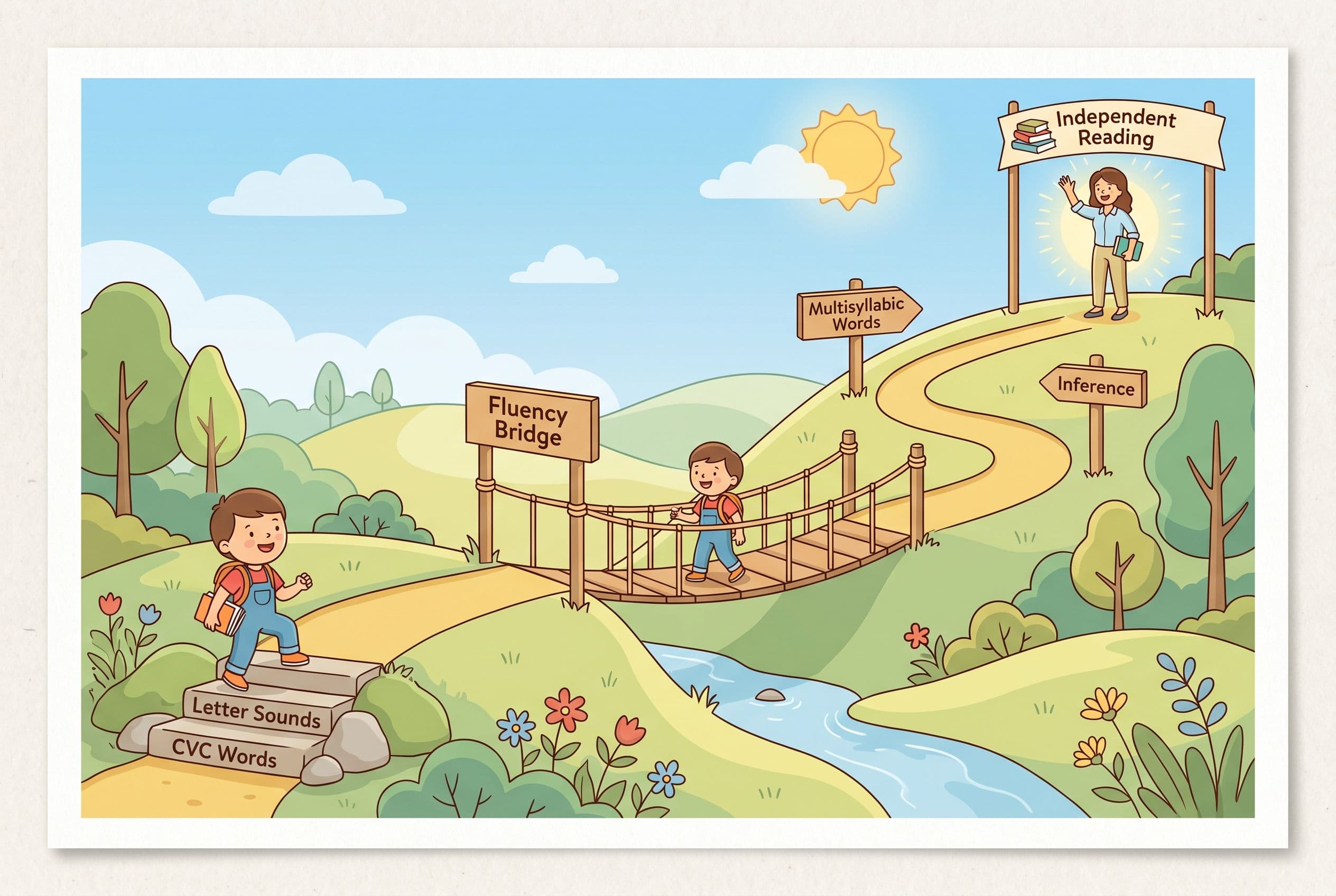
- Reads multisyllabic words fluently. Not just CVC words. Not just two-syllable words. Your 4th grader needs to decode words like resentment, exploration, and unpredictable — without sitting there staring at the page for five seconds trying to guess from context.
- Knows all major vowel patterns and syllable types. Open syllables, closed syllables, vowel teams, r-controlled, consonant-le, silent-e. If those terms sound like gibberish, that's OK — but your kid should be able to apply them even if they can't name them.
- Handles common Latin and Greek roots. Words like transport (trans = across, port = carry), invisible (in = not, vis = see). This is morphological awareness, and it's the secret weapon of strong 4th grade readers.
- Reads grade-level text at roughly 90–120+ words correct per minute with accuracy above 95%. That's in the range of DIBELS 8 Oral Reading Fluency benchmarks for 4th grade, though exact numbers vary by edition and district — check your school's benchmark table for the specific targets they use. Below that range? Your kid is spending so much brainpower on decoding that there's nothing left for comprehension.
Comprehension & Vocabulary
- Makes inferences. Not just "what happened" — I mean "why did it happen" and "how do you know?" That's inferential thinking, and Scarborough's Reading Rope shows it's one of the strands that separates real comprehension from surface-level recall.
- Identifies main idea AND supporting details in nonfiction — and can tell the difference between a fact and an opinion.
- Uses context clues AND morphology to figure out unfamiliar words. If your kid sees the word reformulate and can break it apart (re + form + ulate), that's real skill.
- Reads across genres: fiction, nonfiction, poetry, informational text. A kid who devours Diary of a Wimpy Kid but can't get through a two-page article about volcanoes is not reading at grade level. I love Wimpy Kid — we own every book — but it's dessert, not dinner.
- Can summarize and synthesize. "Tell me what this chapter was about" should produce a coherent 3-4 sentence response, not a blank stare.
The Fluency Piece Nobody Talks About
Reading fluency in 4th grade isn't just speed. It's prosody — the rhythm, expression, and phrasing that show a kid actually understands what they're reading. A kid who reads every sentence in the same flat monotone is probably not comprehending. They're word-calling. It sounds like reading. It's not.
I caught this with my oldest when he was 8. He could read fast — 120 words per minute, no problem. But the second I asked him to tell me what he'd just read? Total freeze. He was decoding the words but not building meaning. We had to slow down, work on chunking phrases, reading dialogue with expression, and stopping after each paragraph to check understanding. It took about six weeks of targeted practice before the comprehension caught up to the speed.
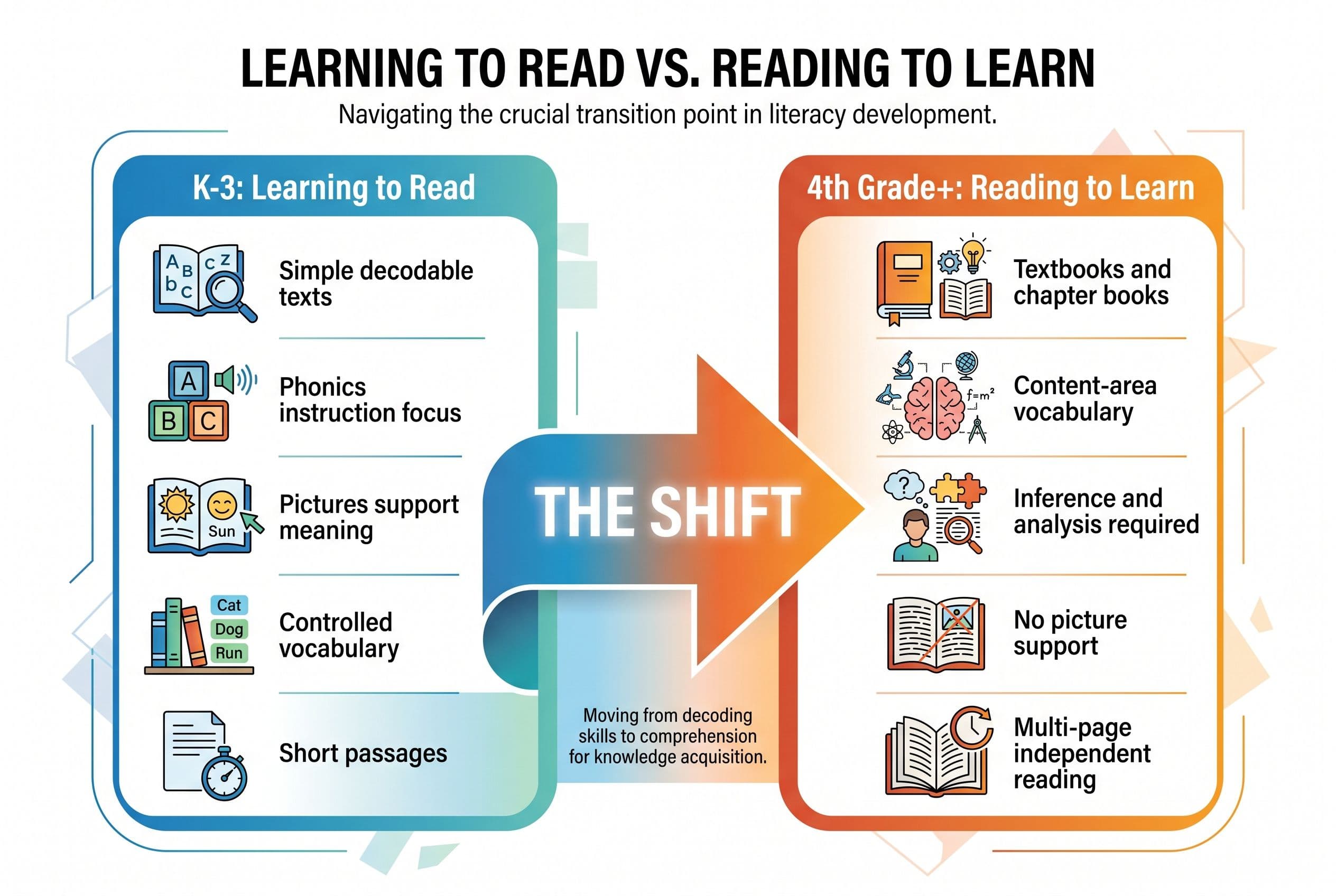
The "Learning to Read" vs. "Reading to Learn" Shift — And Why It Destroys Kids
Jeanne Chall described this back in the 1980s in her stages of reading development. The shift happens around 4th grade. Before that, most of what kids read in school is about learning to read. The texts are simple. The vocabulary is controlled. A kid with weak decoding skills can sometimes fake it — they've memorized enough high-frequency words, they use pictures for context, they guess from the first letter.
Then 4th grade pulls the safety net away.
Suddenly the content areas demand real reading. Science, social studies, even math word problems — they all assume your kid can read independently. The kid who was "getting by" in 2nd and 3rd grade is now drowning, and the gap widens every single month.
Mark Seidenberg describes this perfectly in Language at the Speed of Sight (2017). Seidenberg's a cognitive scientist at the University of Wisconsin, and he lays out exactly how our education system created what he calls "two cultures" — on one side, the scientists studying how reading actually works in the brain, and on the other, the educators teaching it in classrooms. Those two groups — the researchers and the teachers — haven't been talking to each other for decades, and honestly? Our kids are the ones paying for it.
The kicker? Kids who can't read proficiently by the end of 3rd grade are four times more likely to drop out of high school. That's from the Annie E. Casey Foundation's 2010 report. Four times. Not a little more likely. Four times.
Red Flags: How to Know Your 4th Grader Is Behind
Parents ask me this constantly: "How do I actually know if my kid is reading at a fourth grade level or just really good at faking it?" I'm gonna tell you exactly what to watch for.
They avoid reading. Like, actively. They "forget" their book at school. They go to the bathroom every time it's reading time. They pick the thinnest book at the library. This isn't laziness. It's a kid protecting themselves from the pain of failure.
They can't retell what they read. Hand your kid a passage — two paragraphs of grade-level nonfiction from a library book or a free DIBELS passage — and ask them to tell you what it was about. If they can give you a main idea and two details, great. If they say "I don't know" or retell only the last sentence, there's a comprehension breakdown.
They stumble on multisyllabic words. This is the dead giveaway. A 4th grader who reads important as "im-poor-tent" or skips magnificent entirely and says "that big word" is showing you they never got solid syllable division and advanced phonics instruction. The foundation has gaps.
They read word-by-word. No phrasing. No expression. Like a robot. I call this "the robot test" — if your kid sounds like Alexa reading a bedtime story, something's off.
They guess. This one drives me crazy. Your kid sees planet and says place. They see stretched and say started. They're using the first letter and the picture and their best guess. That's not reading. That's a coin flip with better odds.
I had my own wake-up-call moment about this a couple years back. I was at a playground in Raleigh when another mom mentioned her son's school had just switched away from Lucy Calkins' Units of Study and adopted a Science of Reading curriculum. This was right after North Carolina passed SB 387 — the Excellent Public Schools Act — which required the shift. She seemed confused and honestly kind of annoyed. "He was doing fine before," she told me, kind of defensively. So I asked a simple question: could her son read the word splint? He was in second grade. He couldn't do it — not even close. He looked at it, said "sp... sah... split?" and then just shrugged.
I sat on that playground bench for a solid twenty minutes breaking it all down — Emily Hanford's Sold a Story podcast that exposed decades of garbage reading instruction, the NAEP scores that have been flat or dropping for thirty years, Stanislas Dehaene's brain imaging research proving that reading isn't like speech — your kid's brain doesn't just pick it up naturally. Dehaene describes it as "neuronal recycling" — the brain repurposes circuits meant for other things, but only when kids get explicit instruction in how print maps to sound. There is no "readiness fairy."
She went home and listened to Sold a Story that night. Texted me at 11pm: "I had no idea. Why didn't anyone tell us this sooner?"
Because nobody does. And that's the whole problem right there. And by 4th grade, the kids who got guessing-based instruction instead of systematic phonics are the ones sitting in class unable to decode splint — let alone precipitation.
The Damage of "Wait and See" in Upper Elementary
I'm going to be blunt with you here. Real talk.
If your kid's in 4th grade and can't read well, you don't get to wait this out. You don't get "a few more years to see how things develop." The research is clear and it's brutal.
The gap doesn't close on its own. Linnea Ehri's research on word reading development shows that kids progress through phases — pre-alphabetic, partial alphabetic, full alphabetic, consolidated alphabetic. A 4th grader who's still in the partial alphabetic phase (recognizing words by a few letters rather than fully mapping them) is years behind where they need to be. And every day they spend reading texts they can't actually decode, they're reinforcing bad habits — guessing, skipping, memorizing shapes.
Reading intervention gets harder and more expensive every year. A kindergartner with a phonological awareness gap? You can close that in 10-20 weeks of targeted instruction. A 4th grader with the same gap? You're looking at 6-12 months of intensive intervention. Programs like the Wilson Reading System or Barton Reading & Spelling work — they're Orton-Gillingham-based, structured, sequential, and proven — but they're intense. The Wilson system uses 12 steps and a controlled reader. Barton requires 4 tutoring sessions per week. Private tutoring with these programs costs $80-150 per hour in most areas. Do the math on a year of that — you're looking at $10,000 to $15,000, easy. Insurance won't cover it. Most schools don't offer it at sufficient intensity.
Self-esteem damage compounds. By 4th grade, kids know. They know they're in the "low" reading group. They see their classmates reading Harry Potter while they're still on Magic Tree House. They start calling themselves stupid. And that belief — "I'm stupid, I can't do this" — once it takes root in a kid's head, it's the hardest thing in the world to undo. Harder than the reading gap itself.
The school system is not going to save your kid. I say this with love for teachers — my sister-in-law teaches 3rd grade and she's incredible. But the system? It's broken. Only 40-something states have passed Science of Reading legislation since 2019. That means there are still states where kids are being taught to guess. And even in states like Mississippi — which passed the Literacy-Based Promotion Act in 2013 and went from 49th to 21st in national reading rankings in six years — the changes took time to reach every classroom. Your kid is in school right now.
What Should a 4th Grader Be Reading? The Honest Book List
Parents always want a book list, so here's one. But first — a caveat.
The books your kid should be reading depend on where they actually are, not where they "should" be. If your 4th grader is reading at a 2nd grade level, handing them Island of the Blue Dolphins isn't going to help. It's gonna make them cry. Or throw the book. Or both. (Ask me how I know.)
Here's how I think about chapter books for 4th graders, broken into tiers:
On-Level 4th Grade Reads (Where They Should Be)
- Charlotte's Web by E.B. White
- Because of Winn-Dixie by Kate DiCamillo
- The One and Only Ivan by Katherine Applegate
- Shiloh by Phyllis Reynolds Naylor
- Hatchet by Gary Paulsen
- Number the Stars by Lois Lowry
- Nonfiction: Who Was...? biography series, National Geographic Readers Level 3+
For Strong 4th Grade Readers (Push Them)
- Tuck Everlasting by Natalie Babbitt
- The Phantom Tollbooth by Norton Juster
- Where the Mountain Meets the Moon by Grace Lin
- Brown Girl Dreaming by Jacqueline Woodson
- The Watsons Go to Birmingham by Christopher Paul Curtis
For Struggling 4th Grade Readers (Meet Them Where They Are)
- Dog Man series by Dav Pilkey (yes, graphic novels count — they build fluency and love of reading)
- Magic Tree House series by Mary Pope Osborne
- Owl Diaries series by Rebecca Elliott
- Nate the Great series by Marjorie Weinman Sharmat
- High-interest, low-level decodable chapter books from publishers like High Noon Books or Flyleaf Publishing — these are designed for older kids who need controlled text without babyish content
The bottom line: meet your kid where they are, not where the grade-level standard says they should be. Then build them up systematically.
How to Close the Gap: The Action Plan
All right, let's go. So your 4th grader is behind. Could be a little behind, could be way behind. So here's what you do. No fluff. Just steps.
Step 1: Find Out Exactly Where They Are
Listen — you can't fix what you haven't measured. Forget the report card. Forget Fountas & Pinnell levels — those are whole-language aligned and tell you almost nothing about decoding skills. You need real data.
- Give the Kilpatrick PAST test. It's the Phonological Awareness Screening Test, developed by David Kilpatrick, author of Equipped for Reading Success (2016). It takes about 5 minutes. It tells you exactly where the phonological processing breakdown is — blending, segmenting, deleting, substituting. You can find the instructions and stimuli in his book. This single test has saved me more time than anything else I've used with my kids.
- Check oral reading fluency. Pull a grade-level passage (DIBELS has free ones) and time your kid for one minute. Count correct words per minute. On DIBELS 8, many schools expect roughly 90–120+ words correct per minute across 4th grade with at least 95% accuracy — but exact benchmarks vary by edition and district, so check your school's specific benchmark table. If your kid is significantly below that range, fluency work is part of the plan.
- Check comprehension separately. After they read, ask: What was the main idea? Give me two details. What's one word you didn't know? If they can decode but can't comprehend, the issue might be vocabulary or background knowledge, not phonics.
Step 2: Fill the Phonics Gaps (Yes, Even in 4th Grade)
I know. Your kid is 9 or 10. Phonics feels like a baby thing. It's not. If your kid can't decode multisyllabic words, they have phonics gaps. Period.
UFLI Foundations from the University of Florida is excellent for filling gaps — the online slide decks and practice materials are free, though the teacher manual itself runs about $70. Explode the Code books 5-8 cover advanced phonics patterns. For more intensive needs, Wilson Reading System or Barton Reading & Spelling provide structured, Orton-Gillingham-based intervention that works for upper elementary kids.
The research backs this up. The 2000 National Reading Panel report — the one Congress commissioned — found that systematic phonics instruction produces significant benefits for kids through 6th grade, not just little ones. So no, phonics isn't just for kindergartners. It's for any kid — or adult, honestly — who still needs it.
Step 3: Build Fluency Through Repeated Reading
Fluency is the bridge between decoding and comprehension. Here's how you build it:
- Repeated oral reading. Pick a passage at your kid's instructional level (where they can read about 90-95% of words correctly). Read it together once. Have them read it alone. Then again. Three times minimum. Track their words per minute — kids love seeing the numbers go up.
- Partner reading. You read a paragraph, they read a paragraph. This gives them a model for phrasing and expression.
- Reader's Theater. Print out a script (tons of free ones online), assign parts, and read it like a play. My 7-year-old begs for this. It doesn't feel like "work" but it builds prosody like crazy.
Step 4: Vocabulary and Background Knowledge Are Non-Negotiable
The Simple View of Reading — Gough and Tunmer's 1986 model — says reading comprehension = decoding × language comprehension. You can be a perfect decoder and still have no clue what you just read — if the vocabulary's unfamiliar or the background knowledge isn't there, comprehension falls apart.
For 4th graders, this means:
- Read aloud to them even though they can read independently. Read above their level. This builds vocabulary and exposure to complex sentence structures they can't access on their own yet. I still read aloud to my 10-year-old. Last week we read a chapter of The Hobbit together.
- Teach word parts. Latin and Greek roots, prefixes, suffixes. Make a "word wall" on the fridge. Every week, add 3-5 roots. Tele = far. Micro = small. Rupt = break. My kids compete to find words with the week's root. Winner picks the Friday movie.
- Build background knowledge deliberately. Read nonfiction. Watch documentaries. Visit museums. Talk about the news at dinner (age-appropriately). A kid who knows what the American Revolution is before they read about it in their textbook will comprehend the chapter ten times better.
Step 5: Practice Every Day. No Exceptions.
Tiger Rule #1: We Never Skip. Not on birthdays. Not on Christmas. Not on vacation. Twenty minutes of reading practice every single day is the bare minimum. Some days it's 45 minutes. Some days (birthdays, honestly) it's 10 minutes of flashcards in the car. But we never skip.
Consistency beats intensity. Every time. A kid who reads 20 minutes a day, every single day of the week, for a full year will read somewhere around 1.8 million words. A kid who reads 20 minutes a day only on school days? Roughly 1.2 million. That 600,000-word gap is the difference between a kid who catches up and a kid who falls further behind.
Step 6: Use Technology That Teaches, Not Technology That Babbles
I'm not anti-screen. I'm anti-lazy screen. There's a difference between an iPad app that drills phonics patterns with immediate corrective feedback and one that lets your kid tap pictures and hear a narrator read the story for them. One builds a reader. The other builds a listener.
Teach Your Kid to Read was built on systematic phonics principles — the same Orton-Gillingham methodology used in clinical reading intervention. It's not a game that happens to have letters in it. It's structured reading instruction that happens to be on a screen. Every lesson follows a scope and sequence. Every response requires the child to decode, not guess. It also tracks progress week by week, so you can see exactly where your kid stands and what gap to tackle next.
For 4th graders who are behind, an app like this can fill foundational gaps in phonics while you work on fluency and comprehension through books and conversation. It's the phonics drill sergeant so you can be the reading coach.
What About the Schools? Can't They Fix This?
Honestly? Maybe. Eventually. But probably not fast enough for your kid.
The Science of Reading movement is real and it's gaining serious ground. Over 40 states have passed legislation requiring evidence-based reading instruction since 2019. Mississippi's results after their 2013 law are the poster child — they went from 49th to 21st in national reading scores. That's extraordinary. But Mississippi's gains took 6 years to show up in the data, and they happened because the state mandated training for every K-3 teacher, plus a retention policy for kids who weren't reading by 3rd grade.
Your kid can't wait for systemic change. Systemic change is measured in years. Your kid's reading gap is measured in months. Every month they spend guessing instead of decoding, the gap widens.
Colorado's READ Act requires schools to identify struggling readers and notify parents. Ohio's Third Grade Reading Guarantee holds kids back if they can't pass a reading assessment. These policies matter. But they're backstops, not solutions. The solution is you, in your kitchen, with a phonics program and a timer and a kid who'd rather be playing Minecraft.
I know that's heavy to hear as a parent. But — and I mean this — you can do this.
The Teach Your Kid to Read Approach
Here's why I built start lesson one free this program.
After teaching my two oldest to read — one picked it up like it was nothing, the other one fought me on every single page — I figured out that most parents desperately want to help but have zero idea where to start. They Google "what should a 4th grader be reading" and get a list of chapter books. That's not help. That's a shopping list.
What parents need is a system. A structured, sequential, explicit phonics program that starts wherever their kid is and builds skill by skill toward mastery. That's what Teach Your Kid to Read does.
It's based on the same synthetic phonics approach that the Clackmannanshire study (Johnston & Watson, 2005) proved superior over seven years of longitudinal data out of Scotland. Kids who got synthetic phonics outperformed analytic phonics kids in reading, spelling, and comprehension — and the gains held through the end of the study.
The program works for pre-readers AND for older kids with gaps. Because the truth is, a 4th grader who can't decode splint needs the same foundational instruction a kindergartner needs — just delivered faster, with more respect for their maturity, and with materials that don't make them feel like a baby.
That's exactly what we built — and I built it because I've been that parent sitting at the kitchen table at 9pm wondering why this is so hard.
FAQ: Fourth Grade Reading Level
What reading level should a 4th grader be at?
A 4th grader should read grade-level text (Lexile range roughly 740-940L) with at least 95% accuracy, at a rate of roughly 90-120+ words correct per minute (based on DIBELS 8 benchmarks — check your district's specific targets), with good comprehension and expression. But "level" is less important than skills — can they decode multisyllabic words, make inferences, identify main ideas in nonfiction, and use word parts to figure out new vocabulary?
How do I know if my 4th grader is behind in reading?
Look for these red flags: they avoid reading, they can't retell what they read, they stumble on big words, they read in a flat monotone, or they guess at words instead of sounding them out. For a quick diagnostic, give them David Kilpatrick's PAST (Phonological Awareness Screening Test) and a one-minute oral reading fluency check using a free DIBELS passage. These two assessments take less than 10 minutes and tell you exactly where the breakdown is.
Is it too late to fix reading problems in 4th grade?
Absolutely not. But the window is narrowing and urgency matters. Research from the National Reading Panel shows systematic phonics instruction benefits kids through at least 6th grade. Programs like the Wilson Reading System and Barton Reading & Spelling are specifically designed for older struggling readers. The key is finding the specific gap — is it phonics? Fluency? Vocabulary? Comprehension? — and targeting it with the right intervention.
What are good chapter books for struggling 4th grade readers?
You've gotta meet them where they actually are, not where the grade-level standard says they should be. The Magic Tree House series, Dog Man graphic novels, and Nate the Great series are high-interest options for kids reading below level. For decodable chapter books without babyish content, look at High Noon Books and Flyleaf Publishing. And keep reading aloud to them from grade-level and above-grade-level books — this builds vocabulary and keeps them engaged with complex stories while their decoding catches up.
Should I hire a reading tutor for my 4th grader?
If your kid is more than a year below grade level and you can afford it, yes — but only a tutor trained in structured literacy or Orton-Gillingham methodology. Ask them what program they use. If they say "balanced literacy" or "we follow the child's interests," keep looking. A good reading tutor will assess your child, identify specific gaps, and follow a structured, sequential plan. Budget around $80 to $150 an hour for someone who's actually qualified — think Orton-Gillingham certified, Wilson Reading trained, or Barton Reading tutors. If that's not in the budget, Teach Your Kid to Read at start lesson one free provides the same systematic phonics foundation at a fraction of the cost.
Part of these guides

Xia Brody
Co-Founder, Teach Your Kid to Read
Mom of 4 who has successfully taught her kids to read. Currently in the trenches with her 4-year-old while her two oldest (10 and 7) devour books on their own. Passionate about phonics-based methods and building a lifelong love of reading.
Related Articles
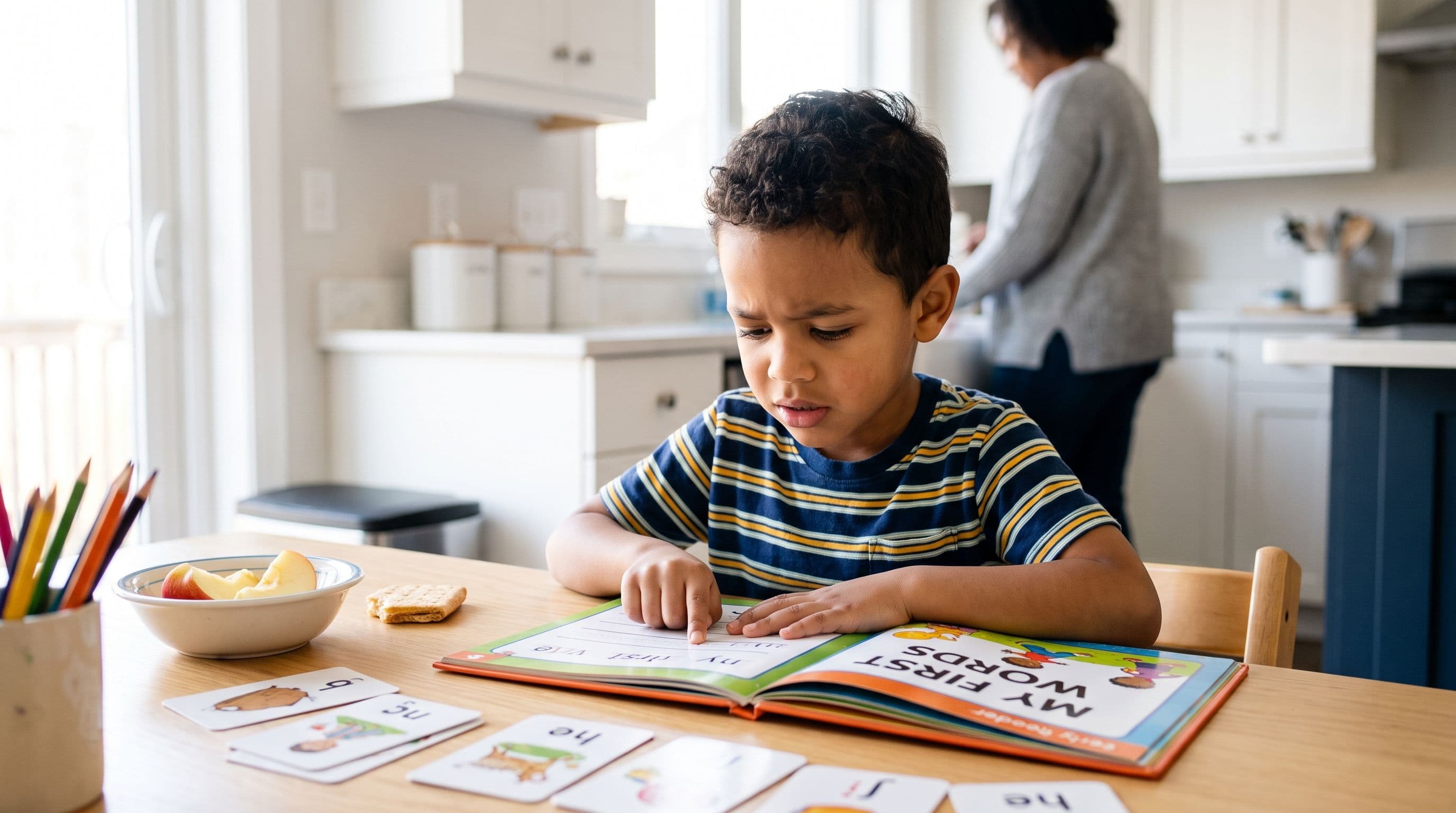
Is My 2nd Grader Behind in Reading? 9 Signs
Wondering if your 2nd grader is behind in reading? Here are the real warning signs, what 2nd graders should be able to do, and what to do next if your child is guessing, slow, or stuck.
Read More →
Best Reading App for 4th Graders Behind + Free Plan
Your 9-year-old is guessing at words and hiding books in his backpack. Most reading apps are built for 5-year-olds and will waste his time. Here's what a real 4th grade reading intervention app has to do — and the exact daily plan I use.
Read More →
Best Reading App for 3rd Graders Behind in 2026: Full List + Free Trial
Your 3rd grader is behind in reading and you're running out of time. Here's what the science says about which reading apps actually work — and which ones are expensive digital babysitters dressed up as 'learning tools.'
Read More →