Printable Phonics Worksheets for Kindergarten: Free PDFs + How to Use Them Right
What You'll Learn
- Why roughly 80% of the "free phonics worksheets" on Pinterest will actually slow your kid down (based on my own download-and-test obsession) — and what to look for instead
- The exact order to introduce letter sounds so your kindergartner builds real decoding skill (not just memorization)
- How one veteran teacher's mid-year curriculum switch boosted every kid's reading scores — and what that means for your worksheets at home
- Where to get genuinely free, science-backed printable phonics worksheets for kindergarten that you can use tonight
The Worksheet Wasteland: A Reality Check
Let me save you about four hours of scrolling.
I've downloaded hundreds of free phonics worksheets for kindergarten. Hundreds. From Pinterest boards, Teachers Pay Teachers, random mommy blogs, you name it. And I'd estimate that maybe 15-20% of them are actually worth printing.
The rest? They're cute. They've got adorable clipart hedgehogs and rainbow borders. And they're teaching your kid to do everything except read.
Here's what I mean. Last week I pulled up a wildly popular "free phonics printable" that had been pinned over 50,000 times. The worksheet showed a picture of a cat, a picture of a bat, and a picture of a hat — and the kid was supposed to circle the one that starts with the letter B.
Sounds fine, right?
Nope. That's a picture identification task. The kid never has to look at a single letter. Never has to connect a grapheme to a phoneme. Never has to blend sounds together. They just look at pictures and guess.
That's not phonics. That's a matching game with extra steps.
Real printable phonics worksheets for kindergarten should force your child to interact with letters, map sounds to those letters, and blend those sounds into words. Period. If the worksheet can be completed without looking at a single letter, throw it away.
The Tiger Truth: What Happens When You Use the Wrong Worksheets
I'm not being dramatic when I say the wrong worksheets do real damage.
Here's why: every time your kindergartner "reads" by looking at pictures instead of letters, their brain builds a neural pathway that says reading = guessing. Stanislas Dehaene's research in Reading in the Brain (2009) proved that the brain doesn't come pre-wired for reading. It has to be trained — and it can be trained to guess just as easily as it can be trained to decode.
Once that guessing habit locks in? It's brutal to undo.
The National Reading Panel report from 2000 — the one Congress actually commissioned — found that systematic phonics instruction produces significant benefits for kids in kindergarten through 6th grade. But the key word is systematic. Random worksheets pulled from a Google image search aren't systematic. They're a grab bag.
And grab bags produce grab-bag results.
Here's the scary part. According to the 2022 NAEP scores, only 33% of 4th graders read at a proficient level. One in three. And the Annie E. Casey Foundation's 2010 report found that kids who can't read proficiently by 3rd grade — especially those from low-income backgrounds — are four times more likely to drop out of high school.
Four times.
So when I tell you the worksheet matters — that the type of phonics practice matters — I'm not being a perfectionist tiger mom for fun. I'm trying to keep your kid off the wrong side of that statistic.
What Makes a Phonics Worksheet Actually Work
Before I point you to free resources, you need to know what to look for. Because a bad worksheet is worse than no worksheet — it builds bad habits.
Here are my non-negotiable rules for kindergarten phonics printables:
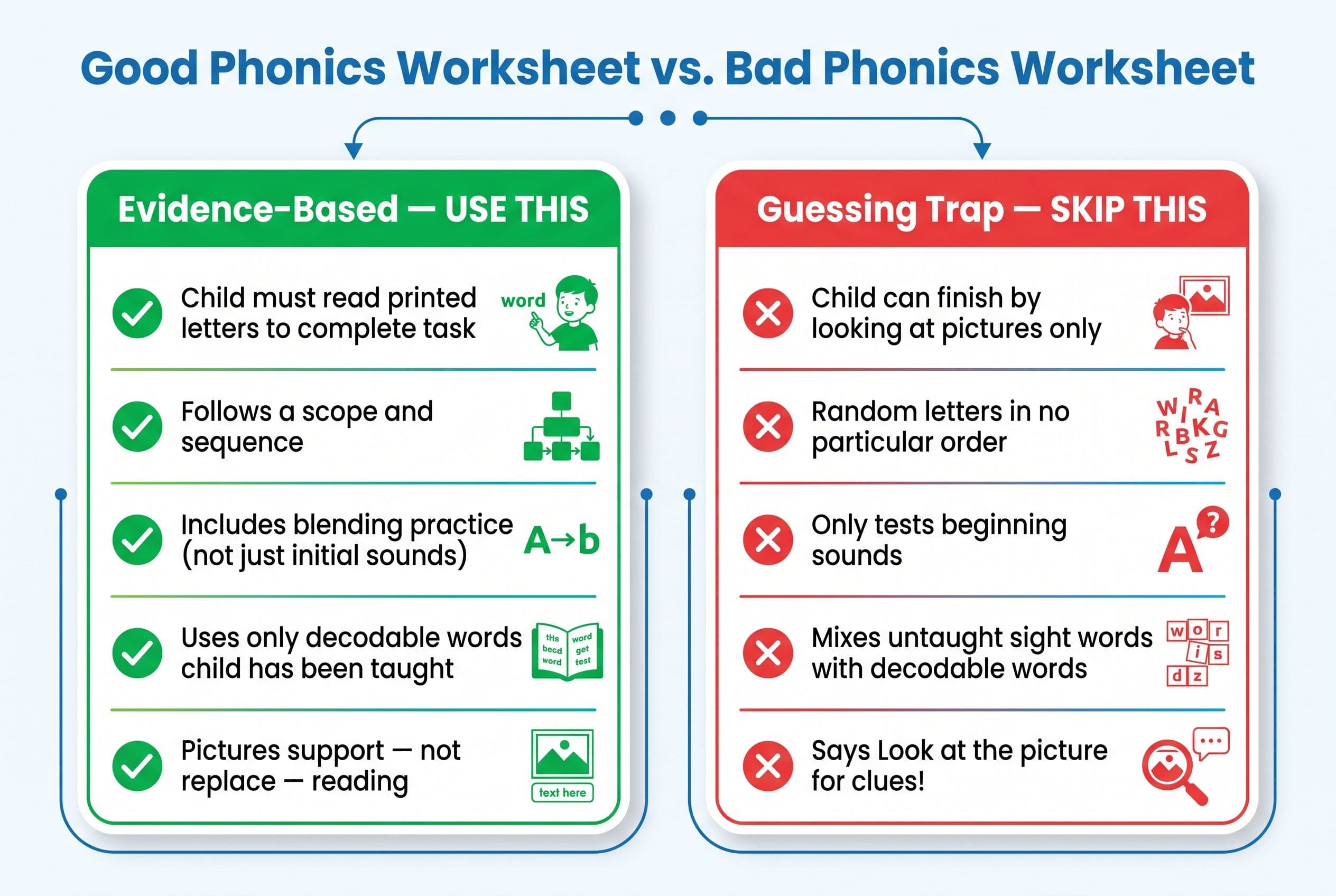
Rule 1: Letters First, Pictures Second (or Never)
The worksheet should require the child to look at and process written letters to complete the task. Pictures can be there for support, but they should never be the primary way to arrive at the answer.
Good worksheet: The child sees the letters C-A-T and blends them to read the word, then draws a line to the matching picture.
Bad worksheet: The child sees a picture of a cat and writes the first letter.
See the difference? In the good version, the child is reading. In the bad version, they're labeling a picture. Labeling pictures is a vocabulary activity, not a phonics activity.
Rule 2: Follow a Scope and Sequence
You can't just print random letter sounds worksheets and call it a curriculum. Phonics has to be taught in a specific order.
Most evidence-based programs — UFLI Foundations, Fundations, Logic of English — introduce sounds in a deliberate sequence. They don't go A-B-C-D-E. They start with the most useful letters first so kids can start building real words as fast as possible.
A common science-of-reading sequence starts with: s, a, t, p, i, n — because with just those six letters, your kid can read "sat," "tap," "pin," "nap," "sit," "pan," and a dozen more real words.
If your free phonics worksheets jump from the letter Q to the letter X to a random digraph — stop. That's not systematic. That's chaos with a cute font.
Rule 3: Include Blending Practice
Letter-sound identification is step one. But the actual reading happens when kids blend those sounds together.
A strong CVC worksheets kindergarten printable will have the child:
- Identify each sound in the word
- Say the sounds in order (/s/ /a/ /t/)
- Blend them into the word ("sat")
If the worksheet only asks kids to circle the beginning sound? It's incomplete. Blending is where the magic happens. Linnea Ehri's research on phases of word reading development (2005) shows that kids have to move from the "partial alphabetic" phase — where they only use the first letter as a cue — to the "full alphabetic" phase where they process every letter. Worksheets that only focus on initial sounds trap kids in that partial phase.
Rule 4: Decodable Words Only (No Sight Word Soup)
If the worksheet mixes decodable CVC words with high-frequency words the child hasn't been taught yet, it's a mess. Your kindergartner will try to sound out "the" and get frustrated, or — worse — learn that sometimes you decode and sometimes you just memorize, which undermines the whole system.
Keep worksheets focused on whatever letter-sound correspondences your child has already mastered. This is what David Kilpatrick calls the orthographic mapping process in Equipped for Reading Success (2016) — kids permanently store words in memory by connecting the sounds to the letters, one phoneme at a time.
Random sight word worksheets skip that process entirely.
The Neighbor Who Changed Everything
I want to tell you a quick story because it shows why the type of phonics practice matters so much.
After Emily Hanford's Sold a Story investigation came out in 2023, my neighbor — a first-grade teacher for 18 years — called me almost in tears. She'd been using Lucy Calkins' Units of Study curriculum her entire career. Three-cueing, MSV, the whole thing. She told me, "I've been teaching kids to guess for two decades and I didn't even know it."
She switched her classroom to UFLI Foundations mid-year. It was messy. She had to relearn everything herself first — phoneme-grapheme correspondences, blending routines, the whole systematic synthetic phonics approach. But by spring, her kids' DIBELS scores had jumped an average of 15 points on nonsense word fluency. She told me that was the first time in her career where every single kid in her class could decode CVC words by February.
Every. Single. Kid.
And here's the part that matters for your worksheets at home: she told me the biggest change wasn't a fancy program or expensive materials. It was that every single practice activity — including worksheets — now followed the same systematic sequence. No more grab-bag Pinterest printables. No more cute coloring pages disguised as literacy. Every piece of paper that went home in a folder was aligned to what they'd just learned, in the order they'd learned it.
That's the standard I hold my own printable phonics worksheets to at home with my 4-year-old. If it doesn't match what we've covered in our phonics sequence? It doesn't get printed. I don't care how cute the hedgehog clipart is.
Where to Find Free Phonics Worksheets That Actually Work
OK, here's what you came for. Free kindergarten phonics printables that pass the tiger mom test.
1. UFLI Foundations Virtual Teaching Resources
The University of Florida Literacy Institute (UFLI) released their Foundations manual and a ton of supporting materials. Their resources follow the exact scope and sequence of one of the most respected phonics programs in the country. You'll find word-building activities, blending practice sheets, and CVC worksheets that are aligned to a real systematic progression.
2. Florida Center for Reading Research (FCRR) Student Center Activities
This is the hidden gem most parents don't know about. FCRR has free, downloadable phonics activities organized by skill — phonemic awareness, phonics, fluency, vocabulary, comprehension. The kindergarten-level materials include letter-sound sorting activities and CVC word-building exercises. These were designed by actual reading researchers, not Pinterest influencers.
3. Reading Rockets Printable Activities
Reading Rockets is funded by a U.S. Department of Education grant, and their phonics activities section has free worksheets organized by skill. They're not as comprehensive as a full program, but they're vetted by reading scientists.
4. Teach Your Kid to Read Worksheets
Real talk — this is why we built our program. I got so tired of sifting through junk printables that I started creating my own practice sheets that match a proper scope and sequence. Our phonics worksheets follow Orton-Gillingham principles and are designed to be used in 10-15 minute daily sessions alongside our structured phonics lessons.
5. Explode the Code Online Sampler Pages
Explode the Code has been around for decades, and they offer sample pages from their workbooks as free downloads. These are solid, no-nonsense phonics worksheets — not flashy, but effective. They follow a systematic progression and focus on encoding (spelling) alongside decoding (reading), which strengthens that grapheme-phoneme connection from both directions.
How to Actually Use These Worksheets (The Step-by-Step)
Downloading a stack of free phonics worksheets is the easy part. Using them correctly is where most parents go wrong.
Here's my system — the same one I use with my 4-year-old at our kitchen table:
Step 1: Know What Your Child Has Mastered
Before you print a single page, figure out where your kid is right now. Can they identify all 26 letter sounds? Some of them? None?
If you want a quick, research-backed assessment, grab Kilpatrick's PAST test (Phonological Awareness Screening Test). It takes about 5 minutes and tells you exactly where the phonological breakdown is. You can find the administration guide in his book Equipped for Reading Success, and many school reading specialists will administer it for free if you ask.
For letter sounds specifically, just run through flashcards. Show the letter, ask for the sound. Track which ones they've got and which ones they don't. Only print worksheets for sounds they've been taught (not just exposed to — actually taught and practiced to accuracy).
Step 2: Follow This Sequence
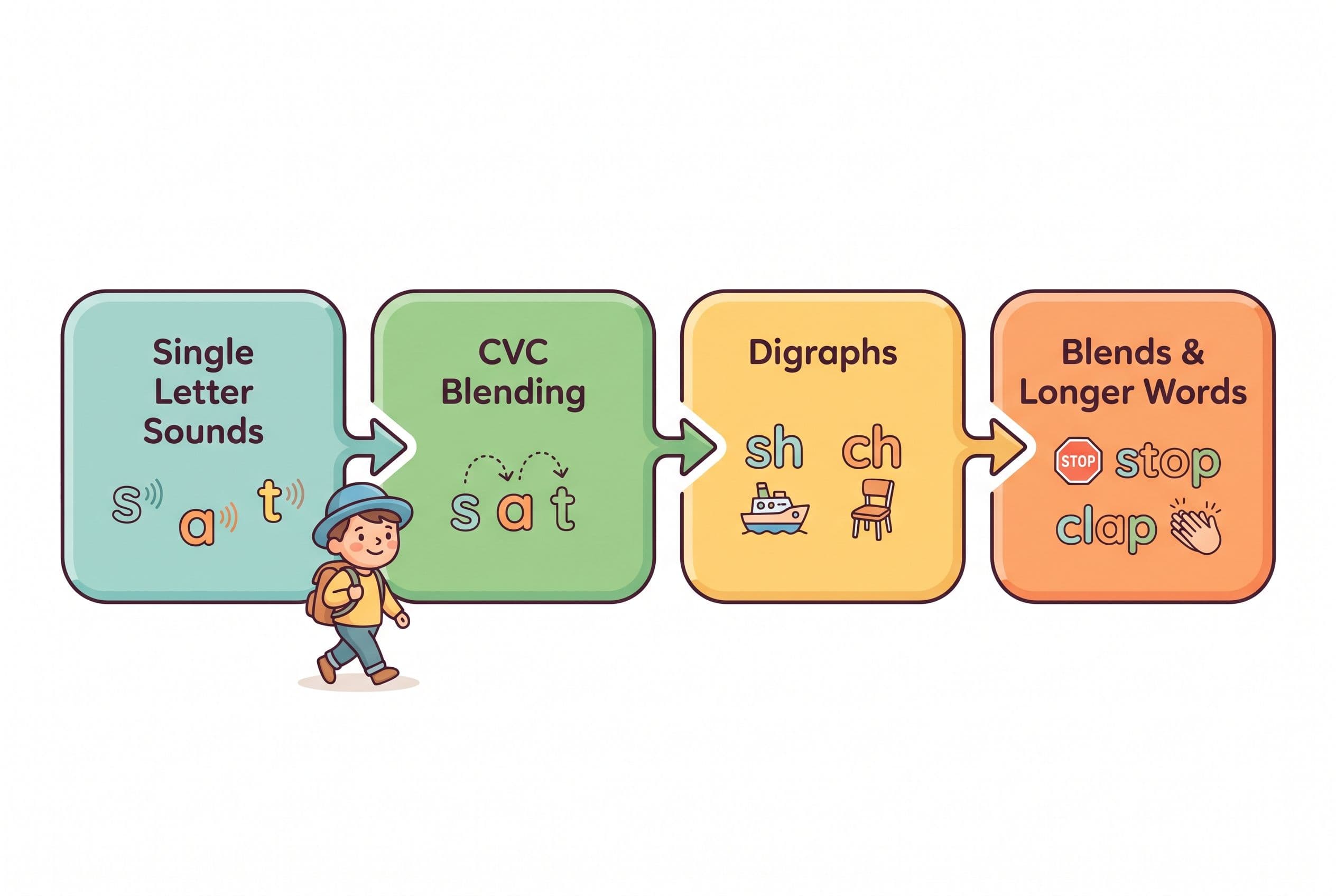
Here's a simplified scope and sequence for kindergarten phonics printables:
Phase 1: Single Letter Sounds (Consonants + Short Vowels) Start with: s, a, t, p, i, n, c, k, e, h, r, m, d, g, o, l, f, b, j, u, w, v, y, z, x, q
Phase 2: CVC Word Blending Once your child knows 6+ letter sounds, start CVC word worksheets. Begin with short-a words (sat, cap, man), then short-i (sit, pin, tip), and so on.
Phase 3: Consonant Digraphs sh, ch, th, wh, ck — these are two letters that make one sound. Don't introduce these until your child is blending CVC words fluently.
Phase 4: CCVC and CVCC Words Words like "stop," "clap," "mist," "bent" — consonant blends at the beginning or end of words.
Print worksheets that match whichever phase your child is in. Not ahead. Not behind. Right where they are.
Step 3: The 10-Minute Daily Drill
This is my non-negotiable. We do phonics every single day. Birthdays. Christmas. Vacation. We never skip.
But here's the thing — it's only 10-15 minutes. That's it. I had my 4-year-old at the kitchen table last Tuesday doing CVC blending worksheets while her baby brother was in the high chair smearing banana on his face. It wasn't Instagram-perfect. It was 12 minutes of focused work.
Here's how I structure it:
- Minutes 1-3: Quick review of previously learned letter sounds (flashcard drill)
- Minutes 4-5: Introduce or review the target sound for the day
- Minutes 6-12: Complete the worksheet together. I don't hand it to her and walk away. I sit with her, point to each letter, and say "What sound?" She says the sound. We blend together. If she guesses from the picture, I cover the picture with my hand. No guessing in this house.
- Minutes 13-15: One quick game to reinforce — magnetic letters on the fridge, writing the word in a salt tray, whatever keeps it tactile
Step 4: Track Progress
Every two weeks, I do an informal check. Can she still produce the sounds we covered? Can she blend the CVC words from last week without hesitation?
If your child's school uses DIBELS (any version), ask the teacher for the published benchmark goals for kindergarten at each time of year — the specific targets vary by edition and measure (letter-sound fluency, nonsense word fluency, etc.), so you want the numbers that match what your school actually administers. That gives you a concrete target instead of the vague "she seems to be doing fine" that parents (and teachers) often default to.
Want a quick home version? Write 10-15 unfamiliar CVC nonsense words (like "riz," "vap," "tob") on index cards and see if your child can decode them accurately. If they're blending smoothly without guessing, they're on track. If they're freezing or looking at you for clues, go back and drill the individual sounds before moving forward.
If she's stuck on a skill? We don't move on. We drill it again. Different worksheet, same skill. Mastery before progress.
The Worksheets to Avoid (The Blacklist)
I've been collecting bad worksheets like a blooper reel. Here are the types I throw straight in the recycling bin:
"Color the Letter" worksheets — Your kid spends 10 minutes coloring a giant letter A with a crayon. They learn nothing about the sound that letter makes. It's an art project, not phonics.
"Circle the picture that starts with..." worksheets — As I mentioned above, this tests vocabulary and picture recognition, not letter-sound knowledge. If there's no printed word to decode, it's not a phonics worksheet.
"Word Family" wheels with no blending component — These show -at, -it, -an families and have kids stick on beginning consonants. The concept is fine, but most of these worksheets let kids just memorize the chunk without actually blending through each sound. That's the "partial alphabetic" trap Linnea Ehri warns about.
Anything with three-cueing prompts — If the worksheet says "Look at the picture for clues!" or "Does it make sense?" or "What word would fit?" — that's Balanced Literacy in disguise. Run.
"Trace the sight word 10 times" worksheets — Rote copying isn't reading. It's handwriting practice. There's nothing wrong with handwriting practice, but don't fool yourself into thinking your kid learned to read the word "was" because they traced it a dozen times.
Why Worksheets Alone Aren't Enough (And What to Pair Them With)
I need to be straight with you about something. Worksheets are a reinforcement tool. They're not a reading program.
A worksheet can't teach your child to blend for the first time. It can't model the mouth position for /th/ vs /f/. It can't hear your child say the wrong sound and gently correct them in real time.
You need three things working together:
- Direct instruction — someone (you, a tutor, a program) explicitly teaching each sound, showing how to blend, correcting errors immediately
- Guided practice — worksheets, word-building activities, and decodable readers where the child applies the skill with support
- Independent practice — the child reads decodable text on their own using only the sounds they've mastered
Worksheets live in category two. They're the bridge between "I just learned this" and "I can do this on my own."
That's exactly how we designed the Teach Your Kid to Read program — structured phonics lessons that introduce and model each skill, followed by practice activities (including printable worksheets) that reinforce it, followed by decodable reading that lets your child apply it independently.
You don't need our program to make worksheets work. But you do need some kind of systematic instruction alongside them. Printing 50 random CVC worksheets and handing them to your kindergartner is like giving someone a weight set without showing them proper form. They might get some benefit. They'll probably get hurt.
The Policy Context: Why This Matters Right Now
Here's something that should make you feel both validated and a little angry.
Over 40 states have now passed "Science of Reading" legislation since 2019. Mississippi's Literacy-Based Promotion Act of 2013 took the state from 49th to 21st in national reading scores in six years. Ohio's Third Grade Reading Guarantee requires intervention for struggling readers starting in kindergarten.
Schools are finally catching up to what the research has said for decades: systematic phonics works, guessing doesn't.
But policy changes take time. Your kid's teacher might still be using Balanced Literacy-aligned materials. Your school might still be sending home leveled readers from Fountas & Pinnell instead of decodable texts. The transition is messy and slow.
That's why what you do at home matters so much. You don't have to wait for the district to adopt a new curriculum. You can start printing evidence-based phonics worksheets tonight and drilling letter sounds at the kitchen table tomorrow morning.
You are the backstop.
Frequently Asked Questions
How many phonics worksheets should my kindergartner do per day?
One to two worksheets per day is the sweet spot — roughly 10-15 minutes of focused work. More than that and you're pushing past a 5-year-old's attention span, which turns phonics into a battle instead of a routine. Quality over quantity. I'd rather my daughter do one worksheet with full attention and accurate blending than three worksheets while zoning out.
Can I use free phonics worksheets as my child's only reading instruction?
No. Worksheets are practice, not instruction. Your child needs someone to explicitly teach each sound, model blending, and correct errors in real time before a worksheet becomes useful. Think of worksheets like homework — they reinforce what's already been taught. Use a structured phonics program (UFLI Foundations, Fundations, Logic of English, or Teach Your Kid to Read) as the primary instruction, and worksheets as the follow-up practice.
What's the difference between phonics worksheets and phonemic awareness worksheets?
Phonemic awareness is about sounds only — no letters involved. A phonemic awareness activity might ask your child to "tell me the first sound in the word 'map'" orally. Phonics connects those sounds to printed letters. A phonics worksheet shows the letters M-A-P and asks the child to blend the sounds and read the word. Both are important, but they're different skills. Phonemic awareness usually develops first (ages 3-5) and supports phonics learning.
My kindergartner's school sends home letter-of-the-week worksheets. Are those good enough?
Honestly? Probably not. Letter-of-the-week programs spend 26 weeks just teaching letter names, and most reading scientists (including Louisa Moats, who wrote Teaching Reading IS Rocket Science in 1999 for the American Federation of Teachers) argue that kids can learn letter sounds much faster with systematic instruction. If your child is only learning one letter per week, they won't even start blending CVC words until midway through the school year. Supplement at home with a faster-paced sequence.
How do I know if my kindergartner is making good progress with phonics worksheets?
Use concrete benchmarks, not vibes. If your school administers DIBELS, ask the teacher for your child's scores and how they compare to the grade-level benchmarks for that time of year — the specific targets depend on the edition and measure, so get the numbers straight from the school. For a quick home check, write 10-15 nonsense CVC words (like "riz," "vap," "tob") on index cards and see if your child can decode them accurately without guessing. If they're blending smoothly, they're on track. If they're freezing or looking at the ceiling for divine intervention, go back and drill the individual sounds before moving forward.
The Bottom Line
Free printable phonics worksheets for kindergarten are everywhere. Good ones are rare.
Your job is to be the filter. Does the worksheet require your child to look at letters and produce sounds? Does it follow a systematic sequence? Does it build toward blending, not just letter identification? Does it keep pictures in a supporting role, not the starring role?
If yes — print it, use it, drill it daily.
If no — delete it. I don't care how many Pinterest saves it has.
Your kindergartner's reading future is not going to be built on cute clipart and coloring pages. It's going to be built on systematic, daily, no-excuses phonics practice. Worksheets are one piece of that puzzle. A real structured program is the rest.
Ready to pair those worksheets with a complete phonics program? Teach Your Kid to Read gives you the systematic instruction, the practice materials, and the daily structure — all built on Orton-Gillingham principles and the science of reading. No guessing. No fluff. Just a kid who can actually read.
📞 Questions? Call us at (407) 707-6850 or visit TeachYourKidToRead.org to get started today.
Part of these guides

Xia Brody
Co-Founder, Teach Your Kid to Read
Mom of 4 who has successfully taught her kids to read. Currently in the trenches with her 4-year-old while her two oldest (10 and 7) devour books on their own. Passionate about phonics-based methods and building a lifelong love of reading.
Related Articles

Best Free Reading Apps for Kids: 7 Truly Free Picks (2026)
Most "free" reading apps aren't free — they're a 7-day trial with a credit card form at the end. Here are 7 that are genuinely free, which ones actually teach phonics, and the one thing no app can do for your child.
Read More →
Best Reading App for Kindergartners in 2026 (6 Tested)
Not all kindergarten reading apps are created equal. I tested 6 of the most popular options with my own kids and broke down which ones actually teach phonics — and which ones just keep your child busy while pretending to be educational.
Read More →
Best Phonics App for a 3-Year-Old: 5 Tested & Compared (2026)
Most phonics apps for toddlers are glorified cartoons with a letter slapped on top. I tested 5 of the most popular ones with my own kids and ranked them by what actually matters: systematic phonics instruction, not flashy animations. Here's what I found.
Read More →