Reading.com vs Teach Your Monster to Read: Parent Pick
What You'll Learn
- The one feature that separates a real kindergarten phonics app from a cute screen-time game
- Why “free” reading apps can cost you months if they train guessing instead of decoding
- Where Reading.com helps, where Teach Your Monster to Read shines, and where both can leave gaps
- My parent pick if your child needs daily, systematic phonics without you becoming a reading specialist overnight
Reality Check
Your kid doesn’t need another adorable app where monsters dance every time they tap a picture.
Your kid needs to read.
If you’re searching reading.com vs teach your monster to read, you’re probably trying to make a fast decision before your 5-year-old starts kindergarten (age 5) or your 6-year-old hits that scary “why are they still guessing?” stage. Good. Don’t wait.
I’m Xia Brody, co-founder of TeachYourKidToRead.org, Chinese-American homeschooling mom of four, and yes, I’m the mom at the kitchen table making my 4-year-old blend m-a-t while the baby throws Cheerios like confetti. Literacy is a survival skill. Cute helps. Cute doesn’t replace phonics.
The Verdict: My Parent Pick
Here’s the short version before we get into the weeds.
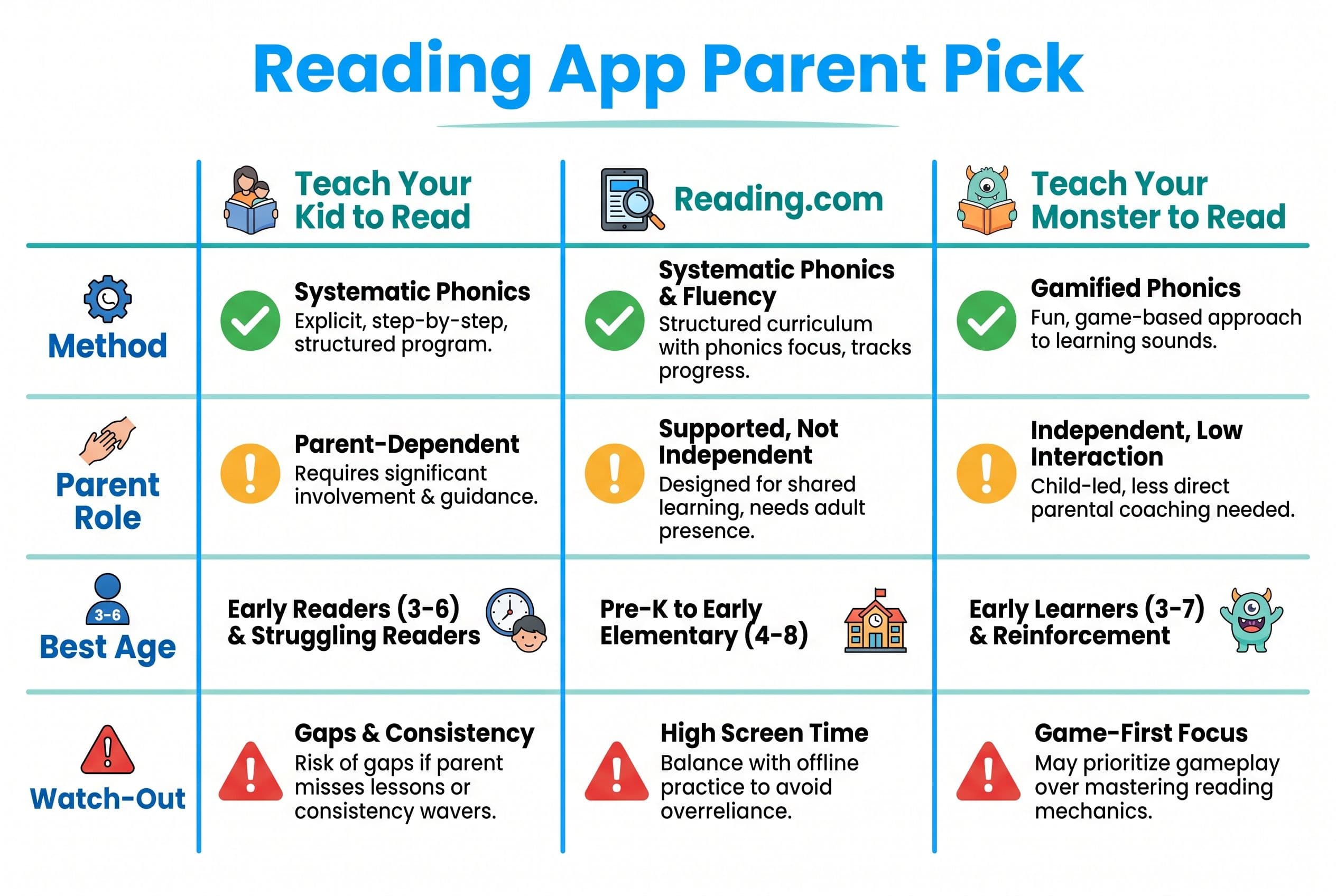
| Rank | App | What it teaches | Price | Best for |
|---|---|---|---|---|
| #1 | Teach Your Kid to Read | Systematic synthetic phonics with Orton-Gillingham-style structure, no guessing | Lesson one is free with no card and nothing to cancel; from lesson two the whole program is a 7-day free trial, then US$9.95/month | Ages 4-7, especially pre-K through 1st grade (ages 4-7) |
| #2 | Reading.com | Parent-led reading lessons with phonics practice and decodable reading | Paid subscription, pricing may vary by plan | Ages 4-7 with a parent sitting right there |
| #3 | Teach Your Monster to Read | Fun phonics games, letter sounds, early blending | Often free on web; app price varies by platform and region | Ages 3-6 as extra practice, not the full plan |
My pick is Teach Your Kid to Read because it gives parents the thing most apps skip: a structured path that teaches decoding step by step, with no picture-guessing nonsense. You can start lesson one free — lesson one is free with no card and nothing to cancel; from lesson two the whole program is a 7-day free trial, then US$9.95 a month.
That doesn’t mean Reading.com or Teach Your Monster to Read are useless. They’re not. But if your child needs real reading skill, not just “literacy vibes,” you need to know exactly what each app does.
Tiger Truth: The Cost of Picking the Wrong Reading App
Real talk — the app matters because the method matters.
The National Reading Panel report in 2000 found that systematic phonics instruction gives kids clear benefits in learning to read. That wasn’t a mommy-blog opinion. That was a US federal reading panel reviewing the research.
And the stakes? Brutal.
US students on the 2022 NAEP / The Nation’s Report Card showed only 33% of 4th graders (ages 9-10) reading at or above proficient. That means two-thirds weren’t proficient. I wish I was kidding.
Then there’s Donald Hernandez’s 2011 Double Jeopardy report for the Annie E. Casey Foundation showing an ugly association: kids who weren’t reading proficiently by the end of 3rd grade (ages 8-9) were four times more likely to leave high school without a diploma than proficient readers. That doesn’t prove one magical cliff day where everything suddenly breaks. But it does mean 3rd grade reading trouble is a giant red flag with flashing lights and a siren.
So no, I don’t shrug when an app teaches a child to look at the picture and guess “pony” for horse. That’s not reading. That’s a party trick with a subscription.
Deep Dive: Reading.com vs Teach Your Monster to Read vs Teach Your Kid to Read
#1 Teach Your Kid to Read: Best for Real Phonics Mastery
Teach Your Kid to Read is my top pick because it starts from the right premise: children don’t naturally learn to read the way they learn to talk.
Stanislas Dehaene explains this beautifully in Reading in the Brain (2009). The human brain has to build new reading circuits. We train those circuits through grapheme-phoneme correspondence — letters connected to sounds — then blending, spelling, and repeated accurate reading.
That’s the foundation.
This is why I’m so intense about No Guessing. If my 4-year-old looks at sat and says “sun” because there’s a cheerful little picture nearby, I stop him. Nicely, but fast.
“Sound it out.”
Not “try the first letter.” Not “look at the picture.” Not “what would make sense?”
Sound. It. Out.
Teach Your Kid to Read uses a systematic synthetic phonics path. That means your child learns sounds in a planned order and blends them into words they can actually decode. It’s the same basic reading science behind strong structured literacy approaches like Orton-Gillingham, UFLI Foundations, Fundations, Logic of English, and Wilson Reading System.
No, it doesn’t mean every child reads on the same timeline. My oldest clicked faster than my second. My second needed more repetition and more “we are not crying over short vowels today, buddy” pep talks. Different kids, same non-negotiable foundation.
What I like most:
- It teaches decoding directly
- It keeps lessons short enough for real families
- It doesn’t depend on picture guessing
- It gives parents a sequence instead of random activities
- It works as daily practice at the kitchen table, on vacation, or after dinner when everyone is slightly feral
The offer is simple and honest: lesson one is free with no card and nothing to cancel. From lesson two, the whole program is a 7-day free trial, then US$9.95/month.
That matters because parents hate surprise paywalls. Same.
The kicker is that Teach Your Kid to Read treats parents like capable adults. You don’t need a master’s degree in literacy. You need a plan, clear lessons, and the willingness to practice every day.
Tiger Rule: We Never Skip. Birthdays, holidays, hotel rooms, Grandma’s house — five to ten minutes still counts. Reading doesn’t take a vacation just because we found a pool.
#2 Reading.com Review: Strong Parent-Led Lessons, But Watch the Fit
A fair Reading.com review has to give credit where it’s due: Reading.com tries to bring parents into the process. I like that.
Too many reading apps babysit. Reading.com asks the adult to sit beside the child, guide the lesson, and practice reading together. That’s a no-brainer for early literacy because young kids need feedback.
If a child says pin for pan, an app may mark something wrong or move on. A parent can stop and say, “Wait. Look at the middle sound. Is that /i/ or /a/?” That tiny correction builds skill.
Reading.com includes phonics, blending, and early reading practice. For many families, especially parents who want a polished app with a clear daily routine, it can help.
But here’s where I get picky.
I want to know whether an app builds full decoding independence or leans too heavily on guided reading patterns, memorized text, or “read with me” support. If a child can read a lesson only because the adult prompts every other word, we haven’t reached mastery yet.
Use Reading.com if:
- You want a parent-child lesson format
- Your child enjoys app-based instruction but still needs you beside them
- You’re willing to check whether the words are truly decodable
- You’ll stop guessing the second it appears
Don’t use it as a magic wand. No app is a magic wand. If your child struggles with phonemic awareness — hearing and manipulating individual sounds in spoken words — you may need extra work outside the app.
For that, I like David Kilpatrick’s PAST, the Phonological Awareness Screening Test, when it’s used correctly. It screens phonological awareness through word-part manipulation tasks like deletion and substitution at the syllable, onset-rime, and phoneme levels. It’s not a full diagnostic evaluation, and it doesn’t replace separate checks for oral blending and segmentation if those are the problem. But used with the administration guidance? Nerdy reading mom gold.
#3 Teach Your Monster to Read Comparison: Fun Practice, Not the Whole Plan
Now let’s talk Teach Your Monster to Read comparison honestly.
Teach Your Monster to Read is charming. My kids liked it. The little monster is cute, the games move quickly, and for some children, it makes letter-sound practice feel less like a drill and more like play.
I’m not anti-fun. I’m anti-fake learning.
Teach Your Monster to Read can support:
- Letter sound recognition
- Early blending
- Simple word reading
- Motivation for reluctant learners
- Extra practice after direct instruction
That’s useful.
But I wouldn’t make it the spine of a reading plan. It’s game-first. Some kids race through rewards and animations without slowing down enough to form strong orthographic mapping — that mental process Linnea Ehri described in her 2005 work on phases of word reading development, where children bond spelling, pronunciation, and meaning in memory.
Translation? Your child needs to look at the letters, say the sounds, blend the word, and store it correctly.
If the game energy replaces accurate decoding, you’ve got a problem.
Teach Your Monster to Read works best as a supplement after a lesson. Think dessert, not dinner. Ten minutes after structured phonics? Fine. Replacing direct instruction with monster games for six months? Nope.
Bottom line: I’d rather see a child do five focused minutes of decoding map, mat, sat, Sam than 30 minutes of tapping through animations while half-reading.
Free vs Paid Reading Apps: What Parents Usually Miss
Let’s tackle free vs paid reading apps because this one drives me crazy.
Free isn’t bad. Paid isn’t automatically better. The question is whether the app teaches reading or keeps your child busy.
A free app that reinforces letter sounds accurately can help. A paid app that trains guessing can hurt. Price doesn’t prove quality.
Check for these features:
- Does the app teach letter-sound relationships explicitly?
- Does it require left-to-right blending?
- Does it use decodable words matched to taught sounds?
- Does it correct mistakes clearly?
- Does it avoid picture guessing?
- Does it build from simple CVC words to digraphs, blends, vowel teams, and multisyllable words?
If the answer is “mostly no,” don’t let the cute graphics fool you.
I’ve seen parents spend US$200 on subscriptions and still have a 7-year-old guessing from the first letter. That’s painful. Not because the parent failed, but because nobody told them what to look for.
My Raleigh Playground Moment: Why This Comparison Matters
I was at a playground in Raleigh when another mom told me her kid’s school had just switched from Lucy Calkins to a Science of Reading curriculum because of North Carolina’s SB 387 — the Excellent Public Schools Act, a US state law.
She was confused and a little annoyed.
“He was doing fine before,” she said.
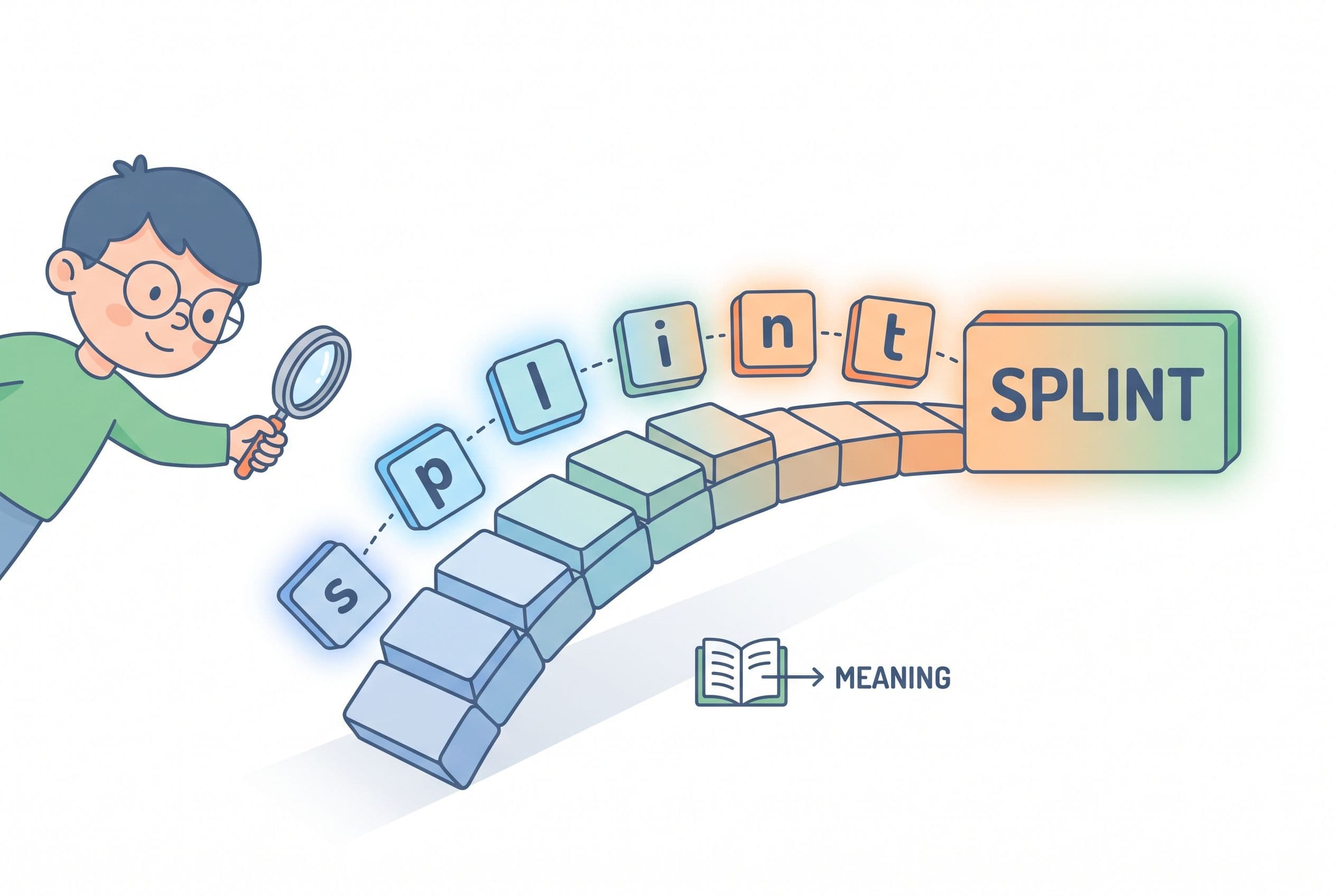
I asked if her son could read the word splint. He was in 2nd grade (ages 7-8). He couldn’t.
Now, one word doesn’t diagnose a child. I’m not handing out reading verdicts from a playground bench like some phonics fortune teller. Maybe he hadn’t been taught that pattern clearly. Maybe he was tired. Maybe he froze because a random mom asked him to read splint next to the monkey bars. Fair.
But that moment raised the exact question worth checking: could he decode unfamiliar words with taught patterns, or was he leaning on familiar books, memorized patterns, and pictures?
I spent 20 minutes on that playground bench explaining why the switch was happening: Emily Hanford’s reporting in APM Reports / “Sold a Story”, the NAEP data, and Dehaene’s neuroscience showing the brain doesn’t learn to read naturally.
That mom went home and listened that night. She texted me at 11 p.m.: “I had no idea. Why didn’t anyone tell us this sooner?”
Exactly.
Parents aren’t lazy. They’re under-informed by systems that made guessing sound normal.
So when you compare reading.com vs teach your monster to read, don’t ask, “Which one is cuter?” Ask, “Which one will stop my child from guessing and teach them to decode unfamiliar words?”
That’s the real deal.
What a Kindergarten Phonics App Must Teach
If you’re choosing among the best reading apps for kindergarten, demand these skills.
1. Phonological Awareness Before Print Gets Hard
Phonological awareness means hearing sound parts in spoken language. Phonemic awareness is the sharper version: hearing individual sounds.
Example: Can your child hear that ship has three sounds: /sh/ /i/ /p/? Can they blend /m/ /a/ /t/ into mat without seeing letters?
If not, reading will feel like climbing stairs with roller skates on.
2. Letter Sounds, Not Just Letter Names
Letter names are nice. Letter sounds read words.
Your child needs to know that m says /m/, s says /s/, and a can say /a/ as in apple in early short-vowel words.
Then they need to use those sounds.
3. Blending CVC Words
CVC means consonant-vowel-consonant: sat, map, pin, dog, cup.
This is where many apps get exposed. If a child can tap sounds individually but can’t blend them into a word, they’re not reading yet.
4. Decodable Readers
Decodable readers use patterns your child has learned.
Bob Books, Flyleaf Publishing, High Noon Books, and some UFLI-aligned passages give kids practice with controlled text. Fountas & Pinnell leveled readers are everywhere, but they come from a whole-language aligned tradition. Be careful there.
Leveled readers often push kids toward memorizing predictable sentences and using pictures. Decodable readers force the brain to do the reading work.
5. Fluency Without Rushing
Fluency means accurate, smooth reading with understanding. It doesn’t mean speed-racing like a tiny auctioneer.
Schools may use tools like DIBELS, the Dynamic Indicators of Basic Early Literacy Skills, to screen early reading skills under specific timed conditions. But don’t grab one random benchmark number from the internet and start diagnosing your child at the kitchen table. The score depends on the DIBELS edition, grade, time of year, measure, and official benchmark table.
Why do screeners use nonsense words like sim, lat, mup? Because they can show whether a child can decode instead of memorize.
At home, treat nonsense words as a quick “are we decoding or guessing?” check, not a formal diagnosis. Tiger mom rule: useful information, not panic theater.
The Action Step: How to Choose Today
Do this before you buy another subscription.
- Test one unfamiliar word. Give your child a word like splint, mop, chin, or raft, depending on age and skill. Cover any pictures. Watch what they do.
- Listen for guessing. If they say a word that starts with the same letter but doesn’t match the sounds, stop. That’s not reading.
- Check the app’s sequence. Look for a clear order: letter sounds, blending, CVC words, digraphs, blends, long vowels, vowel teams, multisyllable words.
- Try a real lesson. Don’t judge by the mascot. Judge by what your child can decode after the lesson.
- Use Teach Your Monster to Read as practice only. Great for extra reps. Not my full curriculum pick.
- Use Reading.com if you want parent-led support. Stay alert for mastery gaps.
- Use Teach Your Kid to Read if you want the cleanest structured phonics path. Lesson one is free with no card and nothing to cancel; from lesson two the whole program is a 7-day free trial, then US$9.95/month.
- Recheck every two weeks. Use a quick nonsense-word check or take the 2-minute reading check to see whether your child is decoding, not memorizing.
My Final Pick for Parents
If your child is 3-4, Teach Your Monster to Read can work as playful exposure.
If your child is 4-7 and you want parent-led app lessons, Reading.com deserves a look.
But if your child needs a structured, no-guessing phonics path, my pick is Teach Your Kid to Read.
I want decoding. I want mastery. I want a child who sees splint and attacks it sound by sound instead of melting into the rug.
That’s independence.
And honestly? Independence is the whole point. Not app points. Not monster hats. Not parent bragging rights at pickup.
A child who can read can learn anything.
Start with one lesson, watch how your child handles the sounds, and decide from evidence instead of marketing. Lesson one is free with no card and nothing to cancel; from lesson two the whole program is a 7-day free trial, then US$9.95/month.
FAQ
Is Teach Your Monster to Read enough to teach my child to read?
For some children, it helps with early skills like letter sounds and blending, but I wouldn’t use it as the whole reading plan. Use it as extra practice after structured phonics instruction.
Is Reading.com good for kindergarten?
Reading.com can help kindergarten-age children when a parent sits with them and gives feedback. Check that your child can decode unfamiliar words outside the app, not just follow guided lesson patterns.
What’s the best reading app alternative to Reading.com and Teach Your Monster to Read?
My pick is Teach Your Kid to Read because it focuses on systematic synthetic phonics and avoids guessing. It’s built for parents who want short daily lessons with a clear sequence.
Should I choose a free or paid reading app?
Choose the app that teaches decoding. A free app with accurate phonics beats a paid app that trains guessing. A paid app with a strong sequence can save time if it helps your child practice consistently.
How long should my child practice reading each day?
For ages 4-6, start with 5-10 focused minutes. Older beginners may handle 10-15 minutes. Short, accurate, daily practice beats one dramatic weekend session every time.

Xia Brody
Co-Founder, Teach Your Kid to Read
Mom of 4 who has successfully taught her kids to read. Currently in the trenches with her 4-year-old while her two oldest (10 and 7) devour books on their own. Passionate about phonics-based methods and building a lifelong love of reading.
Related Articles

Best Free Reading Apps for Kids: 7 Truly Free Picks (2026)
Most "free" reading apps aren't free — they're a 7-day trial with a credit card form at the end. Here are 7 that are genuinely free, which ones actually teach phonics, and the one thing no app can do for your child.
Read More →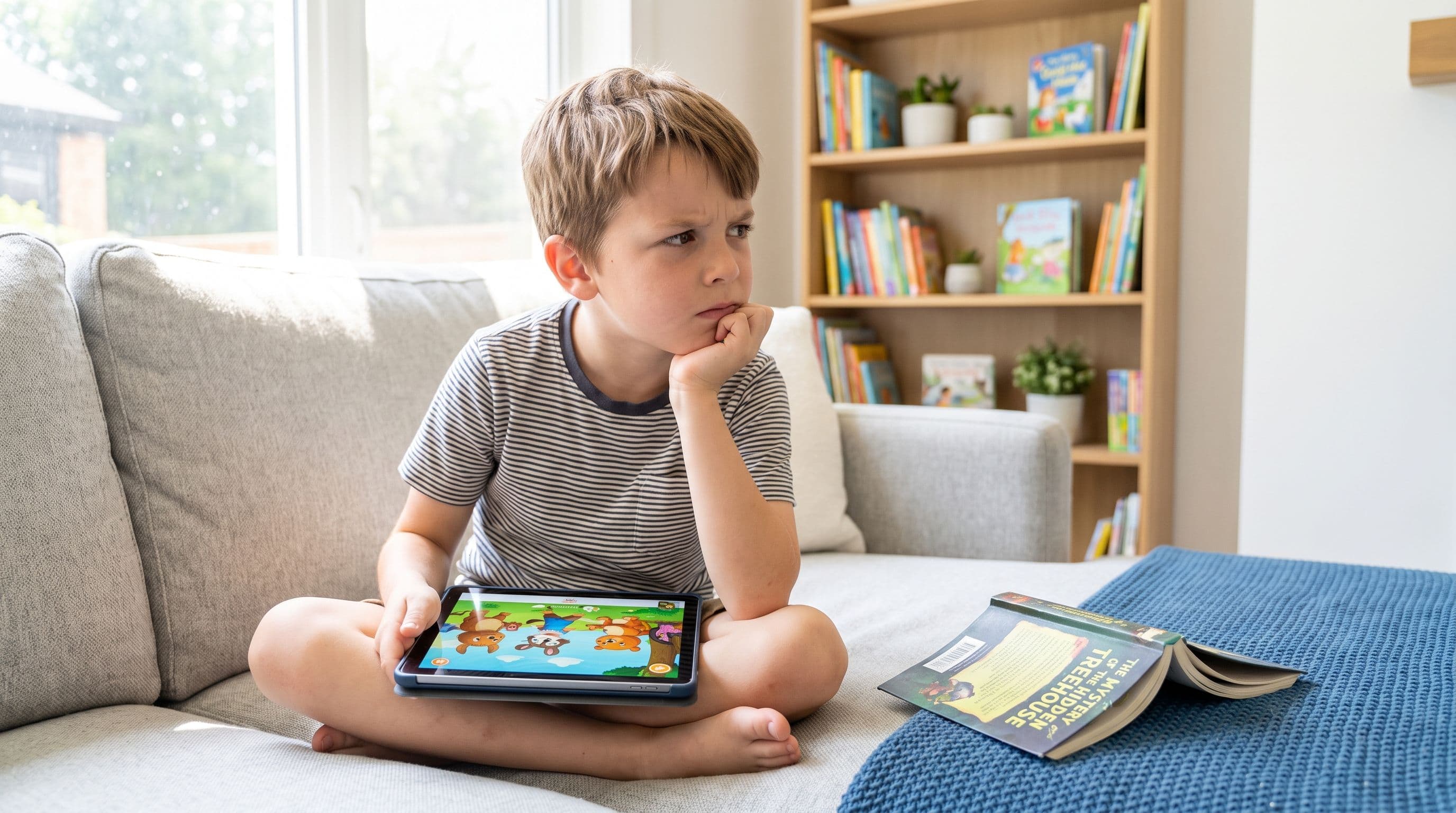
Teach Your Monster to Read vs Reading Eggs: 2026 Honest Comparison
Both apps promise to teach your kid to read, but one leans harder on phonics science and the other leans on flashy gamification. Here's my unfiltered breakdown of Teach Your Monster to Read vs Reading Eggs — what works, what doesn't, and what's still missing from both.
Read More →
Khan Academy Kids vs HOMER: Reading App Showdown (2026)
Khan Academy Kids and HOMER are the two biggest names in early reading apps. But do either of them actually teach phonics the right way? I broke down both apps lesson by lesson — here's what I found and what your kid actually needs.
Read More →