Teach Your Monster to Read vs ABCmouse: 2026 Ranking

Your child can collect digital rewards and still struggle to read map on a piece of paper. That’s the problem behind the teach your monster to read vs abcmouse decision: you’re buying reading practice, not proof that your child can tap quickly.
I’m Xia Brody, a Chinese-American homeschooling mum of four, ages 10, 7, 4 and 1. I’ve taught my two oldest to read, and I’m back in the sound-it-out trenches with my four-year-old. Cute monsters? Fine. Independent decoding? Non-negotiable.
What You’ll Learn
- Which app wins the original head-to-head—and when I’d choose differently.
- The catch behind comparing a free reading app vs ABCmouse.
- Why I rank a parent-led option above a bigger activity library.
- The paper-and-pencil check that matters more than digital rewards.
Reality Check: Playing Isn’t Proof of Reading
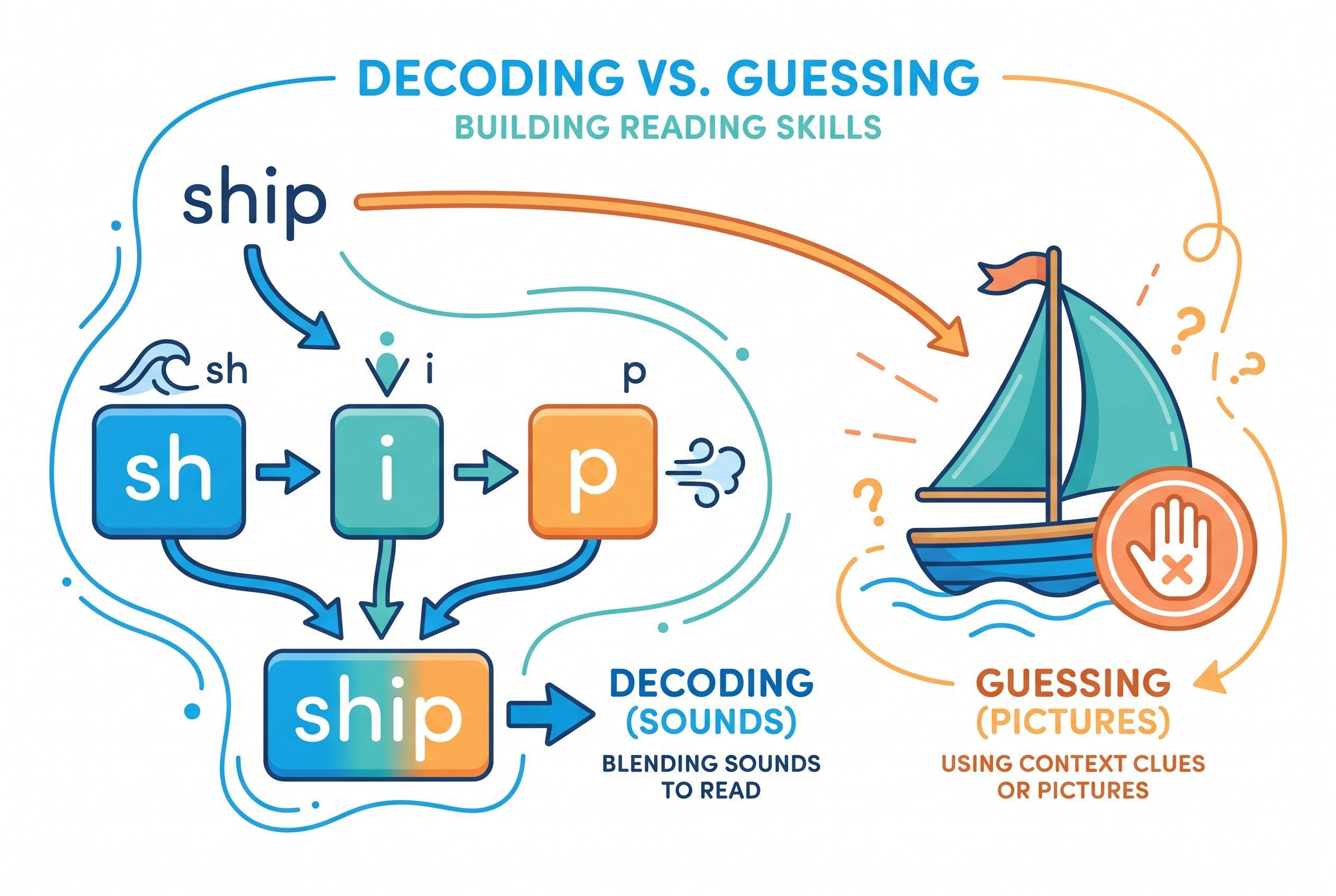
Imagine your child sees ship, spots the accompanying boat illustration and announces, “Boat!” The answer makes sense. It still isn’t reading the printed word. My rule: No Guessing. Pictures support understanding; letters identify the word.
For teach your monster to read vs abcmouse, judge the instruction before the entertainment. My ranking prioritises explicit sound–letter teaching, blending practice, parent involvement and transfer to unfamiliar print, then access and cost. These are curriculum-fit judgments based on public product descriptions—not hands-on competitor testing or comparative outcome studies.
The Verdict
Between the two headline apps, I’d choose Teach Your Monster to Read for focused phonics practice. Choose ABCmouse if you want a broader early-learning subscription. I’ve added our parent-led option and Khan Academy Kids because families making this decision often also want structured guidance or genuinely free mobile access.
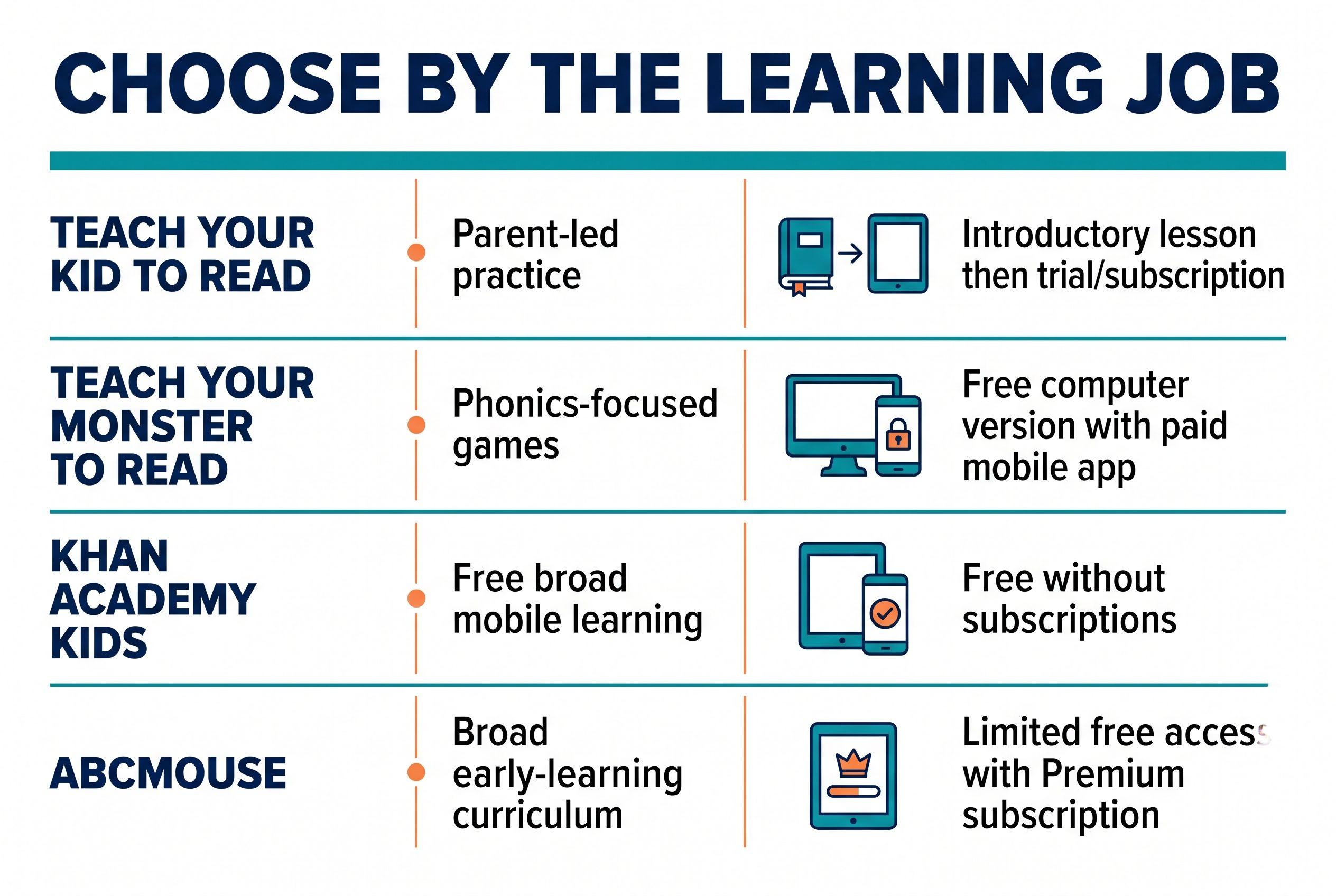
| Rank and app | Reading approach | Price/access model | Best-for age |
|---|---|---|---|
| 1. Teach Your Kid to Read | My pick for parent-led reading practice; judge progress through sounding out, not guessing | Lesson one free, no card and nothing to cancel; from lesson two, the whole program has a 7-day free trial, then US$9.95/month | My recommendation: beginners around 4–7, depending on skill |
| 2. Teach Your Monster to Read | Phonics-focused games covering sound–letter connections and blending | Free on computers; one-time paid mobile app; check current price | Stated ages 3–6 |
| 3. Khan Academy Kids | Early literacy, including phonics, within a broader learning library | Free; no ads or subscriptions | Stated ages 2–8 |
| 4. ABCmouse | Reading and phonics activities within a broad early-learning curriculum | Limited free Basic Access; Premium subscription; check current price and trial terms | Stated ages 2–8 |
Full disclosure: I co-founded Teach Your Kid to Read, so weigh my #1 pick accordingly; the rest of the ranking is based on the criteria above.
For a parent-led starting point, I recommend Teach Your Kid to Read: start lesson one free. Lesson one is free with no card and nothing to cancel; from lesson two, the whole program has a 7-day free trial, then US$9.95 a month.
Bottom line: my #1 reflects my preference for parent involvement, not evidence that our app outperforms these competitors. None of the other apps automatically deserves a “guessing programme” label simply because it includes pictures or games.
Tiger Truth: Don’t Let Rewards Hide a Reading Gap
The US Nation’s Report Card reported that 40% of US fourth-grade students (ages 9–10) scored below NAEP Basic in reading in 2024. That’s a national warning, not a prediction about your child. NAEP Proficient also isn’t interchangeable with “at grade level.”
Here’s the kicker: as schoolwork demands more independent reading, weak decoding makes everything harder. A child may avoid books, need extensive support or start believing they’re stupid. Don’t wait for that story to settle in. Children can catch up, including older children, but persistent difficulty deserves explicit instruction and timely assessment—not another reward system.
The 2000 report from the US National Reading Panel found benefits from systematic phonics instruction. It didn’t evaluate these apps. It supports the teaching principle: teach sound–letter relationships in an organised sequence and practise applying them.
Solution: Four Reading Apps, Ranked for Real Families
1. Teach Your Kid to Read: My Parent-Led Pick
I put Teach Your Kid to Read first because I want the parent in the teaching loop. You hear the hesitation. You catch the guessed ending. You notice when your child knows individual sounds but can’t blend them yet.
That’s the job—not simply supervising a screen.
My recommendation comes with a practical condition: use the lesson as part of an active teaching session. Sit beside your child, listen to their responses and follow with a tiny amount of off-screen practice. Lesson one is free with no card and nothing to cancel; from lesson two, the whole program has a 7-day free trial, then US$9.95 a month.
The method matters more than the device. Systematic synthetic phonics teaches sound–letter correspondences in a planned sequence, then teaches children to blend those sounds into words. Explicit teaching and cumulative review also fit principles associated with Orton-Gillingham approaches; that doesn’t make an app a full Orton-Gillingham intervention.
Linnea Ehri’s 2014 paper, Orthographic Mapping in the Acquisition of Sight Word Reading, Spelling Memory, and Vocabulary Learning, explains how readers connect spelling with pronunciation and meaning. That’s how familiar words become quick to recognise—not through memorising their overall shape.
At my kitchen table, the goal is small and observable: can my four-year-old read a fresh word containing sounds we’ve taught? Not perform yesterday’s page from memory. Not watch me mouth the answer. Read it.
For example, after practising map, write mat. Point to each letter, help with any unknown sound and blend together. If the lesson demands knowledge your child doesn’t have, step back. No big deal; that’s useful information.
Limit: parent-led learning needs parent time. I won’t sell you the fantasy that a subscription replaces responsive instruction or specialist help. In the teach your monster to read vs abcmouse debate, this is the extra question I want you asking: who notices the errors?
2. Teach Your Monster to Read: Best Head-to-Head Phonics Fit
For the original teach your monster to read vs abcmouse question, this is my winner when the goal is phonics practice rather than a broad curriculum. Its public description centres on early reading, including letter sounds and blending, through a game format.
Its stated age range is 3–6. That’s a product range, not a deadline for mastery.
The access distinction matters: Teach Your Monster to Read is free on computers; the mobile app uses a one-time purchase model. Check the current app-store price. “Free computer game” and “free phone app” aren’t the same offer, which catches busy parents out.
My teach your monster to read review verdict is straightforward: the phonics focus makes it a sensible supplement to direct teaching. A monster adventure can make repetition more appealing. Fair enough—I’m not opposed to fun; I’m opposed to fun doing an impersonation of instruction.
What keeps it below #1 in my ranking: I prioritise parent-led correction over independent game practice. That’s my criterion, not evidence that this game lacks educational value.
After teach your monster to read phonics practice, ask your child to read two unfamiliar words using the same patterns. If the learning transfers, lovely. If it doesn’t, teach the missing step yourself rather than treating completed levels as mastery.
3. Khan Academy Kids: Best Fully Free Broad Alternative
Khan Academy Kids belongs here because many parents searching for abcmouse alternatives free actually mean, “I need something usable on a mobile device without another bill.” Its model answers that question: no ads and no subscriptions.
Its stated ages span 2–8, and its public materials describe literacy alongside other early-learning activities. Think broader learning support rather than a one-purpose decoding programme.
The no-brainer advantage is access. Families can explore without deciding whether another subscription fits the budget. Free doesn’t mean inferior; it means the payment model differs.
What keeps it below the phonics-focused choice: breadth isn’t the same as a tightly focused reading lesson. A worthwhile story, drawing activity or maths task may still leave today’s blending problem untouched.
If you’re searching for the best free reading app for kids 2026, separate two needs: fully free mobile learning and focused phonics practice. Khan Academy Kids fits the first; Teach Your Monster to Read’s computer version merits attention for the second.
Bottom line: choose the relevant activity, then listen to your child read. Don’t let “educational screen time” become a category so broad that nobody checks the actual skill.
4. ABCmouse: Best for a Wider Early-Learning Menu
ABCmouse serves stated ages 2–8 and presents reading within a broader curriculum. If your family wants several learning areas in one place, that breadth may suit you better than a narrower phonics game.
It offers limited free Basic Access plus Premium subscriptions. The supplied product information lists a 30-day free trial for web monthly signups; check current eligibility, renewal terms and price before subscribing. Don’t assume every signup route carries identical terms.
In an abcmouse vs teach your monster reading comparison, my objection isn’t that ABCmouse has no phonics. It includes phonics activities. My concern is whether the activities your child actually chooses provide enough connected decoding practice.
What keeps it fourth for this specific need: a broad activity library doesn’t automatically give a struggling beginner the next precise reading step. Nor does a reward total tell you which sound–letter connections need more teaching.
For teach your monster to read vs abcmouse, choose ABCmouse when you genuinely want the wider curriculum. Don’t choose it simply because “more activities” sounds like “more reading progress.” Those aren’t synonyms (trust me on this).
The Teacher Conversation That Changed the Question
In 2023, after my neighbour listened to Emily Hanford’s Sold a Story—which debuted in 2022—she called me almost in tears. She’d taught US first grade (ages 6–7) for 18 years and had used Lucy Calkins’ Units of Study throughout her career.
Three-cueing. MSV, meaning meaning, structure and visual cues. The whole thing. She told me she’d spent nearly two decades teaching children to guess without recognising it.
She switched her classroom to UFLI Foundations mid-year. Messy doesn’t begin to cover it; she had to learn the routines herself before teaching them. By spring, she told me her class’s DIBELS nonsense-word fluency scores had increased by an average of 15 points. She also said every child could decode consonant–vowel–consonant words by February—a first in her career.
That’s her classroom report, not a controlled study. DIBELS includes different measures, so “15 points” without the edition and scoring metric isn’t a benchmark you can apply to your child.
But the lesson stuck: change the instruction, not just the packaging. That’s why teach your monster to read vs abcmouse shouldn’t become a contest over whose graphics look nicer.
Action Step: Check Reading Before Choosing
Keep it simple. This isn’t a home diagnosis, and speed isn’t today’s target.
- Identify known sounds. Write five lowercase letters your child has learned. Ask for their sounds, not just their names. Note uncertain responses.
- Check oral blending. Say /m/ /a/ /p/ without showing print. Can your child combine them into map? Help if needed; you’re finding the teaching point.
- Check printed-word reading. Offer three unfamiliar combinations using known correspondences. Try mat, sat and Sam only if those sounds are familiar. Avoid picture clues.
- Match the activity to the gap. Unknown correspondences need direct teaching. Separate sounds without a whole word call for supported blending. Accurate but effortful reading needs more successful practice.
- Keep a small record. Write the date and exact responses. Revisit the skill with fresh examples. For persistent difficulties, ask the school or a qualified specialist about screening, including DIBELS where appropriate; use edition-specific guidance rather than random internet cut-offs.
- Choose one starting lesson. If you want my parent-led option, lesson one of Teach Your Kid to Read is free with no card and nothing to cancel; from lesson two, the whole program has a 7-day free trial, then US$9.95 a month.
Our We Never Skip rule means we keep a reading habit, even if a busy birthday only allows two cheerful minutes. It doesn’t mean pushing through illness or distress. Consistency beats a Saturday worksheet marathon, hands down.
Make the Pick, Then Watch the Reading
My teach your monster to read vs abcmouse answer stays simple: choose the monster game for focused phonics practice or ABCmouse for broader learning. Consider Khan Academy Kids for fully free mobile access. Whichever you choose, demand evidence on paper—not perfection, just growing independence.
Want parent-led support instead? Try Teach Your Kid to Read’s first lesson: it’s free with no card and nothing to cancel; from lesson two, the whole program has a 7-day free trial, then US$9.95 a month.
FAQ
Is Teach Your Monster to Read completely free?
Its computer version is free. The mobile app uses a one-time purchase model, so check your app store’s current price. Don’t assume the computer and mobile offers match.
Does ABCmouse teach phonics or just guessing?
ABCmouse includes phonics activities within its broader curriculum. Calling the whole product a guessing programme would misrepresent it. Check whether your child applies those skills to unfamiliar printed words without picture clues.
Which wins: Teach Your Monster to Read vs ABCmouse?
For focused phonics practice, I favour Teach Your Monster to Read. For a broader early-learning curriculum, ABCmouse may fit better. Neither choice replaces listening to your child read and responding to errors.
Can a reading app help a child with suspected dyslexia?
An app may provide supplementary practice, but it can’t diagnose dyslexia or replace individualised instruction. Persistent difficulty with sound–letter learning, blending or accurate word reading warrants discussion with your child’s teacher or a qualified reading specialist. Don’t wait for an app to fix it.
From teachyourkidtoread.org/blog/teach-your-monster-to-read-vs-abcmouse-2026-ranking

Xia Brody
Co-Founder, Teach Your Kid to Read
Mom of 4 who has successfully taught her kids to read. Currently in the trenches with her 4-year-old while her two oldest (10 and 7) devour books on their own. Passionate about phonics-based methods and building a lifelong love of reading.
Related Articles
Teach Your Monster to Read vs HOMER: 4 Apps Ranked (2026)
Teach Your Monster to Read offers focused phonics practice; HOMER offers a broader early-learning experience. Here's how they compare with two alternatives—and how I judge whether an app helps a child actually read.
Read More →
Teach Your Monster to Read Review: 2026 Parent Verdict
Teach Your Monster to Read offers real phonics practice, not just cute creatures. Here's where it earns a place, where parents still need to teach and how it compares with three alternatives.
Read More →
Reading Eggs vs Prodigy English: 2026 Parent Pick
Reading Eggs is the stronger pick for a child who still needs phonics; Prodigy English better suits a reader who needs extra English practice. Here's how they compare with two alternatives—and what I'd check before paying.
Read More →