Teach Your Monster to Read Review: 2026 Parent Verdict

Teach Your Monster to Read Review: Is It Worth It?
Your child can collect rewards, steer a monster across a screen and still struggle to read cat on a cereal-box scrap. Screen success isn't reading mastery.
My short answer? Teach Your Monster to Read deserves consideration as a phonics-practice game, especially on a computer. But I wouldn't make any game your child's entire reading teacher. This teach your monster to read review explains that distinction without pretending I've personally tested competing apps.
What You'll Learn
- Why the computer-versus-mobile distinction matters before you pay.
- What separates useful phonics practice from impressive-looking tapping.
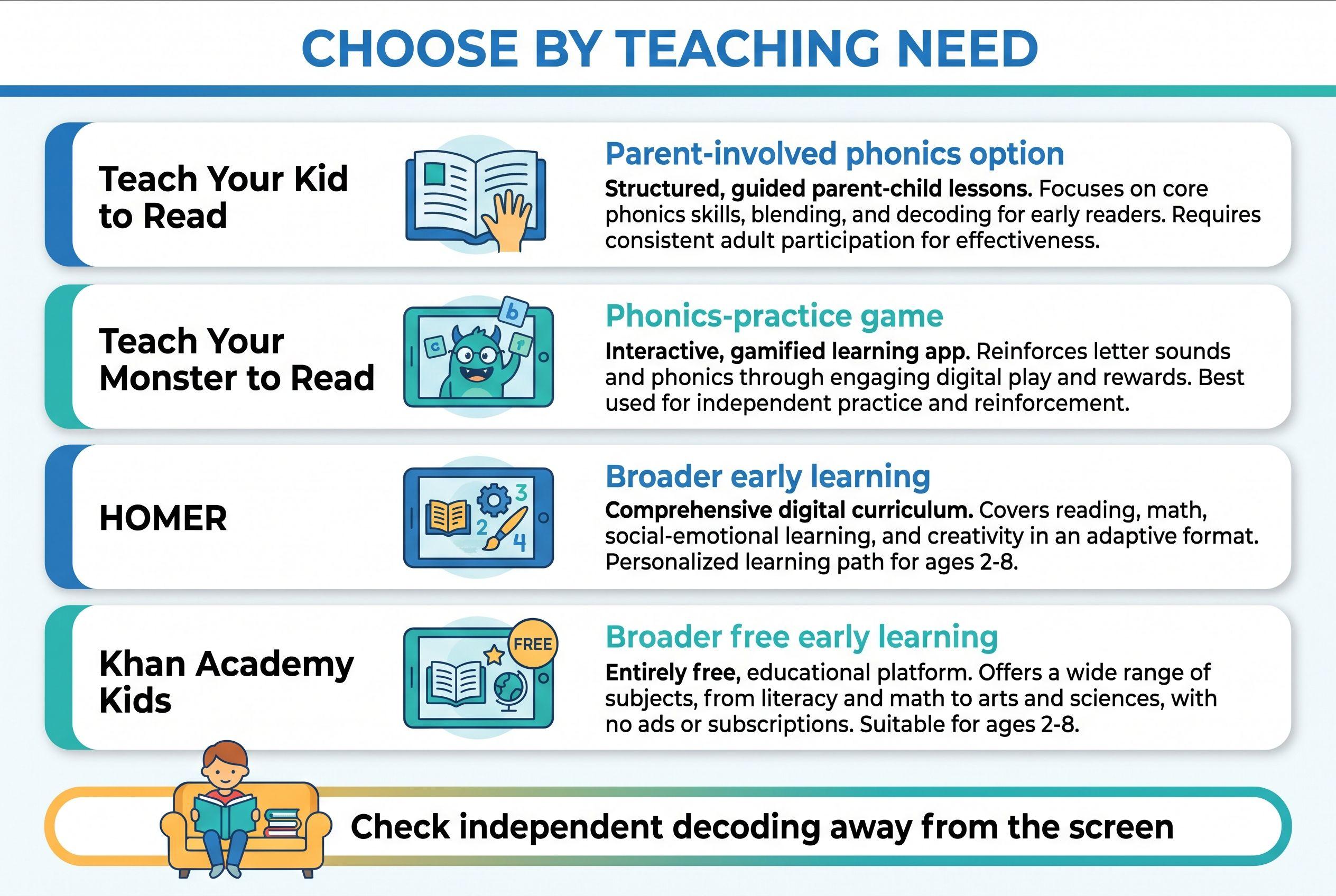
- How four options compare for a parent choosing today.
- The tiny off-screen check that tells you more than another reward screen.
The Verdict
I rank these options for parents who want to stay involved in beginning reading: explicit sound-to-print teaching first, independent decoding second and entertainment third. This is an editorial comparison of publicly described approaches, not a hands-on trial or a measured effectiveness ranking.
I'm widening this teach your monster to read review to include three alternatives because your real decision isn't whether monsters look adorable. It's which tool fits the teaching your child needs. Prices and availability can change; check competitors' current prices and terms before signing up.
| Rank and option | Teaching approach | Price model | Best-for age |
|---|---|---|---|
| 1. Teach Your Kid to Read | My parent-involved phonics pick; judge progress through independent decoding | Lesson one is free with no card and nothing to cancel; from lesson two the whole program is a 7-day free trial, then US$9.95 a month | My recommendation: beginning readers around 4–7, based on skills |
| 2. Teach Your Monster to Read | Synthetic-phonics game covering letter sounds, blending and early reading | Computer version free; mobile app one-time purchase; check current price | Product states 3–6 |
| 3. HOMER | Early-literacy activities including phonics within a broader learning experience | Subscription; fact sheet lists a 30-day free trial; check current terms | Store listings state 2–8; Begin's product page says 2–6 |
| 4. Khan Academy Kids | Broad early learning with literacy and phonics activities | Free, without ads or subscriptions; verify current availability | Product states 2–8 |
Full disclosure: I co-founded Teach Your Kid to Read, so weigh my #1 pick accordingly; the rest of the ranking is based on the criteria above.
I recommend Teach Your Kid to Read for a parent-involved phonics routine: start lesson one free; lesson one is free with no card and nothing to cancel; from lesson two the whole program is a 7-day free trial, then US$9.95 a month.
The Tiger Truth: Practice Must Transfer
The 2024 US NAEP reading assessment found that 40% of US fourth-grade students (ages 9–10) scored below NAEP Basic. That national result doesn't predict your child's future, and NAEP Proficient doesn't mean the same thing as grade-level performance. Still, the warning deserves attention.
As school reading gets harder, weak decoding can turn science homework into a nightly argument. Children may avoid books because every sentence costs too much effort. Waiting without changing instruction doesn't fix that problem.
Here's the kicker: difficulty isn't destiny. The 2000 report from the US National Reading Panel found benefits from systematic phonics instruction. That's evidence for a teaching approach—not proof that any particular app works. Act early, teach clearly and check actual reading.
Four Options, Ranked for Parent-Involved Reading
1. Teach Your Kid to Read: My Pick for an Involved Parent
I'm a Chinese-American homeschooling mom of four, ages 10, 7, 4 and 1. I've taught my two oldest to read, and my 4-year-old keeps me humble. A toddler nearby can turn a serious teaching moment into a snack negotiation in three seconds flat.
My recommendation starts with the adult's role, not a promise about software. Sit beside your child. Listen to the sounds. Ask them to read something away from the screen before you call a lesson successful.
That's the routine I want around Teach Your Kid to Read. Lesson one is free with no card and nothing to cancel; from lesson two the whole program is a 7-day free trial, then US$9.95 a month. Use that first lesson to examine the fit rather than buying on my enthusiasm alone.
Look for a manageable teaching step. Can your child explain or demonstrate what they practised? Can you identify which sound or blending step needs another go? If neither answer comes easily, slow down and teach that smaller skill.
My non-negotiable standard is systematic synthetic phonics: teach letter–sound relationships in a planned sequence, then teach children to blend those sounds into whole words. Don't ask a beginner to identify ship by spotting a boat in the illustration. That's guessing with excellent artwork.
Linnea Ehri's 2014 paper, “Orthographic Mapping in the Acquisition of Sight Word Reading, Spelling Memory, and Vocabulary Learning,” explains how readers connect spellings with pronunciations in memory. Accurate sound-to-print work supports that process. Photographing whole words with your eyeballs isn't the plan.
The deal-breaker for any option below would be a routine where rewards replace instruction or pictures replace decoding. I haven't established that every competitor does those things, and I won't invent a defect to sell you mine. Bottom line: choose the tool that helps you teach, then demand evidence off-screen.
2. Teach Your Monster to Read: Strongest Fit for Game-Based Practice
Here's the central finding of this teach your monster to read review: this is a genuine phonics option, not simply a guessing game wearing a reading badge. Its publicly described approach includes synthetic phonics, blending and segmenting within an adventure game.
The product's stated age range is 3–6. That doesn't mean every 3-year-old needs it or every 6-year-old has outgrown it. Match the activity to what your child can read, not the number on the birthday cake.
The computer version's free access makes it especially appealing to families watching their budget. The mobile app uses a one-time purchase model. Check your device's current listing rather than assuming “free on computers” means “free everywhere.”
Teach Your Monster to Read pros cons, in plain English:
- Pro: Its phonics focus matches an evidence-supported part of reading instruction.
- Pro: Free computer access removes a financial barrier.
- Pro: The game format may encourage a reluctant child to practise.
- Con: Game progress alone doesn't establish independent reading.
- Con: Some children need more direct explanation and corrective feedback than independent play provides.
- Con: Mobile access and computer access don't share the same pricing model.
Is Teach Your Monster to Read worth it? On a computer, it's a reasonable practice option if your child engages and transfers the skill to print. Before paying for mobile convenience, check whether the computer experience meets your needs.
My disqualifier isn't the monster. It's using the monster as a babysitter and calling that instruction. Sound familiar?
3. HOMER: Consider It for Broader Early Learning
For parents searching teach your monster to read vs homer, the useful distinction is scope. Teach Your Monster to Read centres its reading game on phonics progression; HOMER publicly presents a broader early-learning experience that includes reading activities.
HOMER's store listings state ages 2–8, while Begin's product page says 2–6. Check the specific offering and subscription terms. The supplied product information lists a subscription with a 30-day free trial, but don't assume every platform presents the same checkout.
Broader content isn't automatically a weakness. A family seeking several kinds of early-learning activities may prefer it. But if your child specifically struggles to blend m-a-p, variety doesn't answer the instructional question.
My deal-breaker would be an unclear path from letter sounds to independent word reading. Ask what your child will practise next and how you'll recognise mastery. For this teach your monster to read review, I place the more narrowly focused phonics game above the broader option—not because I've proved HOMER teaches guessing.
4. Khan Academy Kids: A Budget-Friendly Broader Option
Khan Academy Kids states ages 2–8 and offers free access without ads or subscriptions. Its publicly described content covers early literacy alongside other learning areas. That's a meaningful option for a family that can't take on another monthly bill.
If you're searching for the best free phonics app, remember that “free” answers the budget question, not the teaching question. Examine the actual reading tasks your child encounters.
For a child who needs general early-learning activities, this broader scope may fit. For persistent decoding trouble, I'd add targeted adult teaching rather than hope that more activity time solves it. That's the catch.
A responsible free reading app for kids review shouldn't imply that a free product lacks value—or that a subscription guarantees better results. My disqualifier is relying on broad practice when the child needs a specific skill taught explicitly.
Why I Care More About Decoding Than App Rewards
After I listened to Emily Hanford's “Sold a Story” in 2023—the series launched in 2022—my neighbour called me almost in tears. She'd taught US first grade (ages 6–7) for 18 years and used Lucy Calkins' Units of Study throughout her career.
Three-cueing, MSV, the whole thing. She told me she'd spent nearly two decades teaching children to guess without recognising what she was doing. That conversation still sticks with me.
She switched her classroom to UFLI Foundations mid-year. It was messy. She had to learn the routines herself before teaching them, and she couldn't simply wave a new manual at old habits.
By spring, she reported an average 15-point increase on her class's DIBELS nonsense-word-fluency measure. She also told me that, for the first time in her career, every child in her class could decode consonant-vowel-consonant words by February.
That's her classroom report, not a controlled study or a promise for your child. DIBELS includes different scores, so that “15 points” doesn't give us a universal benchmark. The lesson I took was simpler: change the teaching, then measure the skill—not the child's enthusiasm for collecting stars.
The Action Step: Run a Small Reading Check
Choosing a reading app for 5 year olds? Start with five minutes beside the child, not five pages of marketing. Use familiar sounds and keep the mood matter-of-fact. We're checking instruction, not auditioning for university.
- Check a few taught sounds. Show lowercase letters your child has learned, such as m, s, a, t. Ask for sounds rather than only letter names. Avoid adding an extra “uh” to consonants.
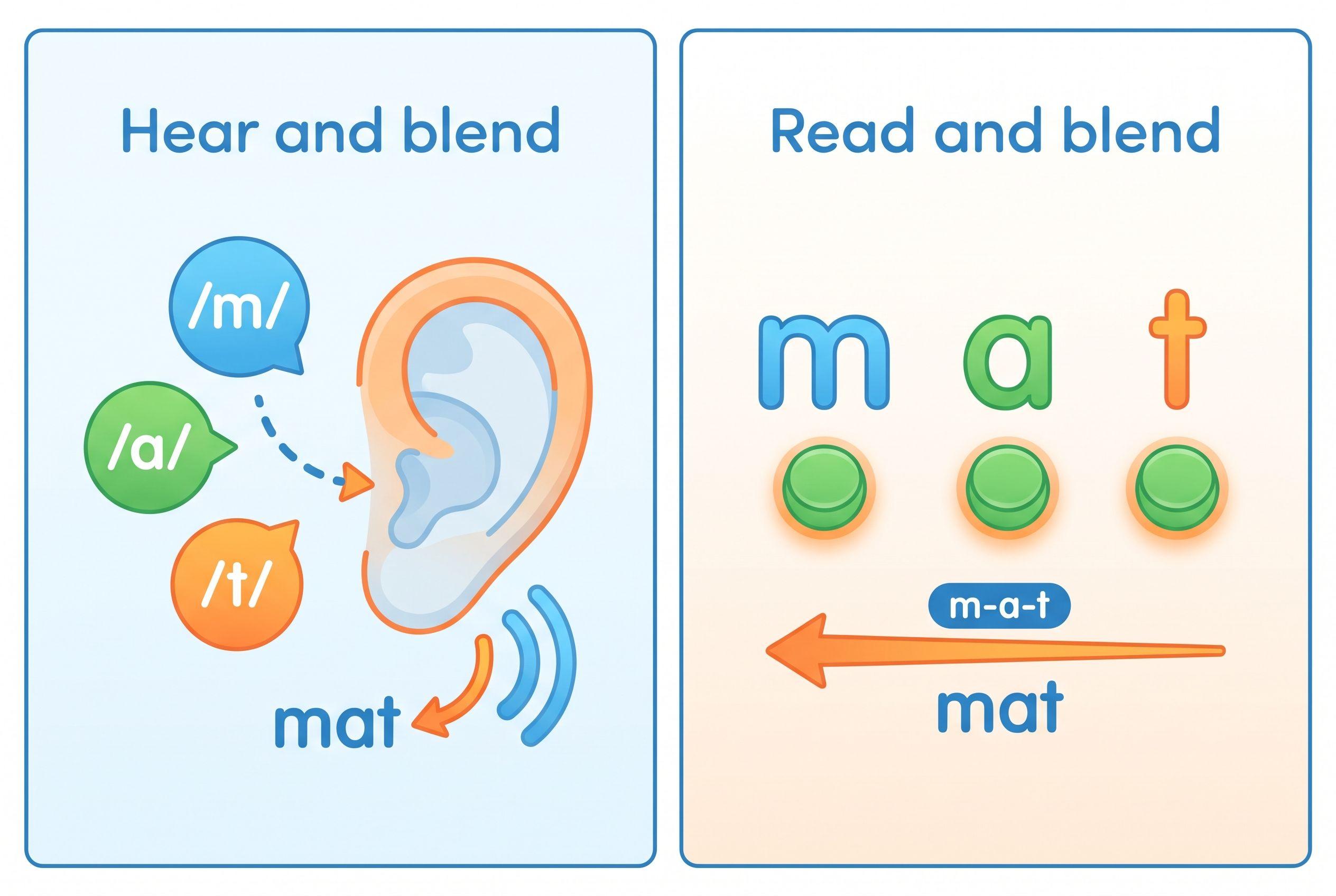
- Check spoken blending. Say /m/ /a/ /t/ and ask what word those sounds make. This checks phonemic awareness without printed letters; it doesn't replace a decoding check.
- Check print separately. Write mat, sat and Sam, if your child knows those spellings. Ask them to point, sound out and blend. Don't supply a picture clue.
- Practise one gap. If sounds are secure but blending stalls, I'd say, “Listen: mmm-aaat. Now a little faster: mat. Let's do it together. Your turn.” Stretch /m/ and the short /a/ without a gap, then finish with a crisp /t/—no “tuh.” If spoken blending works but print doesn't, I'd point beneath each letter in mat while modelling that same blend, then let my child try. If a letter sound is missing, teach that sound first. Practise mat → sat → sam, using only taught correspondences and blending each word rather than guessing from the last one. Still stuck? Model it together again; don't demand another random answer. Keep the session short enough for accurate attention.
- Check transfer tomorrow. Offer a different word using taught correspondences. Note whether your child reads independently, needs prompting or guesses. These are informal observations, not standardised scores.
- Choose with that evidence. If you want to try Teach Your Kid to Read, lesson one is free with no card and nothing to cancel; from lesson two the whole program is a 7-day free trial, then US$9.95 a month.
My Tiger Rule is “We Never Skip”: protect a small, regular practice habit, even on busy days. It isn't a command to drill through illness or distress. The other rule, “No Guessing,” means I model the missing skill instead of demanding another random answer.
Don't turn DIBELS into a kitchen-table speed contest. Trained educators interpret its measures using the correct edition, assessment period and scoring rules. Ask the school which skill needs support, not just whether the score looks green.
If progress stalls despite clear teaching, request a reading assessment. Children with dyslexia indicators may need more explicit, intensive support; an app can't diagnose or rule out dyslexia.
My Final Buying Advice
This teach your monster to read review comes down to one question: Can your child read the word without the game? If yes, the practice has value. If not, adjust the instruction rather than extending screen time.
Teach Your Monster to Read earns consideration for focused phonics practice and free computer access. HOMER and Khan Academy Kids belong on your shortlist if broader early learning matters more. None earns a pass on independent decoding.
Need a starting point before choosing? take the 2-minute reading check. Treat it as an initial guide, not a diagnosis or a substitute for formal assessment.
FAQ
Is Teach Your Monster to Read worth it?
Its free computer version offers a reasonable way to add phonics practice. A mobile purchase may suit your household, but check the current price first. Judge value by independent reading outside the game, not time spent playing.
Is Teach Your Monster to Read completely free?
The computer version offers free access. The mobile app uses a one-time purchase model, so check the current listing for your device. Don't assume both versions share the same cost.
Teach Your Monster to Read vs HOMER: which should I choose?
Consider Teach Your Monster to Read for a phonics-focused reading game. Consider HOMER for a broader early-learning experience that includes reading. Compare the specific activities with your child's next learning need rather than choosing by character design.
Can a reading app replace a parent or teacher?
I wouldn't rely on one as the sole instructor. Apps can provide practice, but children still need conversation, vocabulary, shared reading and responsive help. Persistent difficulty calls for assessment and targeted instruction—not simply another download.
From teachyourkidtoread.org/blog/teach-your-monster-to-read-review-2026-parent-verdict

Xia Brody
Co-Founder, Teach Your Kid to Read
Mom of 4 who has successfully taught her kids to read. Currently in the trenches with her 4-year-old while her two oldest (10 and 7) devour books on their own. Passionate about phonics-based methods and building a lifelong love of reading.
Related Articles
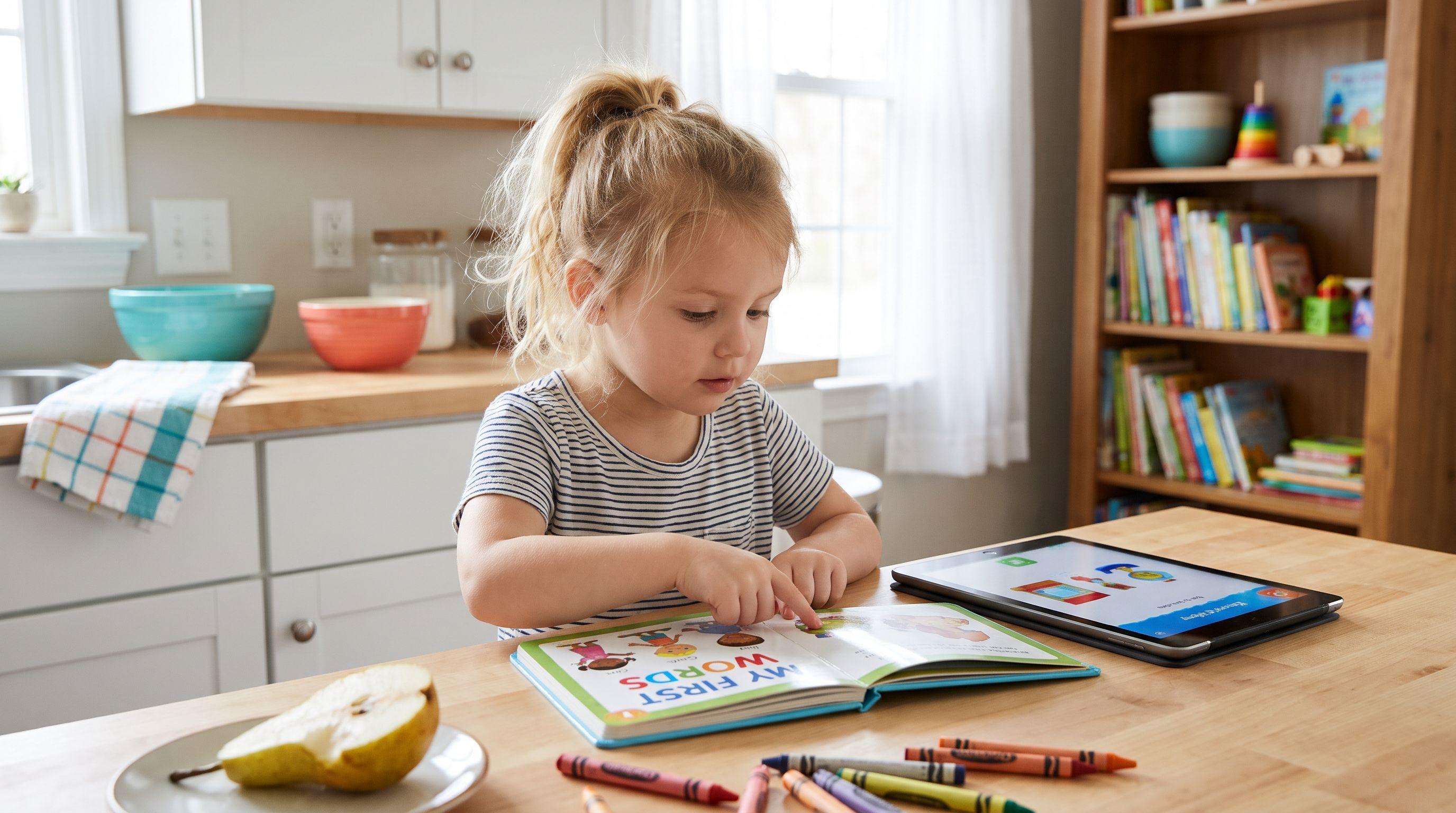
Teach Your Monster to Read vs HOMER: 4 Apps Ranked (2026)
Teach Your Monster to Read offers focused phonics practice; HOMER offers a broader early-learning experience. Here's how they compare with two alternatives—and how I judge whether an app helps a child actually read.
Read More →
Teach Your Monster to Read vs ABCmouse: 2026 Ranking
Teach Your Monster to Read wins the head-to-head for focused phonics practice; ABCmouse suits families seeking broader learning activities. Here’s my four-app ranking, with clear pricing models and a simple way to check whether screen practice transfers to real reading.
Read More →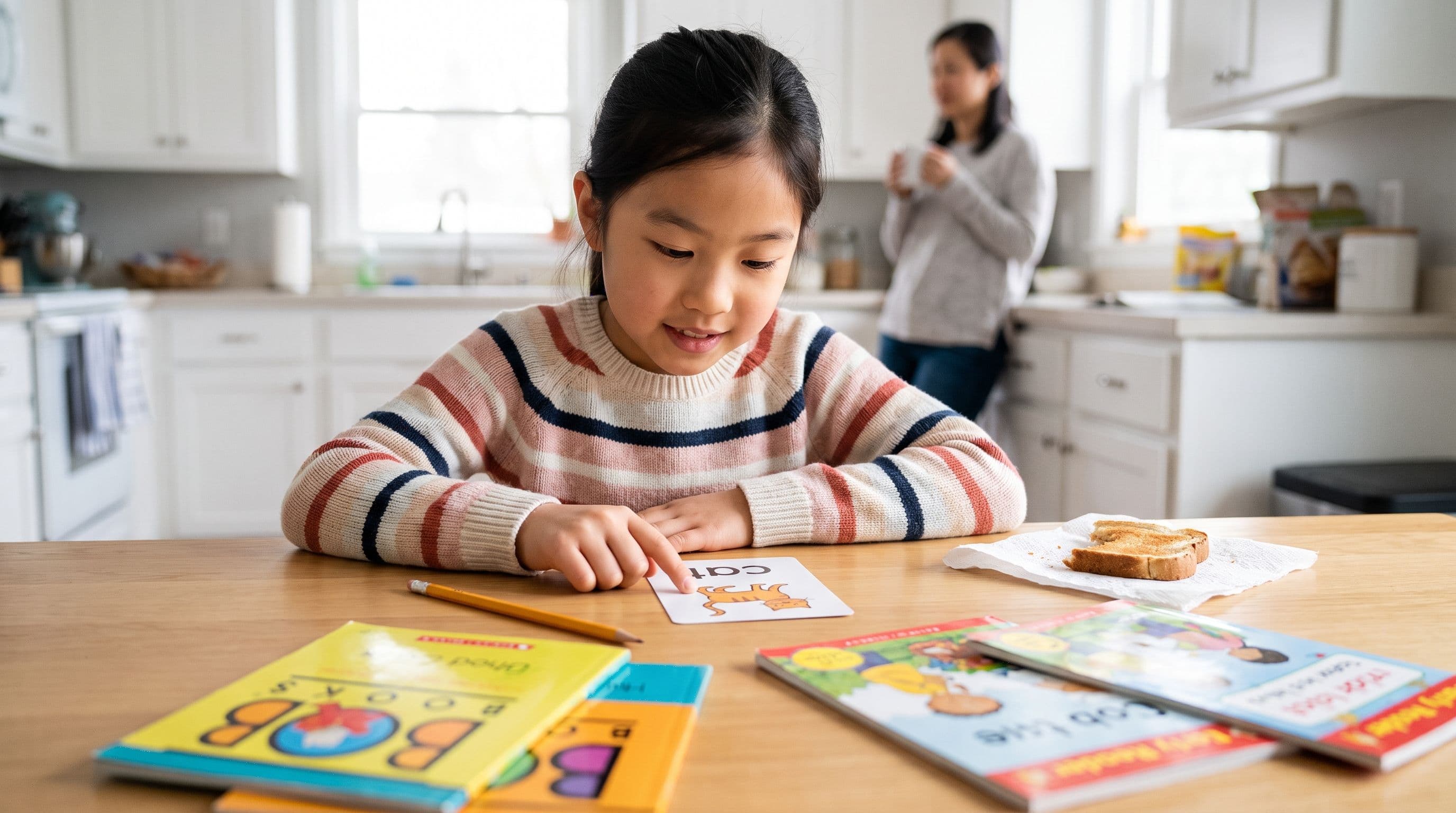
HOMER vs Reading Eggs for 6-Year-Olds: Best Fit?
Choosing between HOMER and Reading Eggs for a 6-year-old? Here’s the no-nonsense parent breakdown: which app teaches decoding, which one fits which child, and where Teach Your Kid to Read beats both for focused phonics.
Read More →