Teach Your Monster to Read vs HOMER: 4 Apps Ranked (2026)
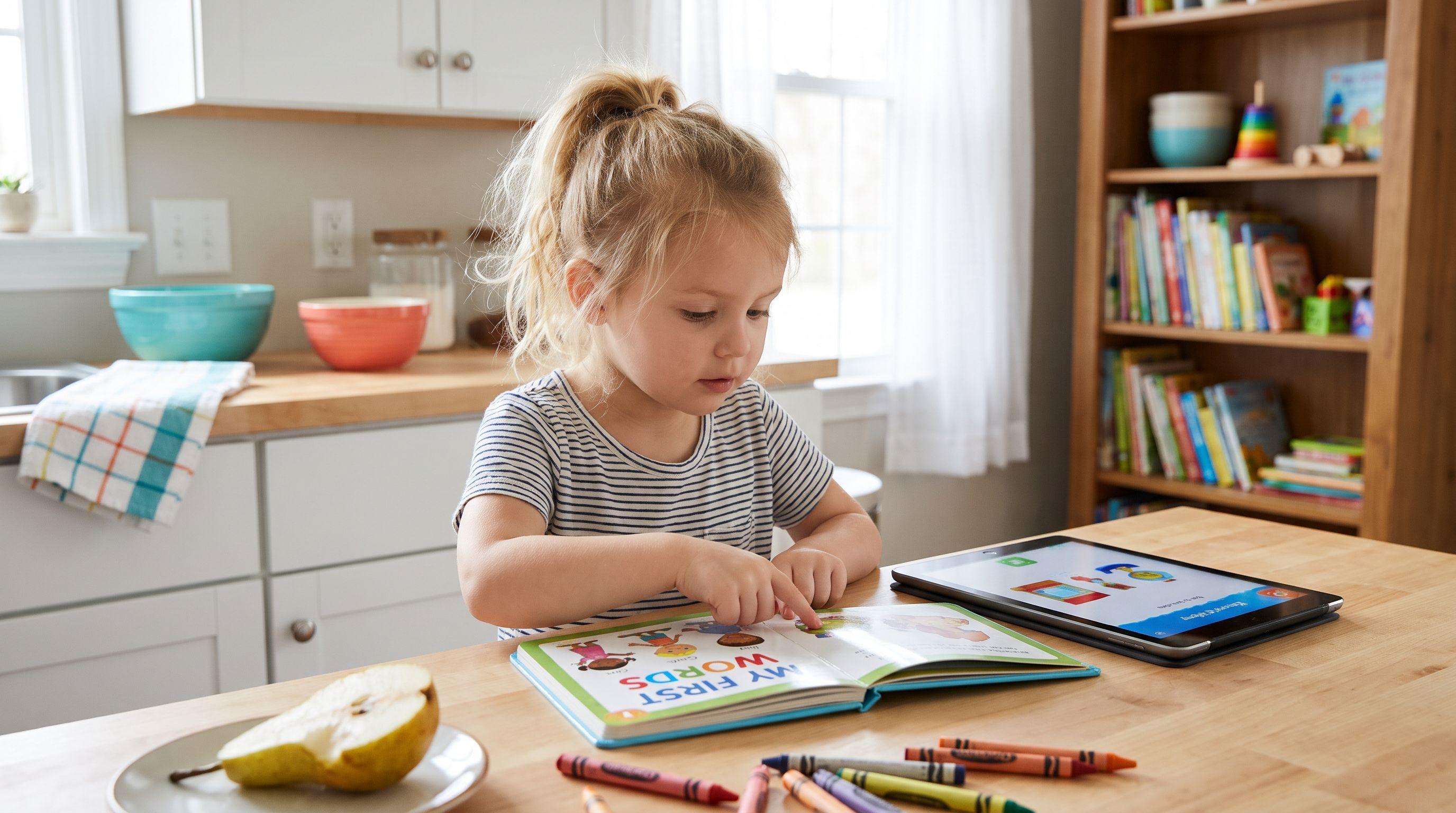
Your child can collect digital rewards and still stare helplessly at map on paper. That's the problem with choosing a reading app by how happily your child taps.
I'm Xia Brody, a Chinese-American homeschooling mum of four, ages 10, 7, 4 and 1. I've taught my two oldest to read, and I'm currently teaching my 4-year-old. My standard isn't complicated: does the learning survive when the screen goes dark?
What You'll Learn
- Which differences in Teach Your Monster to Read vs HOMER actually affect your decision.
- Why my first-ranked option puts the parent back in the lesson.
- The tiny off-screen check that tells you more than a reward dashboard.
- When another app isn't the help your child needs.
Look, a phonics game and a broad early-learning subscription don't solve exactly the same problem. Neither does an entertaining session prove independent reading. That's our reality check—no guilt trip required.
The Verdict
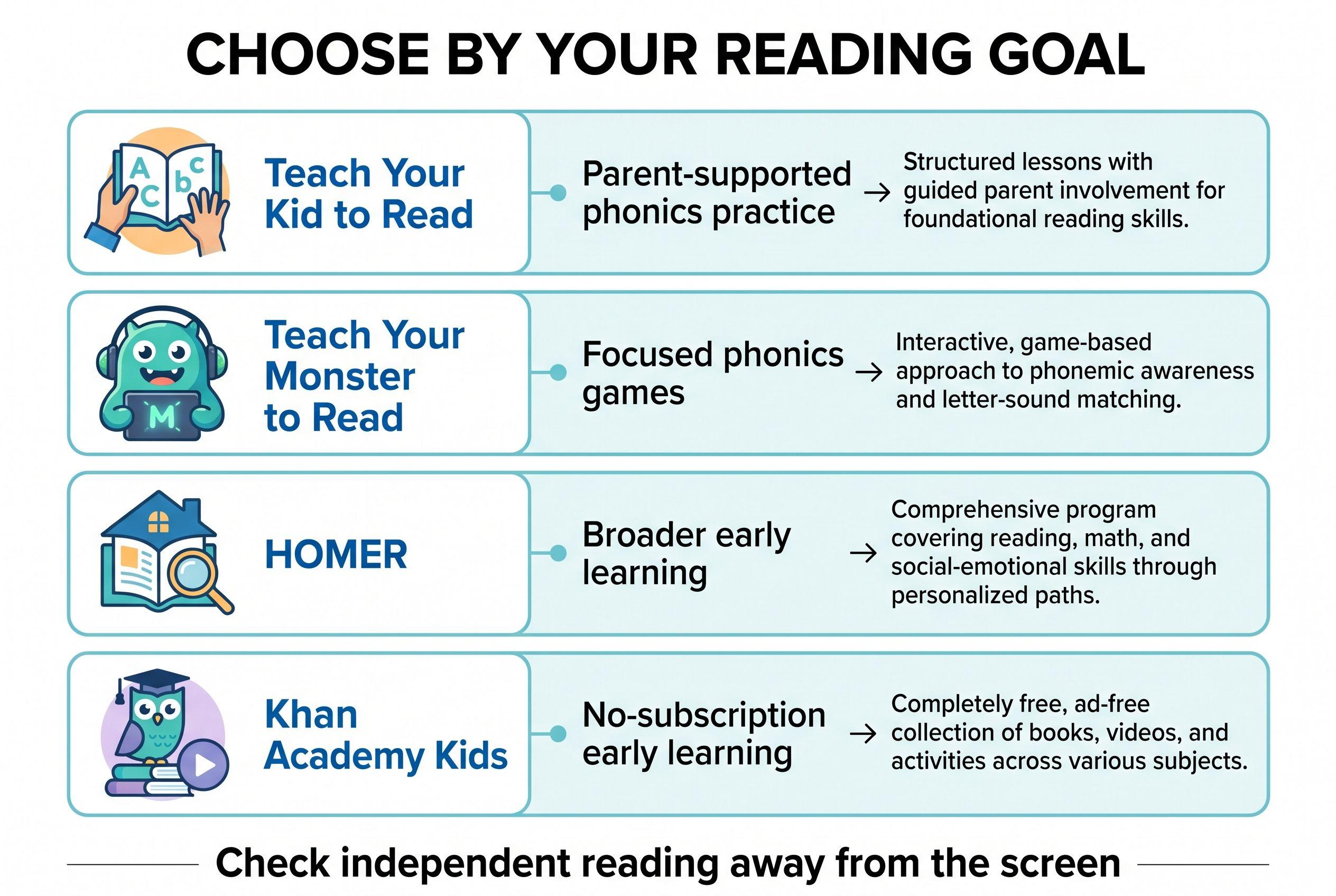
Between the headline pair, I'd choose Teach Your Monster to Read for focused phonics practice and HOMER for broader early learning. My overall ranking favours parent-supported decoding, clear practice and transfer to paper—not the biggest activity library.
I've added our app and Khan Academy Kids because parents comparing these two often need either closer adult guidance or a no-subscription alternative. These are editorial recommendations based on published approaches, not hands-on competitor testing.
| Rank and app | Reading approach | Price model | Best-for age |
|---|---|---|---|
| 1. Teach Your Kid to Read | My pick for parent-supported phonics practice; judge progress through independent decoding | Lesson one is free with no card and nothing to cancel; from lesson two, the whole program is a 7-day free trial, then US$9.95 a month | My recommendation: ages 4–6 with an adult |
| 2. Teach Your Monster to Read | Phonics games covering letter sounds, blending and increasingly complex reading | Free on computers; one-time paid app; check current app price | Stated ages 3–6 |
| 3. HOMER | Personalised early learning that includes phonics alongside other activities | Subscription; fact sheet lists a 30-day free trial; check current price and terms | Stated ages 2–8; Begin's product page says 2–6 |
| 4. Khan Academy Kids | Broad early learning, including early literacy and phonics activities | Free, without ads or subscriptions; confirm current availability | Stated ages 2–8 |
Full disclosure: I co-founded Teach Your Kid to Read, so weigh my #1 pick accordingly; the rest of the ranking is based on the criteria above.
I recommend Teach Your Kid to Read for parents who want to practise alongside their child: start lesson one free; lesson one is free with no card and nothing to cancel, and from lesson two the whole program is a 7-day free trial, then US$9.95 a month.
Bottom line: this Teach Your Monster to Read vs HOMER comparison ranks tools for early decoding, not general entertainment or every family's budget.
Tiger Truth: Waiting Doesn't Teach the Missing Skill
In the US, 37% of fourth-grade students (ages 9–10) scored below NAEP Basic in reading on the 2022 Nation's Report Card. That's a population-level warning, not a prediction about your child. NAEP achievement categories also don't equal a clinical diagnosis or a simple school-year reading level.
But here's the kicker: harder books won't teach missing letter–sound connections by magic. By third grade (ages 8–9 in the US), growing reading demands can make those gaps more painful. Children can improve later; the claim that they rarely catch up regardless of instruction goes too far. Earlier help saves avoidable struggle.
The 2000 report from the US National Reading Panel found benefits from systematic phonics instruction. It didn't endorse any app in this ranking. The useful takeaway? Teach the code deliberately rather than hoping exposure does the job.
A child who repeatedly guesses needs instruction, not six more months of crossing our fingers. Real talk—that's the non-negotiable.
Ranked: Four Reading Apps for Early Decoding
1. Teach Your Kid to Read: My Pick for Parent-Supported Practice
I rank Teach Your Kid to Read first for the parent who wants an active role rather than a digital babysitter. Lesson one is free with no card and nothing to cancel; from lesson two, the whole program is a 7-day free trial, then US$9.95 a month.
Here's how I'd approach that first lesson: sit beside your child, listen carefully and check what they can do afterwards without help. Don't buy because I co-founded it. Look for evidence in your child's reading.
My deciding feature is the adult's involvement. A parent can hear whether a child blends sounds or guesses. A correct tap alone can't tell you that.
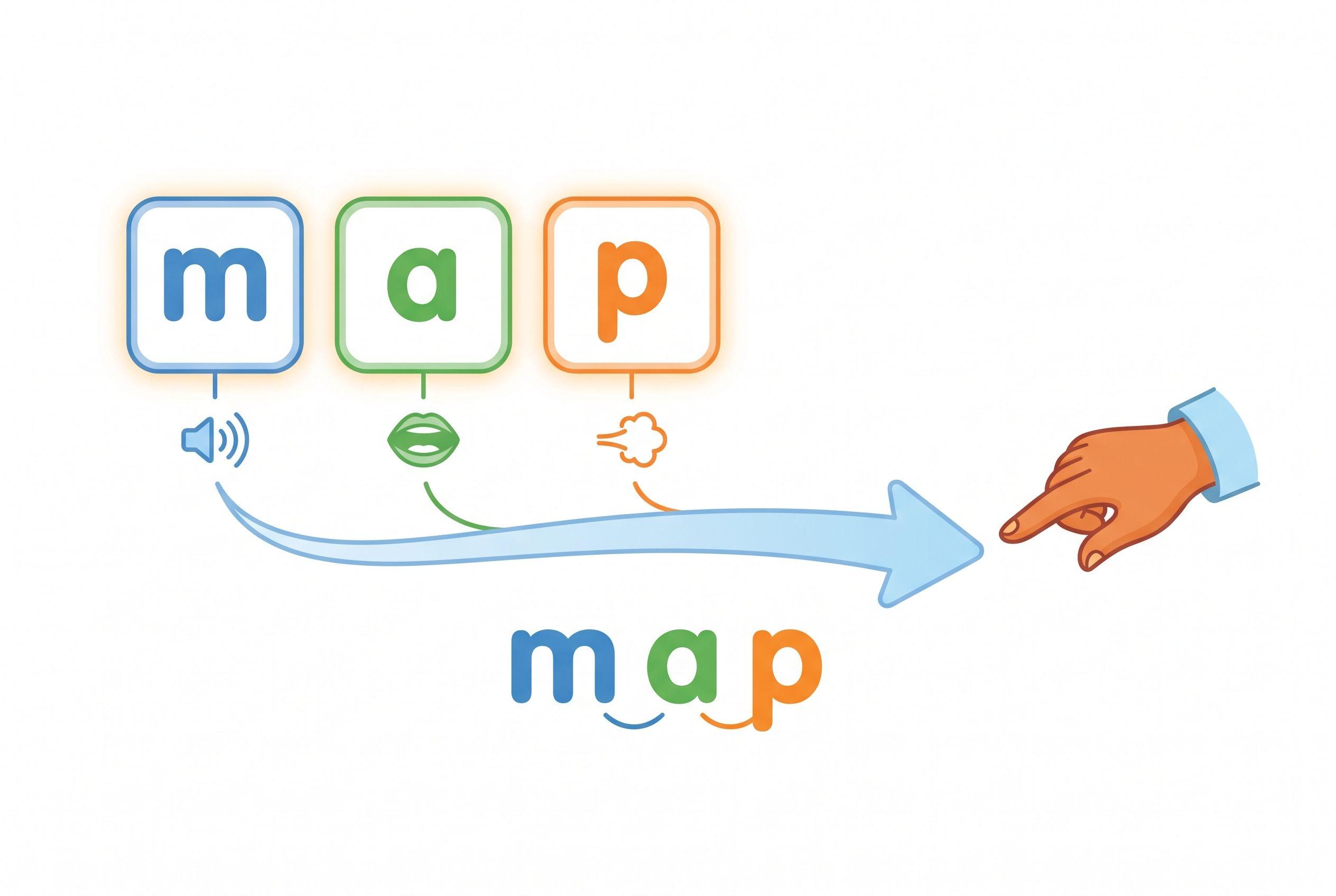
For example, imagine your child sees sat and says “sit.” Point back to the middle letter. Say, “This sound is /a/. Let's blend all three again.” Keep your voice ordinary. We're fixing a sound connection, not prosecuting a biscuit theft.
Systematic synthetic phonics means teaching letter–sound correspondences in a planned order, then blending those sounds into words. Effective practice also revisits previous learning. That's the instructional standard I want parents to apply to our app and every competitor—not a claim that research on phonics proves one particular product works.
Linnea Ehri's 2014 article, Orthographic Mapping in the Acquisition of Sight Word Reading, Spelling Memory, and Vocabulary Learning, explains how connections between sounds and spellings help words become familiar. Instant recognition grows from those connections; it doesn't require memorising every word as a picture.
My kitchen-table rule is simple: a sound, a blend, then a little reading on paper. With a 1-year-old nearby, I value short routines. Fancy preparation? Not happening.
The limitation: parents seeking fully independent screen time may prefer another format. And no app replaces specialist assessment when a child struggles persistently. I won't promise that a subscription fixes every reading difficulty.
2. Teach Your Monster to Read: Best Headline Pick for Phonics Games
If you're searching for a teach your monster to read review, here's the useful distinction: this product describes a phonics-based game, not a picture-guessing reading method. Its published scope includes letter–sound practice, blending and later reading challenges.
The fact sheet lists ages 3–6, with free computer access and a paid, one-time mobile app. Check the current app price in your region. A computer version can make this a practical choice for families avoiding another subscription.
For Teach Your Monster to Read vs HOMER, its more focused reading purpose gives it my vote when the question is, “Which of these two fits extra phonics practice?”
The catch? Game performance and reading independence aren't interchangeable. An adult still needs to notice whether the child can read unfamiliar combinations without on-screen assistance.
What would disqualify it for your child: successful game play without corresponding off-screen decoding. That's a child–tool mismatch, not evidence that the product teaches guessing. Keep the game if it supports the skill; change the plan if progress stalls.
3. HOMER: Best for Families Wanting Broader Early Learning
A useful HOMER reading app review separates breadth from reading intensity. HOMER describes personalised early learning with reading among its learning areas. Its reading offering includes phonics; I wouldn't label the whole product a guessing program.
The fact sheet lists a subscription model with a 30-day free trial. Confirm the current price, renewal conditions and cancellation process before signing up. Its listed age ranges vary: app listings say 2–8, while Begin's product page says 2–6.
Here's the trade-off in Teach Your Monster to Read vs HOMER: a broader experience may suit a family seeking varied activities, but a child with a specific blending gap needs enough direct practice on that gap.
Imagine a 5-year-old who knows /m/, /a/ and /p/ separately but can't combine them. More variety isn't automatically the answer. That child needs a clear model followed by successful blending practice.
What would disqualify it for your goal: a routine that spends most of its time away from the reading skill your child needs. That's my no-brainer test for any broad learning app, including one with excellent activities elsewhere.
4. Khan Academy Kids: Best No-Subscription Alternative
Khan Academy Kids belongs here because searches for free reading apps for kids often sit right beside the headline comparison. Its fact-sheet model is free, without ads or subscriptions, for stated ages 2–8.
Its published offering covers broad early learning, including literacy. That's useful for families who want accessible activities without starting a trial countdown.
But free doesn't settle the teaching question. If your child needs a tightly targeted decoding routine, inspect the sequence and provide focused adult practice rather than assuming a large library supplies exactly the next lesson.
What would disqualify it as your main reading plan: you can't identify what your child practised or what they can now read independently. Keep it as a supplement if it helps. Don't confuse a zero-cost app with a complete intervention plan.
The Classroom Story Behind My No-Guessing Rule
In 2023, after my neighbour listened to Emily Hanford's Sold a Story—which first launched in 2022—she called me almost in tears. She'd taught first grade (ages 6–7 in the US) for 18 years and had relied on Lucy Calkins' Units of Study throughout her career.
Three-cueing. Meaning, structure and visual cues—often shortened to MSV. She told me she'd been teaching children to guess for nearly two decades without recognising the problem. That conversation still sticks with me.
She switched to UFLI Foundations mid-year. It was messy: she had to learn the routines herself before teaching them. By February, she reported that every child in her class could decode CVC words—consonant–vowel–consonant words such as map. By spring, she said the class had gained an average of 15 points on DIBELS nonsense-word fluency.
That's her classroom account, not a controlled study. DIBELS includes different measures and editions, so “15 points” alone doesn't establish a universal benchmark or prove that one curriculum caused the change.
Still, the practical lesson hit home: look at the letters, teach the sounds and practise blending. Pictures help us discuss meaning. They shouldn't replace reading the printed word.
That's why my Teach Your Monster to Read vs HOMER decision starts with instruction, not characters. Cute monsters don't bother me. Guessing does.
Action Step: Run a Ten-Minute Reading Check
Before choosing the best reading app for a 5 year old, find the actual sticking point. This isn't a diagnosis or a speed test. Keep it low-pressure—bottom line, useful information beats another hopeful download.
- Check a few taught sounds. Show five lowercase letters your child has already learned, one at a time. Ask for their sounds rather than their names. Note which ones need help.
- Model one blend. Choose a word using known correspondences, such as am or sat. Say the sounds clearly, then blend. Avoid adding a heavy “uh” to consonants.
- Offer three fresh words. Try map, sat and mat only if your child knows those correspondences. Skip pictures. Record whether your child reads independently, blends with help or guesses.
- Choose the matching practice. Uncertain sounds need sound practice. Separate sounds without a whole word need blending instruction. Accurate but effortful reading needs supported rereading—not pressure to race.
- Check transfer after several short sessions. Offer a few new words with the same taught patterns. Three words won't establish mastery, but they can reveal whether learning extends beyond a familiar screen.
- Ask for help when difficulty persists. Ask your child's teacher or a qualified reading specialist about a suitable screening measure, such as DIBELS. Follow its administration rules; a homemade word list isn't a standardised score.
If parent-supported practice fits what you found, try Teach Your Kid to Read: lesson one is free with no card and nothing to cancel; from lesson two, the whole program is a 7-day free trial, then US$9.95 a month.
Make the Choice, Then Watch the Reading
For Teach Your Monster to Read vs HOMER, my short answer stays the same: choose the former for focused phonics games, the latter for broader early learning. Consider Khan Academy Kids when no subscription matters most.
My Tiger Rules are No Guessing and We Never Skip—meaning I protect a brief, manageable practice habit, including busy days. Illness and distress call for rest or adjustment, not a kitchen-table showdown. Consistency isn't punishment.
Read aloud together, too. Vocabulary and understanding matter alongside decoding. An app can't replace the conversation about why the character hid the muddy shoes (a subject my household understands deeply).
Still unsure where to begin? take the 2-minute reading check for an initial check, not a diagnosis. Use that starting point to ask better questions rather than collecting more reading app alternatives for 2026.
FAQ
Is Teach Your Monster to Read better than HOMER?
For focused phonics-game practice, it's my pick between the two. HOMER suits families wanting broader early-learning activities. Neither choice removes the need to check whether your child can read unfamiliar words off-screen.
Is Teach Your Monster to Read completely free?
The fact sheet lists free computer access and a one-time paid mobile app. Check the current price for your device and region; don't assume every version has the same payment model.
Does HOMER teach phonics or guessing?
HOMER describes phonics within its reading approach. I wouldn't call it a guessing program without evidence. Watch whether your child attends to the letters and blends instead of relying on pictures or repeated answer attempts.
Can a reading app replace a teacher or tutor?
No app guarantees that. Apps can support practice, but persistent problems with sounds, blending or reading accuracy warrant help from a teacher or qualified specialist. Ask for assessment and targeted instruction rather than waiting for another birthday.
From teachyourkidtoread.org/blog/teach-your-monster-to-read-vs-homer-4-apps-ranked-2026
Part of these guides

Xia Brody
Co-Founder, Teach Your Kid to Read
Mom of 4 who has successfully taught her kids to read. Currently in the trenches with her 4-year-old while her two oldest (10 and 7) devour books on their own. Passionate about phonics-based methods and building a lifelong love of reading.
Related Articles

Teach Your Monster to Read Review: 2026 Parent Verdict
Teach Your Monster to Read offers real phonics practice, not just cute creatures. Here's where it earns a place, where parents still need to teach and how it compares with three alternatives.
Read More →
Teach Your Monster to Read vs ABCmouse: 2026 Ranking
Teach Your Monster to Read wins the head-to-head for focused phonics practice; ABCmouse suits families seeking broader learning activities. Here’s my four-app ranking, with clear pricing models and a simple way to check whether screen practice transfers to real reading.
Read More →
HOMER vs Reading Eggs for 6-Year-Olds: Best Fit?
Choosing between HOMER and Reading Eggs for a 6-year-old? Here’s the no-nonsense parent breakdown: which app teaches decoding, which one fits which child, and where Teach Your Kid to Read beats both for focused phonics.
Read More →