Reading Eggs vs Prodigy English: 2026 Parent Pick
Between Reading Eggs and Prodigy English, I'd pick Reading Eggs for a child who still needs letter sounds and blending, and Prodigy English for a child who already reads and wants game-based English practice. For ages 6–8, the deciding question isn't which game looks better—it's which reading skill needs teaching.
What You'll Learn
- Reading Eggs wins the head-to-head for beginning reading, with early-reading options and its separate Fast Phonics strand.
- Prodigy English fits supplementary practice better than first phonics instruction; free game content doesn't make it a complete reading plan.
- My #1 overall pick is parent-led phonics, because an adult needs to hear whether the child actually reads the word.
- Check decoding before subscribing: listen to unfamiliar words that use sounds your child already knows, then choose instruction for the first gap.
Reality check: A child can enjoy an educational game without getting better at reading unfamiliar words. Imagine an 8-year-old who confidently answers a familiar question but reads ship as shop. The middle sound still needs attention, however impressive the digital village looks.
I'm Xia Brody, a Chinese-American homeschooling mom of four, ages 10, 7, 4 and 1. I've taught my two oldest to read, and I'm teaching my 4-year-old now. Honestly, I care much more about what comes out of a child's mouth than what flashes across a screen.
The Verdict
I included Teach Your Monster to Read alongside the two headline apps and my own program because parents comparing reading apps also need a lower-cost, phonics-focused alternative.
How we ranked
- Clear decoding instruction: teaches how letters represent sounds, rather than relying on guessing.
- A sensible sequence: builds new reading tasks from earlier skills.
- Adult visibility: lets a parent notice mistakes instead of assuming completion means understanding.
- Fit and cost: matches the child's actual gap and the family's available teaching time.
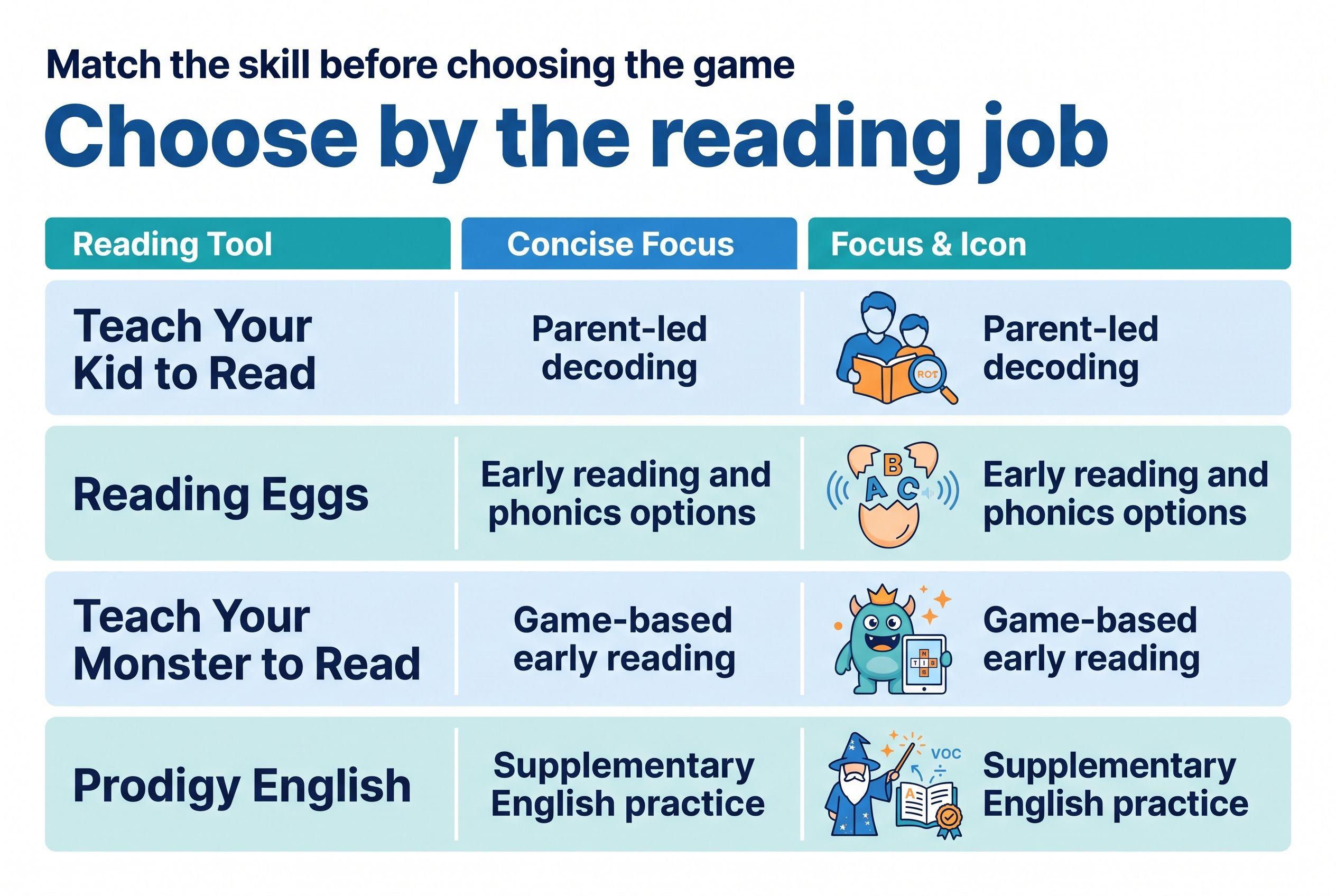
| Rank and app | What it teaches or describes itself as offering | Price / pricing model | Best-for age |
|---|---|---|---|
| 1. Teach Your Kid to Read | A step-by-step, parent-led phonics program with 50 lessons | Lesson one free, then 7-day trial, US$9.95/month | My recommendation: ages 6–8 who need decoding instruction; not a stated product age range |
| 2. Reading Eggs | Describes early-reading lessons, phonics and reading practice across several strands | US$13.99/month (checked October 2026) or US$99.99/year (checked October 2026); Reading & Math, up to 4 children; 30-day free trial | Stated: Reading Eggs 3–7; Fast Phonics 5–10; Eggspress 7–13 |
| 3. Teach Your Monster to Read | Describes games covering letter sounds, blending and early reading | Free on computers; app US$8.99 (checked October 2026), one-time purchase | Stated: ages 3–6; my recommendation for some older beginners with matching gaps |
| 4. Prodigy English | Describes game-based English skill practice | Free game content with optional paid membership | Stated: grades 1–6; my recommendation here: readers ages 6–8. |
Full disclosure: I co-founded Teach Your Kid to Read, so weigh my #1 pick accordingly; the rest of the ranking is based on the criteria above.
Prices checked October 2026.
I recommend Teach Your Kid to Read for side-by-side decoding instruction: start lesson one free. Lesson one is free, with no card and nothing to cancel. From lesson two, the whole program is a 7-day free trial, then US$9.95 a month.
Ranked: Four Reading Apps for Different Needs
1. Teach Your Kid to Read: My Pick for Parent-Led Decoding
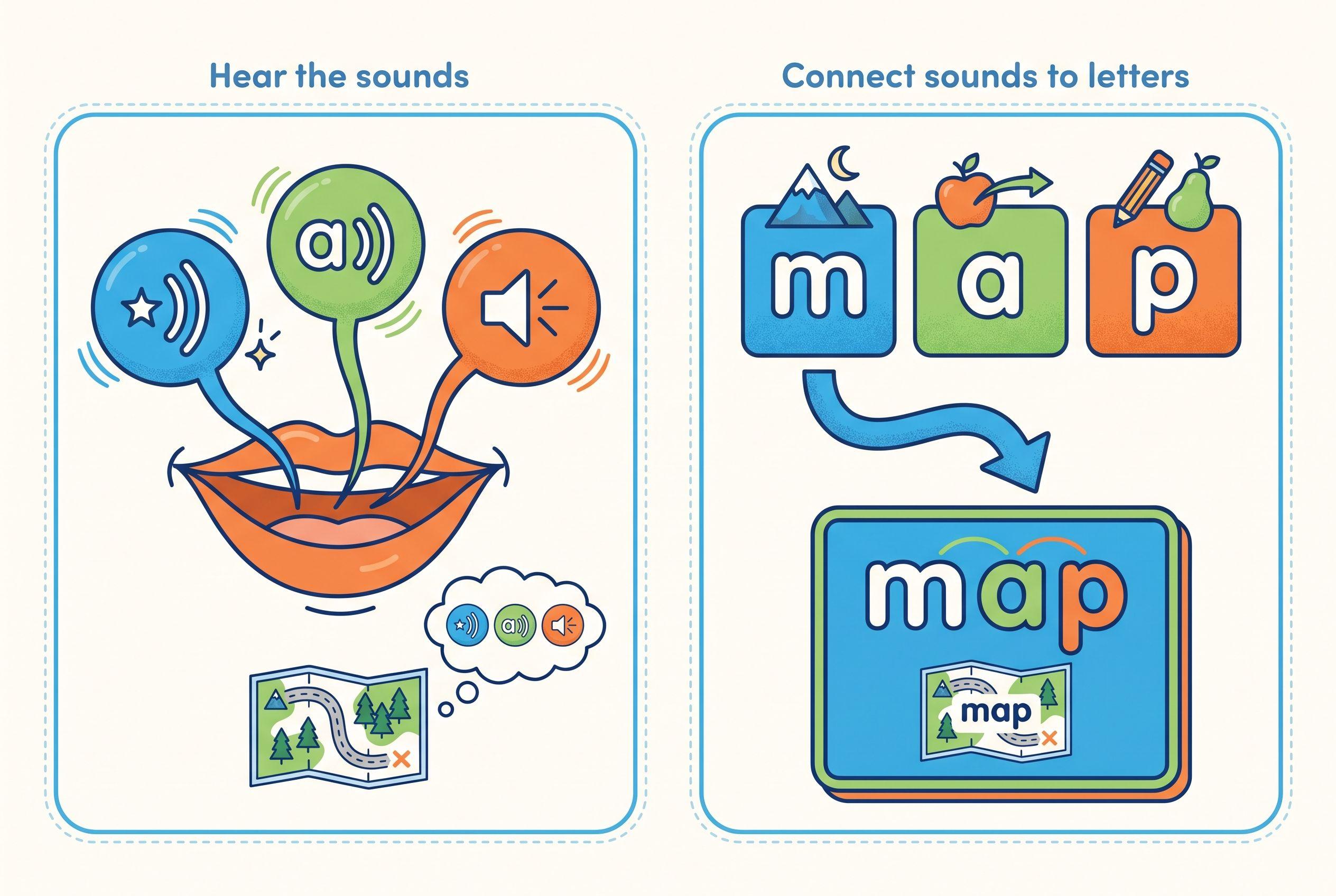
My first criterion is simple: does the lesson teach the child how to read the word? Teach Your Kid to Read starts with four sounds—m, s, p and short a. The child hears each sound, taps its matching letter, then blends and builds am, map and sap. Lesson one doesn't include a story.
That small starting set matters. You're not asking a beginner to juggle the entire alphabet while also figuring out blending. You can listen closely: did your child say /m/, or add an extra vowel and say “muh”? That extra sound can make blending harder.
The program follows 50 lessons in a fixed order. It moves from single letter sounds through digraphs such as sh, ch and th, then covers blends, vowel teams, silent e, prefixes and suffixes. It also teaches a small set of common irregular words by sight, calling them “leap words.”
From lesson two, each lesson includes a short story built from sounds taught so far. That's the sequence criterion in practical terms: teach the code, practice it in words, then read connected text that uses it.
You sit alongside your child for about 15 minutes a day. The app teaches you what to listen for and how to correct mistakes; your child does the lesson. Several children can share one account, and the lessons page lets you see every lesson and jump to the one you need.
The limitation: it doesn't use speech recognition. The parent listens and checks pronunciation, so families who need independent use or automatic spoken corrections should choose something else.
That requirement explains my ranking. I want an adult to hear the difference between reading map and guessing mat. The program runs on iPhone/iPad, Android and the web, but the device isn't the teacher's ears. You are.
2. Reading Eggs: The Stronger Head-to-Head Choice for Beginners
In a Reading Eggs vs Prodigy English decision, Reading Eggs offers the clearer match for a child still learning to decode. Its public descriptions distinguish early reading from later reading practice, rather than presenting one broad English game as the answer to every need.
Watch the strand names. The overall offering spans ages 2–13, but Reading Eggs itself states ages 3–7, Fast Phonics states ages 5–10 and Eggspress states ages 7–13. An 8-year-old who struggles to blend doesn't automatically need the older-reader strand simply because of a birthday.
For my sequence criterion, I'd examine the actual lesson path your child will follow. Does it teach a sound-spelling pattern before asking your child to read it? Can your child read a fresh example away from the activity? A placement result helps you start; listening helps you judge the fit.
My Reading Eggs review 2026 verdict is favorable for families who want a broader reading subscription and can supervise transfer to real reading. Its coverage gives parents options, but coverage alone doesn't tell you whether a particular child has learned a skill.
Before committing, use the trial to watch your child's reading—not just whether they request another session. If budget drives the decision, Reading Eggs vs Khan Academy Kids: Worth Paying in 2026? looks at another relevant comparison.
3. Teach Your Monster to Read: A Lower-Cost Phonics Supplement
Teach Your Monster to Read describes a game progression involving letter sounds, blending and early reading. That makes it more relevant to a beginning decoder than a broad English-practice game.
Its stated App Store age range is 3–6. I wouldn't exclude an older beginner solely because of that range, but I'd consider whether the presentation feels comfortable for that child. An embarrassed 8-year-old doesn't need another reminder that reading feels difficult.
On sequence and decoding, its stated focus earns it a place here. On adult visibility, I still want an occasional off-screen check: show a new word containing the same patterns and listen. Correct game responses can't answer every question about spoken reading.
The free computer version makes this one of the Reading Eggs alternatives worth considering before adding another subscription. I'd choose it for supplementary phonics practice with adult check-ins, not as a reason to postpone instruction when a child keeps struggling.
4. Prodigy English: Better for Practice After Decoding
My Prodigy English review starts with a distinction parents often miss: practicing English skills and learning the alphabetic code aren't the same job. Prodigy English describes a game-based English experience for US grades 1–6, not a dedicated beginner phonics course.
That doesn't make it useless. A child who already reads instructions and sentences may enjoy English practice inside a game. But enjoyment doesn't establish a sound-by-sound teaching sequence, and a broad grade range doesn't tell you which decoding gaps the program will address.
For the parent asking about Prodigy English vs Reading Eggs phonics, I'd choose Reading Eggs between those two. For an established reader who wants additional practice, Prodigy English becomes a more sensible contender.
Prodigy English cost: the game content is free, with an optional paid membership. I don't have a verified membership amount to quote. Start by deciding whether the learning activities serve your child; don't assume buying extras buys the instruction a struggling decoder needs.
Its fourth-place position reflects this article's priority: teaching or repairing early decoding. For a confident reader seeking game-based English practice, your order could reasonably differ.
The Tiger Truth: Don't Confuse Participation With Progress
Only 31% of US fourth graders (ages 9–10) scored at or above Proficient in reading on the 2024 NAEP. That doesn't mean the other children couldn't read. It does mean parents shouldn't treat school attendance—or app attendance—as proof of strong reading.
The US National Reading Panel, in its 2000 report, found benefits from systematic phonics instruction. That research supports teaching phonics; it doesn't certify any app in this ranking.
Linnea Ehri's 2005 review, Learning to Read Words: Theory, Findings, and Issues, explains how connections between spellings and pronunciations support word learning. Orthographic mapping isn't photographing a word's shape. Children connect letters with sounds so words become familiar and accessible.
Waiting while a child repeatedly guesses can leave that child avoiding harder books and needing more support later. Help now. No panic required—and no promise that one subscription will fix everything.
Reading Eggs vs Prodigy English: Check the Skill First
Picture two 7-year-olds. One reads fish accurately but struggles to explain why a story character feels disappointed. The other understands the story beautifully when an adult reads it aloud but can't blend f-i-sh.
Those children need different teaching.
The first needs attention to language and comprehension. The second needs decoding instruction while an adult continues reading rich books aloud. The best reading app for 6–8 year olds depends on that distinction, not the most persuasive age badge.
I separate phonemic awareness—hearing and working with individual speech sounds—from phonics, which connects those sounds to written letters. Saying the sounds in map without looking at print checks a different skill from reading map on a card. Both observations can help you find the sticking point.
For a starting picture, use our free reading-level-by-age check. If your child is eight, compare your observations with what to expect at age 8 rather than borrowing expectations from a younger sibling.
My tiger rule is No Guessing. Pictures help children enjoy and understand stories; they shouldn't replace reading the printed word. If the page says ship, “boat” isn't close enough just because the illustration floats.
The Action Step: Make Your Choice With a Reading Check
- Find the first gap. Use our free phonics skill check. Your child reads short lists of real and made-up words; you mark responses and see the first pattern to practice. Treat it as a teaching guide, not a diagnosis.
- Listen without feeding the answer. Ask your child to read a word containing familiar patterns. Notice whether they blend, omit a sound or guess from the first letter. Write down the actual response.
- Match the app to that gap. Choose parent-led instruction when decoding needs teaching. Between the headline products, favor Reading Eggs for beginning reading and Prodigy English for supplementary English practice after decoding.
- Teach one manageable target. If /sh/ causes trouble, explain that s and h together represent one sound in ship. Model it, let your child blend and revisit it in another appropriate word. Skip the speed contest.
- Check transfer and seek help when needed. Look for accurate reading of fresh words with taught patterns. If difficulty persists despite explicit instruction, talk with the teacher or a qualified reading specialist about assessment and targeted support rather than cycling through subscriptions.
For a side-by-side starting point, try lesson one and listen to how your child blends the sounds.
My Parent Pick
The Reading Eggs vs Prodigy English answer stays straightforward: Reading Eggs for the child learning the code; Prodigy English for the child ready to practice broader English skills through a game.
My overall #1 remains Teach Your Kid to Read for families who want explicit, parent-led decoding lessons. Teach Your Monster to Read offers another phonics-focused route worth considering, especially when subscription costs matter.
I favor a dependable daily routine over a weekend marathon. “We Never Skip” is my tiger-rule shorthand for protecting practice—not forcing a sick or overwhelmed child through a lesson. Keep the habit humane. Keep listening.
If parent-led phonics matches your child's gap, lesson one is free.
FAQ
Is Reading Eggs or Prodigy English better for a struggling reader?
Between those two, I'd choose Reading Eggs when the main difficulty involves letter sounds or blending. Prodigy English better fits supplementary English practice for a child who can already decode. Persistent difficulty needs targeted teaching and may warrant a professional assessment.
Is Prodigy English free?
Prodigy English offers free game content and an optional paid membership. I don't have a verified membership price to quote. Judge the learning fit before deciding whether membership extras matter to your family.
Which app should I choose for an 8-year-old who can't blend?
Choose by the missing skill, not the oldest age on the package. My recommendation is adult-supported decoding instruction; Reading Eggs' Fast Phonics strand states ages 5–10. An 8-year-old who struggles with basic blending also deserves prompt discussion with a teacher or reading specialist.
Can an app replace listening to my child read?
No app completion record tells you everything about spoken reading. Listen to fresh words containing taught patterns and ask your child to explain short passages they can read. Teach Your Kid to Read specifically requires an adult alongside the child; it doesn't listen to or check pronunciation.
From teachyourkidtoread.org/blog/reading-eggs-vs-prodigy-english-2026-parent-pick

Xia Brody
Co-Founder, Teach Your Kid to Read
Mom of 4 who has successfully taught her kids to read. Currently in the trenches with her 4-year-old while her two oldest (10 and 7) devour books on their own. Passionate about phonics-based methods and building a lifelong love of reading.
Related Articles
HOMER vs Reading Eggs for 6-Year-Olds: Best Fit?
Choosing between HOMER and Reading Eggs for a 6-year-old? Here’s the no-nonsense parent breakdown: which app teaches decoding, which one fits which child, and where Teach Your Kid to Read beats both for focused phonics.
Read More →
HOMER vs Reading Eggs for 5-Year-Olds: Best Fit?
Choosing between HOMER and Reading Eggs for a 5-year-old? I’m breaking down phonics quality, guessing risks, rewards, pricing, and the app I’d put first for decoding mastery.
Read More →
Reading Eggs vs Hooked on Phonics vs HOMER: 2026 Ranked
A finished lesson doesn't necessarily mean your child can read the words. Here's how I rank four reading apps, what I'd check before subscribing and why decoding beats digital rewards.
Read More →