Reading.com vs Hooked on Phonics: Which Is Better? (2026)

Reading.com vs Hooked on Phonics: 4 Reading Apps Ranked (2026)
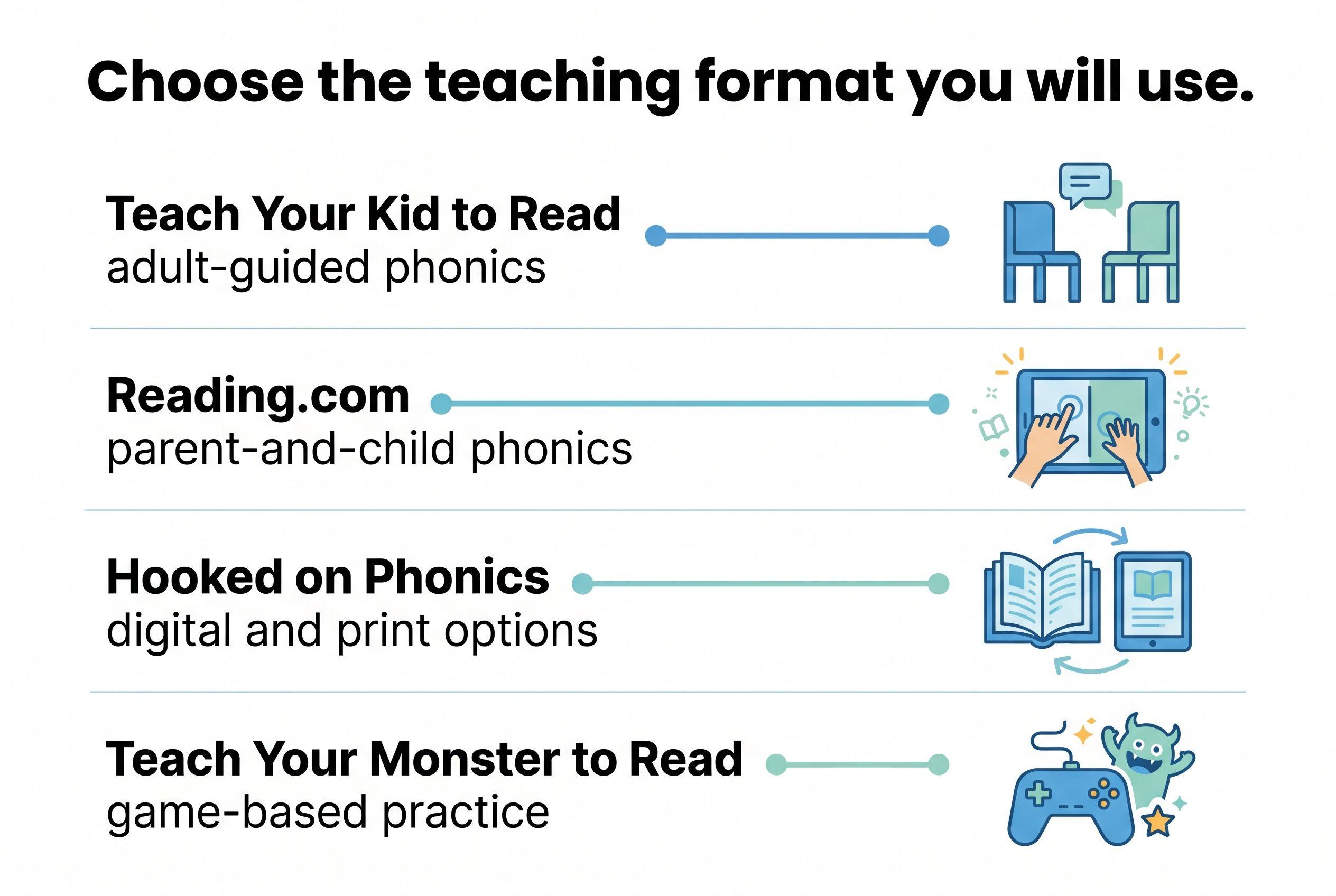
Teach Your Kid to Read is my overall pick on this four-app list. Within the Reading.com vs Hooked on Phonics comparison, I'd pick Reading.com for a beginning reader whose parent wants to teach alongside them; I'd choose Hooked on Phonics if you prefer its advertised combination of digital activities and physical practice materials. That's a fit judgment based on their described approaches—not a claim that either produces better reading results.
What You'll Learn
- Reading.com wins my head-to-head pick for parent-led practice. Hooked on Phonics suits families who want digital and print practice; check the contents of the plan you choose.
- Teach Your Kid to Read ranks first on this four-option list for explicit parent guidance and a fixed phonics sequence, but every lesson needs an adult beside the child.
- Teach Your Monster to Read offers the lowest-cost route here: computer access costs nothing, while its mobile app requires a one-time purchase.
- Check decoding before subscribing. A child who recognizes a familiar page might still struggle to blend a new word from its sounds.
Here's my reality check: the useful question isn't which screen looks more educational. It's what happens when your child looks at map, says “mat” and waits for you to approve.
I homeschool four kids, ages 10, 7, 4 and 1. I've taught my oldest two to read, and with my 4-year-old, I care far more about hearing that final /p/ than seeing another celebration animation. Confetti doesn't offend me. Confetti that distracts from an uncorrected mistake does.
The Verdict
This Reading.com vs Hooked on Phonics comparison includes two alternatives because parent coaching and a low-cost practice option deserve a place in the same buying decision.
How we ranked
- Clear phonics sequence: children need instruction that builds on sounds they've learned.
- Adult role and correction: parents need to know who notices a wrong sound and what happens next.
- Transfer to reading: blending unfamiliar words matters more than finishing activities.
- Cost and household fit: a program must fit both your budget and your available teaching time.
| Rank and app | What it teaches or how it describes itself | Price / pricing model | Best-for age |
|---|---|---|---|
| 1. Teach Your Kid to Read | Step-by-step, parent-led phonics; blending and short decodable stories from lesson two | Lesson one free, then 7-day trial, US$9.95/month | My recommendation: beginning readers around ages 4–6 with an adult alongside |
| 2. Reading.com | Describes its approach as parent-and-child phonics instruction | US$12.49/month (checked October 2026); US$74.94/year (checked October 2026) | Stated ages 3–8; my pick for parent-led practice |
| 3. Hooked on Phonics | Describes a phonics approach combining digital learning with print practice options | Plans US$23.96–US$31.99/month (checked October 2026); 7-day free trial in the app | Stated app ages 3–8; my pick for families wanting print alongside digital practice |
| 4. Teach Your Monster to Read | Describes a reading game covering letter sounds and early reading | Free on computers; app US$8.99 (checked October 2026), one-time purchase | Stated App Store ages 3–6; my pick for additional game-based practice |
Full disclosure: I co-founded Teach Your Kid to Read, so weigh my #1 pick accordingly; the rest of the ranking is based on the criteria above.
Prices checked October 2026.
For a parent-guided phonics routine, I recommend Teach Your Kid to Read: start lesson one free. Lesson one is free, with no card and nothing to cancel. From lesson two, the whole program is a 7-day free trial, then US$9.95 a month.
The Tiger Truth: Practice Must Change the Reading
Only 31% of US 4th graders (ages 9–10) scored at or above Proficient in reading on the 2024 Nation's Report Card. That doesn't mean everyone below that level can't read, and it doesn't tell you which app to buy. It does give parents a reason to check actual skills rather than assume that completed activities mean secure reading.
The US National Reading Panel, in its 2000 report, found benefits from systematic phonics instruction. That supports teaching sound–letter relationships in a planned sequence—not treating pictures or sentence context as substitutes for reading the letters. It doesn't establish that any app on this list works better than another.
Waiting without checking can let a child rehearse guessing while school reading becomes more demanding. Start instruction, watch the response and ask for help when difficulties persist. No panic purchase necessary.
The Ranking
1. Teach Your Kid to Read: Best for Explicit Parent Guidance
My first pick serves the parent who says, “I'll sit down and teach, but tell me what to listen for.” Teach Your Kid to Read gives that adult a step-by-step phonics program, with about 15 minutes a day side by side.
Sequence: the course has 50 lessons in a fixed order. It moves from single letter sounds through digraphs such as sh, ch and th, then covers blends, vowel teams, silent e, prefixes and suffixes. A small set of common irregular words appears along the way as “leap words,” which the app teaches by sight.
Lesson one starts with m, s, p and short a. Your child hears each sound, taps the matching letter, then blends and builds am, map and sap. There's no story yet. I like that narrow first target: connect sounds to letters, then use those connections immediately.
Adult role: the app teaches the parent what to listen for and how to correct a mistake. Imagine your child says “muh” instead of a clean /m/. You're there to model the sound rather than let the extra vowel travel into every blending attempt. That's teaching, not hovering.
Transfer: from lesson two, the child reads a short story built from sounds taught so far. That gives the lesson a purpose beyond tapping the right letter: use the code to read connected print.
Household fit: it runs on iPhone/iPad, Android and the web. Several children can share one account. The lessons page lets parents see every lesson and jump to one, while a parent “mastered this” button skips some practice activities in later lessons.
Here's the limitation: the app has no speech recognition; the parent checks pronunciation. Choose something else if you need the software itself to listen and correct your child, or if you need a child-alone activity while you handle another task.
My age recommendation in the table reflects my judgment, not a stated product age range. Starting skill and adult availability matter more than the birthday candle count.
2. Reading.com: My Pick Between the Two Headliners
In Reading.com vs Hooked on Phonics, Reading.com gets my vote when a parent specifically wants a shared phonics lesson rather than a broader package of materials.
Rules it in / rules it out: I'd recommend it for beginning readers around ages 4–6 when an adult can join the lesson; I'd rule it out if you need child-alone practice.
Sequence and adult role: Reading.com describes a phonics approach that brings parent and child together. That matches my preference for an adult hearing the child's responses. Before paying, look at its lesson demonstration and ask whether the instructions make sense to you—not just whether your child likes the presentation.
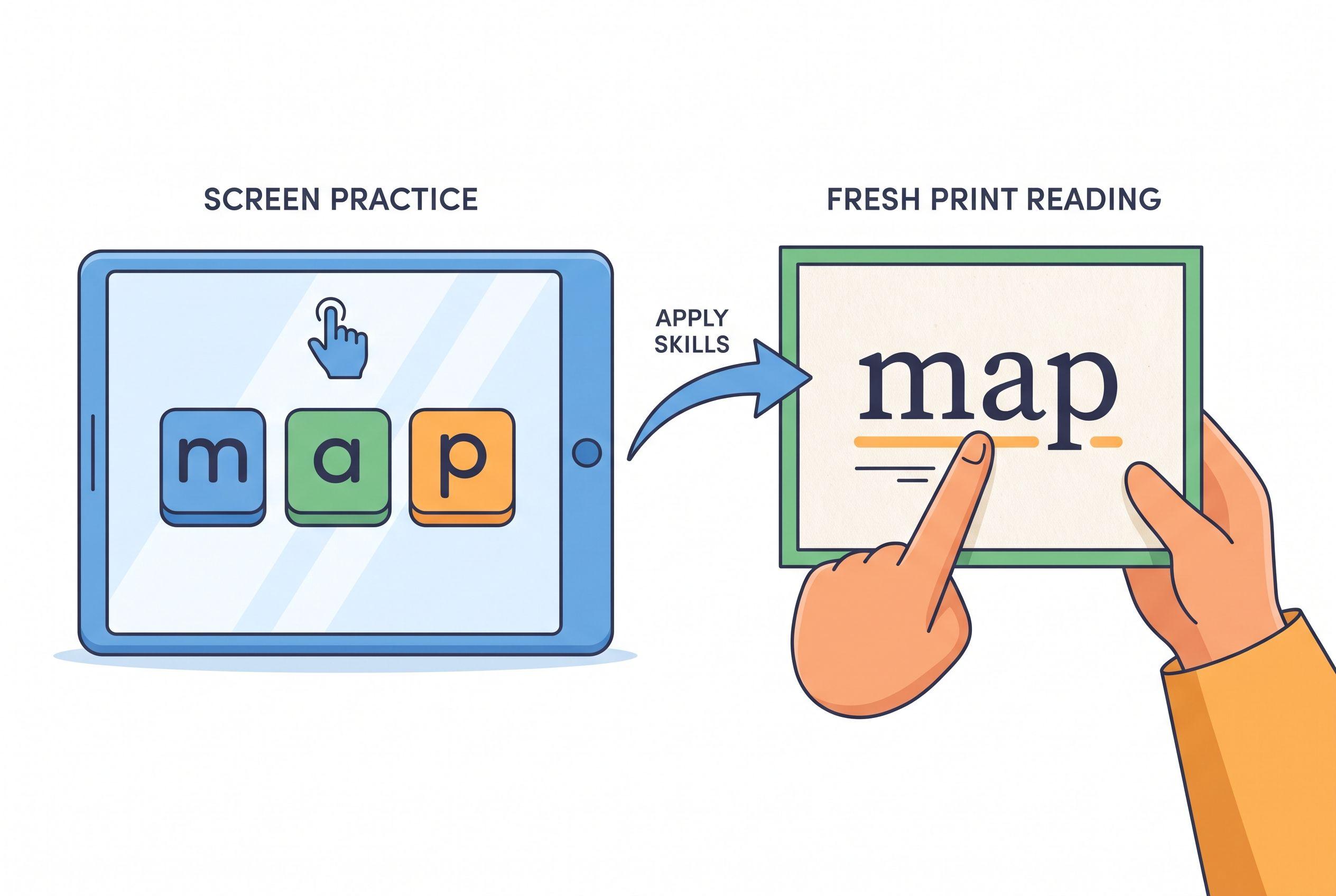
Transfer: watch for the move from recognizing sounds to blending words. Then check the same skill away from the device. A child who can read map only after an animation gives a hint still needs practice reading map without that hint.
Cost and fit: Reading.com offers monthly and yearly subscriptions, with stated ages 3–8. A yearly plan means a larger upfront commitment; I'd establish that the routine fits your household before committing to a longer term.
Is Reading.com worth it? Potentially, if its teaching format helps you give consistent, attentive instruction. Don't buy it on the assumption that an app replaces your listening ear. For a different comparison, see Reading.com vs HOMER.
3. Hooked on Phonics: Best for Families Wanting Print Practice Too
Hooked on Phonics deserves consideration when you want its advertised digital-and-print approach. Some parents find it easier to keep practice going when a physical book sits on the table rather than behind another app icon.
Rules it in / rules it out: I'd recommend it for beginning readers around ages 4–6 if you'll use the print materials in your chosen plan; I'd rule out paying for that package if those materials will stay on the shelf.
Sequence: the product describes itself around phonics instruction. Examine sample lessons for the same thing I'd demand from any program: new reading tasks should draw on sound–letter relationships the child has already learned.
Adult role and transfer: don't interpret digital activities as permission to stop listening. Sit beside your child for reading practice, then use the available print materials to hear whether the skill carries over. Confirm which materials your selected subscription includes; the app's trial and a package subscription aren't interchangeable descriptions of the same purchase.
Cost and fit: the listed plans cost more than Reading.com's listed subscription. That doesn't automatically make Hooked on Phonics poor value. It makes the included materials—and whether you'll actually use them—the deciding factor.
If you're choosing Reading.com or Hooked on Phonics, pick the latter because its format fits your routine, not because a familiar name guarantees progress. The Reading Eggs vs Hooked on Phonics vs HOMER comparison widens that format discussion.
4. Teach Your Monster to Read: Best Low-Cost Practice Alternative
Teach Your Monster to Read describes a game-based route through letter sounds and early reading. Free computer access makes it worth considering when you're exploring Hooked on Phonics alternatives without adding another recurring bill.
Sequence and transfer: its early-reading focus makes it more relevant here than a general entertainment game. Still, ask your child to demonstrate a practiced skill outside the game. Moving a character successfully and reading unfamiliar print aren't identical tasks.
Adult role: I'd use it as additional practice and keep direct teaching in the routine. Sit nearby initially so you can tell whether your child responds to the letters or simply experiments until something works.
Cost and fit: the computer version and paid mobile app offer different purchasing routes. It ranks fourth for this particular parent-coaching need, not because game-based practice has no value. A useful game can support teaching; it doesn't excuse ignoring an ongoing decoding problem.
Reading.com vs Hooked on Phonics: What Should Decide It?
For this buying decision, I'd use three practical questions rather than chase the best phonics app 2026 label.
Will you sit alongside your child? Reading.com suits that parent-led preference. Teach Your Kid to Read also requires it. If you need independent screen time, don't purchase a shared-teaching program and hope the adult requirement disappears.
Will physical materials earn their place? Hooked on Phonics makes more sense if you want its print options and will use them. If another workbook will join the kitchen's leaning tower of good intentions, don't pay extra simply to own it.
Can your child use the skill on fresh print? Linnea Ehri's 2005 review, Learning to Read Words: Theory, Findings, and Scientific Studies, explains how connections between spellings and pronunciations support word learning. Orthographic mapping isn't memorizing a word's silhouette; sound–letter connections help secure it in memory.
That's why my “No Guessing” rule targets the teaching prompt, not the child. If a child guesses, I say, “Let's check the letters,” rather than scold. Pictures can support discussion and meaning; they shouldn't supply the word the child hasn't decoded.
The Action Step: Check, Teach, Then Check Again
Use this routine before switching subscriptions. These are practical teaching steps, not a standardized assessment or a promise about speed.
- Find a starting point. Try our free phonics skill check. Your child reads real and made-up words, you mark responses right or wrong and the check identifies the first pattern to practice.
- Choose one target. If blending breaks down, work with sounds your child knows. Don't add vowel teams just because the lesson menu makes them available.
- Teach the correction. For map, point left to right, model the sounds and blend them. Have your child try again without using a picture clue.
- Read beyond the screen. Write a fresh word using the same taught sounds. Check whether the child can decode it without remembering the app's layout.
- Keep a brief note. Record the word and the error: “said /t/ for final p” tells you more than “reading went badly.”
- Get help for persistent difficulty. Ask a teacher or reading specialist about an appropriate assessment. DIBELS can help trained users examine early literacy skills; use the correct administration guidance rather than treating any single score as a diagnosis.
Start with the first lesson and listen closely to the blending.
I favor daily practice, but I won't turn illness or exhaustion into a battle over a streak. Keep the routine dependable and the task manageable. Accuracy comes before speed.
My Final Buying Advice
Reading.com vs Hooked on Phonics comes down to shared digital teaching versus a preference for digital-and-print practice. My head-to-head pick is Reading.com for the former; Hooked on Phonics earns its place when you'll use the package's physical materials.
My overall pick remains Teach Your Kid to Read for parents who want guidance while they teach. Before choosing any subscription, use our free phonics skill check to identify the skill that needs attention. Then buy for that need—not for a hopeful version of your schedule.
Ready to teach alongside your child? Lesson one is free.
FAQ
Is Reading.com better than Hooked on Phonics?
For parent-led digital phonics, Reading.com is my pick. Hooked on Phonics makes more sense if you want its digital-and-print approach and will use the included materials. This ranking compares fit, not proven differences in reading outcomes.
Which costs less, Reading.com or Hooked on Phonics?
Reading.com's listed subscription costs less than the listed Hooked on Phonics plans. Check the dated prices in the verdict table, then compare the exact materials, renewal terms and purchase route before subscribing.
Can either app replace an adult teaching reading?
Don't assume it can. Children need someone to notice inaccurate sounds and guessing. Check each product's description of the adult role, and regularly listen to reading away from the screen.
What's a low-cost alternative to both?
Teach Your Monster to Read offers free computer access and a one-time paid mobile app. I'd consider it for additional practice while keeping direct phonics instruction and read-aloud time in the routine.
What if my child still struggles after regular practice?
Ask a teacher or qualified reading specialist to examine the difficulty rather than repeatedly swapping apps. Bring examples of errors and notes about instruction. Persistent problems with sounds or blending deserve a closer look, not blame.
From teachyourkidtoread.org/blog/reading-com-vs-hooked-on-phonics-which-is-better-2026
Part of these guides

Xia Brody
Co-Founder, Teach Your Kid to Read
Mom of 4 who has successfully taught her kids to read. Currently in the trenches with her 4-year-old while her two oldest (10 and 7) devour books on their own. Passionate about phonics-based methods and building a lifelong love of reading.
Related Articles

Hooked on Phonics vs Reading Eggs: Which Is Better?
I'd choose Hooked on Phonics for a narrower phonics focus and Reading Eggs for broader reading practice across different stages. Here's how those two compare with two alternatives—and what I'd check before paying.
Read More →
Reading Eggs vs Hooked on Phonics vs HOMER: 2026 Ranked
A finished lesson doesn't necessarily mean your child can read the words. Here's how I rank four reading apps, what I'd check before subscribing and why decoding beats digital rewards.
Read More →
Reading Eggs vs Prodigy English: 2026 Parent Pick
Reading Eggs is the stronger pick for a child who still needs phonics; Prodigy English better suits a reader who needs extra English practice. Here's how they compare with two alternatives—and what I'd check before paying.
Read More →