Reading.com vs HOMER: Which App Is Better in 2026?

What You'll Learn
- The one phonics principle that separates a good reading app from a flashy babysitter — and which of these two apps gets closer to it
- Why the most popular reading app features (animations, mini-games, reward systems) can actually slow down your kid's reading progress
- How the two apps compare for a 4-year-old — including the weakness that would make me close one of them permanently
- The specific reading science benchmarks your kid should be hitting, and whether either app can get them there alone (spoiler: nope)
Let's Get Something Straight First
Neither of these apps is going to teach your kid to read.
I know. You clicked on this comparison expecting me to crown a winner and tell you to download it. And I will tell you which one I think is stronger. But if you walk away from this article thinking "Great, I'll just hand my kid an iPad and they'll be reading chapter books by kindergarten" — I've failed you.
Apps are tools. Some tools are sharp and well-made. Others are dull and dressed up with glitter so you don't notice they can't cut anything. The question isn't just "Reading.com or HOMER?" The question is: does either app teach reading the way the brain actually learns to read?
That's what we're going to dig into.
The Reading Crisis Is Not an App Problem — But Apps Can Make It Worse
Here's the number that should keep every parent up at night: only 33% of 4th graders in America read at a proficient level. That's from the 2022 NAEP — the Nation's Report Card. Two out of three kids can't read well enough to learn from a textbook.
The 2023 NAEP scores showed reading dropped 3 points since 2019 — the largest decline in 30 years.
Kids who can't read by 3rd grade are four times more likely to drop out of high school. That's from the Annie E. Casey Foundation's 2010 study. Four times. And remedial reading intervention? You're looking at $10,000 to $15,000 per year — out of pocket, because insurance doesn't cover it.
So when I evaluate reading apps, I'm not rating the cute animations or the voice acting or whether my kid giggles at the reward screen. I'm asking one thing: does this app build systematic phonics skills in a way that aligns with how Stanislas Dehaene's research in Reading in the Brain (2009) showed the brain actually processes written language?
Dehaene — a French neuroscientist — proved that the brain has to be trained to read. Reading is not natural. It doesn't emerge like walking or talking. You have to deliberately wire the visual cortex to connect letter shapes to sounds. That's grapheme-phoneme correspondence. Any app that skips this, fudges this, or buries this under a pile of games is wasting your kid's time.
Reading.com: What It Actually Is
Reading.com is an app-based reading platform aimed at kids ages 3–8. It's sometimes confused with Reading Eggs (a separate product by Blake eLearning), but Reading.com is its own platform with its own curriculum. It's been around for a few years now, so it's had time to build out its content — though some areas still feel like they're catching up to the Science of Reading revolution.
What it does well:
- It has a structured phonics progression. Lessons move from letter recognition to CVC words to digraphs to longer vowel patterns. There's a sequence. That matters.
- The placement test is decent — it drops your kid into the right starting point instead of forcing a 5-year-old who already knows letter sounds to sit through "A is for Apple" for three weeks.
- It includes decodable readers that tie to the phonics lessons. This is huge. Decodable texts are what David Kilpatrick's orthographic mapping research (Equipped for Reading Success, 2016) shows kids need — they practice only the patterns they've already learned, which builds automatic word recognition.
What bugs me:
- There's a LOT of visual clutter.
- Some lessons let kids advance even when they get answers wrong. That's a problem. Mastery matters. If my kid can't accurately decode "ship" and the app just shrugs and moves on, we're building bad habits.
- The cost: $12.49 a month or $74.94 a year as of October 2026. Not terrible, but not nothing.
- The phonics instruction, while systematic, isn't as explicit as what you'd see in a program built on Orton-Gillingham principles. There's less direct instruction and more "discovery through play," which can leave gaps for kids who need more support.
HOMER: What It Actually Is
HOMER (formerly known as HOMER Reading, now part of the Begin learning platform) targets kids ages 2–8. It pitches itself as a "personalized" reading program that adapts to your child's interests — dinosaurs, princesses, trucks, whatever — and weaves those themes into the reading content.
What it does well:
- The interest-based personalization is genuinely clever from an engagement standpoint. Kids pick topics they care about, and the stories and activities pull from those themes.
- It covers phonics, sight words, and comprehension across different "pathways."
- It includes some phonemic awareness activities — rhyming, initial sound identification, blending — which is good. Phonemic awareness is the foundation that phonics sits on top of.
- The interface is clean and age-appropriate. Less visual chaos than Reading.com.
- Cost: subscription — check HOMER's site for current pricing.
What bugs me a lot more:
- The phonics instruction is not fully systematic or sequential. HOMER jumps around. It mixes phonics lessons with sight word memorization and comprehension activities in a way that doesn't follow a clear scope and sequence. If you've read Louisa Moats' Teaching Reading IS Rocket Science (1999), you know that systematic and sequential instruction isn't a nice-to-have — it's non-negotiable.
- The sight word approach leans heavily on memorization — whole-word recognition — which is exactly the Balanced Literacy methodology that Emily Hanford's 2023 APM Reports investigation Sold a Story exposed as ineffective. Kids don't need to memorize words as whole shapes. They need to decode them through their letter-sound patterns and then, through repeated accurate decoding, map them orthographically. That's Linnea Ehri's phases of word reading development (2005) — pre-alphabetic, partial alphabetic, full alphabetic, consolidated. HOMER shortcuts this process.
- Some of the "reading" activities are more like listening comprehension. The app reads a story aloud and then asks questions. That's audiobook comprehension, not reading. Your kid isn't decoding anything.
- The personalization, while engaging, can become a distraction engine. A kid who picks "puppies" as her interest can end up just looking at the puppy pictures instead of doing the actual phonics work.
The Head-to-Head Breakdown
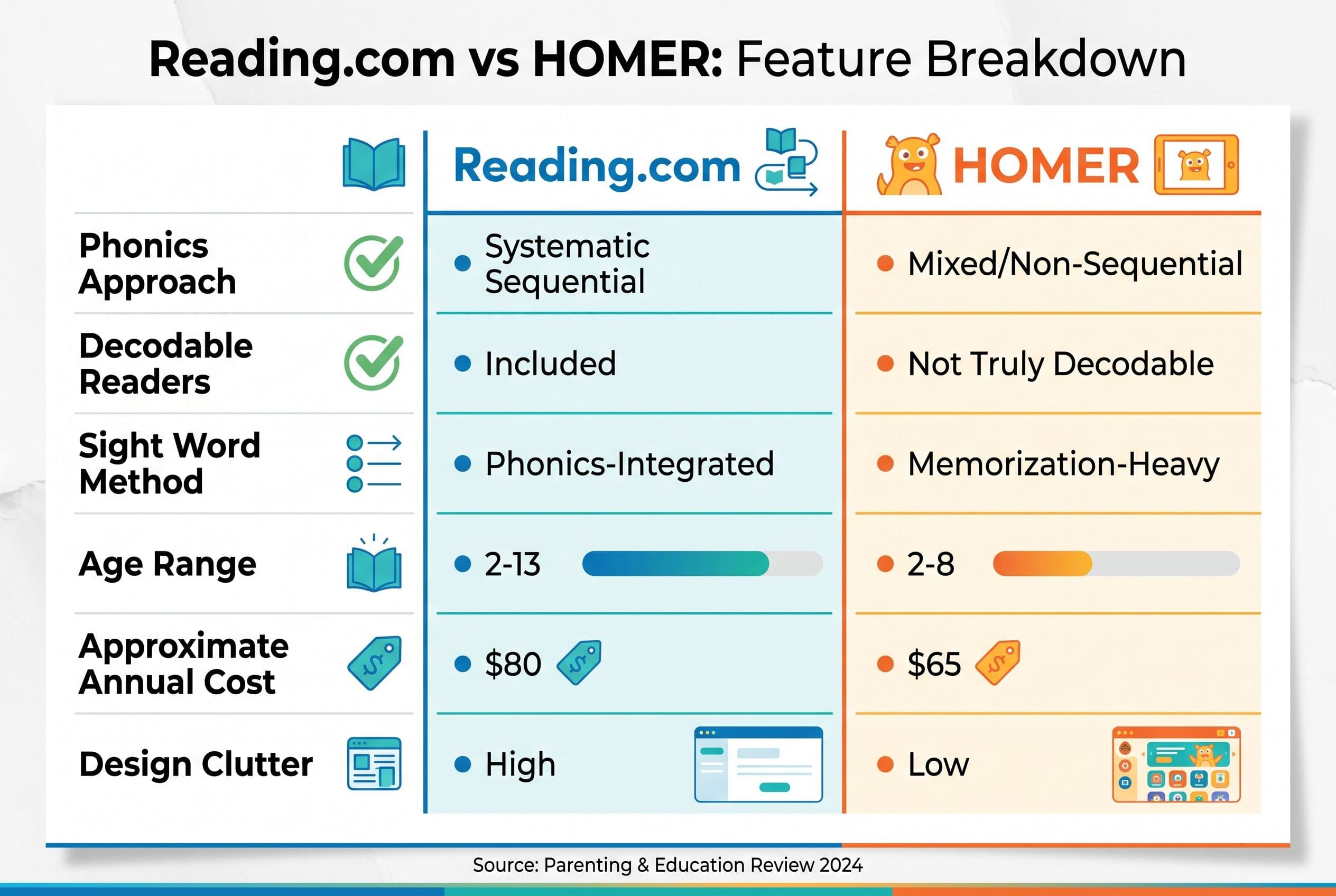
Phonics Approach
Reading.com: More systematic. Follows a recognizable phonics scope and sequence — letter sounds → CVC → consonant blends → digraphs → long vowels → multi-syllable words. Not perfect, but the bones are there.
HOMER: Mixed approach. Some phonics, some sight words, some comprehension — all shuffled together. Less predictable progression. This is a real weakness if your kid needs explicit, sequential instruction (and most kids do, according to the National Reading Panel report from 2000).
Winner: Reading.com, by a significant margin.
Engagement & Design
Reading.com: High engagement but sometimes too stimulating. The reward systems can pull focus away from the actual reading work. Bright, busy, lots of clickable elements.
HOMER: Cleaner design, interest-based personalization keeps kids coming back. But "engagement" isn't learning. My kids are also engaged by YouTube. That doesn't mean they're learning to read.
Winner: HOMER for design, but I want to be clear — engagement without accurate phonics instruction is just entertainment.
Decodable Readers
Reading.com: Yes. Includes decodable texts matched to phonics lessons. This is a big deal. Decodable readers are what programs like UFLI Foundations and Fundations use to reinforce newly learned phonics patterns.
HOMER: Has stories, but they're not strictly decodable. Many include words kids haven't been taught to decode yet, which means they're either guessing or the app is reading the words aloud for them. Neither builds actual reading skill.
Winner: Reading.com, and it's not close.
Assessment & Progress Tracking
Reading.com: Offers progress reports and a placement quiz. The reports show which skills have been "completed" but don't tell you much about mastery vs. just clicking through.
HOMER: Has a learning plan and progress tracking. Same limitation — completion isn't mastery.
Winner: Tie. Neither app gives you the kind of diagnostic data you'd get from a real assessment like Kilpatrick's PAST (Phonological Awareness Screening Test) or DIBELS. If you want to actually know where your kid stands, you need to assess them yourself.
Price
Reading.com: $74.94/year (as of October 2026)
HOMER: check HOMER's site for current pricing
Winner: check both current prices — but honestly, if the phonics instruction is weaker, a small saving doesn't matter.
The Playground Conversation That Changed a Mom's Mind
I was at a playground in Raleigh last fall when another mom told me her kid's school had just switched from Lucy Calkins' Units of Study to a Science of Reading curriculum because of North Carolina's SB 387 — the Excellent Public Schools Act. She was confused and honestly kind of annoyed about it. "He was doing fine before," she said. I asked if her son could read the word "splint." He's in second grade.
He could not.
I spent 20 minutes on that playground bench explaining why the switch was happening — Hanford's reporting on how three-cueing (the "look at the picture and guess" strategy) had been failing kids for decades, the NAEP data showing two-thirds of kids can't read proficiently, the neuroscience from Dehaene's lab showing the brain doesn't learn to read naturally the way it learns to speak. She went home and watched the Sold a Story podcast that night. Texted me at 11pm: "I had no idea. Why didn't anyone tell us this sooner?"
Here's why I'm telling you this story in an article about reading apps: that mom had been using HOMER with her younger daughter at home, thinking she was getting ahead of the problem. She liked the cute interface. Her daughter liked picking "unicorns" as her interest theme. But when I asked what phonics patterns her daughter had mastered — could she blend consonant clusters? Could she decode a CVCC word like "lamp"? — the mom had no idea. The app never made it clear.
This is the danger of apps that prioritize engagement over explicit instruction. You feel like your kid is learning because they're busy and happy on the screen. But busy and happy isn't the same as mastering grapheme-phoneme correspondence. Mississippi didn't go from 49th to 21st in national reading scores (after their Literacy-Based Promotion Act of 2013) by making reading "fun." They did it by making reading instruction systematic, explicit, and non-negotiable.
So Which App Wins? And Does It Even Matter?
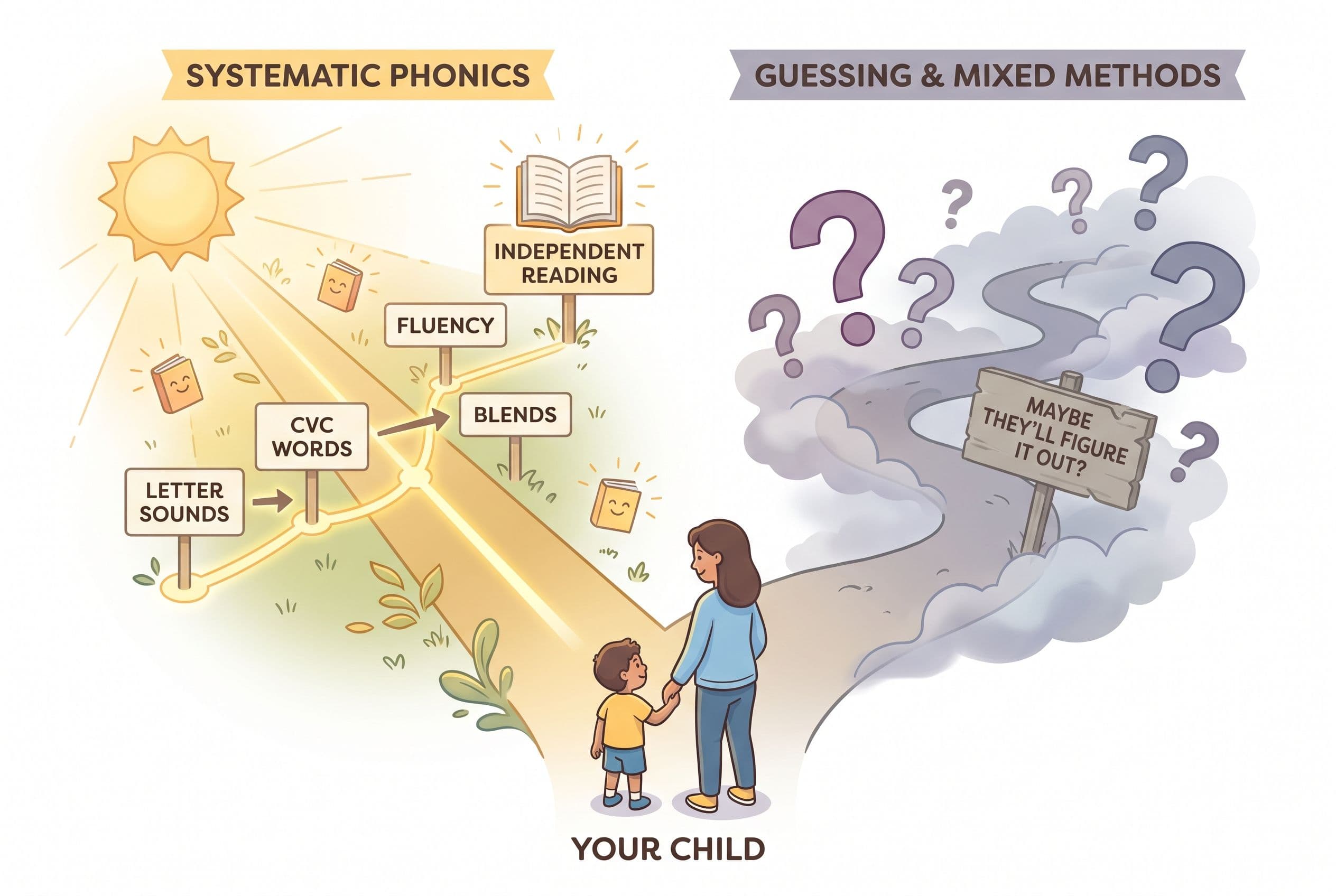
Gun to my head? Reading.com is the stronger app for actual phonics instruction. It has a clearer scope and sequence, it includes decodable readers, and it more closely aligns with what the Science of Reading research says works.
But here's the thing — and I cannot stress this enough — neither app is sufficient on its own. Not even close.
Both apps share the same fundamental limitation: they're screen-based, self-directed tools that can't do what a skilled parent or teacher does. They can't watch your child's eyes to see if they're tracking left to right. They can't hear the subtle difference between your kid saying /b/ and /d/. They can't stop a lesson mid-stream and say, "Wait, let's go back — you're confusing 'b' and 'p' because you're not feeling the difference in your mouth."
The National Reading Panel report — the one Congress commissioned in 2000 — identified five pillars of reading instruction: phonemic awareness, phonics, fluency, vocabulary, and comprehension. Both apps cover phonics (Reading.com better than HOMER). Both dabble in the others. But the research is clear that systematic, explicit, interactive instruction with feedback produces the best outcomes. Mark Seidenberg said it plainly in Language at the Speed of Sight (2017) — the reading education establishment has been getting it wrong for decades, and the fix requires more than better software.
Apps are supplements. They're the 10-15 minutes of independent practice while you're making dinner. They are not the lesson.
What Your Kid Actually Needs (The Action Step)
Here's what I do with my own kids — and what I'd tell you to do if we were sitting on that Raleigh playground bench together:
Step 1: Assess where your kid actually is. Don't guess. Use Kilpatrick's PAST (Phonological Awareness Screening Test) — it takes about 5 minutes and tells you exactly where the phonological breakdown is. Is your kid struggling with initial sound isolation? Blending? Deleting phonemes? You need to know.
DIBELS benchmarks say your kid should hit 28+ correct letter sounds per minute on nonsense word fluency by mid-kindergarten. That's a concrete number. Test it.
Step 2: Use a structured phonics program as your core instruction. Not an app. A real program. UFLI Foundations is free and excellent. Logic of English is thorough. Explode the Code is affordable. If your child shows dyslexia indicators, look at Barton Reading & Spelling or the Wilson Reading System (which uses 12 steps and a controlled reader — it's intense, but it works).
Step 3: Supplement — don't substitute — with an app. If you want a reading app for extra practice, Reading.com is the better choice between these two. Use it for 10-15 minutes a day as reinforcement of what you've already taught. Not as the primary instruction.
But honestly? Teach Your Kid to Read is what I built for exactly this problem. It follows systematic synthetic phonics — the same Orton-Gillingham-aligned approach that the Clackmannanshire study (Johnston & Watson, 2005) showed outperformed every other method across 7 years of longitudinal data. It teaches one sound at a time, in sequence. No guessing from pictures. No skipping ahead.
Step 4: Read decodable books together every single day. Not leveled readers (Fountas & Pinnell levels are everywhere, but they're whole-language aligned — skip them). Get decodable readers from Flyleaf Publishing or High Noon Books. Or use the ones built into Reading.com if you're using that app.
Step 5: Never skip. This is my Tiger Rule. Phonics happens on birthdays, Christmas, vacation. Ten minutes. Every day. The brain builds reading circuitry through consistent practice, not sporadic bursts of enthusiasm.
The Bottom Line
Reading.com has better phonics. HOMER has better design. Neither one is going to teach your kid to read by itself.
If you're choosing between the two, go with Reading.com — but go in with your eyes open about its limitations. Use it as a supplement, not a curriculum. And don't let the reward animations trick you into thinking screen time equals reading instruction.
If you want an app that was actually designed from the ground up around the Science of Reading — systematic synthetic phonics, no guessing, no shortcuts — that's what Teach Your Kid to Read does. I built it because I couldn't find what I needed for my own kids. And I'm currently using it with my 4-year-old, who's blending CVC words at the kitchen table while her 1-year-old brother tries to eat the flashcards.
That's the real picture of early literacy. It's messy. It's daily. And it's the most important thing you'll ever do for your kid.
FAQs
Is HOMER actually based on the Science of Reading?
HOMER claims to be research-based, and it does include some phonics components. But its heavy reliance on sight word memorization and its mixed instructional approach don't fully align with what the Science of Reading research prescribes. The National Reading Panel report specifically found that systematic phonics instruction — where skills are taught in a clear, sequential order — produces significantly better results than non-systematic approaches. HOMER's phonics instruction is less systematic than Reading.com's and much less systematic than dedicated programs like UFLI Foundations or Teach Your Kid to Read.
Can my 3-year-old use Reading.com or HOMER?
HOMER accepts kids as young as 2 and Reading.com starts at 3, but I'd be cautious. At 3, the real priority is phonemic awareness — can your child hear and manipulate individual sounds in spoken words? Think rhyming, clapping syllables, identifying the first sound in "cat." That's pre-reading skill, and it's best taught through real-world interaction, not screens. If you want an app for a 3-year-old, keep sessions under 10 minutes and focus on letter-sound activities, not full reading lessons. Your voice is always going to be a better teaching tool than a tablet at this age.
How long does it take for a reading app to work?
This is a trick question, because it depends entirely on what you mean by "work." If you mean "my kid can tap the right answer on a screen" — weeks. If you mean "my kid can pick up an unfamiliar decodable book and actually read the words on the page" — that requires months of consistent instruction, and an app alone won't get you there. Every kid's timeline is different, but for a typically developing 4-5 year old getting daily explicit phonics instruction, you should see CVC word decoding within 2-3 months and simple decodable book reading within 4-6 months.
Is Reading.com worth the money compared to free options?
Reading.com costs $74.94 a year (as of October 2026), which is cheaper than a single hour with most reading tutors. If you use it consistently as a supplement to real phonics instruction, it can be worth it for the decodable readers alone. But UFLI Foundations is free, and Teach Your Kid to Read offers a structured phonics app that's purpose-built for parent-led instruction. Don't pay for Reading.com if it's going to sit unused after the first week — I've seen that happen with a lot of families.
My kid's school uses HOMER in the classroom. Should I be worried?
It depends on what else the school is doing. If HOMER is a 10-minute supplement alongside a structured phonics curriculum like Fundations or UFLI, that's fine. If HOMER is the primary reading instruction? Yes, I'd be concerned. Ask the teacher directly: "What is the phonics scope and sequence you're following?" If they can't answer that question clearly, you have a problem — and you need to be doing explicit phonics instruction at home regardless of what apps the school uses. Colorado's READ Act and over 40 other state laws now require evidence-based reading instruction in schools. Hold your school accountable.
Part of these guides

Xia Brody
Co-Founder, Teach Your Kid to Read
Mom of 4 who has successfully taught her kids to read. Currently in the trenches with her 4-year-old while her two oldest (10 and 7) devour books on their own. Passionate about phonics-based methods and building a lifelong love of reading.
Related Articles
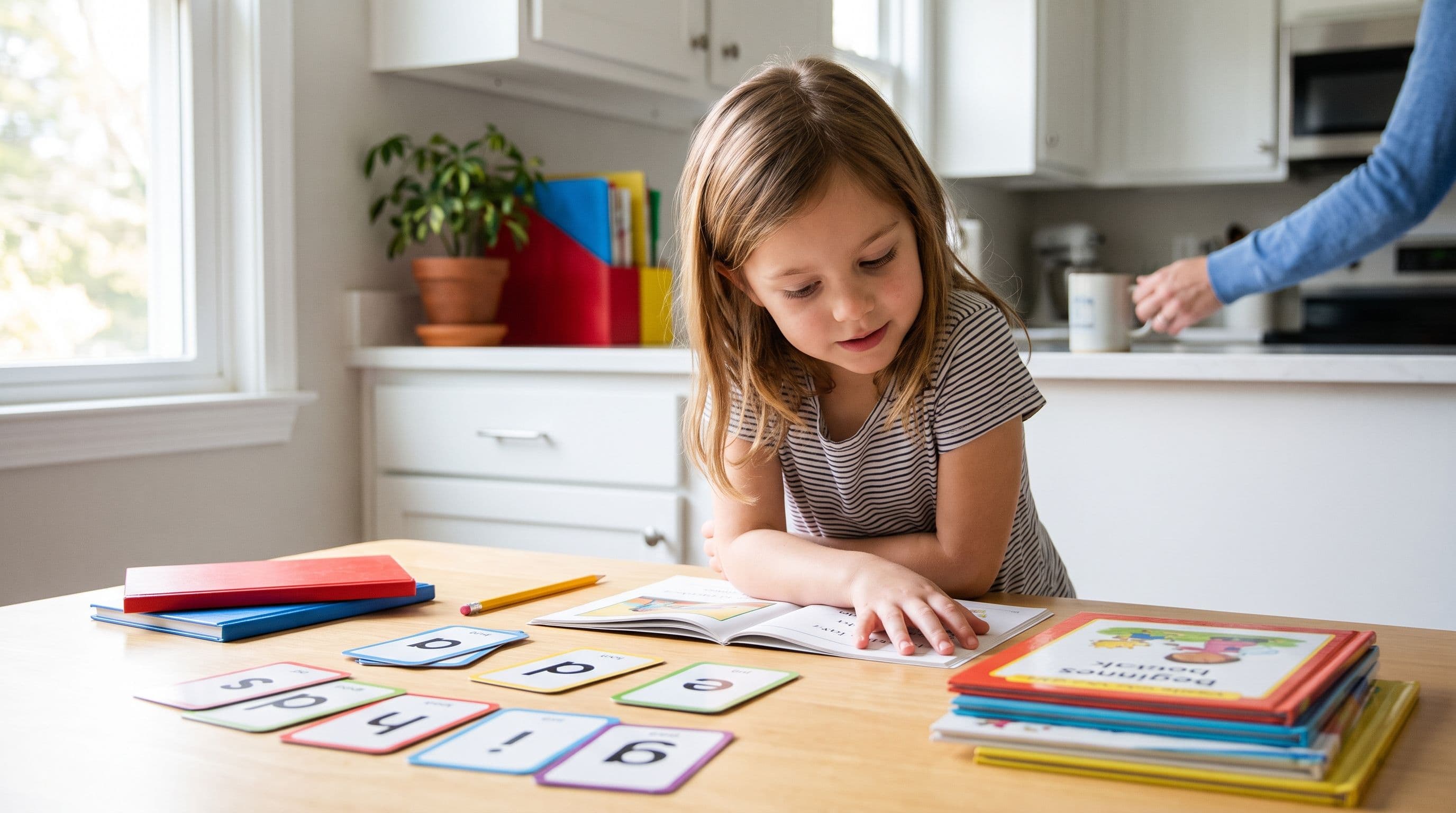
Reading.com vs Teach Your Monster to Read: Parent Pick
Choosing between Reading.com and Teach Your Monster to Read? Here’s the no-fluff parent pick from Xia Brody: what each app teaches, where it falls short, and which reading app I’d use for kindergarten phonics.
Read More →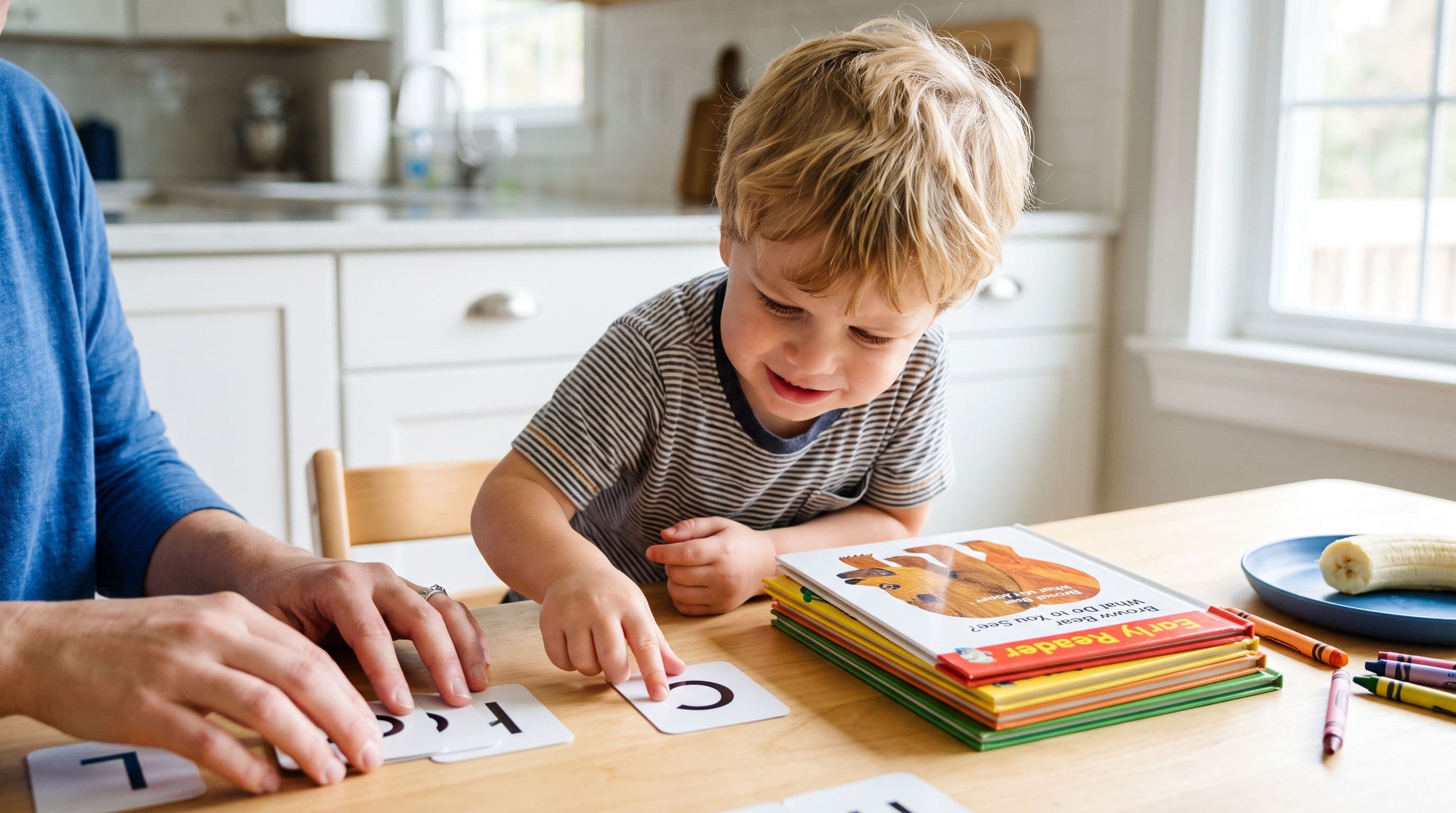
Reading.com vs Reading Eggs Cost: Cheapest 2026 Pick
Comparing Reading.com vs Reading Eggs cost? Here’s the no-fluff 2026 breakdown of pricing, phonics quality, free trials, and which app I’d actually use with my own kid.
Read More →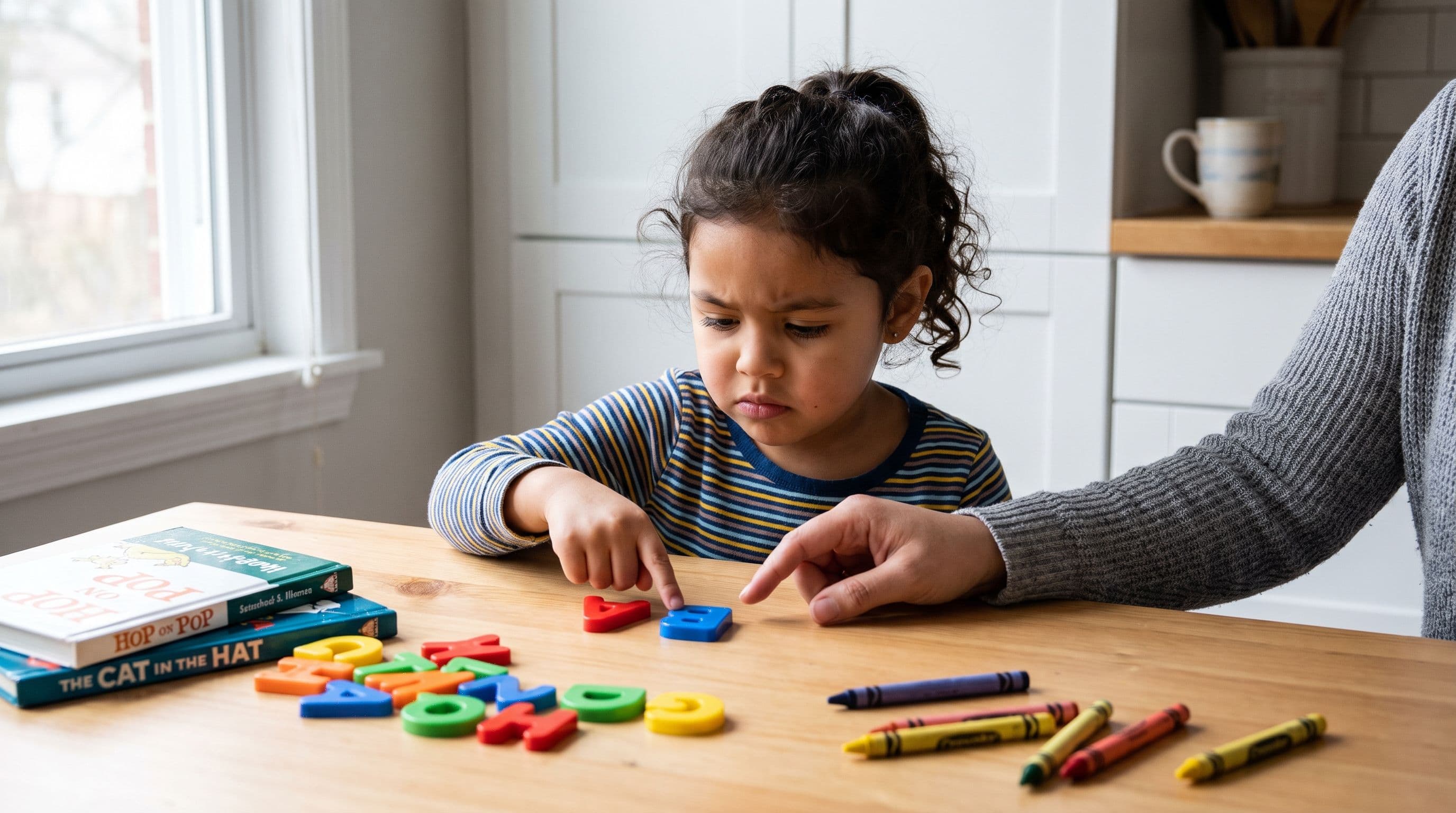
HOMER Learning App vs ABCmouse: Reading Skills Compared
Choosing between HOMER and ABCmouse? Here’s the no-nonsense reading comparison parents need before handing over the iPad. I compare phonics, decoding, app structure, pricing, and what actually helps kids sound out words.
Read More →