Is My 3rd Grader Behind in Reading? Signs + App Plan
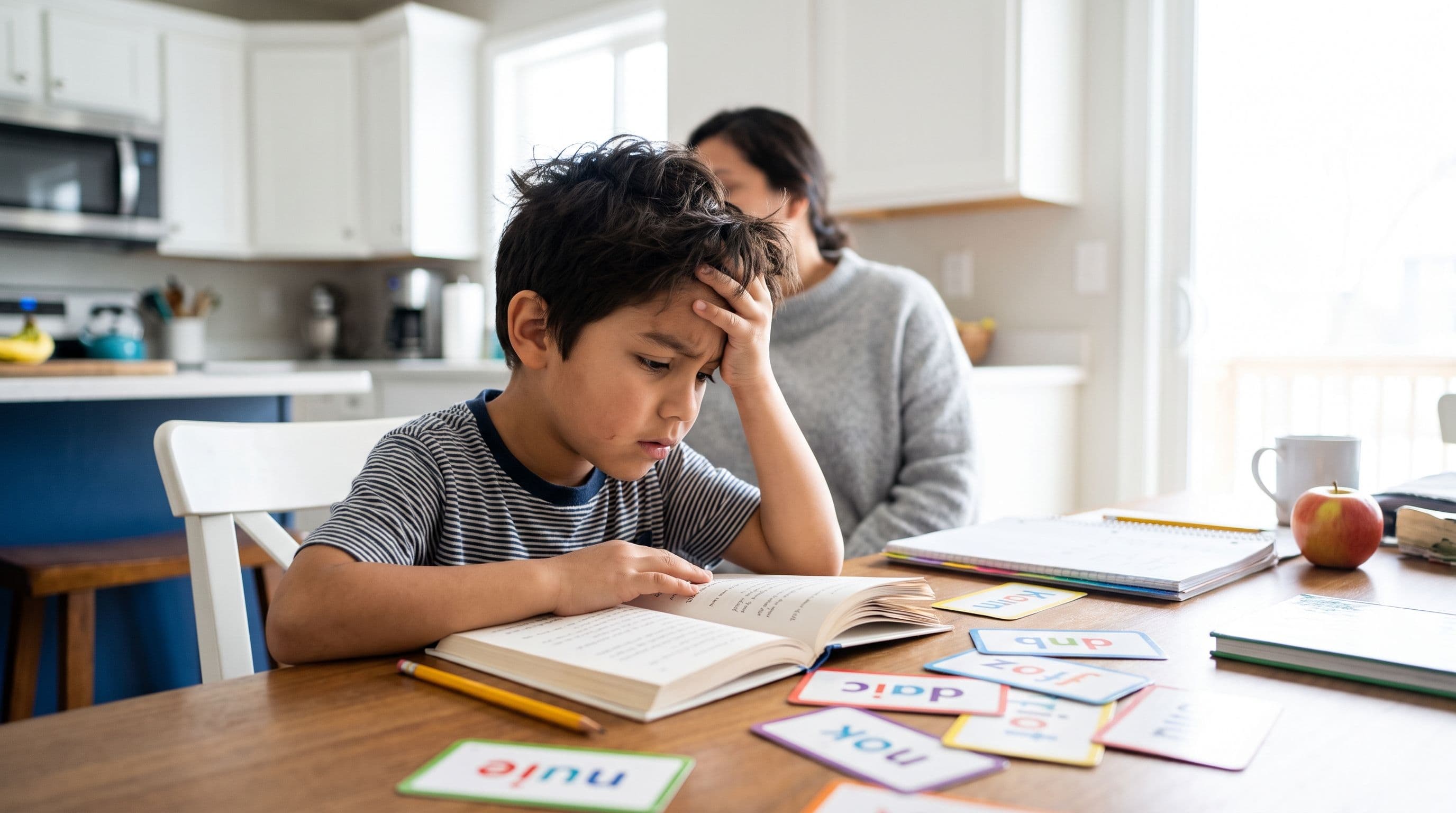
3rd Grader Behind in Reading? Best Apps, Signs, and a 7-Day Plan
What You'll Learn
- The one mistake parents make when a 3rd grader gets stuck on a word
- Which reading apps teach real phonics — and which ones lean on guessing, games, or leveled readers
- The warning signs that your child has hit the third grade wall
- A 7-day action plan for a 3rd grader struggling to read
Reality Check
If you're Googling “is my 3rd grader behind in reading”, your gut already knows something's off.
Maybe your child can read easy books but freezes on words like plastic, shouted, or splint. Maybe they “read” by looking at the picture and guessing. Maybe homework takes 90 minutes and everyone ends up cranky, including the dog.
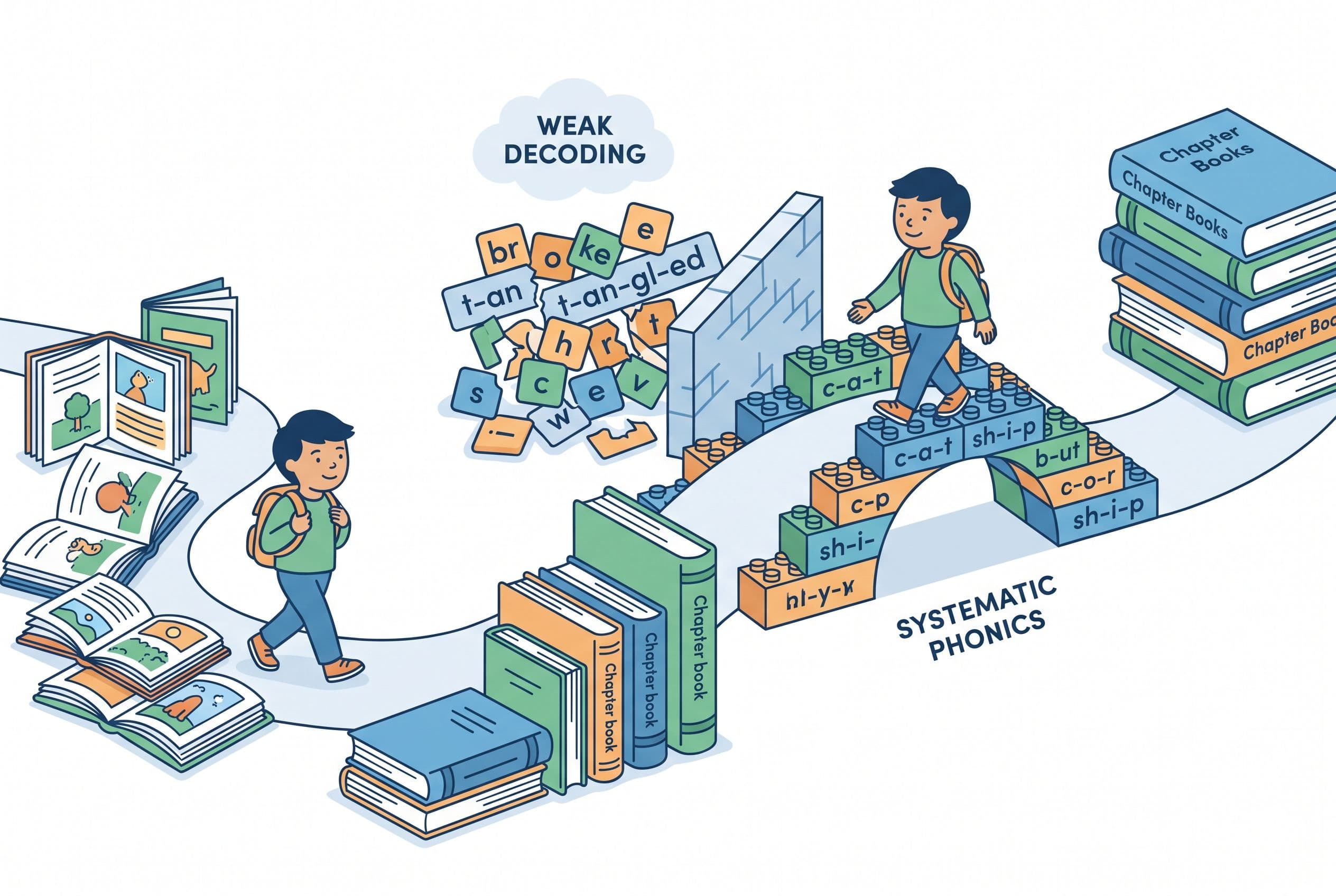
Look, 3rd grade (ages 8-9) is where texts get longer, pictures start disappearing, and independent reading demands jump. Good schools should still teach decoding, fluency, vocabulary, and comprehension when kids need it. But this is often the year old gaps get exposed. That's the wall. And if your child hits it without solid decoding, reading comprehension in 3rd grade can start looking shaky fast.
Fast Answer for Worried Parents
- The most common hidden problem? Decoding. Your child may understand stories just fine when you read aloud, but struggle when they have to read the words themselves.
- Do the 10-word check tonight. No pictures. No hints. Just the words.
- Start systematic phonics tomorrow. Not more guessing. Not more “try the picture.” Letters first, friend.
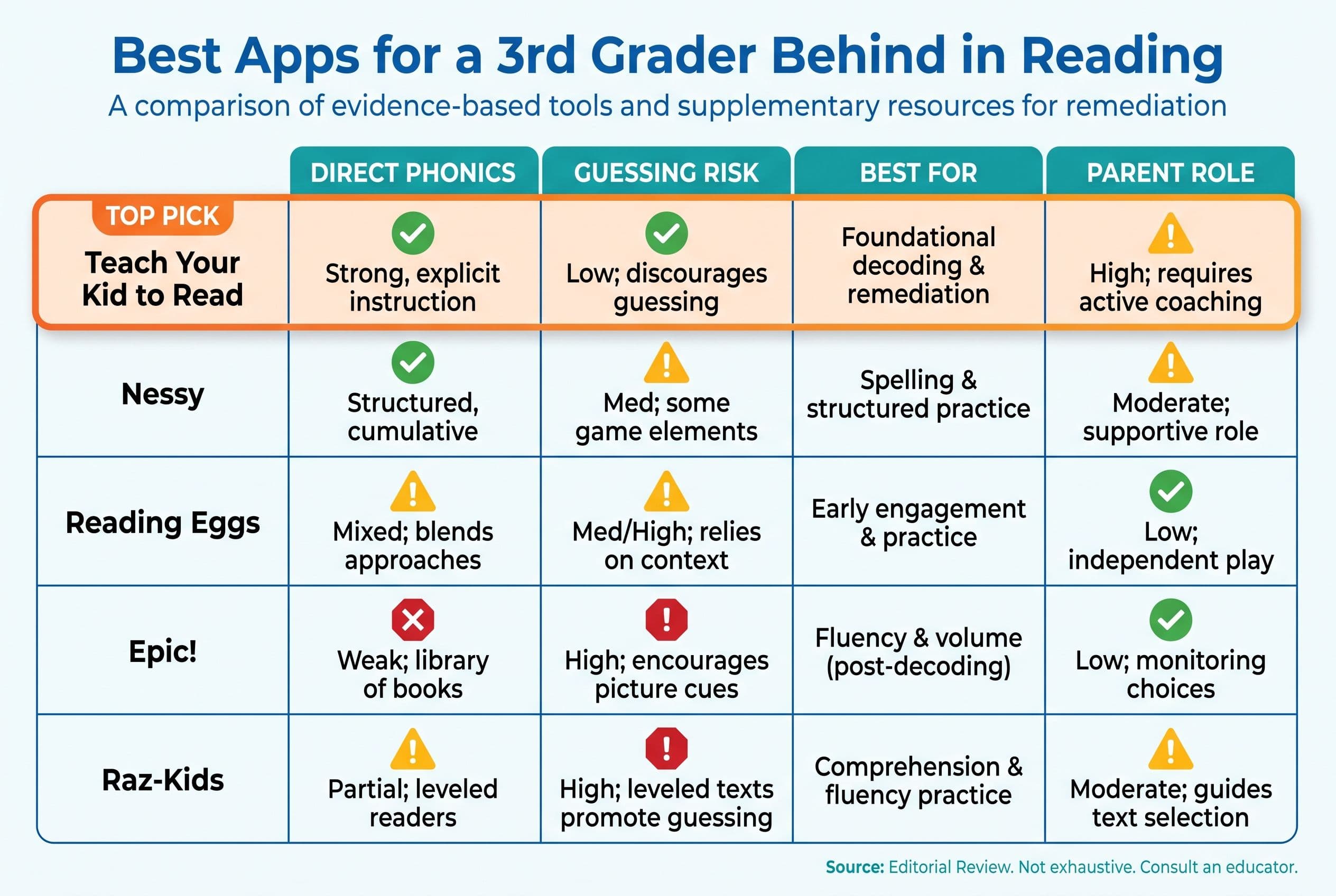
The Verdict: Best Reading Apps for a 3rd Grader Behind in Reading
| Rank | App / Program | What It Teaches | Price | Best For |
|---|---|---|---|---|
| #1 | Teach Your Kid to Read | Systematic synthetic phonics, no guessing, parent-led mastery | Lesson one free with no card and nothing to cancel; from lesson two the whole program is a 7-day free trial, then US$9.95/month | Ages 4-9, especially kids with weak decoding |
| #2 | Nessy Reading & Spelling | Structured phonics with dyslexia-friendly design | Paid subscription | Ages 5-12, dyslexia support |
| #3 | Reading Eggs | Phonics mixed with games and rewards | Paid subscription | Ages 4-8, early practice |
| #4 | Epic! | Digital library, lots of books, not direct reading instruction | Paid subscription | Confident readers who need volume |
| #5 | Raz-Kids | Leveled readers, school-style reading practice | Paid subscription or school access | Kids who already decode well |
If your child has a third grade reading level behind problem, start with direct phonics instruction, not a bigger digital bookshelf. I built Teach Your Kid to Read for parents who need a clear path at home: short lessons, real decoding, and no “look at the picture and guess” nonsense. You can start lesson one free — lesson one is free with no card and nothing to cancel; from lesson two the whole program is a 7-day free trial, then US$9.95/month.
Tiger Truth: Third Grade Reading Problems Don't Fix Themselves
Here's the part nobody wants to say at the PTA meeting: waiting is a decision.
US students on the 2022 NAEP / The Nation's Report Card showed only 33% of 4th graders (ages 9-10) reading at or above NAEP Proficient. NAEP Proficient is not the same thing as “on grade level,” so don't go waving one number around like a magic wand. But still? That's not “some kids need more time.” That's a five-alarm fire.
Donald Hernandez's 2011 Annie E. Casey Foundation report, Double Jeopardy, found that children who weren't reading proficiently by the end of 3rd grade were far more likely to not graduate from high school on time, especially when poverty was also in the picture. That's an association, not a prophecy over your individual child. But it's serious enough that I don't play cute with it.
And the kicker? A lot of these kids don't look “behind” in 1st grade (ages 6-7) or 2nd grade (ages 7-8). They memorize early books. They use pictures. They charm the adults. Then chapter books arrive, pictures disappear, sentences get longer, and boom — third grade wall.
I saw this play out on a playground in Raleigh. Another mom told me her child's school had switched from Lucy Calkins to a Science of Reading curriculum because of North Carolina's SB 387 — the Excellent Public Schools Act, a US state law. She sounded annoyed. “He was doing fine before,” she said.
So I asked, “Can he read splint?”
He was in 2nd grade. He couldn't.
I spent 20 minutes on that playground bench explaining why the switch was happening: Emily Hanford's 2023 APM Reports investigation Sold a Story, the NAEP data, and Stanislas Dehaene's neuroscience in Reading in the Brain (2009), which shows the brain doesn't naturally learn to read the way it learns to speak. That mom went home and listened to Sold a Story that night. She texted me at 11 p.m.: “I had no idea. Why didn't anyone tell us this sooner?”
Exactly.
Deep Dive: Which App Should You Pick?
#1 Teach Your Kid to Read: Best for a 3rd Grader Struggling to Read
Teach Your Kid to Read wins for one reason: it teaches the code.
Not vibes. Not guessing. Not “use the picture.” The code.
A child with third grade reading problems usually doesn't need more random books. They need systematic work on grapheme-phoneme correspondence — which letters spell which sounds — plus blending, segmenting, and review until the skill sticks.
This follows the same direction the 2000 National Reading Panel found: systematic phonics instruction produces strong benefits, especially in the early grades and for struggling readers. Louisa Moats said it plainly in her 1999 paper Teaching Reading IS Rocket Science: teaching reading requires serious knowledge of language structure. She's right. Hands down.
Teach Your Kid to Read uses:
- Systematic synthetic phonics — sounds first, then blending
- No guessing from pictures — ever
- Short daily lessons — because tired parents still need a plan
- Mastery before moving on — no fake progress badges
- Parent coaching — so you know what to say when your child stalls
This matters because many 3rd graders behind in reading have holes from earlier instruction. They may know letter names but not vowel teams. They may read hop but crash on hope. They may memorize said and where but panic when they see splashing.
In my house, I had my 4-year-old practicing CVC words at the kitchen table last Tuesday while the baby threw blueberries like confetti. Was it magical? No. Did we do it anyway? Yes. Tiger Rule: We Never Skip.
For a 3rd grader, I usually start with a quick decoding check:
- Can they read short-vowel words like ship, mop, thin?
- Can they handle blends like flag, crisp, plant?
- Can they read vowel teams like rain, boat, seat?
- Can they read multisyllable words like basket, sunset, plastic?
- Do they guess based on the first letter?
If they guess, stop everything. That's not reading. That's gambling with alphabet costumes.
The offer stays simple: lesson one is free with no card and nothing to cancel; from lesson two the whole program is a 7-day free trial, then US$9.95/month.
#2 Nessy Reading & Spelling: Best Dyslexia-Friendly Support
Nessy has a solid reputation, especially for kids with dyslexia indicators. It uses structured literacy, phonics practice, spelling work, and a friendly design that doesn't shame kids.
If your child reverses letters sometimes, don't panic — lots of young kids do that. But if your 3rd grader still can't map sounds to print, can't remember common patterns, and avoids reading like it's broccoli with homework sauce, you need a serious look.
The International Dyslexia Association describes structured literacy as explicit, systematic instruction in phonology, sound-symbol association, syllables, morphology, syntax, and meaning. Nessy lines up with parts of that, which makes it a decent option.
My caution? Some families still need more parent direction than an app gives. If your child melts down, clicks randomly, or races through games, sit beside them. Apps don't raise readers. Parents do.
#3 Reading Eggs: Fun, But Watch the Rewards
Reading Eggs can help younger kids practice phonics skills. It has color, movement, songs, and reward systems. Kids often like it.
But here's my tiger mom eyebrow raise: rewards can replace instruction if you're not careful.
If your 3rd grader is truly behind, you can't confuse “my child played a reading game for 20 minutes” with “my child mastered vowel teams.” Those are not the same thing. One feels productive. The other creates readers.
Use Reading Eggs only if you can verify the skill afterward. Ask your child to read real words on paper. No animation. No hints. No dancing egg. Just the word.
If they can't read it without support, the app didn't teach it to mastery.
#4 Epic!: Great Library, Not Reading Intervention
Epic! gives kids access to tons of books. That's great if your child already reads independently.
But for reading intervention third grade, a digital library won't solve weak decoding. More books don't teach a child how igh works in night.
This is where parents get trapped. They think, “My child needs to read more, so I'll give them more books.” Sure, volume matters after decoding works. But if decoding is broken, volume just creates more frustration.
It's like handing a kid more sheet music when they still don't know the notes. No-brainer: teach the notes first.
#5 Raz-Kids: Useful Practice, But Leveled Readers Can Hide Problems
Raz-Kids appears in many schools. It uses leveled books, comprehension questions, and audio support.
The issue? Leveled readers often let kids lean on patterns, pictures, and memorized sentence frames. Fountas & Pinnell levels are everywhere, but they're whole-language aligned. They don't tell you whether your child can decode unfamiliar words.
A child may “pass” a level and still fail on nonsense words like lat, sheb, or mip. That's why DIBELS Nonsense Word Fluency can reveal what leveled books hide. In K-1, schools may look at measures like NWF (Nonsense Word Fluency) and CLS (Correct Letter Sounds). By 2nd-3rd grade, they often look at ORF (Oral Reading Fluency) accuracy and rate, and sometimes Daze for comprehension. If NWF or decoding is weak, leveled texts can hide the mess under a very tidy rug.
If your child uses Raz-Kids, pair it with decodable reading. Look for controlled text from programs like UFLI Foundations, Logic of English, Bob Books for younger readers, or High Noon Books for older struggling readers.
Signs Your 3rd Grader Is Behind in Reading
A 3rd grader behind in reading usually shows patterns. One bad day doesn't mean crisis. A cluster means act now.
Watch for these:
- They guess words from the first letter
- They skip small words like of, the, from, was
- They read painfully slowly
- They avoid reading out loud
- They can answer questions when you read to them but not when they read alone
- They confuse vowel sounds
- They melt down over chapter books
- They memorize books but can't read new words
- They spell words in sound-based but not conventional ways, like trane for train or sed for said, especially after those patterns have been taught
- They complain that reading is boring, stupid, or “too hard”
Sound familiar?
A big clue: comprehension looks bad, but decoding causes the problem. Parents say, “My child has weak reading comprehension 3rd grade.” Sometimes yes. But often the child spends so much brain power decoding that no energy remains for meaning.
Scarborough's Reading Rope explains this beautifully: skilled reading requires language comprehension and word recognition working together. If word recognition frays, the whole rope weakens.
Quick Home Check: Is This a Decoding Problem or a Comprehension Problem?
Try this tonight. It takes 10 minutes.
Step 1: Give a Word List
Write these words on paper, one per line:
- flag
- string
- brave
- shout
- farmer
- plastic
- splint
- bedtime
- rainfall
- mistake
No pictures. No context. No clues.
If your child misses several, you likely have a decoding gap.
Step 2: Compare Listening vs Reading
Read a short passage aloud to your child and ask three questions. Then have your child read a similar-level passage alone and ask three questions.
If they understand when you read but not when they read, decoding or fluency may be draining their brain battery.
Step 3: Use a Real Screener
If you want a named tool, look at Kilpatrick's PAST — the Phonological Awareness Screening Test from David Kilpatrick's Equipped for Reading Success (2016). The PAST takes about 5 minutes when you know what you're doing and shows where phonological awareness breaks down.
You can also ask your school about DIBELS, AIMSweb, MAP Growth, or PALS. Just remember: a score doesn't teach your child. It tells you where to start.
The Action Step: Your 7-Day Reading Intervention Plan for Third Grade
Here's what I'd do this week if my 3rd grader were struggling to read.
-
Stop guessing immediately.
Cover the picture if you need to. Say, “Look at the letters. Sound it out.” No shame. Just reset the habit. -
Run the 10-word decoding check.
Use the word list above. Mark every error. Don't help. You need clean data, not a performance. -
Check phonemic awareness.
Ask: “Say smile. Now say it without /s/.” If that kind of task breaks them, use the Kilpatrick PAST or ask a reading specialist. -
Start systematic phonics daily.
Use Teach Your Kid to Read, UFLI Foundations, Logic of English, or another explicit phonics program. Pick one. Don't hop around like a caffeinated squirrel. -
Use decodable text for decoding practice.
Decodable means the words match phonics patterns your child has learned. Use it when you're practicing the code. Still do rich read-alouds, vocabulary talk, and supported comprehension work, because kids need meaning and knowledge too. This practice supports orthographic mapping — the process Linnea Ehri described in her 2005 work on phases of word reading development — where children connect spellings, sounds, and meanings in memory. -
Drill 15 minutes a day.
Short. Focused. Non-negotiable. I'd rather see 15 honest minutes daily than one dramatic two-hour Sunday session with tears and snacks everywhere. -
Track three numbers.
Track accuracy, speed, and attitude. Can your child read the pattern correctly? Can they read it a little faster? Are they panicking less? -
Talk to the school in writing.
Ask what reading curriculum they use, what assessment data they have, and whether your child receives evidence-based intervention. If you're in the US, ask whether the instruction lines up with your state reading law or Science of Reading policy. If your concerns are substantial or you suspect a disability, you can request an evaluation now. You don't have to prove yourself with six more weeks of kitchen-table phonics first. -
Get help if progress stalls.
If your child doesn't improve after 6-8 weeks of daily explicit phonics, request more help or evaluation if you haven't already. Don't wait a year. A year is forever in kid reading time.
If you want a simple starting point at home, use Teach Your Kid to Read today: lesson one is free with no card and nothing to cancel; from lesson two the whole program is a 7-day free trial, then US$9.95/month.
What Not to Do
Please don't do these. I say this with love and a tiny bit of bossiness.
- Don't tell your child to guess from the picture
- Don't rely on audiobooks as reading instruction
- Don't keep moving up levels if decoding is weak
- Don't assume good grades mean good reading
- Don't let shame run the show
- Don't wait for “readiness” in 3rd grade
Reading is a skill. You teach it. You drill it. You build mastery.
And yes, you can still make it warm. My kids get hugs, snacks, silly voices, and the occasional ridiculous victory dance. But we don't skip the hard part because hard things make a child whine. That's parenting, friend.
Bottom Line
If you're asking “is my 3rd grader behind in reading?”, don't bury the question under hope. Check the signs. Test decoding. Start structured phonics.
A 3rd grader struggling to read doesn't need more guessing strategies. They need explicit instruction, daily practice, and a parent who refuses to drift.
Start with one lesson, one word list, one honest look at the data. Then move.
FAQ
How do I know if my 3rd grader is behind in reading?
If your 3rd grader guesses words, reads very slowly, avoids reading, can't decode unfamiliar words, or understands stories only when someone else reads aloud, they may be behind. Use a quick word list and ask the school for assessment data from tools like DIBELS, AIMSweb, MAP Growth, or PALS.
What reading level should a 3rd grader be at?
By 3rd grade (ages 8-9), a child should read grade-level text with enough accuracy and fluency to understand what they read. Exact labels vary by country and school system, so focus less on the level name and more on decoding, fluency, vocabulary, and comprehension.
Can a 3rd grader catch up in reading?
Yes, many can make strong progress with explicit, systematic phonics and daily practice. Don't expect magic in one week, though. If your child has years of gaps, plan for steady work and get specialist help if progress stalls.
Is poor reading comprehension in 3rd grade always a comprehension problem?
No. Many kids look like they have comprehension problems because decoding takes too much effort. If your child understands a passage when you read it aloud but not when they read it alone, check decoding and fluency first.
What's the best reading intervention for third grade?
Start with structured phonics, decodable text for practiced patterns, phonemic awareness work, and daily practice. Keep rich read-alouds and vocabulary work in the mix too. Programs based on Orton-Gillingham principles, UFLI Foundations, Logic of English, Wilson Reading System, or Teach Your Kid to Read can help, depending on your child's needs.
Part of these guides

Xia Brody
Co-Founder, Teach Your Kid to Read
Mom of 4 who has successfully taught her kids to read. Currently in the trenches with her 4-year-old while her two oldest (10 and 7) devour books on their own. Passionate about phonics-based methods and building a lifelong love of reading.
Related Articles
Best Reading App for 3rd Graders Behind in 2026: Full List + Free Trial
Your 3rd grader is behind in reading and you're running out of time. Here's what the science says about which reading apps actually work — and which ones are expensive digital babysitters dressed up as 'learning tools.'
Read More →
Is My 1st Grader Behind in Reading? 7 Warning Signs
Worried your first grader is behind in reading? Here are the warning signs I’d act on fast, the apps worth comparing, and the phonics plan I’d use at home.
Read More →
Is My 2nd Grader Behind in Reading? 9 Signs
Wondering if your 2nd grader is behind in reading? Here are the real warning signs, what 2nd graders should be able to do, and what to do next if your child is guessing, slow, or stuck.
Read More →