Best Reading App for 3rd Graders Behind in 2026: Full List + Free Trial
What You'll Learn
- Why most "top-rated" reading apps for 3rd graders are built on debunked reading methods — and how to spot them in 30 seconds
- The one reading skill deficit that explains 90% of why 3rd graders are behind (it's not what you think)
- How to tell if your child needs a reading app, a structured intervention, or both — and the specific assessment that takes 5 minutes
- The reading app that uses Orton-Gillingham principles and systematic synthetic phonics — not guessing games with cartoon rewards
Your 3rd Grader Is Behind. Let's Stop Pretending Otherwise.
You already know something is wrong. That's why you're googling "best reading app for 3rd graders" at 10pm instead of watching Netflix.
Maybe your kid's teacher mentioned "below benchmark." Maybe your 8-year-old still moves their lips and sounds out words their classmates read in a flash. Maybe — and this one guts me every time I hear it — your child told you they're "stupid" because reading is so hard for them.
They're not stupid. But they are in trouble.
Here's the thing most parents don't realize: 3rd grade is the year reading switches from a subject you learn to a tool you use for every other subject. Science textbooks. Math word problems. Social studies. If your child can't read fluently by the end of 3rd grade, every single subject starts to collapse.
This isn't my opinion. It's the architecture of American education.
The 3rd Grade Cliff Is Real — and the Numbers Are Brutal
Let me give you the data that should make every parent of a struggling 3rd grader lose sleep — and then channel that anxiety into action.
The 2022 NAEP (the Nation's Report Card) showed that only 33% of 4th graders read at a proficient level. That means two out of every three kids in America walk into 4th grade unable to read at the level their textbooks demand. The 2023 scores? Dropped another 3 points since 2019 — the largest decline in 30 years.
Kids who can't read by the end of 3rd grade are four times more likely to drop out of high school. That's from the Annie E. Casey Foundation's 2010 "Double Jeopardy" report, and it's one of the most replicated findings in education research.
The kicker? Private, 2–3x/week structured literacy tutoring — the kind with a specialist, not an app — can easily run $10,000 to $15,000 per year in many cities. That's the range I hear from parents constantly. Insurance doesn't cover it. Most school districts don't offer enough of it. And the waitlists? I've talked to parents who waited 8 months just to get their kid assessed.
So yes, you should be looking for a reading app. But you need the right one, not just a popular one.
Why Most Reading Apps for 3rd Graders Don't Actually Work
I'm going to say something unpopular: most reading apps on the market are digital guessing games.
They use the same debunked methods that got us into this mess. The child sees a picture of a ship. The app asks "what word is this?" The kid looks at the picture, sees a boat on water, and says "boat." The app gently corrects them. The kid taps "ship." Gold stars. Confetti animation. Dopamine hit.
Did the child decode the word? No. Did they learn grapheme-phoneme correspondence? No. Did they practice orthographic mapping — the brain process David Kilpatrick describes in his 2016 book Equipped for Reading Success — where letter patterns get permanently stored in long-term memory? Absolutely not.
They guessed. They got a sticker. They moved on.
This is exactly the approach that Emily Hanford exposed in her 2023 APM Reports investigation Sold a Story. Balanced Literacy and three-cueing systems (look at the picture! does it make sense? what word would fit?) were widespread in American schools for decades — and the outcomes speak for themselves. When kids are taught to cue and guess instead of decode, struggling readers get stuck. And NAEP scores show a generation's worth of stagnation to prove it.
Here's how I know this isn't just abstract education debate.
I was at a playground in Raleigh when another mom told me her son's school had just switched from Lucy Calkins' Units of Study to a Science of Reading curriculum. North Carolina's SB 387 — the Excellent Public Schools Act — forced the change. She was confused. A little annoyed, honestly. "He was doing fine before," she said.
I asked if her kid could read the word "splint." He's in second grade. He could not. He stared at it, looked at me, and said "split?" Close — but that's not reading. That's partial decoding with a guess bolted on.
I spent 20 minutes on that playground bench explaining why the switch was happening. Hanford's reporting. The NAEP data. Stanislas Dehaene's research in Reading in the Brain (2009) showing that the brain doesn't learn to read naturally — it has to be explicitly trained, the way it's trained to do math. Reading isn't like speech. Speech is wired in. Reading is an invention, and your brain has to be rewired to do it.
She went home and listened to the Sold a Story podcast that night. Texted me at 11pm: "I had no idea. Why didn't anyone tell us this sooner?"
Nobody tells parents this. That's why I'm telling you now. The app you choose for your struggling 3rd grader has to be built on the science of reading, not on the debunked guessing methods that failed your child in the first place.
What a Good Reading App for 3rd Graders Actually Looks Like
Forget the star ratings on the App Store. Here's what the research says your child needs — and what you should demand from any reading app you put in front of them.
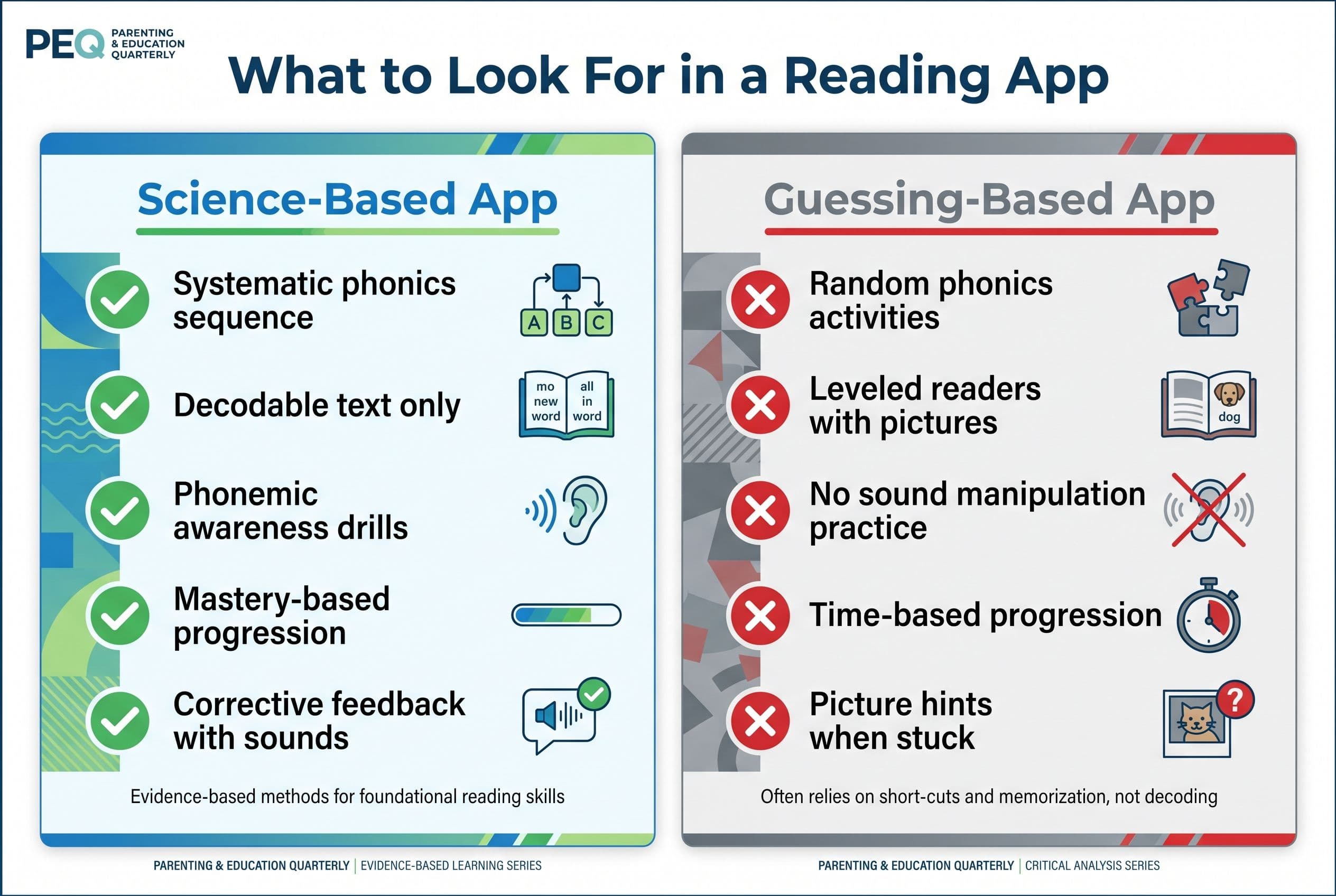
1. Systematic Synthetic Phonics — Not Random Phonics
The National Reading Panel report from 2000 — the one Congress commissioned — found that systematic phonics instruction produces significant benefits for reading accuracy and comprehension, especially for kids who are struggling.
The key word is systematic. That means phonics taught in a specific, sequential order — short vowels before long vowels, single consonants before blends, blends before digraphs. Not random "phonics activities" sprinkled into a digital storybook.
The Clackmannanshire study out of Scotland (Johnston & Watson, 2005) tracked kids for 7 years and found that children taught with synthetic phonics outperformed those taught with analytic phonics by 3.5 years in reading and spelling by age 11. Seven years of data. That's not a fluke.
2. Decodable Text — Not Leveled Readers
If the app uses leveled readers (Fountas & Pinnell style), run. I'm not kidding. Leveled readers encourage guessing from context and pictures. They mix in words the child hasn't been taught to decode, which trains the brain to skip, guess, and memorize.
A good app uses decodable text — stories built from the letter-sound patterns the child has already mastered. If your kid just learned the /sh/ digraph, the story should be full of "ship," "shop," "shed," and "fish" — not the word "ocean" because the topic is water.
3. Explicit Phonemic Awareness Work
Here's the thing most apps miss entirely. Phonemic awareness — the ability to hear, isolate, and manipulate individual sounds in spoken words — is one of the strongest early predictors of word-reading success, and a common hidden reason kids stay stuck. It supports orthographic mapping, which is the process that makes word recognition automatic. Without it, decoding stays slow and labored no matter how many letter sounds your kid has memorized.
Linnea Ehri's phases of word reading development (from her 2005 meta-analysis) show that kids can't move into the "full alphabetic" phase — where they actually decode systematically — until they can segment and blend individual phonemes. Your struggling 3rd grader might know their letter sounds. But can they hear the difference between /ship/ and /chip/? Can they delete the /s/ from "splint" and tell you the remaining word is "plint"?
This is exactly what Kilpatrick's PAST (Phonological Awareness Screening Test) checks. It takes about 5 minutes. You can administer it yourself at home. And it'll tell you exactly where the phonological breakdown is.
If an app doesn't work on phonemic awareness, it's missing the foundation entirely.
4. Mastery-Based Progression — Not Time-Based
Your kid shouldn't "move on" because they spent 15 minutes on a lesson. They should move on because they've demonstrated mastery. That means 90%+ accuracy on a skill before the app introduces the next one.
This is how the Wilson Reading System works — 12 steps, each one mastered before moving on. It's how Orton-Gillingham works. It's how UFLI Foundations works. And it's how a good app should work.
The Best Reading App for 3rd Graders Who Are Behind
OK, so which app actually meets all these criteria?
I've looked at a lot of them. Here's my honest take.
Teach Your Kid to Read
This is the app I built with my co-founder because nothing else on the market did what the research says works.
Teach Your Kid to Read is built on Orton-Gillingham principles and systematic synthetic phonics. Here's what that means in practice:
- Sequential phonics instruction — letter sounds, blending, digraphs, vowel teams, r-controlled vowels, diphthongs — all taught in the order the brain needs them
- Decodable text at every level — no guessing from pictures, no context clues, no three-cueing nonsense
- Built-in phonemic awareness drills — segmenting, blending, and manipulation exercises woven into every lesson
- Mastery-based progression — your child doesn't move forward until they've nailed the current skill
- Progress tracking for parents — you can see exactly where your child is, what they've mastered, and what's giving them trouble
Real talk — I designed this for my own kids. My oldest two learned to read with systematic phonics instruction, and my 4-year-old is working through CVC words right now at our kitchen table. When I couldn't find an app that matched the rigor of what I was doing at home, I helped build one.
For a 3rd grader who's behind, the app diagnoses where the gaps are and starts there. If your 8-year-old doesn't have solid short vowel decoding, the app doesn't pretend they do. It goes back, fills the gap, and builds forward. No ego. No shortcuts.
Tiger Rule: No Guessing. Every word in our app must be sounded out. If a child taps incorrectly, they don't get a gentle "try again!" with a picture hint. They get explicit corrective feedback — the sounds, the blending, the word. Then they try again.
What About Other Apps?
Let me be straight with you.
- Reading Eggs / Reading Eggspress: Heavy on games and rewards. Light on systematic phonics. Kids can end up enjoying the animation more than the reading. That's a problem.
- Homer: Better phonics foundation than most, but still uses leveled readers and context-based strategies for older kids. Fine for a pre-reader, not intensive enough for a behind 3rd grader.
- Raz-Kids: Leveled readers. Full stop. It's Fountas & Pinnell in an app. Your struggling 3rd grader doesn't need more leveled readers — that's probably what failed them.
- Lexia Core5: This one's actually science-based and used in schools. If your child's school has a Lexia license, use it. But it's not available for individual parent purchase at a reasonable price, and the interface is... not what I'd call engaging for a frustrated 8-year-old.
Bottom line: if the app doesn't teach systematic synthetic phonics with decodable text and mastery-based progression, it's a digital babysitter with a reading costume on.
How to Know If Your 3rd Grader Is Actually Behind
Before you download anything, you need to know exactly where your child stands. Not "I think they're a little behind." Not "the teacher said they're working on it." Specific. Measurable. Data.
Here's how to get it:
Step 1: Ask the School for DIBELS or AIMSweb Scores
Most schools that use evidence-based screening administer DIBELS (Dynamic Indicators of Basic Early Literacy Skills). Ask for your child's most recent scores — specifically:
- Oral Reading Fluency (ORF): Benchmarks vary by DIBELS edition and time of year, but as a rough ballpark, many districts set the beginning-of-3rd-grade goal around 77 correct words per minute and the end-of-year goal at 104+. Ask the school for your child's specific benchmark goal line and percentile — they'll have it broken out by season (BOY/MOY/EOY).
- DAZE (Maze): A comprehension measure. A typical end-of-3rd-grade benchmark is around 14+, but again, ask for your child's percentile relative to their district's norms.
If your child is below the 20th percentile on either measure, they need intervention. Not "enrichment." Not "extra reading time." Intervention.
Step 2: Administer Kilpatrick's PAST at Home
David Kilpatrick's Phonological Awareness Screening Test is free, takes 5 minutes, and tells you whether your child has the phonemic awareness foundation required for fluent reading. You can find it in his book Equipped for Reading Success or through his published materials.
Here's the kind of task it includes: "Say 'splint' without the /l/." The answer is "spint." Yes, it's a nonsense word — that's the point. This task is about sounds, not meaning. Another example: "Say 'stop' without the /t/." The answer is "sop." If your 3rd grader can't do tasks like these, they have a phonological processing gap that no amount of reading practice will fix. They need targeted phonemic awareness work first.
Step 3: Do the "Nonsense Word" Test
Give your child a made-up word like "blim" or "flonk" or "streb." Can they read it?
If they can, their decoding is functional — they might need fluency and comprehension work.
If they can't — if they stare at "blim" and say "...blue?" — their decoding is broken. That's where you start.
Your 30-Day Action Plan (Start Tonight)
I don't do vague advice. Here's exactly what to do.
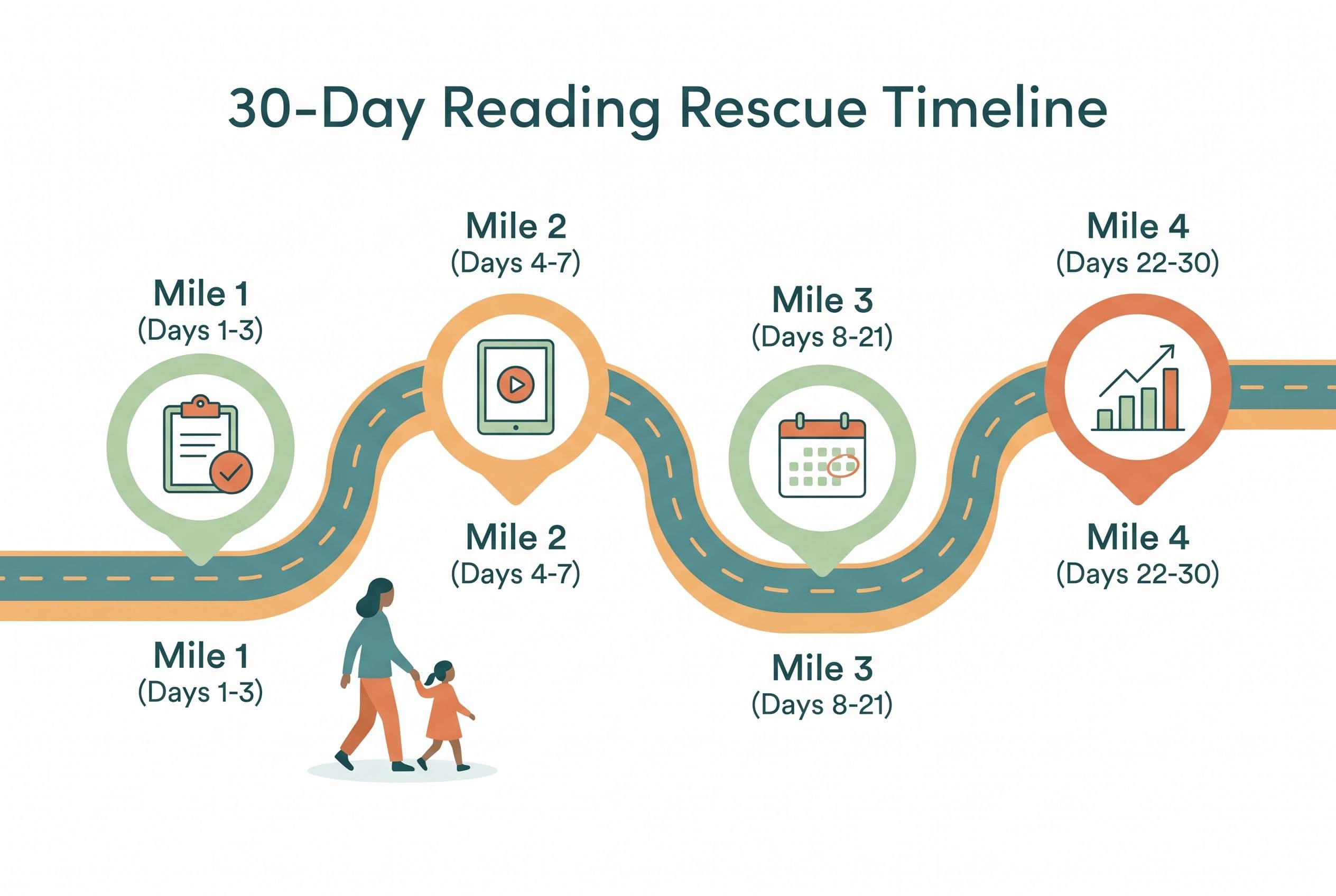
Days 1-3: Assess
- Request DIBELS scores from your child's school
- Administer the PAST at home
- Try the nonsense word test (5 words is enough: blim, streb, flonk, crad, thump)
- Write down what you find — this is your baseline
Days 4-7: Start the App
- Download Teach Your Kid to Read
- Let the diagnostic assessment place your child at the right level (it will probably be lower than you expect — that's OK)
- Commit to 15-20 minutes per day. Every day. We Never Skip. Birthdays. Vacation. Saturday morning cartoons can wait.
Days 8-21: Build the Habit
- Same time every day — I do phonics with my kids right after breakfast, before the day gets away from us
- No screens until the lesson is done (this is the tiger mom part — I don't apologize for it)
- Track progress weekly — is your child's accuracy improving? Are they moving through the levels?
Days 22-30: Re-assess
- Give the nonsense word test again. Same 5 words plus 5 new ones.
- Compare to your baseline
- If you see improvement — even small improvement — you've found the right tool. Keep going.
- If you see zero change, your child may need in-person Orton-Gillingham tutoring. Look for a practitioner certified through the International Dyslexia Association or trained in Barton Reading & Spelling.
But What About the "Fun" Problem?
I hear this constantly: "But my kid won't do it if it's not fun!"
Look, I get it. Your 8-year-old has been playing Roblox and watching YouTube shorts. Phonics drills aren't going to compete with that dopamine hit. I know. I have a 10-year-old and a 7-year-old. I live in this reality.
But here's what I've learned: mastery is its own reward. When my oldest — who is now 10 and reads above grade level — first started sounding out words and getting them right? The look on her face wasn't "this is fun like a video game." It was "I can DO this." That's a different kind of joy. A deeper one.
The "fun" trap is how we ended up with apps that are 80% animation and 20% learning. Your child doesn't need another game. They need to learn to read. And once they can read — really read, fluently and confidently — everything becomes more fun. Books. Science experiments with written instructions. Text messages from grandma. Video game dialogue they can actually follow.
Reading is the fun. You just have to get them there first.
And honestly? 15 minutes a day of structured phonics isn't torture. It's 15 minutes. My 4-year-old does it without complaints because it's just what we do. It's like brushing teeth. Non-negotiable. Not up for debate.
The Policy Landscape Is Changing — But Your Kid Can't Wait
Over 40 states have now passed Science of Reading legislation since 2019. Mississippi's Literacy-Based Promotion Act of 2013 took them from 49th to 21st in national reading scores in just 6 years. Ohio has a Third Grade Reading Guarantee that retains students who don't pass the reading test. Florida's 3rd grade retention policy has been in place for over a decade.
These laws are important. They're changing how schools teach reading, moving away from the Balanced Literacy and whole-language methods that failed a generation of kids.
But policy moves slowly. Curriculum adoption moves slowly. Teacher training moves slowly.
Your child is in 3rd grade right now. They're behind right now. You can't wait for their school to finish implementing a new curriculum. You can't wait for their teacher to complete Science of Reading training. You can't wait for the district to buy new decodable readers.
You have to act now. At home. Every day. With the right tools.
That's not a criticism of teachers — most of them were taught the wrong methods in education school, as Louisa Moats documented in her 1999 paper Teaching Reading IS Rocket Science for the American Federation of Teachers. Your child's teacher probably wants to help. They might just not have the right training yet.
So you do it. You fill the gap. You find the best reading app for your 3rd grader and you use it like the intervention tool it is — not as a "maybe this will help" Hail Mary, but as a structured, daily, non-negotiable part of your child's routine.
Frequently Asked Questions
How long does it take for a 3rd grader to catch up in reading?
It depends on how far behind they are and what's causing the gap. A child with solid phonemic awareness who just needs decoding practice might make significant gains in 3-6 months of daily, systematic phonics instruction. A child with underlying phonological processing weaknesses might need 12-18 months of intensive work — potentially with an Orton-Gillingham trained tutor in addition to app-based practice. The research is clear that early, intensive intervention works better than "wait and see." Every month you delay makes the gap harder to close.
Is my 3rd grader behind in reading? What are the signs?
The most reliable indicator is a formal assessment like DIBELS Oral Reading Fluency — by the start of 3rd grade, many districts set the benchmark around 77 correct words per minute on grade-level text (though ask your school for the exact goal). But you can also watch for these red flags: your child avoids reading, guesses at words based on first letters or pictures, can't read nonsense words (like "blim" or "streb"), reads very slowly and laboriously, or struggles to retell what they just read. If you see two or more of these signs, don't wait — assess and intervene.
Can a reading app replace a reading tutor for a struggling 3rd grader?
A high-quality, phonics-based app like Teach Your Kid to Read can absolutely close the gap for many kids — especially those whose main issue is that they were never taught systematic phonics in the first place. But if your child has a diagnosed or suspected reading disability like dyslexia, an app should be one part of a broader plan that includes a certified Orton-Gillingham or Wilson Reading System tutor. Use Kilpatrick's PAST test to check for phonological processing deficits. If those are present, get a professional evaluation through your school or an IDA-certified diagnostician.
Are free reading apps effective for 3rd graders?
Most free apps make their money through ads, data collection, or upsells — and they cut corners on instructional design. The ones with the prettiest graphics often have the weakest phonics. That said, cost doesn't guarantee quality either. The question to ask isn't "is it free?" but "does it use systematic synthetic phonics, decodable text, and mastery-based progression?" Teach Your Kid to Read offers a free trial so you can evaluate whether it works before committing.
Should I use a reading app alongside what the school is doing?
Absolutely — as long as the app uses evidence-based methods. If your child's school is still using Balanced Literacy or leveled readers, the app might actually be the only systematic phonics instruction your child gets. If the school has switched to a Science of Reading curriculum (programs like UFLI Foundations or Fundations), the app becomes reinforcement and extra practice. Either way, 15-20 minutes of structured phonics at home every day makes a measurable difference. The Simple View of Reading (Gough & Tunmer, 1986) tells us that reading comprehension = decoding × language comprehension. The app builds the decoding side. You build the language side by reading aloud to your child, having conversations, and building vocabulary.
Part of these guides

Xia Brody
Co-Founder, Teach Your Kid to Read
Mom of 4 who has successfully taught her kids to read. Currently in the trenches with her 4-year-old while her two oldest (10 and 7) devour books on their own. Passionate about phonics-based methods and building a lifelong love of reading.
Related Articles
Is My 2nd Grader Behind in Reading? 9 Signs
Wondering if your 2nd grader is behind in reading? Here are the real warning signs, what 2nd graders should be able to do, and what to do next if your child is guessing, slow, or stuck.
Read More →
Best Reading App for 4th Graders Behind + Free Plan
Your 9-year-old is guessing at words and hiding books in his backpack. Most reading apps are built for 5-year-olds and will waste his time. Here's what a real 4th grade reading intervention app has to do — and the exact daily plan I use.
Read More →
My 8 Year Old Can't Read: Best Apps + Rescue Plan
If your 8-year-old is still guessing at words, this is not a wait-and-see moment. Here’s my no-nonsense app comparison and rescue plan for getting real phonics intervention started now.
Read More →