Reading Readiness Quiz for 4-Year-Olds: 12 Signs
What You'll Learn
- The 12 signs that tell you if your 4-year-old is actually ready to start reading — not fake “memorized the book” reading
- The one mistake parents make when a child gets stuck on a word (it drives me bananas)
- How to check letter sounds and phonemic awareness in 2 minutes at your kitchen table
- What to do if your child knows the alphabet song but still can’t blend m-a-t into mat
Reality Check: Here’s the 12-Point Reading Readiness Quiz
Your 4-year-old doesn’t need to read chapter books. Calm down, tiger parent.
But your child does need the foundation: attention, language, letter sounds, phonemic awareness, and the ability to play with sounds in words. That’s 4 year old reading readiness. Not guessing from pictures. Not reciting a memorized bedtime book like a tiny stage actor.
Here’s my reading readiness quiz for 4-year-olds. It’s an informal observation checklist, not a medical diagnosis, not a school evaluation, and not a magic crystal ball. Give 1 point for each “yes,” then use the score to choose what to practice next.
The 12 Reading Readiness Signs
-
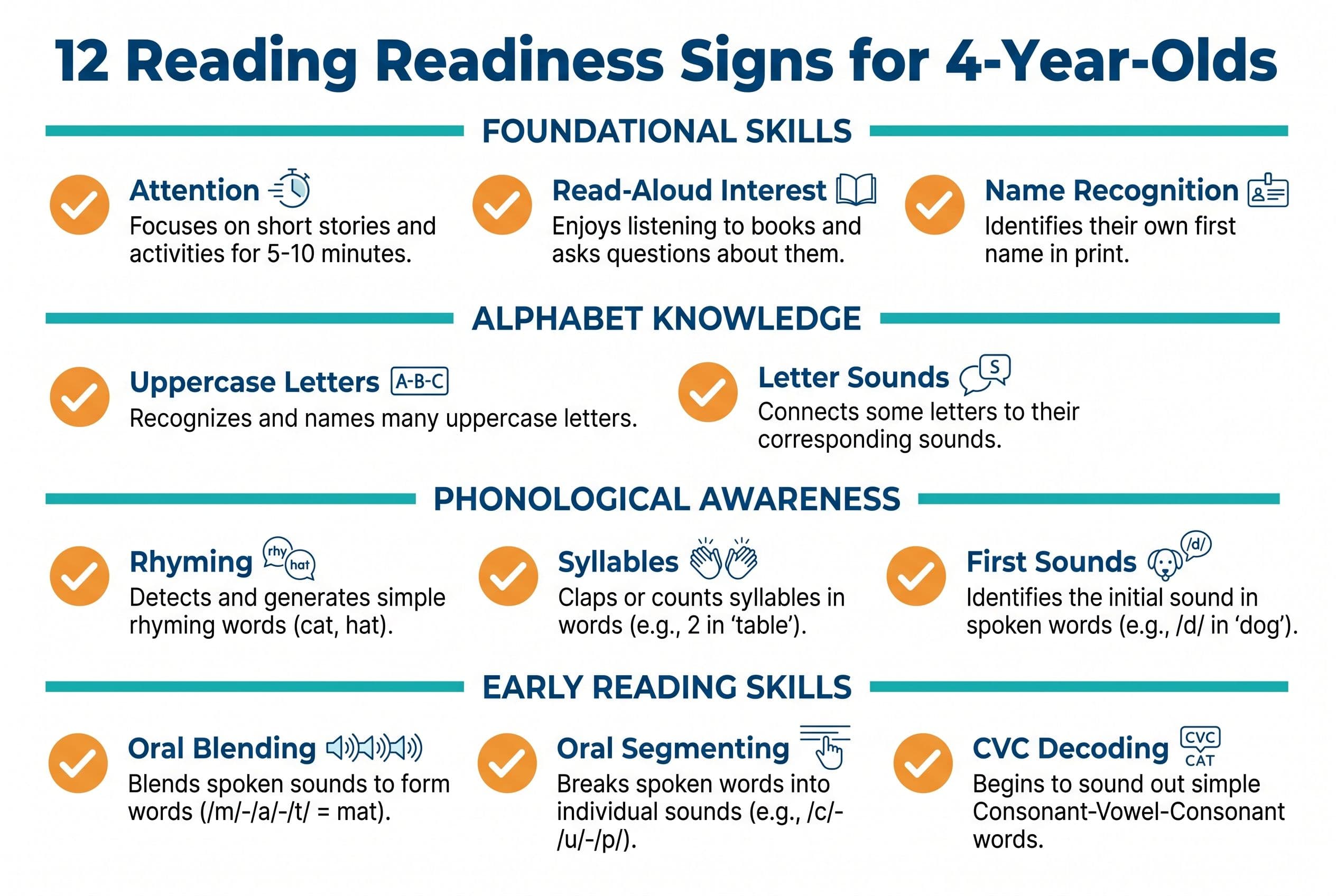
Your child can sit for a short lesson for 5–7 minutes.
Not 45 minutes. Not a TED Talk. Just enough time to do a short phonics drill without licking the table. -
Your child enjoys being read to most days.
They don’t have to sit like a statue, but they should care about stories, pictures, characters, or what happens next. -
Your child can recognize their own name in print.
This shows print carries meaning. It’s not reading yet, but it’s a nice little on-ramp. -
Your child knows at least 10–15 uppercase letters.
Letter names help, but don’t worship them. Letter sounds matter more for decoding. -
Your child knows at least 8–10 letter sounds.
If you point to m and they say /m/, that’s gold. If they only say “em,” keep drilling sounds. -
Your child can hear rhymes.
Ask, “Do cat and hat rhyme?” If they grin and say yes, good. If they say “banana,” we’ve got work to do. -
Your child can clap syllables.
“Dinosaur” has three claps. “Table” has two. This builds sound awareness without worksheets. -
Your child can hear the first sound in a word.
“What sound starts sun?” You want /s/, not “yellow.” -
Your child can orally blend simple sounds.
You say /m/ /a/ /t/. They say “mat.” This is a big one. Huge. -
Your child can orally segment simple words.
You say “dog.” They can stretch it into /d/ /o/ /g/. This takes practice. -
Your child tracks print left to right.
They know we read across the page in English. No random finger hopping. -
Your child tries to sound out simple CVC words.
CVC means consonant-vowel-consonant, like sat, pin, mud. If they can blend even a few, you’re in business.
Score Guide
- 10–12 yes answers: Start a short, systematic phonics routine now.
- 7–9 yes answers: Your child is close. Build letter sounds and phonemic awareness daily.
- 4–6 yes answers: Don’t panic, but don’t “wait and see.” Work on the foundation and start tiny, explicit sound-letter practice where your child can succeed.
- 0–3 yes answers: Focus on oral language, read-alouds, rhyming, syllables, attention, and a few playful letter sounds first.
And yes, if you’re asking, “Is my 4 year old ready to read?” this quiz gives you a real starting point. Not a vibe. Not a teacher shrug. A place to begin.
What To Do If They’re Not There Yet
If your child scores under 10, don’t spiral. A 4-year-old isn’t “behind forever” because they can’t read ship yet. But you also don’t get to toss the problem into the magical “they’ll catch up someday” basket. That basket is where literacy problems go to grow teeth.
Do a quick check at home. Ask for 5 letter sounds, 3 rhymes, and 3 oral blends like /s/ /u/ /n/. Or use take the 2-minute reading check if you want a fast read on whether this is normal preschool wiggle or a real gap.
Usually, the gap means one of three things: your child doesn’t know enough letter sounds, your child can’t hear sounds inside words yet, or your child has already started guessing from pictures instead of decoding. That last one? No. We don’t do that in my house. Tiger Rule: No Guessing. Sound it out.
If your child is ready or almost ready, use start lesson one free. Lesson one is free with no card and nothing to cancel; from lesson two the whole program is a 7-day free trial, then US$9.95 a month.
Why Reading Readiness at Age 4 Matters
Look, I’m not saying every 4-year-old must read fluently. My own 4-year-old was at the kitchen table last Tuesday tapping sounds with a cracker in one hand and a toy dinosaur in the other. That’s preschool. It’s messy.
But early reading skills don’t appear out of nowhere at kindergarten (age 5). Kids build them through daily exposure to sounds, print, books, and direct teaching. The foundation starts before formal school.
The National Reading Panel report from 2000 — the one commissioned by the US Congress — found that systematic phonics instruction gives children significant benefits in learning to read. That doesn’t mean “shove a workbook at a toddler.” It means teach the code clearly, in order, without asking kids to guess.
Stanislas Dehaene’s Reading in the Brain (2009) says the quiet part out loud: the brain doesn’t naturally learn to read. We evolved to speak. We did not evolve to decode squiggles on a page. The brain has to build a reading circuit through practice.
So when parents ask me about reading readiness signs, I’m listening for the code skills:
- Can the child hear sounds?
- Can the child link sounds to letters?
- Can the child blend sounds into words?
- Can the child stop guessing and look through the word?
That’s the real deal.
Tiger Truth: Waiting Can Get Expensive Fast
Here’s the scary part. A child who can’t decode early often becomes the kid who hates reading, avoids schoolwork, melts down over homework, and starts believing, “I’m just not smart.”
That one breaks my heart.
US students on the 2022 NAEP / The Nation’s Report Card showed only 33% of 4th graders (ages 9–10) reading at or above proficient. That’s not a tiny problem. That’s a national five-alarm fire.
Donald Hernandez’s 2011 report, Double Jeopardy: How Third-Grade Reading Skills and Poverty Influence High School Graduation, found that children who don’t read proficiently by the end of 3rd grade (ages 8–9) are four times more likely to leave high school without a diploma than proficient readers. That’s an association, not a personal prophecy for your preschooler. Nobody gets to look at one 4-year-old and predict doom. But the 3rd Grade Cliff is real. I know people hate the phrase. I hate the reality more.
And when schools finally intervene late, families can end up paying thousands a year for private reading remediation, and some intensive tutoring or center-based programs can hit US$10,000+ depending on location, frequency, and dosage. Wilson Reading System, Barton Reading & Spelling, Lindamood-Bell, Orton-Gillingham tutoring — these can help, but they’re not cheap. Insurance usually won’t swoop in with a cape.
This is why I don’t like “wait and see.” Wait for what? The child to fail loudly enough that adults finally move?
Nope.
The Playground Story That Still Bugs Me
I was at a playground in Raleigh when another mom told me her child’s school had switched from Lucy Calkins to a Science of Reading curriculum because of North Carolina’s SB 387 — the Excellent Public Schools Act, a US state law. She looked confused and a little annoyed.
“He was doing fine before,” she said.
I asked if her son could read the word splint. He was in second grade (ages 7–8). He couldn’t.
So there we were, sitting on a playground bench while my kids climbed like feral squirrels, and I spent 20 minutes explaining why schools were changing course: Emily Hanford’s APM Reports investigation Sold a Story, NAEP reading data, and Dehaene’s neuroscience showing that reading doesn’t develop naturally like speech.
That night she watched the podcast. At 11 p.m., she texted me: “I had no idea. Why didn’t anyone tell us this sooner?”
That’s the kicker.
A lot of parents don’t know because the old system made guessing look like reading. A child looked at a picture of a boat and said “ship,” and adults smiled. But ship and boat don’t have the same letters, the same sounds, or the same spelling pattern. That isn’t reading. That’s guessing with confidence.
And confidence without skill is a trap.
What Counts as Real 4 Year Old Reading Readiness?
Real 4 year old reading readiness means your child has the pre-reading skills to start learning the alphabetic code. The alphabetic code is simple in theory: letters represent sounds. But kids need explicit teaching to use it.
Here’s what I care about most.
Letter Sounds Beat Letter Names
The alphabet song is cute. It also tricks parents.
A child can sing “L-M-N-O-P” like one long noodle word and still have no idea that m says /m/. For early reading, letter sounds do the heavy lifting.
Start with common, easy-to-teach sounds:
- m /m/
- s /s/
- f /f/
- a /ă/
- t /t/
- p /p/
Avoid adding “uh” after consonants. Say /m/, not “muh.” Say /t/, not “tuh.” If your child blends “muh-a-tuh,” they’ll get “muhatuh,” and then everyone needs a snack.
Phonological Awareness Comes Before Phonics
Phonological awareness means your child can hear and play with sound parts in spoken words. Rhyming and syllables count.
Phonemic awareness is smaller. It means hearing individual sounds, or phonemes. For example, cat has /k/ /ă/ /t/.
Now, don’t turn this into another weird gatekeeping rule. Sound awareness and phonics can grow together. You can practice oral blending for 30 seconds and then show how m-a-t blends into mat. The point is not “master every rhyme before seeing print.” The point is: don’t skip the sound work and then wonder why blending looks like a circus.
David Kilpatrick’s Equipped for Reading Success (2016) explains why phonemic awareness matters so much for orthographic mapping — the process that lets kids store words for instant recognition. That’s how a child stops sounding out sat forever and starts recognizing it quickly.
If you want a named tool, the PAST test — Kilpatrick’s Phonological Awareness Screening Test — takes about 5 minutes and shows where the sound breakdown sits. For school screening, DIBELS also measures early skills like letter naming, phonemic segmentation, and nonsense word fluency.
Blending Is the Bridge
Blending turns sounds into words. This is where many kids wobble.
You say: /m/ /a/ /t/
Child says: “mat.”
If your child says “table,” they’re guessing. If they say each sound but can’t push them together, they need more blending practice — oral blending and letter-based blending with sounds they already know.
Try this in the car:
- “Touch your /n/ /ō/ /z/.”
- “Find your /sh/ /oo/.”
- “Can you say /s/ /u/ /n/ fast?”
No worksheet. No drama. Just reps.
Preschool Reading Checklist: What I’d Drill for 10 Minutes a Day
You don’t need a Pinterest command center. You need a short routine and the spine to repeat it.
Here’s my preschool reading checklist for a 4-year-old who’s ready or close.
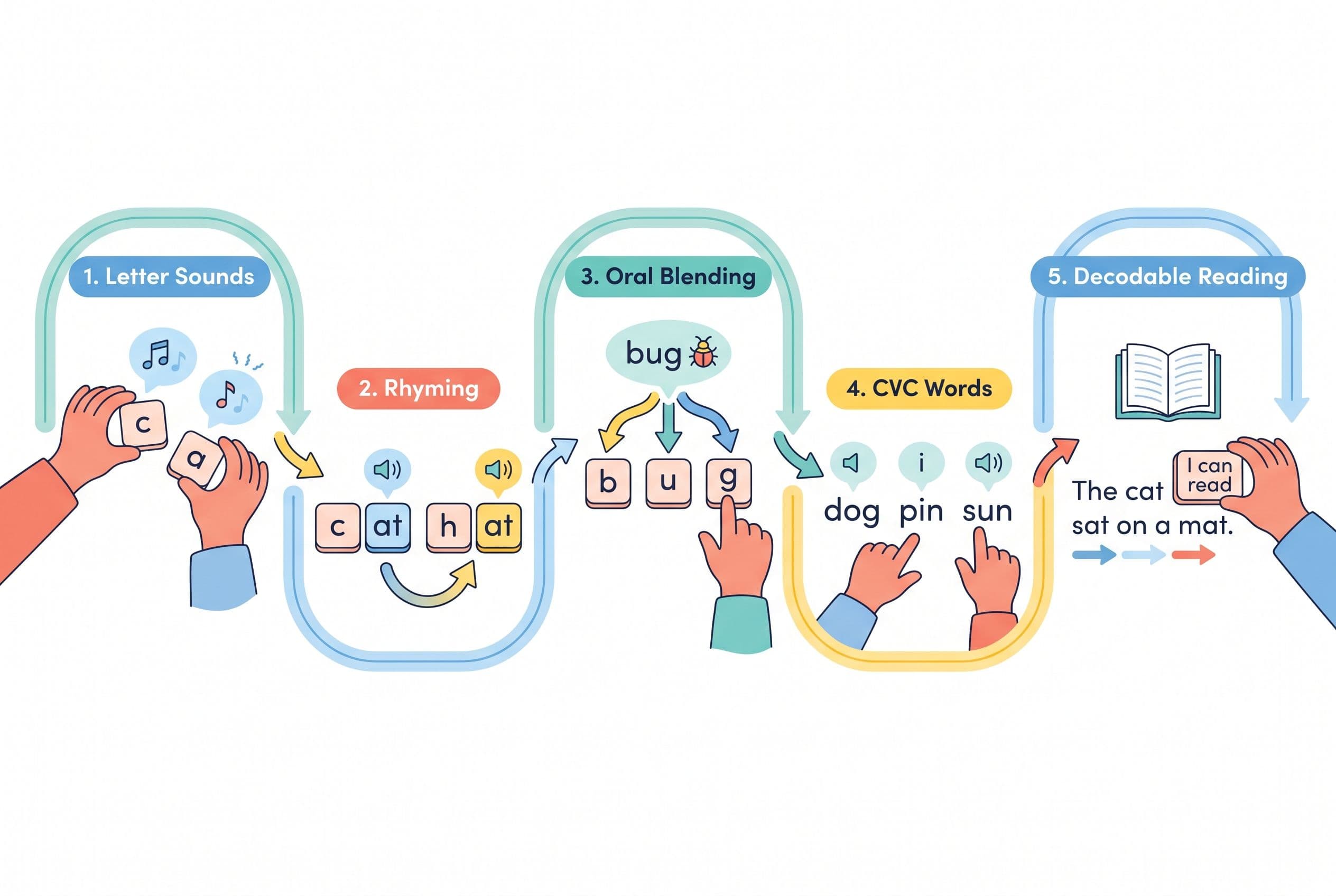
Daily 10-Minute Routine
-
Review 3–5 letter sounds
Show the letter. Child says the sound. Keep it snappy. -
Do 2 minutes of sound games
Ask for first sounds, rhymes, oral blending, or oral segmenting. -
Blend 3–5 CVC words
Use words like sat, map, pin, mud, fog. -
Read one tiny decodable page
Bob Books, UFLI Foundations decodables, or Flyleaf-style controlled text work well. -
End with a real read-aloud
You read the rich story. They enjoy the language. Don’t make every book a lesson.
That’s it. Ten minutes. We Never Skip.
Yes, birthdays too. Christmas too. Vacation too. You can drill /m/ and /s/ in a hotel room while someone’s eating cereal from a paper cup. Ask me how I know.
The Solution: Use Systematic Synthetic Phonics
Teach Your Kid to Read uses systematic synthetic phonics with Orton-Gillingham principles: clear letter-sound instruction, blending, review, and no guessing from pictures. We teach children to look at the letters and say the sounds in order.
OG principles here means explicit, sequential, cumulative phonics + lots of review — not that you need a private OG tutor to start.
That sounds basic because it is. Basic works.
Whole Language and Balanced Literacy often trained kids to use “three-cueing”: look at the picture, think what makes sense, check the first letter. I can’t stress this enough — that teaches guessing. It teaches children to sample the word instead of reading the word.
Linnea Ehri’s 2005 work on phases of word reading development shows that children move from partial cues to full alphabetic reading as they map letters to sounds. Translation for tired parents: your child needs to connect the sounds in the word to the letters on the page. There’s no shortcut.
Teach Your Kid to Read keeps it short enough for real families. Lesson one is free with no card and nothing to cancel; from lesson two the whole program is a 7-day free trial, then US$9.95 a month.
Action Step: Give the 12-Sign Quiz Today
Do this today. Not next month. Not after you reorganize the playroom.
-
Print or copy the 12 signs above.
Put a check beside every skill your child can do comfortably. -
Test 5 letter sounds.
Use m, s, a, t, p. Ask for sounds, not names. -
Ask 3 rhyming questions.
“Do cat and hat rhyme?” “Do dog and sun rhyme?” “What rhymes with bee?” -
Try 3 oral blends.
Say /m/ /a/ /t/, /s/ /u/ /n/, and /p/ /i/ /g/. See if your child can say the word. -
Try 2 CVC words in print.
Write sat and map. Ask your child to sound them out left to right. -
Score it honestly.
Don’t give credit for guessing. Don’t give credit for memorizing. Count skills. -
Pick the next step.
If your child scores 10–12, begin phonics. If your child scores 7–9, drill letter sounds and phonemic awareness for two weeks. If your child scores under 7, start with oral sound games, read-alouds, and a few playful letter sounds every day. -
Repeat in 30 days.
Progress at age 4 can jump fast with daily practice. But if nothing moves, get curious and use a screen like PAST or ask about DIBELS-style early literacy checks.
If you want a guided next step, start with the app and keep lessons short, direct, and consistent.
Common Mistakes Parents Make
Mistake 1: Letting the Child Guess from Pictures
Imagine Lily sees a picture of a dog and the word says puppy. She says “dog.”
Cute? Sure.
Reading? No.
Say, “Check the letters. What sound comes first?” Make the eyes go back to print. Every time.
Mistake 2: Teaching Too Many Letter Sounds at Once
Don’t throw 26 sounds at a 4-year-old and act shocked when they melt. Teach a small set. Review daily. Add slowly.
Mastery beats exposure.
Mistake 3: Confusing Readiness with Pressure
You can be serious without being mean. I’m a tiger mom, not a cartoon villain.
If your 4-year-old cries every time you show a letter card, shorten the lesson. Use movement. Use magnetic letters. Use snack-sized drills.
But don’t quit for six months because one Tuesday got dramatic.
Mistake 4: Depending on Apps That Entertain More Than Teach
A lot of reading apps are basically digital confetti. Tap the frog. Win a badge. Hear a song. Learn almost nothing.
You want explicit phonics, blending, review, and decodable practice. Fun is fine. Fun cannot replace skill.
Quick Benchmarks by Age
These are general, not medical rules. Kids develop differently, and speech-language delays, hearing issues, dyslexia risk, ADHD, and vision problems can affect the timeline.
Still, here’s what I like to see.
- Age 3: enjoys read-alouds, notices print, hears some rhymes, knows some letters
- Age 4: knows many letter sounds, hears first sounds, blends simple oral words, starts CVC decoding
- Kindergarten (age 5): reads simple decodable words and short sentences with taught patterns
- 1st grade (ages 6–7): grows fluency, learns long vowels, digraphs, more spelling patterns
- 2nd grade (ages 7–8): reads longer decodable and controlled texts, builds fluency and comprehension
If your child is 4 and not ready, you’re not doomed. But you do need a plan.
Bottom line: reading readiness signs tell you where to start. They don’t give you permission to ignore the foundation.
Use the quiz, trust the data, and teach the code.
If your child is ready to begin, lesson one is free with no card and nothing to cancel; from lesson two the whole program is a 7-day free trial, then US$9.95 a month.
FAQ
Is my 4 year old ready to read if they know the alphabet?
Maybe, but the alphabet alone isn’t enough. Your child needs letter sounds, phonemic awareness, and early blending. A child can sing the alphabet song and still struggle to read mat.
What are the most important reading readiness signs?
The big ones are letter sounds, rhyming, first-sound awareness, oral blending, and attention for short lessons. If your child can blend /s/ /a/ /t/ into sat, that’s a strong sign they’re ready for phonics.
Should I teach phonics to a 4-year-old?
Yes, if your child shows readiness. Keep lessons short, explicit, and playful without turning them into fluff. Five to ten minutes a day works better than one giant weekly lesson.
What if my 4-year-old guesses words from pictures?
Stop the habit early. Say, “Look at the letters. Say the sounds.” Guessing can look impressive at first, but it blocks real decoding.
When should I worry about reading readiness?
If your child can’t remember letter sounds after repeated practice, can’t hear rhymes, can’t blend oral sounds, or has a family history of dyslexia, don’t wait. Use a screener like PAST or ask a qualified reading specialist for help.
Part of these guides

Xia Brody
Co-Founder, Teach Your Kid to Read
Mom of 4 who has successfully taught her kids to read. Currently in the trenches with her 4-year-old while her two oldest (10 and 7) devour books on their own. Passionate about phonics-based methods and building a lifelong love of reading.
Related Articles
Best Reading App for a 4-Year-Old with Dyslexia Signs: My Top Pick
If your 4-year-old mixes up sounds, guesses from pictures, or avoids letters, don’t wait and see. Here’s my tiger-mom ranking of reading apps that help — and the ones I’d skip.
Read More →
Reading Readiness Checklist for 5-Year-Olds: Free Printable + Parent Guide
Is your 5-year-old ready to read? Most parents can't answer that question — because nobody gave them the right checklist. Here's the one I use with my own kids, backed by reading science, not wishful thinking.
Read More →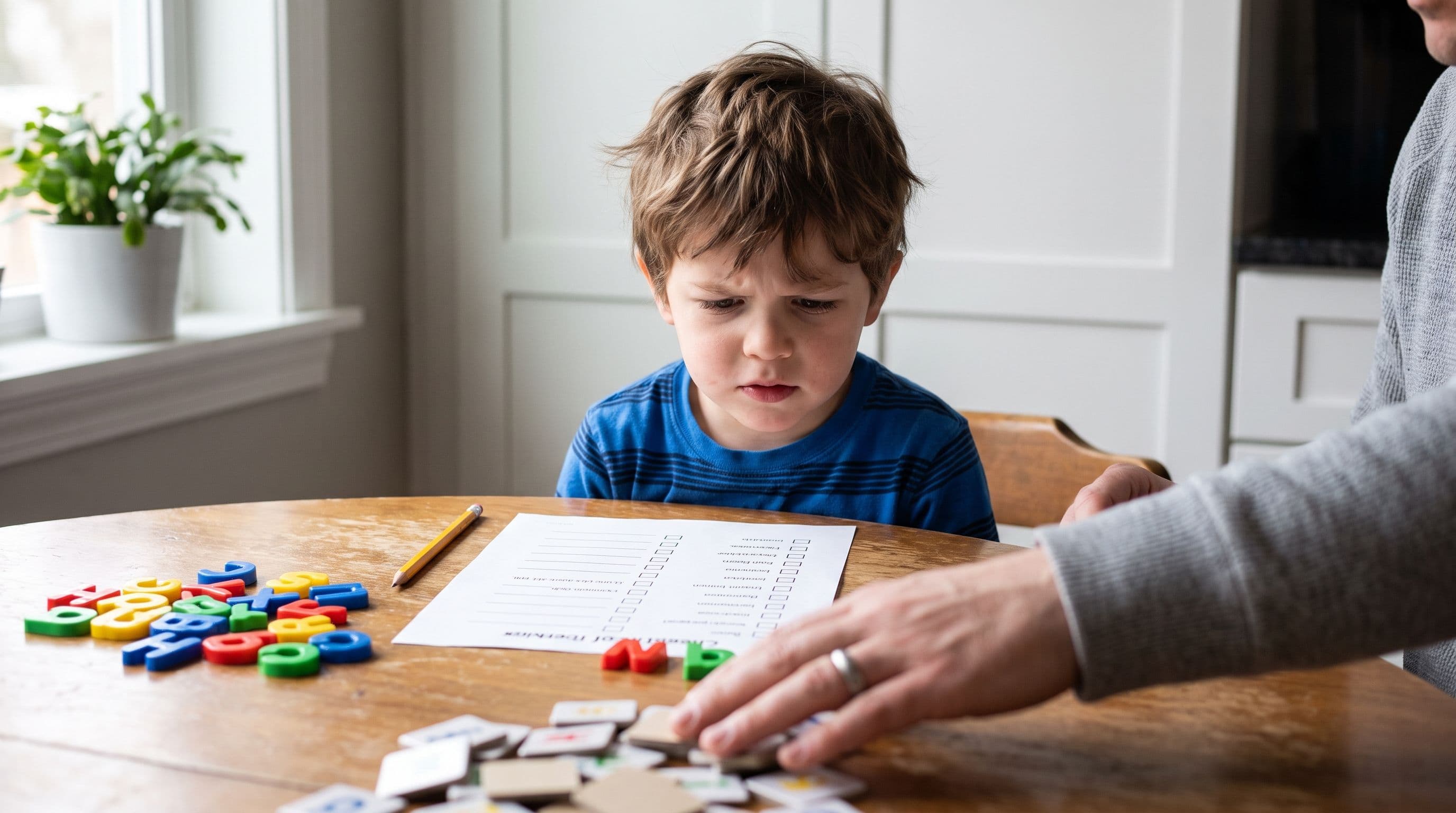
Reading Readiness Checklist for Kindergarten: Free PDF
Wondering if your child is ready to read in kindergarten? Here’s the no-fluff reading readiness checklist I use at my own kitchen table, plus what to do if your child isn’t there yet.
Read More →