6 Best Reading Apps for 7-Year-Olds with Speech Delay, Ranked
The best reading apps for 7-year-olds with speech delay don't make a microphone the judge of understanding.
If speech takes extra effort, reading practice needs to separate understanding print from producing clear speech. Otherwise, a child can work out the word and still feel like they've failed. That's a lousy lesson.
What You'll Learn
- Teach Your Kid to Read ranks first for adult-led decoding practice: it doesn't use speech recognition, and an adult checks the child's responses.
- Reading.com, Nessy, Reading Eggs, Teach Your Monster to Read and Khan Academy Kids fill different needs; none replaces speech-language therapy.
- Speech errors and decoding errors aren't interchangeable. Ask your child's speech-language professional how to distinguish them.
- Start with the first uncertain letter-sound pattern, not an age label or a timed reading score.
Here's my reality check: “speech delay” doesn't describe one tidy learning profile. One seven-year-old understands complex stories but struggles to pronounce particular sounds. Another also needs help understanding language or identifying the sounds inside words.
I'm a homeschooling mom of four, ages 10, 7, 4 and 1, and I've taught my two oldest to read. My opinion? Choose the teaching task before choosing the animation. The best reading apps for 7-year-olds with speech delay need to fit the child's actual difficulty, not just their birthday.
The Verdict
We're a team of teachers, and this ranking is our teaching team's pick.
How we ranked
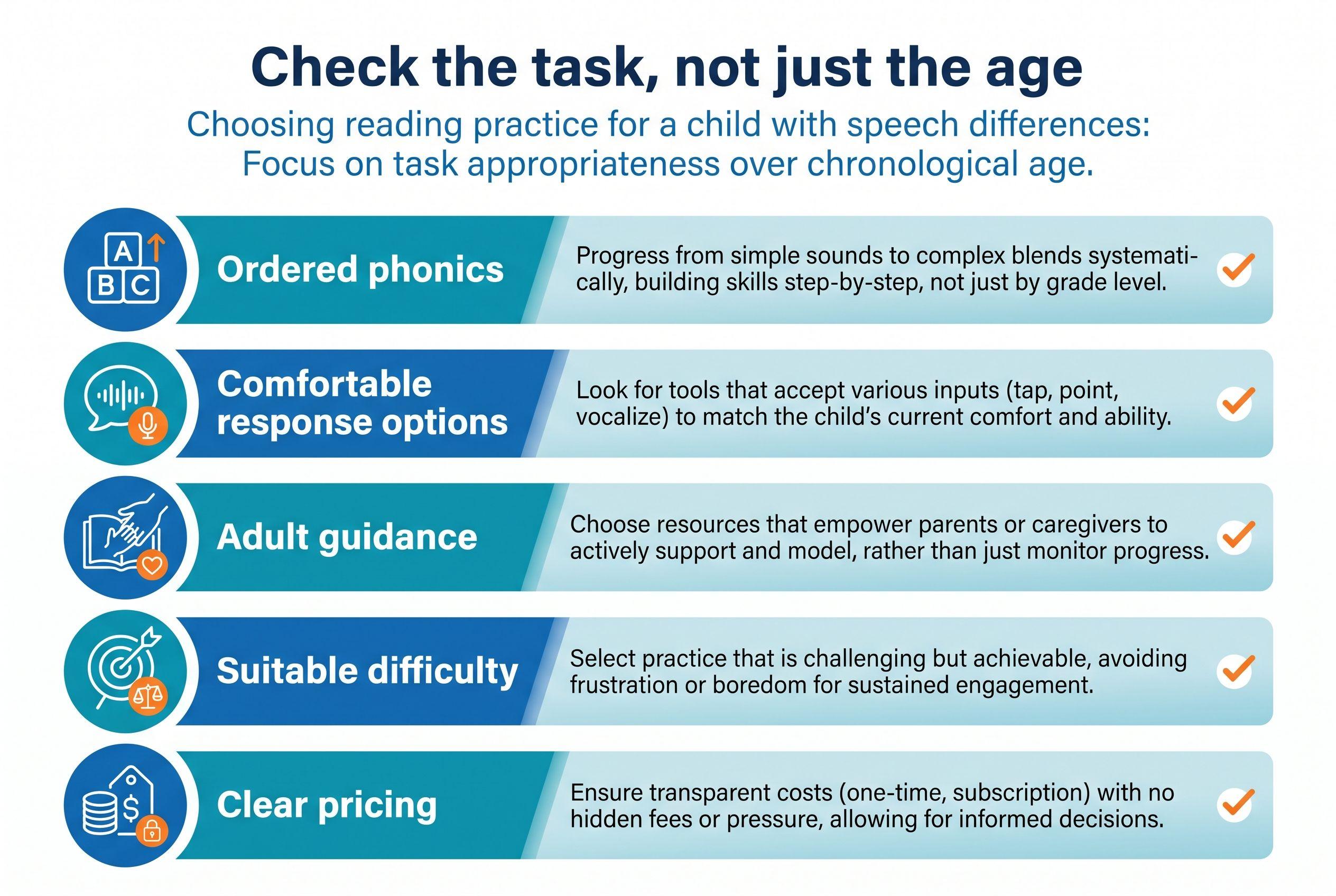
- Ordered phonics: a clear sequence helps parents find and teach missing skills.
- Response demands: speech differences shouldn't automatically block practice.
- Adult involvement: someone needs to distinguish pronunciation from decoding.
- Age and task fit: beginning material should teach a seven-year-old without overwhelming them.
- Cost clarity: families need to know what they're buying beyond the first activity.
| Rank and app | What it teaches or describes itself as teaching | Price / pricing model | Best-for age |
|---|---|---|---|
| 1. Teach Your Kid to Read | Step-by-step, parent-led phonics and decoding | Lesson one free, then 7-day trial, US$9.95/mo | My pick for a 7-year-old needing beginning decoding with an adult |
| 2. Reading.com | Describes its approach as parent-child reading instruction with phonics | Subscription: US$12.49/month (checked October 2026) | Stated ages 3–8 |
| 3. Nessy | Describes its reading and spelling instruction as structured support for struggling learners | Home subscription from US$15.50/month (checked October 2026) | Stated ages 6–11 |
| 4. Reading Eggs | Describes a reading suite covering phonics through comprehension | Subscription: US$13.99/month (checked October 2026), Reading & Math, up to 4 children | Fast Phonics: stated ages 5–10; Eggspress: 7–13 |
| 5. Teach Your Monster to Read | Describes a game covering letter sounds, blending and early reading | Free on computers; one-time app purchase: US$8.99 (checked October 2026) | Stated ages 3–6; my supplemental pick for an interested 7-year-old beginner |
| 6. Khan Academy Kids | Describes broad early learning, including literacy | Free; no ads or subscriptions | Stated ages 2–8 |
Full disclosure: I co-founded Teach Your Kid to Read, so weigh my #1 pick accordingly; the rest of the ranking is based on the criteria above.
For side-by-side decoding practice, I recommend Teach Your Kid to Read: start lesson one free. Lesson one is free, with no card and nothing to cancel. From lesson two, the whole program is a 7-day free trial, then US$9.95 a month.
This is a curriculum-fit ranking, not a clinical trial or a hands-on competitor test. Competitor descriptions don't establish accessibility for every speech profile. I can confirm that Teach Your Kid to Read has no speech recognition; I can't promise microphone-free access to every activity in the other five products.
The Tiger Truth: Don't Wait for Perfect Speech
Speech clarity and reading development overlap, but they aren't the same thing. A child can need articulation therapy and phonics teaching at the same time. Waiting for every sound to become perfect can postpone useful instruction.
The US National Reading Panel, in its 2000 report, found benefits from systematic phonics instruction. That supports teaching letter-sound relationships deliberately—not any particular app or a promise that phonics resolves speech difficulties.
The wider reading problem deserves attention, too: only 31% of US fourth graders (ages 9–10) scored at or above Proficient on the 2024 NAEP. That doesn't mean everyone below Proficient can't read, and it doesn't predict your child's future. It does reinforce my refusal to accept “just wait” as an instructional plan.
Get help early. Keep teaching. Don't turn either job into a pronunciation battle.
Ranked: The 6 Best Reading Apps for 7-Year-Olds with Speech Delay.
1. Teach Your Kid to Read: Best for Side-by-Side Decoding
This is my first choice when a parent wants a fixed phonics sequence and can sit beside the child for about 15 minutes a day. The app teaches the adult what to listen for and how to correct a reading mistake. It never listens to the child or checks pronunciation.
Lesson one introduces m, s, p and short a. The child hears each sound, taps the matching letter, then blends and builds am, map and sap. There's no story yet. From lesson two, each lesson includes a short story using sounds taught so far.
That sequence matters. Instead of asking a beginning reader to tackle unfamiliar patterns because a book looks age-appropriate, the program adds a few sounds at a time. Its 50 lessons move from single letter sounds through digraphs, blends, vowel teams and silent e to prefixes and suffixes. It also teaches a small set of irregular “leap words” by sight.
For speech and literacy, the adult's role needs care. Imagine a child who consistently substitutes /t/ for /k/ in conversation. Hearing that same substitution while they read cat doesn't, by itself, prove a decoding error. Ask their speech-language professional how to interpret that response; don't invent your own speech correction routine.
The app runs on iPhone/iPad, Android and the web. Parents can view every lesson and jump to one, which helps when choosing an appropriate starting point. A dyslexia-friendly font and high-contrast mode offer display choices, not treatment.
The limitation: there's no mode for a child to use alone. Choose something else if you need independent app time while you work; every lesson assumes an adult alongside.
2. Reading.com: Best Alternative for Parent-Child Lessons
Reading.com describes an approach that brings a parent and child together for reading instruction. That earns it second place here: adult involvement matters when spoken responses need interpretation rather than a quick right-or-wrong judgment.
Its stated ages of 3–8 include seven-year-olds. I'd consider it for a family seeking phonics lessons they can guide directly, rather than a broad activity collection.
Check before subscribing: how easily can you revisit the child's first shaky sound pattern, and can you complete the relevant activities without automated pronunciation scoring? I haven't established those accessibility details across its lessons. Parent participation is a strength, but it doesn't automatically make every response demand suitable.
3. Nessy: Best Age-Range Fit for Extra Reading and Spelling Support
Nessy describes structured reading and spelling support for struggling learners. Its stated ages of 6–11 put a seven-year-old comfortably inside the intended range, rather than at the upper edge of a preschool-focused product.
I'd shortlist it when spelling difficulties accompany weak decoding. Reading a pattern and spelling it draw on related knowledge, although neither activity replaces direct work on a speech or language difficulty.
Against the ranking criteria, its appeal is focused literacy support and age fit. Ask about the exact home product's sequence and response requirements before buying. A subscription price or dyslexia-oriented description doesn't establish that a particular child can complete every activity comfortably. Keep an adult involved enough to see what the child actually understands.
4. Reading Eggs: Best for a Wider Range of Reading Tasks
Reading Eggs describes a suite with several reading pathways. Fast Phonics lists ages 5–10, while Eggspress lists ages 7–13. Those ranges overlap at seven, but they don't mean both pathways match the same reading needs.
For a child who struggles to blend, I'd investigate the phonics pathway first. For a child who decodes accurately but needs reading comprehension practice, I'd examine the broader reading activities instead.
Its breadth puts it below the more focused options for this particular task: a parent needs to select carefully rather than assume any activity counts as decoding instruction. Confirm the response demands in your chosen pathway. For a closer look at broad learning subscriptions, read ABCmouse vs Reading Eggs for 7-Year-Olds: Best Fit?.
5. Teach Your Monster to Read: Best Free Computer Supplement
Teach Your Monster to Read describes a game that practices letter sounds, blending and early reading. Free computer access gives parents a way to explore the format without buying the mobile app first.
Its stated app age range is 3–6. My recommendation for a seven-year-old is therefore skill-based, not a claim that the publisher lists age seven. Some beginners will enjoy the presentation; others will consider it too young. Let the child have that opinion.
I'd use it as a supplement, with an adult checking whether success transfers to print away from the game. Before relying on it as one of your reading apps without speech recognition, check the current activities and device requirements. Free access doesn't answer that question by itself.
6. Khan Academy Kids: Best Free Broad-Learning Option
Khan Academy Kids describes early learning across several areas, including literacy. Its stated ages of 2–8 include seven-year-olds, and it has no ads or subscriptions.
That makes it a useful budget option for additional activities. It ranks sixth because this article prioritizes a focused decoding sequence and adult interpretation of speech—not the largest collection of learning tasks.
I'd select activities around a known target and stay close enough to notice random tapping. Check whether the relevant activity accepts the child's response comfortably. Broad learning can complement phonics, but a pleasant session doesn't prove that a missing letter-sound connection has improved.
Speech Delay Changes How You Check Reading
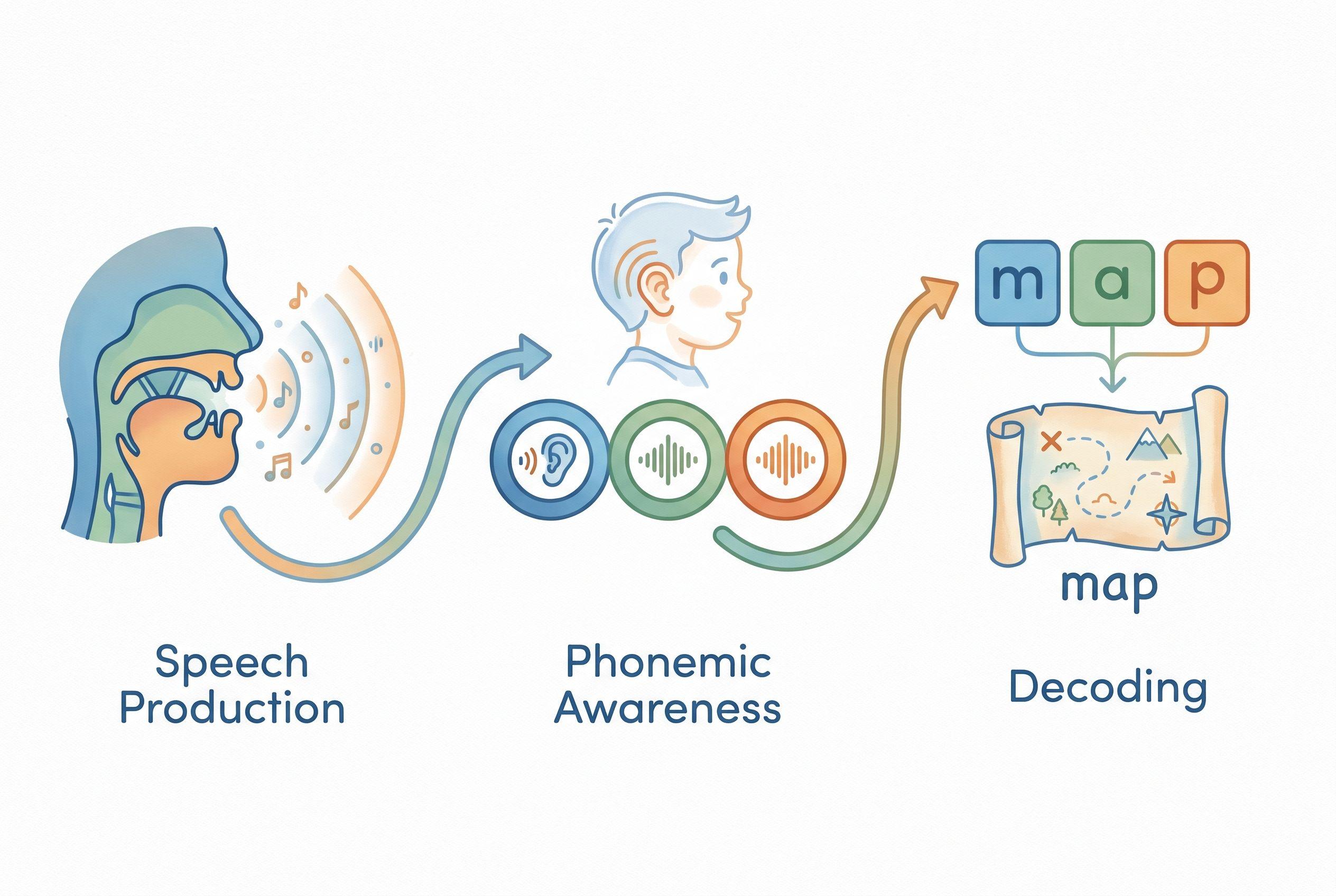
Here’s the distinction I want parents to carry into every lesson: speech production, phonemic awareness and decoding are related but separate skills.
Speech production concerns making sounds. Phonemic awareness concerns noticing and working with individual sounds in spoken words. Decoding connects written letters with sounds to identify words. Understanding spoken language matters, too.
Linnea Ehri's 2005 review, Learning to Read Words: Theory, Findings, and Scientific Issues, explains how connections between spellings and pronunciations support word learning. That's a reason to teach print-sound connections carefully—not to demand flawless articulation before teaching print.
Imagine a child sees map and says mat. Perhaps they confused the final letters. Perhaps their familiar speech pattern affected the spoken answer. Look at what happens in ordinary speech and other reading tasks, then discuss the pattern with their clinician. One response can't settle it.
No Guessing remains my tiger rule, but it targets guessing from pictures—not disability-related speech differences. “Look at the letters” can help. “Say it properly or start over” can miss the problem entirely.
The Action Step: Choose One Target Before One Subscription
- Ask the speech-language professional about response options. Request guidance on familiar speech errors, when pointing can show understanding and which spoken tasks to practice. If your child has no support yet, seek an assessment rather than waiting for an app to solve the difficulty.
- Find the first uncertain reading pattern. Try our free phonics skill check. You mark responses yourself, so interpret known pronunciation differences carefully; it isn't a clinical assessment or a speech-adjusted standardized score.
- Check the bigger picture. Use our free reading-level-by-age check to record skills you've actually observed. Ask the teacher or clinician about a named assessment such as Kilpatrick's PAST when sound awareness needs closer examination; speech differences can complicate interpretation.
- Preview the response demands. Look for required recording, pronunciation scoring and activities that won't advance without speech. Don't treat “phonics” as a guarantee of accessibility.
- Teach one manageable pattern. Model the sound, connect it to print and practice blending. Keep the book or screen at a comfortable level. For Teach Your Kid to Read, plan about 15 minutes side by side, adjusting expectations with your child's professional support.
- Check transfer without a timer. Revisit familiar patterns on paper and note the help your child needs. Bring repeated difficulties to the teacher or clinician rather than hopping between subscriptions.
For adult-led phonics practice, begin with lesson one and watch how your child responds.
What Progress Should Look Like
Look for less prompting, more reliable letter-sound knowledge and better blending of patterns you've taught. Keep speech observations separate: “identified the letters correctly; familiar substitution in spoken response” tells a professional more than “got it wrong.”
Consult what to expect at age 7 for broader expectations, but don't turn an oral reading speed chart into a home diagnosis. Speech production can affect timed oral performance. A seven-year-old deserves an interpretation that accounts for that.
My We Never Skip rule means protecting a regular teaching habit—not forcing a distressed or exhausted child through a lesson. Consistency can include a shorter review and a conversation with the clinician about what needs changing. Accuracy comes before speed.
If you need more adult-led options, see Top 6 Homeschool Reading Programs for a Struggling 7-Year-Old.
Choose the app that supports the next teachable skill. If that's beginning decoding with you beside your child, lesson one is free.
FAQ
What are the best reading apps for 7-year-olds with speech delay?
My ranking is Teach Your Kid to Read, Reading.com, Nessy, Reading Eggs, Teach Your Monster to Read and Khan Academy Kids. I prioritize ordered phonics, adult involvement and suitable response demands. The best fit depends on whether your child needs decoding, language support or both.
Which reading apps work without speech recognition?
Teach Your Kid to Read doesn't use speech recognition; the parent listens and checks responses. For the other apps here, confirm the current activity requirements before subscribing. An app may offer tapping activities without making every lesson microphone-free.
Can a child learn to read before their speech becomes clear?
Yes. Clear pronunciation isn't a prerequisite for all reading instruction. Teach letter-sound connections while a speech-language professional helps distinguish speech production difficulties from phonological or language needs. Some children need support in several areas at once.
Can phonics apps replace speech-language therapy?
No. Phonics apps teach reading-related skills; they don't diagnose or treat a speech disorder. Reading support for speech delay works best when adults coordinate instruction with the child's individual speech and language needs.
From teachyourkidtoread.org/blog/6-best-reading-apps-for-7-year-olds-with-speech-delay-ranked
Part of these guides

Xia Brody
Co-Founder, Teach Your Kid to Read
Mom of 4 who has successfully taught her kids to read. Currently in the trenches with her 4-year-old while her two oldest (10 and 7) devour books on their own. Passionate about phonics-based methods and building a lifelong love of reading.
Related Articles
6 Best Reading Apps for 6-Year-Olds with Dyslexia and ADHD, Ranked
My first pick is parent-led phonics, not an app that keeps a child busy. Compare six options by teaching approach, adult involvement and price—and see when your child needs more than an app.
Read More →
Reading Eggs vs ABCya: 5 Picks for Your 5-Year-Old
Reading Eggs offers a reading lesson sequence; ABCya mainly offers games for practising skills. Here's how I'd choose between them, where three alternatives fit and how to check whether your child can actually read without the screen.
Read More →
7 Best Science of Reading Apps for 6-Year-Olds, Ranked (2026)
Phonics practice matters more than digital prizes. Here’s my ranking of seven reading apps for a 6-year-old, with clear prices, honest limitations and a plan for checking whether the learning sticks.
Read More →