7 Best Science of Reading Apps for 6-Year-Olds, Ranked (2026)
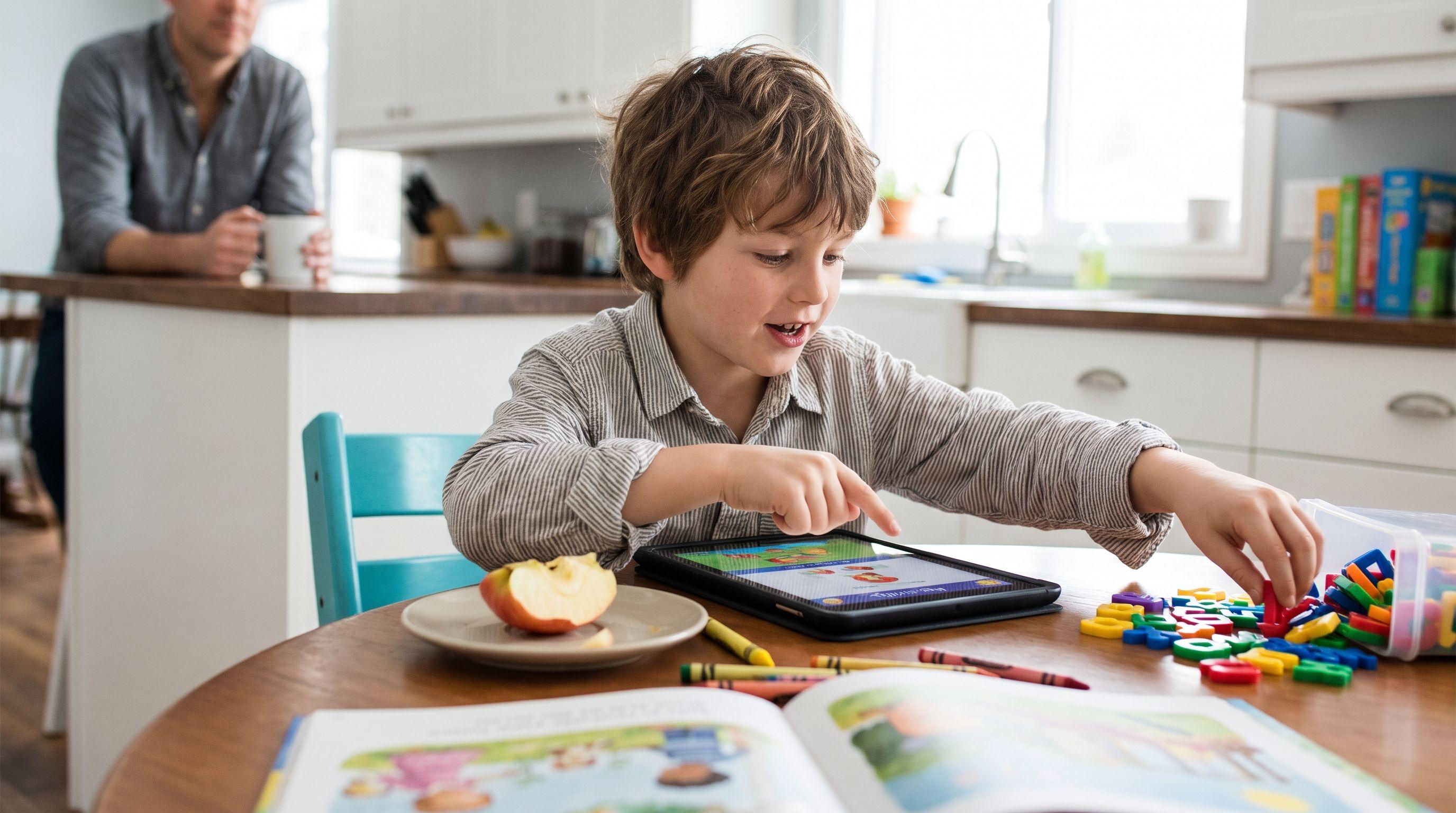
A dancing mascot can't hear the extra sound your child slips into /m/. An attentive adult can.
I'm Xia Brody, a homeschooling mom of four, ages 10, 7, 4 and 1. I've taught my two oldest to read, and teaching my 4-year-old keeps my opinions about short lessons extremely practical. Somebody always needs a snack.
What You'll Learn
- Teach Your Kid to Read ranks first for parent-led decoding practice, not independent screen time.
- Teach Your Monster to Read offers a free computer option; Khan Academy Kids and Duolingo ABC offer free app options.
- The best science of reading apps teach sound–letter connections and blending, rather than rewarding picture-based guessing.
- Start with your child's missing skill, then check whether they can read the same spelling pattern away from the screen.
Here's the reality check: “science of reading” isn't an app certification. A product can mention research without proving that its particular lessons improve reading.
Imagine a child who taps the picture of a boat when the screen displays ship. That's a successful picture match, not successful decoding. My rule is No Guessing: look at the letters, say the sounds and blend.
The Verdict
This ranking prioritizes a 6-year-old who needs help turning letter sounds into words. It compares published product descriptions, not hands-on testing or a head-to-head effectiveness study.
For Teach Your Kid to Read, the offer is: Lesson one is free, with no card and nothing to cancel. From lesson two, the whole program is a 7-day free trial, then US$9.95 a month.
How we ranked
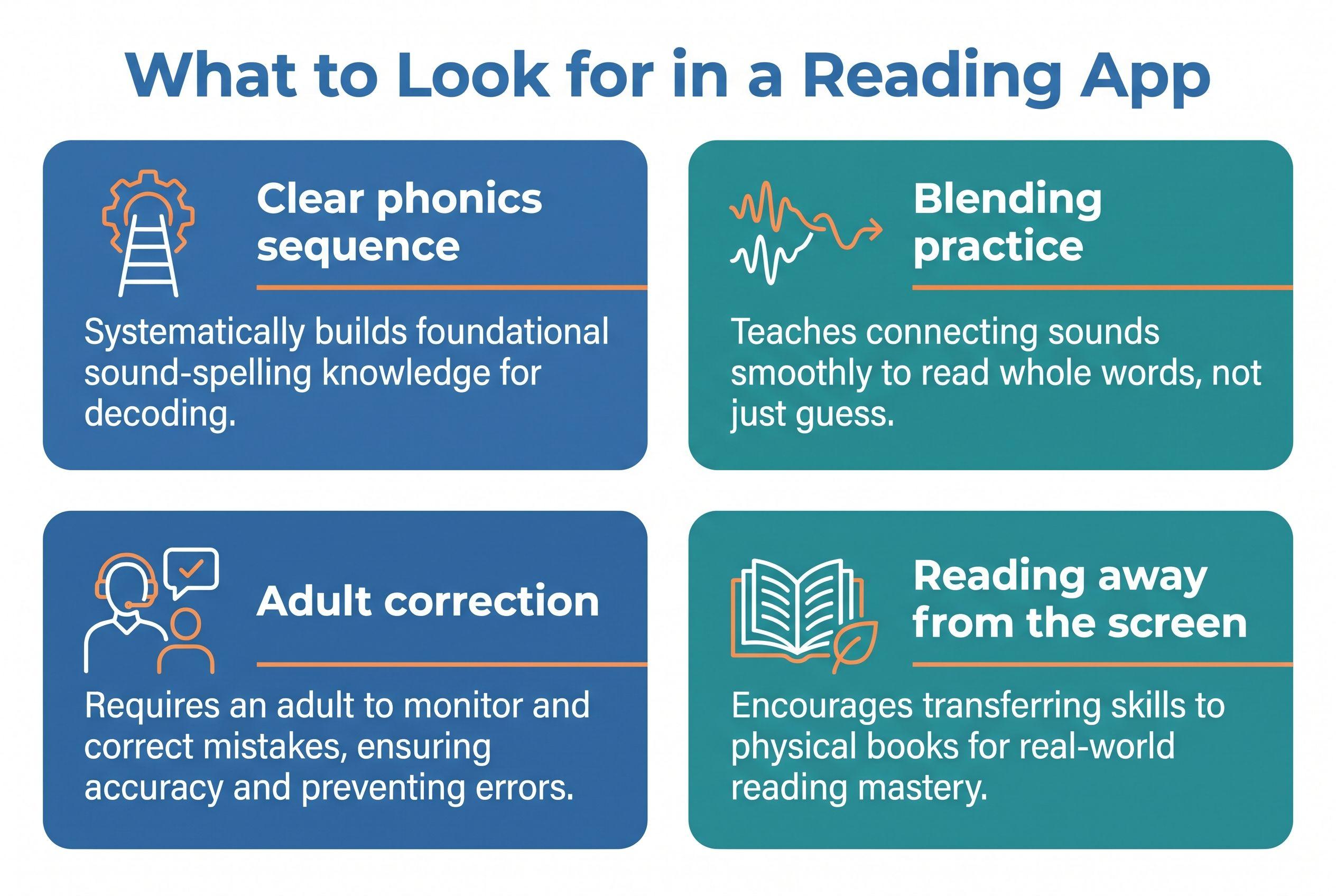
- Clear phonics sequence: new spelling patterns should build on earlier teaching.
- Actual decoding practice: the child needs to blend sounds, not identify pictures.
- Useful adult involvement: someone needs to notice and correct mistakes.
- Fit and cost: a manageable routine matters more than a giant activity menu.
| App | What it teaches or how it describes itself | Price / pricing model | Best-for age |
|---|---|---|---|
| 1. Teach Your Kid to Read | Step-by-step, parent-led phonics with blending and short stories from lesson two | Lesson one free, then 7-day trial, US$9.95/mo | My pick for a 6-year-old learning to decode with an adult |
| 2. Reading.com | Describes a parent-and-child approach to phonics and learning to read | US$12.49/month (checked October 2026); US$74.94/year (checked October 2026) | Stated ages 3–8; consider for age 6 with adult support |
| 3. Reading Eggs | Describes a reading suite that includes Fast Phonics | Subscription; 30-day free trial | Reading Eggs: 3–7; Fast Phonics: 5–10 |
| 4. Teach Your Monster to Read | Describes games covering letter sounds, blending and early reading | Free on computers; app US$8.99 (checked October 2026) | Stated ages 3–6; consider for beginning readers at 6 |
| 5. Duolingo ABC | Describes short early-literacy lessons involving phonics and reading | Free; no ads or in-app purchases | Stated ages 3–8; consider for early practice at 6 |
| 6. Khan Academy Kids | Describes early learning across literacy and other subjects | Free; no ads or subscriptions | Stated ages 2–8; consider for broader practice at 6 |
| 7. HOMER | Describes personalized early reading within broader learning activities | Subscription with a 30-day free trial | Store listings say 2–8; Begin's product page says 2–6 |
Full disclosure: I co-founded Teach Your Kid to Read, so weigh my #1 pick accordingly; the rest of the ranking is based on the criteria above.
Prices checked October 2026.
For a parent-led decoding routine, I recommend Teach Your Kid to Read; start lesson one free and sit beside your child for the first lesson.
The Tiger Truth: Practice Must Transfer to Print
Only 31% of US 4th graders (ages 9–10) scored at or above Proficient in reading on the 2024 NAEP. That doesn't mean everyone below Proficient can't read, and it doesn't predict your child's future. It does give parents a reason to take reading difficulties seriously.
The US National Reading Panel, in its 2000 report, found significant benefits from systematic phonics instruction. That supports explicit phonics teaching—not every app that borrows the vocabulary.
Linnea Ehri's 2005 review, Learning to Read Words: Theory, Findings, and Issues, explains how connections between spellings and sounds support word learning. Orthographic mapping isn't memorizing the outline of a word. Children connect its letters with its spoken sounds.
Waiting while a child rehearses guessing can leave that child avoiding harder books. The best science of reading apps should support accurate practice now, alongside conversation and adult read-alouds that build language comprehension.
Ranked: The 7 Best Science of Reading Apps for Age 6
1. Teach Your Kid to Read — Best for Parent-Led Decoding
This is my first pick for a 6-year-old who needs a clear sequence and an adult's attention. Teach Your Kid to Read gives the parent a job: sit alongside, listen carefully and help correct mistakes. The app teaches the adult what to listen for.
Lesson one introduces m, s, p and short a. Your child hears each sound, taps its matching letter, then blends and builds am, map and sap. There's no story in that first lesson; stories begin in lesson two and use sounds the course has already taught.
That sequence matters. A beginning reader shouldn't meet a page full of unfamiliar spelling patterns and then face instructions to “have a go.” That's where guessing sneaks in wearing a cheerful little hat.
The course has 50 lessons in a fixed order, moving through digraphs such as sh, ch and th, blends, vowel teams, silent e, prefixes and suffixes. It also teaches a small set of common irregular words by sight, calling them “leap words.” Plan for about 15 minutes a day, side by side.
You can use it on iPhone, iPad, Android or the web, with several children on one account. The lessons page lets a parent view every lesson and jump to one when appropriate.
Honest limitation: it has no speech recognition; the parent checks pronunciation. Pick something else if you need independent child use or want the software itself to listen and correct speech.
My verdict: strongest fit here for families who want a parent-led science of reading phonics app focused on phonics and decoding. That's a fit judgment, not a claim that research has validated this specific product.
2. Reading.com — Best Alternative for Learning Together
Reading.com describes an approach that brings the parent and child together for reading instruction. That puts it high on my list: adult involvement can turn a mistaken response into a useful teaching moment rather than another unnoticed tap.
Its stated ages of 3–8 include this reader's age comfortably. For a 6-year-old, I'd look closely at the starting lessons and ask whether the sequence matches the sounds the child already knows.
Before subscribing, inspect how the lessons move from individual sounds into blending. Can you understand the correction routine? Can your child practice without picture clues doing the work?
My verdict: a strong alternative to investigate when comparing the best science of reading apps for shared lessons. Choose according to lesson fit and the adult guidance you find clearest, not the size of a marketing claim.
3. Reading Eggs — Best for Families Wanting a Broader Suite
Reading Eggs describes several age-targeted products, including Fast Phonics for ages 5–10. That distinction matters more than the umbrella age range: a child who struggles to blend needs a phonics route, not just access to more reading activities.
For this ranking, I'd investigate Fast Phonics first. Check its sequence against your child's current skills and watch whether your child actually sounds out the practice words.
The broader suite may appeal to families who want activities beyond beginning decoding. The tradeoff is choice: an adult still needs to select practice that addresses the difficulty rather than letting the menu choose the lesson.
My verdict: worth considering for breadth, with deliberate phonics selection. For a closer comparison, read HOMER vs Reading Eggs for 6-Year-Olds: Best Fit?.
4. Teach Your Monster to Read — Best Free Computer Option
Teach Your Monster to Read describes a game-based route through letter sounds, blending and early reading. Its computer version costs nothing, while the mobile app uses a one-time purchase model.
That makes it appealing if subscriptions aren't in your budget. Its stated ages of 3–6 also place a beginning 6-year-old within its advertised audience.
Games aren't the enemy. Practice without attention to accuracy is the problem. Sit nearby initially and ask your child to say the sounds aloud; don't assume movement through a game proves independent word reading.
My verdict: one of the best science of reading apps to consider for low-cost beginning practice, especially on a computer. Check transfer to paper before deciding that a completed activity represents a learned skill.
5. Duolingo ABC — Best for Free, Short Practice
Duolingo ABC describes short early-literacy lessons that include phonics and reading. It offers them without ads or in-app purchases, which removes a purchasing decision from the practice routine.
For a 6-year-old, I'd treat it as an option for short, focused practice and inspect the level carefully. An age range of 3–8 can't tell you whether today's activity addresses your child's missing skill.
Listen during the reading work. A child who recognizes a familiar screen may still need help blending an unfamiliar printed word with the same pattern.
My verdict: a sensible free candidate among the best science of reading apps, particularly for supplementary practice. Don't let lesson length or a pleasant interface stand in for checking decoding.
6. Khan Academy Kids — Best Free Broad-Learning Option
Khan Academy Kids describes a wider early-learning program, including literacy alongside other subjects. Its stated ages of 2–8 include 6-year-olds, and it charges no subscription.
I rank it below the more reading-focused choices for this particular need. Broad learning can be valuable, but it doesn't automatically provide the focused phonics practice a struggling decoder needs today.
Choose a relevant literacy activity, then check what your child can do afterward. If the problem involves blending, another enjoyable activity in a different subject won't address it.
My verdict: useful for families seeking free, broader learning. For parents shopping for the best science of reading apps specifically to repair decoding gaps, keep a direct phonics routine at the center.
7. HOMER — Best for Broader Early-Learning Interests
HOMER describes personalized early reading within a broader learning experience. Its published age descriptions differ: store listings say 2–8, while Begin's product page says 2–6.
For a 6-year-old, inspect the actual starting material rather than assuming either range settles the question. Does the reading practice address the sound–letter connections your child needs? Does it require blending?
Personalization sounds attractive, but parents still need to understand what the child practices. I'd prioritize a visible phonics sequence over a wide selection of appealing activities.
My verdict: consider it when broader early learning suits your family. It ranks seventh here because this list prioritizes focused decoding and adult correction—not because this comparison establishes that HOMER can't help children learn.
Your Action Plan: Choose One App, Check One Skill
Don't download seven apps tonight. Pick the missing skill first.
- Find a starting point. Use our free phonics skill check. Your child reads real and made-up words while you mark responses, helping identify the first pattern to practice.
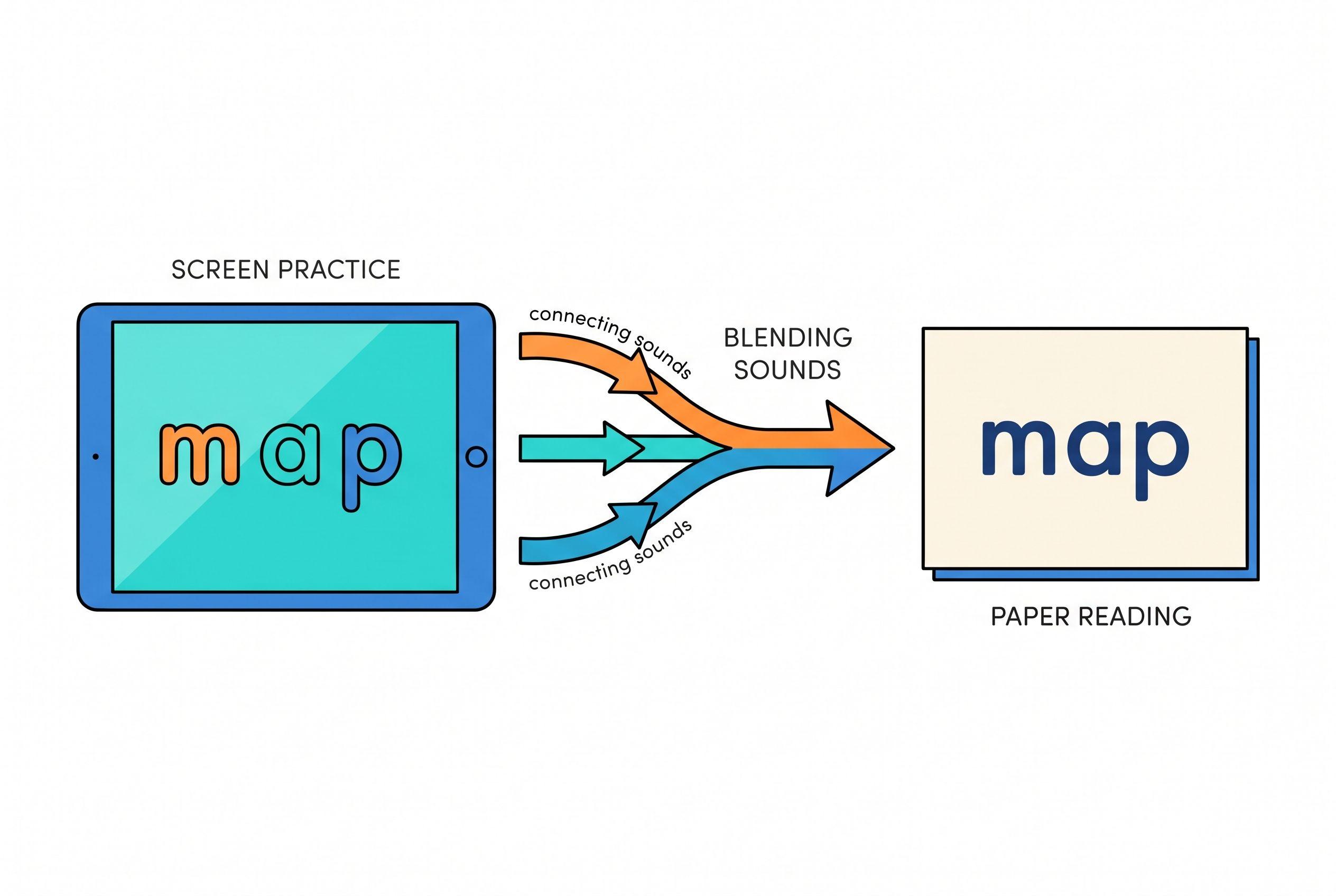
- Separate sounds from print. Can your child blend spoken /m/ /a/ /p/ into map? Can they connect those sounds to the printed letters? Those questions reveal different teaching needs. A trained educator can use Kilpatrick's PAST, the Phonological Awareness Screening Test, to examine sound-awareness skills more closely.
- Choose the routine you can support. Pick shared instruction if you can sit alongside. If independent use is essential, don't choose a program that assumes an adult in every lesson.
- Practice a small, specific target. Work on one taught pattern. Say continuous sounds cleanly—/mmm/, not “muh”—and model blending rather than requesting a guess.
- Check away from the screen. Write a few unfamiliar words using the taught pattern. Record what your child reads independently and which errors recur; don't turn this into a race.
- Respond to persistent difficulty. Consult what to expect at age 6 for age context. If accurate reading remains difficult despite explicit teaching, ask a qualified reading specialist for assessment rather than cycling through subscriptions.
My Tiger Rule, “We Never Skip,” means keeping a dependable reading routine, not pushing through illness or distress. On a difficult day, I prefer a brief, accurate review to a long argument over a screen.
If resistance dominates the session, My 6 Year Old Hates Reading: 7 Fast Fixes can help you rethink the task without abandoning instruction.
Pick for the Reading, Not the Rewards
The best science of reading apps earn their place through what your child learns to read outside them. My first choice here suits parents who want to teach alongside their child; the free alternatives deserve consideration when budget or format points elsewhere.
Start with one lesson and listen to the reading. Lesson one is free.
FAQ
What makes an app a science of reading app for 6 year olds?
Look for explicit sound–letter teaching, an understandable sequence and practice blending words. “Science of reading” isn't a certification. A good fit also depends on whether the activities address your child's current skills and how someone corrects errors.
Is an evidence-based reading app the same as a proven program?
No. An app may use practices that research supports without having research on the app itself. Ask whether a claim refers to phonics generally or to a study of that specific product, including children similar to yours.
Which options are free?
Khan Academy Kids and Duolingo ABC offer free apps. Teach Your Monster to Read offers free computer access, with a paid mobile app. Teach Your Kid to Read offers lesson one free; access from lesson two involves a trial followed by a paid subscription.
Can the best science of reading apps replace a reading specialist?
No. An app can't diagnose dyslexia or replace individualized assessment. If your child persistently struggles with sounds, blending or accurate word reading, seek help while continuing supportive instruction. You don't need to wait for repeated failure.
How long should my 6-year-old practice?
Teach Your Kid to Read suggests about 15 minutes a day alongside an adult. Other products differ, and children vary in stamina. Prioritize attentive, accurate practice, and keep adult read-alouds and conversation in the day too.
From teachyourkidtoread.org/blog/7-best-science-of-reading-apps-for-6-year-olds-ranked-2026
Part of these guides

Xia Brody
Co-Founder, Teach Your Kid to Read
Mom of 4 who has successfully taught her kids to read. Currently in the trenches with her 4-year-old while her two oldest (10 and 7) devour books on their own. Passionate about phonics-based methods and building a lifelong love of reading.
Related Articles
Reading Eggs vs ABCya: 5 Picks for Your 5-Year-Old
Reading Eggs offers a reading lesson sequence; ABCya mainly offers games for practising skills. Here's how I'd choose between them, where three alternatives fit and how to check whether your child can actually read without the screen.
Read More →
6 Best Reading Apps for 7-Year-Olds with Speech Delay, Ranked
A pronunciation error doesn't automatically mean a reading error. Here are six reading apps ranked for phonics practice with a speech-delayed seven-year-old, with clear limits on what each can offer.
Read More →
6 Best Reading Apps for 6-Year-Olds with Dyslexia and ADHD, Ranked
My first pick is parent-led phonics, not an app that keeps a child busy. Compare six options by teaching approach, adult involvement and price—and see when your child needs more than an app.
Read More →