ABCmouse vs Reading Eggs for 7-Year-Olds: Best Fit?
What You'll Learn
- The big difference between ABCmouse vs Reading Eggs for 7-year-olds when your child is already behind
- The one mistake parents make when an app feels “fun” but doesn’t build decoding Skill
- Why rewards, games, and leveled books can hide weak phonics
- The action plan I’d use this week if my 7-year-old still guessed at words
Reality Check
Your 7-year-old doesn’t need another cute screen full of badges.
Your child needs to read.
If they see ship and say “boat” because the picture has water, that’s not reading. That’s guessing with better branding. And honestly? This is where a lot of reading apps make me twitchy.
A reading app for 7 year old kids has one job: build accurate decoding, automatic word recognition, and confidence without teaching them to fake it.
The Verdict
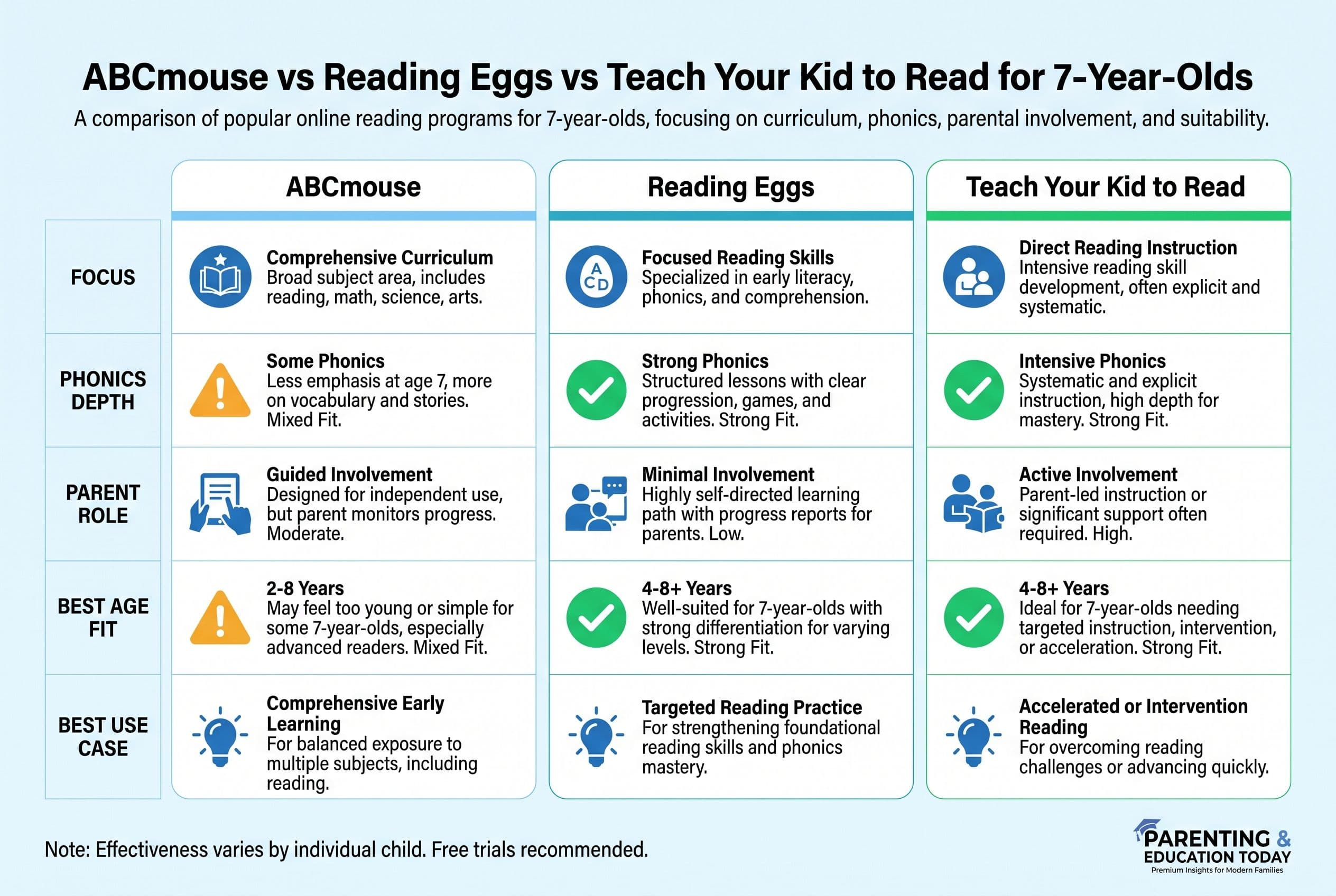
Here’s my straight answer on ABCmouse vs Reading Eggs for 7-year-olds: if your child is 7 and struggling, I wouldn’t make either one my main phonics program. Reading Eggs is the stronger fit of the two for structured reading practice, especially because its Fast Phonics pathway targets ages 5-10. ABCmouse works better as broad early-learning enrichment for younger kids.
But if your 7-year-old guesses, skips words, hates reading, or can’t decode CVC and vowel-team words cleanly, I’d start with Teach Your Kid to Read first because it focuses on systematic synthetic phonics and parent-led Mastery.
| Rank | Program | What it teaches | Pricing model | Best fit |
|---|---|---|---|---|
| #1 | Teach Your Kid to Read | Systematic synthetic phonics, no guessing, parent-led Drill | Lesson one free with no card and nothing to cancel; from lesson two the whole program is a 7-day free trial, then US$9.95/month | Struggling 4-8-year-olds who need real decoding |
| #2 | Reading Eggs | Reading games, lessons, Fast Phonics, Eggspress for older kids | Subscription with 30-day free trial; check current price | 5-10-year-olds who need more structured practice than ABCmouse |
| #3 | ABCmouse | Broad early learning: reading, math, art, music | Limited Basic Access plus Premium subscription; check current price | Ages 2-8, better for younger beginners and enrichment |
If you want my tiger-mom recommendation, start with start lesson one free before you spend another month watching your child tap animations instead of decoding words.
Tiger Truth: Seven Is Not “Wait and See” Time
Look, I’m warm. I bake muffins. I read bedtime stories. I also do not play around with literacy.
By 7, many children are in 2nd grade (ages 7-8) in the US system, or the equivalent early primary year elsewhere. This is when weak decoding starts turning into weak comprehension, slow writing, school anxiety, and the dreaded “I’m just not a reader” identity. That phrase makes me want to flip a table.
US students on the 2022 NAEP / The Nation's Report Card showed only 33% of 4th graders (ages 9-10) read at or above proficient. That’s not a tiny wobble. That’s a national alarm bell.
And yes, reading science backs the urgency. The 2000 National Reading Panel report found that systematic phonics instruction produces significant benefits, especially when introduced early. Louisa Moats’ 1999 paper Teaching Reading IS Rocket Science said the quiet part out loud: teaching reading well takes explicit knowledge, not vibes and pretty book baskets.
The kicker is this: struggling readers don’t usually “catch up” because we bought a more colorful app. They catch up when adults stop accepting guessing and start teaching the code.
Teach Your Kid to Read: Best First Choice for a Struggling 7-Year-Old
I’m biased because I helped build it. I’m also biased because I’ve sat at my own kitchen table with a tired kid, a pencil, a stack of decodable words, and exactly seven minutes before the baby needed me. That’s real life.
Teach Your Kid to Read works best for parents who need a clear path, not a giant digital carnival. It uses systematic synthetic phonics: teach the sound-spelling pattern, practice blending, read controlled words, build Mastery, move on.
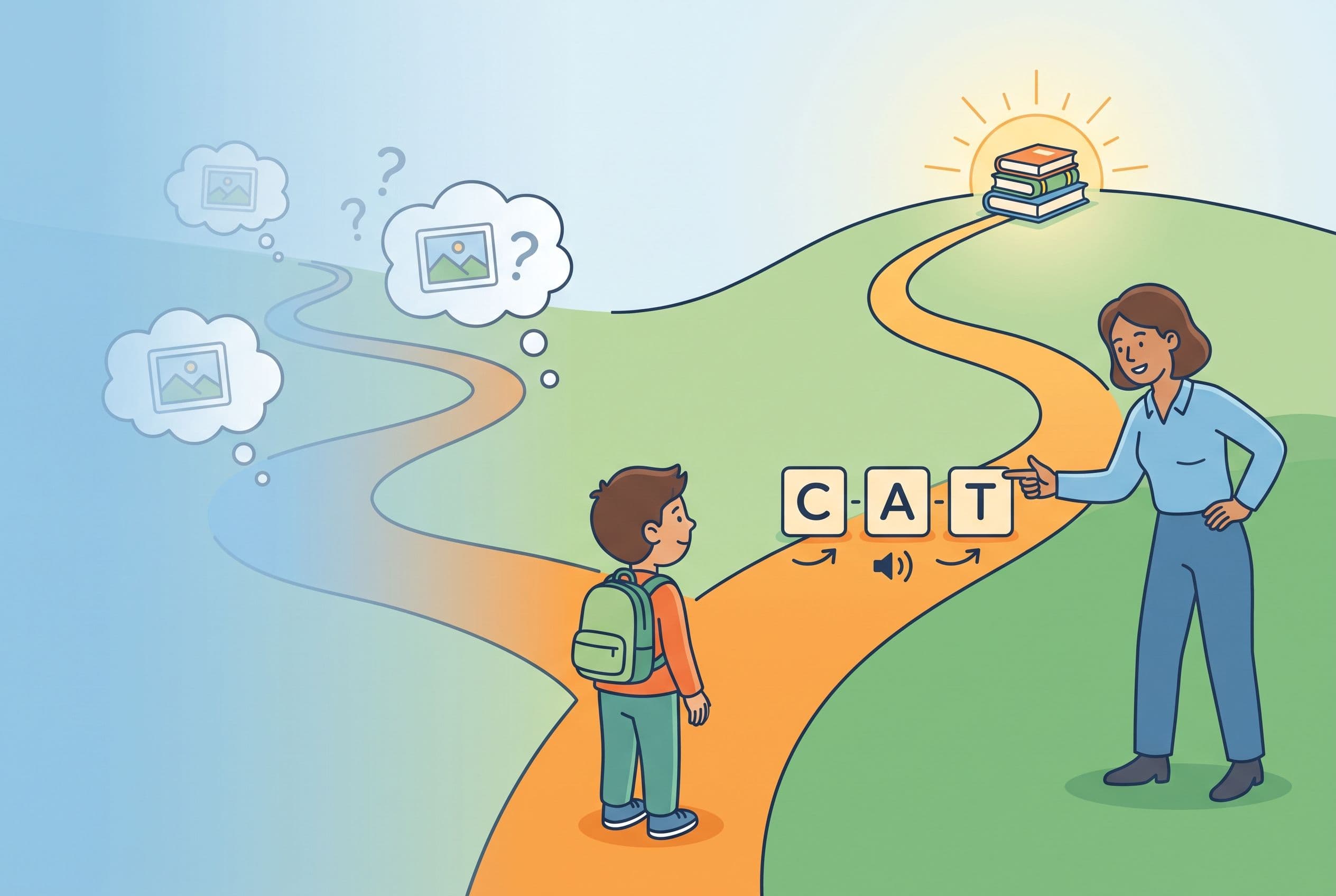
No guessing from pictures.
No “look at the first letter and think what would make sense.”
No three-cueing nonsense.
That matters because a 7-year-old who struggles often has shaky grapheme-phoneme correspondence. That’s the fancy term for matching letters and letter groups to sounds. If your child sees sh and still says /s/ /h/ separately, the app needs to teach that directly. If they see cake and read cack, they need explicit instruction in silent-e patterns.
Our whole philosophy lines up with Orton-Gillingham principles: explicit, sequential, multisensory, and cumulative. We’re not claiming every child reads in the same timeline. Nope. Kids vary. But the path shouldn’t be random.
This is where orthographic mapping comes in. David Kilpatrick’s Equipped for Reading Success (2016) explains why strong readers store words for instant recognition after connecting sounds to spellings. They don’t memorize word shapes like little visual goblins. They map sounds to letters.
That’s why I care less about whether an app has fireworks and more about whether it asks your child to actually decode.
What I Like Most
- It keeps the parent in the loop instead of outsourcing reading to a tablet
- It makes sounding out non-negotiable
- It gives short lessons parents can actually do daily
- It supports kids who need repetition without turning reading into a circus
What Parents Need to Know
Lesson one is free with no card and nothing to cancel. From lesson two, the whole program is a 7-day free trial, then US$9.95 a month.
I like honest offers. Parents have enough chaos without subscription jump scares.
Reading Eggs for 7-Year-Olds: Better Than ABCmouse for Reading Focus
Now let’s talk about Reading Eggs.
Reading Eggs comes from Blake eLearning, an Australian-owned company that merged with 3P Learning in 2021. The program states ages 2-13 overall: Junior for ages 2-4, Reading Eggs for 3-7, Fast Phonics for 5-10, and Eggspress for 7-13.
For the reading eggs vs abcmouse question, Reading Eggs wins on reading specificity. It has a clearer literacy lane. It includes phonics activities, comprehension, spelling, and pathways for older children inside the Reading Eggs family.
For a 7-year-old, the strongest piece is usually Fast Phonics, because it fits the 5-10 age band and targets phonics more directly than a general early-learning app. If your child likes game-based learning, Reading Eggs may keep them engaged long enough to practice.
But here’s my tiger-mom caution: engagement is not the same as Mastery.
A child can click through a lesson, earn a reward, and still fail to read bride, slope, or sharp on paper five minutes later. I see this all the time with screen learning. The screen says, “Great job!” The child says, “Can I have a snack?” The parent assumes reading happened.
Maybe it did.
Maybe it didn’t.
So if you use Reading Eggs for a 7-year-old, sit nearby sometimes. Ask your child to read the words out loud without the animation, without the voice prompt, without the picture giving it away. That’s the no-brainer test.
Best Fit for Reading Eggs
Reading Eggs may fit your child if:
- They already know most letter sounds
- They can blend simple CVC words like map, sit, and run
- They need more practice and motivation
- They aren’t severely behind
- You’ll check whether they can read outside the app
If your child has dyslexia indicators, big phonemic awareness gaps, or a long history of guessing, pair any app with assessment. The PAST test by David Kilpatrick takes about 5 minutes once you know how to give it, and it can show where phonological awareness breaks down, but it doesn’t diagnose dyslexia. Follow the administration guidance or ask a trained educator to help. DIBELS can also give useful screening and progress-monitoring data when it’s given correctly; for example, nonsense word fluency helps show whether a child can decode unfamiliar words instead of memorizing.
ABCmouse for 7-Year-Olds: Good Enrichment, Weak Main Reading Plan
ABCmouse is made by Age of Learning, Inc. Its stated age range is 2-8, and its pricing model includes limited Basic Access plus Premium subscription options. Parents should check the current price before signing up.
Here’s my abcmouse reading review in one sentence: ABCmouse can be lovely for broad early learning, but I wouldn’t pick it as the main reading intervention for a struggling 7-year-old.
ABCmouse covers reading, math, art, music, and other early learning areas. That breadth can help younger children build school readiness. It can also distract parents from the hard question: is my child actually decoding better?
A 7-year-old who struggles doesn’t need 14 learning paths and a digital hamster wheel of rewards. They need direct phonics.
I’m not anti-fun. I’m anti fake-progress.
If a child spends 25 minutes in an app and only reads six words independently, that’s not a reading lesson. That’s screen time wearing a graduation cap.
Best Fit for ABCmouse
ABCmouse may fit your child if:
- They’re younger or still building basic school-readiness habits
- They need broad enrichment, not targeted reading intervention
- They enjoy interactive lessons and rewards
- You’re not relying on it as your primary reading plan
For a 7-year-old who’s already reading on level, ABCmouse might feel too young. For a struggling 7-year-old, it may feel busy without being direct enough. That’s the bottom line.
The Feature That Disqualifies Many Reading Apps
Want to know what makes me instantly suspicious?
Any app or curriculum that trains a child to use pictures, context, or the first letter to guess the word.
The 2022 APM Reports / Sold a Story investigation by Emily Hanford exposed how Balanced Literacy and three-cueing misled schools and parents for years. And I saw the fallout up close.
After Hanford’s reporting came out, my neighbor — a first-grade (ages 6-7) teacher for 18 years — called me almost in tears. She’d used Lucy Calkins’ Units of Study curriculum her whole career. Three-cueing, MSV, the whole thing. She told me, “I’ve been teaching kids to guess for two decades and I didn’t even know it.”
She switched her classroom to UFLI Foundations mid-year. Total mess at first. She had to relearn everything herself: phoneme drills, blending routines, dictation, decodable text, the works. By spring, she told me her classroom data looked completely different: stronger nonsense word fluency, fewer wild guesses, and kids actually decoding CVC words instead of praying to the picture gods.
That story lives rent-free in my head.
Because if a veteran teacher can get fooled by cute literacy language, parents can absolutely get fooled by cute apps.
ABCmouse vs Reading Eggs for 7-Year-Olds: Head-to-Head
Here’s the practical comparison. No glitter. No marketing fog.
Reading Focus
Reading Eggs has the stronger reading focus, especially because the Reading Eggs family includes Fast Phonics and Eggspress for older kids.
ABCmouse covers reading as one subject among many. That may help with variety, but variety is not what a struggling reader needs most.
Winner: Reading Eggs
Age Fit
ABCmouse states ages 2-8. Reading Eggs states ages 2-13 overall, with different programs by age. For a 7-year-old, Reading Eggs has the better age runway.
Winner: Reading Eggs
Phonics Depth
Reading Eggs appears more reading-centered and has a Fast Phonics pathway. ABCmouse includes phonics activities, but the program’s broad early-learning model makes it less targeted.
For serious intervention, though, I’d still choose a direct phonics program first: Teach Your Kid to Read, UFLI Foundations with parent support, Logic of English Foundations for ages 4-7, or All About Reading if you want a physical curriculum.
Winner between the two: Reading Eggs
Parent Control
This one matters. A struggling reader needs an adult listening for accuracy.
Apps can prompt. Apps can reward. Apps can repeat. But they can’t always catch the tiny errors that reveal a broken Foundation: dropping ending sounds, mixing /b/ and /d/, guessing horse for house, or reading went as want.
Teach Your Kid to Read puts the parent back in the lesson. That’s why I rank it first for the best reading app for struggling 7 year old searches.
Winner overall: Teach Your Kid to Read
My Action Step Plan for This Week
If your child is 7 and reading feels shaky, don’t spend three more weeks comparing app screenshots. Do this instead.
-
Check letter-sound Mastery. Show lowercase letters in random order. Your child should give sounds quickly, not sing the alphabet song and hunt around.
-
Test simple blending. Write five CVC words: map, sit, pen, hop, rug. Cover any pictures. Ask your child to sound out and blend.
-
Add nonsense words. Try mip, lat, fep, zug. Nonsense words reveal decoding. Memorization can’t save them here. This is an informal decoding check at your kitchen table, not a standardized fluency score.
-
Watch for guessing. Don’t diagnose guessing from eye contact alone. Kids look away when they’re thinking, nervous, distracted, or hoping you’ll magically make dinner appear. Watch the spoken answer. If they say boat for ship, point to sh, supply the sound if needed, and help them blend the word. Tiger Rule: Eyes on the letters. No Guessing.
-
Pick one structured path. Use Teach Your Kid to Read for daily parent-led phonics, or choose another explicit program like UFLI Foundations, Logic of English, or All About Reading. Don’t app-hop every four days.
-
Drill daily for 10-15 minutes. We Never Skip. Birthdays, holidays, vacation, grandma’s house — we still do a short lesson. Reading is a survival Skill.
-
Track one number. Use nonsense words read correctly, words read correctly, or lesson level. Don’t track “minutes on app” as your main win. Minutes don’t equal reading.
-
Escalate if needed. If your child can’t hear or manipulate sounds in words, look at phonemic awareness screening. The PAST test can help, but again, it’s not a dyslexia diagnosis. If dyslexia runs in the family or progress stays painfully slow, contact a qualified reading specialist or ask your school about evidence-based intervention.
If you want the cleanest place to start today, use Teach Your Kid to Read: lesson one is free with no card and nothing to cancel; from lesson two the whole program is a 7-day free trial, then US$9.95 a month.
So Which One Should You Choose?
If the question is strictly ABCmouse vs Reading Eggs for 7-year-olds, choose Reading Eggs.
It has a better age fit, a stronger reading focus, and more pathways for a child who’s no longer a preschool beginner. ABCmouse can still work for broad enrichment, but I wouldn’t use it as the main plan for a struggling 7-year-old.
If the real question is, “What should I use because my 7-year-old can’t read well yet?” then choose systematic phonics first. That’s Teach Your Kid to Read, or a structured curriculum like UFLI Foundations, All About Reading, Logic of English, Barton Reading & Spelling, or Wilson Reading System for older kids with more serious intervention needs.
Here’s the thing: your child doesn’t need the app with the cutest map. They need the app that makes them read the word in front of them.
No guessing.
No pretending.
No waiting.
Start the lesson, sit beside them, and listen. That’s where reading changes.
FAQ
Is Reading Eggs better than ABCmouse for a 7-year-old?
Usually, yes. Reading Eggs has a stronger reading focus and includes pathways like Fast Phonics for ages 5-10 and Eggspress for ages 7-13. ABCmouse states ages 2-8 and works better as broad early-learning enrichment than targeted reading intervention.
Is ABCmouse good for a struggling 7-year-old reader?
I wouldn’t use ABCmouse as the main plan for a struggling 7-year-old. It may help with general practice, but struggling readers need explicit, systematic phonics, direct blending practice, and an adult checking accuracy.
What’s the best reading app for a struggling 7-year-old?
Look for systematic synthetic phonics, no guessing from pictures, short daily lessons, and parent involvement. Teach Your Kid to Read fits that need, and lesson one is free with no card and nothing to cancel; from lesson two, the program has a 7-day free trial, then costs US$9.95 a month.
How do I know if my 7-year-old is behind in reading?
Check whether they can quickly name letter sounds, blend CVC words, read simple nonsense words, and read decodable sentences without guessing. If they rely on pictures, skip small words, or panic with unfamiliar words, that’s a sign to act now.
Should I use an app or a tutor?
Start with daily structured phonics at home if your child has mild to moderate gaps. If progress stays slow, dyslexia runs in the family, or your child can’t hear sounds in words, bring in a trained reading specialist. A good tutor uses evidence-based instruction, not leveled-reader guessing.
Part of these guides

Xia Brody
Co-Founder, Teach Your Kid to Read
Mom of 4 who has successfully taught her kids to read. Currently in the trenches with her 4-year-old while her two oldest (10 and 7) devour books on their own. Passionate about phonics-based methods and building a lifelong love of reading.
Related Articles
Reading Eggs vs ABCmouse for 5-Year-Olds: Best Pick
Choosing between Reading Eggs and ABCmouse? Here’s the no-fluff mom verdict on which app actually teaches a 5-year-old to read — and where both fall short.
Read More →
HOMER vs Reading Eggs for 6-Year-Olds: Best Fit?
Choosing between HOMER and Reading Eggs for a 6-year-old? Here’s the no-nonsense parent breakdown: which app teaches decoding, which one fits which child, and where Teach Your Kid to Read beats both for focused phonics.
Read More →
HOMER vs Reading Eggs for 5-Year-Olds: Best Fit?
Choosing between HOMER and Reading Eggs for a 5-year-old? I’m breaking down phonics quality, guessing risks, rewards, pricing, and the app I’d put first for decoding mastery.
Read More →