Is My 5 Year Old Behind in Reading? Age-by-Age Signs
What You'll Learn
- The reading signs at age 5 that make me sit up straight and cancel my laundry plans
- The one mistake parents make when a child gets stuck on a word
- What kindergarten (age 5) reading expectations actually mean — without the school jargon
- How to test your child at home in 10 minutes without turning your kitchen into a panic bunker
Reality Check: A 5-Year-Old Not Reading Yet Can Be Normal — But Not Always
Is my 5 year old behind in reading? Maybe. Maybe not.
Helpful, right? Stay with me.
A 5-year-old who isn’t reading full books yet isn’t automatically behind. Some kids at this age read Bob Books independently. Some still mix up b and d, forget half the letter sounds, and think guessing from the picture counts as reading.
It doesn’t.
Here’s the thing: age 5 is not the finish line. It’s the inspection point. You’re checking the foundation before the house gets heavy. If your child doesn’t know most letter sounds, can’t hear the first sound in a word, or melts down when asked to blend /m/ /a/ /t/, don’t shrug and say, “They’ll get it when they’re ready.”
That sentence has wrecked a lot of kids.
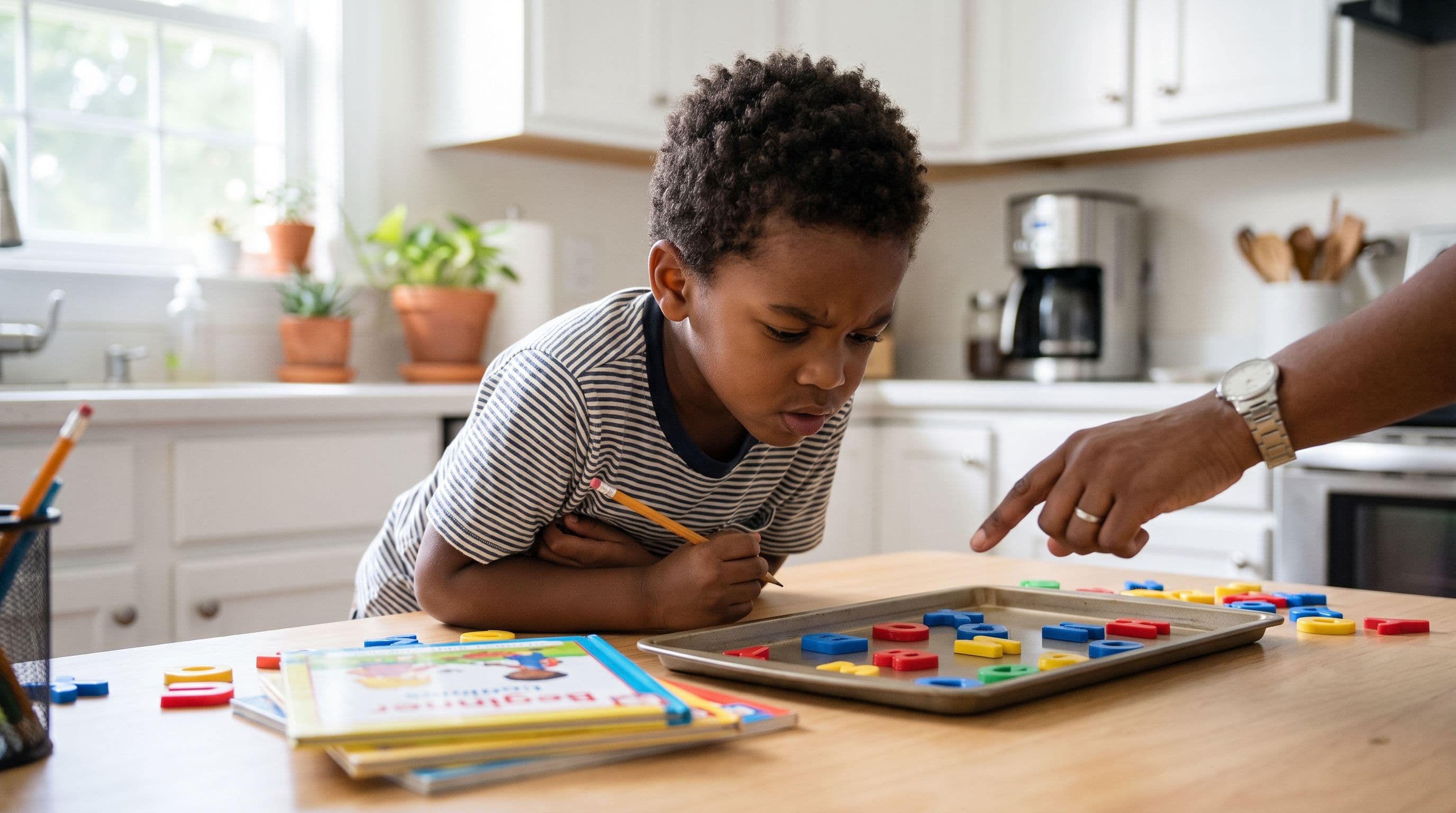
I say that as a homeschooling mom of four. I’ve taught my two oldest to read, and I’m currently at the kitchen table with my 4-year-old doing CVC words while the 1-year-old tries to eat the magnetic letters. Glamorous? No. Effective? Yes.
Tiger Truth: Waiting Can Cost Your Child Years
Look, I’m not here to scare you for clicks. I’m here because reading is a survival skill.
In the US, 32% of 4th graders (ages 9-10) performed at or above NAEP Proficient in reading on the 2022 NAEP, also called The Nation's Report Card. That’s NAEP’s own assessment standard, not the same thing as a simple “grade level” label, but still? It tells us way too many kids aren’t reading as strongly as we’d want for real academic independence.
And the kicker is this: kids who don’t read well by 3rd grade (ages 8-9) often hit what I call the 3rd Grade Cliff. Before that, adults read instructions aloud, books have pictures, and school still gives lots of support. After that? Kids read to learn science, history, maths, word problems, everything.
If reading is weak, school starts punching them in every subject.
Donald Hernandez’s 2011 report for the Annie E. Casey Foundation, Double Jeopardy, found that children who weren’t reading proficiently by the end of 3rd grade were four times more likely than proficient readers to fail to graduate from high school on time. That’s an association from a big report, not a crystal ball for your individual child. But it’s not a tiny little “oops.” That’s a flashing red light.
And yes, some kids catch up later. But late catch-up usually takes more time, more money, more tears, and more specialist support. In the US, intensive private remedial reading help can run US$10,000-US$15,000 a year. Insurance often says, “Cute problem. Not ours.”
No thank you.
So if you’re asking, “is my 5 year old behind in reading?” I’m glad. That question means your radar is on.
Should My 5 Year Old Be Reading?
Short answer: your 5-year-old doesn’t need to read chapter books. But your 5-year-old should be building the machinery that makes reading possible.
Reading doesn’t happen naturally. Talking happens naturally for most kids because the human brain comes wired for spoken language. Reading is different. Stanislas Dehaene’s Reading in the Brain (2009) explains that the brain has to repurpose visual and language circuits for print. Translation: you train the brain to read.
That’s why I get twitchy when adults say, “Just surround them with books.”
Books are wonderful. I have piles of them in my house. Piles. Possibly structural piles.
But exposure alone doesn’t teach a child that sh spells /sh/, that m-a-t blends into “mat,” or that you read words from left to right in English. Kids need explicit instruction in grapheme-phoneme correspondence — fancy phrase, simple idea: letters and letter groups represent sounds.
The 2000 National Reading Panel report found that systematic phonics instruction produces significant benefits, especially in kindergarten (age 5) and 1st grade (ages 6-7). Systematic means we don’t throw random words at kids and hope magic happens. We teach sounds in a planned order and practice until the child reaches mastery.
That’s the real deal.
5 Year Old Reading Milestones: What I Want to See
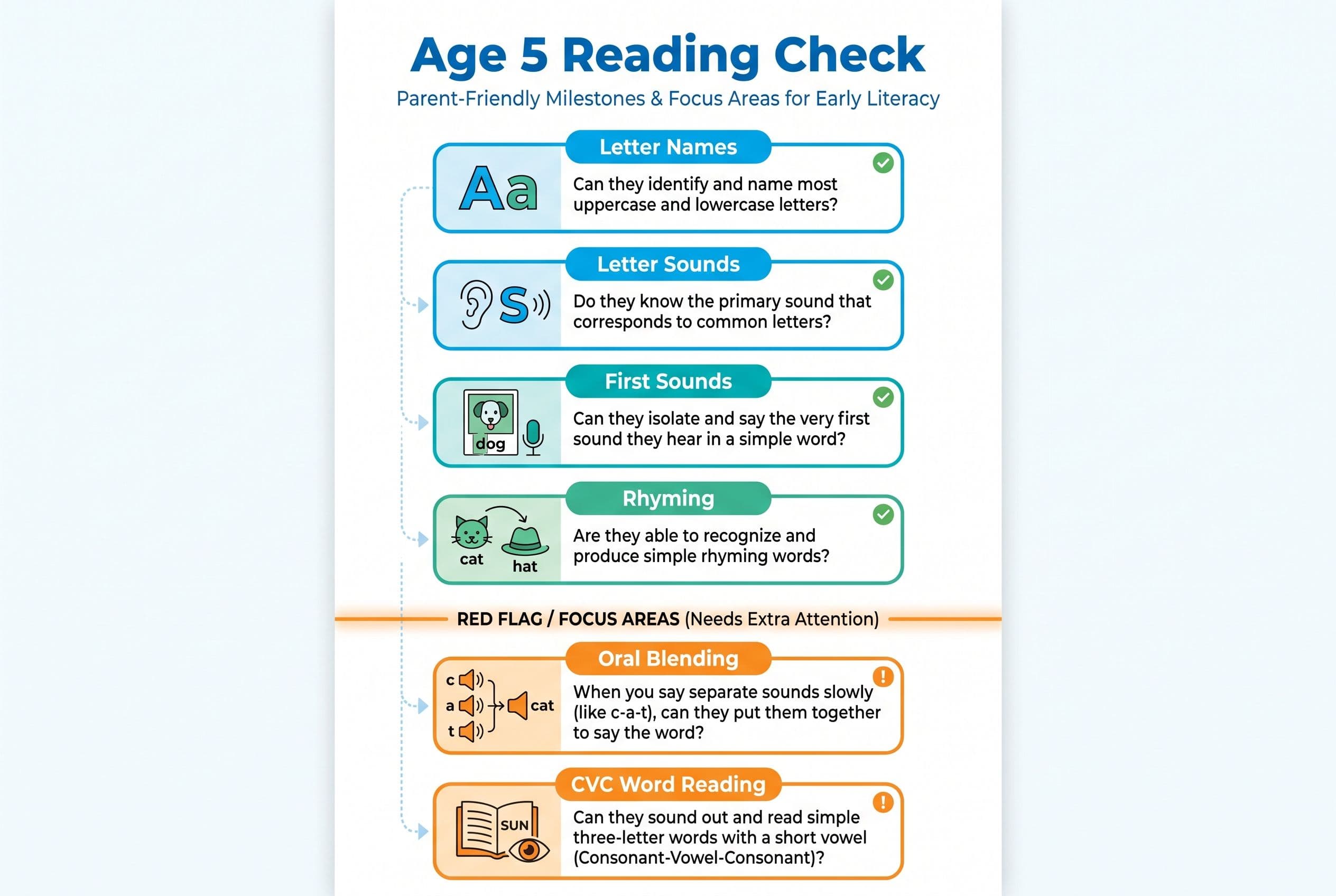
Here are the 5 year old reading milestones I use as a practical parent checklist. Not every child will hit every item at the same time, but these signs tell me the foundation is forming.
Most 5-Year-Olds Should Be Working Toward These Skills
By age 5, many children can:
- Recognize most uppercase letters
- Recognize many lowercase letters
- Say many letter sounds quickly, not after a 12-second staring contest
- Hear rhymes, like cat/hat or pig/wig
- Identify the first sound in simple words, like /s/ in sun
- Clap syllables in words, like rab-bit or ba-na-na
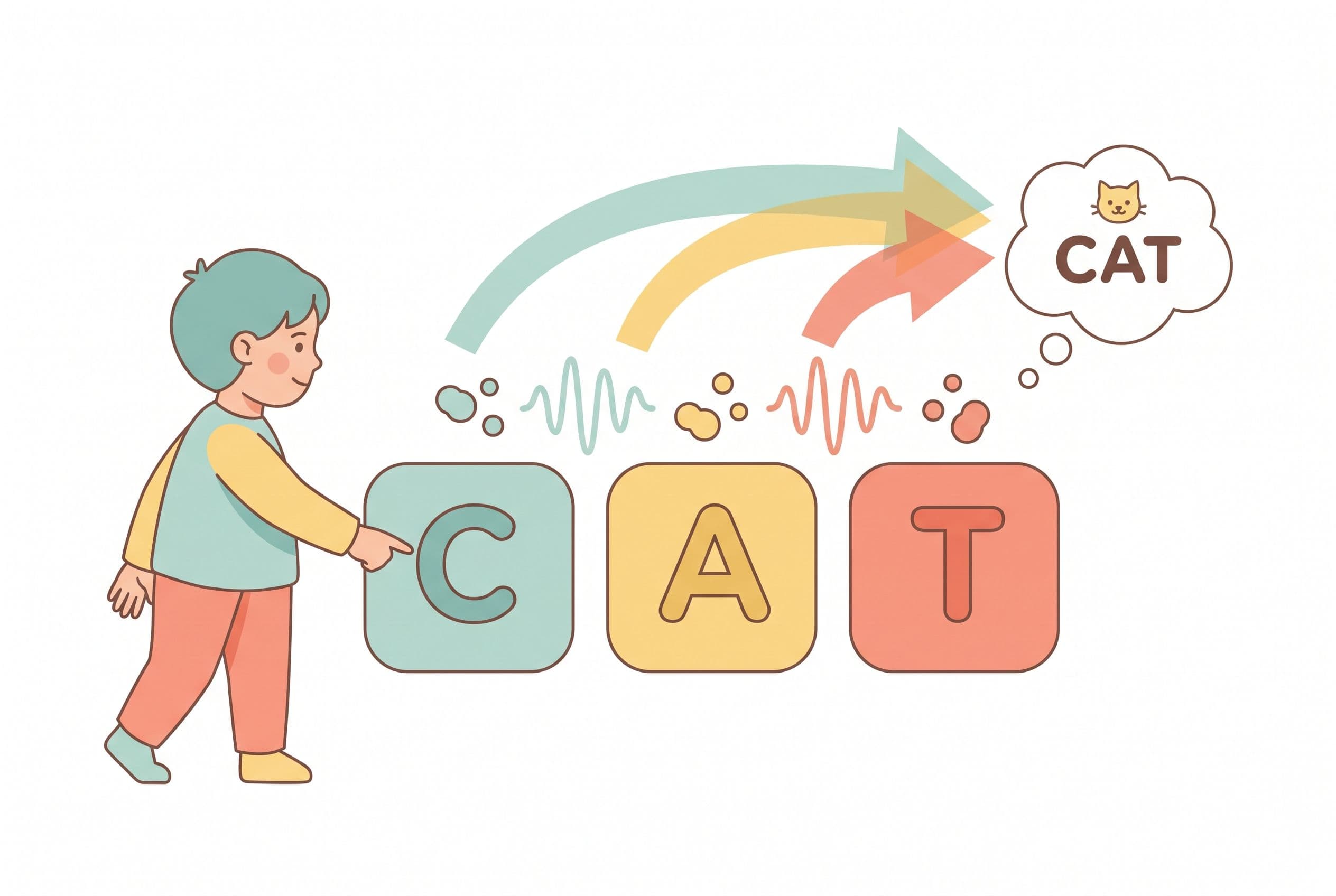
- Blend simple sounds orally, like /m/ /o/ /p/ into mop
- Start blending printed CVC words, like sat, pin, map
- Recognize a small number of high-frequency words, especially decodable ones
- Understand that print carries meaning and moves left to right in English
Now, if your child just turned 5, don’t panic if blending is still messy. But if your child is almost 6 and still doesn’t know letter sounds? That’s not a “wait and see” moment. That’s a “sit down after breakfast and start daily phonics” moment.
Kindergarten Reading Expectations Without the Nonsense
Kindergarten reading expectations vary by country, school, teacher, and curriculum. In the US, kindergarten (age 5) often expects children to leave the year reading simple decodable text. In the UK, many children begin formal phonics in Reception (ages 4-5). In Australia, Canada, and New Zealand, expectations vary by region.
The reading science doesn’t change because your postal code changes.
A strong kindergarten reading foundation usually means your child can connect sounds to letters, blend simple words, segment sounds for spelling, and read simple decodable sentences like: “The cat sat.”
Not “guess the word because the picture has a cat.”
No guessing words from pictures instead of decoding. Ever.
Use context after the word is read to understand meaning or notice if something sounded wrong. Fine. Great. Reading police approve. But using the picture to identify an unfamiliar word? Nope.
If Lily sees the word ship and says “boat” because the picture shows water, Lily didn’t read. Lily guessed. And if an adult says, “Good job using the picture clues,” I need to go breathe into a paper bag.
Red Flags: Signs Your 5-Year-Old May Be Behind
This is where we get practical. If you searched “is my 5 year old behind in reading,” check these signs.
Big Red Flags at Age 5
This is an informal parent checklist, not a diagnosis and not a fancy validated screener. Age in months, how much instruction your child has had, hearing, vision, language background, and school history all matter. Still, pay attention if your child:
- Can’t name many letters after repeated teaching
- Knows letter names but not letter sounds
- Can’t hear the first sound in simple words like dog, sun, fish
- Can’t blend two sounds orally, like /s/ /ee/ into see
- Avoids books, letters, or any reading practice
- Memorizes books but can’t read the same words on a plain card
- Guesses words from pictures instead of sounding them out
- Can’t remember a sound you practiced many times
- Has a family history of dyslexia or serious reading struggles
- Struggles with rhyming past age 5
One red flag doesn’t mean disaster. A cluster means act. And if one concern is big enough that your gut is yelling? You don’t need to wait for a whole bouquet of red flags before asking for screening.
And honestly? I’d rather have a parent overreact with 10 minutes of phonics a day than underreact for two years and then discover the child needs intensive intervention.
Dyslexia Clues to Watch
Dyslexia doesn’t mean a child sees letters backward. That myth needs to retire.
Early dyslexia signs often involve phonological processing: trouble hearing, remembering, and manipulating sounds in words. The International Dyslexia Association has helpful parent-friendly information on this.
Watch for:
- Trouble learning nursery rhymes
- Difficulty remembering letter sounds
- Weak phonemic awareness
- Slow naming of familiar items
- Family history of dyslexia
- Persistent difficulty with accurate or fluent word reading and spelling despite appropriate instruction
Dyslexia can happen across intellectual ability levels. Your child doesn’t need some dramatic IQ-reading “gap” for you to take reading struggles seriously.
If your gut says something’s off, don’t let someone pat your head and tell you to relax. Ask for screening. Use tools like the PAST — the Phonological Awareness Screening Test by David Kilpatrick — or school assessments such as DIBELS or AIMSweb.
The Kilpatrick PAST takes about 5 minutes once you know how to give it, and it can sample phonological-awareness skills so you can see what to teach next. It doesn’t diagnose dyslexia, and it doesn’t magically tell you the exact cause of every reading struggle. If concerns persist, follow the official administration guidance and ask for a qualified assessment.
That’s gold. Not magic. Gold.
“5 Year Old Not Reading Yet Normal?” Yes, If These Foundations Are There
A 5 year old not reading yet can be normal if the pre-reading foundation looks strong.
For example, if your child:
- Knows most letter sounds
- Can rhyme and play sound games
- Can blend orally
- Can segment simple words into sounds
- Enjoys being read to
- Shows steady progress with short lessons
Then no, I wouldn’t panic. I’d teach systematically and keep going.
But if your child has had months of exposure and still can’t remember letter sounds, can’t blend, and guesses wildly? Don’t call that “not ready.” Call it a skill gap.
Skill gaps need instruction.
My Raleigh Playground Wake-Up Call
A while back, I was at a playground in Raleigh when another mom told me her child’s school had switched from Lucy Calkins to a Science of Reading curriculum because of North Carolina’s SB 387 — the Excellent Public Schools Act, a US state law.
She was confused and a little annoyed. “He was doing fine before,” she said.
So I asked one question: “Can he read the word splint?”
Her son was in 2nd grade (ages 7-8). He couldn’t.
That one word told me a lot. Splint is decodable if a child knows consonant blends and short vowel patterns. You don’t need to memorize it. You don’t need a picture. You need phonics.
I spent 20 minutes on that playground bench explaining why schools were making the switch: Emily Hanford’s 2023 APM Reports investigation Sold a Story, the NAEP data, and Dehaene’s neuroscience showing that reading doesn’t bloom naturally like speech.
That night, she watched Sold a Story. At 11 p.m., she texted me: “I had no idea. Why didn’t anyone tell us this sooner?”
That question haunts me because parents trust schools. I get it. But if your 5-year-old is struggling right now, you don’t have to wait for a school district, a policy fight, or a curriculum committee to catch up.
You can start at the kitchen table today.
The Mistake 90% of Parents Make When Kids Get Stuck
The child sees mat.
They freeze.
The parent says, “Look at the picture.”
Nope. Stop. Hard stop.
The picture might help with story meaning, but it should not help your child identify the word. That trains guessing. And picture guessing bypasses the spelling-sound work that supports accurate word learning.
Orthographic mapping — the process Linnea Ehri described in her 2005 work on how children bond spellings to pronunciations and meanings in memory — is how a child stops sounding out cat every single time and starts recognizing it instantly. But the word has to get mapped through sounds and spellings, not vibes.
So when your child gets stuck, say:
- “Point to the first letter.”
- “Say the sound.”
- “Next sound.”
- “Blend it.”
- “Now read the whole word.”
Tiny drill. Big payoff.
The Solution: Systematic Phonics, Not Reading Vibes
Teach Your Kid to Read uses the same core principles I trust in my own house: systematic synthetic phonics, mastery, review, and no guessing.
This lines up with Orton-Gillingham principles: explicit, structured, sequential, multisensory instruction. Programs like UFLI Foundations, Logic of English, Fundations, Wilson Reading System, and Barton Reading & Spelling all draw from structured literacy ideas in different ways.
You don’t need to turn your living room into a private school. You need a plan.
At Teach Your Kid to Read, we help parents work through the foundation:
- Phonological awareness
- Letter sounds
- Blending
- Segmenting
- CVC words
- Digraphs like sh, ch, th
- Decodable reading
- Fluency practice
No random leveled-reader guessing. No “memorize this whole book and pretend you read it.” No iPad babysitting while the app throws confetti at wrong answers.
Just skill, drill, and mastery.
Action Step: The 10-Minute Age 5 Reading Check
Do this today. Not next month. Not after the school meeting. Today.
Grab paper, a pencil, and a snack your child likes. Keep your face calm. You’re collecting information, not interrogating a tiny witness.
This is informal and non-diagnostic. It won’t label your child, and it won’t replace a real screener. It will tell you what to teach tomorrow morning, which is still very useful.
Step 1: Check Letter Names
Write 10 uppercase letters and 10 lowercase letters in random order.
Ask: “What letter is this?”
Use common letters first: m, s, t, a, p, f, c, b, r, n.
If your 5-year-old knows only a few, start daily letter work. Keep it short. Five minutes. No drama.
Step 2: Check Letter Sounds
Point to the same letters and ask: “What sound does this spell?”
You want quick answers. If your child says “mmm” for m, great. If they say “monkey,” say, “Yes, monkey starts with /m/. What sound?”
Letter sounds matter more than letter names for early reading.
Step 3: Check First Sounds
Say:
- sun
- map
- dog
- fish
- red
Ask: “What’s the first sound?”
Not first letter. First sound.
If your child says “sun starts with S” but can’t say /s/, teach the sound level. Reading lives at the sound level.
Step 4: Check Blending
Say the sounds slowly:
- /m/ /a/ /t/
- /s/ /u/ /n/
- /p/ /i/ /g/
- /f/ /a/ /n/
Ask: “What word?”
That’s phonemic blending: individual sounds into a word. You can also play with bigger chunks, like /m/ /at/ into mat, but that’s a different sound-awareness skill. Both can help. Don’t make this weird. Just know what you’re checking.
If your child can blend orally, printed blending may come more easily. If oral blending is weak, practice it briefly while also doing supported blending with a few letter sounds your child already knows. Don’t wait forever for “perfect” oral blending before touching print.
Step 5: Check CVC Word Reading
Write:
- mat
- sat
- pin
- hop
- cup
Ask your child to sound out each word.
If they guess, cover any pictures nearby and say, “No guessing. Sound it out.” In our house, that’s a Tiger Rule.
Step 6: Decide Your Next Move
Use this quick guide:
- Knows most sounds and can blend CVC words: keep building with decodable books like Bob Books or other controlled text.
- Knows sounds but can’t blend: practice oral blending daily and practice printed blending with a few known sounds.
- Doesn’t know sounds: teach 2-3 sounds at a time, review daily, and don’t rush.
- Can’t rhyme, blend, or hear first sounds: screen phonological awareness with PAST or ask the school about DIBELS, AIMSweb, or another early literacy screener.
Bottom line: match the lesson to the missing skill.
A Simple Daily Plan for Reading Readiness at Age 5
If you’re wondering about reading readiness 5 year old signs, here’s my no-fancy-plan plan.
Do 15 minutes a day, 5-6 days a week.
Yes, birthdays too. Yes, holidays too. We Never Skip. You can do a tiny lesson before cake.
The 15-Minute Routine
-
Review sounds — 3 minutes
Flash 5-10 letters or graphemes. Quick response. No long speeches. -
Phonemic awareness — 3 minutes
Say individual sounds and blend them orally: /s/ /i/ /t/ = sit, /m/ /a/ /t/ = mat. Ask for first sounds and last sounds. -
Word reading — 5 minutes
Read 5-10 decodable words using only patterns your child has learned. -
Sentence reading — 2 minutes
Try one simple sentence: “Sam sat.” Celebrate accuracy, not guessing. -
Read-aloud — 2 minutes or more
You read a real book aloud for vocabulary and love of story. That part matters too.
Short. Direct. Repeatable.
When Should Kids Start Reading?
Kids start reading at different ages, but instruction shouldn’t wait until a child magically asks for phonics.
Most children can begin playful sound awareness around ages 3-4. Many can learn letter sounds at 4-5. Many can start blending simple words around 5-6 with good instruction.
But don’t confuse “developmentally normal variation” with “no action needed.”
If your child resists, shorten the lesson. If your child forgets, review more. If your child struggles hard despite daily practice, screen early.
Early help beats late rescue. Hands down.
FAQ
Is my 5 year old behind in reading if they can’t read books yet?
Not automatically. Many 5-year-olds aren’t reading full books yet. I care more about letter sounds, phonemic awareness, and blending. If those are weak, start targeted practice now.
Should my 5 year old be reading before kindergarten?
Some children read before kindergarten (age 5), but not all. Your child should at least be building reading readiness: letter knowledge, sound awareness, and early blending. Those skills make formal reading instruction much smoother.
Is guessing from pictures a normal reading strategy?
No. Children may naturally try it, but adults shouldn’t teach it as reading. Teach your child to look at the letters, say the sounds, and blend the word. Pictures can help with meaning after the word is read. They don’t get to do the decoding job.
What if my 5-year-old hates reading practice?
Make it shorter and more precise. Five strong minutes beats 30 minutes of whining. Use movement, magnetic letters, whiteboards, and decodable words your child can actually sound out.
When should I ask for help?
Ask for help if your child can’t remember letter sounds after repeated teaching, can’t rhyme or blend sounds, has a family history of dyslexia, or shows no progress after consistent practice. Don’t wait a year.
Final Word From This Tiger Mom
If you’re asking “is my 5 year old behind in reading,” you’re not being dramatic. You’re paying attention.
Your child doesn’t need shame. Your child needs instruction.
Start with sounds. Kill the guessing habit. Use decodable words. Practice daily. If the foundation looks shaky, screen early and get support.
Teach Your Kid to Read was built for parents who don’t want to wait for failure before taking action. Come get the plan, follow the steps, and let’s build a reader — one sound at a time.
Need help choosing the right next step? Visit start lesson one free or reach out through contact us today.
Part of these guides

Xia Brody
Co-Founder, Teach Your Kid to Read
Mom of 4 who has successfully taught her kids to read. Currently in the trenches with her 4-year-old while her two oldest (10 and 7) devour books on their own. Passionate about phonics-based methods and building a lifelong love of reading.
Related Articles
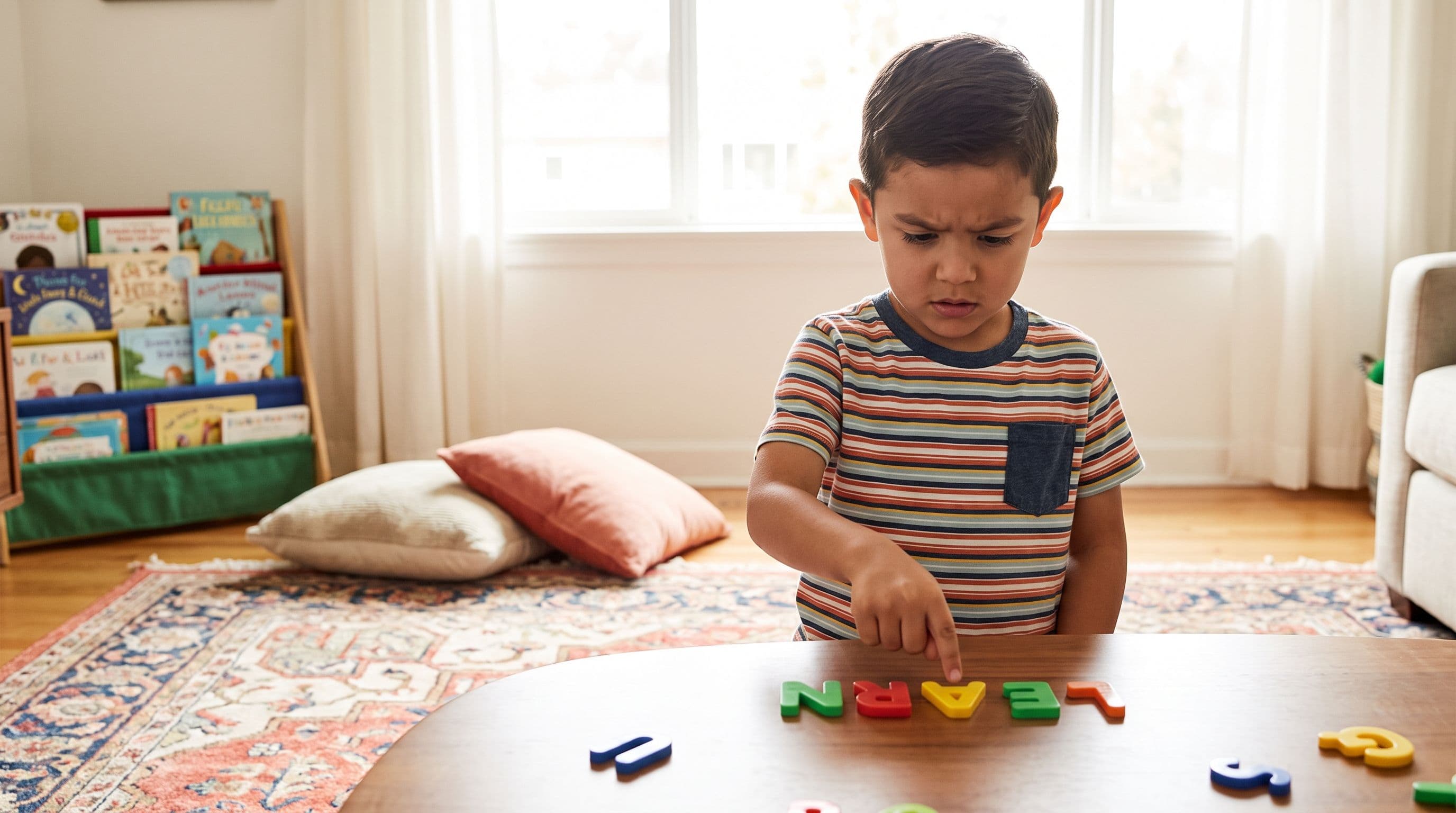
Is My 4-Year-Old Behind in Reading? Here's What's Normal (and What's Not)
Most 4-year-olds shouldn't be reading yet — but they absolutely should be building specific pre-reading skills. Here's how to tell if your child is on track, what the real warning signs look like, and what to do right now if they're not.
Read More →
My 5-Year-Old Can't Read: A Step-by-Step Plan to Fix It Fast
If your 5-year-old can't read yet, you're not a failure — but you don't have time to waste. Here's the exact step-by-step plan I use with my own kids, grounded in reading science and zero guessing.
Read More →
Reading Readiness Checklist for 5-Year-Olds: Free Printable + Parent Guide
Is your 5-year-old ready to read? Most parents can't answer that question — because nobody gave them the right checklist. Here's the one I use with my own kids, backed by reading science, not wishful thinking.
Read More →