My 5 Year Old Can't Read: What to Do This Week
What You'll Learn
- The exact age-5 reading skills I want to see before I relax even one tiny bit
- The one mistake parents make when a kindergartner can't read and starts guessing
- How to check your child's reading gap at home in 2 minutes without buying a giant testing kit
- The phonics plan I'd start this week if my 5 year old couldn't read yet
Reality Check: Should a 5-Year-Old Be Reading?
If you're typing "my 5 year old can't read" into Google at 11:47 p.m. while your kid sleeps peacefully and you spiral into literacy doom — hi, I've been there.
Here's the direct answer: a 5-year-old does not need to read chapter books, but they should be building real decoding skills.
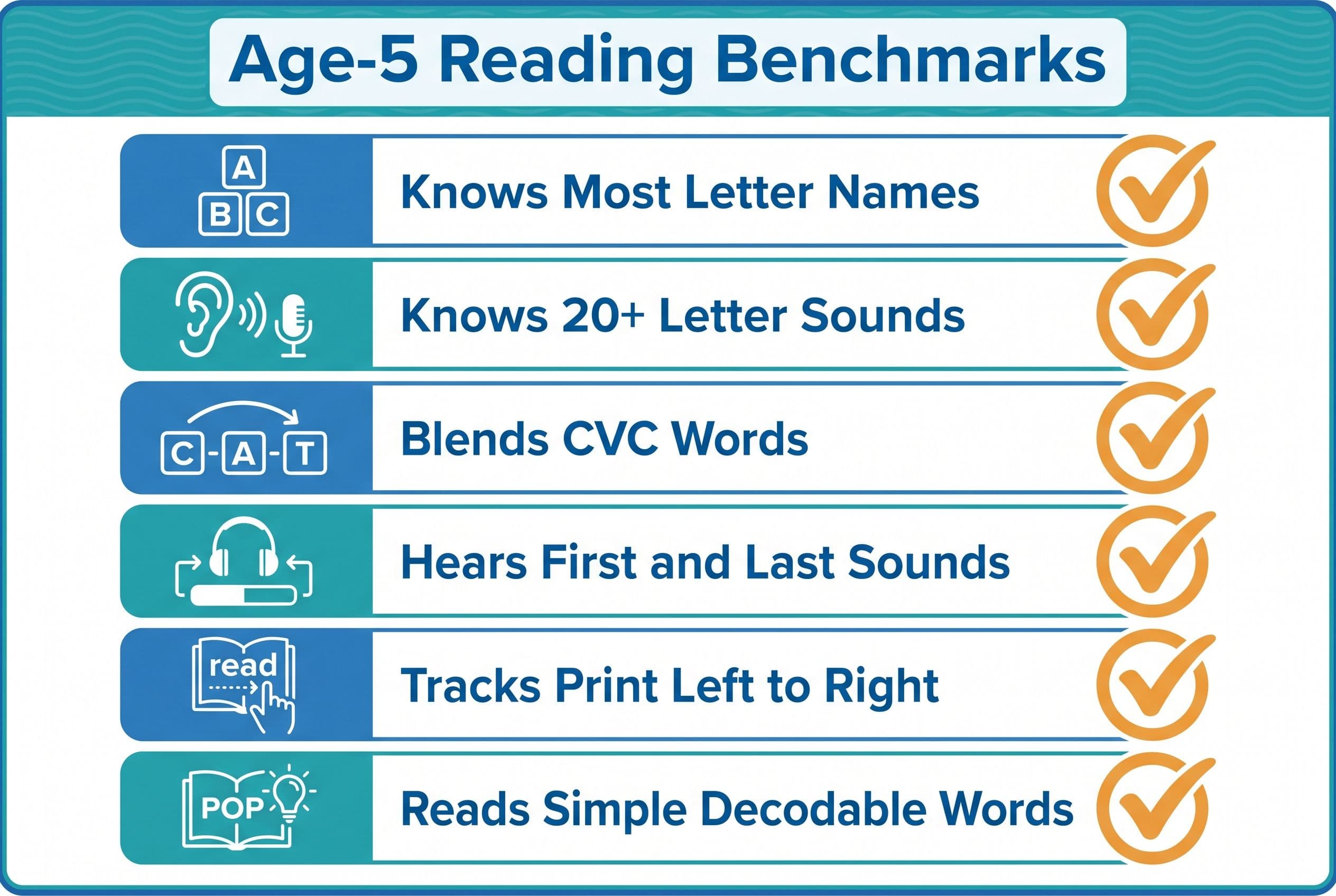
By kindergarten (age 5), I want to see most children doing several of these things:
| Skill | Age-5 Benchmark |
|---|---|
| Letter names | Recognizes most uppercase and lowercase letters |
| Letter sounds | Knows at least 20 common letter sounds |
| Blending | Can blend simple CVC words like m-a-t, s-i-t, p-o-t |
| Phonemic awareness | Can hear and play with individual sounds in words |
| Print awareness | Tracks left to right and knows words carry meaning |
| Decodable reading | Can read a few short, controlled phonics words without guessing |
So, is it normal for a 5 year old not to read? Sometimes, yes. Some 5-year-olds bloom later, especially if they just turned 5, haven't had much phonics, or are still developing attention and language skills.
But here's where I put on my tiger mom glasses: a 5 year old not reading yet still needs daily instruction. Not pressure. Not shame. Instruction.
If your child doesn't know letter sounds, can't blend sat, or looks at the picture and says “puppy” when the word says dog, that's not reading readiness. That's a flare in the sky.
Sound familiar?
What to Do If They're Not There Yet
If your child falls below those benchmarks, don't panic — but don't do the lazy parent thing where you say, “They're just not ready,” then hand them an iPad and hope 1st grade (age 6-7) magically fixes it.
Start by checking the gap. You can take the 2-minute reading check in about 2 minutes and get a clearer sense of whether your child is missing letter sounds, blending, phonemic awareness, or all three. No drama. Just data.
Most of the time, when a kindergartner can't read, the problem isn't intelligence. It's that nobody has taught the child how the code works. English looks wild, but it has patterns. Kids need grapheme-phoneme correspondence — letters linked to sounds — drilled clearly and daily.
That's why I recommend starting with start lesson one free. Lesson one is free with no card and nothing to cancel; from lesson two the whole program is a 7-day free trial, then US$9.95 a month. It uses systematic synthetic phonics, keeps guessing out of the lesson, and gives you the next step instead of leaving you to duct-tape Pinterest worksheets together at midnight.
Tiger Truth: Waiting Can Cost Your Child
Look, I love children. I love childhood. I love mud pies, couch forts, and watching my 4-year-old put underwear on her head like she's the mayor of chaos.
But reading? Reading gets a different rule.
We don't wait and see with reading. We check and act.
In the US, only 33% of 4th graders (ages 9-10) scored at or above proficient in reading on the 2022 NAEP / The Nation's Report Card. That's not a tiny blip. That's a national five-alarm fire.
And the 3rd grade (ages 8-9) cliff is real. Kids who can't read well by that point often start reading less because reading feels awful. Then their vocabulary stalls. Their background knowledge thins out. Science, history, maths word problems — everything gets harder because the child can't access the text.
The Annie E. Casey Foundation's 2010 report found that children who don't read proficiently by the end of 3rd grade are four times more likely to leave high school without graduating. That's not me being dramatic. That's the bill coming due.
And if you're thinking, “Well, the school will catch it,” maybe. Maybe not.
I've seen plenty of sweet, hardworking teachers stuck inside weak systems. After Emily Hanford's 2023 APM Reports investigation Sold a Story came out, my neighbor — a first-grade teacher for 18 years — called me almost in tears. She'd used Lucy Calkins' Units of Study curriculum her whole career. Three-cueing, MSV, the whole circus. She told me, “I've been teaching kids to guess for two decades and I didn't even know it.”
She switched her classroom to UFLI Foundations mid-year. Messy? Oh yes. She had to relearn the whole thing first, and there were sticky notes everywhere like a phonics tornado had hit her desk. But by spring, her kids' DIBELS nonsense word fluency scores jumped an average of 15 points. She told me it was the first time in her career every single child in her class could decode CVC words by February.
That story still gives me chills.
Because the kids didn't suddenly become smarter. The instruction changed.
Why Your 5-Year-Old Can't Read Yet
A 5 year old not reading yet usually falls into one of these buckets. Sometimes two. Sometimes all of them, because kids like to keep us humble.
1. They Don't Know Enough Letter Sounds
Letter names are nice. Letter sounds do the heavy lifting.
A child can sing the alphabet song beautifully and still not know that m says /m/ or t says /t/. I want quick, automatic sound recall. Not “ummm... apple?” every time they see a.
Try this: show lowercase letters in random order and ask for the sound, not the name. If your child knows fewer than 15-20 sounds, start there.
2. They Can't Blend Sounds
This one drives me crazy because adults think blending is obvious.
It's not.
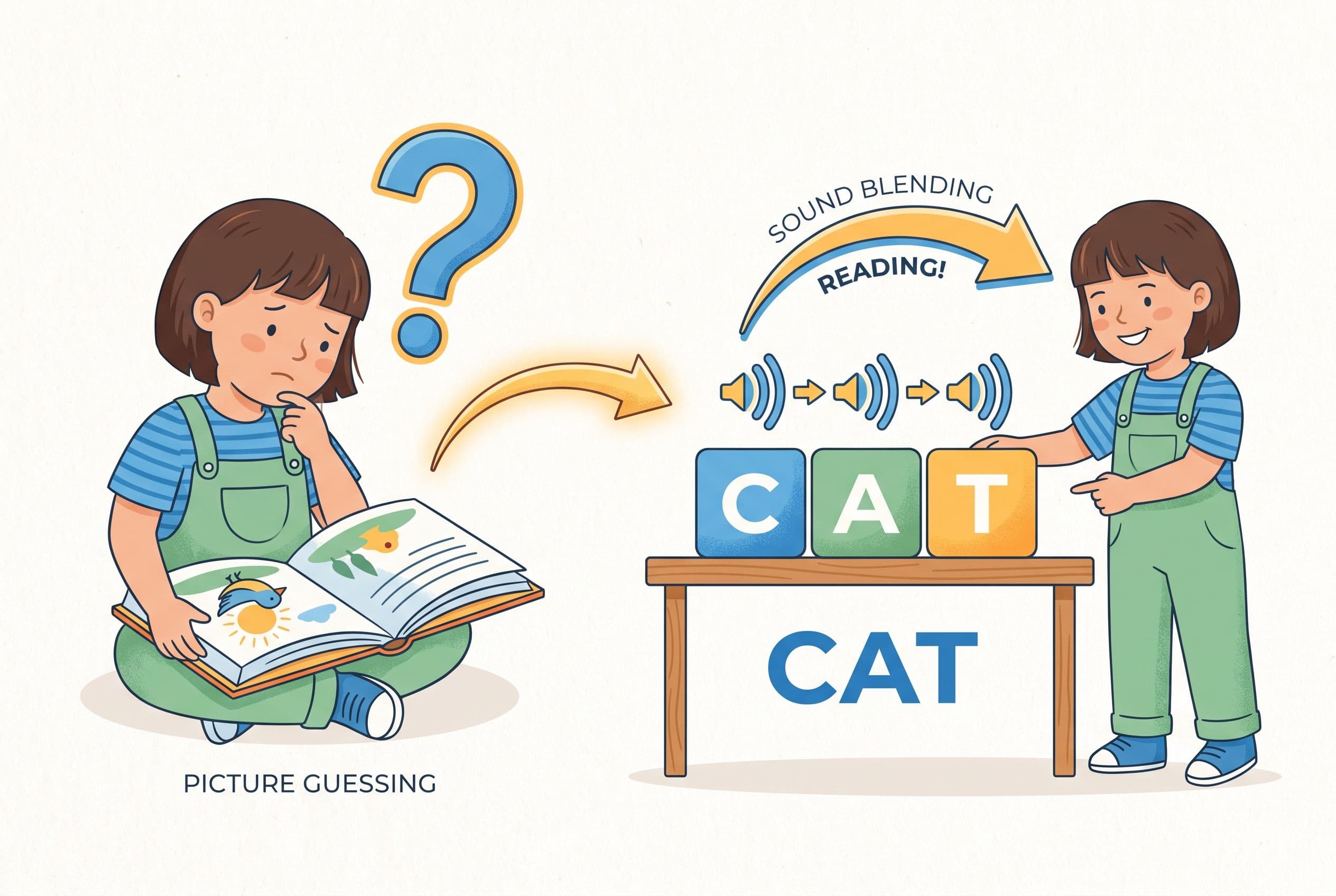
You say /s/ /a/ /t/ and expect the child to hear sat. But many kids hear three separate noises floating around like alphabet soup. They need explicit blending drills.
At my kitchen table last Tuesday, I had my 4-year-old tapping three blocks for m-a-p. She kept saying “mop.” I didn't say, “Close enough.” Nope. Tiger Rule: No Guessing. We slowed it down, stretched the vowel, and did it again.
Because close enough becomes sloppy. Sloppy becomes guessing. Guessing becomes reading failure.
3. They Lack Phonemic Awareness
Phonological awareness means hearing larger sound parts like syllables and rhymes. Phonemic awareness means hearing individual sounds inside words.
That difference matters.
If your child can't tell you that dog starts with /d/ or that cat without /k/ becomes at, decoding will feel brutal. David Kilpatrick's PAST test — the Phonological Awareness Screening Test — takes about 5 minutes when you know how to give it, and it tells you where the breakdown sits.
Kilpatrick's Equipped for Reading Success (2016) explains why orthographic mapping depends on strong phonemic awareness. Translation: the brain stores words permanently when it connects sounds to spellings. No sound awareness, no fast word storage.
4. They've Been Taught to Guess
Imagine Lily sees a page with a boat picture and the word ship. She says “boat” because the picture gave her a clue.
A balanced literacy teacher might say, “Good try! Does that make sense?”
I say: Nope. That's guessing.
Reading means looking at the letters and saying the sounds. Pictures can help with story meaning after decoding, but they don't replace decoding. If your child looks away from the word, covers the word, checks the picture first, or says a random word that begins with the same letter, stop the habit now.
The 2000 National Reading Panel report — the one a US Congress commissioned — found that systematic phonics instruction produced significant benefits, especially in the early grades. Louisa Moats' 1999 paper Teaching Reading IS Rocket Science said the same quiet part out loud: teaching reading takes real knowledge.
5. They Need More Time, But Not Less Teaching
Some kids are developmentally young at 5. That's real.
But “young” doesn't mean “leave them alone.” It means short lessons, more repetition, more movement, and zero shame.
For a wiggly 5-year-old, I like 10 minutes of phonics, 5 minutes of sound games, then a decodable book. Done. Leave while they still have gas in the tank.
Reading Readiness Signs I Actually Trust
Parents ask me about reading readiness signs all the time. Honestly, most lists online sound like someone copied them off a preschool wall poster.
Here's what I care about.
Green Lights
Your child may be ready for formal reading instruction if they can:
- Identify most letters
- Say many letter sounds quickly
- Clap syllables in words like banana
- Hear rhymes like cat, hat, sat
- Blend two or three sounds orally
- Sit for a short adult-led lesson
- Track print left to right
- Enjoy being read to, even if they can't read alone yet
Yellow Lights
Pay attention if your child:
- Mixes up many letter sounds after repeated practice
- Can't blend /m/ /a/ /t/ into mat
- Guesses from pictures
- Memorizes books but can't read the same words on a plain card
- Avoids reading tasks with sudden “I'm tired” theatrics
- Gets angry or silly every time letters appear
That last one? I know it well. One of my kids once slid under the table during a phonics lesson like a dramatic Victorian ghost. Cute? Yes. A reason to skip? Absolutely not.
Red Flags: When to Worry About Reading
If you're wondering when to worry about reading, here's my no-nonsense list.
Talk to your child's teacher, pediatrician, health visitor, GP, or a qualified literacy specialist if your 5-year-old:
- Can't remember letter sounds despite daily practice
- Can't hear the first sound in simple words
- Can't blend two sounds after weeks of instruction
- Has a strong family history of dyslexia
- Struggles to learn nursery rhymes or remember verbal sequences
- Avoids print intensely
- Shows speech-language delays
- Makes no progress after 8-12 weeks of structured phonics
The International Dyslexia Association has parent-friendly information on dyslexia signs. Dyslexia doesn't mean a child can't learn to read. It means they need explicit, structured, systematic instruction — often more of it, with more repetition.
How to Teach a 5-Year-Old to Read This Week
OK so, what do you actually do on Monday morning?
You don't need a US$400 curriculum haul. You don't need glitter glue. You don't need to turn your living room into a Montessori catalog.
You need a plan.
Step 1: Stop All Guessing
Make this your house rule: look at the word, say the sounds, blend the word.
If your child guesses, respond calmly:
- “Try the sounds.”
- “Point to each letter.”
- “What sound does this letter make?”
- “Now blend it.”
No lectures. No shame spiral. Just back to the code.
Tiger Rule: No Guessing.
Step 2: Drill 3-5 Letter Sounds at a Time
Don't throw 26 letters at a child and call it a day. That's chaos with flashcards.
Start with a small set: m, s, t, a, p. These letters build words like sat, mat, map, tap, pat.
Do this daily:
- Show the letter.
- Child says the sound.
- Child traces the letter.
- Child says the sound again.
- Mix the cards and repeat.
Keep it quick. Fast success beats long misery.
Step 3: Blend CVC Words Every Day
CVC means consonant-vowel-consonant, like sat, pin, mud.
Use your finger under each letter:
- /s/ /a/ /t/
- stretch: sssaaat
- snap it together: sat
Then switch one sound:
- sat → mat
- mat → map
- map → tap
This builds the decoding muscle. Hands down, it's the real deal.
Step 4: Use Decodable Books, Not Predictable Books
Predictable books say things like:
- “I see the horse.”
- “I see the cow.”
- “I see the pig.”
Your child can “read” that by memorizing the pattern and staring at pictures. That's not decoding.
Use decodable books that match the phonics you've taught. Bob Books, UFLI Foundations readers, Flyleaf Publishing decodables, and High Noon Books all give children words they can actually sound out.
Fountas & Pinnell levels come from a balanced-literacy/leveled-reading system, and a level alone does not tell you whether a child can decode.
Step 5: Add Phonemic Awareness Games
No paper needed.
Try these in the car, bath, or grocery line:
- “What sound starts sun?”
- “Say cat. Now say it without /k/.”
- “What word do you get: /m/ /oo/ /n/?”
- “Do fish and fan start the same?”
Make it brisk. Like a game show, but without the creepy host energy.
Step 6: Track Progress for 8 Weeks
Pick 3 measures:
- Letter sounds known
- CVC words read correctly
- Ability to blend orally
Check once a week. Write it down.
DIBELS, which stands for Dynamic Indicators of Basic Early Literacy Skills, uses measures like nonsense word fluency because nonsense words show whether a child can decode instead of memorizing. In many benchmark systems, mid-kindergarten goals may expect children to produce around 28 or more correct letter sounds per minute on nonsense word fluency, though schools use different cut points.
Don't obsess over one number. Watch the trend.
The Action Step: Your 7-Day Reading Reset
If my 5 year old can't read were the problem in my house this week, here's exactly what I'd do.
- Day 1: Check the baseline. Test letter sounds, oral blending, and 5 easy CVC words. Write down what your child can do without help.
- Day 2: Teach 3-5 sounds. Use lowercase letters. Drill fast. Keep it under 10 minutes.
- Day 3: Blend CVC words. Build words with the sounds you taught. Use tiles, magnets, or plain index cards.
- Day 4: Add phonemic awareness. Do 5 oral sound games. No worksheets. Just ears and mouth.
- Day 5: Read a decodable page. Choose a book that only uses sounds your child knows. If they guess, stop and decode.
- Day 6: Review and mix. Shuffle known sounds. Read 10 CVC words. Celebrate accuracy, not speed.
- Day 7: Decide the next step. If your child makes progress, continue. If they can't blend or remember sounds, get support now.
If you want the lessons laid out without creating your own kitchen-table command center, use Teach Your Kid to Read. Lesson one is free with no card and nothing to cancel; from lesson two the whole program is a 7-day free trial, then US$9.95 a month.
What If My Child Still Can't Read After Practice?
If you've practiced consistently for 8-12 weeks and your child still can't remember sounds or blend simple words, don't blame yourself and don't blame the child.
Get better data.
Ask about:
- A phonological awareness screening, such as Kilpatrick's PAST
- A school literacy screener, such as DIBELS or AIMSweb
- Speech-language evaluation if oral language seems delayed
- Dyslexia screening if family history or warning signs appear
- Vision and hearing checks, because kids don't always tell us what feels off
Some children need Orton-Gillingham-style instruction, Wilson Reading System, Barton Reading & Spelling, or another structured literacy program. The label matters less than the method: explicit, systematic, cumulative, phonics-based, with lots of review.
And yes, you can ask the school direct questions:
- “What phonics scope and sequence do you use?”
- “Do you teach students to use picture clues to guess words?”
- “What assessment shows whether my child can decode?”
- “How often do you monitor progress?”
If the answer sounds like fog, keep asking.
The Bottom Line for a 5-Year-Old Not Reading Yet
A 5-year-old who can't read yet isn't doomed.
But a 5-year-old who can't read and gets no structured help? That's a problem we don't ignore.
Your job isn't to panic. Your job is to act.
Teach the sounds. Drill blending. Use decodable books. Ban guessing. Watch progress. Get help early if the needle doesn't move.
Reading is a survival skill. We don't skip it on birthdays. We don't skip it on vacation. We don't skip it because the child whines for the tablet like a tiny lobbyist.
We Never Skip.
If you're ready to stop guessing about your child's reading and start teaching the code, begin with a short, structured lesson today. Lesson one is free with no card and nothing to cancel; from lesson two the whole program is a 7-day free trial, then US$9.95 a month.
FAQ
Is it normal for a 5-year-old not to read?
Yes, it can be normal for a 5-year-old not to read full books yet. But by age 5, many children should know many letter sounds, begin blending simple CVC words, and show growing phonemic awareness. If your child has none of those skills, start structured phonics now.
Should I worry if my kindergartner can't read?
Worry enough to act, not enough to panic. A kindergartner who can't read needs explicit phonics, daily blending practice, and progress tracking. If 8-12 weeks of consistent instruction don't help, ask for screening.
How do I teach a 5-year-old to read at home?
Start with letter sounds, then blend CVC words like sat and map. Use decodable books, not predictable books that train guessing. Keep lessons short, daily, and accurate.
What are the biggest warning signs?
Watch for trouble remembering letter sounds, inability to blend sounds, guessing from pictures, poor rhyming skill, speech-language delays, or a family history of dyslexia. Those signs don't mean disaster, but they do mean you should move quickly.
Should my child memorize sight words?
Some high-frequency words need attention, but don't start with giant sight word lists. Teach phonics first and map words sound by sound whenever possible. Even many “sight words” have regular or partially regular patterns children can learn.
Part of these guides

Xia Brody
Co-Founder, Teach Your Kid to Read
Mom of 4 who has successfully taught her kids to read. Currently in the trenches with her 4-year-old while her two oldest (10 and 7) devour books on their own. Passionate about phonics-based methods and building a lifelong love of reading.
Related Articles
My 5 Year Old Can't Read Reception: When to Act
If your Reception child isn't reading yet, don't panic — but don't drift. Here's how to tell normal early reading from a real phonics gap, and what to do this week.
Read More →
Is My 5 Year Old Behind in Reading? Age-by-Age Signs
Wondering if your 5-year-old should already be reading? Here’s the no-panic, no-waiting checklist for age 5 reading milestones, warning signs, and next steps.
Read More →
My 5-Year-Old Can't Read: A Step-by-Step Plan to Fix It Fast
If your 5-year-old can't read yet, you're not a failure — but you don't have time to waste. Here's the exact step-by-step plan I use with my own kids, grounded in reading science and zero guessing.
Read More →